The handle
http://hdl.handle.net/1887/19103
holds various files of this Leiden University
dissertation.
Author
: Pisanti, Renato
Title
: Beyond the job demand control (-support) model : explaining stress reactions in
nurses
Beyond the Job Demand Control (-Support) model:
explaining stress reactions in nurses
2 Renato Pisanti
Beyond the Job Demand Control (-Support) model: explaining stress reactions in nurses Thesis Leiden University
ISBN: 978-94-6203-048-0
Printed by: CPI Koninklijke Wöhrmann Print Service
Beyond the Job Demand Control (-Support) model:
explaining stress reactions in nurses
Proefschrift ter verkrijging van
de graad van Doctor aan de Universiteit Leiden, op gezag van Rector Magnificus Prof. Mr. P.F. van der Heijden,
volgens besluit van het College voor Promoties te verdedigen op dinsdag 19 juni 2012
klokke 13:45 uur door
Renato Pisanti
Promotiecommissie
Promotor: Prof. dr. C.M.J.G. Maes, Leiden University
Co-promotor: Dr. M.P. van der Doef, Leiden University
Overige leden: Prof. dr. N. Ellemers, Leiden University
Prof. dr. F. Kittel, Free University Brussels
Prof. dr. M.J.P.M. van Veldhoven, Tilburg University
This dissertation is dedicated with love to my wife, Caterina, for her selfless sacrifice and support that made this dream a reality; and to my son, Antonio Maria, for inspiring me daily to chase my dreams and for understanding when Daddy was working hard.
CONTENTS
LIST OF ABBREVIATIONS --- 9
CHAPTER 1. INTRODUCTION --- 13
1.1INTRODUCTION --- 15
1.2THE JOB DEMAND CONTROL (SOCIAL SUPPORT)(JDC(-S)) MODEL --- 15
1.3OUTLINE OF THESIS --- 18
1.4REFERENCES --- 20
CHAPTER 2. THE JOB DEMAND CONTROL (-SUPPORT) MODEL AND PSYCHOLOGICAL WELL BEING IN NURSES: A REVIEW. --- 23
2.1.INTRODUCTION --- 25
2.2.METHOD --- 29
2.3.RESULTS --- 30
2.4DISCUSSION --- 54
2.5.REFERENCES --- 61
CHAPTER 3. JOB CHARACTERISTICS, ORGANIZATIONAL CONDITIONS, AND WELL-BEING AMONG ITALIAN AND DUTCH NURSES: A CROSS-NATIONAL COMPARISON. --- 73
3.1.INTRODUCTION --- 75
3.2. METHOD --- 78
3.3.RESULTS --- 80
3.4. DISCUSSION --- 86
3.5.REFERENCES --- 88
CHAPTER 4. DEVELOPMENT AND VALIDATION OF A BRIEF OCCUPATIONAL COPING SELF-EFFICACY QUESTIONNAIRE FOR NURSES. --- 93
4.1.INTRODUCTION --- 95
4.2.THE STUDY --- 97
4.3.RESULTS --- 101
4.4.DISCUSSION --- 105
4.5.REFERENCES --- 108
CHAPTER 5. OCCUPATIONAL COPING SELF EFFICACY INCREASES THE PREDICTION OF DISTRESS AND WELL BEING IN NURSES BEYOND PSYCHOSOCIAL JOB CHARACTERISTICS. --- 113
5.1.INTRODUCTION --- 115
5.2.METHOD --- 119
5.3.RESULTS --- 122
5.4.DISCUSSION --- 131
5.5.REFERENCES --- 136
CHAPTER 6. PSYCHOSOCIAL JOB CHARACTERISTICS AND PSYCHOLOGICAL DISTRESS - WELL BEING: THE MEDIATING ROLE OF PERSONAL GOAL FACILITATION. --- 141
6.1.INTRODUCTION --- 143
6.2.METHODS--- 146
6.3RESULTS --- 150
6.4.DISCUSSION --- 155
6.5.REFERENCES --- 158
CHAPTER 7. PSYCHOSOCIAL JOB CHARACTERISTICS AND JOB BURNOUT IN NURSES: A LONGITUDINAL ANALYSIS OF THE CHANGES OF JOB CHARACTERISTICS. --- 163
7.1INTRODUCTION --- 165
7.2.METHODS--- 169
7.3.RESULTS --- 171
7.4.DISCUSSION --- 176
7.5.REFERENCES --- 179
CHAPTER 8. GENERAL DISCUSSION --- 185
8.2THEORETICAL AND METHODOLOGICAL CONSIDERATIONS--- 192
8.3PRACTICAL IMPLICATIONS --- 194
8.4SUGGESTIONS FOR FUTURE RESEARCH --- 195
8.5.REFERENCES --- 196
SUMMARY IN ENGLISH --- 201
SUMMARY IN DUTCH --- 207
SUMMARY IN ITALIAN --- 213
ACKNOWLEDGEMENTS --- 219
List of abbreviations
The following table explains various abbreviations and acronyms used throughout the thesis. The page on which each one is defined or first used is also given.
Abbreviation Meaning Page
AIC
AMOS
CFA
CFI
CINAHL
CISS-SV
CSE
EFA
JCQ
JDC
JDC (-S) or JDCS
LQoWQ-N
MANCOVAs
MBI-HSS
MEDLINE
MIs
OCSE
OCSE-N
PGFW
RMSEA
SCL-90
UWES
Akaike’s Information Criterion
Analysis of Moment of Structure
Confirmatory Factor Analysis
Comparative Fit Index
Cumulative Index to Nursing and Allied Health Literature
Coping Inventory for Stressful Situations – Short Version
Coping Self Efficacy
Exploratory Factor Analysis
Job Content Questionnaire
Job Demand Control
Job Demand Control Social support
Leiden Quality of Work Questionnaire for Nurses
Multivariate ANalyses of COVAriance
Maslach Burnout Inventory Human Service Surveys
Medical Literature Analysis and Retrieval System Online
Modification Indexes
Occupational Coping Self Efficacy
Occupational Coping Self Efficacy for Nurses
Personal Goal Facilitation through Work
RootMean-Square Error of Approximation
Symptom Checklist-90
Utrecht Work Engagement Scale
100
100
100
100
29
98
96
100
45
15
15
45
80
45
29
104
17
17
17
100
45
1.1 Introduction
Nursing is generally considered to be a stressful profession. The nature and organization of the job make nursing inherently difficult (Clegg, 2001; McVicar, 2003: Gelsema, Maes, & Akerboom, 2007). Since the mid-1980s, however, nurses’ work stress escalated due to the increasing use of technology, changes in health care, and increasing complexity of their work (Aiken, Clarke, Sloane, Sochalski, & Silber, 2002). These structural changes have led to the intensification of activity within healthcare as providers seek to do more work, with fewer people, in less time, at lower costs. Dysfunctional working conditions can impact both psychological well being of health care workers and the quality of cares (Montgomery, Panagopoulou, Kehoe, & Valkanos, 2011).
European countries can differ importantly in the number of nurses per capita. This ratio is markedly different in South and North Europe For example, Italy has one of the lowest nurse per capita ratio in Europe: 5 nurses per 1000 inhabitants. In comparison, the Dutch healthcare system has one of the highest ratios: 14 nurses per 1000 inhabitants (World Health Organization, 2006). As a result, workloads of nurses are heavier in some countries than others.
There are several theoretical models that relate work conditions to stress reactions. The most popular theoretical framework is the Job Demand Control (JDC) model (Karasek, 1979) and its expanded version, the Job Demand Control Support (JDC(-S) model (Karasek & Theorell, 1990).
1.2 The Job Demand Control (Social support) (JDC(-S)) model
sources of social support as resources that people use in response to stressful working conditions, social support was added later to the model (Johnson & Hall, 1988; Johnson, Hall, & Theorell, 1989). Social support refers to instrumental and emotional support from colleagues and superiors (Karasek & Theorell, 1990).
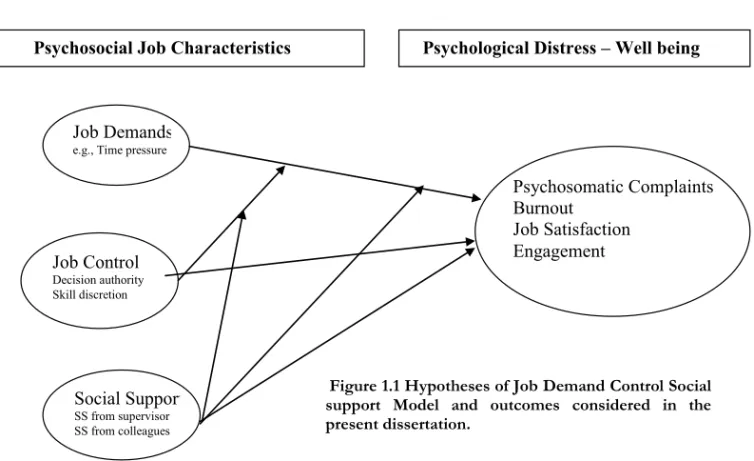
The original version of the model assumes two basic hypotheses of how job demand and control may combine and lead to various distress and well-being outcomes: (1) the strain hypothesis which assumes additive effects of both dimensions: high job demands precipitate job strain, as does low job control (main effects); (2) the interaction or buffer hypothesis, that states that job control has a moderating effect on the relationship between job demands and job strain (interaction effect). Later, adding social support from coworkers and supervisors as a third dimension, a crucial issue became whether job demands, job control and social support combine additively (high demands, low control and low workplace social support are associated with highest stress: iso-strain hypothesis) or interactively (social support decreases the negative impact of high demands and low control: buffer hypothesis) to explain distress and well-being (See Figure 1.1).
A number of reviews (Van der Doef & Maes, 1999; De Lange, Taris, Kompier, Houtman, & Bongers, 2003; Häusser, Mojzisch, Niesel, & Schulz-Hardt, 2010) examined whether job demands, job control and social support combine additively ((iso-)strain hypotheses) or interactively to explain well-being. They indicated that the (iso-) strain hypotheses have been tested more often than the buffer hypothesis and that the (iso-) strain hypotheses have received considerable support, whereas, only limited support was found for the buffer hypothesis.
While the JDC(-S) model was a starting point for the research reported in this thesis, the chapters expand on the model for various reasons.
Firstly, the JDC(-S) model, neglects the impact of organizational variables on health-related outcomes (Van der Doef & Maes, 1999). The present thesis addresses this issue in chapter 3, where we examined in two groups of nurses (Italian and Dutch) how and to what extent various organizational variables from the Tripod accident causation model (Wagenaar, Hudson, & Reason, 1990; Wagenaar, Groeneweg, Hudson, & Reason, 1994) make an independent contribution in explaining occupational and general well-being, beyond that attributed to the JDC(-S) constructs.
Therefore, in our studies (chapters 3, 5, 6 and 7) a specific measure developed with the purpose of assessing nurses’ psychosocial job variables was adopted.
A third issue regards the validity of the JDC(S) model in different countries. In chapter 3 we tested the effects of JDC(-S) characteristics on several strain reactions in two samples of academic nurses working in different European health care contexts, i.e. Italian and Dutch nurses.
Fourthly, traditionally, research on the JDC(S) model has neglected individual variables (Van der Doef & Maes, 1999; Semmer & Meier, 2009). The present thesis addresses this issue in chapters 4, and 5. In chapter 4 we described the development and psychometric qualities of the Occupational Coping Self-Efficacy for Nurses (OCSE-N) scale. The questionnaire measures the individual’s beliefs about one’s ability to cope with the specific occupational stressors (OCSE) of nursing profession. In the chapter 5 we examined the direct and the interactive role of OCSE in the JDC(-S) model(s). In addition, the attainment of personal goals at work may have an influence on the well being of nurses. In the chapter 6 we analyzed the mediating role of personal goal facilitation through work (PGFW), defined as perceptions of the extent to which one’s job facilitates the attainment of one’s personal goals (Ter Doest, Maes, Gebhardt & Koelewijn, 2006), in the association between JDCS variables and psychological distress and job-related well being.
Psychosocial Job Characteristics Psychological Distress – Well being
Job Demands
e.g., Time pressure
Job Control
Decision authority Skill discretion
Social Support
SS from supervisor SS from colleagues
Psychosomatic Complaints Burnout
Job Satisfaction Engagement
The fifth issue concerns the design of the studies that tested the assumptions of JDC(S) model(s). The vast majority of studies that investigated the relationships between the JDC(S) model and psychological distress were based on a cross-sectional design and did not therefore permit inference of causality. Furthermore, the underlying assumption in many longitudinal studies is that psychosocial job dimensions remain fairly stable over time, allowing researchers to make causal inferences regarding the observed differences in psychological strain over time. However, as suggested by several authors (e.g., Roe, 2008) the work environment is not a static phenomen, it is dynamic and susceptible to change. In chapter 7 we examined the across-time effects of changes in JDC(S) variables on burnout indicators.
1.3 Outline of thesis
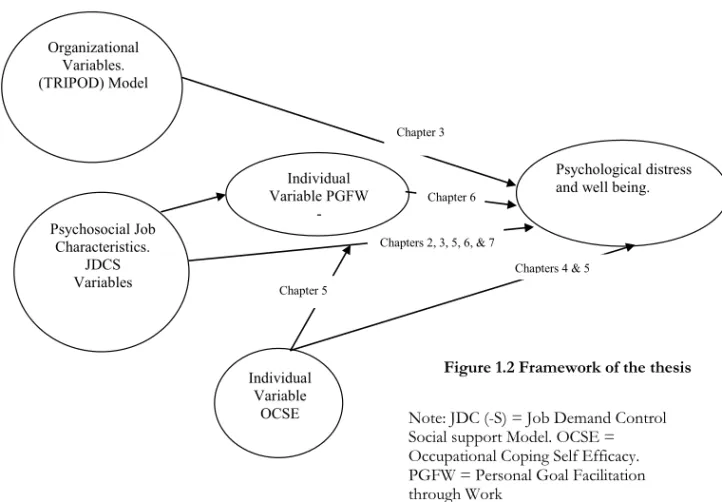
The studies included in this thesis focus on the relationships between occupational stressors and job resources, operationalized on the basis of the JDC(-S) model, and psychological well being and distress in nurses (See Figure 1.2).
Chapter 2 contains a state of the art review of 43 studies conducted among nurses and based on the Job Demand Control (Support) (JDC(-S)) model. The review addresses the different hypotheses of JDC(-S) model(s), investigating the effects of the JDC(-S) variables on general psychological distress and well being (e.g., depression, anxiety, somatic complaints, mental health) and job related well being (namely burnout and job satisfaction).
Chapter 4 addresses one of the instruments used in this dissertation. Since occupational coping self efficacy can function as a moderator in the JDC(-S) model(s), the main purpose of this study was to develop and evaluate the psychometric properties of the Occupational Coping Self Efficacy for Nurses (OCSE-N) scale in a large sample of nurses.
Chapter 5 describes a cross sectional study conducted in a sample of 1479 Italian nurses. The aims of the study were: a) to test the core hypotheses of the Job Demand Control Support - JDC(-S) – model(s); and b) to extend the model analyzing the direct and moderating role of OCSE of nurses on relevant outcomes, such as psychological distress, somatic complaints, burnout and job satisfaction.
Chapter 6 reports on a cross sectional study that examined in a group of 217 Italian nurses whether personal goal facilitation through work mediated the association between JDC(-S) dimensions and specific outcomes such as somatic complaints, burnout, job satisfaction and work engagement.
Psychosocial Job Characteristics.
JDCS Variables Organizational
Variables. (TRIPOD) Model
Individual Variable OCSE
Psychological distress and well being. Chapter 3
Chapters 2, 3, 5, 6, & 7
Chapters 4 & 5 Individual
Variable PGFW
-Chapter 6
Chapter 5
Figure 1.2 Framework of the thesis
The last study, which is described in chapter 7, is a longitudinal study on the relation between psychosocial job dimensions and burnout. This 14-months follow up study provides a longitudinal test of the JDCS model and aims to analyze whether changes in the job characteristics are related to (changes in) burnout in a sample of Italian nurses (N = 217).
The thesis concludes with a general conclusions and discussion (chapter 8). The major results of the studies described in this thesis, the strengths and limitations of the studies, and suggestions for further research are discussed. Finally, indications for practice are formulated.
1.4 References
Aiken, L. H., Clarke, S. P., Sloane, D. M., Sochalski, J. & Silber, J. H. (2002). Hospital nurse staffing and patient mortality, nurse burnout, and job dissatisfaction. The Journal of the American Medical
Association 288, 1987–1993. doi:10.1001/jama.288.16.1987
Clegg, A. (2001). Occupational stress in nursing: A review of the literature. Journal of Nursing
Management, 9(2), 101-106. doi:10.1046/j.1365-2834.2001.00216.x
De Lange, A.H., Taris, T.W., Kompier, M.A.J., Houtman, I.L.D., & Bongers, P.M. (2003). The very best of the millennium: Longitudinal research and the demand-control (-support) model. Journal of
Occupational Health Psychology, 8, 282-305. doi:10.1037/1076-8998.8.4.282
Gelsema, T. I., Maes, S., & Akerboom, S. (2007). Determinants of job stress in the nursing profession: a review. In Gelsema T. I. (Eds.). Job Stress in the Nursing Profession. (pp.13-36). Doctoral dissertation, Leiden University, Leiden, The Netherlands. ISBN 978-90-9021917-2
Häusser, J. A. , Mojzisch, A. , Niesel, M., & Schulz-Hardt, S. (2010) Ten years on: A review of recent research on the Job Demand-Control (-Support) model and psychological well-being. Work &
Stress, 24:(1), 1 – 35. doi:10.1080/02678371003683747
Johnson, J. V., & Hall, E. M. (1988). Job strain, work place social support, and cardiovascular disease: A cross-sectional study of a random sample of the Swedish working population. American Journal
of Public Health, 78, 1336-1342.
Karasek, R. A. (1979). Job demands, job decision latitude and mental strain: Implications for job redesign. Administrative Science Quarterly, 24, 285-308. doi:10.2307/2392498
Karasek, R. A., & Theorell, T. (1990). Healthy Work, Stress, Productivity, and the Reconstruction of
Working Life. Basic Books, New York.
McVicar, A. (2003). Workplace stress in nursing: A literature review. Journal of Advanced Nursing, 44, 633–642. doi:10.1046/j.0309-2402.2003.02853.x
Montgomery, A.J., Panagopoulou, E., Kehoe, I., Valkanos, E. (2011). Connecting organisational culture and quality of care in the hospital: Is job burnout the missing link? Journal of Health Organisation and Management, 25, 108-123.
Roe, R. (2008). Time in applied psychology: The study of "what happens" rather than "what is."
European Psychologist, 13(1), 37-52. doi:10.1027/1016-9040.13.1.37
Semmer, N. K., & Meier, L. L. (2009). Individual differences, work stress and health. In M. J. Schabraq, J. A. Winnubst, & C. L. Cooper (Eds.). Handbook of Work and Health Psychology (3rd ed., pp. 99-122). Chichester: Wiley.
ter Doest, L., Maes, S., Gebhardt, W. A., & Koelewijn, H. (2006). Personal goal facilitation through work: Implications for employee satisfaction and wellbeing. Applied Psychology: An International
Review, 55, 192–219. doi:10.1111/j.1464-0597.2006.00232.x
Van der Doef, M., & Maes, S. (1999). The job demand-control (-support) model and psychological well-being: A review of 20 years of empirical research. Work & Stress, 13, 87-114. doi:10.1080/026783799296084
Van der Doef, M., & Maes, S. (2002). Teacher-specific quality of work versus general quality of work assessment: A comparison of their validity regarding burnout (psycho)somatic well-being and job satisfaction. Anxiety, Stress and Coping,, 15, 327–344. doi:10.1080/1061580021000056500
Wagenaar, W. A., Hudson, P. T. W., & Reason, J. T. (1990). Cognitive Failures and Accidents.
Applied Cognitive Psychology 4, 273-294. doi:10.1002/acp.2350040405
Wagenaar, W. A., Groeneweg, J., Hudson, P. T. W., & Reason, J. T. (1994). Promoting safety in the oil industry. Ergonomics, 37, 1999–2013. doi:10.1080/00140139408964963
Abstract
Occupational stress is a widespread problem in nurses. The present paper provides a review of 43 studies on the Job Demand Control (-Support) Model (JDC(-S)) in relation to psychological distress and well-being, involving nurses and published in English language journals from 1979 to 2010 (inclusive). According to the central tenets of the model(s), we examined two hypotheses: a) the (iso) strain hypothesis, stating that the highest level of psychological distress is expected when employees perceive high demands and low control (and low social support), and b) the buffer hypothesis, predicting that control (and social support) can buffer the potential negative effects of high demands on psychological distress. We focused our attention on two types of well being outcomes: general distress-well being (i.e., psychological distress and well being) and job related distress-well being (namely burnout and job satisfaction).
The review shows that the (iso)strain hypothesis is more intensively studied than the buffer hypotheses, and results are more supportive for the (iso)strain hypothesis than for the buffer hypotheses. In line with previous reviews, support for both hypotheses is mainly found in cross-sectional studies.
Buffering effects of job control in the relationship between demands and outcomes were found in 9% of the tests. The most important difference between supportive and non supportive studies was the operationalizations of demands and control. Supportive studies more often used more focused and specific measures of job demands (quantitative overload, monitoring demands, role stressors) and job control (e.g. influence on the pace of work). The limited number of studies that investigated the three way interaction hypothesis of the JDCS model did not permit any conclusions about the validity of this hypothesis.
Based on these review results, suggestions for future research, practical implications and theoretical development are proposed.
2.1. Introduction
Occupational stress in nurses is a widespread problem and therefore has received a lot of research attention. A plethora of studies has shown that burnout, job dissatisfaction, depression, anxiety and physical health consequences are prominent in today’s nurses (Bourbonnais, Comeau, & Vezina, 1999; Lambert & Lambert, 2001; McVicar, 2003).
While existing reviews try to identify determinants of these outcomes, most studies are not driven by a theoretical model (Lambert & Lambert, 2001; Hayes, Bonner, & Pryor, 2010; Lu, While, & Barriball, 2005: McVicar, 2003; Richards et al., 2006). For example, McVicar (2003) identified six main areas for the sources of workplace distress for nurses: a) workload/inadequate staff cover/time pressure, b) relationship with other clinical staff, c) leadership and management style/poor locus of control/poor group cohesion/lack of adequate supervisory support, d) coping with emotional needs of patients and their families/ poor patient diagnosis/death and dying, e) shift working, and f) lack of reward, but there is no underlying theory.
In another narrative review, Hayes, Bonner, & Pryor, (2010) examined data from 17 studies on job satisfaction among nurses employed in acute hospital settings. They identified 44 dimensions contributing to job satisfaction that were grouped in three clusters: a) intra-personal variables (e.g. background dimensions and individual coping strategies), b) inter-personal variables (e.g. autonomy, providing direct patient care, professional relationships, leadership, and professional pride), and c) extra-personal variables (e.g., pay, organizational policies and job resources). However, also in this case the authors do not refer to a theoretical background to explain the relationship with job satisfaction.
Occupational stress theories are organized core constructs and conceptualizations that attempt to reduce the complex reality into more comprehensive and parsimonious models, in order to explain job related well being. One of the most important models that has guided occupational health research is the Job Demand-Control Model (JDC, Karasek, 1979) and its extended version, the Job Demand-Control-Social support Model (JDCS model; Karasek & Theorell, 1990). Although a substantial amount of research has been published considering both JDC(-S) indicators and nurses as subjects, a detailed review evaluating those studies is lacking. Moving toward a knowledge-based theory of occupational stress, the present paper tries to fill this gap by presenting a review of empirical studies conducted among nurses, testing the assumptions of the JDC(-S) model(s).
The Job Demand Control Support model and psychological well being outcomes.
The JDC(-S) model focuses on three dimensions of psychosocial working conditions: job demand and two job resources: job control and social support (Karasek & Theorell, 1990). Psychosocial job demands relate to the work load, and include, for example, time pressure, role conflict and quantitative workload. Job control, or decision latitude, refers to the person’s ability to control his or her work activities. It includes two distinct but related dimensions: skill discretion and decision authority. Skill discretion refers to the level and variety of the skill required for the work tasks and the possibilities to acquire new skills in the job role; decision authority reflects the extent to which people have freedom over how they do their work and have a say over what happens. The third dimension, added later to the model, social support refers to instrumental and emotional support from colleagues and superiors (Johnson & Hall, 1988; Johnson, Hall, & Theorell, 1989; Karasek & Theorell, 1990).
The original version of the model assumes two basic hypotheses of how job demands and control may combine and lead to various distress and well-being outcomes: (1) the strain hypothesis which assumes additive effects of both dimensions: high job demands precipitate job strain, as does low job control (main effects); (2) the interaction or buffer hypothesis, that states that job control has a moderating effect on the relationship between job demands and job strain (interaction effect). Later, adding social support from coworkers and supervisors as a third dimension, a crucial issue became whether job demands, job control and social support combine additively (high demands, low control and low workplace social support are associated with highest distress: (iso)strain hypothesis); or interactively (social support decreases the negative impact of high demands and low control: buffer hypothesis) to explain distress and/or well-being.
job control and social support combine additively ((iso)strain hypothesis) or interactively to explain psychological distress and well-being. In a review that considered 63 studies published in the period 1979-1997, Van der Doef & Maes (1999a) found that the strain hypothesis was supported in 67% of the studies conducted, whereas the iso-strain hypothesis was supported in 53% of cases. Design, the sample and the measurement of JDC(-S) variables were key factors in discriminating supportive from non supportive studies. Cross sectional studies that used predominantly male samples and self report measures provided more support for the (iso) strain hypothesis. The buffer hypotheses have been tested less often than the additive hypotheses (Van der Doef & Maes, 1999a). In addition, on the basis of the review of Van der Doef & Maes (1999), Taris (2006) concluded that statistical interactions were fully supported in only 10% of the studies conducted to test the demands X control interaction, little more than chance level. Supportive studies were characterized by using more focused measures of job demands (e.g. time and job pressures, role ambiguity) and job control (e.g. influence on amount and pace of work, decision authority) (Van der Doef & Maes, 1999a). Furthermore, in the supportive studies the job control assessed more adequately the amount of control the employee could exert over the demands experienced (match principle). In their review, De Lange et al. (2003) considered five criteria for evaluating methodological quality. They reviewed 45 longitudinal studies of which 19 were identified as high quality studies, obtaining acceptable ratings on all criteria; they found that high-quality studies did not provide consistent support both for the (iso) strain hypothesis of the JDC(-S) model and for the interaction effect. They concluded that high quality studies did not differ notably in their support for the JDC(- S) model(s) from the mixture of high-quality and lower-high-quality studies included in Van der Doef and Maes’ (1999) review. Häusser et al. (2010) updated the Van der Doef and Maes’ review considering 83 studies published between 1998 and 2007. They found robust support for additive effects in cross sectional studies. With regard to the interactive hypotheses, the conclusions of the previous reviews were confirmed: they found weak support for the buffer hypotheses of the JDC(- S) model(s), and mainly in the few studies where the type of demands match with the type of job control.
samples. More specifically, we will focus our attention on two types of well being outcomes: general distress-well being and job related distress-well being.
In the first group we included psychological distress and somatic complaints. Some form of
psychological distress is often used to assess the outcomes of work-related stress (Van der Doef & Maes,
1999). Psychological distress includes depression and anxiety as well as the physiological symptoms associated with those moods. Nursing is emotionally and physically demanding and its essence is an intense interaction with a difficult client group; nursing is therefore one of the occupational groups that is most frequently affected by psychological distress symptoms (Eriksen, Tambs, & Knardahl, 2006). Somatic complaints refer to complaints (such as headache, stomach ache, back pain), which are considered to be influenced by psychological distress. We considered somatic health complaints, as previous studies found that psychosomatic complaints among nurses are well above average (Chan & Chan, 2004).
In the second group we considered burnout and job satisfaction. Burnout is described as a combination of emotional exhaustion, depersonalisation, and diminished personal accomplishment that may occur among individuals ‘‘who work with other people in some capacity’’ (Maslach, 1993). There is a growing body of evidence (e.g. Garman, Corrigan, & Morris, 2002) that burnout among nurses is associated with reduced quality of care. In addition, we considered job satisfaction because previous studies (Lu, While, & Barriball, 2005) had identified it as a key factor in nurses’ recruitment and retention. Job satisfaction could be defined as “a positive (or negative) evaluative judgment one makes about one’s job or job situation” (Weiss, 2002, p. 175).
Review Hypotheses .
The present review will focus on the following hypotheses regarding the JDC model:
H1a) nurses perceiving a “high strain” condition (high demands and low control) experience the highest level of psychological distress and the lowest level of psychological well being (“strain” hypothesis);
H2a) job control interacts with job demands, indicating a moderating effect of control on the negative impact of high demands on psychological distress and well being (“buffer” hypothesis).
And, reformulating these hypotheses for the JDCS model:
H2b) social support interact with job demands and job control, indicating a moderating effect of support on the negative impact of high strain on psychological distress and well being.
2.2. Method
A preliminary inspection of the JDC(-S) studies showed that most studies used (hierarchical) regression analyses in which variables are examined in a particular composition (for instance including socio-demographic variables), which complicates revealing the unique contribution of the JDC(-S) variables (as would be necessary for a quantitative review). As many studies would have to be excluded for a meta-analysis, a review of a narrative nature was preferred.
The search engine used was EBSCOHost which accesses a range of databases, including Medline, PsychInfo, PsycArticles, and CINAHL. These were supplemented by hand searches of contents of journals, and reviews of reference lists of identified papers. Various combinations of the following keywords were used: nurses, job demands, control, support, autonomy, skill discretion, job strain,psychosocial stressors, work environment, job stress(ors), job conditions, burnout, job satisfaction, (psycho)somatic complaints, and psychological
distress.
Inclusion Criteria.
Criteria for inclusion were as follows: 1) studies involving nurses published in English language journals from 1979 to 2010 (inclusive); 2) in the cases of mixed samples we considered only papers where it was possible to detect the results in the nurses sample, or where the vast majority of sample (at least 60%) was made up by registered nurses; 3) inclusion of at least the two core dimensions of the model: job demands and job control; 4) studies were included if they were published empirical quantitative research reports examining the predictions of JDC(-S) variables on psychological well being in nurses. Therefore, descriptive/theoretical papers on the JDC(-S) model were not included in the review; and 5) studies were published in peer reviewed scientific journals (hence paper presentations, personal communications, and unpublished papers were excluded).
Categorization of the Studies.
comparing the high (iso)strain group to a reference group (e.g. the low (iso)strain group); those examining product terms or ratios of demands and control (and support) as predictors without taking main effects into account; and those reporting on additive effects of demands and control (and support). Studies examining the “buffer” hypotheses were defined as those studies that explicitly included multiplicative effects between demands, control (and support), in addition to the main effects of these variables.
Secondly, studies were categorized according to their outcome variables, such that a distinction has been made between 1) general measures of psychological distress and well being, and 2) job related psychological distress, and well being. General psychological distress/well being includes measures as depression, anxiety, physical symptoms and mental health. Job related psychological distress and well being indicators include job satisfaction, and burnout.
2.3. Results
Overview of the studies. Study characteristics.
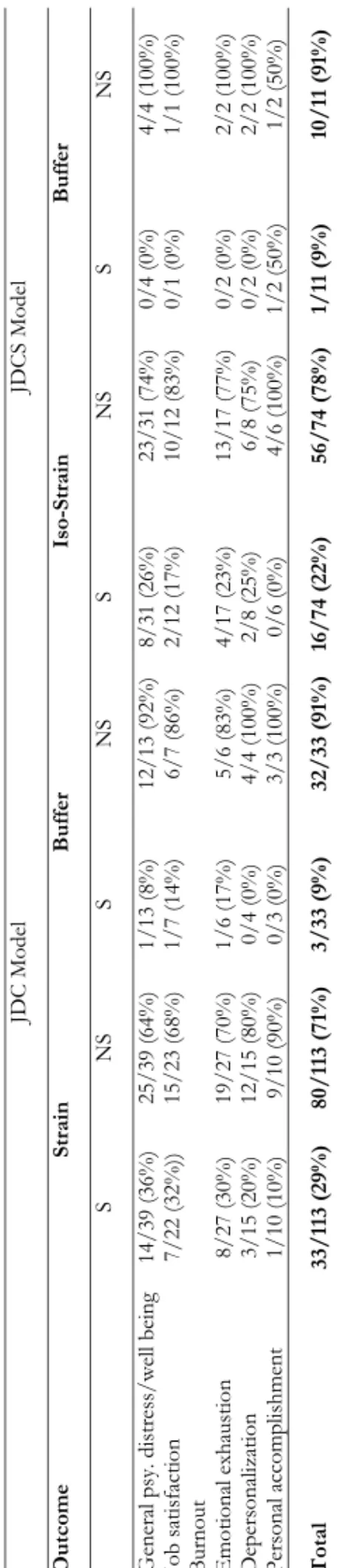
On the basis of these criteria, reports on 43 samples were included in this review. The results are presented in two sections to highlight the key outcomes identified within the research: general psychological distress and well being and job related psychological distress and well being.
Nine studies were based in the Netherlands, 7 in Sweden, 6 in Canada, 4 in USA, 3 in Belgium, 2 in Australia, Germany, Korea and Taiwan; and 1 in Spain, Finland, Denmark, Norway, UK, China and one study was conducted in 12 EU countries.
significance, and regarding the buffer hypotheses, when the interactive effects were either not significant or not in line with the expected buffer effect.
Previous reviews (Van der Doef and Maes, 1999a; Häusser et al. 2010) analyzed the distinctions between supportive, partial supportive and non supportive studies on the basis of characteristics such as: gender of employees, method adopted to analyze hypotheses (linear vs non linear), type of occupation, design of the study, generality vs specificity of instruments, and the sample size. Given the specific characteristics of the samples of our review (nurses populations largely female) supportive and non supportive studies were compared taking into account the following study characteristics: design of the study, method adopted to analyze hypotheses (linear vs non linear), specificity of the instruments, sample size, type of wards, and country of study.
Measurements of JDCS dimensions.
Regarding the operationalization of job demands, almost all authors were inspired by the original definition of job demands: “psychological stressors involved in accomplishing the work load, stressors related to unexpected tasks (Karasek 1979; pag. 291)”, and measured the degree of psychological demands as hectic work and work overload. Besides the original concept, 5 studies (Gelsema, et al., 2005; Gelsema, et al., 2006; Munro et al., 1998; Rodwell et al., 2009; Yang et al., 2004) included an indicator of physical demands (e.g., “working in a bending position”), 3 studies (Aust et al., 2009; Escriba-Aguir & Perez Hoyos, 2007; Fillion et al., 2007) considered an additional scale of emotional demands (e.g., “….have to face and
carry much of the patients worries/burdens/destinies of life’’). Elovaino and Kivimaki (1996) assessed job demands
via a measure composed by five subscales: demanding patients, time pressure, quantitative work overload, high levels of responsibility, and conflicts in occupational collaboration or cooperation, analogously, the studies of Fox et al. (1993), Landeweerd and Boumans (1994), used broader conceptualizations of job demands that included specific stressor items for nurses, such as quantitative (e.g. patient load, time pressure) and qualitative (e.g. high demands on concentration, high complexity of tasks) workload scales. Finally, McLaney & Hurrel (1998) included a scale of interpersonal conflict (intergroup and intragroup).
new skills in the job role. Beside the original construct (decision authority and skill discretion), two studies (De Gucht, et al., 2003; McLaney & Hurrell; 1998) included a scale of task control (e.g., ‘‘I can determine my
work pace.’’). McLaney & Hurrel, (1998) adopted a scale developed by Greenberger (1988) that was
composed by 4 subscales: task control, decision control, control over physical environment, and resource control factor. Finally, in one study (Verhaeghe, Vlerick, De Backer, Van Maele, & Gemmel, 2008)job control was assessed via two scales (Wall, Jackson, & Mullarkey, 1995) referring to timing control (“Do you
have full authority in determining how much time you spend on particular tasks?”) and method control (“Can you
choose the methods to use in carrying out your work?”).
Social support was considered in 29 of the 43 studies. In 14 of them (48%), social support was assessed in line with the original definition (Karasek & Theorell; 1990) via one scale composed by two sub-dimensions indicating instrumental and emotional social support from supervisors and colleagues. In 10 studies the two sub-dimensions indicating support from colleagues and supervisors were considered separately (De Gucht et al., 2003; Escribà-Agüir & Pérez-Hoyos, 2007; Gelsema et al., 2005; 2006; Hansen et al., 2009; Jourdain & Chenevert; 2010; Lee & Akhtar, 2007; Proost et al., 2004; Rodwell et al., 2009; Seo et al., 2004; Zangaro & Johantgen; 2009).
33
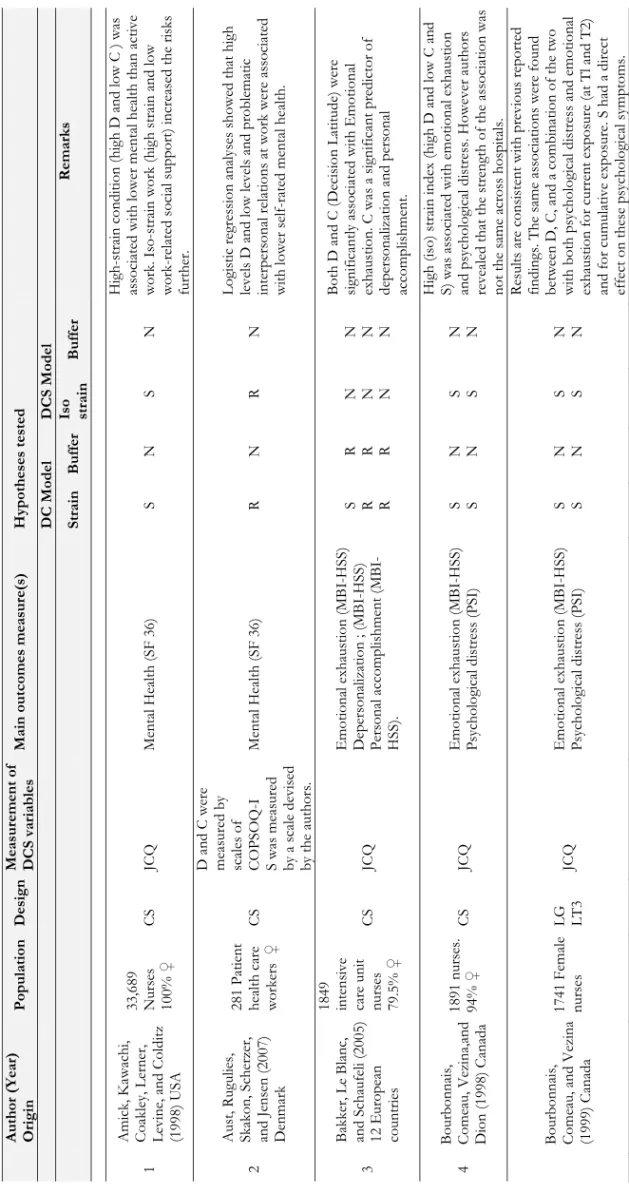
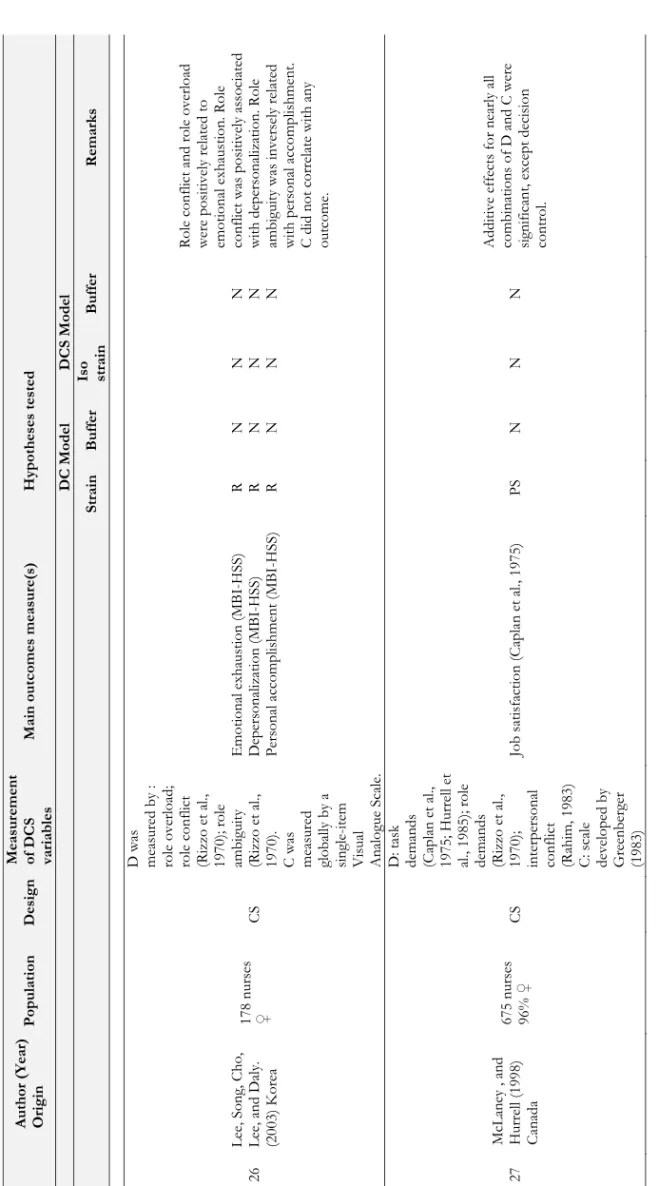
Table 2.1. Su
m m ary of pa pers u n der review. Author ( Y ear) O rigin Population Design Meas ur ement of D C S var iab le s Main outc omes measur e (s) Hypothes es tested DC Model DCS M odel Strain Buffer
Iso strain
Buffer Remarks 1 Amick, Ka wachi, Co akley, Lern er,
Levine, and Colditz (1998) USA 33,689 Nurs
es 100% ♀ CS JCQ Mental Healt h (SF 36) S N S N High-strain co nditi on ( h ig
h D and low C ) wa
assoc iated wit h lo we r me ntal h ealth tha work. I so-strain work ( h ig h stra
in and low
wor k -related social sup port ) inc reased th furth er. 2 Aust, Rugulies , Sk ako n , Sch erz er,
and Jensen (2007) Den
m
ark
281 Patient health
care wor ke rs ♀ CS D an
d C w
ere meas ured b y sc al es of COPSOQ-I S w as meas ured
by a scale devised by th
e auth o rs . Mental Healt h (SF 36) R N R N Logis tic regre ssi on analy ses sh o w ed th
levels D and low le
vels and pro
b lematic inter pe rs o n al r ela tio ns a t w o rk we re with l ower self -rated mental he alth . 3
Bakker, Le Blanc, and Sc
haufe li (2005) 12 E uro p ean countries
1849 inten
sive care un it n urs es 79.5% ♀ CS JCQ Emo tional e x haust io n (MB I-HS S) De pe rsona li za ti on ; (MB I-HSS ) P er sona l a cc o mpli sh me nt ( MBI -HSS).
S R R R R R N N N N N N
Bot
h
D and C (Dec
isio n Latit u d e) were sign ific an tly ass o ciated with E m oti onal
exhaustion. C wa
s a s
ignific ant predicto d epe rsona liza tio n a n d pe rs o n al accomplis hment . 4 Bourbo nnai s, Comeau, Vezi na,and Dion (1998) Canada
1891 nurses. 94% ♀
CS JCQ Emo tional e x haust io n (MB I-HS S) Psycholo gical d istress (PSI )
S S N N S S N N
High (i so ) strai n index (h ig h D an d lo
S) was ass
o ciated with em oti o n al e x and psychol ogical d istre ss . Ho wever auth revealed th at th e stren gth
of the as
soc not t h e same ac ross ho spital s. Bourbo nnai s,
Comeau, and Vezina (1999) Canada 1741 Female nurs
es LG LT3 JCQ Emo tional e x haust io n (MB I-HS S) Psycholo gical d istress (PSI )
S S N N S S N N
Re sults are c onsis tent wit h pre v ious re finding
s. The same as
sociati
on
s were found
b
etw
een
D, C, a
n
d a co
mbina
ti
on of t
with bo th psychol ogical d istres s and exh aus tion for curren t exp o
sure (at Tl an
and for c u mulative e x posure
. S had
34
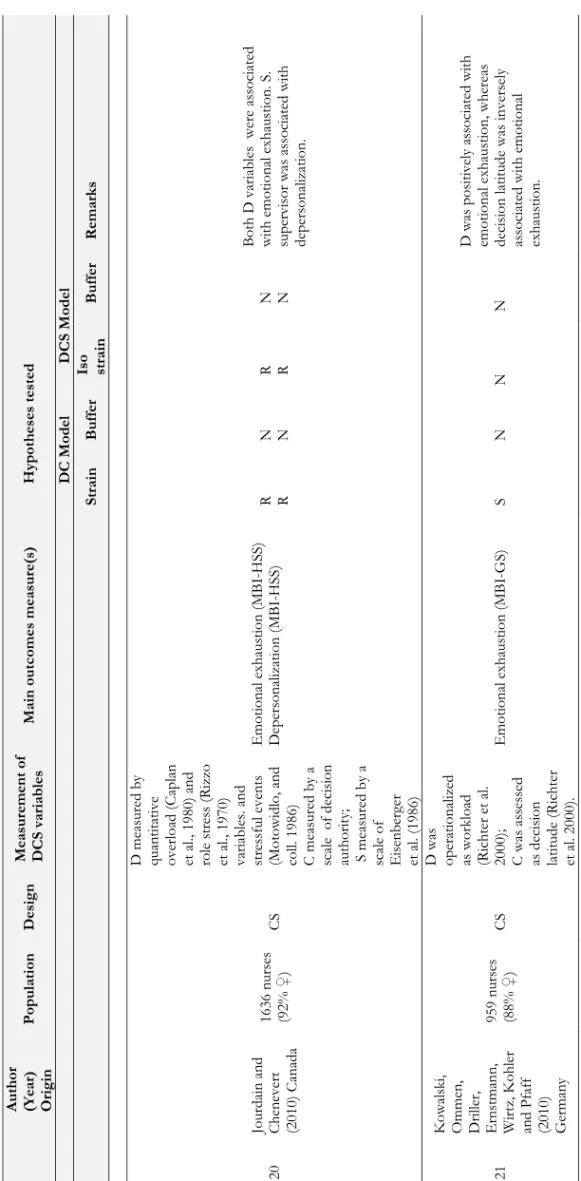
Table 2.1. (Co
n ti nue d ) Author ( Y ear) O rigin Population Design Meas ur ement of DCS var iables Main outc omes measur e (s) Hypothes es tested DC Model DCS M odel Strain Buffer
Iso strain
Buffer Remarks Bourbo nnai s, Brisso n, Male fan t,
and Vezina (2005) Canada
2006 fe male n urs es CS Changes of JDCS variab les after
restructuring. (JCQ) (Items in Ap
pe ndix of article) Psycholo gical Distres s (PSI) S N S N Auth ors com p ared th e results with re fe re nc e popu la ti on s. F ind in gs sho
increase in psych
o
logical r
isk fa
cto
rs at w
amo n g n urs es after res tr
ucturing of th
care s
ecto
r an
d a h
igh
er p
revale
n
ce o
low C, and lo
w S.
De Gucht, Fisc
hle
r, a
n
d
Heiser (2003) Belgium 202 Nurses ♀ 79%
CS LQoW Q F u nc tiona l d yspe sia Irritable b owel syndro me Idiopat
ic chronic fatigue
meas ured b y vario u s s cales
R R R N N N R R R N N N
Hypot
heses we
re tested with
lo gis tic regre an alys es , in cludin g i n each equatio n
measures of individ
ual d ifferen ces (alexithymia and neuroticism) an d ps ycho lo gical d
(anxiety and depressio
n
).
de Jonge, van Breukelen, Lan
d ew eerd, an d Nijhuis (1 999) The Neth erlands
895 regis
tered n urs es ♀ 84% CS D wa s a sse ss ed by a sc al e d ev elope d
by de Jonge, Lan
d erw eed & Njjus (1993) ; C w as meas ured b y MAQ. Emo tional e x haust io n (MB I-HS S) Job related anxiety (VOS) Job sati sfaction: o n
e item (de
Jonge, 1995)
R R S R R R N N N N N N
D was ass
o ciated wit h a ll outco m es.
de Rijk, Le Blanc, Schaufe
li,
an
d de Jo
n
ge
(1998) The Neth
erlands 367 inten sive care n urs es . 56%♀ CS D wa s a sse ss ed by a w o rklo ad s cale develo p ed b y de Jonge (199) ; C w as meas ured as decision authority. E m o tional e x haust io n (MB I-HS S) Depersonali zati on ( M B I-HSS ) R R PS R N N N N
Buffer eff ect w as s u pp orted in emotional exhaustion o n ly amo n g nurses with copin g st rategies .
Doncevic, Romelsj
o, and
Theorell (1998) Sweden 236 Swedish female district nurs
es
;
69 Croatian female district nurs
es
CS
D an
d C w
ere meas ured b y JDC S wa s a sse ss ed by tw o general items Job sati sfactio
n (one item)
R
N
R
N
D was n
35
Elova
ino
, &
Kivimaki. (1996) Fin
lan
d
433 nurses. 56%♀
CS D a sse sse d by 5 su bsc al es : troubles ome patient
s, time
pressure; quantit
ative
work overload , hi
gh
levels of respon
sib
ility
, and
conflic ts ; C w as meas ured b y a sc al
e of Ga
nster (1984) Strain (OSQ) S R N N Job strai n was s ign ific
antly and pos
related
to
D and negatively rela
C did not moderate th
e stress -s relatio ns hip . Esc ribà -Ag üir, an d P ér ez-Hoy os. (2007) Spai n
279 nurses 56%♀
CS Items adapted fr om Job Co ntent
Questionnaire. It wa
s i n cl u d ed a sc ale th at meas ured emotional d emands Emo tional e x haust io n (MB I-H SS) Mental healt h (SF36) R R N N R R N N
Exp osure to hig h psych olo gical increased th e probabi
lity of bad
health and hi gh emo tional e x ha amo n g n urs es .
C did n
o t sho w an y s ign ificant th e outcome
s of t
h e stud y. E v ans , an d Stepto e. (20 02) UK
233 nurses 74%♀
CS
D an
d C w
ere asse sse d by a a sc al e devised by Cropley, Stepto e, & Joekes
(1999); S w
as meas ured b y a scale devised by Unden, Orth-Gomer, and Elofs so n (1991 ) An xiety (H ADS) S N S N After adjustin g for age, sex, pai h o urs an
d a meas
ure o f s o cial bias, risk of elevated anxiety was independently ass o ciated with
strain and lo
wer job
social sup
Fillion, Tremblay, Truc
hon, C o te, Struth ers , an d Dupuis. (200 7) Can ada
209 palliative- care n
urs es 92.3% ♀ CS Fren ch adap tio n of JCQ. Job sati
sfaction (JDS)
Emo
tional d
istress
(POMS).
R R N N R R N N
D was related
to
bo
th
36
Table 2.1. (Co
n ti nue d ) Author ( Y ear) O rigin Population Design Meas ur ement of DCS var iables Main outc omes measur e (s) Hypothes es tested DC Model DCS M odel Strain Buffer
Iso strain
Buffer
Remarks
14
Fox, Dwyer, and Ganster. (1993) USA 136 Nurses ♀
CS D: w o rkl o ad
(Caplan et al; 1980) and stressful events (Mo
towidlo, and
coll. 1986) C: scale of Dwyer & Ganster (1991)
Job sa ti sfa ctio n Illnes
s and so
ma tic complai n ts (Gans ter, 1985)
PS R S R N N N N Wit h r egar d
s job sa
ti sfa ctio n, s hy po the si s wa s su pp or ted only o f s tres sf ul even ts , b u ffer effect su pp or ted wit h bo th me as u re s: an d s tres sf ul even ts . As regards to Ill n ess a n d somat complai n ts
, strain hypo
th esi s w su pp or ted . Ganster, Fo x,
and Dwyer, (2001) USA
101 Nurs es ♀ LG1 D: w o rkl o ad
(Caplan et al; 1980) and stressful events (Mo
towidlo, and
coll. 1986) C: scale of Dwyer & Ganster (1991)
Illnes
s and so
ma tic complai n ts (Gans
ter, 1985) + Me
ntal Healt h (MH I) R R N N Re su lts s h o w ed tha t n one of t h
and control v
ariable
s, or t
h eir interactio were sign ific antly related with Mental health
( a com
p o site me ntal health th at com b ined th e item s fr om t Health I n
dex and th
e so matic complai scales, wit h hig h scores i n dicatin pos itive mental hea lth .)
Gelsema, van der Doef, Mae
s, Akerbo o m, and Ver hoeven.
(2005) The Neth
erlands 807 hos pital n urs es 85% ♀ CS Leiden Qualit y o f Wor k
Questionnaire for Nurses (LQo
WQ -N) Job sati sfaction (LQo WQ -N ) Emo tional e x haust io n (MB I-H SS) Psycholo gical d is tress (( SCL -90 ) Somatic comp laint s (SCL -90)
R R R R N N N N R R R R N N N N
D resulted correlated with all o except with j ob satis facti on. Anoth
measure of D (p
hysica l d emands) resulted correlated with all outcomes . B
measures of C (s
kill di scretio n and la titu d e) we re positi ve ly a ssoc ia satis faction. Skill discret io n wa assoc ia ted wit h e m oti o n al e x ha fr om su p. sh owe d a pos itive a ssoc with j o b satis facti
on. S fr
37
Gelsema, van der Doef, Mae
s, Ja nsse n, Akerbo o m, and Ver hoeven.
(2006) The Neth
erlands 381 hos pital n urs es 84%♀ LG3 Leiden Qualit y o f Wor k
Questionnaire for Nurses (LQo
WQ -N) Job sati sfaction (LQo WQ -N ) Emo tional e x haust io n (MB I-H SS) Psycholo gical d is tress (( SCL -90 ) Somatic comp laint s (SCL -90)
R R R R N N N N R R R R N N N N
The mos
t imp
ortan
t result regarded
long itud inal c h an ges in work conditi
These were predic
tive of th
e outcomes,
espe
ci
ally
of job sa
ti sfa ctio n a emotional e x haus tion. Hansen , Sverke,
and Naswall (2009) Sweden
Hos p ital n urs es . 279 fr om
Private for profit h
o
sp
ital
91% ♀; 562 fr
om
Private non- profit h
o
sp
ital
97% ♀; 261 fr
om
Public hos
pital
96% ♀
CS
D: 3 scales : workl
oad
, role
conflic
t, j
ob
insecurity. C: job
autono
m
y
(Sverke & Sjoo
berg,
1994);
S: work grou
p su pp or t, superviso r supp ort ( E kvall & Arvone n (1994) . Emo tional e x haust io n (MB I - HSS); De pe rsona li za ti on ( M B I-HSS )
PS R N N R R N N
As regards emotiona l e x haus tion strain hy po the si s wa s c o nfir me d only nurses fr
om private n
o n -profi Hoch wälder (2006) Sweden
694 nurses 91% ♀
CS Wor k environme n t scale
(Theorell, Michelsen, & Nordemar, 1991).
Emo tional e x haust io n (MB I-H SS) De pe rsona li za ti on ( M B I-HSS ) P er sona l a cc o mpi shme n t ( MBI -HSS) Somatic symp to m s (G HQ) An
xiety and in
som
nia (G
HQ)
Se
vere depression
(G
HQ)
S S R R R R N N N N N N S S R R R R N N N N N N
All JDCS variables sh
owed sig assoc ia ti on s wit h ou tc ome va excep t relatio n sh ip b etw een D an pe rsona l a cc o m p lis hme n t a n on t h
e one ha
nd, and a
ll me ntal va ri ab le
s on t
h e ot he r ha nd . Hoch wälder (2007) Sweden 838 regis tered
nurses 95% ♀
CS Wor k environme n t scale
(Theorell, Michelsen, & Nordemar, 1991).
Emo tional e x haust io n (MB I-H SS) De pe rsona li za ti on ( M B I-HSS ) P er sona l a cc o mpi shme n t ( MBI -HSS).
S S R N N N S S R N N N
JDCS variables sho
wed signific assoc ia ti on s wit h bu rn ou t va excep t relatio n sh ip b etw een D an pe rsona l a cc o m p lis hme n t. Ja nse n, K erkst ra, A b u -Sa
ad, and van
der Zee., (1996) The Nerth
erlan
ds
402 community nurs
es
93% ♀
CS
Algera ques
tio
nn
aire
(Alger
a et al., 1986)
Emo tional e x haust io n (MB I-H SS) Depersonali zati on ( M B I-HSS ) P er sona l a cc o mpli sh me nt ( MBI
-HSS) Job sa
ti sfa ctio n (Bou mans , 199 0)
S R R R N N N N N N N N N N N N
38
Table 2.1. (Co
n
ti
nue
d
)
Author (Yea
r) O rigin Population Design Meas ur ement of DCS var iables Main outc omes measur e (s) Hypothes es tested DC Model DCS M odel Strain Buffer
Iso strain
Buffer Remarks Jo urdain an d Ch en evert (2010) Canada 163 6 n urs es (92% ♀ ) CS D meas ured b y quan tit ative
overload (Caplan et al., 1980) and role stress (Ri
zz
o
et al., 1970) variables. and stressful e
v
ents
(Mo
towidlo, and
coll. 1986) C meas
ured b
y a
sc
al
e of d
ec ision auth o rity; S meas ured b y a sc al e of Eise n b er ge r
et al. (1986)
Emo tional e x haust io n (MB I-H SS) De pe rsona li za ti on ( M B I-HSS )
R R N N R R N N
Bot h D va ri ab le
s we
re a ssoc with em oti onal e x haus tion. S. superviso r wa s ass o ciated with d epe rsona liza tio n. Ko walski, Omme n,
Driller, Erns
tman n, Wir tz, K ohle r an d Pfaff
(2010) German
y
959 nurses (88% ♀
)
CS
D wa
s
operationalized as wor
kl
oa
d
(Richter et al. 2000); C wa
s a sse ss ed as d ec ision latit ude (Richter
et al. 2000).
Emo tional e x haust io n (MB I-G S) S N N N
D was p
39 Lan d ew eerd, an d Bouman s (1994) The Neth erlands
561 trained staff nurs
es 76%♀ CS D an d C meas ured b y sc al es of Hac kman & Old ham (1975) an d Alg era an d coll., (1986 ) Job sa ti sfa ctio n (Bou mans , 199 0) Health com p lain ts (V OS)
R S R R N N N N
Str ai n hy p o the se s we re c onfir m auth o
rs did partial co
rrelations,
for gender, job level, fu
ll/part t length of service. After step wis stra in hy pot he sis wa s su pp or te
case of health
c o m p laint s. Landsbergis (1998 ) USA
289 hos
pital
an
d
nursing home emp
lo
yees
95% ♀
CS
D an
d C w
ere meas ured b y JCS Job sati sfaction (JCS) Depressio n (JCS)
Physical strain (JCS) Sle
eping pr oblem s (JCS) Emo tional e x haust io n (MB I-H SS) De pe rsona li za ti on ( M B I-HSS ) P er sona l a cc o mpli sh me nt ( MBI -HSS )
S S S S S S R R R R R R R R N N N N N N N N N N N N N N
D correlated with all outcomes pe rsona l a cc o m p lis hme n t. C w assoc ia ted wit h d epr essio n , phy sleeping pro b lems, em o tional e d epe rsonaliza tio n, a n d wa s po assoc ia ted wit h jo b sa ti sfa cti o n accomplis hment . L asc hinger , F ine ga n,
Shamian, and Almost. (20
01)
Can
ada
404 nurses 48 %
♂
CS
D an
d C w
ere meas ured b y sc ales adap ted b
y JDC ques
tio nn aire. Job sa ti sfa ctio n (H
ackman & O
ldham’s scale (1975) S N N N
There was a signific
an
t difference on job
satis faction bet w een hi gh s train active groups. Lee, an d Akh tar (2007) Chi n a
2267 nurs
es
89 % ♀
CS
D wa
s
measured with wor
kl oa d sc al e o
f JDC; ro
le
conflic
t (Ri
zz
o
et al., 1970), tensi
ons i n pr ofe ssi ona l wor k relatio ns hip s
(NSS). C w
as meas ured by sc al e of Dw yer &
Ganster ( 1991) S w
as meas ured by sc al e of
Caplan et al., (1980)
Emo tional e x haust io n (MB I-H SS) De pe rsona li za ti on ( M B I-HSS ) P er sona l a cc o mpli sh me nt ( MBI -HSS )
R R S N N N R R PS N N N
D was ass
o
ciated
wit
h
all three outcomes.
Iso-S tra in hy pot he sis wa s c o nfi th
e case of perso
n
al a
ccompli
sh
outcome was related
40
Table 2.1. (Co
n ti nue d ) Author ( Y ear) O rigin Population Design Meas ur ement of DC S var iables Main outc omes measur e (s) Hypothes es tested DC Model DCS M odel Strain B uffer
Iso strain
Buffer Remarks Lee, So n g, Cho , Lee, an d Daly. (2003) K o rea
178 nurses ♀
CS D wa s meas ured b y :
role overload; role conflic
t
(Rizzo et al., 1970); role ambiguity (Rizzo et al., 1970). C wa
s meas ured glo bally by a single-i tem Vis ual An alo gue Sc ale. Emo tional e x haust io n (MB I-H SS) De pe rsona li za ti on ( M B I-HSS ) P er sona l a cc o mpli sh me nt ( MBI -HSS )
R R R N N N N N N N N N
Role conflic
t and ro
le overload we re posit ive ly r ela ted to emotional e x haus tion. Role conflic t was po sitively ass o ciated with depers onali zati on. R o le ambiguity wa
s inversely related
with perso n al accompli shme
C did not correlate with
any
outcome.
McLan
ey , an
d
Hurrell (1998) Can
ada
675 nurses 96% ♀
CS
D: task dema
nd
s
(Caplan et al., 1975; Hurrell e
t
al., 1985); role dema
nd
s
(Rizzo et al., 1970); interperso
n al conflic t (Rahim, 1983 )
C: scale deve
lope d by Greenberger (1983) Job sati sfactio n (Capla n
et al., 1
975) PS N N N Additive effects for n early a combi n ations
of D and C were
sign
ific
an
t, except decisio
n
control
41 28 Munro, R o dwell an d Hardin g. (1998). Au stralia
60 Psychiatric nurs
es
73% ♀
CS
D (Workload) (Caplan et al., 1980) C (d
ec
ision
latit
ude) (Dw
yer
& Ganster, 1991) S (in
and outs ide th e w o rk p lace; Et zio n , 1984) Jo b s ati sf action ( W
arr et al.,
1979)
Worker Health
(
GHQ
)
R R R R R R N N
D was n
o
t as
sociated
wit
h
any outcome. C
and S correlated
pos
itively with bot
outcomes. 29 Pe tte rson, Arnet z,
and Arnetz (1
995)
Sweden
2566 nurs
es 85% ♀ CS JDC Job sa ti sfa ctio n S N N N
Lower levels of D and
hig
h
er levels of C
we re a ssoc ia ted with hig h jo b s atisfa 30 Proost , De Wit te, De Witt e, and
Evers (2004) Belgium 2075 nurs
es . 84% ♀ CS Scales adap ted fro m JDCS meas ures .
D time pressure C d
ec ision auth ority S Su port fr om co ll an d s u p erv Emo tional e x haust io n (MB I-H SS) De pe rsona li za ti on ( M B I-HSS ) P er sona l a cc o mpli sh me nt ( MBI -HSS).
R R R R R R R R R R R PS
D an
d S h
ad a s
ign
ifican
t effect o
thr ee d ime nsio ns of bu rnou t i n line th e th eo ry o f th e JDCS mo del. No
was found of decisio
n
authority
on any of
the thr ee d ime nsio ns of bu rn ou t. W it h res p ect to t h e in teractive effects auth o rs fou
nd a small but si
gn ific in teractio n effect b etw een D a n
d C o
emotional e
x
haus
tion, but
no
t in th
exp ec ted d ir ec tion. F ina lly t h er e wa
small but si
gn ific an t th ree -way i n effect b etw een jo b deman d s, j o b an d su pp or
t of c
o lle ague s o n p er accomplis hment . Nurses w o rki n strain job s b en efited mo st fro m receiving S fr om collea gues. 31 Rodwell, N oblet,
Demir, and Steane (2009) Aus
tralia
168 nurses wor
ki
ng
with elderly patient
s 93%♀ CS D: phys ical a n d psychol ogical d ema nd s (Ca pla n
et al., 1980); C: (K
aras
ek,
1985); S: SS superviso
r,
colleagues at work, and life ou
tsid e wor k Job sa ti sfa ctio n (B
rayfield et al.,)
Psycholo gical health ( GHQ ) Psycholo gical d is tress ( K 10, Kessler & Mrocz ek, 1994)
R R R R R R R R R R R R
D was ass
o ciated wit h , p sychol ogical d istre ss a n d he alth
. C an
d S w
ere
sign
ific
an
t predicto
rs of j
ob sati sfactio C o w o rk er su pp or t a n d su p por t ou
work were no
t ass
o
ciated
with
any
outcomes. Bu
42
Table 2.1. (Co
n ti nue d ) Author ( Y ear) O rigin Population Design Meas ur ement of DCS var iables Main outc omes measur e (s) Hypothes es tested DC Model DCS M odel Strain Buffer
Iso strain
Buffer
Remarks
Sc
haufe
li, and
Janczur (1994) The Neth
erlands 200 Polis h n urs es ♀
183 Dutch nurs
es 100% ♀ CS D wa s a sse ss ed
by 3 items of wor
k stre
ssor
s;
C w
as
meas
ured
by 2 items.
Emo tional e x haust io n (MB I-H SS) De pe rsona li za ti on ( M B I-HSS ) P er sona l a cc o mpli sh me n t ( MBI -HSS )
R R R N N N N N N N N N
Relatio n shi ps were tested wit regre ssion analy ses, in cludin
g in each
eq u ation me as u re
s of ot
he
r job
dimensio
ns (e.
g., uncertainty) a
individ ual d ifferenc es (s elf estee va ri ab le s we re not as sociate d w b urn o u t variab le. Se o, Ko
, and Price
(2004) K
o
rea
353 acute care n
urs es ♀ CS D W o rkl o ad
(Rizzo et al., 1970); C auto
n omy (Breaugh , 1985) S a sse sse d by two sc al es fr om House (1981) : co -wor ke r su pp or t a n d superviso r su pp or t. Job sa ti sfa ctio n R N R N Structural e q u atio ns analy ses sh tha t w o rkloa d a n d su pe rvis or h ad s ign ificant effects o n ho sp nurses’ jo b sati sfaction. Shen, Chen g, Tsai , Lee, an d Guo (2005) Taiwa n
408 psychiatric nurs
es ♀ CS JCQ General He alth (Sf36) Mental Healt h (SF 36)
S S N N R S N N
Str ai n hy p o the sis wa s su p por outcomes. Is o strai n hyp o th es su pp or ted in the c ase of mental Testad , Mikkelsen ,
Ballard, and Aarlsand (2009) No
rw
ay
197 nurses worki
ng in
dementia wards 95% ♀
CS JDCS variab les w ere meas ured
by QPSNordic D: w
o rkl o ad C: Co n tr o l an d
mastery at work; SS s
o cial interactio n s Psycholo
gical stress (
HSc
l)
Somatic and psych
os ocial c o m p laint s SHC
R R N N R R N N
Among JDCS variables,
only C correlated with psych olo gical d In t h
e case of som
atic and p
sychos complai n ts , aut hor
s did not fin
sign ifi can t ass o ciation bet w een
variables on t
h
e o
n
e hand, and
43 36 Tho m sen, Arnetz , Nola n, Soar es, and
Dallender (1999) Sweden 1016 psychiatric nurs
es fro m Sweden an d En gland 78% ♀ CS D an
d C w
ere meas ured b y sc al es d eve lope d
by Arnetz (1997)
Mental Healt h Profe ssio n al fulfilme nt (i tems d escribed in the pa pe r) Work-Related Ex hausti on
. (Thomsen et
al. 1998)
R R R N N N N N N N N N
C c o rr ela ted with pr ofe ssi ona l fulfilme
nt. D correlated
with m health and w o rk related exhaustio 37 Tho m sen, Soar es, Nola n,
Dallender, and Arnetz (1999) Sweden 1, 051 psychiatris
ts
and mental health nurs
es
74% ♀
CS
D an
d C w
ere meas ured b y sc al es d eve lope d by (Pe tte rson & Arnetz , 1997) Profe ssio n al fulfilme nt (i tems d escribed in th e pa per) Wor k -Related Ex hausti on . (Ar n etz , 1997 )
R R N N N N N N
C c o rr ela ted with pr ofe ssi ona l fulfilme
nt. D correlated
with w related exhaustio n. 38
Tummers, Jansse
n, Lan d erw eed, an d Ho ukes
(2001) The Netherlands
196 stud
ent
and general nurses (88% ♀) 175 mental health nurses (85% ♀)
CS
Demands (wor
kl oa d ) wa s meas ured b y a sc al
e of De
Jonge et al., 1995); Contr
o l was asse sse d by the
MAQ; Social supp
ort w as meas ured by VOS-D. Emo tional e x haust io n (MB I-H SS) R N R N Emo tio na l e x ha u st io n wa s a sso with workl
oad and social sup
p o bot h sa m p le s. 39
Tummers, Lan
d
ew
eerd,
an
d van
Merode (2002) The Neth
erlands
1,253 Nurses; 85% ♀
CS
D (w
orkl
oad,
De Jonge et al; 1995); C (MAQ)
.
S (from colleagues and senior
nu rs in g off ic er ) wa s asse sse d by VOS-D.. Emo tional e x haust io n (MB I-H SS), Psychos omatic com p lain ts ( V oeg) Job sati sfactio n (Landerweed
et al., 1996)
R R S R R R R R S N N N
D and S reveale
44
Table 2.1. (Co
n ti nue d ) Author ( Y ear) O rigin Population Design Meas ur ement of DCS var iables Main outc omes measur e (s) Hypothes es tested DC Model DCS M odel Strain Buffer
Iso strain
Buffer Remarks va n d en Be rg , Vrijho ef, Tum m ers, Lan d erw eed, an d
van Merode (2008). The Neth
erlands
2 samples: 1204 Hos
p
ital
nurses 85% ♀; 350 Diabetes Specialist Nurse (DSN) 93% ♀
CS D(workload) wa s meas ured b y a sc al
e of De
Jonge et al., 1995); Contr
o l was asse sse d by the
MAQ; Social supp
ort wa s me as u re d by VOS-D. Emo tional e x haust io n (MB I-H SS) Job sa ti sfa ctio n Psychos omatic healt h
R PS R N N N R PS R N N N
Ad d itive hy pot he se s we re su pp only in t h e c ase of job sa tisfa ct hos pital nurses sub sample. D with e m oti ona l e x ha u stio n a n psycho so m atic health i n b o th Ver haegh e, Vlerick,
De Backer, Van Mae
le, and Gemmel
(2008) Belgium
416 (In
tens ive Care Unit s) Nurs es 678 (med ical
and surgical wards
)
84%♀
CS
D: negative appraisal of recurr
en t changes in th e wor k environme n t;
C: timing and meth
od co ntrol (W all, 1995 ) S wa s a sse sse d
by items refe
rring supp ort fr om su pe rvis or SPPN (‘‘Stre ss Profe ss io nnel P ositif et
Ne´ gatif’’) questionna
ire (De Keyser and Hansez , 1996) PS PS R R D (n egative ap
praisal of chan
th reat) ) wa s p ositi vely related perceptio n
of distress i
n b o th Bot h C dimensio ns related neg
only in medical a
n
d surgical sample.
W
ith
regard b
u
ffer e
ffects S fr superviso rs was not related in any
sample. Timing a
n
d method c
ontrol ’, m th e relatio n betw een t h
reat and distress
only amo
n
g medical a
n
d surgical nur
Yang
, Pan, and
Yang
. (2004) Tai
w
an
925 nurses ♀
CS
D an
d C w
ere meas ured b y JSQ (Y an
g et al.,
1997) S wa
s a
sse
ss
ed
by ISEL (C
ohen
et al., 1985)
Psychiatric morbid ity (CH Q, C h o n g & Wilks on , 1989) S N S N Multiple l o gistic regre ssi on reve high j ob strain, po
or social su