Randomized Controlled Trial of a Home-Based Walking Program to
Reduce Moderate to Severe Aromatase Inhibitor-Associated
Arthralgia in Breast Cancer Survivors
KIRSTENA. NYROP,a,bLEIGHF. CALLAHAN,cREBECCAJ. CLEVELAND,cLIUBOVL. ARBEEVA,cBETSYS. HACKNEY,cHYMANB. MUSSa,b
a
Division of Hematology-Oncology,bLineberger Comprehensive Cancer Center, andcThurston Arthritis Research Center, School of Medicine, University of North Carolina at Chapel Hill, Chapel Hill, North Carolina, USA
Disclosures of potential conflicts of interest may be found at the end of this article.
Key Words.Breast cancer • Aromatase inhibitor • Arthralgia • Exercise
ABSTRACT
Background.In postmenopausal women diagnosed with breast cancer (BC), most BC tumors are hormone receptor positive and guidelines recommend adjuvant endocrine therapy that includes an aromatase inhibitor (AI). This study investigates the impact of a 6-week, home-based, self-directed walking program on the com-monly reported side effect of AI-associated arthralgia (AIAA).
Materials and Methods.In this phase II trial, consented BC patients were randomized to walking Intervention (n531) or Wait List Control (WLC; n531). Eligibility criteria included: stage 0–III BC, on AI for at least 4 weeks,3 on a 5-point scale inquiring about joint symptom intensity “at its worst,” and exer-cising150 minutes per week. Outcomes were self-reported joint symptoms and psychosocial measures. Analyses compar-ing Intervention and WLC groups were conducted on an intention-to-treat basis to assess intervention impact at 6
weeks (postintervention) and at 6-months follow-up. Adjusted means were calculated to assess differences in two groups.
Results.In our final sample (n562), mean age was 64 years, 74% were white, and 63% had a body mass index of 30 or higher. At postintervention, Intervention group participants reported significantly increased walking minutes per week, reduced stiffness, less difficulty with activities of daily living (ADL), and less perceived helplessness in managing joint symp-toms. At 6-months follow-up (postwalking period in both Inter-vention and WLC), walking minutes per week had decreased significantly; however, improvements in stiffness and difficulty with ADLs were maintained.
Conclusion.This study adds to the growing evidence base sug-gesting exercise as a safe alternative or adjunct to medications for the management of AIAA.The Oncologist2017;22:1238–1248
Implications for Practice:Breast cancer survivors whose adjuvant endocrine treatment includes an aromatase inhibitor (AI) often experience the side effect of AI-associated arthralgia (AIAA). This study investigates the impact of a 6-week, home-based, self-directed walking program in the management of AIAA. Compared with Wait List Control, women in the Intervention group reported significantly increased walking minutes per week, reduced stiffness, less difficulty with activities of daily living, and less perceived helplessness in managing joint symptoms. This study adds to the growing evidence base suggesting exercise as a safe alternative or adjunct to medications for the management of AIAA.
INTRODUCTION
Most new cases of breast cancer are diagnosed in postmeno-pausal women, and in 70%–80% of these women, their tumors are hormone receptor positive (HR1), for which national guide-lines recommend adjuvant endocrine therapy that includes an aromatase inhibitor (AI) [1, 2]. Joint symptoms of pain, stiffness, and achiness (arthralgia) are commonly reported side effects of AI treatment, affecting an estimated 33%–74% of breast cancer patients on AI therapy seen in clinical practice, and rated mod-erate to severe by as many as 70% of women who report them
[3, 4]. For most breast cancer survivors experiencing AI-associated arthralgia (AIAA), pharmacological remedies such as analgesics and antidepressants provide little or no joint symp-tom relief [6]. There is a need to identify effective, easy-to-use, sustainable, and safe alternative or adjunctive approaches to AIAA management, so that they are able to remain on AI ther-apy while having as pain-free a life as possible.
We investigated whether an evidence-based walking pro-gram developed by Callahan and colleagues, which is effective
in reducing joint symptoms in adults with arthritis (Arthritis Foundation’s Walk With Ease [WWE]) [7], could have similar benefits for women experiencing AIAA. We have reported else-where about our adaptation of the WWE program for breast cancer survivors on AI therapy through interviews and pilot testing (WWE-Breast Cancer [WWE-BC]) [8–10]. Here, we pres-ent findings from a 6-week randomized phase II “proof of con-cept” study designed to evaluate the effect of WWE-BC between baseline and 6 weeks (end of intervention) and at 6-months follow-up. The specific focus of our study is breast cancer survivors reporting moderate to severe AIAA. Primary outcomes were patient-reported and included the following: (a) engagement in walking (minutes per week), (b) joint pain/ symptoms, and (c) adherence to AI therapy. Secondary out-comes were as follows: (a) self-efficacy to engage in physical activity and manage joint pain/symptoms, (b) psychosocial measures of quality of life, and (c) satisfaction with WWE-BC. We also report feasibility (recruitment), tolerability (retention), and safety (adverse events).
MATERIALS ANDMETHODS
Participants
The study sample was identified through a review of the appointment schedule for women being seen in breast cancer clinics at a university-affiliated tertiary care hospital. The recruitment period was February 2014 through August 2015. Oncology providers of patients identified as potential study participants were approached to ascertain the patient’s appro-priateness for the intervention study and current status of AI treatment compliance. To be eligible for the study, patients had to be adherent to their AI prescription for at least 4 weeks, age 21 or older, and not undergoing chemotherapy or radiation treatment during the study period. Patients approved by their provider were then screened in person by study staff. To iden-tify patients with moderate to severe AIAA, eligibility was lim-ited to patients who scored 3 or higher on a 5-point scale inquiring about joint pain, stiffness, or achiness intensity “at its worst” in the past 7 days (PROMIS Pain Intensity—Short Form 3a) [11]. Patients were also asked how many days a week they engaged in physical activity for exercise or pleasure and how many minutes per day they did so. For study eligibility, patients had to be exercising below the guideline-recommended level of 150 minutes per week [12]. Patients who met both pain and physical activity criteria were then invited to review informed consent forms and provide written consent to participate in the study. The intervention study protocol was approved by the UNC Lineberger Comprehensive Cancer Center Protocol Review Committee and the UNC Institutional Review Board. The study was registered with clinicaltrials.gov (NCT01900418).
Intervention
Walk With Ease-Breast Cancer has been described in detail elsewhere [8, 9]. The evidence base for WWE was established in group-based classes and as a self-directed physical activity program for adults with arthritis [7]. Walk With Ease includes a WWE workbook that encourages participants to walk for at least 150 minutes per week. For our phase II proof of concept study, consented patients were randomized to Intervention or Wait List Control (WLC).
The intervention period was 6 weeks (as tested in the origi-nal WWE study [7]), during which study participants were asked to walk on their own or with others at a pace that was safe, comfortable, and sustainable at the guideline-recommended level of 150 minutes per week. Participants received a copy of the Arthritis Foundation’s Walk With Ease workbook [13] with strategies for starting and sustaining a daily walking program. Participants also received a 4-page brochure developed by the research team titled “Walk With Ease for women with a breast cancer diagnosis” containing brief topics such as “Why walk,” “Joint pain and some cancer treatments,” quotes from women who had completed the walking program in a prior pilot study [8], “How to get started,” and a summary of the “UNC Pilot Study.” In addition, participants received a printed physical activity log to record daily minutes of walking for leisure, pleasure or recreation. There was no contact with study participants during the 6-week intervention period. The WLC group was asked to await further contact from the research team at 6 weeks after study enrollment/baseline, at which time they received the same materials and instructions as the Intervention group and were encouraged to walk 150 minutes per week.
Questionnaires
At baseline, consented patients received a printed question-naire with a self-addressed stamped return envelope and were asked to mail in the completed questionnaire within 1 week of recruitment. Up to three email and telephone follow-ups were conducted weekly to encourage baseline retention in the study through the completion of the baseline questionnaire. At 6 weeks from baseline, the Intervention group was mailed a 6-week questionnaire with a self-addressed stamped envelope for returning the questionnaire. The questionnaire included “Program Satisfaction” questions and a request to include their walking diary in the return envelope. At this 6-week time point, WLC participants were also mailed the 6-week questionnaire, but without the satisfaction questions. At that time, the WLC participants were provided instructions and materials and encouraged to start the walking program. Six weeks later, the WLC group received a second 6-week questionnaire that included the satisfaction questions and a request to return the walking diary in the self-addressed stamped envelope provided by the study team. Both Intervention and WLC groups were mailed a 6-months follow-up questionnaire, 6 months after they had completed the walking program.
Measures
Scale (ASE) subscales for pain and symptoms [18]. Additional psychosocial measures pertained to efficacy and outcome expectations for physical activity: Outcome Expectations from Exercise [19] and Self-Efficacy for Physical Activity [20] scales.
Study participants were also asked to provide demographic information (age, race, ethnicity, education, marital status, height, weight), self-assessed general health (15excellent to 55poor), and breast cancer stage and treatment. With regard to AI adherence during the study period, the study participants were asked to report how often they (a) forgot to take their AI therapy as prescribed and (b) chose not to take the AI therapy as prescribed, with response options from 15never forgot/ never chose not to take the AI to 55very often forgot/often chose not to take the AI as prescribed. Participants were queried about physical activity through the following items: (a) How many days a week do you go for a walk for at least 10 minutes, for any reason, in and around your neighborhood or elsewhere? and (b) How much time (minutes) do you usually spend when you go for a walk in and around your
neighborhood or elsewhere? Responses to both questions were multiplied to ascertain total minutes of walking per week.
Statistical Analysis
Analyses were conducted on an intention-to-treat (ITT) basis. During recruitment, three participants who were randomized to receive the intervention were inadvertently assigned to the WLC group instead, and three others who were randomized to the WLC group were inadvertently assigned to receive the inter-vention. One of the mis-randomized WLC participants did not complete the 6-week follow-up questionnaire, leaving 5 mis-randomized study participants. The mis-randomizations were unintentional and were found to be non-differential when com-paring baseline demographic characteristics with those who were correctly randomized. Further, the mis-randomized partici-pants still received a protocol-defined regimen (the walking intervention). We therefore decided to go forward with the ITT analyses, with all participants analyzed according to the group
Table 1.Measures
Domain Explanation
Self-reported walking Walking (on average)
. . .days per week
. . .minutes per day
Days times minutes/day5minutes/week
Self-reported joint symptoms VAS
Pain: how much pain/achiness/discomfort have you had in and around your joints over the past week?
Stiffness: How much of a problem has stiffness been for you over the past week?
Fatigue: How much of a problem has unusual fatigue or tiredness been for you over the past week?
05no pain to 105pain as bad as it could be.
Score4 is associated with premature AI discontinuation [29].
05no stiffness to 105stiffness as bad as it could be.
05fatigue is no problem to 105fatigue is a major problem.
Severe fatigue is defined as4 [30].
WOMAC Pain subscale Stiffness subscale
Function/difficulties with activities of daily living
Higher score5greater pain, range 0–20 Higher score5greater stiffness, range 0–8 Higher score5greater difficulties, range 0–68
Total joint pain locations on a body chart Range 1–10 locations Psychosocial measures
FACT-G
Physical well-being Social/family well-being Functional well-being Emotional well-being
Lower score5greater symptoms, range 0–28 Lower score5less support, range 0–28 Lower score5lower function, range 0–28
Lower score5more emotional concerns, range 0–24
RAI Higher score5greater perceived helplessness
Range 1–5 Efficacy for pain self-management
ASE Pain Symptoms
Lower score5lower self-efficacy Range 1–10
Range 1–10
Efficacy and outcome expectations for physical activity
OEE Higher score5negative outcome expectations
Range 1–5
SEPA Higher score5higher confidence in being physically active
Range 1–5
to which they were assigned regardless of the inadvertent ran-domization errors.
Baseline descriptive statistics were computed for partici-pant demographic characteristics, joint symptom, psychosocial and efficacy measures, and other items inquiring about breast cancer diagnosis and treatments, AI adherence, self-reported health, and physical activity using means with standard devia-tion (SD) for continuous variables and percentages for categori-cal variables. Independent chi-square tests and Student’sttests were used to compare categorical and continuous participant characteristics, respectively.
For longitudinal analyses, least squares mean estimates were calculated with 95% confidence intervals at baseline and 6-week follow-up for the Intervention and WLC groups sepa-rately. Differences in mean psychosocial responses from the baseline to the 6-weeks follow-up were then compared between two groups. Adjusted means were calculated for the primary and secondary outcomes at baseline, postintervention follow-up (6 weeks), and at the end of the study (6-months fol-low-up) for the total sample and the differences between the end of intervention (6 weeks for Intervention group and 12 weeks for WLC group) and 6-months follow-up in both groups. Covariates included age, race, education, body mass index (BMI; kg/m2), and breast cancer stage. We used mixed models
to account for any autocorrelation within individual study participants.
As estimates for a future power calculation for larger sam-ple randomized controlled trials, we calculated effect size expressed as Cohen’s d [21] as the difference between the mean change scores from baseline to 6 weeks for the Interven-tion and WLC groups divided by the pooled baseline SD with adjustment for small sample size [22]. To interpret effect sizes, we used Cohen’s “rules of thumb”: small50.20, medium-50.50, and large50.80 [21].
As a proof of concept study, statistical significance was not our highest priority. However, we calculated a priori that a sample size of 60 participants would have an 80% power to detect an effect size of 0.37 or greater for the measures of VAS pain, stiff-ness, and fatigue. In the parent WWE study [7], our observed effect sizes for self-directed participants were 0.36, 0.40, and 0.21, respectively. All analyses were conducted using SAS 9.4 (SAS Insti-tute, Cary, NC, https://www.sas.com/en_us/home.html).
RESULTS
Recruitment, Retention, and Safety
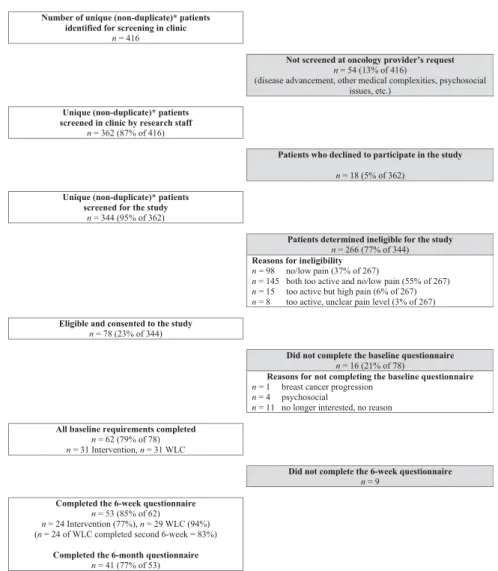
The total number of patients identified for screening was 416 (Fig. 1); this figure does not include multiple contacts with
Number of unique (non-duplicate)* patients identified for screening in clinic
n = 416
Not screened at oncology provider’s request
n = 54 (13% of 416)
(disease advancement, other medical complexities, psychosocial issues, etc.)
Unique (non-duplicate)* patients screened in clinic by research staff
n = 362 (87% of 416)
Patients who declined to participate in the study
n = 18 (5% of 362)
Unique (non-duplicate)* patients screened for the study
n = 344 (95% of 362)
Patients determined ineligible for the study
n = 266 (77% of 344)
Reasons for ineligibility
n = 98 no/low pain (37% of 267)
n = 145 both too active and no/low pain (55% of 267) n = 15 too active but high pain (6% of 267) n = 8 too active, unclear pain level (3% of 267)
Eligible and consented to the study
n = 78 (23% of 344)
Did not complete the baseline questionnaire
n = 16 (21% of 78)
Reasons for not completing the baseline questionnaire
n = 1 breast cancer progression n = 4 psychosocial
n = 11 no longer interested, no reason
All baseline requirements completed
n = 62 (79% of 78) n = 31 Intervention, n = 31 WLC
Did not complete the 6-week questionnaire
n = 9
Completed the 6-week questionnaire
n = 53 (85% of 62)
n = 24 Intervention (77%), n = 29 WLC (94%) (n = 24 of WLC completed second 6-week = 83%)
Completed the 6-month questionnaire
n = 41 (77% of 53)
Table 2.Baseline characteristics of Intervention and Wait List Control groups
Characteristic
Total n(%)
Intervention n(%)
Wait List Control
n(%) pvaluea
Demographics
Age at baseline, years 63.868.3 63.366.9 64.469.7 .59
Education,high school 14 (23%) 6 (19%) 8 (27%) .46
Body mass index,30 kg/m2 7 (11%) 3 (9%) 4 (13%) .95
White race 46 (74%) 23 (72%) 23 (77%) .67
General health .15
Excellent 2 (3%) 2 (7%) 0 (0%)
Very good 16 (27%) 6 (19%) 10 (35%)
Good 32 (53%) 16 (52%) 16 (55%)
Good-to-fair 1 (2%) 0 (0%) 1 (3%)
Fair 9 (15%) 7 (23%) 2 (7%)
Breast cancer clinical characteristics
Breast cancer stage .42
I 25 (40%) 10 (31%) 15 (50%)
II 20 (32%) 11 (34%) 9 (30%)
III 7 (11%) 5 (16%) 2 (7%)
IV 10 (16%) 6 (19%) 4 (13%)
Total years after diagnosis 2.862.5 2.762.9 2.862 .91
Radiation 43 (74%) 21 (70%) 22 (79%) .46
Chemotherapy 35 (65%) 18 (62%) 17 (68%) .65
Lumpectomy 31 (84%) 13 (72%) 18 (95%) .06
Mastectomy 24 (57%) 11 (52%) 13 (62%) .53
Ever taken tamoxifen 16 (29%) 11 (41%) 5 (17%) .05
Currently taking exemestane 12 (25%) 7 (30%) 5 (19%) .36
Currently taking anastrozole 27 (52%) 13 (54%) 14 (50%) .76
Currently taking Letrozole 30 (53%) 16 (53%) 14 (52%) .91
Hysterectomy 31 (50%) 14 (44%) 17 (57%) .31
Taking vitamin D supplement 47 (80%) 28 (90%) 19 (68%) .03
Forgetting/choosing not to take AI .04
Never forget 44 (79%) 25 (89%) 19 (68%)
Forget once a week 11 (20%) 2 (7%) 9 (32%)
Forget twice a week 1 (2%) 1 (4%) 0 (0%)
Never choose not to take AI 54 (100%) 27 (100%) 27 (100%) 1.0
Self-reported joint pain
WOMAC, paina 6.963.4 7.263.6 6.763.1 .50
WOMAC, stiffnessa 4.061.6 4.461.9 3.761.3 .07
WOMAC, difficultya 22.2610.6 24.6610.5 20.0610.4 .11
WOMAC, total scorea 33614.4 36.2614.9 30.5613.8 .17
Pain, VASa 5.262.3 5.362.5 5.162.0 .79
Fatigue, VASa 4.362.8 4.263.1 4.362.5 .94
Stiffness, VASa 4.962.4 4.862.5 4.962.4 .89
Pain points, totala 4.562.0 4.762.1 4.361.9 .45
Psychosocial measures
Pain ASEb 6.362.3 5.762.4 6.862.1 .06
Symptom ASEb 6.762.2 6.262.4 7.161.7 .10
OEEc 2.260.6 2.160.7 2.260.6 .73
SEPAd 2.660.9 2.560.8 2.660.9 .74
potential study participants. Of these patients, 54 were elimi-nated from further consideration based on oncology provider concerns—disease advancement, other medical complexities, or psychosocial issues on the day they were in clinic). Of the patients approached by research staff, 18 declined to be con-sidered for the study. Of the remaining 344 patients screened in person by research staff, 266 (77%) were determined ineli-gible for reasons of low/no pain and/or engagement in high lev-els of physical activity. This left 78 patients who were consented into the study, of which 62 (79% of 78) completed the baseline questionnaire—11 patients were no longer inter-ested in the study, 4 had psychosocial reasons (such as losing a job or taking care of an ailing husband), and 1 had cancer pro-gression. Thirty-one patients who completed the baseline ques-tionnaire were randomized to Intervention and 31 patients to WLC. Nine participants did not complete the 6-week question-naire, leaving 53 (85% of 62) for the ITT analysis—24 Interven-tion and 29 WLC. At 6-months postintervenInterven-tion, 41 (77% of 53) completed the 6-months questionnaire. No adverse events related to the intervention were reported.
Study Participants
An overview of baseline characteristics of Intervention and WLC groups is presented in Table 2. Self-assessed general health was rated very good/excellent by 30% of participants, while the remainder rated their general health as fair, good, and between fair and good. Participants averaged just under 3 years since breast cancer diagnosis. Average amount of time on AI was 1.7 years (SD 1.43), ranging from .17 to 7 years. Seventy-nine per-cent of participants reported “never” forgetting to take their AI therapy, 20% reported forgetting to take their AI about once a week, and 2% reported forgetting to take their AI twice a week. At baseline, significantly more Intervention participants than WLC participants had ever taken tamoxifen (p5.05), taken vita-min D supplement (p5.03), and never forgot to take their AI (p5.4).
At baseline, WOMAC scores (higher scores signifying greater pain) were moderate for Pain (6.9 on a scale of 0–20), mid-range for Stiffness (4.0 on a scale of 0–8), and moderate for Dif-ficulty with Activities of Daily Living (22.2 on a scale of 0–68).
Visual Analog Scales (range 0–10) were in the mid-range for Pain (5.2), Stiffness (4.9), and Fatigue (4.3). Mean number of pain points (identified on a graphic of a human) was 4.5 out of 10. Overall psychosocial quality of life as measured by FACT-G subscales (scale of 0–28, with higher scores signifying higher quality of life) was moderately high: Physical Well-Being (20.9), Social/Family Well-Being (21.2), Functional Well-Being (18.6), and Emotional Well-Being (18.9). Perceived helplessness in cop-ing with joint symptoms (RAI score, range 1–5, with higher scores indicating greater perceived helplessness) was moderate (2.3). Efficacy for self-management of arthritis symptoms (range 1–10, with higher scores signifying higher self-efficacy) was moderately high for ASE Pain (6.3) and ASE Symptoms (6.7). Outcome Expectations from Exercise (range 1–5, with lower scores signifying higher expectations) were positive (2.2), and Self-Efficacy for Physical Activity (range 1–5, with higher scores signifying higher confidence in being physically active) were mid-range (2.6). Average minutes walking per week was 35.5.
Intervention Impact at 6 Weeks
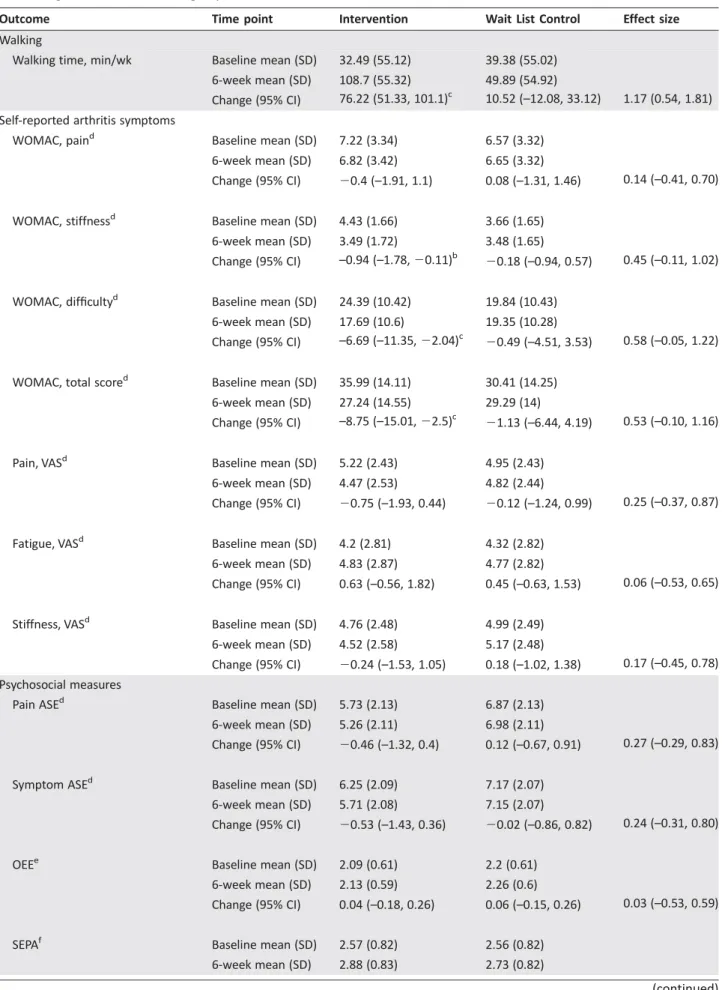
A summary of the mean change scores for Intervention and WLC groups between baseline and end-of-intervention (6 weeks) is presented in Table 3, adjusted for baseline age, BMI, race, education, and breast cancer stage. Measures indicating significant improvement in the Intervention group included increased walking minutes per week (p<.01) and improved WOMAC Stiffness core (p<.05), WOMAC Difficulty with Activities of Daily Living/ Function (p<.01), WOMAC Total score (p<.01), and RAI perceived helplessness score (p<.01). Cohen’s d effect sizes were large for walking minutes/week (d51.17) and medium or approaching medium for WOMAC Stiff-ness (d50.45), WOMAC Difficulty/Function (d50.58), WOMAC Total (d50.53), and RAI Score (d50.44). When the WLC group completed the walking intervention (after their wait period, at weeks 7 through 12), the beneficial effects of walking were similar to those observed in the Intervention group (weeks 1 through 6; data not presented).
Table 2.(continued)
Characteristic
Total n(%)
Intervention n(%)
Wait List Control
n(%) pvaluea
FACT-G, social/familye 21.265.9 21.066.1 21.565.7 .74
FACT-G, functionale 18.665.6 17.366.7 19.963.8 .07
FACT-G, emotionale 18.964.7 18.465.0 19.364.3 .46
RAI scoref 2.360.9 2.461.0 2.260.9 .39
Walking
Walking time, min/wk 35.5650.4 32.2649.7 39.0651.7 .61
Result of Student’sttest (continuous variables) or chi-square test (categorical variables) for determining if the Intervention and Wait List Control means are significantly different.
aHigher scores indicate greater symptom severity. b
Lower scores indicate lower self-efficacy in managing pain and symptoms.
cHigher scores indicate negative outcome expectations from exercise. d
Higher scores indicate higher confidence in being physically active.
e
Lower scores indicate worse well-being.
f
Higher scores indicate greater perceived helplessness.
Table 3.Covariate-adjustedameans (SD) for baseline and 6-week follow-up measures—postwalking for Intervention group, no walking for Wait List Control group
Outcome Time point Intervention Wait List Control Effect size
Walking
Walking time, min/wk Baseline mean (SD) 32.49 (55.12) 39.38 (55.02)
6-week mean (SD) 108.7 (55.32) 49.89 (54.92)
Change (95% CI) 76.22 (51.33, 101.1)c 10.52 (–12.08, 33.12) 1.17 (0.54, 1.81)
Self-reported arthritis symptoms
WOMAC, paind Baseline mean (SD) 7.22 (3.34) 6.57 (3.32)
6-week mean (SD) 6.82 (3.42) 6.65 (3.32)
Change (95% CI) 20.4 (–1.91, 1.1) 0.08 (–1.31, 1.46) 0.14 (–0.41, 0.70)
WOMAC, stiffnessd Baseline mean (SD) 4.43 (1.66) 3.66 (1.65)
6-week mean (SD) 3.49 (1.72) 3.48 (1.65)
Change (95% CI) –0.94 (–1.78,20.11)b 20.18 (–0.94, 0.57) 0.45 (–0.11, 1.02)
WOMAC, difficultyd Baseline mean (SD) 24.39 (10.42) 19.84 (10.43)
6-week mean (SD) 17.69 (10.6) 19.35 (10.28)
Change (95% CI) –6.69 (–11.35,22.04)c 20.49 (–4.51, 3.53) 0.58 (–0.05, 1.22)
WOMAC, total scored Baseline mean (SD) 35.99 (14.11) 30.41 (14.25)
6-week mean (SD) 27.24 (14.55) 29.29 (14)
Change (95% CI) –8.75 (–15.01,22.5)c 21.13 (–6.44, 4.19) 0.53 (–0.10, 1.16)
Pain, VASd Baseline mean (SD) 5.22 (2.43) 4.95 (2.43)
6-week mean (SD) 4.47 (2.53) 4.82 (2.44)
Change (95% CI) 20.75 (–1.93, 0.44) 20.12 (–1.24, 0.99) 0.25 (–0.37, 0.87)
Fatigue, VASd Baseline mean (SD) 4.2 (2.81) 4.32 (2.82)
6-week mean (SD) 4.83 (2.87) 4.77 (2.82)
Change (95% CI) 0.63 (–0.56, 1.82) 0.45 (–0.63, 1.53) 0.06 (–0.53, 0.65)
Stiffness, VASd Baseline mean (SD) 4.76 (2.48) 4.99 (2.49)
6-week mean (SD) 4.52 (2.58) 5.17 (2.48)
Change (95% CI) 20.24 (–1.53, 1.05) 0.18 (–1.02, 1.38) 0.17 (–0.45, 0.78) Psychosocial measures
Pain ASEd Baseline mean (SD) 5.73 (2.13) 6.87 (2.13)
6-week mean (SD) 5.26 (2.11) 6.98 (2.11)
Change (95% CI) 20.46 (–1.32, 0.4) 0.12 (–0.67, 0.91) 0.27 (–0.29, 0.83)
Symptom ASEd Baseline mean (SD) 6.25 (2.09) 7.17 (2.07)
6-week mean (SD) 5.71 (2.08) 7.15 (2.07)
Change (95% CI) 20.53 (–1.43, 0.36) 20.02 (–0.86, 0.82) 0.24 (–0.31, 0.80)
OEEe Baseline mean (SD) 2.09 (0.61) 2.2 (0.61)
6-week mean (SD) 2.13 (0.59) 2.26 (0.6)
Change (95% CI) 0.04 (–0.18, 0.26) 0.06 (–0.15, 0.26) 0.03 (–0.53, 0.59)
SEPAf Baseline mean (SD) 2.57 (0.82) 2.56 (0.82)
6-week mean (SD) 2.88 (0.83) 2.73 (0.82)
Six-Months Follow-Up
A summary of findings at 6-months follow-up is presented in Table 4. Total walking minutes per week decreased significantly from postintervention to 6-months follow-up (p<.01), illus-trating the challenge of sustaining behavioral interventions in the absence of continued active intervention. Rheumatology Attitudes Index perceived helplessness scores returned to base-line values (p<.01). However, improvements seen in WOMAC Stiffness, Difficulty/Function, and Total scores were largely maintained at 6 months, suggesting longer-lasting impact.
Satisfaction with WWE-BC
In response to the question “I benefitted from doing the WWE program,” all who responded (n536) said they agreed or strongly agreed with this statement, including participants in WLC after they had completed the walking intervention. There was similar agreement/strong agreement (100%) with the
statement “The WWE program motivated me to become more physically active” (n537) and with the statement “I would rec-ommend the WWE program to a friend or family member” (97%). Regarding the statement “I think the WWE program is an appropriate amount of time (6 weeks) to see benefits from the program”, 83% agreed/strongly agreed while 17% dis-agreed or strongly disdis-agreed (n531). Eighty-three percent thought the WWE workbook was very helpful or somewhat helpful with reaching their walking goals (n530).
DISCUSSION
We conducted a “proof of concept” study to evaluate the impact of an evidence-based self-directed walking program on joint symptoms in breast cancer survivors experiencing moderate to severe AIAA. Study participants significantly increased their walking minutes per week during the 6-week walking period, and walking was associated with significant improvements in
Table 3.(continued)
Outcome Time point Intervention Wait List Control Effect size
Change (95% CI) 0.3 (–0.09, 0.7) 0.17 (–0.19, 0.53) 0.16 (–0.41, 0.74)
FACT-G, physical well-beingg Baseline mean (SD) 20.9 (4.7) 20.73 (4.67)
6-week mean (SD) 21.26 (4.62) 21.06 (4.63)
Change (95% CI) 0.36 (–1.5, 2.22) 0.33 (–1.4, 2.06) 0.01 (–0.55, 0.56)
FACT-G, social/family well-beingg Baseline mean (SD) 21.14 (5.58) 21.48 (5.54)
6-week mean (SD) 20.64 (5.28) 21.89 (5.45)
Change (95% CI) 20.51 (–2.25, 1.24) 0.41 (–1.2, 2.02) 0.16 (–0.39, 0.72)
FACT-G, functional well-beingg Baseline mean (SD) 17.55 (5.51) 19.74 (5.47)
6-week mean (SD) 18.42 (5.13) 18.98 (5.37)
Change (95% CI) 0.87 (–0.65, 2.39) 20.76 (–2.15, 0.64) 0.29 (–0.27, 0.85)
FACT-G, emotional well-beingg Baseline mean (SD) 18.84 (4.21) 19.07 (4.18)
6-week mean (SD) 18.67 (4.05) 19.11 (4.14)
Change (95% CI) 20.17 (–1.72, 1.38) 0.05 (–1.36, 1.46) 0.05 (–0.51, 0.61)
FACT-G total scoreg Baseline mean (SD) 78.42 (15.34) 80.95 (15.24)
6-week mean (SD) 79.9 (14.36) 81.02 (15)
Change (95% CI) 1.48 (–3.32, 6.27) 0.07 (–4.28, 4.42) 0.09 (–0.47, 0.65)
RAI scoreh Baseline mean (SD) 2.34 (0.94) 2.16 (0.93)
6-week mean (SD) 1.92 (0.87) 2.15 (0.91)
Change (95% CI) –0.43 (–0.68,20.17)c 20.01 (–0.25, 0.23) 0.44 (–0.12, 1.00)
a
Adjusted for baseline age, BMI, race, education, and breast cancer stage.
bp<.05. c
p<.01.
dHigher scores indicate greater symptom severity.
Lower scores indicate lower self-efficacy in managing pain and symptoms.
e
Higher scores indicate negative outcome expectations from exercise.
fHigher scores indicate higher confidence in being physically active. g
Lower scores indicate worse well-being.
hHigher scores indicate greater perceived helplessness.
WOMAC Stiffness, Difficulty with Activities of Daily Living/ Function scales, WOMAC Total score, and perceived helplessness in managing their joint symptoms (RAI). When the 10 study par-ticipants with stage IV breast cancer were excluded from the analysis, the FACT-G measures showed even greater improve-ment for Intervention compared with WLC postintervention.
These findings are promising and warrant further explora-tion in a large-sample trial. Our findings corroborate those reported in an earlier pilot study of WWE-BC that assessed the feasibility of the home-based walking program in breast cancer survivors age 65 and older, which suggested intervention bene-fits for reducing joint stiffness [8]. At 6-months follow-up, the minutes/week that participants walked declined to preinterven-tion levels and a return to baseline values was seen for most psychosocial and efficacy measures. However, it is notable that WOMAC Stiffness, Difficulty/Function, and Total scores remained at the improved levels seen immediately postintervention.
Our findings join a small but growing number of studies eval-uating the potential benefits of physical activity in managing
AIAA. Of these studies, the largest to date, by Irwin and col-leagues, was a randomized controlled trial in breast cancer survi-vors reporting less than 90 minutes a week of aerobic exercise, no strength training, and scoring3 for worst joint pain (scale 0–10) [23, 24]. Participants in that study (n5121) were randomized to usual care or an exercise intervention that included twice-weekly supervised resistance training and home-based aerobic exercise, with increasing intensity over time. At end of intervention (12 months), the intervention group reported at 29% decrease in “worst” joint pain scores, while the usual care group reported a 3% increase (p<.001). Similarly, pain severity and pain interference scores declined significantly in the intervention compared with usual care group (p<.001). The authors did not find a dose-response effect of exercise; more exercise was not associated with greater improvement in joint symptoms. Other small scale studies of exercise to reduce AIAA have explored aquatic exercise [25], Nordic walking [26], and an 8-week home-based aerobic and resistance exercise pro-gram [27], and all have reported promising benefits. Recent meta-analyses of AIAA management interventions rated the
Table 4.Covariate-adjustedameans (SD) for postintervention to 6-month follow-up measures to assess whether outcomes seen postintervention were maintained at 6 months
Outcome
Mean (SD) at baseline
Mean (SD) at postintervention
Mean (SD) at 6 months
Mean change (95% CI) from postintervention to 6 months
Walking
Walking time, min/wk 36.29 (59.96) 101.14 (68.41) 66.15 (85.5) 234.99 (–58.86,211.12)b Self-reported arthritis symptoms
WOMAC, painc 6.92 (3.51) 6.09 (3.81) 6.76 (4.67) 0.67 (20.45, 1.78)
WOMAC, stiffnessc 4.07 (1.76) 3.12 (1.91) 3.27 (2.4) 0.14 (20.47, 0.75)
WOMAC, difficultyc 22.07 (10.57) 17.71 (11.63) 18.23 (14.61) 0.52 (23.46, 4.5)
WOMAC, total scorec 33.21 (14.86) 26.63 (15.89) 27.56 (19.81) 0.92 (24.43, 6.28)
Pain, VASc 5.14 (2.58) 4.33 (2.83) 4.49 (3.54) 0.16 (20.86, 1.18)
Fatigue, VASc 4.32 (3.02) 4.4 (3.35) 4.09 (3.88) 20.31 (21.28, 0.65)
Stiffness, VASc 4.85 (2.48) 4.33 (2.68) 4.32 (3.42) 20.01 (20.98, 0.96)
Psychosocial measures
Pain ASEd 6.31 (2.24) 5.99 (2.49) 6.53 (3) 0.53 (20.19, 1.26)
Symptom ASEd 6.72 (2.17) 6.28 (2.42) 6.64 (3.24) 0.36 (20.52, 1.24)
OEEe 2.15 (0.65) 2.15 (0.74) 2.08 (0.91) 20.07 (20.31, 0.16)
SEPAf 2.55 (0.89) 2.85 (0.88) 2.9 (1.19) 0.04 (20.26, 0.34)
FACT-G, physicalg 20.82 (4.87) 21.71 (5.42) 21.06 (6.46) 20.65 (22.18, 0.87)
FACT-G, social/familyg 21.23 (5.83) 20.84 (6.34) 20.86 (7.35) 0.01 (21.58, 1.61)
FACT-G, functionalg 18.59 (5.69) 18.96 (6.21) 19.42 (7.22) 0.46 (21.12, 2.04)
FACT-G, emotionalg 18.89 (4.43) 18.55 (5) 18.58 (5.99) 0.03 (21.45, 1.51)
FACT-G total scoreg 79.49 (16.17) 80.49 (17.79) 79.66 (20.66) 20.82 (25.48, 3.83)
RAI scoreh 2.26 (0.96) 1.95 (1.07) 2.29 (1.14) 0.34 (0.11, 0.56)b
aAdjusted for baseline age, BMI, race, education, and breast cancer stage. b
p<.01.
cHigher scores indicate greater symptom severity. d
Lower scores indicate lower self-efficacy in managing pain and symptoms.
eHigher scores indicate negative outcome expectations from exercise. f
Higher scores indicate higher confidence in being physically active.
g
Lower scores indicate worse well-being.
h
Higher scores indicate greater perceived helplessness.
overall evidence regarding exercise to reduce AIAA as moderate and that further studies are needed [6, 28].
A strength of our study is that, similar to the Irwin study [23, 24], it is focused specifically on women experiencing moderate to severe AIAA. This subset of breast cancer survivors is in great-est need of effective ways to manage their joint symptoms, because they are at risk of suboptimal adherence and discontin-uation and poor quality of life. A further strength is that we used a simple, scalable intervention that is evidence-based in reduc-ing arthritis and joint symptoms [7] and offers web-based sup-port for adults wanting to pursue a more active lifestyle (http:// www.arthritis.org/living-with-arthritis/tools-resources/walk-with-ease/) [13]. Our findings suggest that almost any level of increased physical activity may reduce AIAA and that home-based physical activity can be done at a time, place, and pace to accommodate the wide variety of lifestyles of breast cancer sur-vivors. And, while our study was focused on women with moder-ate to severe joint symptoms, survivors experiencing milder AIAA symptoms may experience similar benefits.
Our study has some limitations. We have noted earlier that there was some unintentional mis-randomization; however, sen-sitivity analysis did not change the overall results of our study. The findings were the same regardless of whether the analysis was according to original random assignment or mis-randomization. Our final sample is over-represented with women with more than a high school education; however, the proportion of nonwhite women (28% Intervention and 23% WLC) is representative of the racial mix of the state where the study was conducted. Recruitment was challenging in light of the dual requirements for moderate to severe joint symptoms and below guideline recommended levels of physical activity. As we screened survivors for study eligibility, many women reported high levels of exercise despite substantial joint pain. We did not collect information on the type or intensity of exer-cise that these women engaged in, only the number of minutes per week. As in all behavioral intervention studies, there is always the self-selection bias of women who are willing and able to participate in this type of study, which affects generalizability to the general population of female breast cancer survivors.
A second limitation was the shortness of our intervention period—6 weeks, as tested in the original WWE study [7]; a lon-ger intervention period may have produced stronlon-ger and more lasting benefits for reducing joint symptoms and deserves fur-ther investigation in a large sample trial. A future study might
also include intermittent contact with study participants to encourage their engagement in walking, such as contacts via telephone, text messages, or email. Further, although we screened for new or recently-intensified joint symptoms, we cannot rule out the possibility that some of the joint symptom improvements were at least partially for arthritis pain and stiff-ness, which are common in postmenopausal women.
CONCLUSION
Further studies are warranted; however, the combined evi-dence of diverse studies cited above suggests that physical activity can be offered to women on AI therapy as a safe alter-native or adjunct to medications for the management of AIAA. Guidelines in general recommend 150 minutes a week for adults diagnosed with cancer [12], and this level of physical activity could be an appropriate target for breast cancer survi-vors seeking to manage their AIAA. Our interviews with breast cancer survivors suggest that the message of exercise for the management of AIAA would be well-received at the time AI therapy is initiated, rather than waiting until joint symptoms have started or intensified [10]. The breast cancer diagnosis can present a “teachable moment” where patient-oncology pro-vider conversations about physical activity can focus on physical well-being and mental health as well as the potential for symp-tom self-management.
ACKNOWLEDGMENTS
We greatly appreciate and thank the oncology providers and breast cancer survivors for their participation and support for this study. This study was funded through a grant from the National Cancer Institute (1R21CA169492–01A).
AUTHORCONTRIBUTIONS
Conception/design: Kirsten A. Nyrop, Leigh F. Callahan, Hyman B. Muss
Provision of study material or patients: Kirsten A. Nyrop, Betsy S. Hackney
Collection and/or assembly of data: Kirsten A. Nyrop, Betsy S. Hackney
Data analysis and interpretation: Kirsten A. Nyrop, Rebecca J. Cleveland, Liubov L. Arbeeva
Manuscript writing: Kirsten A. Nyrop,
Final approval of manuscript: Kirsten A. Nyrop, Leigh F. Callahan, Rebecca J. Cleveland, Liubov L. Arbeeva, Hyman B. Muss
DISCLOSURES
The authors indicated no financial relationships.
REFERENCES
1.Burstein HJ, Griggs JJ, Prestrud AA et al. Ameri-can Society of Clinical Oncology clinical practice guideline update on adjuvant endocrine therapy for women with hormone receptor-positive breast can-cer. J Oncol Pract 2010;6:243–246.
2.Taylor WC, Muss HB. Recent advances: Adjuvant therapy for older women with breast cancer. Cancer J 2010;16:289–293.
3.Beckwee D, Leysen L, Meuwis K et al. Prevalence of aromatase inhibitor-induced arthralgia in breast cancer: A systematic review and meta-analysis. Sup-port Care Cancer 2017;25:1673–1686.
4.Crew KD, Greenlee H, Capodice J et al. Preva-lence of joint symptoms in postmenopausal women taking aromatase inhibitors for early-stage breast cancer. J Clin Oncol 2007;25:3877–3883.
5.Dent SF, Gaspo R, Kissner M et al. Aromatase inhibitor therapy: Toxicities and management strat-egies in the treatment of postmenopausal women with hormone-sensitive early breast cancer. Breast Cancer Res Treat 2011;126:295–310.
6.Roberts K, Rickett K, Greer R et al. Management of aromatase inhibitor induced musculoskeletal symptoms in postmenopausal early breast cancer: A systematic review and meta-analysis. Crit Rev Oncol Hematol 2017;111:66–80.
7.Callahan LF, Shreffler JH, Altpeter M et al. Evalua-tion of group and self-directed formats of the Arthri-tis Foundation’s Walk with Ease program. Arth Care Res 2011;63:1098–1107.
8.Nyrop KA, Muss HB, Hackney B et al. Feasibility and promise of a 6-week program to encourage
physical activity and reduce joint symptoms among elderly breast cancer survivors on aromatase inhibi-tor therapy. J Geriatr Oncol 2014;5:148–155.
9.Nyrop KA, Callahan LF, Rini C et al. Adaptation of an evidence-based arthritis program for breast can-cer survivors on aromatase inhibitor therapy who experience joint pain. Prev Chronic Dis 2015;12:E91.
10.Nyrop KA, Callahan LF, Rini C et al. Aromatase inhibitor associated arthralgia: The importance of oncology provider-patient communication about side effects and potential management through physical activity. Support Care Cancer 2016;24: 2643–2650.
adult self-reported health outcome item banks: 2005–2008. J Clin Epidemiol 2010;63:1179–1194.
12.Kushi LH, Doyle C, McCullough M et al. Ameri-can Cancer Society guidelines on nutrition and physi-cal activity for cancer prevention: Reducing the risk of cancer with healthy food choices and physical activity. CA Cancer J Clin 2012;62:30–67.
13.Arthritis Foundation. Walk with Ease: Your Guide to Walking for Better Health, Improved Fit-ness and Less Pain (Third Edition). Atlanta, GA: Arthritis Foundation, 2010.
14.Carlsson AM. Assessment of chronic pain. I. Aspects of the reliability and validity of the visual analogue scale. Pain 1983;16:87–101.
15.Bellamy N, Buchanan WW, Goldsmith CH et al. Validation study of WOMAC: A health status instru-ment for measuring clinically-important patient rele-vant outcomes following total hip or knee arthroplasty in osteoarthritis. J Orthoped Rheumatol 1988;1:95–108.
16.Cella DF, Tulsky DS, Gray G et al. The Functional Assessment of Cancer Therapy scale: Development and validation of the general measure. J Clin Oncol 1993;11:570–579.
17.DeVellis RF, Callahan LF. A brief measure of helplessness in rheumatic disease: The helplessness
subscale of the Rheumatology Attitudes Index. J Rheumatol 1993;20:866–869.
18.Brady TJ. Measures of self-efficacy, helpless-ness, mastery, and control: The Arthritis Helpless-ness Index (AHI)/Rheumatology Attitudes Index (RAI), Arthritis Self-Efficacy Scale (ASES), Children’s Arthritis Efficacy Scale (CASE), Generalized Self-Efficacy Scale (GSES), Mastery Scale, Multi-Dimensional Health Locus of Control Scale (MHLC), Parent’s Arthritis Self-Efficacy Scale (PASE), Rheu-matoid Arthritis Efficacy Scale (RASE), and Self-Efficacy Scale (SES). Arthritis Care Res 2003;49: S147–S164.
19.Resnick B, Zimmerman SI, Orwig D et al. Out-come expectations for exercise scale: Utility and psy-chometrics. J Gerontol B Psychol Sci Soc Sci 2000;55: S352–S356.
20.Marcus BH, Selby VC, Niaura RS et al. Self-effi-cacy and the stages of exercise behavior change. Res Q Exerc Sport 1992;63:60–66.
21.Cohen J. Statistical power analysis for the behav-ioral sciences. New York: Academic Press, 1977.
22.Ader R, Cohen N, Felten DL. Brain, behavior, and immunity. Brain Behav Immun 1987;1:1–6.
23.Irwin ML, Cartmel B, Gross CP et al. Random-ized exercise trial of aromatase inhibitor-induced
arthralgia in breast cancer survivors. J Clin Oncol 2014 [Epub ahead of print].
24.Arem H, Sorkin M, Cartmel B et al. Exercise adherence in a randomized trial of exercise on aro-matase inhibitor arthralgias in breast cancer survi-vors: The Hormones and Physical Exercise (HOPE) study. J Cancer Surviv 2016;10:654–662.
25.Cantarero-Villanueva I, Fernandez-Lao C, Caro-Moran E et al. Aquatic exercise in a chest-high pool for hormone therapy-induced arthralgia in breast cancer survivors: A pragmatic controlled trial. Clin Rehab 2013;27:123–132.
26.Fields J, Richardson A, Hopkinson J et al. Nordic walking as an exercise intervention to reduce pain in women with aromatase inhibitor-associated arthral-gia: A feasibility study. J Pain Symptom Manage 2016;52:548–559.
27.DeNysschen CA, Burton H, Ademuyiwa F et al. Exercise intervention in breast cancer patients with aromatase inhibitor-associated arthralgia: A pilot study. Eur J Cancer Care 2014;23:493–501.
28.Yang GS, Kim HJ, Griffith KA et al. Interventions for the treatment of aromatase inhibitor-associated arthralgia in breast cancer survivors: A systematic review and meta-analysis. Cancer Nurs 2016;40:E26– E41.