ORIGINAL RESEARCH ARTICLE
Received 7 May 2012, accepted after revision 24 October 2012 © 2013, Forest Research Institute
Stand damage when harvesting timber using a tractor for extraction
Zbigniew Karaszewski*, Dieter F. Giefing2, Piotr S. Mederski2, Mariusz Bembenek2, Anita Dobek3, Anastasia Stergiadou4
1 Wood Technology Institute, Wood Science and Application Department, Winiarska 1, 60-654 Poznań, Poland; 2 Poznań University of Life Sciences, Department of Forest Utilisation, Wojska Polskiego 71a, 60 - 625 Poznań, Poland; 3 Poznań University of Life Sciences, Department of Mathematical and Statistical Methods, Wojska Polskiego 28, 60-637 Poznań, Poland;
4 Aristotle University of Thessaloniki, Institute of Mechanical Science and Topography, 54124, Thessaloniki, Greece. *Tel. +48 61 849 24 12; email [email protected]
Abstract. Damage to the remaining stand is an unavoidable consequence of thinning operations. The different ma-chines used for timber extraction differ in the level of damage of trees they cause, mainly through wounds to the bark and cambium which can make a substantial impact on the remaining trees. Three different methods of timber harvest-ing with a chainsaw were analyzed: the short wood system (SWS), the long wood system (LWS) and the full tree system (FTS) in which an agricultural tractor is used for timber extracting. All systems were analyzed in stands con-taining three different age classes: 2nd (21–40 years), 3rd (41-60 years) and 4th (61–80 years). The level of damage to the
remaining stand was assessed considering the percentage of trees exhibiting wounds (scratched bark and/or damage to the cambium) to calculate an index of stand damage (WDI) which incorporated the volume of harvested timber per hectare. The SWS produced the lowest damage to trees in stands of all age classes: average 5%, with the less damage in the oldest stand. After using the LWS, 9% of trees were wounded; in this method there was no statistical difference in frequency of wounding across all the analyzed stands. The highest level of damage was incurred after the FTS, causing 11% of trees to be injured. In stands of the 2nd age class, the method of timber harvesting had no statistically
significant effect on the amount of wounding endured. The WDI was lowest in SWS: 0.08, higher in LWS: 0.15 and the highest, 0.23, when FTS was applied.
Key words: tree damage, Scots pine stands, forest operations, timber harvesting methods, extraction by tractor
1. Introduction
Modern timber harvesting technologies are based on the use of multifunctional harvesting machines, with a number of advantages in the fields of ergonom-ics, economics and environmental protection of the forest. Various authors estimate that there are no more than 200 such machines currently operating in Poland (Skarżynski and Brzózko 2010), harvesting no more than about 4 million m3 of wood. There has been a
sig-nificant increase in the number of forwarding machines (forwarders with trailers attached to agricultural trac-tors) being used. In the process of machine harvesting,
chainsaws continue to be used (midfield method), help-ing to increase efficiency and reduce costs (Mederski 2006). In terms of pine tree harvesting in the country, the agricultural tractor is most commonly used, adapt-ed to forestry work by aggregating various processors (Athanassiadis 1997; Stańczykiewicz et al. 2011) or self-loading trailers for extraction. In this study, the ag-ricultural tractor was used to perform both skidding for processes based on the long wood system and full tree system, as well as for forwarding in the short wood sys-tem with a trailer attached to the tractor.
The hypothesis proposed is that the size of the har-vested timber when thinning stands significantly affect
the amount of damage to the remaining trees – the longer and wider the assortments, the greater the probability of damage. This is especially true when the logged wood has to be transported by performing a large number of turns in dense tree stands.
2. Research subject
The study was conducted in the Toruń Regional Directorate of the State Forests National Forest Holding, the Zamrzenica Forest District and Lnianek Forest in pine stands of 2nd, 3rd and 4th age classes while
perform-ing early (II age class) and late (III and IV age classes) thinning.
Logging was carried out in all study plots using manual-machine technology with tractor extraction us-ing the followus-ing three methods:
1) short wood system:
phase: chainsaw tree felling, stump debarking, de-limbing with an axe, or a chainsaw in older age classes, bucking stems at the stump with a chainsaw,
phase: forwarding with an Ursus C-360 agricultural tractor and trailer, stacking log piles at road side;
2) long wood system:
phase: chainsaw tree felling, stump debarking, de-limbing with a chainsaw,
phase: whole log hauling using the Ursus C-360 ag-ricultural tractor - hauling, bucking, stacking log piles at road side;
3) full tree system:
phase: chainsaw tree felling, stump debarking, phase: skidding the trees using an agricultural trac-tor,
phase: delimbing and bucking with a chainsaw, stacking at road side.
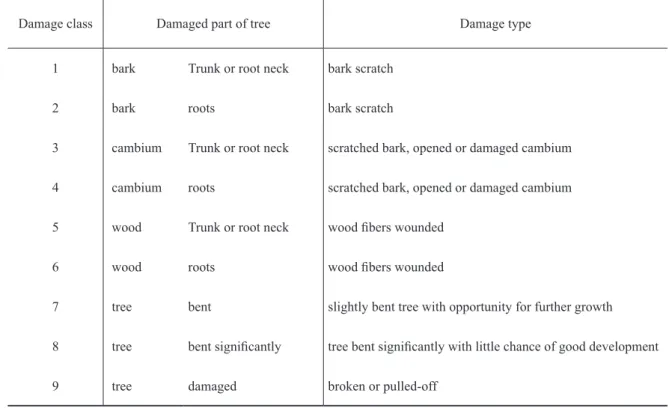
During the development of methods to assess dam-age to trees and soil, the experiences of researchers in the Department of Forest Utilisation of Poznań University of Life Sciences were used, as well as the American concepts of conducting research in this field (Meyeretal., 1966). Sample plots of 50 × 50 m (0.25 ha) were estab-lished. Logging was carried out in plots slightly larger than the study area, surrounded by a buffer zone of sev-eral meters to prevent the distortion of study results from the logging methods used in adjacent sites. Four meter wide skidding trails were located at 30-35 m intervals. They were laid out through the middle of the plots and between them. The stand was assessed before and after logging. The number of damaged and destroyed trees was specified, indicating the location of the damage and depth of the wounds (bark scratches, cambium damage and damage to wood fibers). The damage was
catego-rized according to the respective classes (tab. 1), which allowed the percentage of damaged trees and a weighted coefficient of tree damage (W) to be calculated,
W=
I
,
×
R
N
9
R=1
where I is the number of damaged trees in the study plot, R the tree damage class, and N the total number of trees in the study plot after thinning.
When more than one damage class was identified on one tree, the more serious damage was recorded. In or-der to take into account the volume of harvested wood the weighted stand damage index (WDI) was calculated – as proposed by Meyeretal (1966), and popularized in Poland by Sosnowski (1999),
WDI =
×1000,
I
×R
N
×C
9 R=1where I is the number of trees with damage in a giv-en damage class in 0.25 hectares of the remaining tree stand, R is the numerical value of the damage class number, N is the number of remaining trees in 0.25 hec-tares, and C is the number of harvested wood from 0.25 ha area.
The standard deviation was calculated for each log-ging method for the weighted coefficient of tree damage and the weighted index of damage to the remaining trees in the stand.
Using the Chi-square test, the frequency of dam-age observed among the different logging methods was compared. The same test was used to compare the dif-ferences in the frequency of damaged wood using the same logging method in stands of different age classes.
3. Results
Damaged trees were observed for all logging meth-ods and in all age classes. Damage occurred on all parts of the trees. During the study, damage was observed in the tree crowns, on trunks, and the roots of the remain-ing trees (fig. 1). Broken limbs and smaller branches were damaged in tree crowns. One tree in IV age class was damaged due to having been significantly bent.
Tree trunks were found to be frequently damaged. As many as 58.6% of all the damage was due to bark scratches on the trunk. A relatively frequent type of
damage, with 24.3% of occurrences, was the open cam-bium on tree trunks. Roots were also observed to be damaged, with wounds of varying depths, which were also noted on the stem surface.
The depth of a wound is critical for predicting the prognosis of the damaged trees because the extensive exposure of wood fiber contributes to a high risk of in-fection by pathogenic fungi. In this study, the wood fib-ers of tree trunks were damaged 33 times, representing 12.5% of all observations.
Although the most intensive thinning occurred in III age class stands, most tree damage was observed in the youngest age class stands studied. As the number of trees growing in a test plot decreases, so does the number of damaged trees (tab. 2). In II age class plots, with 621 trees remaining in the test sites, trees were damaged on average 53 times for all three studied harvesting sys-tems. Significantly fewer trees were damaged in III class age stands, where with 370 trees remaining, dam-age was sustained approx. 26 times. The least amount of Table 1. Tree damage classes
Damage class Damaged part of tree Damage type
1 bark Trunk or root neck bark scratch
2 bark roots bark scratch
3 cambium Trunk or root neck scratched bark, opened or damaged cambium 4 cambium roots scratched bark, opened or damaged cambium 5 wood Trunk or root neck wood fibers wounded
6 wood roots wood fibers wounded
7 tree bent slightly bent tree with opportunity for further growth 8 tree bent significantly tree bent significantly with little chance of good development
9 tree damaged broken or pulled-off
154
7 64
4
33 1
bark scratch – trunk bark scratch – roots opened cambium – trunk
wood fibers wounded – trunk tree bent slightly
opened cambium – roots
Figure 1. Number of trees with damage in all analyzed stands
Table 2. Tree damage in the analyzed forest operations
Age class
of stand Damage characteristics
Method of timber harvesting
p (χ2)
SWS LWS FTS mean
II Number of trees with damage 40 61 59 53,3 0,119
Number of remaining trees (including trees with
damage) 602 636 626 621,3
-Ratio of trees with damage to number of remaining
trees (%) 6,6 9,6 9,4 8,6
-III Number of trees with damage 14 29 34 25,7 0
Number of remaining trees (including trees with
damage) 472 373 265 370
-Ratio of trees with damage to number of remaining
trees (%) 3,0 7,8 12,8 7,9
-IV Number of trees with damage 2 6 18 8,7 0
Number of remaining trees (including trees with
damage) 108 103 97 102,7
-Ratio of trees with damage to number of remaining
trees (%) 1,9 5,8 18,6 8,7
-p (χ2) 0,001 0,322 0,004
-All
stands Number of trees with damage 56 96 111 87,7
All remaining trees 1182 1112 988 1094
Ratio of trees with damage to number of remaining trees
(%) 4,7 8,6 11,2 8,2
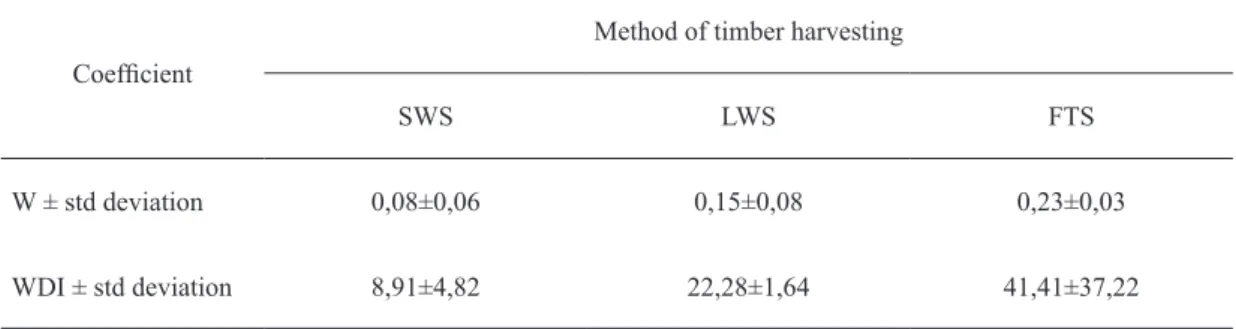
Table 3. Weighted stand damage coefficient W and weighted stand damage index WDI values after using different methods of timber harvesting
Coefficient
Method of timber harvesting
SWS LWS FTS
W ± std deviation 0,08±0,06 0,15±0,08 0,23±0,03
damage noted after harvesting was in the oldest studied age class, with an average of less than 9 times with 103 trees remaining in the study plots.
The percentage of damaged trees by harvesting sys-tem was assessed in relation to the number of trees re-maining in the study plots after harvesting and extract-ing. The smallest proportion of damage occurred with the short wood system. The share of damage with the long wood system was 8.6% and, therefore, was similar to the average of 8.2% for all three methods. The full tree system caused the greatest damage, with as many as 11.2% of all remaining trees sustaining damage.
The probability of causing damage presented in ta-ble 2 indicates a highly significant difference between the values obtained for III and IV age classes (p<0.01). There were no differences found between the frequen-cies of damage for II age class (p = 0.119). The values obtained with regard to the probability of damage oc-curring while using the same harvesting system but in different age class stands indicates a highly significant difference in the case of using the short wood system and full tree system: p = 0.001 and p = 0.004, respec-tively. However, no significant difference was found in the frequency of tree damage among different age class-es when using the long wood system (p = 0.322).
The effect of the harvesting systems tested while us-ing an agricultural tractor for skiddus-ing was expressed by a weighted coefficient of tree damage W. The higher the value of W, the stronger the negative effect of the sys-tem. The lowest coefficient values W were for the short wood system (W = 0.08), medium values for the long wood system (W = 0.15), and the highest (W = 0.23) for the full tree system (tab. 3).
Similar results were found in the case of the index of tree damage to the remaining trees in the stand (WDI), where the harvesting system and intensity of mainte-nance activities - early and late thinning - can be verified because the formula takes the harvested volume into ac-count (tab. 3). Even though tree stands may be of equal age and form one division, they often differ in terms of stand density and tending needs. For this reason, more intensive cutting may be needed in some parts of the stand than in others.
WDI values vary depending on the logging methods used. In all three tree stand age classes, the short wood system had the smallest negative effect on the remaining trees. The long wood system resulted in tree stand dam-age at a WDI level of 22.28. The full tree method caused the most damage in terms of wounds and the amount of wood obtained. The WDI index in this case was 41.41, differing significantly from the values obtained with the remaining harvesting systems.
4. Diuscussion
Comparing the results of tree damage presents some methodological difficulties (Giefing 1995, 1999; Sowa et al. 2008). The existing systems of classifying tree dam-age differ both in terms of registering damdam-age on differ-ent areas of the tree (root, neck and trunk, and crown), as well as due to their cumbersome use and applied co-efficients (Giefing 1997; Suwała 2000; Gil 1999, 2000; Karaszewski 2004, Stańczykiewicz 2011). The least dif-ficult is to compare the percentage of damaged trees in the remaining stand. In Zastocki (2003 a, b), in uncut stands where the assortment system (using short wood) of logging takes place, the share of damaged trees was on average 11.8%, whereas the long wood system dam-aged an average of 13.5% of trees. These figures are significantly higher than those obtained by the authors of this study (4.7% for the short wood system and 8.6% for the long wood system). However, Giefing (1994), in examining II age class tree stand damage after skid-ding with an agricultural tractor, found that only 2.2% of the remaining trees were damaged. The reasons for these differences may depend on such factors as em-ployers’ skills, the season of the timber harvest, as well as the skidding equipment used. In their summary of 10 years of studies at different research centers, Sowa and Stańczykiewicz (2007) present a wide variety of results obtained on the extent of tree stand damage and aged saplings. These authors report levels of tree dam-age varying from 0.8% to more than 85.0%.
The available research results show that an impor-tant factor influencing the degree of tree damage is the length of the harvested assortment. According to Erler (2005), the average ratio of damage for harvesting short wood, logs (up to 2.5 m) and the entire trunk is respec-tively 1: 2: 5. This means that it is better for the stands to process the wood on site and in the shortest possible assortments (Erler 2005). This study also showed the least damage (4.7%) occurring with the short wood sys-tem. Assuming this level of damage at 1, the long wood system achieved 2 (8.6%), and the full tree system 2.5 (11.2%). In Stańczykiewicz’s study (2003), damage to trees using the assortment method (short wood) is also smaller than with the long wood system.
These results are consistent with the views of most scientists. Paschal (1999) assesses the long wood system as practically non-recommendable because of issues re-lated to protection of the forest environment, whereas the assortment system offers the greatest protection to forest ecosystems. Suwała (1996) postulated the gradual elimination of dragging and skidding by tractors. The research of Grodecki and Stempski (2005) confirmed that most of the trees are damaged with the use of a
trac-tor for hauling, especially when an agricultural tractrac-tor is used in tree stands with no access to the network of logging roads.
The full tree method proved to contribute to the greatest amount of disturbance to the remaining stand. This method is the most disadvantageous not only be-cause of environmental protection requirements, but also due to the cost of harvesting (Porter, 1998). This is consistent with the position of Barzdajna et al. (1997), who state that the less valuable wood and tree remains should be left in the forest according to forest protection requirements. A similar opinion on the full tree system was voiced by Pilarek and others (2005).
The statistical analysis of the research presented here produced interesting results:
No differences were obtained in the incidence of damage to II age class stands regardless of the logging system used.
No significant differences were found in the fre-quency of tree stand damage using the long wood sys-tem among the different age classes of stands.
In the first case, the tree density of II age class stands was so high that numerous collisions occurred between the harvested and extracted assortments and remaining trees, regardless of the logging system used. Additionally, the tree stand was still in the early stages of development, so that the harvested trees were much smaller in size than in the older age classes (classes III and IV), therefore the differences in the lengths of short and long assortments were smaller. Regardless of the logging system used, a similar level of damage was ob-served (8.6%) in the youngest age class stands.
In the latter case, tree density was also the decisive factor for the remaining trees in the stand. It should be noted that this phenomenon (lack of difference in the frequency of damage in stands of different age classes) occurred regardless of the fact that long assortments in IV age class tree stands were approx. two times longer than the long assortments in II age class stands. Using the long wood system in stands of different age classes caused damage at a similar level (8.6%).
In the remaining cases, statistically significant dif-ferences were found in the frequency of damage. The short wood system achieved the best results in the oldest IV age class (contributing to the smallest number of de-fects). Meanwhile, the full tree system caused progres-sively more damage with the increasing stand age. This is indicated by the ratio of the number of damaged trees to the number of remaining trees (tab. 2).
Using various factors to assess the impact of a given harvesting system on the forest environment has both positive and negative consequences. Using the W co-efficient and WDI index allows us to assess the
stud-ied harvesting technologies also in terms of the dam-age resulting to trees, and to take other factors into account, such as the volume of wood obtained from the harvested stands. The literature, however, presents yet other factors for tree, tree stand, and sapling dam-age (Stańczykiewicz 2003, 2006, 2011). The different methodologies make it difficult to compare research re-sults, often only allowing for the observation of trends exhibited by the different technological processes. We agree with the constative statement expressed by Sowa and Stańczykiewicz (2007), of the necessity to develop a universal methodology to assess the damage resulting from logging in the forest environment.
5. Conclusion
The smallest damage to tree stands in all age classes were observed when using the short wood system. At the same time, this method resulted in the lowest fre-quency of damage in the oldest age class studied.
The lowest level of damage occurred with the use of the short wood system, which is exhibited by the per-centage of damaged trees (5%), the value of W = 0.08 and the WDI value= 8.91.
Applying the long wood system caused a similar level of damage (9%) in all age class stands analyzed. The W coefficient with the long wood system was high-er than the short wood system, resulting in a value of 0.15 and a WDI value of 22.28.
The full tree logging system caused the highest inci-dence of damage to the remaining trees: 11%. The value of the W coefficient, also the highest in the full tree sys-tem at 0.23, indicates a higher level of damage to trees than the rate expressed as a percentage. The WDI value for this method was 41.41.
The statistical analysis showed no effect of the har-vesting system on the level of damage to trees in II age class, but the systems used had an impact on III and IV age class stands.
There were no statistically significant differences in the level of damage to trees in the age classes analyzed using the long wood system.
References
Athanassiadis D. 1997. Residual stand damage following cut-to-length harvesting operations with a farm tractor in two conifer stands. Silva Fennica, 31(4): 461-67.
Barzdajn W., Ceitel J., Zientarski J. 1997. Wyróżniki leśnictwa wykorzystującego i chroniącego przyrodę. Sylwan, 4: 119-127.
Erler J. 2005. Was kostet die Rückegasse. AFZ-der Wald, 6: 297-301.
Giefing D.F. 1990. Wpływ technologii pozyskiwania i trans-portu drewna w cięciach przedrębnych na szkody i jakość techniczną pozostających drzewostanów sosnowych, w: Reakcja ekosystemów leśnych i ich elementów składowych na antropopresję. Centralny Program Badań Podstawowych 04.10 Podprogram CPBP 04.10.07. Synteza II, 24: 77-85.
Giefing D. F. 1994. Ciągniki rolnicze w procesie pozyskiwania drewna. Przegląd Techniki Rolniczej i Leśnej, 10: 22-23. Giefing D. F. 1995. Wpływ pozyskiwania drewna w
czyszcze-niach późnych drzewostanów sosnowych na środowisko. Część 1. Uszkodzenia drzew. Sylwan, 6: 55-62.
Giefing D. F. 1997: Untersuchungen von technologischen-Prozessen der Holzgewinnung im Pflegehieben (DiemethodologischenFragen der Untersuchungen), in: Technológiaspracovaniadreva a využitiedreva v kom-plexnominteriéri, (red. D. Horský). Technická Univer-zitavo Zvolene, Zvolen: 213-218.
Giefing D. F. 1999. Kryteria oceny i doboru procesów techno-logicznych w leśnictwie, in: Tendencje i problemy mecha-nizacji prac leśnych w warunkach leśnictwa wielofunk-cyjnego (red. H. Różański). Poznań, Prodruk: 17-24. Gil W. 1999. Problem wyboru środków do operacji
pozyskaniowo-zrywkowych. Sylwan, 6: 47-60.
Gil W. 2000. Naziemna zrywka drewna skiderami w ujęciu kodeksu praktyk pozyskaniowych. Sylwan, 1: 59-74. Grodecki J., Stempski W. 2005. Wpływ technologii na
pozi-om uszkodzeń środowiska leśnego podczas pozyskiwan-ia drewna z cięć trzebieżowych, in: Użytkowanie lasu a trwały i zrównoważony rozwój leśnictwa (red. D.F. Giefing, M. Bembenek). Poznań, Akademia Rolnicza: 132–136.
Karaszewski Z. 2004. Optymalizacja procesów technolog-icznych pozyskiwania sosny w cięciach przedrębnych pod kątem ochrony środowiska leśnego. Maszynopis. KatedraUżytkowaniaLasu AR, Poznań.
Mederski P.S. 2006. A comparison of harvesting productiv-ity and costs in thinning operations with and without mid-field. Forest Ecology and Management, 224: 286-296. Meyer G., Ohman J.H., Oettel, R. 1966. Skidding hardwoods.
Articulated rubber-tyred skidders vs. crawler tractors.
Journal of Forestry, 64: 194-196.
Paschalis P. 1999. Wpływ technologii użytkowania lasu (trzebieży i cięć rębnych) na różnorodność biologiczną lasów produkcyjnych w Polsce, w: Ocena wpływu praktyki leśnej na różnorodność biologiczną w lasach w Europie Środkowej (red. K. Rykowski, G. Matuszewski,
E. Lenart). Studium w zakresie polskiej Ustawy o la-sach i innych przepisów prawnych. Warszawa, Instytut Badawczy Leśnictwa: 137-155.
Pilarek Z., Gornowicz R., Gałązka S. 2005. Badania nad sposobami utylizacji pozostałości pozrębowych w drze-wostanach sosnowych, in: Użytkowanie lasu a trwały i zrównoważony rozwój leśnictwa (red. D.F Giefing, M. Bembenek). Poznań, Akademia Rolnicza,: 84-85. Porter B. 1998. Pozyskanie i zrywka drewna wobec
zrównoważonej, wielofunkcyjnej gospodarki leśnej, in: Użytkowanie lasu i problemy regulacji użytkowania lasu w Polsce (red. P. Paschalis). Warszawa, Fundacja „Rozwój SGGW”: 64-67.
Skarżyński, J., Brzózko, J. 2010. Harwestery do pozyski-wania drewna stosowane w polskich lasach. Cz. 1. Charakterystyka ogólna – nośniki. Technika Rolnicza Ogrodnicza Leśna, 6. http://www.pimr.poznan.pl/ trol6_2010/JSJB6_2010.pdf [23.05.2012].
Sosnowski J. 1999. Problem oceny szkód wyrządzanych przy zrywce drewna. Sylwan, 7: 33-43.
Sowa J.M., Stańczykiewicz A. 2007. Uszkodzenia drzew i odnowienia przy pozyskaniu i zrywce drewna ciągnikami rolniczymi, in: Technika i technologia w leśnictwie pol-skim (red. W. Zychowicz, M. Aniszewska, K. Wójcik). Warszawa, Wydawnictwo SGGW. Warszawa: 89-94. Sowa J.M., Kulak D., Leszczyński K., Stańczykiewicz A.,
Szewczyk G. 2008. The level of environmental damage from timber harvesting depending on skidding methods, in: 41st International Symposium on Forestry Mechanization. Formec 2008 (ed. KWF). Schmallenberg: 101-110. Stańczykiewicz A. 2003. Wpływ wybranych technologii
pozyskiwania drewna na rodzaj i wielkość szkód w drzewostanie. Maszynopis. Katedra Użytkowania Lasu i Drewna AR, Kraków.
Stańczykiewicz A. 2006. Poziom uszkodzeń odnowienia w wyniku stosowania ręczno-maszynowych technologii pozyskiwania drewna. Acta Agraria et Silvestria. Series Silvestria, 44: 91-116.
Stańczykiewicz A., Sowa J.M., Szewczyk G. 2011. Uszkodzenia drzew i odnowienia w wyniku ręczno-maszynowego pozyskiwania drewna z wykorzystaniem urządzeń agregowanych z ciągnikami rolniczymi. Sylwan, 2: 129-137.
Suwała M. 1996. Pozyskiwanie drewna metodą sortymentową.
Prace Instytutu Badawczego Lesnictwa, Seria B, 30: 63-76.
Suwała M. 2000. Próba syntetycznej oceny uszkodzeń drzew i gleby przy pozyskiwaniu drewna na przykładzie późnych trzebieży drzewostanów sosnowych. Sylwan, 10: 29-38. Zastocki D. 2003a. Wpływ zastosowanych technologii
pozyskiwania drewna przez Zakłady Usług Leśnych na obecną i przyszłą jakość techniczną drzewostanów przedrębnych. Sylwan,3: 28-34.
Zastocki D. 2003b. Wpływ stosowanych przez Zakłady Usług Leśnych środków zrywkowych na uszkodzenia gleby i pozostających drzew w sosnowych drzewostanach przedrębnych. Sylwan, 4: 53-58.