Model Checking Trust-based Multi-Agent Systems
Nagat Drawel
A Thesis In
The Concordia Institute for
Information Systems Engineering
Presented in Partial Fulfillment of the Requirements for the Degree of
Doctor of Philosophy (Information Systems Engineering) at Concordia University
Montréal, Québec, Canada
December, 2019
c
CONCORDIA UNIVERSITY SCHOOL OF GRADUATE STUDIES
This is to certify that the thesis prepared
By: Nagat Drawel
Entitled: Model Checking Trust-based Multi-Agent Systems
and submitted in partial fulfillment of the requirements for the degree of Doctor Of Philosophy (Information Systems Engineering)
complies with the regulations of the University and meets the accepted standards with respect to originality and quality.
Signed by the final examining committee:
Chair Dr. S. Samuel Li External Examiner Dr. Nadia Tawbi External to Program Dr. Emad Shihab Examiner Dr. Rachida Dssouli Examiner Dr. Roch Glitho Thesis Supervisor Dr. Jamal Bentahar Approved by Dr. Mohammad Mannan, Graduate Program Director
February 10, 2020
Dr. Amir Asif, Dean
ABSTRACT
Model Checking Trust-based Multi-Agent Systems
Nagat Drawel, Ph.D. Concordia University, 2019
Trust has been the focus of many research projects, both theoretical and practical, in the recent years, particularly in domains where open multi-agent technologies are applied (e.g., Internet-based markets, Information retrieval, etc.). The importance of trust in such domains arises mainly because it provides a social control that regulates the relationships and interactions among agents. Despite the growing number of various multi-agent appli-cations, they still encounter many challenges in their formal modeling and the verification of agents’ behaviors. Many formalisms and approaches that facilitate the specifications of trust in Multi-Agent Systems (MASs) can be found in the literature. However, most of these approaches focus on the cognitive side of trust where the trusting entity is normally capable of exhibiting properties about beliefs, desires, and intentions. Hence, the trust is considered as a belief of an agent (the truster) involving ability and willingness of the trustee to per-form some actions for the truster. Nevertheless, in open MASs, entities can join and leave the interactions at any time. This means MASs will actually provide no guarantee about the behavior of their agents, which makes the capability of reasoning about trust and checking the existence of untrusted computations highly desired.
This thesis aims to address the problem of modeling and verifying at design time trust in MASs by (1) considering a cognitive-independent view of trust where trust ingre-dients are seen from a non-epistemic angle, (2) introducing a logical language named Trust
graded trust operators along with a set of reasoning postulates in order to explore its capa-bilities, (3) proposing a new accessibility relation which is needed to define the semantics of the trust modal operators. This accessibility relation is defined so that it captures the intuition of trust while being easily computable, (4) investigating the most intuitive and efficient algorithm for computing the trust set by developing, implementing, and experi-menting different model checking techniques in order to compare between them in terms of memory consumption, efficiency, and scalability with regard to the number of considered agents, (5) evaluating the performance of the model checking techniques by analyzing the time and space complexity.
The approach has been applied to different application domains to evaluate its com-putational performance and scalability. The obtained results reveal the effectiveness of the proposed approach, making it a promising methodology in practice.
ACKNOWLEDGEMENTS
I would like to express my gratitude to Allah Almighty for granting me the health, ability, and patience to complete this thesis.
Dear professor Jamal Bentaher, I would like to thank you for encouraging me to pursue a Ph.D. and for your trust on me, support, patience, motivation, and for catching many of my flawed ideas with your valuable and insightful discussions that helped me accomplish these five years adventure.
Moreover, I would like to express my deepest appreciation to my Ph.D. committee members Dr. Rachida Dssouli, Dr. Emad Shihab, and Dr. Roch Glitho for giving me the honor by being in my Ph.D. committee and for their time, guidance, valuable comments and suggestions.
My gratitude also goes to all my colleagues in the research laboratory at Concor-dia University especially Mona Taghavi, Dr. Omar Abdul Wahab, Gaith Rjoub, Ahmad Bataineh, Amine Laarej, Faryed Eltayesh, and Narges Baharloo for unforgettable moments, and for providing me a warm and friendly atmosphere to work in.
This research would not have been possible without the financial support of the Min-istry of Higher Education - Libya. This support was very important for me to alleviate the financial burdens and focus on my research duties. Furthermore, I would like to thank Con-cordia University for all research facilities that have been provided to me to carry out this work.
Finally, I would like to thank my parents, my brothers and sisters for supporting me spiritually throughout writing this thesis and my life in general, and most importantly, I wish to thank my loving and supportive husband, Miftah, and my five wonderful children, Taha, Anas, Sanad, Shahd, and my little girl Ahad, who provide unending inspiration.
TABLE OF CONTENTS
LIST OF TABLES . . . ix LIST OF FIGURES . . . x LIST OF ACRONYMS . . . xi 1 Introduction 1 1.1 Context of Research . . . 11.1.1 Agents and Multi-Agent Systems . . . 1
1.1.2 Trust in Multi-Agent Systems . . . 2
1.1.3 Verification of Trust in MASs . . . 4
1.2 Motivations . . . 6
1.3 Methodology and Research Questions . . . 8
1.4 Contributions . . . 11
1.5 Thesis Structure . . . 12
2 Background and Literature Review 15 2.1 Computation Tree Logic - CTL . . . 15
2.2 Interpreted Systems . . . 17
2.3 Symbolic Model Checking Technique . . . 18
2.4 Literature Review . . . 21
2.4.1 Qualitative Logical-based Approaches . . . 21
2.4.2 Quantitative Logical-based Approaches . . . 24
2.4.3 Model Checking-based Approaches . . . 26
3 Logic-based Framework for Specifying and Model Checking Trust in MASs 31
3.1 An Overview of The Proposed Approach . . . 32
3.2 Trust Computation Tree Logic TCTL . . . 32
3.3 Vector-based Interpreted Systems . . . 34
3.4 Reasoning Postulates and The Case Study . . . 37
3.4.1 Breast Cancer Diagnosis and Treatment: A Case Study . . . 37
3.4.2 Reasoning Postulates . . . 38
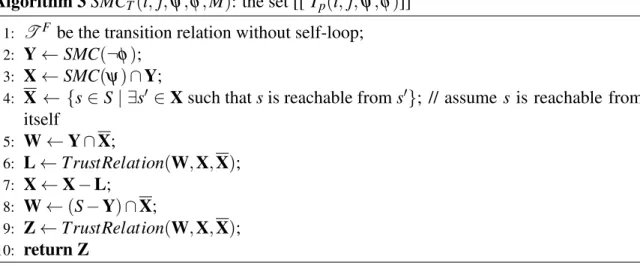
3.5 Automatic Verification of TCTL Properties of MASs . . . 46
3.5.1 Explicit Algorithm of Trust . . . 46
3.5.2 BDD-based Algorithm of Trust . . . 50
3.6 Implementation and Experiments . . . 54
3.6.1 Evaluation: The Breast Cancer Diagnosis and Treatment (BCDT). . 55
3.6.2 Specifications . . . 57
3.6.3 Verification Results . . . 58
3.7 Summary . . . 62
4 Transformation-based Model Checking Temporal Trust 63 4.1 An Overview of The Proposed Approach . . . 64
4.2 Conditional Trust TCTLC . . . 65
4.3 Formal Transformation to Model Check TCTL and Conditional Trust . . . 68
4.3.1 Transformation of TCTL Model . . . 68
4.3.2 Transformation of TCTL Formulae . . . 71
4.3.3 Model Checking Conditional Trust . . . 74
4.4 Complexity Analysis . . . 76
4.4.1 Space Complexity . . . 78
4.5 Implementation and Experimental Results . . . 81
4.5.1 Insurance Claim Processing: A Case Study . . . 81
4.5.2 Implementation . . . 82
4.5.3 Properties . . . 84
4.5.4 Experimental Results . . . 86
4.6 Summary . . . 88
5 Degrees of Trust: Temporal Logic and Model Checking 91 5.1 An Overview of The Proposed Approach . . . 92
5.2 Graded Trust Temporal Logic . . . 93
5.2.1 Syntax and Semantics . . . 93
5.2.2 Reasoning Postulates . . . 95
5.3 Model Checking TCTLG . . . 97
5.3.1 BDD-based Algorithm of Graded Trust . . . 98
5.4 Complexity Analysis . . . 99
5.5 Implementation and Experiments . . . 108
5.5.1 Performance Evaluation . . . 108
5.5.2 Experimental Results . . . 110
5.6 Summary . . . 111
6 Conclusions and Future Directions 112 6.1 Summary . . . 112
6.2 Future Directions . . . 115
LIST OF TABLES
2.1 Comparison between the list of publications reviewed for this thesis with respect to the proposed criteria. . . 29 3.1 Verification results of the BCDT protocol using the direct algorithm . . . . 58 3.2 Verification results of the BCDT protocol using the revisited algorithm . . . 61 4.1 Verification results of the AGFIL protocol using our toolkit . . . 87 4.2 Comparison of the verification results between Java tool and MCMAS-T . . 88 5.1 Verification results of the BCDT protocol against TCTLGformulae . . . . 110
LIST OF FIGURES
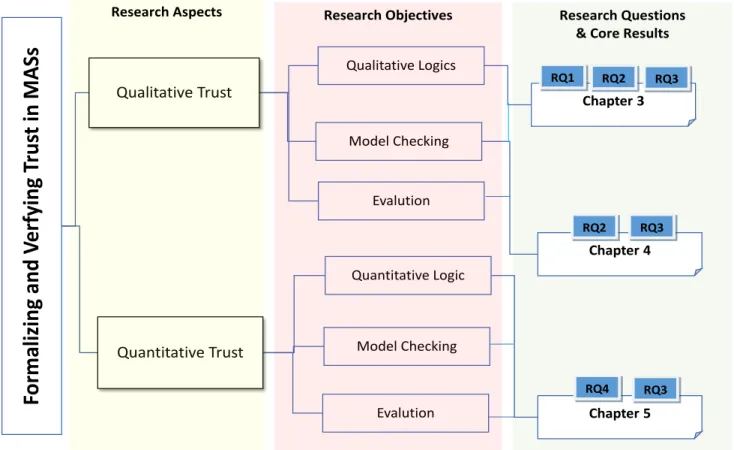
1.1 Research methodology w.r.t the identified research questions . . . 13
2.1 A model checker with counter and witness examples . . . 20
3.1 The main parts of the proposed approach . . . 33
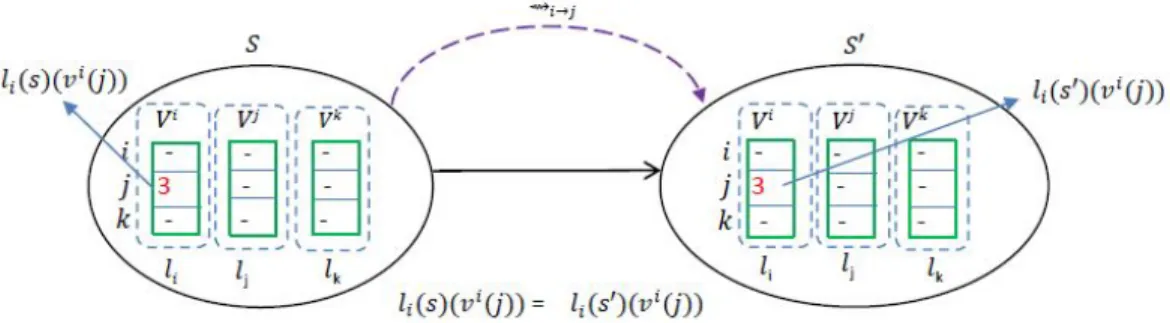
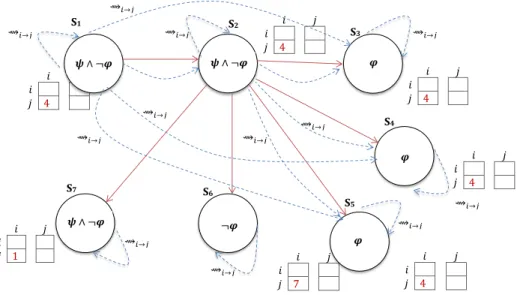
3.2 An example of accessibility relation i→j . . . 37
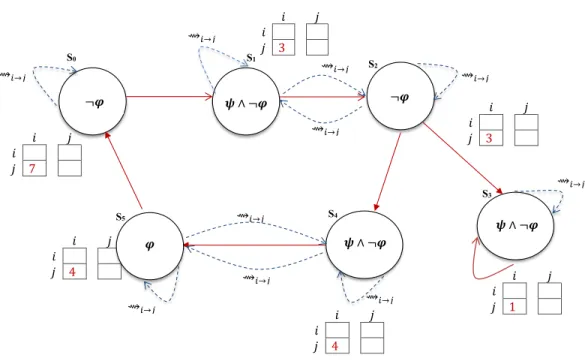
3.3 Example to illustrate Algorithm 1 . . . 49
3.4 Illustrative example of model without-loop (flat) . . . 53
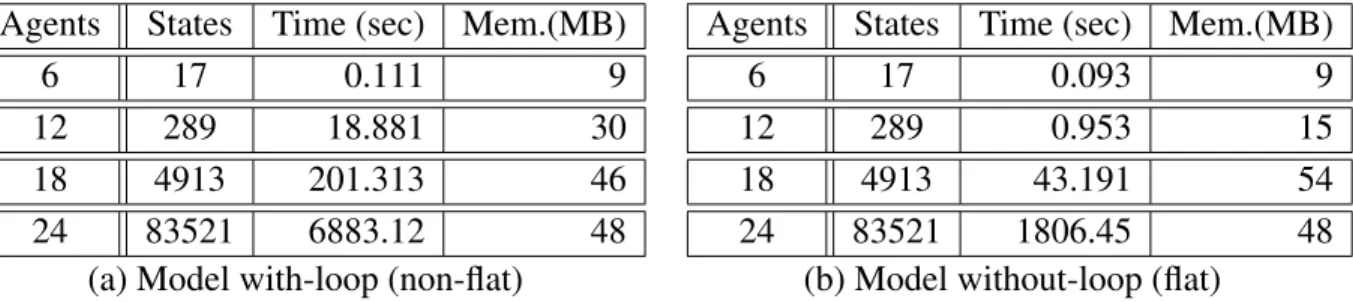
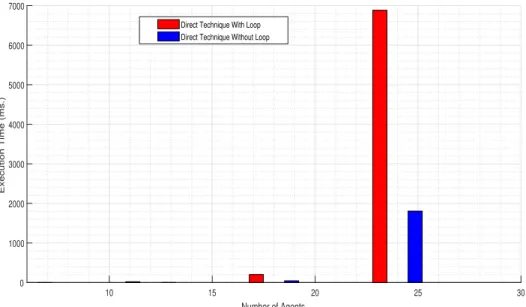
3.5 Comparison results between models with and without-loops using the direct algorithm . . . 60
3.6 Comparison results between the direct and revisited algorithms using a flat model . . . 61
4.1 A schematic view of our TCTL model checking approach . . . 64
4.2 An example of trust accessibility relation i→j . . . 67
4.3 Example of the transformation methods . . . 72
4.4 Illustrative example of Algorithm 7 . . . 76
4.5 Screenshot of the generated NuSMV modules and the verification results . . 83
4.6 Screenshot of the information dialog box that shows the transformation time of each formula . . . 84
4.7 Comparison results between our transformation-based tool and MCMAS-T 89 5.1 The main parts of the proposed approach . . . 92
5.2 A model that satisfies the formula(5.2) . . . 96
LIST OF ACRONYMS
ARCTL Action Restricted Computation Tree Logic BDD Binary Decision Diagram
BDI Beliefs, Desires, and Intentions CCTL Counting CTL logic
CTL Computation Tree Logic
CTLC Computation Tree Logic of Commitment CTLK Computation Tree Logic of Knowledge ISPL Interpreted Systems Programming Language LTL Linear Temporal Logic
MAS Multi-Agent System
MCMAS Model Checker for Multi-Agent Systems NuSMV New Symbolic Model Verifier
PCTL Probabilistic Computation Tree Logic PRISM PRobabilistIc Symbolic Model checker PSPASE Polynomial Space
SMV Symbolic Model Verifier SPIN Simple Promela INterpreter
Chapter 1
Introduction
In this chapter, we introduce the context of our research and motivations. Then, we identify the methodology, research questions, and contributions of our work. Finally, we conclude this chapter by providing the thesis organization.
1.1
Context of Research
1.1.1
Agents and Multi-Agent Systems
Agents are autonomous entities that have reactive, pro-active, social and rational properties. Reactive property means that an agent is capable of responding to external changes in its en-vironment. Pro-active property refers to its ability to behave with respect to its goals. Social property is an agent’s capability to interact and communicate with other agents, and ratio-nality property is an agent’s ability to act consistently with its goals [109]. A Multi-Agent System (MAS) composed of multiple agents, which interact in dynamic and uncertain envi-ronments in order to achieve their goals [110]. Agents may be heterogeneous, which means that they may have different preferences and behaviours, and they may be independently
developed by different programmers. The ability of agents to communicate and interact with one another is one of their essential properties. Interaction among autonomous and heterogeneous agents is the key aspect for: 1) solving complex problems that an individual agent cannot handle alone, and 2) building effective MASs. These appealing features made MASs successfully adopted in a large number of critical applications such as commercial, industrial, governmental and healthcare systems [12, 111, 107, 58]. Nonetheless, this adop-tion raises a number of challenges related to their present and future behaviors. The fact that agents are autonomous and have to interact with each other within unreliable environments makes the concept of trust of particular importance for regulating their interactions.
1.1.2
Trust in Multi-Agent Systems
Trust is regarded as being one of the key aspects behind the success and growth of applica-tions based on MASs. Trust has been an essential research topic in several disciplines for many years. Each of these disciplines gives different definitions for trust [63, 65, 46, 105]. For instance, in the field of distributed computing, trust is used mainly to regulate the re-lationship between service providers and customers [105, 1]. In social science disciplines, trust is seen as a relationship among individuals in social settings [46] (e.g., trust is used to control relationships between trusters and trustees to ensure that the trustees will perform a certain action).
In the context of MASs, the most widely used definition is the one proposed by Castelfranchi and Falcone (abbreviated as C&F) [16], where trust is basically defined as a mental state of one agent (the truster) towards another agent (the trustee) in which the truster’s goals and beliefs are reflected in some internal properties of the trustee. C&F stud-ied the trust concept in a cognitive perspective that emphasizes the importance of the goal
component. Such a component allows us to distinguish trust from mere thinking and fore-seeing [48]. Indeed, by emphasizing the agent’s goal, C&F rely on the internal structures of agents for the fulfillment of their own goals. Since these systems involve autonomous entities that keep their structure private, it is hard to verify if the agents’ goals are achieved. To cope with this limitation, we take in this research a new approach towards social per-spectives of trust where the trust parties do not have intuition for cognitive goals. Instead, we define trust from a high-level abstraction without having to depend on individual agent’s internal mental states.
Trust in multi agent systems has been analyzed from different aspects. The major studies focused on two main approaches: the numerical approach and the logical approach. The numerical direction treats trust as a function that is calculated based on multiple opin-ions through feedback, user ratings, or agent monitoring [106, 17, 82, 94]. Such approaches represent and quantify the strength level in which an agent trusts another party. Specifically, the higher an agent trusts another agent, the more likely the latter would be chosen as an interaction partner. Trust was first introduced as a measurable notation of an entity in [77]. Following this work, a number of computational models have been proposed in the MASs literature (see for instance [90]). Nevertheless, in dynamic MASs where agents may join for a short period of time before leaving the interaction, it might be impossible to collect sufficient information to evaluate the trustworthiness of partners. As a consequence, the well established trust relationships is not guaranteed due to misleading trust results. On the other hand, the logical approach mainly focuses on defining semantic structures for trust. Several logical frameworks have been proposed to describe the static and dynamic proper-ties of trust. Such approaches provide a formal semantics to reason about trust properproper-ties in various applications such as security protocols, information sources, and recommendation
systems. Moreover, in terms of expressiveness, some of these studies adopted combin-ing logics [3, 68], while others extended standard logics of action and belief, or enriched temporal logics with a new modality for trust [27, 48, 98].
1.1.3
Verification of Trust in MASs
Generally, verifying that a system complies with its design requirements is very challeng-ing, especially in multi-agent systems. The existence of many autonomous entities in such systems makes the verification highly difficult due to the increase in their complexity and heterogeneity. The main challenge that faces MASs is how to ensure the reliability of the trust relationships in the presence of misbehaving entities. Such entities not only create an exception for other agents, but also may obstruct their proper work [55]. The fact that such agents are autonomous and have to interact with each other within unreliable environments makes reasoning about trust and checking the existence of untrusted computations highly desired.
Technically, the verification mechanisms of trust in MASs fall into two categories de-pending on when the verification activities are performed: runtime and design-time. For the first approaches, monitoring is the most common used technique where the verification is performed by monitoring the evolving executions of the target system during the operation phase, and then checking whether the desired properties of the system hold or not [4, 6, 8]. Runtime verification can also extract relevant information from a running system and use it to detect undesired behaviors with regard to particular properties. On the other hand, the second approaches rely on the static formal verification, which is a class of logic-based techniques. In such approaches, model checking has become one of the most successful approaches widely used for verifying various aspects of MASs [9, 71, 108]. Indeed, each
technique has its own advantages and limitations. For instance, one of the appealing fea-tures of the runtime verification is the use of real and concrete runs to check the correctness of the target system. This allows us not only to observe the real system, but also react whenever undesired behaviors are detected [66]. However, such techniques only consider a particular execution of the system, which may lead to an incomplete verification process due to the limited coverage. In contrast, the design phase techniques systematically check all possible states of the system, provide full automation of the verification process, and can produce counter examples when the system fails to satisfy a desired property. Yet, such techniques suffer from the state explosion problem that limits the applicability of verifying large systems. Technically, both techniques complement each other in detecting untrust-worthy behaviors and improving MASs development.
In fact, although trust is dynamic because agents can change their behaviors dynami-cally, still verifying trust properties at design time is very critical and useful. Model check-ing trust is of prime importance to ensure that trust behavior can take place among agents engaged in an interaction. For instance, if the outcome of the model checking reveals there is no execution where a particular trust property is satisfied, then this could be considered as a final verdict and the model should be changed because it is unsafe to deploy it in real systems. On the other hand, if the model checking reveals the opposite, which means all possible executions are trusted, then showing the equivalence between the implemented model and the designed one would be enough, if such an equivalence is possible to be proven. In the general case where the outcome reveals that some paths are trusted and some others are not, then model checking will benefit the dynamic verification that could be guided to monitor the untrusted paths, which means monitor if the agents are behaving according to the identified untrusted paths. Though, in this thesis, we adopt a design time approach as our main goal is to improve the utilization of MASs paradigm by reducing
the time and cost of the development process, and to increase the confidence on the safety, efficiency and robustness of the system. Recently, formal evaluation using model checking techniques has been proved to be a highly effective tool [20, 21].
1.2
Motivations
In this research, we are primarily concerned with the issues of reasoning about and verifying trust in the context of MASs using the model checking approach, which has not been deeply investigated yet for trust systems. In the literature, many logical formalism approaches of trust in MASs can be found. However, very few approaches addressed trust from a high level abstraction viewpoint [98]. Modal logic approaches provide powerful mechanisms that can be effectively used for trust reasoning. Such approaches yield a formal semantics to reason about trust properties in various applications such as security protocols, infor-mation sources, and e-markets. For instance, in [24, 48, 75], the authors proposed several logical frameworks for the concept of trust. Trust in such logics is mostly expressed as a combination of different modalities based on the logic of action and time [47] and the BDI logic [22]. In [69], a modal logic for reasoning about the interaction between belief, evidence and trust is presented. Other approaches are interested in analyzing trust in in-formation sources [5, 24, 27, 67]. Moreover, some proposals have addressed trust in the context of computer security [45, 75].
Most of these approaches focus on the cognitive side of trust (i.e., trusted agents are capable of exhibiting beliefs, desires, and intentions properties). Hence, the trust is consid-ered as a belief of an agent (the truster) involving ability and willingness of the trustee to perform some actions for the truster. Since these agents are autonomous and heterogeneous, such a mental concept cannot make those agents abide by the language semantics whenever they interact [9]. Thus, the need for a logical language that can provide a certain level of
abstraction with the ability to express the trust properties is of great significance. More-over, agents are able to show flexible and unpredictable behaviour when they are working together in an unreliable environment. Hence, deciding whether to trust other agents (for instance to perform some actions) or not is a challenging task. For instance, agents may not comply with their obligations (e.g., an agent may not send the payment for goods re-ceived). Thus, this raises the need for developing efficient methodologies to handle their present and future behaviors in order to ensure the fulfillment of the system requirements. Currently, the technique of model checking [20, 21] has attracted several contributions with a significant industrial implication. Although these contributions addressed a number of multi-agent aspects such as social commitments [9, 33] and knowledge [73, 104], model checking trust in multi-agent settings has not been sufficiently investigated yet. From this view, we aim in this research to contribute in the modeling and verification of trust systems. To motivate our study of analyzing the trust in MASs, we use an example in the con-text of electronic commerce where trust is a highly desired property. Let us consider the buyers-sellers relationships. The buyer requests to purchase one or more items from the seller (i.e., the trust relationship is established between the two parties). Once the former selects an item, and the requested items are paid. The seller confirms the order and starts the delivery process. Finally, the requested items are shipped and the buyer is notified. How-ever, online interactions are characterized by uncertainty and, moreover, the anonymity of the interaction partners. Thus, there is no guarantee that this process will be surely satis-fied in concrete applications. Therefore, the need for formally specifying and automatically verifying trust-based interactions among autonomous agents are of great importance.
1.3
Methodology and Research Questions
Our review of the concept of trust in the context of MASs literature has revealed a gap in modeling trust from social perspectives point of view. The existing approaches consider a cognitive concept of trust where trust is defined as an attitude of the truster who believes that the trustee has a given property. Although these approaches are highly appropriate to reason about trust, their verification faces a fundamental limitation due to their reliance on the internal structure of the interacting agents. In fact, the distributed and open na-ture of MASs makes the capability of handling and verifying the trust interaction issues of such approaches arduous. That is, the challenge of automatically detecting the undesir-able behaviors of such agents’ and then fixing them according to preset specifications is an important issue that arises in the cognitive semantic approaches. Another issue that has attracted our attention while reviewing the literature is the limitation of the approaches that addressed the model checking problem of trust logics. The current proposals have been focusing mainly on evaluating the trust-based systems. Such approaches often evaluate the effectiveness and robustness of these models against undesired attackers’ behaviors. While these approaches have the advantage of detecting and isolating different kinds of attacks, they lack the generality (i.e., the proposed assessment tools can only be applied to a single particular model). Moreover, only known and predefined attacks have been considered in the evaluation process. Besides, theses approaches are not designed to formalize and ver-ify trust for autonomous MASs. Nonetheless, interacting agents are heterogeneous, which means one cannot guarantee that they will behave as they are supposed to. Thus, the need for efficient methodologies to automatically check whether or not MASs behavior conforms with the system specifications is recognized. So far, there is almost no approach on verify-ing statically MASs with respect to certain properties related to agents trust. Dealverify-ing with such an issue as a model checking problem is one of our goals in this research. In order to
do so, different important research questions arise:
Question 1. How can we define a temporal logic that is capable of specifying the trust properties from social perspectives viewpoint?
To address this question, we started by investigating the possibility of using the exist-ing temporal logics such as LTL [91] and CTL [43]. However, we realized that the needed modality for trust cannot be expressed using such logics. In fact, these logics lack the capabilities to model trust interactions and the dynamic behaviors of autonomous agents. Therefore, we propose to extend CTL logic with a trust operator to represent and reason about the properties that an agent requires to be achieved by the trusted agent. The main reasons that encouraged us to extend CTL logic are: (1) CTL logic has grounded semantics, which means it can be associated to computational models, (2) there are several open model checker tools that support this logic, and (3) such logic has a high efficient model checking procedure.
Moreover, we associate with the logic a set of reasoning rules along with their formal proofs to capture the common reasoning patterns that uniformly apply to trust relationships and agents are expected to respect them when they engage in interactions.
From the semantics perspectives, we define a new trust accessibility relation to cap-ture the trust relationship between the interacting agents by extending the original frame-work of interpreted systems [44]. To the best of our knowledge, our frame-work is the first ini-tiative that gives formal and computational definitions of the trust accessibility relation as a social concept between interacting agents in MASs. Given that, the direct question is:
Question 2. How can we formally verify the developed temporal logic?.
In order to reduce and eliminate post-development costs and increase confidence on the safety, efficiency and robustness, two verification techniques at design time have been
put forward to verify trust logic: direct and indirect verification techniques. A direct method can be performed by either developing a proper model checker from scratch or by extending existing tools with new algorithms for the needed temporal modalities. In contrast, indirect techniques, also called transformation-based methods, can be performed by applying cer-tain reduction rules in order to transform the problem at hand to an existing model checking problem. In this research, we aim to explore both techniques in order to compare between them in terms of memory consumption, efficiency, and scalability with regard to the number of considered agents. Knowing all these facts, our next research question:
Question 3. How can we evaluate the proposed solution for the model checking prob-lem of the developed temporal logic?
Two evaluation methods have been put forward: Empirical and Theoretical. The first method is evaluated by applying the proposed algorithms in real world case studies and report the experimental results, and the second method is to explore the theoretical analysis by analyzing the time and space complexity. By the end, a key question that need to be asked is how much should we trust?
Question 4. How the degree of trust that an agent has toward anther agent can be computed and verified?
Trust in the existing approaches has often been treated as either true or false, i.e., we either trust the behavior of an agent or not. However, such systems have also quantitative temporal properties (such as degrees of trust), which still need further attention from the logical and model checking perspectives. In fact, in many contexts, it is quite difficult to determine with absolute certainty whether a proposition about the behaviours of potential agents is true or false. For instance, I might trust the agent to a certain degree in relation to given propositions (i.e., I may have only 50% of trust). In our research, we aim to address
this issue by introducing a logical-based framework for quantifying the relationships among the interacting agents.
Figure 1.1 summarizes the research methodology w.r.t the identified research ques-tions and maps them to thesis chapters.
1.4
Contributions
The following contributions are offered by this thesis:
– We introduced the Trust Computation Tree Logic (TCTL) that extended the standard CTL logic with a new temporal modality to represent and reason about preconditional trust, and then defined its formal semantics. We also associated the logic with a set of reasoning rules along with their formal proofs.
– We introduced a new vector-extended version of interpreted systems to capture the trust relationship between the interacting agents.
– We designed a new symbolic model checking algorithm to formally and automatically verify the system under consideration against some desirable properties expressed using the proposed logic. We fully implemented our proposed algorithms by extended the MCMAS model checker for MASs. Hence, a new model checker tool, called MCMAS-T, dedicated to TCTL, along with its new input language VISPL (Vector-extended ISPL) have been introduced.
– We expressed the concept of conditional trust by extending TCTL, the extended logic is called TCTLC. Then, we developed a new model checking framework for the TCTL logic of preconditional trust that is extended to design a new algorithm to
model check conditional trust TCTLC. In particular, we introduced transformation-based algorithms and implemented them in a Java toolkit that automatically interacts with the NuSMV model checker of the CTL logic.
– We introduced a logical language called TCTLG, an extension of TCTL that allows us to formally represent and reason about the quantitative aspect of trust. Moreover, a dedicated symbolic model checking algorithm for TCTLG implemented on top of MCMAS is presented (MCMAS-G).
– We computed the time and space complexity of the model checking problem of the developed temporal logics. We proved that the time complexity of TCTL, TCTLC, and TCTLGmodel checking algorithms in explicit models is P-complete with regard to the size of the model and length of the formula, and the complexity of the same problems for concurrent programs is PSPACE-complete with respect to the size of the program’s components.
– We successfully applied the proposed logic and tools to model check different appli-cation domains.
1.5
Thesis Structure
We present in Chapter 2 the background needed to understand the different concepts of our research work. In particular, we give an overview of the CTL logic, summarize the formal-ism of interpreted systems, and review the model checking techniques. Then, we provide literature reviews on the main approaches on trust modeling. We compare the existing ap-proaches with regard to the proposed criteria and highlight some potential research gaps that are addressed in the thesis.
Research Questions & Core Results
Form
alizing
and
V
erf
ying T
rus
t in MASs
Qualitative Trust Qualitative Logics Chapter 3 Model Checking Chapter 4 Evalution Quantitative Trust Quantitative Logic Chapter 5 Model Checking Evalution Research Aspects RQ3 RQ2 RQ1 RQ2 RQ3 RQ4 RQ3 RQ3 Research ObjectivesFigure 1.1: Research methodology w.r.t the identified research questions
In Chapter 3, we present the syntax and semantics of the developed TCTL logic. A set of reasoning rules are also presented. To verify the trust interactions, new model checking al-gorithms dedicated to TCTL logic are introduced. We also present the full implementation of our algorithms on top of the MCMAS symbolic model checker. Our implementation extends the input language of MCMAS in order to parse the TCTL logic syntax and se-mantics. Thereafter, we evaluate the tool and report experimental results using a real-life scenario in the healthcare platform.
In Chapter 4, we investigate a different model checking technique for TCTL logic. More-over, we extend TCTL logic by introducing a new modality for conditional trust to pro-duce a new logic called TCTLC. In this chapter, the problem of model checking TCTL is transformed to the problem of model checking CTL by means of transformation-based algorithms that are extended to design a new algorithm to model check conditional trust TCTLC. The algorithms are implemented in a Java toolkit that automatically interacts with the NuSMV model checker of the CTL logic. Further, we analyze the time complexity of TCTL model checking in explicit models and its space complexity in concurrent programs. Moreover, we evaluate the effectiveness and efficiency of our approach by performing a set of experiments on a widely-used case study in business domain and compare our results with the results obtained in Chapter 3.
In Chapter 5, we address the quantitative aspect of trust from the modeling and verification perspectives. We start by constructing TCTLG, a logical language to represent the degrees of trust along with its reasoning postulates. Moreover, a new symbolic model checking algorithm for quantifying the relationships among the interacting agents is presented. The implementation of the model checker MCMAS-G, an extended version of the MCMAS model checker is introduced. Moreover, we investigate the complexity and evaluate our approach using a case study in the health care domain.
Chapter 2
Background and Literature Review
In this chapter, we briefly present some preliminaries needed for the rest of the thesis. In Section 2.1, we explore Computation Tree Logic (CTL) as the main ingredient that we used to define a formal semantics for trust in our proposed approach. Section 2.2 is devoted to briefly review the formalism of interpreted systems, which provides a very popular frame-work for modeling and reasoning about MASs. In Section 2.3, we provide the relevant background of symbolic model checking techniques and tools. Thereafter, in Section 2.4, we discuss relevant related work on current logical-based frameworks in trust-based MASs. We explain each proposal and point out if it meets the introduced criteria. Finally, we high-light the main features of our proposed framework and present some potential research gaps.
2.1
Computation Tree Logic - CTL
CTL [43] logic is a branching time logic with modal operators to describe the temporal order of events. The CTL represents a tree-like structure time where each moment in time may split into many possible paths in future.
Definition 2.1. (Syntax of CTL)
The syntax of CTL formulae is defined as follows:
φ ::=ρ | ¬ϕ |ϕ∨ϕ |EXϕ |EGϕ |E(ϕUϕ)
where ρ ∈AP is an atomic proposition from the set of atomic propositions AP, E is the existential quantifier over paths, the formulaEXϕ stands for "ϕ holds in the next state in
at least one path",EGϕ stands for "there exists a path in whichϕ holds globally", and the
formula E(ϕUψ) holds at the current state if there is some future moment for which ψ
holds and ϕ holds at all moments until that future moment. EFϕ is the abbreviation of
E(trueUϕ). A, the universal quantifier over paths, can be defined in terms of the above
as usual: AXϕ =¬EX¬ϕ; AGϕ =¬EF¬ϕ; and A(ϕUψ) = ¬(E(¬ψU(¬ϕ∧ ¬ψ))∨
EG¬ψ).
The semantics of CTL formulae is given in terms of a transition systemM= (S,R,V,I)
whereSis a nonempty set of states,R⊆S×Sis a transition relation,V :S→2AP is a valu-ation function, andI⊆Sis a set of initial states. The transition relationRmodels temporal transitions among states: given two statess,s0∈S, (s,s0)∈Rmeans that s0is an immedi-ate successor of s. The behaviour of the system model M is a set of computation paths. A path π in a model M from a state s0 is an infinite sequence of reachable global states
π=s0s1s2· · · such that for alli≥0 ,(si,s(i+1))∈R.
Definition 2.2. (Satisfaction)
Given the modelM, the satisfaction for a CTL formulaϕ in a global states, denoted
as(M,s)|=ϕ, is recursively defined as follows:
−(M,s)|=ρ iffρ∈V(s);
−(M,s)|=EXϕ iff there exists a pathπ starting atssuch that(M,π(1))|=ϕ;
−(M,s)|=EGϕiff there exists a pathπstarting atssuch that(M,π(k))|=ϕ,∀k≥0;
−(M,s)|=E(ϕ1Uϕ2)iff there exists a pathπstarting atsfor somek≥0,(M,π(k))|= ϕ2and∀0≤i<k,(M,π(i))|=ϕ1;
2.2
Interpreted Systems
An interpreted system [44] is a formal description that has been proven to be a suitable for-malism for reasoning about knowledge and time in MASs, and which systematically models different classes of MASs, such as synchronous and asynchronous. Such a formalism en-joys a high level of abstraction that allows focusing only on the interactions among the various agents, and it is a useful tool for modeling autonomous and heterogeneous agents interacting within a global system. The original version of interpreted systems has been extended in various ways. For instance, Bentahar et al. [10] and El-Menshawy et al. [39] extended the formalism of interpreted systems with sets of shared and unshared variables to account for agent communications that occur during the execution of MASs.
Here, we present the standard semantics of interpreted systems as in [44]. Consider a set Agt ={1,· · ·,n} of n agents and at any given time, each agent in the system is in a particular local state, which represents the complete information about the system that the agent can access at that time. Each agent i∈Agt is associated with a non-empty set of local states Li and a set of local actions Acti to model the temporal evolution of the system together with a local protocolρi:Li→2Acti assigning a list of enabled actions to a
given local state li∈Li. It is assumed thatnull∈Acti for each agent i, where null refers
to the silent action (the fact of doing nothing). A local evolution functionτi is defined as: τi:Li×Acti→Li, which determines the transitions for an individual agenti between her
As in [44], a global state s∈S represents a snapshot of all agents in the system at a given time. A global state s is a tuple s= (l1, . . . ,ln). The set of all global states
S⊆L1×. . .×Ln is a non-empty subset of the Cartesian product of all local states of n
agents. The notation li(s) is used to represent the local state of agenti in the global state
s. I⊆Sis a set of initial global states for the system. The global evolution function of the system is defined as follows: τ :S×ACT −→S, whereACT =Act1×. . .×Actn and each
componenta∈ACT is called a joint action, which is a tuple of actions. As in [44], a special agenteis used to model the environment in which the agents operate. The environmenteis modeled using a set of local statesLe, a set of actionsActe, a protocolPe, and an evolution
functionτe.
2.3
Symbolic Model Checking Technique
The technique of model checking [20, 21] is used in both software and hardware industries since the 1980’s. The goal of model checking is to verify the system correctness against desired properties at design time.The system is modeled as a finite-state transition system and the properties (the specifications) of the system that need to be verified are formulated in temporal logics, and then it is systematically checked whether the specifications are met for a given system (the model). If they are not met, a counterexample is produced which provides a helpful tool for debugging the system design. Many verification tools are devel-oped for this purpose such as SPIN [50], NuSMV [19], MCMAS [73], and PRISM [62]. SPIN is an automaton-based model checker for Linear Temporal Logic (LTL) focusing on proving the correctness of process interactions. NuSMV is an extended version of Symbolic Model Verifier (SMV) [79] that allows checking finite state systems against specifications in both Computation Tree Logic (CTL) and Linear Temporal Logic (LTL). MCMAS [72] is a model checker for multi-agent systems which can verify a variety of properties specified
by different logics such as CTL, Computation Tree Logic of social Commitments (CTLC), and Computation Tree Logic of Knowledge (CTLK). The dedicated programming language used for describing a MAS in MCMAS is called ISPL (Interpreted Systems Programming Language). The PRISM tool [62] is widely used for checking probabilistic specifications over probabilistic model. The specifications can be expressed either in the Probabilistic Computation Tree Logic (PCTL) or in the Continuous Stochastic Logic (CSL).
Formally, letMbe a state-transition graph (the system model), andϕbe the property
that the model has to satisfy. Then, the model checking technique is used to check whether or not the model M representing the system satisfies the logical formula ϕ describing a
certain property.
Recently, model checking has been extended to MASs. Different approaches have been proposed to extend model checking techniques with the aim of verifying extended temporal logics with agent-related modalities. For instance, verifying epistemic proper-ties expressed using logics of knowledge [70, 71, 89, 59], conditional and unconditional commitments [10, 41, 40, 33] and services composition [7, 34].
The main challenge in the application of model checking is the state space explosion problem. Early implementation of model checking algorithms suffered from this problem, which occurs when the number of components in the system grows up to the degree that makes the number of global states enormous. However, researchers have made consider-able progress in dealing with this problem over the last three decades. The introduction of Symbolic Model Checking with Binary Decision Diagrams (BDDs) data structure [14], Bounded Model Checking (BMC), Partial Order Reduction, and Symmetry Reduction tech-niques succeeded in partially combating this problem. Yet, these methods still suffer from the potential memory explosion problem on modern test cases. In this thesis, we adapt a symbolic model checking (SMC) as our underlying technique due to its effectiveness in
Model
Checker
Specifications (System Requirements)
E.g. Temporal Logics
𝝋
𝑴
╞
𝝋 ?
System Model
E.g. Interpreted Systems 𝑀
True
The Model satisfies the Specifications
False Counterexample
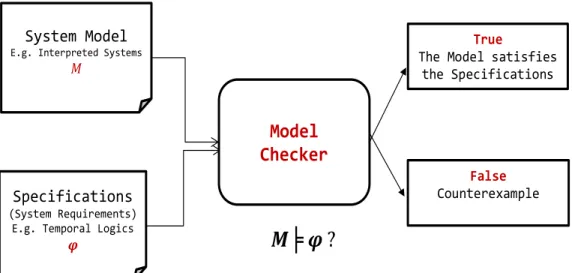
Figure 2.1: A model checker with counter and witness examples
mitigating the state explosion problem. Symbolic model checking considers the set of states (denoted as[[φ]]) satisfying the given formulaφ in the modelM, which is represented and
manipulated using Ordered Binary Decision Diagram (OBDD)[13] data structure. Such a set is then compared against the set of initial statesIin the modelM(also represented as an OBDD). Thus, we say that a modelM satisfies the formulaφ if and only ifI⊆[[φ]]. In a
formal way, this fact can be represented as(M,I)|=φ iff(M,s)|=φ ∀s∈I.
Figure 2.1 describes a typically model checking process that involves three integrated phases. First, the system design formulated in some precise mathematical language. Then, specifications about the system are expressed as temporal logic formulas. Finally, the ver-ification part where automatically verify whether a given model of a system meets a given specification.
2.4
Literature Review
In this section, we present our methodological review where we classify the current state-of-the-art in the domain of trust in MASs in three parts: qualitative logical-based approaches, quantitative logical-based approaches, and model checking trust-based techniques. In the following, we present a brief overview of each of these constituents and highlight the advan-tages and limitations of existing approaches and the main features of our proposed frame-work.
2.4.1
Qualitative Logical-based Approaches
Modal logics have been used to formalize trust in MASs by many researchers. Most of the existing formal approaches consider trust based on key aspects of cognitive view where trust involves four components: truster, trustee, action of the trustee, and goal of the truster. In particular, [24] has proposed several approaches for trust reasoning. He developed a logic by combining a dynamic logic [47] with the BDI logic [22]. Trust in this work is considered as an attitude of the truster who believes that the trustee has a given property. In other proposals, Demolombe, Lorini and Amgoud have focused on analyzing trust in various features of information sources [27, 75]. For instance, in [75], the authors formalize some security properties and their relationships with trust such as integrity, availability and privacy by introducing a modal operator of obligation. Thus, one agent is trusting another agent if the former believes that the information transmitted to it is reliable.
Similarly, trust in the domain of information sources is proposed in early work [67] where the BIT, a modal logic that extends the traditional doxastic logic with modalities for representing belief, information acquisition, and trust is presented. In the BIT formalism, the trust operator is interpreted using neighborhood semantics [80]. The logic is provided with a rigorous semantics to precisely characterize 1) the relationships among beliefs and
information acquisition, and 2) how different trust properties are represented by consider-ing various axioms of the logic. Indeed, this well-known, early formal treatment of trust, has been followed by many researchers. For instance, [87] has simplified the semantical treatment of the trust operator given in [67] by retaining only two types of modalities, a belief operator and trust, and they do not make use of the additional information operator. The idea of this work is to concentrate only on the interrelation between trust and belief. Their alternative logic of trust can also explicate a type of trust that is linked to honesty or sincerity. It allows to consider different forms of honesty separately and to incorpo-rate these already into the base logic. Trust in the sincerity is also presented recently in [18]. The authors proposed a modal logic to reason about an agent’s trust in the sincerity towards a statement formulated by another agent. In this work, trust is represented as a nor-mal modality that allows to reason about trust when an agent attempt to manipulate other agents. Moreover, the authors exhibited some notable properties such as non-transitivity of trust, and they proved the soundness and completeness of the proposed logic.
Following the path of cognitive trust, [48] proposed a formal logical framework to evaluate agents’ behavior in a multi-agent environment. To do so, they presented a lan-guage that combines the expressiveness of the logic of time, the logic of action, and the logic of beliefs. Moreover, the proposed logic is extended in order to enable reasoning about reputation. Trust in their work is based on the basic concept of belief while the repu-tation is considered in the scope of collective beliefs. They distinguish between two general categories of trust: occurrent trust and dispositional trust, and they provided precise defi-nitions and formal representations for the two concepts. In another work [49], Herzig and his colleagues simplified the previous logic presented in [48] by considering a very simple kind of actions based on the concepts of propositional assignment. That is, the truth values of a propositional variable is assigned to either true or false by the corresponding agents’
actions. The new logic provides a simple framework, and it is expressive enough to account for the cognitive theory of trust. In [69], Liu and Lorini presented a new dynamic logic called DL-BET for reasoning about the interaction between belief, evidence and trust. The authors introduced three modal operators where each of these concepts are respectively represented. In this logic, the trust operator semantics is interpreted using neighborhood semantics [80], which maps each world into a set of subsets of worlds. The authors pro-vided a complete axiomatization for both the static component of the proposed logic and its dynamic extension. Another logic-based proposal for trust has been initiated by [15] who introduced a logic of trust called BAN-logic used for reasoning about the correctness of security protocols. The authors translated the protocol steps as logical formulas in order to manipulate them using first-order logic. Fuchs and colleagues [45] also addressed trust in the context of computer security. Moreover, more recent proposals have made the link between trust and argument-based frameworks [85, 101].
The closest approach to our work is the one presented by Singh in [98] where the social perspective of trust has been put forward. Specifically, the author provided a for-mal semantics for trust with various logical postulates used to reason about trust from an architectural perspective. His model is based on the idea of trust as a dependence. This model combines temporal modalities of linear temporal logic (LTL) [91] and modality(C)
for commitments [97] and(T)modality for trust. The semantics is interpreted using neigh-borhood semantics [80], which maps each world into a set of subsets of worlds. A function
kthat produces a set of propositions for each moment, an ordered pair of two agents, and
a proposition is defined. This function yields a set of consequent propositions, which in turn captures what the truster would be trusted to if the antecedent holds. Thus, the trust semantics is defined by computing the set of moments where the consequence holds and testing if those moments are among the moments computed byk on the trust antecedent.
Yet, it is not clear how the functionkis computed, which makes the approach quite difficult to be applied in practice.
While the aforementioned approaches have taken a good step towards developing a modal logic for trust, they fail to present the notion of trust explicitly. Moreover, such studies are mostly focused on agents with mental states where the trusting entity is normally capable of exhibiting beliefs, desires, and intentions. Nevertheless, agents are operating in open environments. Thus, they are likely using different types of platforms and are possibly using different technologies, so it is very difficult for one agent to completely trust others or to make assumptions about their internal states. Besides, such logics are abstract and not computationally-grounded (i.e., we cannot interpret them using concrete computational models), which makes them hard to be applicable for verification purposes. Moreover, model checking neighborhood semantics-based modal logics is yet to be solved [38, 84].
2.4.2
Quantitative Logical-based Approaches
Indeed, there are relatively small amounts of directly related work. For instance, the work in [26, 5] proposed several approaches that address the graded trust. They developed a logic by combining a dynamic logic [47] with a BDI-like logic [22]. The author in [25] defined a logical framework to represent graded trust in terms of two independent com-ponents: graded beliefs and graded regularities. In this work, trust is reduced to graded beliefs, so the graded trust is defined as the strength level of the truster agent belief about the trustee agent sincerity. In another proposal, Demolombe and Lorini [74] have focused on analyzing the trust that can be associated with information sources. The authors have integrated graded beliefs into a logical framework that defines different kinds of trust. In another work [76], Lorini et al. considered the quantitative aspects of trust in a dynamic epistemic logic setting, where the relationship between trust and belief change is presented.
The authors proposed Dynamic Logic of graded Belief and Trust (DL-BT), a modal logic that supports reasoning about agents changing their beliefs based on the degree of trust the receiver agent has in the information source. The proposed logic combines modal operators of knowledge, graded belief and trust with dynamic operators of trust-based belief change. The graded trust operator is interpreted using a neighborhood semantics [80], whose model checking is still an open problem [38]. In this work, two kinds of trust-based belief change policies have been considered: additive and compensatory policies, along with the detailed analysis of their logical properties. Moreover, the authors provided a sound and complete axiomatization. In [81], the authors introduced a logical framework that combines a formal logic based on a logic of belief, a logic of time, and a dynamic logic to cognitively rep-resent the concept of trust (qualitative aspects), and a fuzzy logic to reprep-resent the degree (quantitative aspect) of trust. However, the proposed logics mostly focused on agents with mental states where the trusting entity is normally capable of exhibiting beliefs, desires, and intentions, which makes them difficult to be model checked. Moreover, the trust from the quantitative approach is not considered because the grades are embedded in the modal operators. [93] present a logic called Certain Logic to evaluate trust under uncertainty by evaluating a number of Boolean expressions in terms of real values.
The author in [100] proposed a logical language that can be employed to reason about trust, knowledge, and their interaction. The proposed logic is a modal language augmented with a trust operator, which is interpreted using a combination of a neighborhood structure [80] with an added component to assign weights to formulas. Moreover, they provided a mechanism that can produce values to be fed into Subjective Logic’s trust manipulation component [53]. The idea of this work is to use the expressive power of the proposed for-mal language to describe the information possessed by an agent and then transform this
knowledge into an opinion value about a given proposition with all the three major compo-nents of subjective logic made explicit. Such compocompo-nents are, respectively, belief, disbelief, and uncertainty. Then, an evidence based logic is built, such that evidences are assigned weights that determine whether an agent trusts a given proposition or not.
Huang et al. [51] considered the setting of stochastic multi-agent systems, where an automated verification framework for quantifying and reasoning about cognitive trust is proposed. The authors focused on a quantitative notion of trust defined as a subjec-tive evaluation in order to capture the social notation of trust. This allows one to quantify the amount of trust as a belief-weighted expectation. In this work, a probabilistic rational temporal logic PRTL*, which extends the logic PCTL* with reasoning about agents’ men-tal states is introduced. However, the model checking of the proposed logic was proven undecidable. Yet, no implementation has been considered and no attempt to evaluate the approach on any case studies. Considering our approach, trust is defined from a high-level abstraction without having to depend on agent’s internal mental states, and moreover, quan-tifies trust by relying only on the accessibility relations. Furthermore, our model checking algorithm is proved space-efficient.
2.4.3
Model Checking-based Approaches
Some relevant approaches with the aim of verifying trust-based models using formal meth-ods have appeared recently. For instance, Aldini in [3] has been introduced a formal frame-work to evaluate the effectiveness and robustness of trust-based models in order to detect and then isolate different kinds of attacks . Indeed, the author integrates trust modeling with distributed systems. In this work, the system properties are expressed using a trust tempo-ral logic (TTL) which combines CTL [43] and its action-based extension (ACTL) [23]. Moreover, the trust system model is based on an instance of both labeled transition systems
and Kripke structures. The verification of temporal logic properties expressed in TTL has been performed through a mapping to an existing model checking technique. However, the model mapping between the two logics has not been specified and TTL can only specify a single agent model, and it is not adapted to autonomous MASs. In [83], the authors pre-sented a mechanism for specifying and model checking trust specifications against models (such as Deontic models) of multi-agent interactions. The authors in [108] considered the formal verification of auction mechanisms. They implemented simple and intuitive auction models in a BDI-based programming language, to which they applied agent verification techniques. In this work some sophisticated agent aspects such as goals, intentions, beliefs and deliberation within an auction context has been verified. Moreover, they verified some of the scenarios that is involving a dynamic and static notions of trust. The verification carried out using an agent model-checking system and the properties verified are given in a logic of belief, goals and time. However, the approach has been tested on some small multi-agent programs: variations of the contract net protocol and auction systems, and with very fewer agents. Overall, their verification system is relatively slow where the speed and space required were the main problem.
The authors in [11] proposed an approach to model and verify trust models specified in a Colored Petri Net (CPN). They presented a model (named TCPN) that can be used to check the performance and behavior of such systems from both simulation and model checking points of view. In their approach, state-space is used to formalize the conceptual model of trust, which is then represented by Colored Petri nets to entitle for simulation and verification using existing modeling tools. Yet, this work fail to provide a verification of a trust model using model checking, and moreover, no attackers are considered in their modeling.
the authors present a model checking framework to verify the trust behaviors model against regular and non-regular properties. To model their target system, the authors introduced an algorithm to generate a configuration graph of a deterministic pushdown automata (PDA), where the trust behaviors are captured through the observations’ sequences related to certain interactions between the services and users. By doing so, they overcome the problem of non-regular model checking algorithms based on PDA. From the semantics point of view, they specified the trust behavior properties using Fixed point Logic with Chop (FLC). By using the chop operator, they were able to represent the non-regular properties. Moreover, they applied a symbolic FLC model checking algorithm to verify service trust behaviors with respect to trust properties. Indeed, FCL behavior formulae and the generated models are used as the inputs to the mcflc model checker tool which is the only tool for FLC model checking. However, this approach lacks formal semantics for trust because trust formulae are inferred from the context free grammar of trust pattern languages. Besides, non-regular behaviors verification is limited by its EXPTIME complexity, where no attempt to reduce it to polynomial time has been made in this approach. Moreover, the approach is not designed to formalize and verify trust for autonomous MASs. Further, none of these approaches tend to focus on model checking quantitative trust.
On the other hand, model checking trust can also be achieved by indirect techniques, also called transformation-based methods. The idea is to apply certain reduction rules in order to transform the problem at hand to an existing model checking problem. In fact, transformation has been acknowledged as an alternative mechanism for verifying various MASs aspects. The main advantage of this technique is that it enables the designers of MASs applications to get benefit from powerful and already tested model checkers. This technique has been applied for model checking commitments [36], knowledge [71], and the interaction between knowledge and commitments [2, 99]. To the best of our knowledge,
Table 2.1: Comparison between the list of publications reviewed for this thesis with respect to the proposed criteria.
Approach C1 C2 C3 C4 C5 C6 C7 [24] [27] [75] [49] √ – – – – – – [48] √ – – – – – √ [67] [87] [18] – √ √ – – – √ [98] – √ √ – – – – [5] [74][25] [81] √ – – – √ – – [3] [42] – √ – – – √ – [76] √ – √ – √ – – [26] √ – √ – √ – √ [69] √ – – – – √ [51] √ – – √ √ √ – Our approach – √ √ √ √ √ –
our work is the first attempt that introduces and implements a full transformation technique for verifying trust specifications in MASs.
In summary, we compare only the existing approaches that are mainly related to our research by taking into consideration the following criteria: being cognitive, being social, considering explicit notion of trust, analyzing complexity, dealing with graded modality, supporting model checking, and proving the soundness and completeness. We refer to these criteria as C1, C2, C3, C4, C5, C6, and C7 respectively. Cognitive and social properties indicate whether the logic is based on BDI logics (i.e., logics that describe the mental atti-tudes of agents in terms of beliefs, desires and intentions) or other temporal logics. Explicit notion of trust shows if it is possible to express trust by an explicit modality (i.e., logics that rely on a trust modality) or by means of one or more predicates. Moreover, complexity analysis states whether it is considered or not in the proposed approach. Graded modality indicates whether the work addresses the quantitative aspects of trust. Applicability for model checking confirms the presentation of a formal verification technique to verify the proposed approach, or specifying if the approach is applicable for model checking. Finally,
check whether they address the soundness and completeness of the proposed logic. A sum-mary about the comparison between the existing approaches and our approach with respect to the proposed criteria is presented in Table 2.1.
2.5
Summary
In this chapter, we introduced the background and concepts needed for the rest of the thesis. Moreover, we also presented a revision of the most relevant related work. In the next chapter, we propose a new approach for modeling and verifying trust in MASs.
Chapter 3
Logic-based Framework for Specifying
and Model Checking Trust in MASs
In this chapter, we present a new logic-based framework for specifying and model checking preconditional trust in MASs. We start by introducing TCTL, a new temporal logic of trust that extends the Computation Tree Logic (CTL) to enable reasoning about trust with pre-conditions (Section 3.2). A new vector-extended version of interpreted systems is defined to capture the trust relationship between the interacting parties in Section 3.3. In Section 3.4, we introduce a set of reasoning postulates along with formal proofs to support our logic. Moreover, Section 3.5 presents new model checking algorithms to formally and automat-ically verify the system under consideration against some desirable properties expressed using the proposed logic. We fully implemented our proposed algorithms by extended the MCMAS model checker for MASs. Hence, a new model checker tool called MCMAS-T, dedicated to TCTL, along with its new input language VISPL (Vector-extended ISPL) have been created. We evaluated the tool and reported experimental results using a real-life scenario in the health-care domain1.
3.1
An Overview of The Proposed Approach
The study of trust in MASs has been an area of interest for many researchers over the last years. This is due to the fact that trust is the basis for agent communication wherein entities have to operate in a dynamic and uncertain environment. Several approaches have been proposed to define logical semantics for trust in MASs. However, these approaches are limited to reason about trust based on the sole agents’ mental states. Therefore, in this research, we consider trust from a high-level abstraction based on the social behaviors of agents. Specifically, we propose a logical framework that allows us to reason about preconditional trust and time. Figure 3.1 illustrates the main parts of the proposed approach. It specifically consists of three different, but fully integrated parts. In the logical language part, we develop a new branching-time trust temporal logic called TCTL. This logic is an extension of the CTL logic [43] with a new operator for trust along with its intuitive semantics to effectively modeling trust interactions as temporal modality. In this part, we also express reasoning rules with proofs that they are supported in the proposed logic. In the algorithmic part, we develop new algorithms to tackle the problem of model checking TCTL by examining both explicit and symbolic state model checking. In the third part, we completely implement our algorithm on top of the model checker MCMAS [73] that results in a new open source tool called MCMAS-T. We also extend the input modeling and encoding language of MCMAS with the vector-based semantics to produce a new one called VISPL.
3.2
Trust Computation Tree Logic TCTL
TCTL is a combination of branching time temporal logic (CTL) [43] with trust modality for reasoning about trust and time.
CTL Logic + Trust Syntax and
Semantics + Reasoning Rules
Introducing Explicit and Symbolic State Model Checking for
Trust
Extending The MCMAS Model
Checker by
Explicit and Symbolic Algorithms Embedded by Vector
Variables
Logical Part Algorithmic Part Implementation Part
Figure 3.1: The main parts of the proposed approach
Definition 3.1. (Syntax of TCTL)
The syntax of TCTL is defined as follows:
φ :=ρ| ¬φ |φ∨φ |EXφ |EGφ |E(φUφ)|Tp(i,j,φ,φ)
where ρ,E,A,X,G,∨, and U are defined in Definition 2.1 (Chapter 2). The modality
Tp(i,j,ψ,ϕ)stands for“Preconditional Trust”and is read as “the trusteritrusts the trustee
j to bring about ϕ given that the precondition ψ holds”. That is, we have the trust over
the content given that the precondition is satisfied. A path π in a model M from a state
s0 is an infinite sequence of reachable global states π =s0s1s2· · · such that for all i≥0
,(si,s(i+1))∈R.
Example 3.1. The following formula represents a simple interaction between a buyer and a seller in an e-commerce setting. It states the buyer trusts the seller will deliver the requested items under the precondition that the latter has received the payment.
3.3
Vector-based Interpreted Systems
In order to account for the trust relationship between the truster and trustee, we extend the original formalism of interpreted systems [44] introduced in Section 2.2 to explicitly capture the trust relationship that is established between agents engaged in an interaction. We introduce the notion of agents’ vectorν. That is, for each agenti∈Agt, a vectorνi of
size|Agt|is associated with each local stateli∈Liof this agent. νi(i),νi(j), . . . ,νi(k)are
the components of the vector νi where(i,j, . . . ,k)∈Agt|Agt|. This vector will be used to define the trust accessibility relation. Indeed, the set of local vectorsνirepresents the vision
of agent iwith regard to the trust of other agents. This extension allows us to provide an intuitive semantics for direct trust that takes place between interacting parties. The vector-extended formalism is composed of:
• A setAgt ={1, . . . ,n}ofnagents in which each agenti∈Agt is described by:
– A non-empty set of local statesLi, which represents the complete information that the agent can access at a particular time;
– A set of local actionsActito model the temporal evolution of the system;
– A set of local vectorsνi.
– A local protocolρi:Li→2Acti assigning a list of enabled actions that may be
performed by agentiin a given local stateLi;
– A local evolution functionτiis defined as:τi=Li×Acti→Li, which determines
the transitions for an individual agentibetween local states;
• A set of global states s∈S that represent a snapshot of all agents in the system at a given time. A global state sis a tuple s= (l1. . .ln). The notation li(s) is used to represent the local state of agentiin the global states. Similarly, the notationν(j)(s)
is used to represent the jth component of the local vector of agentiin the global state
s;
• I⊆Sis a set of initial global states for the system;
• The global evolution function of the system is defined as follows: τ:S×ACT −→S,
whereACT =Act1×. . .×Actnand each componenta∈ACT is called a joint action,
which is a tuple of actions.
Definition 3.2. (Model of TCTL)
A model of trust generated from the vector-based interpreted systems is a tupleM= (S,R,I,{ i→j|(i,j)∈Agt2},V), where:
• Sis a non-empty set of reachable global states for the system;
• R⊆S×Sis the transition relation;
• I⊆Sis a set of initial global states for the system;
• i→j ⊆S×S is the direct trust accessibility relation for each truster-trustee pair of
agents(i,j)∈Agt2defined by i→jiff: – li(s)(νi(j)) =li(s0)(νi(j));
– s0is reachable fromsusing transitions from the transition relationR;
• V :S→2AP is a labeling function, whereAPis a set of atomic propositions.
The intuition of the relation i→j is, for agentito gain trust in agent j, the former
identifies the states that are compatible with their trust vision with regard to the latter, i.e., where agentiis expecting that agent jis trustful. Specifically, for two global statess,s0∈S,