Sampling in Human Cognition
by
Edward Vul
Submitted to the Department of Brain and Cognitive Science
in partial fulfillment of the requirements for the degree of
Doctor of Philosophy in Cognitive Science
at the
MASSACHUSETTS INSTITUTE OF TECHNOLOGY
MASSACHUSETTS INSTITUTEOF TECHNOLOGY
LL
2
L LSRAP
E
ARCHIVES
September 2010
©
Massachusetts Institute of Technology 2010. All rights reserved.
Author...
...
Departmert of Brain and Cognitive Science
May 03, 2010
Certified by ...
Walter A.
. . .... . . . . . ..
-Nancy G. Kanwisher
Rosenblith Professor of Neuroscienc
Thesis Supervisor
-. ~A
~1
Accepted by.
. . .../
. . . .Earl Miller, Picower Professor of Neuroscience
Director, Brain and Cognitive Sciences Graduate Program
Sampling in Human Cognition
by
Edward Vul
Submitted to the Department of Brain and Cognitive Science on May 03, 2010, in partial fulfillment of the
requirements for the degree of Doctor of Philosophy in Cognitive Science
Abstract
Bayesian Decision Theory describes optimal methods for combining sparse, noisy data with prior knowledge to build models of an uncertain world and to use those models to plan actions and make novel decisions. Bayesian computational models correctly predict aspects of human behavior in cognitive domains ranging from perception to motor control and language. However the predictive success of Bayesian models of cognition has highlighted long-standing challenges in bridging the computational and process levels of cognition. First, the computations required for exact Bayesian in-ference are incommensurate with the limited resources available to cognition (e.g., computational speed; and memory). Second, Bayesian models describe computations but not the processes that carry out these computations and fail to accurately predict human behavior under conditions of cognitive load or deficits. I suggest a resolution to both challenges: The mind approximates Bayesian inference by sampling. Ex-periments across a wide range of cognition demonstrate Monte-Carlo-like behavior
by human observers; moreover, models of cognition based on specific Monte Carlo
algorithms can describe previously elusive cognitive phenomena such as perceptual bistability and probability matching. When sampling algorithms are treated as pro-cess models of human cognition, the computational and propro-cess levels can be modeled jointly to shed light on new and old cognitive phenomena.
Thesis Supervisor: Nancy G. Kanwisher
Acknowledgments
This would not have been possible without implicit and explicit help from a large number of people.
Most importantly, I need to thank Nancy Kanwisher and Josh Tenenbaum - their patience, insights, and guidance are remarkable, and I can only hope that some day
I will have a fraction of their scientific clarity and supervisory skill. Thanks also to
the other committee members: Ted Adelson and Larry Maloney with whom every conversation has taught me something new. Also thanks to Ruth Rosenholtz for her engaging with this research and providing insightful comments and criticisms.
As much as I learned from the faculty, I probably learned as much from fellow graduate students and post-docs. Thanks so much for engaging, thoughtful, and educational conversations with Mike Frank, Noah Goodman, Vikash Mansinghka, Tim Brady, Steve Piantadosi, Talia Konkle, David Pitcher, and Danny Dilks. Thanks also to their social support, both in debauchery (Dilks), and athleticism (the BCS triathlon team - Mike, Noah, Talia, and Barbara). Of course, thanks to Barbara for her support through all this.
Thanks also to the co-authors on the articles that comprise this thesis (who were not already mentioned): Tom Griffiths, Hal Pashler, Anina Rich, and Deborah Hanus. Particularly, thanks to Deborah Hanus, who working as a UROP with me did a large proportion of the work that went into this document.
And of course - thanks to my parents, who started preparing me for this disser-tation long before I knew how to read or write.
Contents
1 Sampling in Human Cognition 11
1.0.1 Challenges to a purely computational view ... 12
1.1 The sampling hypothesis... . . . . . . . . . . . . 13
1.1.1 Boolean-valued point estimates... . . . . . . . .. 14
1.1.2 Full probability distributions... . . . . . . . . . .. 15
1.1.3 Sample-based representations... . . . . . . 15
1.1.4 Theoretical considerations.. . . . . . . . 16
1.2 Relationship between sampling and classical theories . . . . 18
1.2.1 Probability matching... . . . . .. 18
1.2.2 Generalized Luce choice axiom and soft-max link functions . . 19
1.2.3 Point-estimates, noise, and drift-diffusion models . . . . 20
1.3 People seem to sample basic monte carlo . . . . 21
1.4 Specific sampling algorithms for specific tasks... . . . . . . .. 24
1.5 Conclusion. . . . . . . . . 26 2 One 2.1 2.2 2.3 2.4
and Done? Optimal Decisions From Very Few Samples
Thesis fram ing . . . .
Introduction... . . . . . . .
Approximating Bayesian inference by sampling. . . ...
Two-alternative decisions... . . . . . . ...
2.4.1 Bayesian and sample-based agents... . . . . . . ..
2.4.2 Good decisions from few samples.... . . . ...
2.5 N-Alternative Decisions... . . . . . . . .. 40
2.6 Continuous Decisions... . . . . . .. 44
2.6.1 Making continuously-valued decisions... . . . . . . . 45
2.6.2 How bad are continuous sample-based decisions? . . . . 45
2.6.3 How many samples should the sample-based agent use? . . . . 46
2.7 Strategic adjustment of sampling precision . . . . 47
2.8 Discussion... . . . . . . . . 50
2.8.1 Related arguments . . . . 51
2.8.2 Internal vs. External information gathering . . . . 51
2.8.3 W hat is a sample? . . . . 51
2.8.4 Sam ple cost . . . . 52
2.8.5 Assumption of a uniform prior over p . . . . 52
2.8.6 Black Swans and variable utility functions?.. . . . . .. 53
2.8.7 Limitations... . . . .. 54
2.8.8 Conclusion... . . . . . . . . 54
3 Attention as inference: Selection is probabilistic; Responses are all-or-none samples 55 3.1 Thesis fram ing . . . . 55
3.2 Introduction... . . . . . . . . . . . . 56
3.2.1 Visual selective attention... . . . . . . . .. 57
3.2.2 Selective attention as inference under uncertainty . . . . 58
3.2.3 Within-trial gradation, across-trial noise, and representation 60 3.2.4 Within-trial representations, attention, and probability . . . . 62
3.3 Experiment 1... . . . . . . .. 64 3.3.1 M ethod . . . . 65 3.3.2 Procedure... . . . . . . . . 65 3.3.3 R esults . . . . 66 3.4 Experim ent 2 . . . . .. 72 3.4.1 M ethod . . . . 72
3.4.2 Procedure ... . . . . . . .
3.4.3 Results . . . .
3.5 Discussion . . . .
4 Independent sampling of features enables conscious perception of bound objects 4.1 Thesis framing . 4.2 Abstract . . . . . 4.3 Introduction . 4.4 Experiments 1 and 4.4.1 Method . 4.4.2 Procedure 4.4.3 Results. . 4.5 Experiments 3 and 4.5.1 Method . 4.5.2 Procedure 4.5.3 Results . . Binding Binding space time 4.6 Discussion.. . . . . ... 4.6.1 4.6.2
Alternative accounts of visual selection data
Conclusions... . . . . ...
5 Measuring the Crowd Within: Individuals 5.1 Thesis framing . . . . 5.2 Introduction... . . . . . . 5.3 M ethod . . . . 5.4 Results . . . . 5.5 Discussion... . . . ..
Probabilistic Representations Within
6 Conclusions
6.1 Alternative noise-based accounts... . . . . . . . . . ... 101
9
6.1.1 Alternative noise accounts of visual selection results . . . . 102
6.1.2 Sources of uncertainty in visual selection . . . . 103
6.1.3 Alternative noise accounts for Crowd Within results . . . . 104
6.1.4 Noise-based accounts summary... . . . . . . . 105
6.2 Alternative optimal explanations... . . . . . . .. 106
6.3 Limitations of the sampling hypothesis. . . . .. 107
6.3.1 Inference in different cognitive and neural systems . . . . 107
6.3.2 Inconsistencies with prior data. . . . . . . . 108
6.4 How are samples obtained?... . . . . . . . . 109
6.4.1 Sampling hypotheses vs sampling data . . . . 109
6.4.2 Markov Chain Monte Carlo for perceptual inference and bista-b ility . . . . 110
6.4.3 Neural mechanisms of sampling... . . . . . . .. 110
6.5 Sum m ary . . . 111
7 General Discussion: Towards a Bayesian cognitive architecture 113 7.1 Allocating cognitive resources... . . . . . . . .. 113
7.2 Memory allocation in multiple object tracking . . . . 114
7.3 Strategic adjustment of sampling precision... . . . . . . 115
7.4 Conclusion... . . . . . . . . . . . . 115
Chapter 1
Sampling in Human Cognition
David Marr outlined three interconnected levels at which cognition may be described:
Computation - what information is used to solve a problem and how is this
infor-mation combined? Algorithm/Process - how is inforinfor-mation represented and what procedures are used to combine the representations? Implementation - how are these representations and procedures implemented in the brain?
Bayesian inference and decision theory describe theoretically optimal
computa-tions for combining different sources of uncertain information to build structured models of the world and for using these models to plan actions and make decisions in novel situations. In recent years, this framework has become a popular and successful tool for describing the computations people must carry out to accomplish perceptual (Knill & Richards, 1996), motor (Maloney, Trommershauser, & Landy, 2007), mem-ory (Anderson & Milson, 1989), and cognitive (Chater & Manning, 2006; McKenzie, 1994; Griffiths & Tenenbaum, 2005; Goodman, Tenenbaum, Feldman, & Griffiths,
2008) tasks both in the lab and in the real world; thus supporting the claim the
Bayesian inference provides a promising description of rational models (Anderson,
1990) of cognition at the computational level. However, as Bayesian rational analysis
gains ground as a computational description, several salient challenges have hampered progress, indicating that important constraints at the process level must be taken into account to accurately describe human cognition.
1.0.1
Challenges to a purely computational view
First, exact Bayesian calculations are practically (and often theoretically) impossible in Bayesian statistics and machine learning because computing the exact Bayesian answer often requires evaluating and integrating over innumerably large hypothesis spaces. This is true of even small-scale inferences in artificial problems (for instance possible sentence parses in a probabilistic context-free grammar (Charniak, 1995)), thus limiting the use of exact Bayesian inference to a small set of problems with ana-lytically tractable posterior distributions or those with only small hypothesis spaces. Thus, applications of Bayesian inference by statisticians and computer scientists have relied on approximate inference methods. Since exact Bayesian inference is usually intractable even for small artificial problems, the problem must be even more severe for the large-scale real-world problems that the human mind faces every day. How can the brain do Bayesian inference at a real-world scale?
Second, cognitive limitations pose an additional practical challenge to implement-ing approximate statistical inference in humans. Human cognition is limited in mem-ory (Wixted & Ebbesen, 1991; Cepeda, Vul, Rohrer, Wixted, & Pashler, 2008a), processing speed (Shepard & Metzler, 1971; Welford, 1952), and attention (Pashler, 1984; Broadbent, 1958; Treisman & Gelade, 1980; James, 1890), while people must make split-second decisions. Adequate approximations of Bayesian inference which are necessary in statistics and machine learning rely on millions of complex calcu-lations on dedicated computing clusters over many days (Robert & Casella, 2004). What procedures can people use to approximate statistical inferences in real-world decisions within a fraction of a second, despite their limited cognitive resources?
Third, although people seem to be Bayesian is many cognitive domains on the average over many trials or subjects, individuals on individual trials are often not optimal. Goodman et al. (2008) showed that optimal average Bayesian rule-learning behavior emerges from aggregating over many subjects, each of whom learns just one rule. Similarly, Griffiths and Tenenbaum (2006) demonstrated that on average, people know the distribution of quantities of the world, but individual responses
seemed to reflect knowledge of only a small set of world quantities (Mozer, Pashler, & Homaei, 2008). These results suggest that average behavior reflects optimal actions that take into account complete probability distributions, individual behavior does not reflect such fully probabilistic beliefs. What cognitive processes could produce optimal behavior on the average of many suboptimal trials?
Fourth, the characteristic dynamics of cognition highlight the need for a process-level description: People forget what they have learned (Cepeda, Pashler, Vul, Wixted,
& Rohrer, 2006), they overweight initial training (Deese & Kaufman, 1957), they solve
problems (Vul & Pashler, 2007) and rotate mental images (Shepard & Metzler, 1971) slowly, and they stochastically switch between interpretations when exposed to am-biguous stimuli (Alais & Blake, 2005). Such dynamics of human cognition are outside the scope of purely computational analysis, and require a process-level description. I
1.1
The sampling hypothesis
We suggest a resolution to all of these challenges: The mind approximates Bayesian inference by sampling.
Sampling algorithms represent probabilistic beliefs by considering small sets of hypotheses randomly selected with frequency proportional to their probability. Sam-pling can approximate probability distributions over large hypothesis spaces despite limited resources. Sampling predicts optimal behavior on average and deviations from optimality on individual decisions. Specific sampling algorithms have characteristic dynamics that may help explain the dynamics of human cognition. Altogether, sam-'It must be noted that for any pattern of behavior, it may be possible to construct a particular set of prior beliefs and utilities that would yield this pattern of behavior as the globally optimal solution.
For instance, to describe the seemingly suboptimal human behavior of slow learning and quick forgetting of, say, verbal facts (Cepeda et al., 2008a); one might postulate that people have the following priors:
(a) When people are trying to teach me words, they are likely to be wrong or lying a lot of the time
(b) Whatever words that I am taught, are likely to change meaning, or be dropped from the lexicon,
quite quickly.
These two assumptions will yield slow learning and rapid forgetting for an ideal computational model. However, explanations of behavior with this structure seem to overlook more general properties of cognition and are only narrowly applicable.
pling algorithms are formal process-level descriptions of Bayesian inference that may help bridge the gap between ideal-observer analyses and known resource constraints from cognitive psychology.
To elucidate the sampling hypothesis, it should be contrasted with a number of alternate theories of cognitive representations. The most salient accounts of cognitive representation are Boolean point estimates and probability distributions.
1.1.1
Boolean-valued point estimates
Classical accounts of neural and psychological representation presume that beliefs are represented as noisy, Boolean-valued point-estimates. Boolean-valued belief represen-tations contain single estimates of a belief: In choices from multiple discrete options, one or more options may be deemed true, and the others false. An object either belongs to a category, or it does not. A signal has either passed threshold, or it has not. In choices along continuously valued dimensions (e.g., brightness), all-or-none representations take the form of point-estimates (e.g., 11.3 Trolands). Although the content of a point-estimate is continuous (11.3), its truth value is Boolean. Such Boolean accounts of mental representation have been postulated for signal detection (point estimates corrupted by noise; e.g., D. Green & Swets, 1966), memory (mem-ory traces as point estimates; e.g., Kinchla & Smyzer, 1967), concepts and knowledge (as logical rules and Boolean valued propositions; e.g., Bruner, Goodnow, & Austin,
1956).
However, to produce behavior consistent with ideal Bayesian observers, as they have been shown to do in signal detection (Whitely & Sahani, 2008), memory (Steyvers, Griffiths, & Dennis, 2006), categorization (Tenenbaum, 1999), and knowledge (Shafto, Kemp, Bonawitz, Coley, & Tenenbaum, 2008), people must represent uncertainty about their beliefs. They must know how much they believe different uncertain al-ternatives. Unfortunately, Boolean-valued belief representations fail to represent un-certainty, and as such, cannot support the Bayesian probabilistic computations that describe human behavior in these same domains.
1.1.2
Full probability distributions
The opposite extreme which may be supported by a strictly computational account of Bayesian cognition would hold that cognitive representations are exact representations of probability distributions. A probability distribution may be exactly represented in two ways. First, analytically: as a mathematical function that codifies the proba-bility of any possible hypothesis. Obviously, the cognitive and neural plausiproba-bility of mental representations being, literally, mathematical functions, is low. Second, prob-ability distributions may be represented as a fully enumerated weighted list: a paired list of every hypothesis along with its associated probability. Probabilistic popula-tion codes (Ma, Beck, Latham, & Pouget, 2006) effectively describe a weighted-list
representation.2
While weighted lists may be plausible representations for cases with fairly simple inferences, they quickly break down in large-scale combinatoric problems, where the number of hypotheses grows exponentially to potentially infinite length. In these cases, a weighted list would need to be impossibly, or at least implausibly, long.
1.1.3
Sample-based representations
Thus, neither Boolean representations nor full probability distributions seem ade-quate, so we now turn to sampling as a representational alternative. According to the sampling hypothesis, people represent probability distributions as sample-generating procedures, and as sets of samples that have been generated from these procedures. Inference by sampling rests on the ability to draw samples from an otherwise in-tractable probability distribution: to arrive at a set of hypotheses which are dis-tributed according to the target distribution. Of course, producing exact samples that are distributed according to the correct probability distribution is hard in itself; thus, a number of algorithm have been developed for solving precisely this problem, for instance, Markov chain Monte Carlo; Robert & Casella, 2004; or particle filtering; Doucet, De Freitas, & Gordon, 2001. Samples may then be used to approximate
2
But it should be noted that probabilistic population codes are not exact representations of probability distributions because they approximate continuous densities as a finite set of kernels.
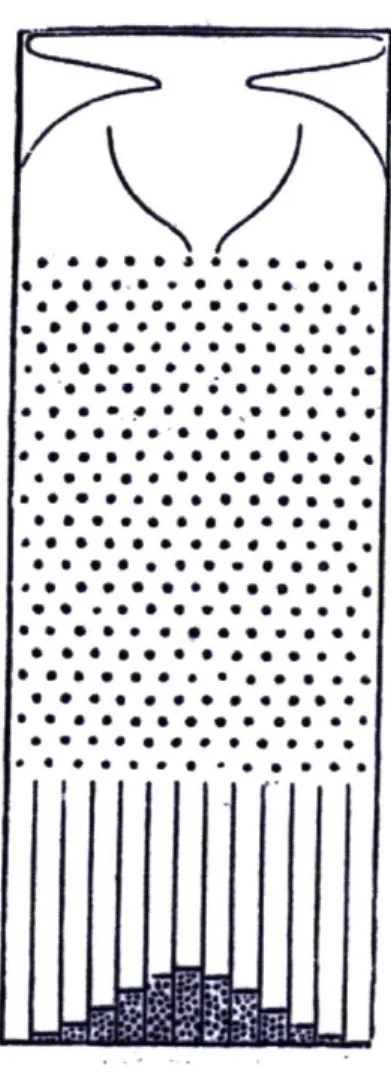
expectations and predictions with respect to the target probability distribution, and as the number of samples grows these approximations approach the exact distribu-tions of interest. As a physical example, consider the "plinko" machine (Figure 1-1, Galton, 1889) - this device represents a Gaussian distribution in so far as additional balls dropped in can generate additional (approximately) Gaussian samples. Repre-sentations via samples and sample-generating procedures can represent uncertainty as the variation of the set of samples (in contrast to single point-estimates). More-over, in contrast to weighted lists, sample-based representations may be truncated at a short, finite length without introducing systematic error.
1.1.4
Theoretical considerations
Sample-based inference is typically used in machine learning and statistics to ap-proximate Bayesian inference for a number of reasons that also make it an appealing process-model for cognitive science. First, sampling algorithms are applicable to a large range of computational models, thus affording a general inference scheme for a range of models across cognitive domains. Second, sampling algorithms scale effi-ciently to high-dimensional problems while minimizing the consequences of the curse of dimensionality; thus remaining plausible candidates for implementations of real-world inference. Third, sampling algorithms are a class of just-in-time algorithms that allow for a smooth tradeoff between precision, speed and computational load; thus sampling algorithms can be used under conditions of limited time and cognitive resources, while also supporting more accurate inferences when resources allow.
For our purposes, the central appeal of sampling algorithms as candidate process models are their graceful degradation with limited cognitive resources as well as their just-in-time properties. However, one would be right to ask: just how much sampling is necessary? In Bayesian statistics and machine learning, it is well-known that ac-curate inference requires tens or hundreds of thousands of samples, each of which is effortful to produce. We recently asked whether the same holds true when making
decisions: How many samples are necessary to make sufficiently accurate decisions?
* . .. e.,0 0 e .. 0 *0 0 0 .0 0 . 0 0 .3*S . . 0 0 00 . * e*e .. 00. 0000 .e ... 00 .0ee.. ... .9 0 0e 0 . 0, 0 . 0 .~ * . . . e.00 e0 SO.e 00. *s.0 eee.e.e 0 .S. @00. . I Ulm I000
Figure 1-1: A physical example of a sampling-function representation of a probability distribution. The plinko machine (quincunx from Galton, 1889) is a device that approximately represents a Gaussian probability distribution. A ball is dropped in
the top, and passes through a series of interlaced pegs - at each layer, there is a 50%
chance of the ball bouncing left or right. After passing through many such layers, the final distribution of positions is Gaussian (given the central limit theorem). Thus, this box is a physical instantiation of a sample-generating process.
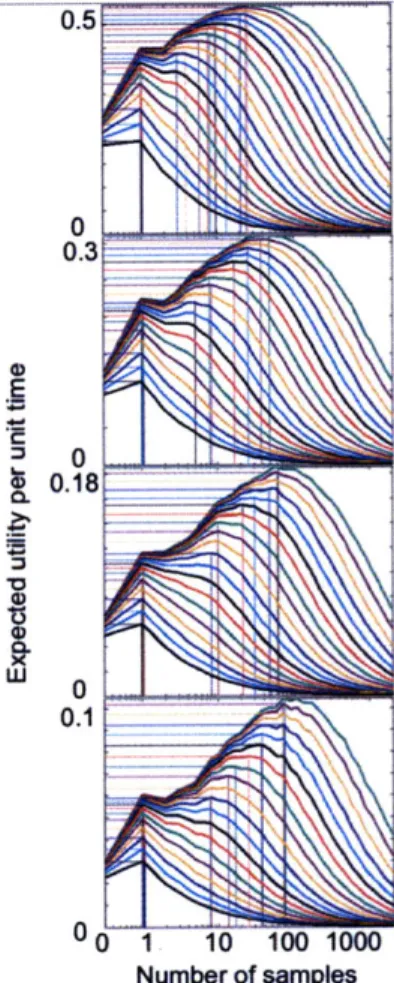
that are not much worse than those based on more precise inferences (Vul, Good-man, Griffiths, & Tenenbaum, n.d.). Moreover, on the assumption that sampling is a time-consuming process, we found that using just one sample for decisions often maximizes expected reward: making quick, suboptimal decisions is often the globally optimal policy (Chapter 2).
1.2
Relationship between sampling and classical
theories
Although the sampling hypothesis is a novel process-level description that can connect computational Bayesian models, it is closely related to several classical laws and theories of cognition.
1.2.1
Probability matching
Probability matching (Herrnstein, 1961; Vulkan, 2000) refers to the characteristic behavior of people and animals when faced with a risky choice among several alter-natives. In a typical probability matching experiment, an observer is faced with a choice between two options, one rewarded with probability p, the other with proba-bility i-p. The optimal choice is to maximize and always choose the option with the greater probability of reward; however, instead, people choose the two alternatives with frequency proportional to the probability of reward; thus matching the reward probability. Thus people behave suboptimally, raising the question of why. Probabil-ity matching can be described as sampling from prior experience: randomly selecting previously experienced outcomes and choosing the option that was rewarded most of-ten in the set of sampled outcomes. When only one previous trial is considered, this procedure yields probability matching, and if more trials are considered then behav-ior will vary between probability matching and maximizing. However, the sampling hypothesis is not restricted to previously experienced outcomes: hypotheses may be sampled not only from direct experience but also from internal beliefs inferred
indi-rectly from observed data. The sampling hypothesis is thus a possible explanation of
the probability matching phenomenon 3, and a generalization of the matching law to
provide predictions about cognition and behavior in cases of pure reasoning, rather than prediction from direct prior experience.
1.2.2
Generalized Luce choice axiom and soft-max link
func-tions
Luce (1959) described a more general relationship between representations and be-havior. He argued that people make responses in proportion to the strength of some internal representations:
PR(a) = v(a)/ v b,(.)
b
where PR(a) is the probability of responding with option a, while v(x) is the value of the internal representation. The soft-max generalization of the Luce choice axiom
postulates that v(x) = p(x)L so that the probability of choosing an alternative is
proportional to the posterior probability of that alternative raised to an exponent L. This formulation provides two interesting generalizations of simple probability match-ing: first, the exponent L yields a smooth gradient between probability matching and maximizing. Second, by generalizing the choice formulation to apply to any quantity of interest - not just probability of reward - this formulation allows for a link between decisions and cognitive representations across domains. Bayesian models of cognition typically rely on this soft-max link function to interface between model predictions and behavior (e.g., Frank, Goodman, & Tenenbaum, 2009; Goodman et al., 2008).
Sample-based approximations ground both of these applications of the generalized
3
0f course, sampling is only one of many possible explanations of probability matching, one recent compelling alternative suggests that matching arises from optimal decisions in light of uncertainty about the structure of the reward process (Green, Benson, Kersten & Schrater, 2010), this alterna-tive is preferable to sampling because it predicts the power-law dynamics of response switching in probability matching behavior.
Luce choice axiom in a single process model. First, the exponent L is a proxy for the number of samples used in a decision: decisions based on more samples (greater k) will follow the choice rule with a correspondingly greater Luce choice exponent (L).
' Second, sample-based inference on any problem will yield a soft-max relationship
between posterior probabilities and response probabilities, thus justifying (and ex-plaining the common need to use) soft-max link functions to connect ideal Bayesian observers to human behavior.
1.2.3
Point-estimates, noise, and drift-diffusion models
Point-estimate based representations explain variation across trials and individuals as noise corrupting point-estimates. Because the structure of the noise defines a probability distribution over possible states, the variation in responses across trials predicted by sampling and predicted by the noise accounts align under these special circumstances. Crucially, however, as I will describe below, predictions of these two accounts diverge when considering the relationship between the errors contained in different guesses.
A specific case of the noisy point-estimate account - the drift-diffusion model
(Ratcliff, 1978; Gold & Shadlen, 2000) - allows for quantitative assessment of speed-accuracy tradeoffs on the tacit assumption that people aggregate noisy samples of input data until they reach some decision criterion. These cases may be construed as obtaining "samples" from the external world when used to account for perceptual decisions (Gold & Shadlen, 2000), but when applied to cognitive decisions, such as memory retrieval (Ratcliff, 1978), the samples must be internally generated. In cases where drift-diffusion models are applied to memory, they are superficially isomorphic to sample-based inference about internal beliefs.
4The exact relationship between the Luce choice exponent (L) and the number of samples (k) used to make a binary decision is analytically intractable, and varies as a function of the underlying probabilities. In all cases, however, as k increases, L increases monotonically. The relationship between L and k is non-linear and variable: This function can be described as piecewise linear, with a steeper slope for small k and a shallower slope for larger k. For Bernoulli trials, when p is near
0.5 this transition happens around k = 100. As p increases, the slopes of the linear components
Thus, the sampling hypothesis unifies internal noise, drift diffusion models, and soft-max probability matching behavior under one general framework that describes how people can approximate optimal Bayesian inference in situations without direct prior experience about the task at hand and must make decisions and inferences based solely on pure reasoning.
1.3
People seem to sample basic monte carlo
Critically, representation via point-estimates, probability distributions, or samples, make different predictions about the information contained in errors and response variability. According to the noisy Boolean point-estimate hypothesis, variation across responses arises from the accumulation of noise on internal point-estimates
- thus, errors will be cumulative and correlated. If internal representations are
com-plete probability-distributions, variation in responses can only reflect variation in inputs or utility functions. In contrast, the sampling hypothesis predicts that varia-tion in responses arises from sampling under uncertainty and thus multiple responses will contain independent error, improve estimates when averaged, and will reflect the posterior distribution of beliefs. Thus, although using only one or a few sam-ples for decisions will not result in substantially worse performance, it will produce characteristic response variation which we can look for in human behavior.
Although sampling - resulting in probability-matching to internal beliefs - pre-dicts similar behavior to noisy point-estimate based representations, there is a crucial distinction in the relationship between multiple guesses. According to internal noise models, a single point-estimate is corrupted by noise, and this noise will therefore be shared by a number of guesses based on the same point estimate. In contrast, sampling based models might predict the same distribution of errors as noise based models on the first guess; however, crucially they predict independence between mul-tiple guesses, based on the same stimulus information. This prediction has now been thoroughly tested in the case of selective visual attention - a domain where such dependencies between guesses can be precisely teased apart - as well as high-level
cognitive decisions.
Vul, Hanus, and Kanwisher (2009) asked subjects to report one letter from a
circular array cued by a line. In these situations, subjects often report nearby items instead of the target. Vul et al. asked if such errors reflect internal noise or sampling under uncertainty. Subjects made multiple guesses about the identity of the cued letter and the researchers investigated the spatial dependency between guesses. If errors in this task reflect noise corrupting the position of the cue, then there would be a correlation in errors between the two guesses: if the first guess contained an error clockwise from the cue, the second guess should as well. However, if these errors due to sampling given uncertainty about the spatial co-occurrence of cue and target, then the errors should be independent. The authors found that the first and second guess were independent and identically distributed - this is characteristic of independent samples from a probability distribution describing uncertainty about the spatial co-occurrence of letters with the cue. This result was replicated for the case of temporal uncertainty when subjects selected items from a rapid serial visual presentation (RSVP) (Vul et al., 2009). Together, these results indicate that when subjects are asked to select items under spatiotemporal uncertainty, subjects make guesses by independently sampling alternatives from a probability distribution over space and time (Chapter 3).
This claim may be further tested and extended by asking subjects to report two orthogonal features of the target object to assess whether illusory conjunctions (Treisman & Schmidt, 1982), or misbinding errors, also arise from sampling under spatiotemporal uncertainty. Vul and Rich (in press) presented subjects with arrays and RSVP streams of colored letters and asked subjects to report both the color and the letter. Given the permuted arrangement of colors and letters, these two dimen-sions yielded two independent estimates of the reported spatial positions. Again, the correlation between these reports could be used to evaluate the independence of the two guesses. In this case as well, errors were independent indicating that different features are independently sampled and that illusory conjunctions and binding errors
One consequence of the independent error arising from sampling under uncertainty is a prediction of a "wisdom of crowds" (Suroweicki, 2004) within one individual. Galton (1907) demonstrated that averaging guesses from multiple individuals yields a more accurate answer than can be obtained from one individual alone because the independent error across individuals averages out to yield a more accurate estimate.
If multiple guesses from one individual are independent samples, they should also
contain independent error, and then the average of multiple guesses from one individ-ual should also yield a similar "wisdom of crowds" benefit, where the crowd is within one individual. Vul and Pashler (2008) tested this prediction in the domain of world knowledge by asking subjects to guess about world trivia (e.g., what proportion of the worlds airports are in the United States?). After subjects made one guess for each question, they were asked to provide a second guess for each. The average of two guesses was more accurate than either guess alone, suggesting that the two guesses contained some independent error (despite the fact that subjects were motivated to provide their best answer on the first guess). This independence would arise if people made guesses by sampling from an internal probability distribution over estimates
(Chapter 5).
The above cases verify the predictions of the sampling account in cases where the implicit computational model is not specified, but does the sampling hypothesis yield additional predictive power in cases with a concrete computational model? Goodman et al. (2008) investigated human decisions in a category-learning task, where subjects see several examples of a category, and are then asked to decide whether new items be-long to the category or not. Goodman et al. (2008) found that the average frequency with which subjects classify new items fits almost perfectly with the probabilistic predictions of a Bayesian rule-learning model. The model considers all possible clas-sification rules, computes a posterior probability for each rule given the training data, and then computes the probability that any item belongs to the category by averaging the decisions of all possible rules weighted by their posterior probabilities. Is this fully Bayesian inference what individual subjects do on any one trial? Not in this task. Goodman et al. (2008) analyzed the generalization patterns of individual subjects
reported by (Nosofsky, Palmeri, & McKinley, 1994) and found that response patterns across seven test exemplars were only poorly predicted by the Bayesian ideal. Rather than averaging over all rules, these generalization patterns were instead consistent with each participant classifying test items using only one or a few rules; while the particular rules considered vary across observers according to the appropriate poste-rior probabilities. Thus, it seems that individual human learners are somehow drawing one or a few samples from the posterior distribution over possible rules, and behavior that is consistent with integrating over the full posterior distribution emerges only in the average over many learners. Similar sampling-based generalization behavior has been found in word learning (Xu & Tenenbaum, 2007) and causal learning tasks (Sobel, Tenenbaum, & Gopnik, 2004), in both adults and children.
1.4
Specific sampling algorithms for specific tasks
Although predictions of sample-based inference are confirmed across a number of domains, the fact remains that producing a sample from the appropriate posterior distribution is no trivial task. In computer science and statistics there are many algorithms available for doing Monte Carlo inference. Simple sample-generating al-gorithms, like rejection sampling, tend to be slow, inefficient, and computationally expensive. In practice, different sampling algorithms are chosen for particular prob-lems where they may be most appropriate. Therefore, while "sampling" may capture some cognitive phenomena at a coarse grain, the exact sampling algorithms used may vary across domains, and may provide more accurate descriptions of specific behavioral phenomena and the dynamics of cognition.
Most real-world domains offer only small amounts of training data which must then support a number of future inferences and generalizations. Shi, Griffiths, Feld-man, and Sanborn (in pressa) showed that in such domains, exemplar models (Medin
& Shaffer, 1978) using only a few examples can support Bayesian inference as an
importance sampler (Ripley, 1987). This can be achieved using an intuitive psycho-logical process of storing just a small set of exemplars and evaluating the posterior
distribution by weighting those samples by their probability - a process known as "importance sampling". Shi et al. (in pressa) argued that such an "importance sam-pler" accounts for typicality effects in speech perception (Liberman, KS, Hoffman, & Griffith, 1957), generalization gradients in category learning (Shepard, 1987), optimal estimation in everyday predictions (Griffiths & Tenenbaum, 2006), and reconstructive memory (Huttenlocher, Hedges, & Vevea, 2000).
In domains where inference must be carried out online as data are coming in, such as sentence processing (Levy, Reali, & Griffiths, 2009), object tracking (Vul, Frank, Alvarez, & Tenenbaum, 2010), or change-point detection (Brown & Steyvers, 2008), particle filtering is a natural algorithm for doing this online inference. Particle filters track a sampled subset of hypotheses as they unfold over time; at each point when additional data are observed, the current set of hypothesized states are weighted based on their consistency with the new data, and resampled accordingly - as a consequence, this inference algorithm produces a bias against initially implausible hypotheses. Levy et al. (2009) showed how this bias can account for garden-path effects in sentence processing: when the start of the sentence suggests one interpretation, but the end of the sentence disambiguates the interpretation in favor of a less likely alternative, people are substantially slowed as they search for the correct parse. This difficulty arises in particle filtering because of the challenge ofresampling/updating when the correct hypothesis is not within the currently entertained set of particles. Similar arguments have been used to explain individual differences in change detection (Brown
& Steyvers, 2008), and performance while tracking objects (Vul et al., 2010), and
might be fruitfully applied to describe other classic sequential inference biases (e.g., Bruner & Potter, 1964). Of course, many other process models could indirectly yield similar results, for instance MCMC algorithms (discussed below), will also be slow to shift to unlikely (and distant) hypotheses if the probability landscape dramatically changes on account of new data.
In some real-world and laboratory tasks, the observer sees all the relevant data and must make sense of it over a period of time. For instance, when looking at at
of the relevant data at once, but must then come up with a consistent interpreta-tion of the data. In cases where two equally likely interpretainterpreta-tions of the stimulus are available, the perceived interpretation changes stochastically over time, jumping between two modal interpretations. Sundareswara and Schrater (2007) demonstrated that the dynamics of such rivalry in the case of a Necker cube arises naturally from approximate inference via Markov Chain Monte Carlo (MCMC; Robert & Casella, 2004). Gershman, Vul, and Tenenbaum (2010a) elaborated on this argument by showing that MCMC in a coupled markov random field - like those typically used as computational models of low-level vision - not only produces bistability and binoc-ular rivalry, but also produces the characteristic traveling wave dynamics of rivalry transitions (Gershman et al., 2010a; Wilson, Blake, & Lee, 2001).
Specific sampling algorithms yield concrete predictions about online processing effects which have been inaccessible to strictly computational accounts. The dynamics of online sampling algorithms can predict learning effects, online biasing effects, as well as the specific dynamics of decision making and belief formation.
1.5
Conclusion
We started with a set of challenging questions for an ideal Bayesian description of the computational level of human cognition: How can people approximate ideal sta-tistical inference despite their limited cognitive resources? How can we account for the dynamics of human cognition along with the associated errors and variability of human decision-making? Across a range of cognitive behaviors, sampling-based ap-proximate inference algorithms provide an account of the process-level dynamics of human cognition as well as variation in responses.
Chapter 2
One and Done? Optimal Decisions
From Very Few Samples
2.1
Thesis framing
The sampling hypothesis suggests that people approximate ideal Bayesian computa-tions by sampling, thus allowing themselves to make near-optimal decisions in large real-world problems under time constraints and with limited cognitive resources. However, sampling itself is often a difficult procedure, and to approximate exact Bayesian inference many samples are required. In this chapter, I ask how many sam-ples are necessary to make a decision and demonstrate that decisions based on few samples are quite close to optimal, and may even be globally optimal themselves, when factoring in the cost of making slow decisions.
A much shorter version of this chapter has been published as: (Vul et al., n.d.).
Abstract
In many learning or inference tasks human behavior approximates that of a Bayesian ideal observer, suggesting that, at some level, cognition can be described as Bayesian inference. However, a number of findings have highlighted an intriguing mismatch between human behavior and standard assumptions about optimality: people often appear to make decisions based on just one or a few samples from the appropriate posterior probability distribution, rather than using the full posterior distribution. Although sampling-based approximations are a common way to implement Bayesian
inference, the very limited numbers of samples often used by humans seem insuf-ficient to approximate the required probability distributions very accurately. Here we consider this discrepancy in the broader framework of statistical decision theory, and ask: if people are making decisions based on samples but samples are costly, how many samples should people use to optimize their total expected or worst-case reward over a large number of decisions? We find that under reasonable assump-tions about the time costs of sampling, making many quick but locally suboptimal decisions based on very few samples may be the globally optimal strategy over long periods. These results help to reconcile a large body of work showing sampling-based or probability-matching behavior with the hypothesis that human cognition can be understood in Bayesian terms, and suggest promising future directions for studies of resource-constrained cognition.
2.2
Introduction
Across a wide range of learning, inference and decision tasks, it has become increas-ingly common to analyze human behavior through the lens of optimal Bayesian mod-els (in perception: Knill & Richards, 1996; motor action: Maloney et al., 2007; language: Chater & Manning, 2006; decision making: McKenzie, 1994; causal judg-ments: Griffiths & Tenenbaum, 2005; and concept learning: Goodman et al., 2008). However, despite the many observed parallels, the argument for understanding hu-man cognition as a form of Bayesian inference remains far from complete. This paper addresses two challenges. First, while human behavior often appears to be optimal when averaged over multiple trials and subjects, it may not look that way within individual subjects or trials. There will always be variance across these dimensions in any behavioral experiment, but the micro-level variation observed in many studies comparing human behavior to Bayesian models is not simply random noise around the model predictions. What kind of online processing is going on inside individual subjects' minds that can appear so different at the local scale but approximate opti-mal behavior when averaged over many subjects or many trials? Second, while ideal Bayesian computations are algorithmically straightforward in most small laboratory tasks, they are intractable for large-scale problems such as those that people face in the real world, or those that most Bayesian machine learning and artificial intelli-gence systems focus on. If human cognition is to be understood as a kind of Bayesian inference, we need an account of how the mind rapidly and effectively approximates these intractable calculations in the course of online processing.
Here we argue that both of these challenges can be resolved by viewing cognitive processing in terms of stochastic sampling algorithms for approximate Bayesian infer-ence, and analyzing the cost-benefit tradeoff underlying the question of "How much to think?". Standard analyses of decision-making as Bayesian inference assume that people should seek to maximize the expected utility (or minimize the expected cost) of their actions, relative to their posterior distribution over hypotheses. We show that in many settings, this ideal behavior can be approximated by an agent who considers only a small number of samples from the Bayesian posterior, and that the time cost
to obtain more than a few samples outweighs the expected gain in decision accuracy they would provide. Hence human cognition may approximate globally optimal be-havior by making a sequence of noisy, locally suboptimal decisions - much as we see when we look closely at individual experimental subjects and trials.
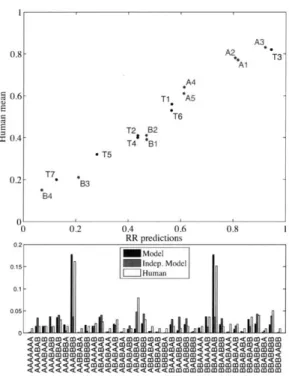
This first challenge - accounting for behavior within individual subjects and tri-als - is highlighted by an intriguing observation from Goodman et al. (2008) about performance in classic categorization tasks. Typically subjects learn to discriminate positive and negative exemplars of a category, and are then asked to generalize the learned rules to new transfer items. Goodman et al. (2008) showed that the average frequency with which subjects classify transfer items as positive instances fits almost perfectly with the probabilistic predictions of a Bayesian rule-learning model (Figure 2-1a). The model considers all possible logical rules for classification (expressed as disjunctions of conjunctions of Boolean features), computes a posterior probability for each rule given the training data, and then computes the probability that any item is a positive instance by averaging the decisions of all possible rules weighted
by their posterior probabilities. Do individual subjects compute this same average
over all possible rules in their heads on any one trial? Not in this task. Goodman et al. (2008) analyzed the generalization patterns of more than 100 individual subjects reported by (Nosofsky et al., 1994) and found that the response patterns across seven test exemplars were only poorly predicted by the Bayesian ideal, even allowing for random response noise on each trial (Figure 2-1b). Rather than averaging over all rules, these generalization patterns were consistent with each participant classifying test items using only one or a few rules; while which rules are considered varies across observers according to the appropriate posterior probabilities (Figure 2-1c). Thus, it seems that individual human learners are somehow drawing one or a few samples from the posterior distribution over a complex hypothesis space, and behavior that is consistent with integrating over the full posterior distribution emerges only in the average over many learners. Similar sampling-based generalization behavior has been found in word learning (Xu & Tenenbaum, 2007) and causal learning tasks (Sobel et al., 2004), in both adults and children.
This sampling behavior is not limited to categorization tasks but has been found in many other higher-level cognitive settings. For example, Griffiths and Tenenbaum
(2006) studied people's predictions about everyday events, such as how long a cake
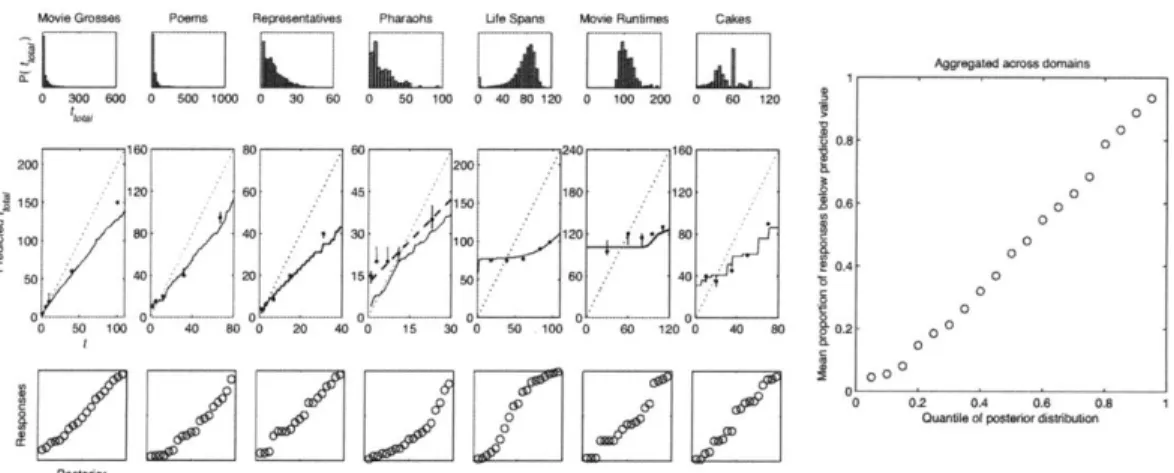
will bake given that it has been in the oven for 45 minutes. They found a close match between the median subjects' judgments and the posterior medians of an optimal Bayesian predictor (Figure 2-2a). But the variation in judgments across subjects suggests that each individual is guessing based on only one or a small number of samples from the Bayesian posterior (c.f. Mozer et al., 2008), and the distribution of subjects' responses looks almost exactly like the Bayesian posterior distribution, rather than the optimal choice under the posterior perturbed by random response noise. Figure 2-2 shows the comparison of median human judgments with Bayesian posterior medians, along with the full quantile-quantile plots relating human and model predictions for seven different classes of everyday events, and an aggregate plot combining these data. While there are some deviations in specific cases - such as a tendency to produce tighter predictions than the posterior for human lifespans
-A3 0.8- A 'T3 A1 A4 9 0.6~ T1 A5 T6 E T2 B2 0.4- a -T4 'B1 T5 0.2- e B3 B4 0 0 0.2 0.4 0.6 0.8 RR predictions = Model
OAS . Indep. Model
[ Human
0.1 -
-0-lnillll-lilgillilliiilliilliMAUll]m <MMMCD <Mmm mmmm coca m<C00
Smmmmmm 11CMMMwM<OMm wwm .n 1*OMMwMMM
Figure 2-1: (Top) Generalization to new exemplars by subjects who learned a cate-gorization rule is almost perfectly predicted by the ideal Bayesian model that learns a posterior over categorization rules, and then makes responses for each exemplar by considering this complete probability distribution (as shown by a very high correla-tion between model prediccorrela-tions, and predicted categorizacorrela-tion probability; Goodman et al., 2008). (Bottom) However, the histogram of generalization patterns for seven test stimuli (white bars) does not match this ideal observer (grey bars). General-ization patterns seem to reflect a much greater correlation of beliefs from one test probe to the next than would be predicted by a model where individuals make inde-pendent judgements to test stimuli, based on the full posterior over rules. Instead, generalization patterns are consistent with individual subjects adopting one, or a few, rules in proportion to their posterior probability, and making many generalization re-sponses accordingly (black bars; Goodman et al., 2008). Bayesian behavior emerges only on average, while individual subjects seem to reflect just a few samples from the posterior.
the aggregate results show a close match between the two probability distributions, consistent with the idea that people are making predictions by sampling from the posterior distribution.
Further evidence that people make predictions by sampling comes from studies in which individuals must produce more than one judgment on a given task. Multiple guesses from one individual have been found to have independent errors, like indepen-dent samples from a probability distribution, when people are making estimates of esoteric quantities in the world (Vul & Pashler, 2008) or in guesses about cued visual items (Vul et al., 2009), and in illusory conjunctions in visual attention tasks (Vul & Rich, in press). More broadly, models of category learning (Sanborn & Griffiths, 2008; Sanborn, Griffiths, & Navarro, 2006; Shi, Griffiths, Feldman, & Sanborn, in pressb), change detection (Brown & Steyvers, 2008), associative learning (Daw & Courville,
2008), and language learning (Xu & Tenenbaum, 2007), have explicitly or implicitly
relied on a sampling process like probability matching (Herrnstein, 1961) to link the ideal Bayesian posterior to subjects' responses, indicating that in many cases when Bayesian models predict human behavior, they do so through the assumption that people sample instead of computing the response that will maximize expected utility under the full posterior distribution.
The second challenge - that Bayesian inference is intractable - comes from the challenges that are produced in scaling probabilistic models to real-world problems. For problems involving discrete hypotheses about the processes that could have pro-duced observed data, the computational cost of Bayesian inference increases linearly with the number of hypotheses considered. The number of hypotheses can increase in any problem that has combinatorial structure. For example, the number of causal structures relating a set of variables increases exponentially in the number of variables (with over three million possible structures for just six variables), and the number of clusterings of a set of objects increases similarly sharply (with over a hundred thousand partitions of just ten objects). In other cases, we need to work with infinite discrete hypothesis spaces (as when parsing with a recursive grammar), or continuous hypothesis spaces where there is no direct way to calculate the integrals required for Bayesian inference. The high computational cost that results from using probabilistic models has led computer scientists and statisticians to explore a variety of approxi-mate algorithms, with exact computations being the exception rather than the rule in implementations of Bayesian inference.
Within cognitive science, critics of the Bayesian approach have seen these chal-lenges as serious enough to question the whole program of Bayesian cognitive model-ing. One group of critics (e.g., Mozer et al., 2008) has suggested that although many samples may adequately approximate Bayesian inference, behavior based on only a few samples is fundamentally inconsistent with the hypothesis that human cogni-tion is Bayesian. Others highlight the second challenge and argue that cognicogni-tion cannot be Bayesian inference because exact Bayesian calculations are computation-ally intractable, so the brain must rely on computationcomputation-ally efficient heuristics (e.g., Gigerenzer, 2008). Addressing these challenges is thus an important step towards increasing the psychological plausibility of probabilistic models of cognition.
Movie Grosses Poems Representatives Pharaohs Ufe Spans Movie Runtimes Cakes 1 Aggregatedacross domains 0 300 600 0 500 1000 0 30 60 0 50 100 0 40 80 120 0 100 200 0 60 120 0 1m 0 0 160 80 60 240 160 0.8 0 200 200 8 5 0 120 60 45 180 120 10, 0100 0O.6 0 0 100 1 80 0 0 80.4 50 40 20 15 00 60 40 0 00 50 100 0 0 80 0 0 4000 15 3000 00 10000 80 12000 40 OD 10,.2 00
0 0.2
0.40.6 0.8 1
Quantile of posterior distributionPosterior
Figure 2-2: Data from Griffiths & Tenenbaum (2006) showing optimal predictions for everyday quantities. (Left, top row) The real empirical distributions of quantities across a number of domains; from left to right: movie grosses, poem lengths, time served in the US House of Representatives, the reign of Egyptian pharaohs, human life spans, movie runtimes, and the time to bake a cake. (Left, middle row) When participants are asked to predict the total quantity based on a partial observation (e.g., what is the total baking time of a cake given that it has been baking for 45 min-utes?) they make predictions that appear to match the Bayesian ideal observer that knows the real-world distribution. Thus, it would appear that in all of these domains, people know and integrate over the full prior distribution of (e.g.) cake baking times when making one prediction. (Left, bottom row) However, the quantile-quantile plots comparing the distributions of human predictions with the corresponding posterior distributions reveal a different story. For each prediction, the quantiles of human re-sponse distributions were computed, and compared with the corresponding posterior distribution produced by using Bayesian inference with the appropriate prior (to pro-duce each plot, quantiles were averaged across five predictions for each phenomenon).
A match between the Bayesian posterior distribution and the distribution of people's
responses corresponds to data points following along a diagonal line in these plots -where the quantiles of the two distributions are in direct correspondence. (Right) The correspondence between the posterior predictive and human responses is most pro-nounced when considering the quantile-quantile plot that reflects an aggregate over all seven individual quantities. Thus, people make guesses with frequency that matches the posterior probability of that answer, rather than maximizing and choosing the most likely alternative. This indicates that although participants know the distribu-tion of cake baking times (as evidenced by the quantile-quantile match), they do not produce the optimal Bayesian response by integrating over this whole distribution, but instead respond based on only a small number of sampled baking times.
reconciled with optimal Bayesian inference and may be the method by which people approximate otherwise intractable Bayesian calculations. Our argument has three central claims. First, that sampling behavior can be understood in terms of sensible sampling-based approaches to approximating intractable inference problems of the kind used in Bayesian statistics and computer science. Second, that very few samples from the Bayesian posterior are often sufficient to obtain approximate predictions that are almost as good as predictions computed using the full posterior. And third, that under conservative assumptions about how much time it might cost to produce a sample from the posterior, making predictions based on very few samples (even just one), can actually be the globally optimal strategy.
2.3
Approximating Bayesian inference by sampling
Bayesian probability theory prescribes a normative method for combining prior knowl-edge with observed data, and making inferences about the world. However, the claim that human cognition can be described as Bayesian inference does not imply that people are doing exact Bayesian inference. Exact Bayesian inference amounts to fully enumerating hypothesis spaces every time beliefs are updated with new data. This is computationally intractable in any large-scale application, so inference must be approximate. As noted earlier, this is the case in Bayesian artificial intelligence and statistics, and is even more relevant to solving the kinds of problems we associate with human cognition, where the real-world inferences are vastly more complex and responses are time-sensitive.
The need for approximating Bayesian inference leaves two important questions. For artificial intelligence and statistics: What kinds of approximation methods work best to approximate Bayesian inference? For cognitive science and psychology: What kinds of approximation methods does the human mind use? In the tradition of ratio-nal aratio-nalysis (Anderson, 1991), or aratio-nalysis of cognition at Marr's (1982) computatioratio-nal level, one strategy for answering the psychological question begins with good answers to the engineering question. Thus, we will explore the hypothesis that the human mind approximates Bayesian inference with some version of the algorithmic strate-gies that have proven best in artificial intelligence and statistics, on the grounds of computational efficiency and accuracy.
In artificial intelligence and statistics, one of the most common methods for im-plementing Bayesian inference is with sample-based approximations. Inference by sampling rests on the ability to draw samples from an otherwise intractable
proba-bility distribution - that is to arrive at a set of hypotheses which are distributed
according to the target distribution, by using a simple algorithm (such as Markov chain Monte Carlo; Robert & Casella, 2004; or particle filtering; Doucet et al., 2001). Samples may then be used to approximate expectations and predictions with respect to the target probability distribution, and as the number of samples grows these
ap-proximations approach the exact quantities1. Sampling methods are typically used
because they are applicable to a large range of computational models, are robust to