Fodder Balance and New Approach for Management of Pastoral
Ecosystems in North-benin
Gaston Houngue, Oscar Teka
Abomey Calavi University, Laboratory of Applied Ecology, Benin. E-mail: [email protected]
Introduction
Breeding in Benin contributes for 16% of agricultural BIP and 6% of total BIP (Sinsin et al., 1996). Breeding of ruminants is extensive and essentially consumer of natural resources (Natta, 1997). In addition to fodder species of substitution (trees and shrubs), leguminous plants in the majority of cases, the spontaneous herbaceous vegetation, principally gramineous, constitutes the main source of ruminants feed in soudanian zone (Rivère, 1991; Yonkeu, 1991; Grouzis & Al, 1991; Peltier, 1991; Voltaire & Lelièvre, 1991; Coats & Al, 1991) but its growth decreases considerably at the end of the rainy season and disappears almost during the dry season (Daget & Al, 1991). This indicates strong internal dynamics of phytocenoses of savannas, which are used at the same time as detector of transformations of natural environment and as biological indicator of overgrazing (Sinsin, 1993). Apart from pedoclimatic factors, which determine fodder production and in addition to annual bush fires, which condition the availability of phytomasse during various meadow periods (Sinsin, 1993), the modes of pastures utilization strongly influence the viability of agropastoral ecological systems. It is important to have data about the evolution of natural pastures, to include sources of conflicts, which frequently oppose farmers and breeders and to propose a consequent approach in order to improve the agropastoral system in Benin. The aims of this study particularly are: i) to evaluate potential productivity of various types of pasture; ii) to estimate the quantity of remaining straw after the passages of traditional fires; iii) to determine the dynamic of “secondary growth” within pastures during the dry season; iv) to quantify harvested residues and to evaluate their contribution in animal feed; v) to calculate pastoral value and shrub percentage of various pastures; vi) to determine periodical carrying capacities and of course equivalent demands of pasture area; vii) to count sedentary livestock and to calculate the effective load of the Ranch; viii) to analyze the mode of utilization of natural and anthropized plant communities and; ix) to propose adapted solutions.
Study area
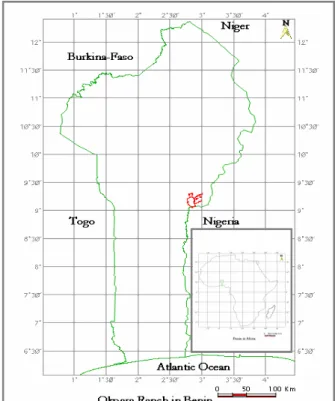
Located in septentrional Benin, the Ranch of Okpara covers an area of 33000 ha geogra-phically locatable by coordinates E 2°42 and E 2°53 then N 9°06 and N 9°20. It has a linear and longitudinal hydrographic net (Okpara) with its seasonal affluents. It is a zone characterized by a continental climate (soudanian type) with a marked dry season (5 months) and a 7-monthly rainy season. The pluviometric average is 1200 mm from April to October. Typical of tropical savan-nas, the soils of Okpara catchment are marked by the existence of deterioration materials with incomplete mineralogical process especially on tops of slopes. The structure of the vegetation presents four great types of vegetation: riparian forests, mosaics of savannas, grassy depressions then fields and fallow.
Methodology
The major elements such as types of vegetation, floristic homogeneity of plant communities and topographic situation (Plateau and depression) allowed to define selection criteria of sites of plots installation.
The design of investigation is composed by several plots within each type of pasture: 3 plots of productivity (10 m X 10 m) and 2 plots of monitoring (40 m X 40 m).
Typology of pastures was made using phytosociological surveys, that are carried out within plant communities according to Braun-Blanquet (1932).
Phytomass was measured according to Levang (1978) and Sinsin (1993). After the passage of traditional bush fires the remaining straw was evaluated.
For the control of fodder availability during the dry season, daily growth rate of herbaceous vegetation was calculated according to Blackman (1919) in Sinsin (1993). This rate is defined as the measurement of the efficiency of plants to produce new tissues:
r = (ln w
2– ln w
1)/t;
Where r = Daily growth rate; w1= Initial phytomass; w2= Final phytomass and T = Time interval between w1 and w2.
Harvested residues were evaluated on the basis of quantification of straws of maize and sorghum, krauts of groundnut, sheets and capsules of cotton plant, atrophied tubers of yam then sheets and peelings of manioc by using squares of density (4m²) posed with 3 recoveries in each type of culture).
Carrying capacity of different types of pasture was calculated based on the phytomass palatable for grazing animals (Boudet, 1984).
Linear transects were performed in each plot according to Daget & Poissonnet (1990) with a view to determine the frequency of plant species. These transects also allow to calculate the relative frequency and the specific contribution (CSC) of each plant species to the forage supply of grazing animals. At the same time pastoral values (Vp) and the percentage of shrub was determined for each type of pasture based on the results of these transects.
Vp = 0.25 Rv x ∑ CSCi x ISi
Where Rv = Soil cover (%) and ISi= coefficient of forage quality of a plant species i. The applied scale of IS ranges from 0 to 4.
For Vpo (Optimal pastoral value), Rv =100% and CSCrefused = 0
Ts = CSC refused / CSC total x 100
Shrub percentage designates the specific contribution of the total number of plants refused by the animals within a pasture.
Data processing
For weight data processing the used method is variance analysis ANOVA (STATITCF). The different values were analyzed using Newman and Keuls test considering their variance at the 5% threshold. The area of various plant communities were determinated using TNTmips and Landsat Image 7ETM+ (11.12.99).
Results and Discussion
Productivity and carrying capacity
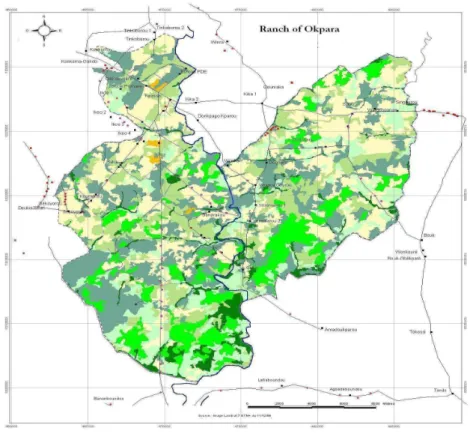
Figure 2 presents the typology of natural pastures, the productivity and the carrying capacity of plant communities and farms at the ranch of Okpara. At the pic of biomass, the herbaceous
phytomasses inform about of the annual productivity of pastures (César, 1990; Sinsin, 1993). The average productivity (natural phytomass) is 3.71 ± 2.07 tDM/ha. Farms provide 0.12 ± 0.07 tDM/ha (Table 1). The gramineous phytomass varies according to type of pasture. Considering the various types of fire (early fire, late fire, and out-of-season fire) applied in hazardous way to all the ranch, there is a significativ difference between the average productivities (p<0.05), that reflects the relevance of biological characteristics of various facies in the fram of pastures management. This supports the concept that it is crucial to maintain a consistent analytical approach of pastures differentiation. The hierachisation of the pastures according to the test of Newman-Keuls at the threshold of 5% is presented as follows:
Pasture with Productivity (tDM/ha) Homogeneous groups
Hyparrhenia involucrata 4.24 ± 0.32 A Andropogon schirensis 3.80 ± 0.36 B Brachiaria falcifera 3.41 ± 0.25 B Schizachyrium sanguineum 1.99 ± 0.61 B Andropogon tectorum 1.79 ± 0.42
B Hyparrhenia smithiana 1.63 ± 0.12 C
Table 1 : Contribution of harvested residues in animal feed
Residues Sowed surfaces
(ha) Productivity (tDM/ha) Contribution in animal feed (%) Straws of maize 623.20 0.12 0.52 Straws of sorghum 418.00 0.09 0.39 Foliage of groundnut 86.80 0.05 0.21
Sheets and capsules of cotton 393.40 0.11 0.48
Atrophied tubers of yam 281.00 0.19 0.82
Sheets and peelings of manioc 122.00 0.14 0.61
TOTAL 1924.40 0.72 3,13
Okpara Ranch counts 41 sedentairized Campings. Apart 2127 oxen of PDE (Breeding Development Project) the livestock counts one average 243 heads per camping. The carrying capacity of Okpara Ranch is 0.32 ± 0.31 TLU/ha/year. Compared to a seasonal load rate of 0.34 ± 0.11 TLU/ha/year, this implies a surplus load of 0.02 TLU/ha.
Critical threshold and renewal of phytomass
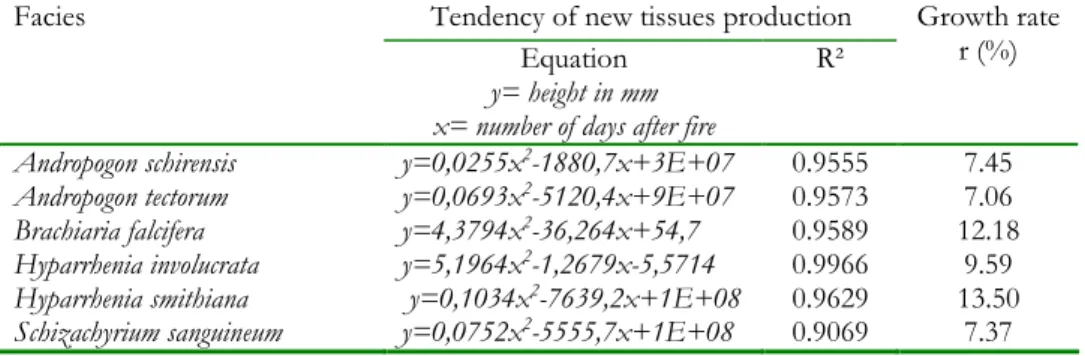
The production of the pastures is seasonal in the majority of tropical countries. It is surplus in rainy periods and overdrawn in dry season. After traditional fires, the remain phytomass represents only 1/10 of the potential production reached during the year. At the resumption of the vegetation, the secondary growth represents 9,61% of the potential production and is strongly choked by the woody secondary growth and weeds.
Table 2 : Speed of phytomass renewal
Tendency of new tissues production Facies
Equation
y= height in mm x= number of days after fire
R²
Growth rate r (%)
Andropogon schirensis y=0,0255x2
-1880,7x+3E+07 0.9555 7.45
Andropogon tectorum y=0,0693x2
-5120,4x+9E+07 0.9573 7.06
Brachiaria falcifera y=4,3794x2
-36,264x+54,7 0.9589 12.18
Hyparrhenia involucrata y=5,1964x2
-1,2679x-5,5714 0.9966 9.59
Hyparrhenia smithiana y=0,1034x2
-7639,2x+1E+08 0.9629 13.50
Schizachyrium sanguineum y=0,0752x2
Figure 2 : Pastures map of Okpara ranch Pastoral values and Shrub percentage
Pastoral values and Shrub percentage of various pastures seem to be acceptable (Table 3). The large soil covers and the low deviation between optimal and effective pastoral values testify the poor quality of available fodder.
Table 3 : Fodder quality on Okpara ranch Pasture (principal specie) Soil cover
(%) Optimal pastoral value Vpo (%) Effective pastoral value Vp (%) Shrub percentage (%) Foder quality
Andropogon schirensis 86 53.87 46.13 3.00 poor
Andropogon tectorum 89 59.41 53.25 7.00 poor
Brachiaria falcifera 75 68.51 51.13 2.00 acceptable
Hyparrhenia involucrata 92 47.97 43.17 5.00 bad
Hyparrhenia smithiana 55 60.33 43.63 0.50 acceptable
Mode of the ranch utilization
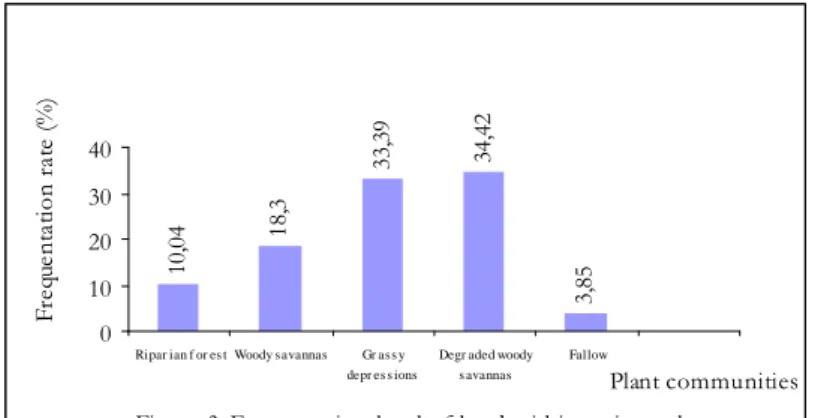
The use of the ranch of Okpara is hazardous and instictive. It is not oriented and depend not only on the availability of phytomass but also on the quality of pastures. Figure 3 shows the most frequented plant communities. This justifies the quality of the related pastures.
Approaches
Prescribed fires seem as an effective management tool. But in the fram of their application biological, phytogeographical and ecosociological characteristics of the various types of pastures must be considered.
Bibliography
Boudet G. 1991. Manuel sur les pâturages tropicaux et les cultures fourragères. Collection Manuels et Précis d’Elevage (4). Ministère de la Coopération et du Développement. 266 p.
Braun-Blanquet, J. 1932. Plant sociology. The study of plant communities. English translation of ‘Pflanzensoziologie‘ by G.D. Fuller and H.S. Conard, University Chicago, USA. 439 p.
Daget, P. & Poissonnet. J. 1990. Prairies permanentes et pâturages. Méthodes d’étude, Institut de botanique, Montpellier. 352 p.
Grouzis M., Nizinski J. & Akpo E. 1991. L’arbre et l’herbe au sahel : Influence de l’arbre sur la structure spécifique et la production de la strate herbacée et sur la régénération des espèces ligneuses. IVth International Rangeland
Congress. Montpellier, France, (1): 207-210.
Levang, P. 1978. Biomasse herbacée de formations sahéliennes. Étude méthodologique et application au bassin versant de la mare d'Oursi. ACC, Lutte contre l'aridité dans l'Oudalan (Haute-Volta), ORSTOM, France : 29 p. + ann.
Natta A. 1997. Contribution à l’étude de la productivité et de la gestion des pâturages naturels dans le Nord-Ouest de l’Atacora : Région de Boukoumbé Matéri. Mémoire d’Ingénieur Agronome FSA/UNB, Bénin. 80-95.
Peltier R. 1991. Productivité en bois et en herbe d’une savane arborée du Nord-Cameroun, sous pâturage feu et coupe. IVth International Rangeland Congress. Montpellier, France, (1): 221-225.
Rivière R. 1991. Alimentation des ruminants domestiques en milieu tropical. Collection manuel et précis d’élevage. IEMVT 9, France. 529 p.
Sinsin B. 1993. Phytosociologie, Ecologie, Valeurs pastorales, Productivité et Capacité de charge des pâturages naturels du périmètre Nikki-Kalalé au Nord-Bénin. Thèse de doctorat Université Libre de Bruxelles, Belgique. 390 p. Sinsin et al. 1996. Gestion des pâturages naturels de la ferme d’élevage de l’Okpara. Rapport principal. Projet de Développement des Productions Animales, phase III (PDPA III); Cotonou, Bénin.
Voltaire F. & Lelièvre F. 1991. Potentiel de production de deux formations herbacées corses soumises à différentes interventions techniques. IVth International Rangeland Congress. Montpellier, France, (1): 236-238.
Yonkeu S. 1991. Evolution d’un écosystème sous l’effet d’une forte charge animale dans la de l’Adamaoua au Cameroun. IVth International Rangeland Congress. Montpellier, France, (1): 186-188.
Figure 3: Frequentation level of herd within various plant communities 10 ,0 4 18,3 33 ,3 9 34 ,4 2 3, 85 0 10 20 30 40
Ripar ian f or es t Woody s avannas Gr as s y depr es s ions
Degr aded woody s avannas Fallow Plant communities F re qu en ta ti o n r at e (% )