comment
reviews
reports
deposited research
interactions
information
refereed research
Protein family review
The 14-3-3s
Robert J Ferl, Michael S Manak and Matthew F Reyes
Address: Program in Plant Molecular and Cellular Biology, Department of Horticultural Sciences, University of Florida, Gainesville, FL 32611, USA.
Correspondence: Robert J Ferl. E-mail: [email protected]
Summary
Multiple members of the 14-3-3 protein family have been found in all eukaryotes so far investigated, yet they are apparently absent from prokaryotes. The major native forms of 14-3-3s are homo- and hetero-dimers, the biological functions of which are to interact physically with specific client proteins and thereby effect a change in the client. As a result, 14-3-3s are involved in a vast array of processes such as the response to stress, cell-cycle control, and apoptosis, serving as adapters, activators, and repressors. There are currently 133 full-length sequences available in GenBank for this highly conserved protein family. A phylogenetic tree based on the conserved middle core region of the protein sequences shows that, in plants, the 14-3-3 family can be divided into two clearly defined groups. The core region encodes an amphipathic groove that binds the multitude of client proteins that have conserved 14-3-3-recognition sequences. The amino and carboxyl termini of 14-3-3 proteins are much more divergent than the core region and may interact with isoform-specific client proteins and/or confer specialized subcellular and tissue localization.
Published: 27 June 2002
GenomeBiology2002, 3(7):reviews3010.1–3010.7
The electronic version of this article is the complete one and can be found online at http://genomebiology.com/2002/3/7/reviews/3010 © BioMed Central Ltd (Print ISSN 1465-6906; Online ISSN 1465-6914)
The 14-3-3 protein family is highly conserved and is repre-sented throughout the eukaryotic branch of life. The proteins were discovered in 1967 during a study of the soluble acidic proteins of the mammalian brain [1] and were named on the basis of fraction number during DEAE-cellulose chromato-graphy and location after starch gel electrophoresis. For 25 years, 14-3-3s were generally thought to reside exclusively in animal brain tissue and to be involved in the function of neurons. During this early period of research, 14-3-3s were characterized as a heterogeneous family of dimeric proteins with a monomer mass of 25-32 kDa and multiple isoelectric points. One of the first biochemical functions of the 14-3-3s to be identified was the activation of the neurotransmitter pathway enzymes tyrosine hydroxylase and tryptophan hydroxylase, in a reaction requiring calcium and the cAMP-dependent kinase or calmodulin-cAMP-dependent protein kinase II
[2]. Once 14-3-3s were found in Arabidopsis thaliana [3],
maize [4] and other plants, and in tissues other than the brain, however, perspectives on their presence and roles
broadened, and now 14-3-3s have been found in every eukaryote that has been screened for their presence. The vast number of organisms containing 14-3-3s suggests that this family of proteins is involved in many important biologi-cal processes [5].
Gene organization and evolutionary history
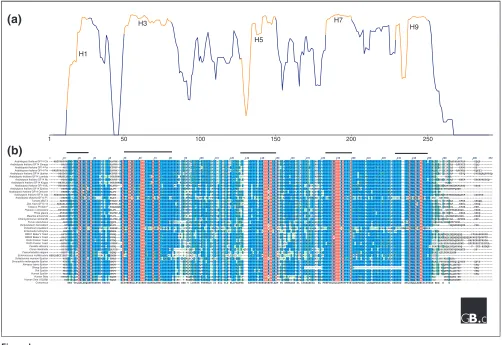
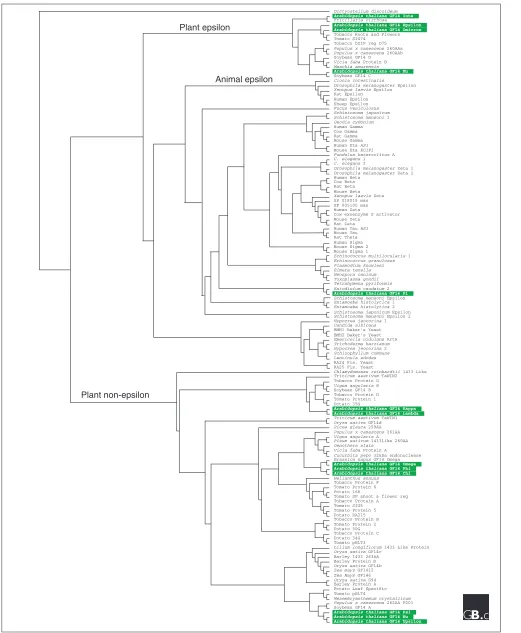
Each 14-3-3 protein sequence can be roughly divided into three sections: a divergent amino terminus, the conserved core region and a divergent carboxyl terminus. The high level of conservation in the core region is demonstrated in Figure 1a, which shows a similarity plot derived from an alignment of selected 14-3-3s. A phylogenetic tree generated from the full alignment of the core region is shown in Figure 2 and demonstrates that plant 14-3-3s fall into twogroups, an epsilon (ε) group and a non-epsilon group [6,7].
The plant non-epsilon group is very different from plant ε
and subgroupings are apparent, but the tree must be evalu-ated carefully because not all species are represented by a complete genome sequence [8]. The presence of the divergent termini and the few amino-acid changes that do occur within the conserved region result in multiple isoforms in most organisms and present the potential for client-specific inter-actions occurring in distinct cellular locations [9].
Although 14-3-3s are found throughout the eukaryotes,
Ara-bidopsis is an excellent model system for studying 14-3-3s for two reasons: it is a higher eukaryote with a fully sequenced genome and it has a large family of thirteen 14-3-3 isoforms [7]; there is also a wealth of knowledge on
key biological pathways. In Arabidopsis, the 14-3-3 epsilon
group has five members (µ (mu), ε, π (pi), ι (iota), and
ο(omicron) and the non-epsilon group has eight members
(κ(kappa), λ(lambda), ψ(psi), ν(nu), υ(upsilon), ω(omega),
φ(phi), and χ(chi)). The presence and chromosomal location
of all Arabidopsis14-3-3 isoforms is known (Table 1); there is
at least one 14-3-3 on each of the five chromosomes. Similar diversity in chromosomal distribution occurs in other species where multiple 14-3-3s have been found.
Characteristic structural features
[image:2.609.54.556.87.432.2]The conserved middle core region of the 14-3-3s encodes an amphipathic groove that forms the main functional domain, a cradle for interacting with client proteins. Extensive
Figure 1
Conservation of 14-3-3 proteins. (a)A graph of percentage similarity derived from (b), which shows a multiple sequence alignment of 40 selected 14-3-3 isoforms. Highly conserved helices in (a) are in red and are indicated by numbers that correspond to helices in the crystal structure of Figure 3. The alignment in (b) was created using Clustal W [39]. Residues in red are 100% conserved across all isoforms; residues in blue are highly conserved. These red and blue colors correspond to the red and blue regions of the crystal structure shown in Figure 3.
H1
H3
H5
H7
H9
Arabidopsis thaliana GF14 Chi Arabidopsis thaliana GF14 Omega Arabidopsis thaliana GF14 Psi Arabidopsis thaliana GF14 Phi Arabidopsis thaliana GF14 Upsilon Arabidopsis thaliana GF14 Lambda Arabidopsis thaliana GF14 Nu Arabidopsis thaliana GF14 Kappa Arabidopsis thaliana GF14 Mu Arabidopsis thaliana GF14 Epsilon Arabidopsis thaliana GF14 Omicron Arabidopsis thaliana GF14 Iota Arabidopsis thaliana GF14 Pi Tomato pBLT4 Zea mays GF14-12 Tobacco Protein F Populus x canescens Picea glauca Maackia amurensis Chlamydomonas reinhardtii Fucus vesiculosus Dictyostelium discoideum Entodinium caudatum Entamoeba histolytica BMH1 Baker's Yeast BMH2 Baker's Yeast RA24 Fission Yeast RA25 Fission Yeast Candida albicans Ciona intestinalis Caenorhabditis elegans Echinococcus multilocularis Schistosoma mansoni Epsilon Drosophila melanogaster Epsilon Xenopus laevis Epsilon Sheep Epsilon Rat Epsilon Human Epsilon Human Beta Human Zeta (1QJBb) Consensus
1 50 100 150 200 250
(a)
(b)
Figure 2 (see the figure on the next page)
Phylogenetic relationships of 14-3-3s. This tree is a rooted cladogram from a neighbor-joining analysis [40] of the 133 different full-length 14-3-3 isoforms that are currently available in the GenBank database [37], with Dictyostelium discoideum14-3-3 as the outgroup. Arabidopsisisoforms are highlighted in green. The separation of plant epsilon and non-epsilon 14-3-3 proteins is clearly visible.
1 10 20 30 40 50 60 70 80 90 100 110
---MATPGASSARDEFVYMAKLAEQAERYEEMVEFMEKVAKAVDK-DELTVEERNLLSVAYKNVIGARRASWRIISSIEQKEESRG-NDDHVSLIRDYRSKIETELSDICDGILKLLD
---MASGREEFVYMAKLAEQAERYEEMVEFMEKVSAAVDG-DELTVEERNLLSVAYKNVIGARRASWRIISSIEQKEESRG-NDDHVTAIREYRSKIETELSGICDGILKLLD
---MSTREENVYMAKLAEQAERYEEMVEFMEKVAKTVDV-EELSVEERNLLSVAYKNVIGARRASWRIISSIEQKEESKG-NEDHVAIIKDYRGEIESELSKICDGILNVLE --MAAPPASSSAREEFVYLAKLAEQAERYEEMVEFMEKVAEAVDK-DELTVEERNLLSVAYKNVIGARRASWRIISSIEQKEESRG-NDDHVTTIRDYRSKIESELSKICDGILKLLD
---MSSDSSREENVYLAKLAEQAERYEEMVEFMEKVAKTVET-EELTVEERNLLSVAYKNVIGARRASWRIISSIEQKEDSRG-NSDHVSIIKDYRGKIETELSKICDGILNLLE ---MAATLGRDQYVYMAKLAEQAERYEEMVQFMEQLVTGATPAEELTVEERNLLSVAYKNVIGSLRAAWRIVSSIEQKEESR-KNDEHVSLVKDYRSKVESELSSVCSGILKLLD
---MSSSREENVYLAKLAEQAERYEEMVEFMEKVAKTVDT-DELTVEERNLLSVAYKNVIGARRASWRIISSIEQKEESRG-NDDHVSIIKDYRGKIETELSKICDGILNLLD
---MATTLSRDQYVYMAKLAEQAERYEEMVQFMEQLVSGATPAGELTVEERNLLSVAYKNVIGSLRAAWRIVSSIEQKEESR-KNEEHVSLVKDYRSKVETELSSICSGILRLLD
---MGSGKERDTFVYLAKLSEQAERYEEMVESMKSVAKLNVD---LTVEERNLLSVGYKNVIGSRRASWRIFSSIEQKEAVKG-NDVNVKRIKEYMEKVELELSNICIDIMSVLD
---MENEREKQVYLAKLSEQTERYDEMVEAMKKVAQLDV---ELTVEERNLVSVGYKNVIGARRASWRILSSIEQKEESKG-NDENVKRLKNYRKRVEDELAKVCNDILSVID
---MENERAKQVYLAKLNEQAERYDEMVEAMKKVAALDV---ELTIEERNLLSVGYKNVIGARRASWRILSSIEQKEESKG-NEQNAKRIKDYRTKVEEELSKICYDILAVID
---MSSSGSDKERETFVYMAKLSEQAERYDEMVETMKKVARVNS---ELTVEERNLLSVGYKNVIGARRASWRIMSSIEQKEESKG-NESNVKQIKGYRQKVEDELANICQDILTIID
---MENEREKLIYLAKLGCQAGRYDG----MRKVCELDI---ELSEEERDLLTTGYKNVMEAKRVSLRVISSIEKMEDSKG-NDQNVKLIKGQQEMVKYEFFNVCNDILSLID
---MADSSREENVYLAKLAEQAERYEEMIEFMEKVAKTADV-EELTVEERNLLSVAYKNVIGARRASWRIISSIEQKEESRG-NEDHVNTIKEYRSKIEADLSKICDGILSLLE ---MASAELSREENVYMAKLAEQAERYEEMVEFMEKVAKTVDS-EELTVEERNLLSVAYKNVIGARRASWRIISSIEQKEEGRG-NEDRVTLIKDYRGKIETELTKICDGILKLLE ---MSSSRDEFVYMAKLAEQAERYEEMVDFMEKVVTAADGGEELTIEERNLLSVAYKNVIGARRASWRIISSIEQKEESRG-NEDHVTSIKTYRSKIESELTSICNGILKLLD
---MDSSKDRENFVYVAKLAEQAERYDEMVDAMKKVAKLDV---ELTVEERNLLSVGYKNVIGARRASWRILSSIEQKEESKG-NETNVKRIKEYRKKVEAELTGVCNDIMTVID
---MVESSREENVYMAKLAEQAERYEEMVEFMEKVTKGVEV-EELTVEERNLLSVAYKNVIGARRASWRIISSIEQKEESRG-NDEHVVTIREYRSKVESELSKICEGILRLLD
---MASSKERETFVYVAKLAEQAERYEEMVDSMKNVATLDV---ELTVEERNLLSVGYKNVIGARRASWRILSSIEQKEEAKG-NEVNAKRIKEYRQKVESELTNICNDVMRVID
---MAVDREECVYMAKLAEQAERYDEMVEEMKKVAKLVHD-QELSVEERNLLSVAYKNVIGARRASWRIISSIEQKEEAKG-NEEHVQRIRKYRTVVEEELSKICASILQLLD
---MASRDDLVYMAKLAEQAERFDEMVDHMKAVAQQPK---ELSVEERNLLSVAYKNVIGSRRASWRVISSIEGKDTVSD----QLPLIRDYKSKIETELTDICADILKIIE ---MTREENVYMAKLAEQAERYEEMVETMKKVAELDV---ELTVEERNLLSVAYKNVIGARRASWRIISSIEQKEESKG-NENHVKKIKEYKCKVEKELTDICNDILEVLE ---DKYEKQVYLAMLAEQCSRYEDMMTFLEDMVKAKAE--DLSSDERNLLSIAYKNTISLDRQAIRTLLAYESKEAKKA-ESPYLDYIKEYKAKVQKELEDLCNKINRTID
---MASREDCVYTAKLAEQSERYDEMVQCMKQVAEMEA---ELSIEERNLLSVAYKNVIGAKRASWRIISSLEQKEQAKG-NDKHVEIIKGYRAKIEKELSTCCDDVLKVIQ
---MSTSREDSVYLAKLAEQAERYEEMVENMKTVASSGQ---ELSVEERNLLSVAYKNVIGARRASWRIVSSIEQKEESKEKSEHQVELICSYRSKIETELTKISDDILSVLD
---MSQTREDSVYLAKLAEQAERYEEMVENMKAVASSGQ---ELSVEERNLLSVAYKNVIGARRASWRIVSSIEQKEESKEKSEHQVELIRSYRSKIETELTKISDDILSVLD
---MSTTSREDAVYLAKLAEQAERYEGMVENMKSVASTDQ---ELTVEERNLLSVAYKNVIGARRASWRIVSSIEQKEESKG-NTAQVELIKEYRQKIEQELDTICQDILTVLE ---MSNSRENSVYLAKLAEQAERYEEMVENMKKVACSNDK---LSVEERNLLSVAYKNIIGARRASWRIISSIEQKEESRG-NTRQAALIKEYRKKIEDELSDICHDVLSVLE ---MPASREDSVYLAKLAEQAERYEEMVENMKAVASSGQ---ELSVEERNLLSVAYKNVIGARRASWRIVSSIEQKEEAKG-NESQVALIRDYRAKIEAELSKICEDILSVLS
---MSTEREDFVYQAKLAEQAERYDEMVEQMKKIAQLGIS---LTVEERNLLSVAYKNVIGARRASWRIISSIEMKE---G-SKAQMPSDYRQQVEEELKNICHDILSVID
---MSDTVEELVQRAKLAEQAERYDDMAAAMKKVTEQGQ---ELSNEERNLLSVAYKNVVGARRSSWRVISSIEQKTEGSE--K-KQQLAKEYRVKVEQELNDICQDVLKLLD
MSRLAECTISDTVDELVQRAKLAEQAERYDDMAGACKTMAEMGN---ELNNEERNLLSVAYKNVLGARRSSWRIMSSIAKKQAG-T--P-LADQTDIYLKKVEEELIPICNDVLALPV ---MTEREALVYRAKLAEQLERYDEMVDAMKEVVEMAE---ELTVEERNLLSVAYKNVIGSRRSSWRVFSAVEQTEGNRG-NAEKQACAKKFREVLESELDRVSKDILELID
---MTERENNVYKAKLAEQAERYDEMVEAMKKVASMDV---ELTVEERNLLSVAYKNVIGARRASWRIITSIEQKEENKG-AEEKLEMIKTYRGQVEKELRDICSDILNVLE ---MEEREDLVYRAKLAEQAERYDEMVESMKKVAGMDV---ELTVEERNLLSVAYKNVIGARRASWRIISSIEQKEENKG-GEDKLKMIREYRQMVETELKSICNDILDVLD
---MDDREDLVYQAKLAEQAERYDEMVESMKKVAGMDV---ELTVEERNLLSVAYKNVIGARRASWRIISSIEQKEENKG-GEDKLKMIREYRQMVETELKLICCDILDVLD
---MDDREDLVYQAKLAEQAERYDEMVESMKKVAGMDV---ELTVEERNLLSVAYKNVIGARRASWRIISSIEQKEENTG-GEDKLKMIREYRQMVETELKLICCDILDVLD
---MDDREDLVYQAKLAEQAERYDEMVESMKKVAGMDV---ELTVEERNLLSVAYKNVIGARRASWRIISSIEQKEENKG-GEDKLKMIREYRQMVETELKLICCDILDVLD
---MTMDKSELVQKAKLAEQAERYDDMAAAMKAVTEQGH---ELSNEERNLLSVAYKNVVGARRSSWRVISSIEQKTERNE--K-KQQMGKEYREKIEAELQDICNDVLELLD
---MDKNELVQKAKLAEQAERYDDMAACMKSVTEQGA---ELSNEERNLLSVAYKNVVGARRSSWRVVSSIEQKTEGAE--K-KQQMAREYREKIETELRDICNDVLSLLE REE VYLAKLAEQAERYEEMVE MKKVA ELTVEERNLLSVAYKNVIGARRASWRIISSIEQKEESKG NED V LIKEYR KVETELS IC DIL VLD
120 130 140 150 160 170
ILVPAAASG---DSKVFYLKMKGDYHRYLAEFKSGQERKDAAEHTLTAYKAAQDIANSE RLIPAAASG---DSKVFYLKMKGDYHRYLAEFKTGQERKDAAEHTLAAYKSAQDIANAE HLIPSASPA---ESKVFYLKMKGDYHRYLAEFKAGAERKEAAESTLVAYKSASDIATAE RLVPASANG---DSKVFYLKMKGDYHRYLAEFKTGQERKDAAEHTLTAYKAAQDIANAE HLIPAASLA---ESKVFYLKMKGDYHRYLAEFKTGAERKEAAESTLVAYKSAQDIALAD
HLIPSAGAS---ESKVFYLKMKGDYHRYMAEFKSGDERKTAAEDTMLAYKAAQDIAAAD
HLVPTASLA---ESKVFYLKMKGDYHRYLAEFKTGAERKEAAESTLVAYKSAQDIALAD
HLIPSATAS---ESKVFYLKMKGDYHRYLAEFKSGDERKTAAEDTMIAYKAAQDVAVAD
HLIPSASEG---ESTVFFNKMKGDYYRYLAEFKSGNERKEAADQSLKAYEIATTAAEAK HLIPSSNAV---ESTVFFYKMKGDYYRYLAEFSSGAERKEAADQSLEAYKAAVAAAENG
HLVPFATSG---ESTVFYYKMKGDYFRYLAEFKSGADREEAADLSLKAYEAATSSASTE HLIPHATSG---EATVFYYKMKGDYYRYLAEFKTEQERKEAAEQSLKGYEAATQAASTE HLIPSTTTNV--ESIVLFNRVKGDYFRYMAEFGSDAERKENADNSLDAYKVAMEMAENS NLIPSASTA---ESKVFHLKMKGDYHRYLAEFKTGTERKEAAENTLLAYKSAQDIALAE HLVPSSTAP---ESKVFYLKMKGDYYRYLAEFKTGAERKDAAENTMVAYKAAQDIALAE NLIRAASTG---DSKVFYLKMKGDYHRYLAEFKTGAERKEAAENTLSSYKSAQDIANAE HLIPSSIPG---ESAVFYYKMKGDYYRYLAEFKSGNERKEAADQSLKAYETATSTAARD
HLIPSSTAA---ESKVFYLKMKGDYHRYLAEFKTGAERKEAAENTLLAYKSAQDIAAAE HLIPSASAG---ESTVFYYKMKGDYYRYLAEFKTGNEKKEAGDQSMKAYESATAAAEAE HLIPTASTG---ESKVFYLKMKGDYHRYLAEFKTGADRKEAAEHTLLAYKAAQDIALVD
ELIPNSTSE---EGKVFYYKMKGDYHRYLAEFQSADERKTSASDALDAYQLASDHANQD
HLIVSSASG---ESKVFYYKMKGDYFRYLAEFATGNPRKTSAESSLIAYKAASDIAVTE NLLPKATTD---EAKVFYHKMKGDYCRYIAENVDGDTKKKYSDEGLAAYNAALEAAK-N NLLPKASTS---ESKVFFKKMEGDYYRYFAEFTVDEKRKEVADKSLAAYTEATEISNAE HLIPSATTG---ESKVFYYKMKGDYHRYLAEFSSGDAREKATNASLEAYKTASEIATTE HLIPSATTG---ESKVFYYKMKGDYHRYLAEFSSGDAREKATNSSLEAYKTASEIATTE HLIPNAASA---ESKVFYYKMKGDYYRYLAEFAVGEKRQHSADQSLEGYKAASEIATAE HLIPAATTG---ESKVFYYKMKGDYYRYLAEFTVGEVCKEAADSSLEAYKAASDIAVAE HLITSAQTG---ESKVFYYKMKGDYHRYLAEFAIAVFRKEAADLSLEAYKAASDVAVTE HLLPPSQTDQDIESQVFYHKMKGDYHRYLAEFETGDERKSAAEDSLTAYKAASDAAG-K FLIVKAGAA---ESKAFYLKMKGDYYRYLAEVAS-EDRAAVVEKSQKAYQEALDIAKDK
PITEKIGA----EAKIFYYKMMGDYYRYLAEVQEGEQNDKSTEAAEEANQKATSLAEAE
YLIKSATKS---DSKVFYLKMKGDYFRYMAEFSVDPQRKKAAEESNKAYQEASEIAATQ HLIPCATSG---ESKVFYYKMKGDYHRYLAEFATGSDRKDAAENSLIAYKAASDIAMND
HLIPAASSG---ESKVFYYKMKGDYHRYLAEFAQGNDRKEAAENSLVAYKAASDIAMTE HLIPAANTG---ESKVFYYKMKGDYHRYLAEFATGNDRKEAAENSLVAY
---HLIPAANTG---ESKVSYYYMKGDYHRYLAEFATGNDRKEAAENSLVAYKAASDIAMTE HLIPAANTG---ESKVFYYKMKGDYHRYLAEFATGNDRKEAAENSLVAYKAASDIAMTE
YLIPNATQP---ESKVFYLKMKGDYFRYLSEVASGDNKQTTVSNSQQAYQEAFEISKKE FLIPNASQA---ESKVFYLKMKGDYYRYLAEVAAGDDKKGIVDQSQQAYQEAFEISKKE
HLIPSATTG ESKVFYYKMKGDYHRYLAEF TG ERKEAAE SL AYKAASDIA E T S A T A S S S E K K Q S S S S E S E D A S D E S S K K D E E L K K K K K K K K 292
180 190 200 210 220 230 240 250 260 270 280
LAPTHPIRLGLALNFSVFYYEILNSPDRACNLAKQAFDEAIAELDTLGEESYKD--STLIMQLLRDNLTLWASDMQDDV
A-DDIKEAAPAAAKPAD---EQQS---LAPTHPIRLGLALNFSVFYYEILNSPDRACNLAKQAFDEAIAELDTLGEESYKD--STLIMQLLRDNLTLWTSD
MQDDAA-DEIKEAA--APKPTE---EQQ---LAPTHPIRLGLALNFSVFYYEILNSPDRACSLAKQAFDDAIAELDTLGEESYKD--STLIMQLLRDNLTLWTSD
MTDEAG-DEIKEAS----KPDG---AE---LAPTHPIRLGLALNFSVFYYEILNSPDRACNLAKQAFDEAIAELDTLGEESYKD--STLIMQLLRDNLTLWTSDMQDES
P-EEIKEAA--APKPAE---EQKEI---LAPTHPIRLGLALNFSVFYYEILNSSDRACSLAKQAFDEAISELDTLGEESYKD--STLIMQLLRDNLTLWTSDLNDEAG-DDIKEAP----KEVQ---KVDEQAQPPPSQ MAPTHPIRLGLALNFSVFYYEILNSSDKACNMAKQAFEEAIAELDTLGEESYKD--STLIMQLLRDNLTLWTSDMQEQ
---MDEA---LAPTHPIRLGLALNFSVFYYEILNSPDRACSLAKQAFDEAISELDTLGEESYKD--STLIMQLLRDNLTLWNSD
INDEAGGDEIKEAS----KHEP---EEGKPAETGQ--LAPTHPIRLGLALNFSVFYYEILNSSEKACSMAKQAFEEAIAELDTLGEESYKD--STLIMQLLRDNLTLWTSDMQEQ
---MDEA---LPPTHPIRLGLALNFSVFYYEIMNAPERACHLAKQAFDEAISELDTLSEESYKD--STLIMQLLRDNLTLWTSD
ISEEGGDDAHKTNGSAKPGAGG---DDAE---LAPTHPVRLGLALNFSVFYYEILNSPESACQLAKQAFDDAIAELDSLNEESYKD--STLIMQLLRDNLTLWTSDLNEEGDER
TKGADEPQDEN---LSTTHPIRLGLALNFSVFYYEILNSPERACHLAKRAFDEAIAELDSLNEDSYKD--STLIMQLLRDNLTLWTSDLEEG
GK---LPSTHPIRLGLALNFSVFYYEIMNSPERACHLAKQAFDEAIAELDTLSEESYKD--STLIMQLLRDNLTLWTSD
LPEDGGEDNIKTEESKQEQAKP---ADATEN---LAPTNMVRLGLALNFSIFNYEIHKSIESACKLVKKAYDEAITELDGLDKNICEE--SMYIIEMLKYNLSTWTSGDGN--GNK
TDG---LAPTHPIRLGLALNFSVFYYEILNSPDRACNLAKQAFDEAISELDTLGEESYKD--STLIMQLLRDNLTLWTSDNADDV
G-DDIKEAS----KPES---GEGQQ---LAPTHPIRLGLALNFSVFYYEILNSPDRACSLAKQAFDEAISELDTLSEESYKD--STLIMQLLHDNLTLWTSD
ISEDPA-EEIREAP----KHDL---SEGQ---LAPTHPIRLGLALNFSVFYYEILNSPDRACNLAKQAFDEAIAELDTLGEESYKD--STLIMQLLRDNLTLWTSD
MQDEGT-EEMKEVA----KPDN---EEH---LSPTHPIRLGLALNFSVFYYEIMNSPERACHLAKQSFDEAISELDTLSEESYKD--STLIMQLLRDNLTLWTSD
IPEDGED--QKMETSAKAGGG---EDAE---LAPTHPIRLGLALNFSVFYYEILNSPDRACNLAKQAFGEAIAELDTLGEDSYKD--STLIMQLLRDNLTLWTSD
MQEDAG-DEIKETS----KRDE---GEEQ---LPPTHPIRLGLALNFSVFYYEILNSPERACHLAKQAFDEAISELDTLNEESYKD--STLIMQLLRDNLTLWTSD
IPEDGEDA-QKANGTAKLGGG---EDAE---LPPTHPIRLGLALNFSVFYYEILNSPERACHLAKQAFDEAIAELDSLGEESYKD--STLIMQLLRDNLTLWTSDMQDPAAGDDREG
AD---MKVED---AEP---LPPTHPIRLGLALNFSVFYYEILNSPDRACGLAKAAFDDAIAELDTLSEESYKDS-TLIIMQLLRDNLTLWTSD
QGEAEEAPGNADGTVVEDL---LPPTHPIRLGLALNFSVFYYEILNSPDRACNLAKTAFDDAIAELDTLSEDSYKD--STLIMQLLRDNLTLWTSDVHNME---K NQDGDDDQNE---PGM---IDYKNPVKLGLALNLSVFYYEVVGNKDEACKLAEDTLSKSKEALNGADEEEDEVKDAMSIVNLLEENL
GMGER---LAPTHPIRLGLALNFSVFYFEIMNDADKACQLAKQAFDDAIAKLDEVPENMYKD--STLIMQLLRDNLTLWTSDA
CDEE---LPPTHPIRLGLALNFSVFYYEIQNSPDKACHLRKQAFDDAIAELDTLSEESYKD--STLIMQLLRDNLTLWTSDMSESGQAEDQQQ
QQQHQQQQ---PPAAAEGEAPK---LPPTHPIRLFLALNFSVFYYEIQNSPDKACHLAKQAFDDAIAELDTLSEESYKD--STLIMQLLRDNLTLWTSDISESGQEDQQQQ
QQQQQQQQQQQQQAPAEQTQGEPTK---LAPTHPIRLGLALNFSVFYYEILNSPDRACYLAKQAFDEAISELDSLSEESYKD--STLIMQLLRDNLTLWTSDAEYS
AAAAGGNTEGAQENAPS---NAPEGEAEPKADA---LPPTDPMRLGLALNFSVFYYEILDSPESACHLAKQVFDEAISELDSLSEESYKD--STLIMQLLRDNLTLWTSDAEYNQSAK
EEAPAAAAASENE---HPEPKESTTDTVKA--LPPTHPIRLGLALNFSVFYYEILNSPDRACHLAKQAFDDAVADLETLSEDSYKD--STLIMQLLRDNLTLWTDLSEAPAATEEQQQ
SSQAPAAQ---P--TEG-KADQE--LPTTHPIRLGLALNFSVFYYEILNSPDRACRLAKEAFDQAIAELDTLSEESYKD--STLIMQLLRDNLTLWTSDMQGDADGH EGNTDEVQEMHATE---AS---MQPTHPIRLGLALNFSVFYYEILNTPEHACQLAKQAFDDAIAELDTLNEDSYKD--STLIMQLLRDNLTLWTSDVGAEDQEQEGNQ
EAGN---LSVTHPIRLGLALNFSVFYYEIKNMPEKACSLAKAAFDAAITEVDSIKDETYKD--STLIMQLLRDNLTLWNSECETDS
---LFPTHPIRLGLALNYSVYFYEIMNDPDEACRLAQAAFDDAIAKLDQLSEESYKD--STLIMQLLRDNLTLWTSDPERDDNVK
KDTDEKA---LPPTHPIRLGLALNFSVFYYEILNSPDRACRLAKAAFDDAIAELDTLSEESYKD--STLIMQLLRDNLTLWTSDMQAED
PNAGDGEPKEQIQDVED---QDVS---LPPTHPIRLGLALNFSVFYYEILNSPDRACRLAKAAFDDAIAELDTLSEESYKD--STLIMQLLRDNLTLWTSDMQG DG-EDQNKEALQDVED---ENQ---PTHPIRLGLALNFSVFYYEID---STLIMQLLRDNLTLWTSDMQG
DG-EEQNKEALQDVED---ENQ---LPPTHPIRLGLALNFSVFYYEILNSPDRACRLAKAAFDDAIAELDTLSEESYKD--STLIMQLLRDNLTLWTSDMQG
DG-EEQNKEALQDVED---ENQ---LPPTHPIRLGLALNFSVFYYEILNSPDRACRLAKAAFDDAIAELDTLSEESYKD--STLIMQLLRDNLTLWTSDMQG DG-EEQNKEALQDVED---ENQ---MQPTHPIRLGLALNFSVFYYEILNSPEKACSLAKTAFDEAIAELDTLNEESYKD--STLIMQLLRDNLTLWTSENQG ---DEGDAGEG-EN---MQPTHPIRLGLALNFSVFYYEILNSPEKACSLAKTAFDEAIAELDTLSEESYKD--STLIMQLLRDNLTLWTSDTQG ---DEAEAGEGGEN---L PTHPIR---DEAEAGEGGEN---LG---DEAEAGEGGEN---LA---DEAEAGEGGEN---LNFSVFYYEI---DEAEAGEGGEN---LNSPDRAC ---DEAEAGEGGEN---LAKQAFDEAIAE---DEAEAGEGGEN---LDT---DEAEAGEGGEN---L EESYKD ST---DEAEAGEGGEN---LIMQ---DEAEAGEGGEN---L---DEAEAGEGGEN---LRDN---DEAEAGEGGEN---LT---DEAEAGEGGEN---LWTSDM EDG D E
H1
H3
H5
H7
H9
Arabidopsis thaliana GF14 Chi Arabidopsis thaliana GF14 Omega Arabidopsis thaliana GF14 Psi Arabidopsis thaliana GF14 Phi Arabidopsis thaliana GF14 Upsilon Arabidopsis thaliana GF14 Lambda Arabidopsis thaliana GF14 Nu Arabidopsis thaliana GF14 Kappa Arabidopsis thaliana GF14 Mu Arabidopsis thaliana GF14 Epsilon Arabidopsis thaliana GF14 Omicron Arabidopsis thaliana GF14 Iota Arabidopsis thaliana GF14 Pi Tomato pBLT4 Zea mays GF14-12 Tobacco Protein F Populus x canescens Picea glauca Maackia amurensis Chlamydomonas reinhardtii Fucus vesiculosus Dictyostelium discoideum Entodinium caudatum Entamoeba histolytica BMH1 Baker's Yeast BMH2 Baker's Yeast RA24 Fission Yeast RA25 Fission Yeast Candida albicans Ciona intestinalis Caenorhabditis elegans Echinococcus multilocularis Schistosoma mansoni Epsilon Drosophila melanogaster Epsilon Xenopus laevis Epsilon Sheep Epsilon Rat Epsilon Human Epsilon Human Beta Human Zeta (1QJBb) Consensus
1 50 100 150 200 250
(a)
comment
reviews
reports
deposited research
interactions
information
[image:3.609.54.575.84.717.2]refereed research
Figure 2 (see the legend on the previous page)
Dictyostelium discoideum Arabidopsis thalianaGF14 Iota Fritillaria cirrhosa
Arabidopsis thalianaGF14 Epsilon Arabidopsis thalianaGF14 Omicron Tobacco Roots and Flowers Tomato SIG74
Tobacco bZIP reg D75 Populus x canescens 260AAa Populus x canescens 260AAb Soybean GF14 D Vicia faba Protein B Maackia amurensis Arabidopsis thalianaGF14 Mu Soybean GF14 C
Cionia intestinalis Drosophila melanogaster Epsilon Xenopus laevis Epsilon Rat Epsilon Human Epsilon Sheep Epsilon Fucus vesiculosus Schistosoma japonicum Schistosoma mansoni 1 Geodia cydonium Human Gamma Cow Gamma Rat Gamma Mouse Gamma Human Eta AS1 Mouse Eta KCIP1 Fundulus heteroclitus A C. elegans 1 C. elegans 2
Drosophila melanogaster Zeta 1 Drosophila melanogaster Zeta 2 Human Beta
Cow Beta Rat Beta Mouse Beta Xenopus laevis Zeta XP 018019 man XP 005100 man Human Zeta
Cow exoenzyme S activator Mouse Zeta
Rat Zeta Human Tau HS1 Mouse Tau Rat Theta Human Sigma Mouse Sigma 2 Mouse Sigma 1
Echinococcus multilocularis 1 Echinococcus granulosus Plasmodium knowlesi Eimera tenella Neospora caninum Toxoplasma gondii Tetrahymena pyriformis Entodinium caudatum 2 Arabidopsis thalianaGF14 Pi Schistosoma mansoni Epsilon Entamoeba histolytica 1 Entamoeba histolytica 2 Schistosoma japonicum Epsilon Schistosoma mansoni Epsilon 2 Hypocrea jeocorina 1 Candida albicans BMH1 Baker’s Yeast BMH2 Baker’s Yeast Emericella nidulans ArtA Trichoderma harzianum Hypocrea jeocorina 2 Schizophyllum commune Lentinula edodes RA24 Fis. Yeast RA25 Fis. Yeast
Chlamydomonas reinhardtii 1433 Like Triticum aestivum TaWIN2 Tobacco Protein G Vigna angularis B Soybean GF14 B Tobacco Protein D Tomato Protein 1 Potato 35G
Arabidopsis thalianaGF14 Kappa Arabidopsis thalianaGF14 Lambda Triticum aestivum TaWIN1 Oryza sativa GF14d Picea glauca 259AA Populus x canescens 261AA Vigna angularis A Pisum sativum 1433like 260AA Oenothera elata
Vicia faba Protein A Cucurbita pepo 32kDa endonuclease Brassica napus GF14 Omega Arabidopsis thalianaGF14 Omega Arabidopsis thalianaGF14 Phi Arabidopsis thalianaGF14 Chi Helianthus annuus Tobacco Protein F Tomato Protein 6 Potato 16R
Tomato SP shoot & flower reg Tobacco Protein A Tomato SIG5 Tomato Protein 5 Potato RA215 Tobacco Protein B Tomato Protein 2 Potato 30G Tobacco Protein C Potato 34G Tomato pBLT3
Lilium longiflorum 1433 Like Protein Oryza sativa GF14c
Barley 1433 263AA Barley Protein B Oryza sativa GF14b Zea mays GF1412 Zea Mays GF146 Oryza sativa S94 Barley Protein A Potato Leaf Specific Tomato pBLT4
Mesembryanthemum crystallinum Populus x canescens 262AA P201 Soybean GF14 A
Arabidopsis thalianaGF14 Psi Arabidopsis thalianaGF14 Nu Arabidopsis thalianaGF14 Upsilon
Plant non-epsilon
Plant epsilon
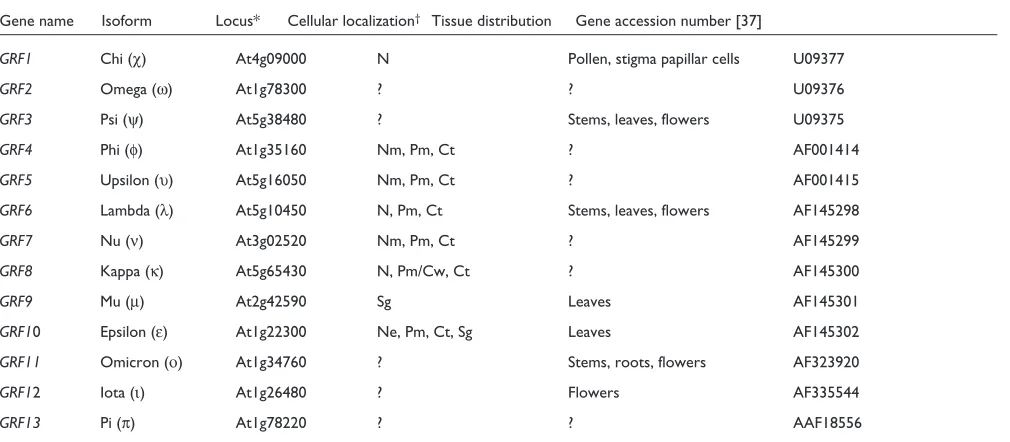
investigation of the 14-3-3 binding site of the mammalian serine/threonine kinase Raf-1 has produced a consensus sequence for 14-3-3-binding, RSxpSxP (in the single-letter amino-acid code, where x denotes any amino acid and p indicates that the next residue is phosphorylated) [10] which has been verified through peptide library screening [11]. A common, but not exclusive, requirement of 14-3-3 ligands is the phosphorylation of a serine or threonine residue in the target sequence. The phosphorylated consen-sus sequence does not, however, fully represent every ligand that 14-3-3s can bind: they are also known to bind other non-phosphorylated sequences such as GHSL [12], and WLDLE [13]. A common, but not exclusive, requirement of 14-3-3 ligands is the phosphorylation of a serine residue in the target sequence. For those client proteins whose target sequences undergo phosphorylation, the binding of 14-3-3s to the target is the major step of a signal-transduction event. Despite the simplicity of the binding-site requirements, a diverse array of proteins potentially interact with 14-3-3s;
some reports suggest that as many as 20% of Arabidopsis
proteins are clients for 14-3-3s [14].
Our knowledge of the three-dimensional structure of 14-3-3s is based on the model derived from X-ray diffraction of the
crystals of the ζand τmammalian isoforms [15,16]. The high
level of conservation of 14-3-3 amino acid sequence in the conserved core allows the general features of this structural model to be applied to all known 14-3-3s. The monomer
con-sists of nine αhelices organized in an antiparallel manner,
forming an L-shaped structure (Figure 3). The interior of the L-structure is composed of four helices: H3 and H5, which contain many charged and polar amino acids, and H7 and H9, which contain hydrophobic amino acids. These four helices form the concave amphipathic groove that interacts with target peptides. An alignment of all currently known full-length isoforms provides evidence that this groove is over 70% conserved (Figures 1 and 3). Five of the most highly conserved regions correspond to helices H1, H3, H5, H7, and H9 (Figure 1). The conserved amphipathic groove is the site for ligand binding; amino acids Lys49, Arg56, and
Arg127 in mammalian 14-3-3 ζsequences have been
demon-strated to interact with the phosphorylated amino acids of ligands (serine/threonine kinases Raf-1 and Bcr) by muta-tional [17-19] and co-crystallization [11,13] experiments; the latter have also shown that both phosphorylated and non-phosphorylated ligands bind in the amphipathic groove [13]. The peptides bound by 14-3-3s adopt an extended conforma-tion, which is thought to reduce steric hindrance between neighboring amino acids of the ligand [20].
The 14-3-3 dimerization interaction occurs between the amino-terminal helix H1 of one monomer and helices H3 and H4 of the opposing monomer; the high conservation of amino-acid sequence along helices H1 and H3 among various isoforms allows 14-3-3s to heterodimerize (Figure 3) [21,22]. Two identical or different client proteins
[image:4.609.315.556.86.438.2]can be bound simultaneously by the dimer. This dual interaction means that possible roles of 14-3-3s include acting as adapters capable of bringing disparate client proteins together or moving or rearranging two different regions of the same protein. An example of the potential role of 14-3-3 dimers as adapters comes from studies of 14-3-3s interacting with the plant plasma-membrane proton ATPase and the plant toxin fusicoccin [6]. It has been suggested that the 14-3-3 dimer binds the carboxy-terminal autoinhibitory (C-TA) domain of the ATPase in the presence of magnesium, creating a binding site where fusicoccin can then interact [6]. Once fusicoccin is bound, the complex of 14-3-3 and the ATPase is stabilized and the C-TA domain is displaced, allowing the ATPase to become fully active.
Figure 3
Localization and function
In general, 14-3-3s are distributed widely throughout the cell, supporting the argument that they are involved in mul-tiple protein-protein interactions in a plethora of biological roles. There is, however, some differential subcellular local-ization, suggesting an element of specialization among spe-cific isoforms. Localization data have been collected for eight
of the Arabidopsisisoforms using isoform-specific
antibod-ies and fusions of 14-3-3 to green fluorescent protein (GFP; Table 1). These data do not necessarily exhaust all possible locations for each isoform; instead, they support the idea that certain isoforms are recruited to distinct subcellular
locations. The localization of 14-3-3 κ and υ was studied
using carboxy-terminal GFP fusions in transgenic
Arabidop-sis [14]. Fusions of κ with GFP tended to localize to the
plasma membrane, whereas υ-GFP fusions tended to be
found in the cytosol [14]. Additional data collected using microscopy and immuno-cytochemistry of total nuclear extracts showed that at least five different forms of 14-3-3s are found in the nucleus [23]. Chloroplast stromal extracts screened with isoform-specific antibodies showed that
14-3-3 µand ε(members of the epsilon group) and 14-3-3 υ
and ν (members of the non-epsilon group) were the only
14-3-3s prominently located in the chloroplast [24]. The
presence of the two non-epsilon members 14-3-3 νand υin
the chloroplast suggests that these proteins, although located on distinct branches of the phylogenetic tree, may
share similar roles and cellular locations [25]. 14-3-3εand µ
were also found in starch grains [26]; εhas also been found
at the nuclear envelope during 14-3-3-GFP studies. GFP-ω
fusion studies showed that 14-3-3 nuclear localization is
reg-ulated by the cell-cycle [27]; generally, 14-3-3-ω-GFP fusions
were excluded from the nucleus, but they accumulated in the nucleus just after nuclear division and then relocated back out of the nucleus just before completion of cytokinesis [28]. In addition, a nuclear export signal was identified in the
14-3-3s of the fission yeast Schizosaccharomyces pombe
that is required (in concert with the Crm1 nuclear export machinery) for the shuttling of the mitosis-inducing protein Cdc25 out of the nucleus following DNA damage [29]. Nuclear shuttling has emerged as an important biological role for 14-3-3s [29], and the nuclear export signal (I/LxxxLxxxLxL) is highly conserved in the 133 full-length 14-3-3 sequences currently available (Figures 1 and 3).
The 14-3-3s are also differentially expressed among tissues
and organs (Table 1). Arabidopsis1ψ, λ, µ, and εare found in
the leaves; ψ and λ are also expressed in the stems and
flowers [30], and χis expressed in pollen grains and stigma
papillar cells [25]. The fact that 14-3-3s are differentially expressed in various tissues and differentially localized in subcellular compartments adds a layer of complexity to the examination and determination of biological roles for 14-3-3s, a complexity that must be reconciled with the highly conserved nature of 14-3-3-target interactions.
The identification of mutants and the use of transgenic organisms have provided some insight into some of the
comment
reviews
reports
deposited research
interactions
information
[image:5.609.56.561.482.703.2]refereed research
Table 1
Genetic, cellular and functional information on Arabidopsis14-3-3s
Gene name Isoform Locus* Cellular localization† Tissue distribution Gene accession number [37]
GRF1 Chi (χ) At4g09000 N Pollen, stigma papillar cells U09377
GRF2 Omega (ω) At1g78300 ? ? U09376
GRF3 Psi (ψ) At5g38480 ? Stems, leaves, flowers U09375
GRF4 Phi (φ) At1g35160 Nm, Pm, Ct ? AF001414
GRF5 Upsilon (υ) At5g16050 Nm, Pm, Ct ? AF001415
GRF6 Lambda (λ) At5g10450 N, Pm, Ct Stems, leaves, flowers AF145298
GRF7 Nu (ν) At3g02520 Nm, Pm, Ct ? AF145299
GRF8 Kappa (κ) At5g65430 N, Pm/Cw, Ct ? AF145300
GRF9 Mu (µ) At2g42590 Sg Leaves AF145301
GRF10 Epsilon (ε) At1g22300 Ne, Pm, Ct, Sg Leaves AF145302
GRF11 Omicron (ο) At1g34760 ? Stems, roots, flowers AF323920
GRF12 Iota (ι) At1g26480 ? Flowers AF335544
GRF13 Pi (π) At1g78220 ? ? AAF18556
*The number after ‘At’ denotes the chromosome. †N, nucleus; Nm, nuclear membrane; Pm, plasma membrane; Ct, cytoplasm; Cw, cell wall; Sg, leaf
biological roles and locations of some 14-3-3s. For instance, a mutation in the RAD24 protein, one of the two 14-3-3s in S. pombe, reduces the yeasts ability to keep DNA damage in
check [28]. In Saccharomyces cerevisiae, disruption of the
14-3-3 genes BMH1 and BMH2creates a lethal phenotype
that can be rescued by introducing 14-3-3 isoforms from
Ara-bidopsis,Dictyostelium discoideum, or Homo sapiens [31].
The Leonardo (14-3-3 ζ) protein of Drosophila melanogaster
is known to regulate presynaptic function, and its mutation results in the death of mature embryos [32]. Two transgenic Arabidopsis lines, one carrying an antisense construct
against 14-3-3µand another against 14-3-3 εshow dramatic
increases in starch production in leaves [26].
Various 14-3-3s in a variety of species have been found to interact with proteins involved in signal transduction (such as Raf-1 [33]), apoptosis (such as the Bcl2-related protein Bad [34]), cell-cycle control (such as Cdc25 [35]), starch syn-thesis [26], nitrogen metabolism [36], and ATP regulation (reviewed in [6]).
Frontiers
Initially, discoveries of 14-3-3s were almost coincidental in nature; in many cases their identification was serendipitous after investigating other biochemical questions. Once it became established that these proteins were ubiquitous, research was directed toward identifying the number and sequences of isoforms present in different species as well as determining their functional diversity. As more genomes are sequenced, experimental tasks will move towards elucida-tion of general roles as well as investigaelucida-tion of isoform-spe-cific roles in order to address the implications of 14-3-3 family diversity within organisms. Such studies are key to understanding the current conundrum: the conservation of 14-3-3s throughout eukaryotes suggests that some central biological roles might be served by any 14-3-3 protein, yet the diversity of 14-3-3 isoforms argues for a multitude of specific roles. Indeed, some combination of both concepts might be the case, with some roles being served by any isoform, and other roles requiring isoform-specific tions. In any case, all the current data suggest that interac-tions involving 14-3-3 proteins are critical for the correct function of higher-order biological systems.
The presence of 14-3-3 proteins in most, if not all, eukaryotic cells, but not in any prokaryotic cells, offers an interesting opportunity to study the early evolutionary history of this protein family and the concomitant development of eukary-otic regulatory processes.
References
1. Moore B, Perez V:Specific acidic proteins of the nervous system.
In Physiological and Biochemical Aspects of Nervous Integration.Edited by
Carlson FD. Englewood Cliffs, NJ: Prentice-Hall; 1967: 343-359.
The first identification of 14-3-3 proteins in mammal brains.
2. Ichimura T, Isobe T, Okuyama T, Yamauchi T, Fujisawa H: Brain 14-3-3 protein is an activator protein that activates trypto-phan 5-monooxygenase and tyrosine 3-monooxygenase in the presence of Ca2+,calmodulin-dependent protein kinase
II. FEBS Lett 1987,219:79-82.
This study was the first to assign a role to 14-3-3 proteins. It was shown that 14-3-3s activate tyrosine and tryptophan hydroxylases in a calcium- and kinase-dependent manner.
3. Lu G, DeLisle AJ, de Vetten NC, Ferl RJ: Brain proteins in plants: an Arabidopsishomolog to neurotransmitter pathway acti-vators is part of a DNA binding complex. Proc Natl Acad Sci USA 1992, 89:11490-11494.
The first identification of 14-3-3 proteins in Arabidopsis thaliana. They were found to be associated with G-box-binding factors.
4. de Vetten NC, Lu G, Ferl RJ: A maize protein associated with the G-box binding complex has homology to brain regula-tory proteins. Plant Cell 1992,4:1295-1307.
The first identification of 14-3-3 proteins in maize.
5. van Hemert, M. J., Steensma, H. Y, van Heusden, G. P:14-3-3 pro-teins: key regulators of cell division, signalling and apoptosis.
BioEssays 2001,23:936-946.
A review discussing the roles of 14-3-3s in cell-cycle control, signal transduction, and apoptosis.
6. Chung HJ, Sehnke PC, Ferl RJ:The 14-3-3 proteins: cellular reg-ulators of plant metabolism. Trends Plant Sci 1999,4:367-371.
A review of the participation of 14-3-3s in plant regulatory events, including the regulation of plasma membrane H1-ATPase, nitrate reductase and sucrose phosphate synthase.
7. DeLille JM, Sehnke PC, Ferl RJ:The Arabidopsis14-3-3 family of signaling regulators. Plant Physiol 2001,126:35-38.
A review of Arabidopsis14-3-3 gene structure and phylogeny.
8. Rosenquist M, Sehnke P, Ferl RJ, Sommarin M, Larsson C:Evolution of the 14-3-3 protein family: does the large number of iso-forms in multicellular organisms reflect functional speci-ficity? J Mol Evol 2000,51:446-458.
This study describes the binding affinity of Arabidopsis14-3-3 isoforms to a unique peptide and discusses the potential for functional specificity for these proteins across all multicellular species. A substantial family tree is also presented.
9. Ferl RJ:14-3-3 proteins and signal transduction. Annu Rev Plant
Physiol Plant Mol Biol 1996,47:49-73.
A comprehensive review of the history, functions, cell-specific expres-sion, evolution and structure of 14-3-3 proteins.
10. Muslin AJ, Tanner JW, Allen PM, Shaw AS:Interaction of 14-3-3 with signaling proteins is mediated by the recognition of phosphoserine. Cell 1996,84:889-897.
This study was the first to show that 14-3-3 is a specific phosphoserine-binding protein.
11. Yaffe MB, Rittinger K, Volinia S, Caron PR, Aitken A, Leffers H, Gamblin SJ, Smerdon SJ, Cantley LC: The structural basis for 14-3-3:phosphopeptide binding specificity. Cell 1997,91:961-971.
Two different binding motifs were identified after screening mammalian and yeast peptide libraries with 14-3-3 proteins. Additionally, the crystal structure of 14-3-3 ζbound to a phosphoserine target peptide was solved.
12. Andrews RK, Harris SJ, McNally T, Berndt MC:Binding of purified 14-3-3 zeta signaling protein to discrete amino acid sequences within the cytoplasmic domain of the platelet membrane glycoprotein Ib-IX-V complex. Biochemistry 1998, 37:638-647.
This study presents another non-phosphorylated target, GHSL, discov-ered via co-purification experiments.
13. Petosa C, Masters SC, Bankston LA, Pohl J, Wang B, Fu H, Lidding-ton RC:14-3-3zeta binds a phosphorylated Raf peptide and an unphosphorylated peptide via its conserved amphipathic groove. J Biol Chem 1998,273:16305-16310.
14-3-3 crystal structures in complex with phosphorylated and unphos-phorylated peptide were solved to determine the location of the binding site.
14. Sehnke PC, DeLille JM, Ferl RJ:Consummating signal transduc-tion: the role of 14-3-3 proteins in completion of signal-induced transitions in protein activity. Plant Cell 2002, 14:S339-S354.
A comprehensive review of the involvement of 14-3-3 proteins in signal transduction.
15. Liu D, Bienkowska J, Petosa C, Collier RJ, Fu H, Liddington R: Crystal structure of the zeta isoform of the 14-3-3 protein.
Crystal structure of the mammalian 14-3-3 ζisoform.
16. Xiao B, Smerdon SJ, Jones DH, Dodson GG, Soneji Y, Aitken A, Gamblin SJ:Structure of a 14-3-3 protein and implications for coordination of multiple signalling pathways. Nature 1995, 376:188-191.
Crystal structure of the mammalian 14-3-3 τisoform.
17. Zhang SH, Kobayashi R, Graves PR, Piwnica-Worms H, Tonks NK: Serine phosphorylation-dependent association of the band 4.1-related protein-tyrosine phosphatase PTPH1 with 14-3-3beta protein. J Biol Chem 1997,272:27281-27287.
Mutation of serine to alanine severely reduced the level of 14-3-3 and PTPH1 binding.
18. Wang H, Zhang L, Liddington R, Fu H: Mutations in the hydrophobic surface of an amphipathic groove of 14-3-3zeta disrupt its interaction with Raf-1 kinase. J Biol Chem 1998, 273:16297-16304.
Mutation of hydrophobic residues on the 14-3-3 amphipathic groove shows that these residues are involved with binding the client protein. The mutated residues are conserved among isoforms, suggesting a general importance for ligand binding.
19. Thorson JA, Yu LW, Hsu AL, Shih NY, Graves PR, Tanner JW, Allen PM, Piwnica-Worms H, Shaw AS:14-3-3 proteins are required for maintenance of Raf-1 phosphorylation and kinase activ-ity. Mol Cell Biol 1998,18:5229-5238.
Overexpression of 14-3-3s causes increased phosphorylation of Raf-1. Similarly, removal of 14-3-3 reduces the kinase activity of Raf-1.
20. Fu H, Subramanian RR, Masters SC:14-3-3 proteins: structure, function, and regulation. Annu Rev Pharmacol Toxicol 2000, 40:617-647.
Comprehensive review of 14-3-3-ligand interaction on a structural basis, a proposal of 14-3-3 function in several pathways, and a discus-sion of regulatory mechanisms.
21. Jones DH, Ley S, Aitken A:Isoforms of 14-3-3 protein can form homo- and heterodimersin vivoand in vitro: implications for function as adapter proteins. FEBS Lett 1995,368:55-58.
Evidence that 14-3-3 proteins form both hetero- and homodimers.
22. Rittinger K, Budman J, Xu J, Volinia S, Cantley LC, Smerdon SJ, Gamblin SJ, Yaffe MB: Structural analysis of 14-3-3 phospho-peptide complexes identifies a dual role for the nuclear export signal of 14-3-3 in ligand binding. Mol Cell 1999, 4: 153-166.
A nuclear export signal was identified in 14-3-3 proteins and shown to share topology with other signals recognized by the Crm1 nuclear export machinery.
23. Bihn EA, Paul AL, Wang SW, Erdos GW, Ferl RJ:Localization of 14-3-3 proteins in the nuclei of Arabidopsisand maize. Plant J
1997, 12:1439-1445.
Scanning confocal microscopy and immunocytochemistry with mono-clonal antibodies against plant 14-3-3 proteins were used for localiza-tion studies.
24. Sehnke PC, Henry R, Cline K, Ferl RJ:Interaction of a plant 14-3-3 protein with the signal peptide of a thylakoid-tar-geted chloroplast precursor protein and the presence of 14-3-3 isoforms in the chloroplast stroma. Plant Physiol 2000, 122:235-242.
Immuno-electron microscopy of leaf tissue and western-blotting analy-sis of chloroplast fractions with monoclonal anti-14-3-3 antibodies localized 14-3-3 proteins to the chloroplast stroma and the stromal side of thylakoid membranes.
25. Daugherty CJ, Rooney MF, Miller PW, Ferl RJ:Molecular organi-zation and tissue-specific expression of an Arabidopsis14-3-3 gene. Plant Cell 1996,8:1239-1248.
In situ hybridization showed that expression of χ(chi) mRNA was
prominent in epidermal tissue of roots, petals, and sepals of flower buds, papillae cells of flowers, siliques, and endosperm of immature seeds. These results show plant 14-3-3 gene expression exhibits cell-and tissue-specific localization rivaling that observed for 14-3-3 proteins within the mammalian brain.
26. Sehnke PC, Chung HJ, Wu K, Ferl RJ:Regulation of starch accu-mulation by granule-associated plant 14-3-3 proteins. Proc
Natl Acad Sci USA 2001,98:765-770.
14-3-3 proteins inArabidopsiswere shown to regulate starch synthesis through the use of two antisense constructs of 14-3-3 εand 14-3-3 µ.
27. Cutler SR, Ehrhardt DW, Griffitts JS, Somerville CR: Random GFP::cDNA fusions enable visualization of subcellular struc-tures in cells of Arabidopsisat a high frequency. Proc Natl Acad
Sci USA 2000,97:3718-3723.
14-3-3-GFP fusions were observed in hypocotyl cells by confocal microscopy and showed localization to nuclei undergoing cytokinesis.
28. Ford JC, al-Khodairy F, Fotou E, Sheldrick KS, Griffiths DJ, Carr AM: 14-3-3 protein homologs required for the DNA damage checkpoint in fission yeast. Science 1994,265:533-535.
This investigation identified two 14-3-3 proteins, Rad24 and Rad25, that are involved in the DNA-damage checkpoint during mitosis.
29. Lopez-Girona A, Furnari B, Mondesert O, Russell P:Nuclear local-ization of Cdc25 is regulated by DNA damage and a 14-3-3 protein. Nature 1999,397:172-175.
The Rad24 14-3-3 protein controls the intracellular distribution of Cdc25.
30. Chung H-J, Shanker S, Ferl RJ: Sequences of five Arabidopsis general regulatory factor (GRF) genes encoding 14-3-3 pro-teins. Plant Physiol 1999,120:1206.
An entry in the Plant Gene Register. Sequences were obtained from stem and flower tissues.
31. van Heusden GP, van der Zanden AL, Ferl RJ, Steensma HY:Four Arabidopsis thaliana 14-3-3 protein isoforms can comple-ment the lethal yeast bmh1 bmh2 double disruption. FEBS Lett
1996,391:252-256.
In this exquisite study, the genes encoding two indigenous 14-3-3 iso-forms in bakers’ yeast were deleted to produce a lethal phenotype and the phenotypes were rescued by replacement of the genes with those of four of six Arabidopsisisoforms.
32. Broadie K, Rushton E, Skoulakis EM, Davis RL: Leonardo, a Drosophila 14-3-3 protein involved in learning, regulates presynaptic function. Neuron 1997,19:391-402.
Immunolocalization studies showed that the Leonardo 14-3-3 protein was expressed at synaptic connections enriched in presynaptic boutons of the neuromuscular junction. Null leonardo mutants die as mature embryos.
33. Chang HC, Rubin GM:14-3-3 epsilon positively regulates Ras-mediated signaling in Drosophila. Genes Dev 1997, 11: 1132-1139.
This study discusses how 14-3-3 εprotein appears to function in multi-ple receptor tyrosine kinase signal transduction pathways.
34. Zha J, Harada H, Yang E, Jockel J, Korsmeyer SJ:Serine phospho-rylation of death agonist BAD in response to survival factor results in binding to 14-3-3 not BCL-X(L). Cell 1996,87: 619-628.
An example of how a 14-3-3 is involved with apoptosis. In the pres-ence of a survival factor, Bad was phosphorylated on two serine residues embedded in 14-3-3 consensus binding sites. Only the non-phosphorylated Bad promotes cell death.
35. Peng CY, Graves PR, Thoma RS, Wu Z, Shaw AS, Piwnica-Worms H: Mitotic and G2 checkpoint control: regulation of 14-3-3 protein binding by phosphorylation of Cdc25C on serine-216. Science 1997,277:1501-1505.
An example of 14-3-3s involved in cell-cycle control. A mutation in human Cdc25c prevented the phosphorylation of Ser216, thus pre-venting 14-3-3 binding. Conditional overexpression of this mutant per-turbed mitotic timing and allowed cells to escape the G2 checkpoint arrest induced by either unreplicated DNA or radiation-induced damage.
36. Bachmann M, Huber JL, Athwal GS, Wu K, Ferl RJ, Huber SC: 14-3-3 proteins associate with the regulatory phosphoryla-tion site of spinach leaf nitrate reductase in an isoform-spe-cific manner and reduce dephosphorylation of Ser-543 by endogenous protein phosphatases. FEBS Lett 1996,398:26-30.
14-3-3 proteins were shown to regulate nitrate reductase by binding a synthetic phosphonitrate reductase peptide.
37. Entrez nucleotide view
[http://www.ncbi.nlm.nih.gov/entrez/query.fcgi]
Access to the GenBank sequence database.
38. The laboratory of Robert J. Ferl[http://www.hos.ufl.edu/ferllab/]
Our lab’s website contains additional information on 14-3-3s and related research.
39. Thompson JD, Higgins DG, Gibson TJ:CLUSTAL W: improving the sensitivity of progressive multiple sequence alignment through sequence weighting, position-specific gap penalties and weight matrix choice. Nucleic Acids Res 1994,22:4673-4680.
CLUSTAL W is a common method used to generate multiple sequence alignments.
40. Saitou N, Nei M: The neighbor-joining method: a new method for reconstructing phylogenetic trees. Mol Biol Evol 1987, 4:406-425.
The neighbor-joining method is a statistical method used to generate possible phylogenetic trees.
comment
reviews
reports
deposited research
interactions
information
![Figure 3The crystal structure of 14-3-3s. The model shown is derived from thehuman 14-3-3 ζ isoform (PDB1QJB [22]) and is shown from (a) the topand (b) one side as visualized by the 3Dmol software found in the VectorNTI 7.0 Suite](https://thumb-us.123doks.com/thumbv2/123dok_us/8649754.867324/4.609.315.556.86.438/figure-crystal-structure-thehuman-isoform-visualized-software-vectornti.webp)