ISSN: 1992-8645 www.jatit.org E-ISSN: 1817-3195
ANALYSIS OF USING EQUIVALENT INSTRUCTIONS AT
THE HIDDEN EMBEDDING OF INFORMATION INTO THE
EXECUTABLE FILES
STANISLAV IGOREVICH SHTERENBERG, ANDREY VLADIMIROVICH KRASOV, IGOR ALEKSANDROVICH USHAKOV
Federal State Educational Budget-Financed Institution of Higher Vocational Education The Bonch-Bruevich Saint-Petersburg State University of Telecommunications
Prospekt Bolshevikov, 22, St. Petersburg, 193232, Russian Federation
ABSTRACT
The article examines the problems and their possible solutions on the specifics of using equivalent instructions for the hidden embedding of information into the executable and library files. This article considers an example of hidden embedding into an executable file of exe format or into a similar elf-format for the Unix/Linux systems. In order to embed information into an executable code by the synonyms substitution method, it is suggested to use instructions that execute one and the same operation and have similar length, but that are encrypted by different opcodes. Such instructions are to be called equivalent instructions. The idea of semantic substitution must be implemented in the executable and library files. An executable code, and not an executable file itself, is used as a container for the information embedding.
Keywords: Machine Code, Authentication Of The Executable Code, Executable File, Equivalent
Instructions, Steganography.
1.
INTRODUCTIONThis article examines an element of interaction with the static libraries. The Linker combines object files of libraries and object files of your program into a single executable file (for example, exe format for Windows or elf for Linux).
The reassembled executable files enable using alphabetical mnemonic operation codes, assigning symbolic names to the computer and memory registers in one’s sole discretion as well as specifying personally convenient addressing schemes (or example, an index or indirect scheme). Unlike a natural language, a low-level programming language has a limited vocabulary (language statements) and a strict set of rules for using that vocabulary, while the semantic rules the same as for any formal language are clearly and unambiguously defined. In this article we present an example and method for semantic substitution of language statements, in order to implement methods for the equivalent replacement of statements, which will allow for provision of copyright protection at the technical level when using digital signatures [4].
An executable code, and not an executable file itself, is used as a container for the information embedding. Such method of embedding is based on the features of an executable code of particular processor architecture and does not depend on the format of an executable file. It is much more difficult to discover the fact of information embedding into an executable code, since there is no one-to-one association between the source code of the program and the compiled executable code. One and the same source code can be associated with various executable codes depending on the compiler and its settings [2].
ISSN: 1992-8645 www.jatit.org E-ISSN: 1817-3195
2.
METHODOLOGYMany instructions with 2 operands contain in their opcode a direction bit indicating which operand is a source, and which – a receiver. Such instructions include adc, add, and, cmp, mov, or, sbb, sub, and xor. Thus, for example, the forms of the add instruction (add reg, r/m, and add r/m, reg) vary by the direction bit’s value and, accordingly, have different opcodes.
[image:2.612.312.531.437.586.2]The first instruction adds values from the register or memory (depending on the ModRM byte’s content) to the register’s value. The second instruction adds register’s value to the value that is in the register or memory. Thus, if two operands are served by the registers, the add instruction can be encoded by any of the methods presented. Table 1 shows an example of such encoding. The add eax, ebx instruction can be assembled as 03 BA or 05 E1 (in hexadecimal notation) (Intel 64 and IA-32 Architectures Software Developer’s Manual, Volume 2A, 2008; Intel 64 and IA-32 Architectures Software Developer’s Manual, Vo lume 2B, 2008).
Table 1. Equivalent Variants Of The Add Edx, Ecx Instruction Encoding
add eax, ebx
add r/m, reg add reg, r/m Opcode ModRM
byte
Opcode ModRM byte 0000
0011
10111010 0000 0101
11100001
03 BA 05 E1
Some instructions working with an immediate value can be replaced by the inverse ones. In this case, an immediate value must be recalculated.
For example, the inverse instructions include add and sub or ror and rol.
The immediate values are to be calculated as follows:
- For the add and sub instructions:
size
imm
not
imm
2
=
(
1
+
1
)
mod
2
(1)- For the ror and rol instructions:
size
imm
size
imm
2
=
(
−
1
)
mod
(2)In both expressions, imm1 and imm2 are the immediate values for the inverse instructions; size
is the size of a register, over which an operation is executed [9].
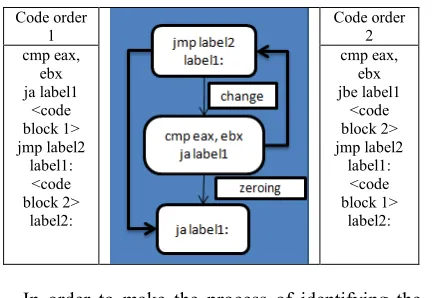
The xor reg, reg instruction is often used for resetting a register. The same operation can be carried out with the help of the sub reg, reg instruction. In some cases the interchangeable instructions differently change the eflags register’s flags. Therefore, one instruction can be replaced by another one only in the event if within the limits to the next instruction, which changes the flags, the flags values do not affect the program flow, i.e. there are no instructions depending on the eflags register, such as conditional jumps. If to swap the operands in the instruction of comparison, the instruction obtained will set the opposite flags. Thus, it will be enough to replace the commands of a conditional jump by the opposite ones on the interval from the instruction of comparison to the next instruction that changes the flags (for example, "cmp eax, ebx ja label1" by "cmp ebx, eax jbe label1") [9].
Besides, it is also possible to change the sequence order of the code’s functionally independent blocks (Table 2).
Table 2. The Equivalent Sequences Of Instructions With The Changed Order Of The Code’s Functionally
Independent Blocks
Code order 1
Code order 2 cmp eax,
ebx ja label1
<code block 1> jmp label2
label1: <code block 2>
label2:
cmp eax, ebx jbe label1
<code block 2> jmp label2
label1: <code block 1>
label2:
In order to make the process of identifying the embedded information in an executable code as complicated as possible, it is required that the statistics of certain instructions in the code with embedded information would minimally differ from the similar statistics in the code without embedded information. This article examines the statistics of instructions occurrence in the executable code without embedded information, and analyses the most suitable for the embedding instructions [10].
ISSN: 1992-8645 www.jatit.org E-ISSN: 1817-3195
with the help of add/sub, resetting the register with the help of xor/sub, and the opposite conditional jumps. In addition, a semantic substitution ja/jbe is shown. Figures 1a and 1b demonstrate the distribution diagrams of each of the equivalent instructions variants and ratio of the variants of the semantic substitutions of statements.
no optimize size time xor 99 99 99 add 45 60 60 ja 45 45 50
mov 1 1 1
sub 55 40 40 jbe 55 55 50
a)
b)
Figure 1. А) Distribution Of The Equivalent Instructions Variants In The Executable Code Without Optimization,
With Optimization By Size And Time; B) Ratio Of Variants Of The Semantic Substitutions Of Statements.
It is evident that in order to reset a register, the GCC compiler always uses the xor instruction. This means that the embedding through the substitution of the add/sub, ja/jbe instructions can be easily detected. The rest of the instructions synonyms are distributed relatively uniformly and can be used for embedding information. [19].
Also, the authors have analyzed the frequency of the instructions, using registers as both operands, occurrence in the executable code compiled at various variants of optimization (Figure 2).
The most frequent mov and xor instructions are the best suitable for embedding information.
Figure 2. Number Of Instructions In An Executable Code That Use Registers As Both Operands.
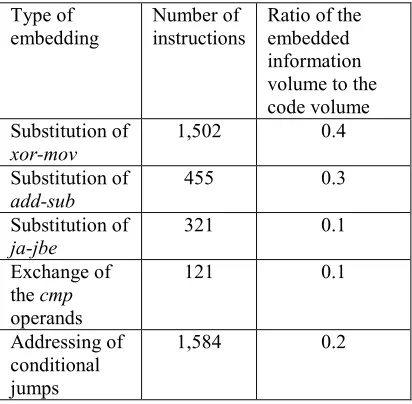
[image:3.612.90.300.196.477.2]Besides, the authors have calculated the amount of information, which can be embedded into an executable code (Table 3). The size of the executable code considered amounted to 10,122 bytes [12].
Table 3. Evaluation Of The Information Volume Being Embedded
Type of embedding
Number of instructions
Ratio of the embedded information volume to the code volume Substitution of
xor-mov
1,502 0.4
Substitution of
add-sub
455 0.3
Substitution of
ja-jbe
321 0.1
Exchange of the cmp
operands
121 0.1
Addressing of conditional jumps
1,584 0.2
Therefore, when using the xor-mov substitution, it is possible to embed 1 KB of hidden information into each 100 KB of a container [9].
[image:3.612.315.521.439.641.2]ISSN: 1992-8645 www.jatit.org E-ISSN: 1817-3195
The following listing demonstrates an example of embedding into the executable code when using semantic substitution of the equivalent xor-mov statements. The experiments on implementation of the hidden embedding require an executable file. A code sample is shown in Listing 1.
…….! main: ;xref o80482d7 …….! push ebp
8048385 ! mov ebp, esp 8048387 ! sub esp, 8 804838a ! and esp, 0fffffff0h 804838d ! mov eax, 0 8048392 ! sub esp, eax
8048394 ! mov dword ptr [esp], strz_STEGO_coder
804839b ! call wrapper_123 80483a0 ! leave
80483a1 ! ret 80483a2 ! nop ………. 80483an ! nop
Listing 1. Place for embedding information
It is required to replace pop esi/xor ebp, ebp by jmp by our code. With that it becomes possible to perform all the conceived actions, to execute these commands, and return back. But first it is necessary to prepare a code for integration [1], [3].
To make it simple, we will display a short greeting. In assembly language it will sound approximately like this:
mov eax, 4 ; system call write mov ebx,1 ; standard output ID mov ecx, offset begin_msg ; a pointer to the first character of the message being displayed
mov edx, offset end_msg ; a pointer to the last character of the message being displayed
int 80h ; displaying pop esi ; saved commands xor ebx,ebp
jmp 80482C3h ; back to the program Listing 2. A short greeting with an on-screen This is not the most optimum variant, and it can be optimized if to rewrite as follows:
xor eax,eax
add al, 4 xor ebx,ebx inc ebx
mov ecx, offset begin_msg mov edx,ecx
add edx, sizeof(msg) int 80h
pop esi xor ebp, ebp jmp 80482C3h
Listing 3. Optimization of the output variant When executing file in a hex-editor, let us find and write out the start addresses of all chains of NOPs suitable for implementation. If two adjacent chains are located within a short jump (roughly – within a hundred bytes), then three NOPs will be quite enough (2 bytes for a jump command, one – for any single-byte command of the useful code, for example, inc ebx or pop esi). Otherwise, a chain of at least 6 NOs is required: five – for a short jump command and one – for a useful command [17].
In this case, it turns out as follows: 8048306h 10 bytes
80483a2 14 bytes 8048464 12 bytes Total – 36 bytes.
This place is taken to demonstrate a semantic substitution. Then the filling of the chain of NOPs with the useful code starts. After the first attempt, it looks as follows:
8048306 31 c0 xor eax, eax 8048308 04 04 add al, 4
804830a e9 93 00 00 00 jmp 80483a2h 804830f 90 nop
ISSN: 1992-8645 www.jatit.org E-ISSN: 1817-3195
8048306 31c0 xor eax, eax 8048308 31db xor ebx, ebx 804830a 43 inc ebx
804830b e9 92 00 00 00 jmp 80483a2h Then, the next chain will be filled as follows: 80483a2 0404 add al, 4
80483a4 b9 ?? ?? ?? ?? mov ecx, offset begin_msg
80483a9 89ca mov edx, ecx 80483ab e9 b4 00 00 00 jmp 8048464h
Listing 4. An implemented example of the semantic substitution XOR EBX,EBX/INC EBX.
1.The rest of the code is too big in size to be included into the third last chain of NOPs, as it lacks one single byte. It is required to try to shrink the code a little bit more. For example, the pairs of mov edx,ecx/add edx,sizeof(msg) instructions with the size of 5 bytes can be used lea edx,[ecx+sizeof(msg)] [
11
].The message can also be placed in the data segment. Since there is not so much free space there, we can restrict ourselves to the string "hello". There is no need for a null-terminated string, as the system call "write" displays exactly as many characters as it is set to display. At this stage the example of the semantic substitution is considered to be completed [14].
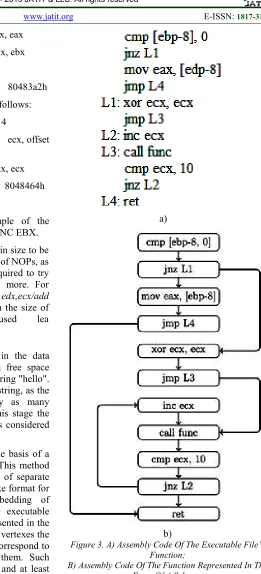
An executable code is formed on the basis of a graph of the function execution flow. This method can be used for verifying the integrity of separate segments of an executable file of the .exe format for implementation of the hidden embedding of information. A machine code of the executable file’s function (Figure 3a) can be represented in the form of a scheme (Figure 3b), in which vertexes the instructions are placed, and the edges correspond to the possible control jumps between them. Such scheme has only one initial command and at least one final command. The source of this graph is the instruction located at the function’s entry point address (for example, cmp or mov), and stocks are the instructions of return from the function (for example, ret).
a)
b)
Figure 3. А) Assembly Code Of The Executable File’s Function;
B) Assembly Code Of The Function Represented In The Form Of A Scheme.
[image:5.612.250.511.65.639.2]ISSN: 1992-8645 www.jatit.org E-ISSN: 1817-3195
obtained
T
=
(
V
,
E
′
)
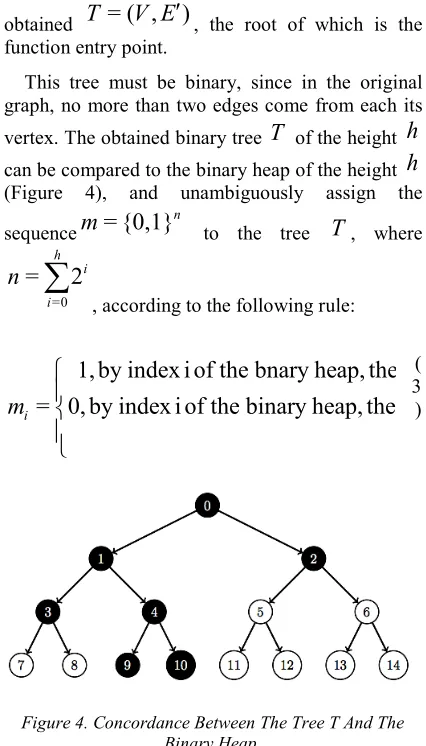
, the root of which is the function entry point.This tree must be binary, since in the original graph, no more than two edges come from each its vertex. The obtained binary tree
T
of the heighth
can be compared to the binary heap of the heighth
(Figure 4), and unambiguously assign thesequence
n
m
=
{0,1}
to the treeT
, wherei h
i
n
=
2
0 =
∑
, according to the following rule:
1, by index i of the bnary heap, there is a
= 0, by index i of the binary heap, there is
i
m
T
[image:6.612.88.301.94.467.2]( 3 )
Figure 4. Concordance Between The Tree T And The Binary Heap.
Painted Are The Vertexes Entering Into T (M = 1 11 1100 00110000)
The numerical representation of the function control flow graph is used to generate a hidden embedding into an executable file. The above entered number
m
is exponentially dependent on the height of the treeT
. Therefore, it makes sense to apply to it a hash function, so that the numerical representation would have a fixed size (Figure 5). Changing the instructions to the equivalent ones does not disturb the function control flow graph, and hence it is possible to embed into the executable code of the same function by the method of synonyms substitution [7].When verifying the code validity, the same way is used to generate the numerical representation of the function control flow graph
m
. Afterwards, it is compared to the function extracted from the executable code [18].Figure 5. Scheme Of The Executable Code Authentication
4.
CONCLUSIONUsing the example of the executable code authentication scheme, it is possible to explain why exactly these methods of embedding into the structure of an executable file and embedding into an executable code are implemented. With the help of these methods, an "attacker" can be distracted by the instructions considered that do not change the program control flow and by the vertexes presented with one exiting edge. Replacement of such instructions by the equivalent ones does not change the function control flow graph. Therefore, after embedding information into an executable code, its numerical representation, which was used for generating a digital signature, remains unchanged. [15].
Therefore, it is proposed to use instructions that execute one and the same operation and possess similar lengths for embedding digital signature into an executable code by the method of synonyms substitution. The idea of the semantic substitution of statements will allow distracting an "attacker" when verifying the integrity of the separate segments of an executable code. It will be difficult to notice the hidden embedding integrated into the file because the changes inside the file will affect neither the size nor the functionality of the executable code. The method suggested is simple for implementation and cost-effective. On the shown example with the use of a NOP chain, it is evident that the equivalent substitution of the mov and xor statements, proposed in this work, is highly effective and is being successfully implemented.
ISSN: 1992-8645 www.jatit.org E-ISSN: 1817-3195
allows for copyright protection at the technical level by using a digital signature.
REFERENCES:
[1] ELF. Files Structure. (n.d.). Retrieved May 30, 2015, from http://www.gfs-team.ru/articles/read/149.
[2] Gribunin, V., Okov, I., & Turintsev, I. (2002).
Digital Steganography (pp. 227). Moscow: Solon-Press.
[3] Implementation of Additional .ELF Segments in QNX. (2014). Retrieved May 30, 2015, from http://web.archive.org/web/20081120013357/htt p://qnx.org.ru/article9.html.
[4] Cox, I. (2008).
Digital Watermarking and Steganography (pp. 593). Second Edition: Morgan Kaufmann. [5] Intel 64 and
IA-32 Architectures Software Developer’s Manual.
(2008). Volume 2A: Instruction Set Reference. A-M: Intel Corp. [6] Intel 64 and IA-32 Architectures Software
Developer’s Manual. (2008).
Volume 2B: Instruction Set Reference. N-Z: Intel Corp.
[7] Krasov, A., & Shterenberg, S. (2013). Development of Methods for the Software Copyright Protection Based on the Digital Watermarks Integrated into the Executable and Library Files. Actual Problems of Infocommunication in Science and Education, Saint Petersburg, pp.847-852.
[8] Krasov, A., & Vereshchagin, A. (2012). Certificate of State Registration of a Computer Program No. 2013612237. Program for Embedding Digital Watermarks into the Executable and Library Files. Copyright holder: Federal State Educational Budget-Financed Institution of Higher Vocational Education the Bonch-Bruevich St. Petersburg State University of Telecommunications. Incoming date: December 25, 2012. Registered in the Register of Computer Programs on February 18, 2013. [9] Krasov, A., Vereshchagin, A., Abaturov, V., &
Reznik, M. (2012). Methods for Hidden Embedding of Information into the Executable Files. Proceedings of the Saint Petersburg Electrotechnical University "LETI", Saint Petersburg, 8, pp.51-55.
[10] Krasov, A., Vereshchagin, A., & Tsvetkov, A. (2013). Software Authentication Using the Embedding of Digital Watermarks into an Executable Code. Telecommunications, (pp. 27-30). Moscow.
[11] Norton, P., & Souhe, D. (1992). Assembly language for IBM PC. Moscow: Computer. [12] Venkatesan, R., Vazirani, V., & Sinha,
S. (2001). A Graph Theoretic Approach to Software Watermarking. 4th International Information Hiding Workshop, pp.157-168. [13] Secrets of the Elves Conquest. (2005б
November). Hacker Journal, 83. Retrieved May 30, 2015, from http://inf.tltsu.ru/res/strogov/j/xa083/106/6.htm. [14] Shterenberg, S., & Andrianov, V. (2013).
Variants of Modifying the Structure of the Executable Files of PE Format. Prospects for Development of Information Technologies, Novosibirsk, pp.134-143.
[15] Shterenberg, S., & Andrianov, V. (2014). Methods of Selecting the Optimal Methods for Copyright Protection on Unix Systems Using the Executable and Library Files. Efektivní Nástroje Moderních Věd, Praha.
[16] Shterenberg, S., & Andrianov, V. (2014). Study of the Adaptive Attacks Methodology Based on the Hidden Embedding into the Executable Files. Science, Technology, Innovation, Bryansk, pp.287-294.
[17] Shterenberg, S., Andrianov, V., Lipatnikov, V., & Kostarev, S. (2015). Certificate of State Registration of a Computer Program No. 2015611539. RPA (Rationable Progressimo Aggredi) (lat.). Copyright holder: Federal State Educational Budget-Financed Institution of Higher Vocational Education the Bonch-Bruevich St. Petersburg State University of Telecommunications. Incoming date: December 2, 2014. Registered in the Register of Computer Programs on January 30, 2015.
[18] Shterenberg, S., & Prosikhin, V. (2014). Methodology for Applying a Mathematical Model of Stegosystem for the Hidden Embedding of Information. Eurasian Union of Scientists, Moscow, 9.
[19] Stern, J., Hachez, G., Koeune, F., &
Quisquater, J. (1999). Robust Object Watermarking: Application to Code.