COOPERATIVE
PACKET
DELIVERY
USING
ENHANCED
COOPERATIVE
OPPORTUNISTIC
ROUTING
SCHEME
(ECORS)
IN
MANET
1VIJAYAKUMAR A, 2 SELVAMANI K
1
Research Scholar, Department of Computer Science and Engineering, Anna University, Chennai -25, Tamil Nadu, India.
2
Assistant Professor, Department of Computer Science and Engineering, Anna University, Chennai -25, Tamil Nadu, India.
E-mail: [email protected]
,
2
ABSTRACT
Cooperativecommunication is an active area of research today. It enables the nodes to achieve spatial diversity, which leads to tremendous improvement in system capacity and delay. In this proposed system cooperative communication mechanism is used to determine a list of intermediate relay nodes that follows en-route to the destinations. Here, when data packets are broadcasted from a source node and the packets are received by a destination node along with the route. Cooperative communications which utilizes nearby terminals to relay the message transmissions also induces the non-cooperative nodes to participate in some opportunistic environments for achieving the diversity gains and to improve the efficiencies among the mobile nodes in wireless mobile ad hoc networks. The Enhanced Cooperative Opportunistic Routing Scheme (ECORS) which is based on light weight proactive source routing is used in this work to ensure the cooperation of participating mobile nodes in MANETs. This new protocol is used to easily identify the intermediate nodes and establishing the trusted routes. The comparative performance analyses among AODV versus ECORS are properly carried out and the better cooperative packet delivery ratio, increased throughput and decreased delay in packet delivery are achieved in this network simulation.
Keywords: Cooperative communication, MANETs, Opportunistic packet forwarding, Packet delivery,
Retransmission, Throughput.
1. INTRODUCTION
A Mobile Ad-hoc NETwork (MANET) is a self organized, self-configured network and the mobile nodes are connected by wireless links. Cooperative communication (CC) [2] is also a promising technique to enhance information transmission quality that the user are able to share and coordinate by participating with the resources and doing better communication even though the robust situation occurs in MANETs. This system generally allows the single antenna and multiple antenna systems. The most of the cooperative communication works focus based on link level issues in MANETs. This work mainly focuses the concepts of data forwarding and routing in network layer. i.e., how packets are delivered from one link to another link and identifying opportunistic routing from source to destination via the intermediate relaying nodes. To achieve this, the overall idea of ExOR work is enhanced and the proposed enhanced cooperative
opportunistic routing is utilized to achieve efficiency in throughput and also to reduce the delay in packet delivery in an opportunistic MANETs. ECORS algorithm is also exploits the multi user diversity and increased throughput, and ensuring more cooperation. In this work the comparative analysis among AODV and ECORS are carried out to ensure the efficiency via, throughput and delay in packet delivery in small scale mobile ad hoc networks.
and finding the appropriate route to the desired
destination. The opportunistic data forwarding which allows the relay nodes that are not available in forwarder list to select the neighbour nodes to ensuring the opportunistic cooperative message transmission in desired route and reducing delay in packet delivery and also to avoid the retransmission in this communication.
This paper is organized as following structure. The section 2 describes the related work which expose with ExOR and AODV. In Section 3, the details of proposed enhanced cooperative opportunistic routing based packet delivery were represented. Section 4 represents throughput and delay analysis. The simulation results and comparative performance analysis among AODV and ECOR is given in section 5. Finally, the conclusion and future work are presented in Section 6.
2. BACKGROUND WORK
The utilization of the broadcasting nature of wireless channels at the link layer and recent histories are compared with the physical layer. Larsson [4] proposes a new handshake technique which is referred as Selection Diversity Forwarding (SDF) is used to implement downstream forwarder node selection in a multi hop wireless networks. In this forwarding approach that the senders select from a set of usable downstream neighbors for the high transient link quality when communication takes place. Then the IEEE 802.11 Distributed Coordination Function (DCF) based DATA/ACK handshake was enhanced. One step ahead, this type of handshake which initiates an opportunistic usage of link quality variation in multi hop wireless mobile networks, specifically at link and network layers. The coordination in SDF is costly and its overhead needs are significantly reduced in practical.
Another type of routing is extended Opportunistic Routing (ExOR).The Extended Opportunistic Routing (ExOR) [3] Cross-layer opportunistic data forwarding methods in multi-hop wireless networks proposed by Biswas and Morris. It melts the MAC (Medium Access Control) and network layers. The MAC layer can find the actual next-hop forwarder aftertransmission depending on the transient channel conditions at all capable of downstream nodes. Nodes are empowered to overhear all packets transmitted in the channel. A multitude of forwarders can possibly forward the
packets and it was included on the forwarder list. Thus, if a packet is received through a listed forwarder near to the destination by means of a good reception condition, this long-haul transmission should be utilized. Otherwise, shorter and more robust transmissions are required to guarantee reliable progress. This experiment was to ensure anyone of the listed forwarders which relay the packetsthat is probably to be the closest to the destination at the same time. This is addressed using prioritized scheduling methodology among the listed forwarders based on their priority indicated in theforwarder lists.
In Extended Opportunistic Routing, the data packets are prepended with an Extended Opportunistic Routing header, and it was included some of the following information. Then, they are further appended with an 802.11 data frame header before they are being broadcasted.
The important terms which are used in ExOR scheme are given below for a brief review.
Batch size - No of packets in batch. It has the same
number for all data in a given batch.
Forwarder list - The source specifies the forwarder
list in priority order based evaluated cost of delivering a packet from each node in the destination.
Forwarder List Update - A forwarder list
automatically updated when during packet transmission.
Routing- Way of packet transmit from source to
destination.
Opportunistic Routing - To take opportunistic for
alternative routing when non-cooperative nodes become into cooperative node routing
Opportunistic Data Forwarding- It refers to way
that data packets are handled in a multi-hop wireless networks.
forwarding in routing updates. The extreme case of
LV is that only one link is included per destination which is coincides with the PFA. Above two algorithms were initially proposed to address the routing scalability the issue of routing scalability and based on that the Wireless Routing Protocol (WRP) [11] which provides the better routes in mobile networks.
2.1 ExOR: Opportunistic Multi-hop Routing for
Mobile Ad hoc Network
The ExOR ensures the “best” receiver of packet forwarding operates on batches of packets to reduce the communication. a source node a list of candidate forwarders prioritized by closeness to the desired destination. The receiving nodes successfully received the packets and also awaited at the end of the batch. The highest priority forwarder was utilized to broadcast the packets in its buffer, including its copy of the “batch map” in each packet. The batch map incorporated the sender’s guess of the highest priority node and received each packet by relaying node. The remaining forwarders transmit in order, but only send packets which were not acknowledged in the batch maps of higher priority nodes. The forwarders was continued in this cycle through the priority lists until the destination has received 90% of the packets and the remaining packets were transferred through the traditional routing schemes.
2.2 Node State
Extend Opportunistic routing, the node’s batch map indicates 90% of the batch has been received through higher priority nodes that node sends nothing when its turn comes.. Additionally, if packet fragments are smaller that the node will set incorrect forwarding timer and ExOR guarantee the deliverability of 90% a batch then the destination request the remaining packet via traditional routing. Destination sends its batch map to source node that only source nodes sends the remaining packet with traditional routing, which ensure the reliable delivery.
2.3 Ad-hoc On Demand Distance Vector
Routing (AODV)
In AODV type of routing algorithm, the routes were discovered, when a source node are requested to send the data to a specific destination. The main objective of AODV is that it used traditional routing tables to maintain routing information, with one entry per destination. The each record inthistable had a destination sequence number. This number is covered in the RREQ
(Route Request) ofany node that they wish to send data. AODV protocol used these sequence numbers to certify the validity of routing information and also to prevent the routing loops. A requesting node selects a route through the greatest sequence number to communicate destination node. Once a fresh path was found, a RREP (Route Reply) was sent back to the requested node. A time-base state in each node was maintained in this routing protocol. Atable entry has been removed if it was not used recently. A set of predecessor nodes was carried out for each routing table entry, specifying the set of neighbouring nodes, which used that arrive to route the data packets. These nodes were reported when the next-hop link breaks with RERR (Route Error) packets. On that receiving these packets in each predecessor node, in revolve forwards the RERR packets to its own predecessors, that it was erased all routes with broken links. Thus the AODV was designed to inform all sources using a given route when link failure occurs.
3. ENHANCED COOPERATIVE
OPPORTUNISTIC SCHEME (ECORS)
In this proposed routing scheme that the flow of data packets are divided into batches. All the packets in the same batch are using the same forwarder list when they leave the source node. The enhanced cooperative opportunistic routing scheme supports that it will provide complete routing information from each node to another in this network. Often mobilization of nodes in network the topology is also changed. Then the forwarder list is also changed which is referred as amble scale currently updated, in this ECORS, the data retransmission is also remain and it is achieved through the moderate scale retransmission.
The design of ECOR include following three modules.
2) Ample Scale Currently Update - it is purely
based on changed in forwarder list that the node having idea to forward packets to desired destination and how the packets carries out forwarder list. This kind of efficient update is achieved through this amble scale currently update.
3) Moderate scale retransmission - A short forwarder list forces the packets which have to be forwarded over pathetic and weak links. The reliability of data forwarding between two listed forwarders is increased in this ECORS and it allows nodes which are not on the forwarder list. To cooperate and forwarding the data retransmission if downstream forwarder has not received packet successfully. In this situation this type of opportunistic coordination among mobile allows the successful and efficient retransmission.
3.1 Cooperative Route Identification
3.1.1 Route Discovery
Route discovery begins when a source node ensures and it needs viable a route to the desired destination. It places the destination IP address, last known sequence number for the desired destination, its own IP address and current sequence number into a Route Request (RREQ). Then RREQ is broadcasts and timer is setting and the source node is waiting for reply through the route table when a destination node receives the RREQ, A reverse route entry is there in a source node of route table. In order to respond to the RREQ, it also checks whether it is unexpired route to destination. Until these conditions are met, the node rebroadcasts the RREQ.
On the other hand, if it does meet either of these conditions, a Route Reply (RREP) message is created by the node and it places the current sequence number of the destination, as well as its distance in hops to the destination, into the RREP, and then unicasts this message back to the source. The node which received the RREQ is used is next hop. When an intermediate node receives the RREP that it creates a forward route entry to the destination node in its route table, and then it forwards the RREP back to the source node. Once the source node receives the RREP, it begins to transmit data packets to the desired destination. Then receives a RREP with a equivalent sequence number and smaller hop count, that it updates its route table entry and it begins using the new route. If the source node does not receive a RREP by the
time its discovery timer expires, then it rebroadcasts the RREQ. It attempts route discovery while this kind process reached maximum number of attempts, the session is aborted. When no route is discover after the maximum number of attempts.
3.1.2 Route maintenance
In this route maintenance, an active route which has been recently used to the transmit data packets is acted as a route. The non-active link breaks are not triggering any protocol action. If there are the link breaks occurs in an active routes, the node upstream of the break determines whether any of its neighbors are utilizing that specified link to reach the desired destination. That it creates a Route Error (RERR) packet, The RERR contains the IP address of each destination but it unreachable, due to the link break. The RERR also contains the sequence number of each destination incremented by one. The node then broadcasts the packet and invalidates the routes in the route table. When a neighbouring node receives the RERR, it is invalidates each of the routes listed in the packet, if that route used the source of the RERR as a next hop. It creates and broadcasts its own RERR message. If a source node receives RERR that it invalidates the listed routes. Also, it determines the expired routes and re-initiates the route discovery to establish the route properly.
The route discovery process and maintenance is clearly discussed in the following steps
If S is source node, D is destination node TTL is time to live , APR is accumulated path reputation and ni is node number.
Step1: S initializes the APR to random ro= (0,1].
It encrypt the APR with D, public key, and signature.
RREQ: S || D || TTL || EpkD(r0) || EpkD(r0)
|| sigskS(r0).
Step2:Intermediate node ni receiving a RREQ,
after updating the APR and TTL fields, appends its ID and it is rebroadcasted the RREQ.
RREQ: S || D || TTL || n1,…ni ||
EpkD(APRi) || EpkD(r0) || sigskS(r0).
Where
EpkD(APRi)= EpkD(APRi-i). EpkD(πj=1i-1rij).
sigsks(r0) using pks. D rejects the route, if
[image:5.595.362.453.601.710.2]APRk> r0.
RREQ: S || D || TTL || n1,..nk || EpkS(APRD)
|| Epks(APRD) || sigskd(APRD).
Where
EpkS(APRD)= EpkS(APRk). EpkD(πj=1k-1rDj).
RSD= k+1 root APR1 (πkj=1rjs)
r0
Step4:An intermediate node ni receiving a RREP,
multiplies all its own reputation values rji ,
j = i + 1. for nodes included in the reverse path so far. It encrypts π kj =i+1 rji with S’s
public key (pkS) and multiplies the result with the APR field.
RREP: S || D || TTL || n1, . . . ,nk || EpkS
(APRi) || Epks (APRD) || sigskD (APRD).
Where
Epks (APRi)=Epks(APRi+1)・EpkD(πkj=i+1rji)
Step 5: For received RREP, that the source decrypts the APR field using its private key skS and recovers APR1. It also decrypts Epks(APRD)
and verifies SigskD (APRD). Based on
verification, S accepts route only if APR1 ≤
APRD
RSD= k+1 root APR1 (πkj=1rjs)
r0
3.2 Ample Scale Currently Update
In Ample scale current update, each node has node information about neighbor node. So the forward list node and intermediate node should have the ability to update the forwarder list is determine. Adaptively with new knowledge is introduced, when data packets are forwarded. If any routes fail that the upstream nodes will be notified about the new route and it is propagated to source node immediately. Here v1 is source node and v10 is destination node in figure 1, the data packet transform from v1 to v10 through the best route v1v2v3v4v5v6v7v8v9v10.Then, if the routing module indicates the new route to the destination v1v2v3v4v5v’6v’7v9v10 the following points are considered.
Figure. 1. Current Route Update.
1. The routing information can be outdated through the time and it has been propagated to a remote node.
2. A frontier node updates an forwarder list, only the segment of the list between the frontier and destination is replaced.
3. A frontier node will update a packet’s forwarder list according to its routing module.
4. Consider a particular intermediate node is on the forwarder list that the frontier moves from the source to the destination, then the forwarder list may be refreshed multiple times through different frontiers.
3.3. Moderate scale retransmission
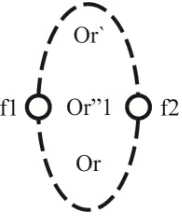
A short forwarder list forces the packets to be forwarded with possible weak links to increase the reliability of packet forwarding between two listed forwarders. It is clearly explained in the retransmission process in Figure.2.
In this figure f1 and f2 is forwarder list node. The Node r is located somewhere between f1 and f2. The f2 has transmitted its fragment of packets and it is compared with the packets transmitted by f1, the node r knows the missed packets in f2. It believes the missing packets are now eligible for retransmission.
1.Node rshould be a neighbour of bothf1 and
f2. Node rcan learn this by looking up its neighbour list.
2.The separation distance between f1 and f2, refers d(f1, f2), should be greater than d(f1, r) and d(r, f2).
3.Node r uses a scoring function F(d(f1, r), d(r, f2)). F can be any function that favors a node close to the midpoint of the line segment between f1 and f2 and it is not too close to either one of them.
4. THROUGHPUT AND DELAY ANALYSIS
Therefore, unavailability of alternative routes causes the source node to initiate route discovery and also the protocol initiates route repair mechanism, if any route breaks occurs. The intermediate nodes are unable to send the data packets due to the link break that the ECOR sends the route error and its leads packet dropping. It also reduces the Packet Delivery ratio and throughput. Thus the route discovery and route maintenance are efficiently carried out through ECOR. The PDR, Throughput, End-to-End delay and Packet dropping ratio are clearly discussed in this section for analysis.
1. Packet Delivery Ratio (PDR)
The ratio of the number of data packets actually delivered to the destinations versus the number of data packets supposed to be received. This number presents the effectiveness of a protocol.
PDR = ∑ No.of packet received / ∑ No.of packet sent
2. Throughput
Throughput is the total amount of packets which is received by a destination node. It is measured by byte/sec or bit/sec.
Total no.of pack successfully delivered Throughput =
Time
3. End-to-End Delay
It is the average delay of data packets received by destination from source. It is measured through the time taken between the generation of data packet at source and the last bit of arrival at destination.
4. Packet Drop Ratio
The total number of packets dropped during the transmission.
Packet lost = number of packet sent - number of packet received.
Thus the analysis is achieved based on the above derivations in this proposed ECOR. The proper performance analysis is explained in detail in the section 5.
5. RESULTS AND DISCUSSION
In this work, the proposed system is simulated using Network Simulator NS-2. Fifty nodes are randomly deployed in a 1000×1000 m2 area. The simulation is carried out by the comparison between AODV and proposed ECOR.
5.1Packet Delivery Ratio and Throughput
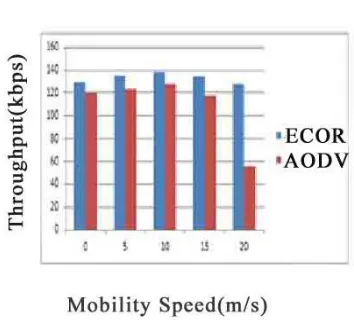
In this proposed scheme PDR performance analysis between AODV and ECOR is represented in Figure 3. This figure denotes the result from first experiment, where AODV’s PDR is low as 56%. Although the PDR significantly drops with the increase of low power nodes, the proposed scheme consistently outperforms the other competing protocols. It is observed that, at lower link connectivity, the proposed scheme is able to achieve a PDR of 91%, which is twice as much compared to the AODV routing protocol. Figure 3 represents the results from the second experiment. At the same ratio that the proposed scheme’s PDR increases up to 93% compared to the first experiment.
In Figure 4, the packets are being dropped due to the unidirectional links, because many of the RREP occurs which causes the source to frequent rebroadcast. As a result the links become severely congested and reducing the probability of successful RREP packet transmission.
Figure. 3. Throughput Vs Node Mobility
5.2 End-to-End Delay
Figure 4 represents the average end-to-end delay from the first and second experiments, respectively. The results are slightly increased in the first experiment and this may be due to the different mobility model sets in each simulation. The observation are made that the average end-to-end delay of the AODV scheme consistently remains at a level high than the proposed scheme. This is expected since AODV constraints routing by assuming that all links are bidirectional.
Figure. 4. Packet Delay Vs Node Mobility
Therefore, it severely affects the route discovery, which causes the source nodes to frequently broadcast RREQ packets. On the contrary, the proposed scheme utilizes the unidirectional link during the route discovery, causing lower delay. Consequently, data packets will be rapidly transmitted by the relay nodes with reduced delay once the route is established. Thus the Simulation is achieved successfully based on nodes velocity and average delay and it is plotted clearly in the above figure.
6. CONCLUSION AND FUTURE WORK
In this proposed work, Cooperative packet delivery is achieved in multi-hop mobile ad hoc networks. We have proved that our proposed scheme achieves the optimal packet delivery using 1. ECOR 2. Large - Scale Live Update. and 3. Small scale Retransmission. All nodes utilize the broadcasting nature of wireless channels and are achieved via efficient cooperative participation in this network. Sender can send the packets and they forwarded through the relay nodes to the desired destination under the proper route discovery and route maintenance. In this cooperative packet delivery, the non-cooperative nodes are included wherever required. In this opportunistic network, the cooperative nodes are in forwarder list update and based the efficiencies of node in the network the packets are disseminated through the established route to reach the destination. The performance analysis of throughput and delay was successfully simulated using the ECORS. Our future work is to increasing energy level of mobile nodes in cooperative message transmissions to achieve the nodes lifetime in entire mobile ad hoc network.
REFERENCES
[1] I.Chlamtac, M. Conti, and J.-N. Liu, “Mobile ad hoc Networking: Imperative and Challenges,” ad hoc networks, vol. 1, no. 1, pp.13-64, July 2003.
[2] R. Rajaraman,“Topology Control and Routing in Ad hoc Networks: A Survey,” SIGACT News, vol. 33, pp. 60–73, June 2002.
[4] P. Larsson, “Selection Diversity Forwarding in
a Multi hop Packet Radio Network With Fading Channel and Capture,” ACM Mobile Computing and Communications Review, vol. 5, no. 4, pp. 47–54, October 2001.
[5] S. Chachulski, M. Jennings, S. Katti, and D. Katabi, “Trading Structure for Randomness in Wireless Opportunistic Routing,” in Proc. ACMConference of the Special Interest Group on Data Communication(SIGCOMM), Kyoto, Japan, pp. 169–180, August 2007.
[6] C. Fragouli, J.-Y. L. Boudec, and J. Widmer, “Network Coding: an Instant Primer,”
SIGCOMM Computer Communication Review, vol. 36, pp. 63–68, January 2006.
[7] I. Leontiadis and C. Mascolo, “GeOpps: Geographical Opportunistic Routing for Vehicular Networks,” in Proc. IEEE International Symposium on a World of Wireless Mobile and Multimedia Networks (WoWMoM), Helsinki, Finland, pp. 1–6, June 2007.
[8] S. Yang, F. Zhong, C. K. Yeo, B. S. Lee, and J. Boleng, “Position Based Opportunistic Routing for Robust Data Delivery in MANETs,” in Proc. IEEE Conference on Global Telecommunications(GLOBECOM), Honolulu, Hawaii, USA, pp. 1325–1330, December 2009.
[9] S.Muthy, “Routing in Packet-Switched Networks using Path-finding Algorithms,”
Ph.D. dissertation, university of California -santa cruz, 1156 High street, Santa Cruz, CA 95064, United States, 1996.
[10] J. Behrens and J. J. Garcia-Luna - Aceves, “Distributed, Scalable Routing based on Link- State Vectors,” in Proc. ACM SIGCOMM, pp. 136–147, 1994.
[11] S. Murthy and J. J. Garcia-Luna-Aceves, “An Efficient Routing Protocol for Wireless Networks,” Mobile Networks and Applications, vol. 1, no. 2, pp. 183–197, October 1996. [12] Z. Wang, C.Li, and Y.chen,”PSR: Proactive
Source Routing in Mobile Ad hoc Networks,”
In Proc. IEEE Conference on Global Telecommunications (GLOBECOM), Houston, TX USA, Dec 2011.
[13] Z. Wang, Y. Chen, and C. Li, “A New Loop-free Proactive Source Routing Scheme for Opportunistic Data Forwarding in Wireless Networks,” IEEE Communications Letters, to appear.
[14] C. E. Perkins and E. M. Royer, “ Ad hoc On-Demand Distance Vector (AODV) Routing,”
RFC 3561, July 2003.
[15] M. K. Marina and S. R. Das, “ Routing Performance in the Presence of Unidirectional Links in Multihop Wireless Networks,” In the Third ACM International Symposium on Mobile Ad Hoc Networking and Computing (MobiHoc’02), Lausanne, Switzerland, pp. 12– 23, June 2002.
[16] Chung-Ming Huang, Kun-chan Lan and Chang-Zhou Tsai, “ A Survey of Opportunistic Networks”, In Proc. IEEE Conference on Advanced Information Networking and Applications, pp- 1672-1677, 2008.