PARIS RESEARCH LABORATORY
d i g i t a l
September 1993
34
34
A penalty function method
for constrained motion planning
Pierre Ferbach J ´er ˆome Barraquand
Publication Notes
The authors can be contacted at the following addresses:
Pierre Ferbach
Ecole Nationale Sup´erieure des Techniques Avanc´ees 32 Bd Victor
75015, Paris, France
Jerome Barraquand
Digital Equipment Corporation Paris Research Laboratory 85 Avenue Victor Hugo
92500 Rueil-Malmaison, France
c
Digital Equipment Corporation 1993
This work may not be copied or reproduced in whole or in part for any commercial purpose. Permission to copy in whole or in part without payment of fee is granted for non-profit educational and research purposes provided that all such whole or partial copies include the following: a notice that such copying is by permission of the Paris Research Laboratory of Digital Equipment Centre Technique Europe, in Rueil-Malmaison, France; an acknowledgement of the authors and individual contributors to the work; and all applicable portions of the copyright notice. Copying, reproducing, or republishing for any other purpose shall require a license with payment of fee to the Paris Research Laboratory. All rights reserved.
Abstract
The path planning problem, i.e. the geometrical problem of finding a collision-free path between two given configurations of a robot moving among obstacles, has been studied by many authors in recent years. The interest in constrained motion planning is more recent. Constrained motion planning consists in finding motion sequences for robotic systems whose free space in not an open subset of the configuration space. In particular, manipulation
planning is an important instance of the general constrained motion planning problem. It
consists in planning the motions of a system including robots and movable bodies that are constrained by grasping relationships. In a manipulation planning problem, the dimension of the free space may be dynamically changing along the solution path.
In this report, we establish necessary and sufficient conditions under which grasping constraints are holonomic. Then we present a systematic approach to motion planning in the presence of grasping constraints deriving from this theory. Its principle is to replace a constrained problem by a convergent series of less constrained subproblems increasingly penalizing motions that do not satisfy the constraints. Each subproblem is solved using a standard path planner. We use the method of Variational Dynamic Programming for solving the subproblems. We report several experiments in manipulation planning with multiple redundant robots and multiple moving objects in configuration spaces having up to 12 degrees of freedom (DOF). The implemented planner has solved manipulation planning problems of unprecedented complexity.
R ´esum ´e
Le probl`eme de la planification de trajectoire, i.e. the probl`eme g´eom´etrique consistant `a trouver des chemins sans collisions entre deux configurations d’un robot en pr´esence d’obstacles, a ´et´e largement ´etudi´e ces derni`eres ann´ees. L’int´erˆet pour les probl`emes de planification sous
contraintes est plus r´ecent. La planification de mouvement sous contraintes consiste `a trouver
des s´equences de mouvements pour des syst`emes robotis´es dont l’espace libre n’est pas un sous espace ouvert de l’espace des configurations. En particulier, le probl`eme de la planification de manipulation est une instance importante du probl`eme g´en´eral de la planification sous contraintes. Il consiste `a planifier les mouvements d’un syst`eme incluant des robots et des objets `a manipuler li´es entre eux par des contraintes de pr´ehension. Dans un probl`eme de manipulation, la dimension de l’espace libre peut changer dynamiquement le long du chemin solution.
Dans ce rapport, nous ´etablissons les conditions n´ecessaires et suffisantes sous lesquelles une contrainte de pr´ehension est holonome. Nous pr´esentons ensuite une approche syst´ematique pour la planification sous contraintes de pr´ehension d´erivant de cette th´eorie. Son principe est de remplacer un probl`eme sous contraintes par une suite convergeante de sous-probl`emes moins contraints p´enalisant de fa¸con croissante les mouvements qui ne satisfont pas les contraintes. Chaque sous-probl`eme est r´esolu grˆace `a un planificateur de trajectoire classique. Nous utilisons la m´ethode de Programmation Dynamique Variationnelle pour r´esoudre les sous-probl`emes. Des simulations effectu´ees sur plusieurs probl`emes de manipulation sont pr´esent´ees dans ce rapport, incluant plusieurs robots redondants et plusieurs objets `a manipuler dans des espaces ayant jusqu’`a 12 degres de libert´e. Le planificateur peut r´esoudre des probl`emes de manipulation d’une complexit´e sans pr´ec´edent.
Keywords
Path Planning, Constrained Motion Planning, Manipulation Planning, Grasping, Nonholo-nomic Constraints, Robotics, Computer Aided Design, Computer Graphics, Penalty Function Method
Contents
1 Introduction 1
2 Relation to other work 2
3 Manipulation tasks, grasping, and nonholonomy 3
3.1 The manipulation planning problem : : : : : : : : : : : : : : : : : : : 3
3.2 Grasping and stability constraints : : : : : : : : : : : : : : : : : : : : 4
3.3 Nonholonomy of grasping constraints : : : : : : : : : : : : : : : : : : 6 3.3.1 An introductory example : : : : : : : : : : : : : : : : : : : : : : 6 3.3.2 General case : : : : : : : : : : : : : : : : : : : : : : : : : : : : 7
3.4 Docking positions and holonomic grasp planning : : : : : : : : : : : : 9
4 A penalty function method for holonomic manipulation planning 9 4.1 An introductory example : : : : : : : : : : : : : : : : : : : : : : : : : 9
4.2 Variational planning : : : : : : : : : : : : : : : : : : : : : : : : : : : : 11
4.3 General case : : : : : : : : : : : : : : : : : : : : : : : : : : : : : : : : 12
5 Experimental results 13
5.1 10-DOF non-serial manipulator robot grasping a 2-DOF disk. : : : : 13
5.2 3-DOF serial manipulator robot manipulating two 2-DOF disks. : : : 15
5.3 Two 3-DOF manipulator arms manipulating a 3-DOF bar : : : : : : : 15
5.4 Three robots manipulating a 2-DOF disk : : : : : : : : : : : : : : : : 16
6 Discussion 17
6.1 Current limitations and possible extensions : : : : : : : : : : : : : : : 17 6.1.1 Automatic selection of docking positions : : : : : : : : : : : : : : 17 6.1.2 Computation of efficient-strategies : : : : : : : : : : : : : : : : 19 6.1.3 Combining the penalty function method with other path planners : : 19
6.2 Other applications of the penalty function method : : : : : : : : : : : 20 6.2.1 Application to standard path planning problems : : : : : : : : : : 20 6.2.2 Applications in assembly planning : : : : : : : : : : : : : : : : : 20
7 Conclusion 20
References 22
A penalty function method for constrained motion planning 1
1 Introduction
We present a systematic approach to constrained motion planning for robotic systems with many degrees of freedom (DOF). Constrained motion planning consists in finding motion sequences for robotic systems whose free space in not an open subset of the configuration space. In general, constraints in motion planning problems can be classified into two categories:
Path-independent constraints, i.e. constraints that only depend on the current
configu-ration of the robot. Path-independent constraints are often called holonomic constraints.
Path-dependent constraints, that depend on more than a single configuration along the
path. Path-dependent constraints are generally called nonholonomic constraints. An important class of path-dependent constraints is that of constraints on the first derivative (velocity) that are not integrable.
In particular, manipulation planning is an important instance of the general constrained motion planning problem. Given an environment containing robots, stationary obstacles, and movable bodies, the manipulation problem consists in finding a sequence of free robot motions, grasping and ungrasping operations, to reach a given state from a given initial state in the joint configuration space of all robots and movable bodies. In a manipulation planning problem, the dimension of the free space may be dynamically changing along the solution path.
We first develop a theory of manipulation planning. We show that in general a grasping constraint is nonholonomic, since it involves the first derivative of the path followed by the movable objects. We characterize conditions under which grasping constraints can be made holonomic. Loosely stated, a grasping constraint is holonomic if and only if the set of stable configurations for the movable object is a series of disconnected points called docking
positions.
Then, we present an implemented planner derived from this theory. This planner is capable of planning manipulation tasks when the number of docking positions is finite. This simplification makes the problem holonomic. The principle of our approach is to replace the original equality-constrained problem by a convergent series of more and more difficult inequality-equality-constrained planning problems with open free spaces increasingly penalizing motions that do not satisfy the grasping constraints. We call this approach a penalty function method. In other words, grasping constraints are handled by our planner in a progressive fashion. We first solve the problem assuming that the movable objects can move without being grasped by a robot. Then, this path is used as an input for a series of more and more difficult problems forcing the objects to get closer and closer to the robots in order to move. Each subproblem is solved using a standard path planner. We use the method of Variational Dynamic Programming (VDP) described in Barraquand and Ferbach 1993 [2] for solving the subproblems. However, in theory, any other variational planner could be used instead of VDP. We call the overall method
Progressive Variational Dynamic Programming (PVDP).
The planner has successfully solved manipulation planning problems of unprecedented complexity. We report several manipulation planning experiments for systems with up
2 Pierre Ferbach and J ´er ˆome Barraquand
to 12 DOF.
Initially, this penalty function approach was developed in Barraquand and Ferbach 1993 [2] as a variant of the VDP method for solving difficult instances of the basic path planning problem in open free space. Indeed, given any variational path planning method, one can replace the collision avoidance constraints in a classical path planning problem by a convergent series of simpler constraints increasingly penalizing motions that do not satisfy collision avoidance constraints. The resulting planner is less general in theory than the original VDP planner, since it uses problem-specific heuristics to guide the search. On the other hand, it is dramatically faster. In fact, it can solve some problems in a time comparable to that of potential-field based methods (see Barraquand and Ferbach 1993 [2]).
This report is organized as follows. In Section 2, we relate our contribution to previous work in motion planning. In Section 3, we develop a theory of manipulation planning, and characterize in particular conditions under which grasping constraints can be made holonomic. In Section 4 we describe the general principle underlying the penalty function approach to manipulation planning in the presence of holonomic grasping constraints. We also describe our implemented planner PVDP. In Section 5, we present experimental results illustrating the capabilities of the implemented planner. In section 6, we discuss current limitations and possible generalizations of the PVDP approach to manipulation planning. We also review possible applications of the penalty function method to other constrained motion planning problems. Section 7 is the conclusion.
2 Relation to other work
The path planning problem, i.e. the geometrical problem of finding a collision-free path between two given configurations of a robot moving among obstacles, has been studied by many authors in recent years (Latombe 1990 [8]).
The interest in constrained motion planning is more recent in the robotics literature. The problem of planning the path of a convex polygonal robot translating in a two-dimensional polygonal workspace in the presence of multiple convex polygonal movable objects is addressed in Wilfong 1988 [12]. The general manipulation problem is described in a series of papers from Alami, Laumond, and Simeon (e.g. Alami Simeon and Laumond 1989 [1], Laumond and Alami 1989 [10]).
To the best of our knowledge, although nonholonomic rolling constraints in motion planning have been investigated by several authors (e.g. Laumond 1986 [9] and subsequent papers, Li and Canny 1989 [11], Barraquand and Latombe 1989 [4], 1993 [6]), the nonholonomic nature of grasping constraints in manipulation tasks has never been investigated to date.
An implemented algorithm for manipulation task planning with a 2 DOF robot grasping a single object at a time and several 2 DOF bodies translating in the plane is presented in Alami Simeon and Laumond 1989 [1]. The planner has two components: a classical path planner, and a manipulation task planner (MTP). The MTP plans a sequence a robot motions, grasping and
A penalty function method for constrained motion planning 3
ungrasping operations, and transfer motions (i.e. motions of the robot together with a grasped object). The approach is in practice limited to non-redundant robots with few DOF, and requires an exhaustive exploration of the robot’s configuration space. Koga and Latombe 1992 [7] present several implemented planners solving various dual-arm manipulation planning problems of increasing difficulty. They use and extend the framework of Alami Simeon and Laumond 1989 [1]. The planner is again the combination of a path planner and a manipulation task planner. For problems with many degrees of freedom, the path planner used is the potential field based planner RPP (Barraquand and Latombe 1991 [5]).
Our approach to manipulation task planning is fundamentally different. We do not decompose the problem into a sequence of robot motions and manipulation tasks. Our planner is not a combination of a path planner and a manipulation task planner. Instead, we simply consider the whole manipulation problem as a special instance of the basic path planning problem in the joint configuration space of the robot and the movable objects. The major advantage of this approach is to avoid the artificial decoupling between motion planning and task planning. As a consequence, PVDP can solve manipulation planning problems of unprecedented complexity.
3 Manipulation tasks, grasping, and nonholonomy
3.1 The manipulation planning problem
We consider one or more robots R1;. . .;Rlwith respective configuration spacesC
R1
;. . .;C
Rl, one or more movable objects M1;. . .;Mswith respective configuration spacesC
M1
;. . .;C
Ms, evolving in a workspaceW populated by stationary obstacles. We assume that for any object
A2fR1;. . .;Rl;M1;. . .;Msg, the manifoldC
Ais bounded (hence compact, since it is a closed subset of the Euclidean space) and connected. The joint configuration space of the robots is denoted byC
robots
= Q
l i=1
C
Ri. Similarly, the joint configuration space of the movable objects in denoted by C
obj
= Q
s j=1
C
Mj. The joint configuration space of the robots and movable objects is simply the cartesian productC =C
robots
C
obj. We denote its dimension, i.e. the total number of degrees of freedom of all the robots and movable objects, by n.
For any robot or movable object A2fR1;. . .;Rl;M1;. . .;Msg, we can define the projection
that maps any configuration for all robots and objects q=(q
R1
;. . .;q
Rl
;q
M1
;. . .;q
Ms
)2Cto
the corresponding configuration qA
2C
Aof A.
X : C ! C
A
q 7 !
A
(q)=q
A
We assume that an appropriate distance metric d(q;q 0
)has been defined overC. The collision
avoidance space, i.e. the set of configurations q2 Csuch that robots, movable objects, and
stationary obstacles do not collide with each other in denoted byCavoid. We assume thatCavoid
can be represented as
Cavoid =fq2C; gavoid(q)<0g
where gavoid is an appropriate function defined over C. For example, gavoid could be the
opposite of the minimum distance between any robot or object with other robots, objects, or
4 Pierre Ferbach and J ´er ˆome Barraquand
with obstacles. We see that the collision avoidance constraint is an inequality constraint in configuration space.Cavoidis an open subset ofC.
Let qinit be the initial configuration of the system, and qgoal its desired configuration. The problem of manipulation planning consists in finding a sequence of free robot motions, grasping and ungrasping operations, to reach qgoalfrom qinitin the joint configuration spaceC
of the robot and all movable bodies.
This sequence can be simply represented by a pathinCjoining(0)=qinitand(1)=qgoal.
As in any classical path planning problem, the pathmust not cross colliding configurations,
i.e. we must have:
8t2[0;1]; (t)2Cavoid
However, there are two other kinds of constraints that must also be satisfied by: grasping
constraints, and stability constraints. These constraints are due to external forces (e.g. gravitational forces) applied to the movable objects. First, the movable objects can only move when they are grasped by some robot. Hence, the forbidden pathsare not only those
for which the robots or the movable objects hit the stationary obstacles or collide with each other, but also all those for which the movable objects are moving without being grasped by a robot. Second, movable objects can be ungrasped by robots only within the subset of stable configurations, i.e. the subset of configurations where exterior forces sum to zero.
The formalisation of these notions is the object of the next subsection.
3.2 Grasping and stability constraints
We first introduce the notion of grasping constraint by a simple example. More complex examples are presented in Section (5). Let us consider a 2-dimensional workspaceW, with
a single serial robot manipulator R with nrobot = 2 revolute joints a1 and a2 as illustrated
in Figure (1). We assume that the robot base is fixed at the position(x0;y0) in W. The
coordinates(xeff;yeff)of the end-effector satisfy the forward kinematic equations:
xeff(a1;a2)=x0+ L1cos a1+ L2cos a2
yeff(a1;a2)=y0+ L1sin a1+ L2sin a2
where L1 and L2 are the respective lengths of the two robot arms. A configuration of R is a couple qR = (a1;a2). We assume that the workspace is populated by a single movable
disk M with nobj=2DOF translating in the plane, and whose configuration is defined by the
coordinates of its center qM =(xm;ym). The total dimension of the joint configuration space
is n=nrobot+ nobj=4. We define a grasp between R and M as the set Ggraspof configurations
q=(a1;a2;xm;ym)of the whole system verifying:
g1grasp(a1;a2;xm;ym)=xeff xm=0
and
g2grasp(a1;a2;xm;ym)=yeff ym=0
A penalty function method for constrained motion planning 5 a1 a2 Yeff Xeff X0 Y0 Ym Xm L1 L2
Figure 1: A simple two-dimensional grasping problem in a two-dimensional configuration space
The number h of coordinates of the grasping constraint ggrasp = (g
1 grasp;g
2 grasp)
T is h
= 2.
We say that ggraspis a h =2-dimensional grasping constraint. Hence, we see that Ggraspis
a n h = 2-dimensional submanifold ofC. The dimension of a typical grasping constraint
for a classical industrial robot with nrobot=6DOF manipulating a solid object with nobj=6
DOF in a three dimensional configuration space is h= 6. A robot with nrobotDOF designed
for satisfying grasping constraints of dimension h=nobj, i.e. for grasping objects with nobj
DOF, is said to be non-redundant iff nrobot= h=nobj. The robot is said to be redundant iff
nrobot>h=nobj.
More generally, given a robot Riand an object Mj, an h-dimensional grasping constraint g Ri;Mj
grasp is represented by the n h dimensional set of valid grasping configurations GRi;Mj:
GRi;Mj
=fq2C; g
Ri;Mj
grasp(
Ri
(q);
Mj
(q))=0g
where gRi;Mj
graspis a continuous mapping fromC
Ri
C
Mj onto Rh.
gRi;Mj
grasp : C
Ri C Mj ! R h (q Ri ;q Mj
) 7 ! g
Ri;Mj
grasp(q
Ri
;q
Mj
)=
gRi;Mj
grasp 1 (q Ri ;q Mj
);. . .;g
Ri;Mj
grasp h (q Ri ;q Mj ) T
In general, a robot can grasp a given object in several different ways. For example, if the robot at hand has two arms, and the object to be manipulated is a long bar, there are two possible ways of grasping the long bar using both arms at both extremities of the bar, that correspond to the possibility of swapping the two arms. Such problems are called dual arm manipulation
6 Pierre Ferbach and J ´er ˆome Barraquand
planning problems. An example of such problem is presented in Section (5). Also, any finite set of robots can be viewed as another robot. Hence, the above formalism applies to complex problems such as multifingered manipulation planning. We take the set GRi;Mj as the set of all
possible valid grasping configurations, regardless of the way the object is being grasped.
A manipulation path satisfies the grasping constraints iff for any movable object Mj, the object is either stationary or grasped by some robot Ri. Formally:
8t2[0;1];
9i2[1;l]; g
Ri;Mj
grasp(
Ri
((t));
Mj
((t)))=0 _ d dt Mj
((t))=0
(1)
We see that a grasping constraint may be nonholonomic, since it involves the first derivative of the path followed by the movable object. We will formally prove this intuitive fact in the next subsection. Before, we introduce a simplified concept of stability.
An object Mj can be ungrasped by some robot only if its configuration qMj is stable with respect to exterior forces, e.g. with respect to the gravitational force and reaction forces from stationary obstacles. It may be that the configuration of other objects influences the stability of Mj. Here we only consider absolute stability, i.e. stability in the absence of other objects. Hence, the set of stable configurations of Mj is a well-defined subset ofC
Mj. It is denoted by STABLE(Mj). We assume that STABLE(Mj)is a closed set.
3.3 Nonholonomy of grasping constraints
3.3.1 An introductory example
We first consider the example above, and then turn to the general case. Applying formula (1) to the example of Figure (1), we get:
8t2[0;1];
xeff(t) xm(t)=yeff(t) ym(t))=0
_
dxm
dt
(t)=
dym
dt
(t)=0
(2)
If the above two-dimensional constraint were holonomic, we could integrate it, i.e. we could find a couple of real-valued functions F1 and F2 such that a path (t) =
(a1(t);a2(t);xm(t);ym(t))satisfies the constraint iff
8t2[0;1]; F1(a1(t);a2(t);xm(t);ym(t))=F2(a1(t);a2(t);xm(t);ym(t))=0
If we define the real-valued function F = q
F21+ F22 =jj(F1;F2)
T
jj
R2, the above constraint can be rewritten:
8t2[0;1]; F(a1(t);a2(t);xm(t);ym(t))=0
We consider an arbitrary object location (x
0 m;y
0
m) reachable by the robot, i.e. such that
there exists(a
0 1;a
0
2)verifying xeff(a
0 1;a
0 2)=x
0
m and yeff(a
0 1;a
0 2)= y
0
m. We write(x
0 m;y
0 m)2
REACH(M). We consider a path starting at a1(0)=a
0
1;a2(0)=a
0
2;xm(0)=x
0
m;ym(0)=
y0mconsisting of immediately ungrasping the object and bringing the robot to an arbitrary other location a11 =a1(1);a
1
2 =a2(1). Along such a path, the object will not move since it must
A penalty function method for constrained motion planning 7
satisfy (2). Hence, we have xm(1)=x
0
m and ym(1)=y
0
m. By holonomy, we must have at
t=1:
F(a
1 1;a
1 2;x
0 m;y
0 m)=0;
We have just shown that for any reachable couple(x
0 m;y
0
m), the function F takes the value0no
matter the value taken by its first two variables a11and a12:
8(a
1 1;a
1 2)2C
R
; 8(x
0 m;y
0
m)2REACH(M); F(a
1 1;a
1 2;x
0 m;y
0 m)=0
Hence, F is identically null over the set of reachable configurations. Now, given any configuration (a
1 1;a
1 2;x
0 m;y
0
m) such that (x
0 m;y
0
m) is reachable, we take any other reachable
configuration(x
1 m;y
1
m)different from(x
0 m;y
0
m), and we can consider the path:
8t2[0;1]; a1(t)=a
1
1; a2(t)=a
1
2; xm(t)=x
0 m+ t(x
1
m x0m); ym(t)=y
0 m+ t(y
1 m y0m)
Along this path, F is identically null by the above result. But this path obviously does not satisfy constraint (2). Hence, we have a contradiction. The constraint (2) cannot be holonomic.
3.3.2 General case
We now turn to the general case. Before stating the result, we first define formally the notion of reachable configuration for a movable object. Given an object Mj, the configuration qMj is
reachable and we write qMj
2REACH(Mj)iff there exists a robot Rithat can grasp Mjat q
Mj. The set of reachable configurations REACH(Mj)can be defined as follows.
REACH(Mj)=fq
Mj
2C
Mj
; 9i2[1;l]; 9q
Ri
2C
Ri
; g
Ri;Mj
grasp(q
Ri
;q
Mj
)=0g
Clearly, REACH(Mj)is closed, since the constraints g
Ri;Mj
graspare continuous andC is compact.
We call docking position an object configuration that is both stable and reachable, and we write
DOCK(Mj)=STABLE(Mj)\REACH(Mj)
By the above results, we see that DOCK(Mj)is a closed bounded subset of C
Mj. Hence, DOCK(Mj)is compact. We will prove the following result.
Characterization of holonomic grasps
We consider the grasping constraint (1) for an object Mj. The following two
statements are equivalent.
i) All pathwise-connected components of the set of stable reachable object positions
DOCK(Mj)=STABLE(Mj)\REACH(Mj)are singletons.
ii) The constraint is holonomic
In other words, a grasping constraint is holonomic iff there is no path composed only of stable reachable configurations connecting two different stable reachable configurations.
8 Pierre Ferbach and J ´er ˆome Barraquand
Proof of ii)=>i).
We first prove ii)=>i)by generalizing the argument developed above for the example in
Figure (1).
Assume the constraint (1) is holonomic. We consider a function F mappingConto R such that
(1) is equivalent to:
8t2[0;1]; F((t))=0
We take an arbitrary qM0j 2DOCK(Mj). Since q
Mj
0 is reachable, there exists a robot Ri and a configuration qRi
0 such that
gRi;Mj
grasp(q
Ri 0;q
Mj 0 )=0
Without loss of generality, we can consider all other objects and robots as static, and limit our study to paths in C
Ri
C
Mj. We define the path
starting at(0)= (q
Ri 0;q
Mj
0 ), consisting
of ungrasping Mj and bringing Ri to an arbitrary other location qR1i. This path is valid since qM0j is a stable configuration. By the grasping constraint (1) we must have(1)=(q
Ri 1;q
Mj 0 ).
By holonomy, we have F(q
Ri 1;q
Mj
0 )= 0. SinceC
Ri is connected, this is true for any couple
(q
Ri 1 ;q
Mj 0 )2C
Ri
DOCK(Mj). We can write:
F(C
Ri
DOCK(Mj))=0 (3)
Now, we take any other object configuration qM1j 2DOCK(Mj). We will show that there can
be no pathin DOCK(Mj)linking(0)=q
Mj
0 and(1)= q
Mj
1 . This will in turn prove i).
Indeed, if such a path exists, we can define the path(t)=(q
Ri
(t);q
Mj
(t))inC
Ri
C
Mj:
8t2[0;1]; q
Ri
(t)=q
Ri 1 ; q
Mj
(t)=(t)
By (3) and ii), this path satisfies the grasping constraint. But clearly cannot satisfy (1)
sincejoins two different configurations. Hencecannot exist, and we get the desired result.
Proof of i)=>ii).
Reciprocally, let us assume i). We define the following real-valued function overC:
F(q)=min min
i2[1;l]
jjg
Ri;Mj
grasp(
Ri
(q);
Mj
(q))jj
; min
D2DOCK(Mj)
d(
Mj
(q);D)
! (4)
Since DOCK(Mj)is a compact set, the minimum min
D2DOCK(Mj)
d(
Mj
(q);D)
is well-defined by the Bolzano-Weierstrass theorem. Hence, F(q)is a well-defined function.
We will show that the grasping constraint (1) is equivalent to the following holonomic constraint:
8t2[0;1]; F((t))=0 (5)
Indeed, the above holonomic constraint can be rewritten:
8t2[0;1];
9i2[1;l]; g
Ri;Mj
grasp(
Ri
((t));
Mj
((t)))=0
W
9D(t)2DOCK(Mj);
Mj
((t))=D(t)
A penalty function method for constrained motion planning 9
Hence, it suffices to show the following implication for any interval [t1;t2][0;1]
8t2[t1;t2];9D(t)2DOCK(Mj);
Mj
((t))=D(t)
=>
8t2[t1;t2];
d dt
Mj
((t))=0
But, since DOCK(Mj)verifies i), the path D(t)is necessarily constant:
8t2[t1;t2];
Mj
((t))=D(t)=D
Deriving the above identity with respect to t, we get the desired result.
3.4 Docking positions and holonomic grasp planning
In this paper, we consider only manipulation planning problems for which the grasping constraints are holonomic. From the above result, this implies that we impose to the set of stable reachable configurations (i.e. docking positions) to be composed of pathwise-connected components containing a single element. In practice, we will restrict ourselves to problems for which a movable object Mj is only stable at a finite number of docking positions
8u2[1;dj];D
u j 2C
Mj, unless it is grasped by a robot. Formally:
DOCK(Mj)=fD
1 j;. . .;D
dj j g
We call free space and denote byCfreethe subset ofCavoidsatisfying the (holonomic) grasping
constraints. We see that in general, Cfree is not an open subset of C, since the grasping
constraints are equality constraints. The dimension ofCfreecan dynamically change along the
solution path. This may happen when a robot grasps an object (reduction of the dimension) or ungrasps it (increase in the dimension). Hence, a standard path planner only capable of planning motions in open free spaces of constant dimension cannot be used for solving the manipulation planning problem. In the next section, we introduce a new paradigm for circumventing this limitation of path planning techniques.
4 A penalty function method for holonomic manipulation planning
In this section, we present a new paradigm for solving motion planning problems in the presence of holonomic constraints. This approach applies in particular to manipulation planning problems when the set of docking positions for movable objects is finite and prespecified as part of the planning problem.
4.1 An introductory example
We first illustrate the approach on a manipulation planning example using the setup of Figure (1). We assume that initially the robot R is at the configuration(a
init 1 ;a
init 2 )= (a
0 1;a
0 2), and
10 Pierre Ferbach and J ´er ˆome Barraquand
that the object M is located at an arbitrary reachable configuration (x
init m ;y
init m ) = (x
0 m;y
0 m).
We define the goal configuration for the robot as (a
goal 1 ;a
goal
2 ) = (a
0 1;a
0
2), and the goal
configuration for the object as (x
goal m ;y
goal m ) = (x
1 m;y
1
m) 6= (x
0 m;y
0
m). We see that the task
assigned to the robot is simply a pick and place operation consisting of moving M to another location. Hence, in this case, it is easy to imagine how the problem should be addressed. First, the robot must move its end effector towards the object and grasp it. Second, both the robot and the grasped object must move in order to bring the end-effector (hence the object) to the goal configuration. Third, the robot must ungrasp the object and get back to its initial configuration. The above manipulation problem can be decomposed into a sequence of three basic motion planning problems in open free space. One may argue that it is not necessary to develop planners capable of dealing with grasping constraints, since manipulation problems can be decomposed into sequences of classical path planning problems without grasping constraints. However, the task of planning the sequence of motions, called manipulation task planning, is often much more complex than in the above pick and place problem. For example, there can be more than one object to manipulate, and the geometry of the workspace may imply that different objects interact with each other. As another example, the object to manipulate can be a long bar that must be grasped at the same time by two robot arms. In such a case, the robot arms may have to switch their respective grasps at the two ends of the bar. Examples of such problems will be presented in Section (5). For those more difficult problems, the task of planning the sequence of motions, grasping, and ungrasping operations may become a hard problem in itself. Then, a manipulation planner should be the combination of two planners: 1) a classical path planner in open free space computing motions between grasping and ungrasping operations 2) a manipulation task planner computing the sequence of grasps. This is the way the problem has been addressed in previous work (see Section (2)).
Here, we take an opposite approach, and attempt to solve the whole manipulation planning at once. This enables us to deal with intricated interactions between geometric and task planning constraints that cannot be taken into account by other planners decoupling the two problems.
We first define two docking positions for the object M, namely its initial and goal positions.
DOCK(M)=f(x
0 m;y
0 m);(x
1 m;y
1 m)g
In a more difficult problem, we might have to define intermediate docking positions. Examples of such intermediate docking positions are given in Section (5). This raises the problem of defining these docking positions as part of the planning task. Although the issue is still open in the general case, we briefly discuss it in Section (6).
Following the results of the previous section, the grasping constraint can be replaced by the following scalar holonomic constraint:
8t2[0;1]; F(a1(t);a2(t);xm(t);ym(t))=0
with
F(a1;a2;xm;ym)=min
" q
(xeff xm)
2+
(yeff ym)
2
; min
u2f1;2g q
(xm x
u m)
2+
(ym y
u m)
2
#
A penalty function method for constrained motion planning 11
We define a decreasing sequence of positive numbersk;k >0 converging towards 0. For
example, we can choosek =1=k. We replace the pick and place problem P defined above by
the sequence of problems Pk for which the grasping constraint is replaced by:
8t2[0;1]; F(a1(t);a2(t);xm(t);ym(t))<k
We see that the free space for problem Pkis an open subset of the configuration space. Hence, we can use a standard path planner to solve Pk.
The idea underlying the penalty function method is that, since the difficulty of solving Pk increases with k, it is better to first solve problem P1, and then use the solution path of problem
P1as a heuristic to solve problem P2. In turn, the solution hopefully obtained of problem P2 can be used as an input heuristic for solving problem P3, and so on until the grasping constraint is satisfied up to a prespecified accuracyk
max =1=kmax.
Hence, the penalty function method will work well if one can devise a path planner that makes efficient use of the solution path of problem Pk 1in order to solve problem Pk. Such a path planner is called a variational path planner. Variational planning is discussed in the next subsection.
4.2 Variational planning
Variational path planning consists of iteratively improving an initial path possibly colliding with obstacles (or any other inequality constraint) in order to obtain a collision free path.
We use the method of Variational Dynamic Programming (VDP) developed by Barraquand and Ferbach 1993 [2]. VDP consists in perturbing at each iteration the current path by performing a dynamic programming search around the current path in a m-dimensional submanifold of the n-dimensional configuration spaceC. In practice, m is chosen equal to 2,3, or 4, in order
to make the dynamic programming search tractable. The m-dimensional submanifold is an arbitrarily chosen ruled surface containing the current path. This surface is quantized into a
m-dimensional grid of configurations. Then, the grid is searched using Dijkstra’s algorithm
with an additive cost function proportional to the number of configurations colliding with obstacles. Hence, the new path obtained is guaranteed to collide obstacles less than the previous path. Then, the operation is repeated until a free path is found. See Barraquand and Ferbach 1993 [2] for more detail on the VDP algorithm.
Experiments reported in Section 5 show that VDP is well suited to using the output solution of problem Pk 1in order to solve efficiently problem Pk. However, other planners capable of planning paths in high dimensional configuration spaces could be adapted in theory to imbed the same feature. For example, the RPP planner described in Barraquand and Latombe 1991 [5] is not a variational planner in its original form, but could be adapted in the following fashion.
Given a solution pathk 1of problem Pk 1, and since the solution of problem Pk should not
differ significantly fromk 1, one could estimate the maximum distance dmaxover all t2[0;1]
between configurationk 1(t)and the corresponding configurationk(t)on a solution path
12 Pierre Ferbach and J ´er ˆome Barraquand
for problem Pk. Then,k 1could be used to include the additional heuristic constraint on the
free configuration spaceC
k
freeof problem Pk:
8q2C
k
free; 9t2[0;1];d(q;k 1(t))<dmax
This additional heuristic constraint would force the path planner RPP to limit its search for a solution pathk of problem Pkto a “tubular neighborhood” of the previous solution pathk 1.
We plan to investigate this alternative in future research.
4.3 General case
We consider the general manipulation planning problem of Section (3). We assume a finite number of docking positions for the objects have been prespecified as part of the planning problem. From the results of subsection (3.3), and more specifically from formula (4), we see that the grasping constraints for object Mj can be expressed:
8t2[0;1]; Fj((t))=0
with
Fj(q)=min min
i2[1;l]
jjg
Ri;M
j grasp(
Ri
(q);
Mj
(q))jj
; min
D2DOCK(Mj)
d(
Mj
(q);D)
!
For each object Mj, we can choose a positive decreasing sequence of numbers
j
k converging towards zero, an replace our original manipulation planning problem P by a sequence of problems Pk using the partially relaxed grasping constraints:
8j2[1;s]; 8t2[0;1]; Fj(k(t))<
j k
The penalty function method consists in first solving the simpler problem P1as a standard path planning problem in open free space using a variational path planner such as VDP, to obtain a first path1. Then, for any k>1, problem Pkis solved using as input to the variational planner
the solutionk 1 of the previous problem Pk 1. The algorithm is stopped when the numbers
Ek =(
1 k;. . .;
s
k)are all smaller than a prespecified tolerance valuek
max. The overall method is called Progressive Variational Dynamic Programming (PVDP), since the penalties on the grasping constraints are applied in a progressive fashion.
The vector sequence(Ek)k
>0is called
-strategy. Both the rate of convergence towards0and
the relative values for a given k of the various numbers
1 k;. . .;
s
k may influence the overall computation time and even the nature of the solution found by the planner.
More complex-strategies can be devised. Indeed, many different functions Fj can be used
to represent the same holonomic grasping constraints applying to the object Mj. For example, when the dimension h of a given grasp between robot Ri and object Mj is higher than 1, one may choose any other equivalent norm instead of the standard L2Euclidean norm to compute
A penalty function method for constrained motion planning 13
the number jjg
Ri;M
j
graspjj. One may find it preferable to use a weighted L
2 norm instead of the standard norm:
jj(g1;. . .;gh)
T
jj
weighted
L2 =
v u u t h X
i=1 ig
2 i
where 1;. . .;h are adequately defined positive numbers depending on the type of grasp
considered. Alternatively, one may use the weighted L1
norm:
jj(g1;. . .;gh)
T
jj
weighted L1
= max
i2[1;h] ijgij
Also, any other additional heuristic constraints can be added to improve the progressiveness in the difficulty of the sequence of problems Pkwhen facing a particularly complex manipulation problem. In general we call-strategy the whole set of empirical parameters that can be used
to define the holonomic constraints Fj and their rate of convergence towards0. Examples of efficient problem-specific strategies are presented in Section (5).
5 Experimental results
We have implemented PVDP in a program written in C, running on a DEC3000-500 Alpha AXP workstation. We have experimented with PVDP using a variety of manipulation planning problems. The most significant of these experiments are described below.
5.1 10-DOF non-serial manipulator robot grasping a 2-DOF disk.
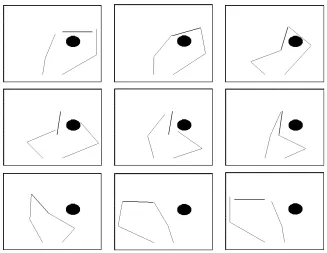
We consider the planar non-serial manipulator robot depicted in Figure 2, which includes three prismatic joints (telescopic links) and seven revolute joints. The task assigned to this robot is a simple pick and place operation consisting in grasping the disk in the lower right corner of the workspace, bringing it to the lower left corner, and then returning to its initial configuration. The total number of degrees of freedom for the whole problem is 12. Figure 2 illustrates a manipulation plan found by PVDP.
In this example, the robot is said to have grasped the disk when the following conditions are satisfied:
the center M of the disk coincides with the middle R=
E1+E2
2 of the two end-effectors
E1and E2of the robot.
the distancejjE1E2jjbetween the two end effectors E1and E2is equal to the diameter D
of the disk.
There are two admissible docking positions M1and M2for the disk, namely its initial and goal configurations.
14 Pierre Ferbach and J ´er ˆome Barraquand
The grasping constraint8t;F((t))=0is replaced in the approximating problem P
by the
constraint8t;F((t))<with the following expression for F(q).
F(q)=min max(jjE1E2jj D;jjRMjj); min
i2f1;2g
jjMMijj !
In other words, in problem P, either the disk is at distance less than
of a docking position,
or if satisfies both conditionsjjE1E2jj<D +andjjRMjj<.
We denote by F1E1the segment representing one of the two terminal fingers of the robot, F2E2
the other one. In addition to the-strategy defined above, we use in problem P
the following
heuristic constraint, systematically satisfied in the original definition of the grasp. If M is at distance longer thanfrom both M1and M2, it must always lie in the domain of the workspace
bounded by 1) the two straight lines prolongating the two robot fingers, i.e. the lines passing through F1;E1and F2;E2, and 2) the line F1F2. This additional heuristic constraint enhances
the progressiveness in the difficulty of problem P.
The initial value of is one fourth of the size of the workspace. Then, it is decreased at each
iteration of the penalty function method by0:001, i.e. 0:1% of the size of the workspace. The
tolerance value was set tok
max =0:006, i.e0:6% of the workspace. The path was computed
[image:24.612.135.461.391.628.2]in about half an hour.
Figure 2: A pick and place operation using a 10-DOF non-serial manipulator
A penalty function method for constrained motion planning 15
5.2 3-DOF serial manipulator robot manipulating two 2-DOF disks.
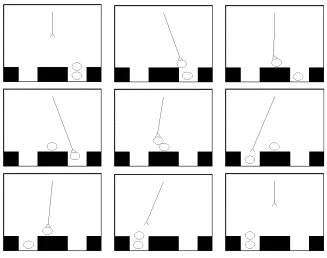
We consider the planar serial manipulator robot depicted in Figure 3, which includes two revolute joints and one telescopic link. The robot is composed of 1) a single telescopic arm, and 2) an end effector that can rotate at the end of the telescopic arm. The task assigned to this robot is to move both disks from the right-hand bucket to the left-hand bucket on the bottom of the workspace. Additionally, the two disks must be put in the left-hand bucket in a last-in first-out order, i.e. the disk on the top of the right-hand bucket at the initial configuration must be on the top of the left-hand bucket at the final configuration. Hence, the robot must first move the top disk to an intermediate docking position, then put the disk at the bottom of the right-hand bucket into the left-hand bucket, and finally bring the top disk from its intermediate position to the top of the left-hand bucket.
The total number of degrees of freedom for the whole problem is 7. Figure 3 illustrates a manipulation plan found by PVDP.
Let E1and E2be the two points at the extremities of the two fingers on the end-effector. Let M be the center of any one of the two disks. Let D be the diameter of the disks. In this example, the robot is said to have grasped a disk iff the distances E1M and E2M are both equal to D=2.
There are three docking positions for the top disk: 1) the initial position, 2) the goal position, 3) the intermediate docking position on top of the central obstacle separating the two buckets (see figure (3)). There are two docking positions for the bottom disk: 1) the initial position, 2) the goal position.
The grasping constraints in the partially relaxed problems Pwere defined in a fashion similar
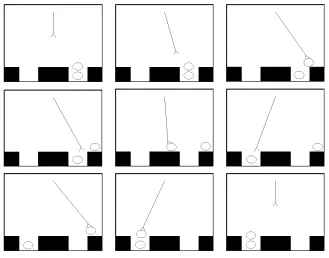
to that of the previous example. The total computation time in the example shown in figure (3) was 45 minutes. The planner PVDP was also capable of solving the same problem using a randomly selected intermediate docking position on top of the obstacles, instead of the prespecified position in the center (Figure 4).
5.3 Two 3-DOF manipulator arms manipulating a 3-DOF bar
We consider the dual-arm manipulating planning problem depicted in Figure 5. There are two identical 3-DOF arms. Each arm has two links. The first link has fixed length, and can rotate around the base. The second link is telescopic and has two degrees of freedom, one revolute and one prismatic. The bar has 3-DOF. The bar can only move when it is grasped by both arms. The task assigned to the two arms is to move the bar from the right side to the left side of the workspace. Because of the presence of an obstacle, the two arms must swap their respective grasps before reaching the goal. The total number of degrees of freedom for the whole problem is 9. Figure 5 illustrates a manipulation plan found by PVDP. The path was computed in about 40 minutes.
The definitions of the grasping constraints and of the approximating problems P are similar
to that of the previous examples. Three docking positions are allowed for the bar: its initial
16 Pierre Ferbach and J ´er ˆome Barraquand
Figure 3: A 3-DOF arm manipulating two disks
position, its goal position, and an intermediate vertical position in the middle of the workspace. The specification of this intermediate position is critical for the success of the manipulation plan. We have chosen this intermediate docking position in an ad-hoc fashion. If this intermediate position had been randomly chosen in the workspace, the planner would have most probably failed to find a manipulation plan. This example demonstrates that the choice of intermediate docking positions is a serious limitation of our manipulation planner in its current implementation. In Section (6), we briefly discuss how intermediate docking positions could be dynamically determined by the planner itself in a less ad-hoc fashion.
5.4 Three robots manipulating a 2-DOF disk
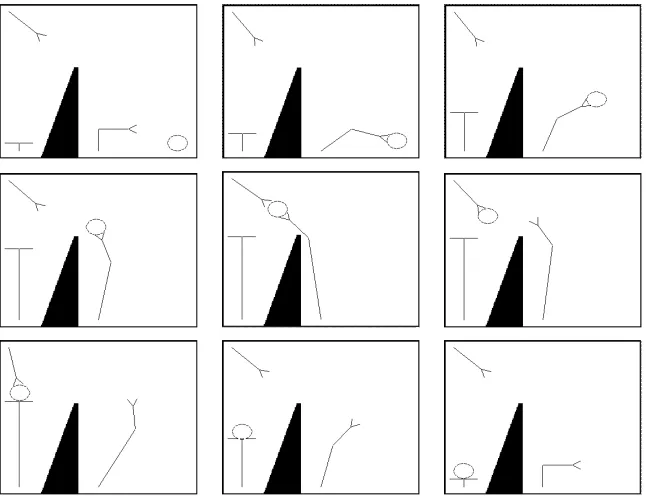
We consider the planar manipulation planning problem depicted in Figure 6. The robot on the lower left side is a kind of piston that can extend vertically. It has 1 DOF, which corresponds to the prismatic extension link. It can grasp the 2-DOF disk on the middle of the horizontal shelf. Another robot with 1 DOF on the upper left corner can only rotate around its base. The third manipulator is composed of one telescopic arm, another arm with fixed length and two revolute joints. This manipulator has 3 DOF. The task assigned to these manipulators is to move the 2-DOF disk from the right side to the left side of the picture. At the end the disk is placed on the piston in the lower left corner.
The total number of degrees of freedom for the whole problem is 7. Figure 6 illustrates a
A penalty function method for constrained motion planning 17
Figure 4: The same problem with a randomly chosen intermediate docking position
manipulation plan found by PVDP in 13 minutes.
This example shows a solution where several manipulators have to cooperate with each other: one robot picks the disk and brings it to a second manipulator that gives the object to a third one. The solution has been found without using any docking position or predefining the positions where the manipulators transmit the disk between each other.
6 Discussion
6.1 Current limitations and possible extensions
6.1.1 Automatic selection of docking positions
The examples presented above show that the penalty function method is capable of dealing with manipulation planning problems of unprecedented complexity. However, the method has a severe limitation in its current form: an appropriate set of docking positions must be chosen for each manipulation problem. Often, a simple and natural choice consists in considering only docking positions that correspond to the initial or goal configurations for the movable objects. But in some more complex problems, intermediate docking positions must be prespecified in a somewhat ad-hoc fashion. We believe this limitation of the current planning algorithm could
18 Pierre Ferbach and J ´er ˆome Barraquand
Figure 5: A dual arm manipulation planning problem
be removed by defining the set of docking positions dynamically while the manipulation plan is constructed. Indeed, one could define the intermediate docking positions in the following way. Using the notations of Subsection (4.3), and given an object Mj, we can consider the grasping function:
Gj(q)= min
i2[1;l] jjg
Ri;Mj
grasp(
Ri
(q);
Mj
(q))jj
Then, we can subdivide the current solution pathkof problem Pk into a sequence0 =t0 <
t1<. . .<t2r<t2r+1=1verifying:
8p2[0;r];8t2[t2p;t2p+1];Gj(k(t))
j k
and
8p2[0;r 1];8t2]t2p+1;t2p+2[;Gj(k(t))<
j k
In other words, we can subdivide the current path into subintervals where the object is successively close (i.e. at distance less than
j
k) to some robot end-effector, of far from any robot’s end-effector. Then, for each subinterval [t2p;t2p+1] for which the object is far from
all robots, we can define dynamically the intermediate docking position in the middle of the subinterval:
Djp=
Mj
(k(
t2p+ t2p+1
2 ))
The r +1intermediate docking positions Dj0;. . .;D
j
rthen defined can be used as the new set of docking positions for problem Pk+1. We plan to investigate this idea in future research.
A penalty function method for constrained motion planning 19
Figure 6: A pick and place operation with three cooperating robots
6.1.2 Computation of efficient-strategies
Besides the problem of defining intermediate docking positions, another important issue is to define an appropriate-strategy. Although we have found that the planner is relatively
robust with regards to the choice of the-strategy, future research is needed to reduce the
number of empirical parameters associated with the definition of the-strategies. Devising
efficient computational techniques for automatically selecting the appropriate strategies is an open problem.
6.1.3 Combining the penalty function method with other path planners
Finally, although the method of Variational Dynamic Programming has proven efficient for solving the subproblems Pk, other variational planners could be used in theory to solve the same problem. In Subsection (4.2), we have briefly described how standard planners such as RPP capable of dealing with many degrees of freedom could possibly be adapted for this purpose. We believe this idea is also worth investigating.
20 Pierre Ferbach and J ´er ˆome Barraquand
6.2 Other applications of the penalty function method
6.2.1 Application to standard path planning problems
Initially, this penalty function approach was developed in Barraquand and Ferbach 1993 [2] as a variant of the VDP method for solving difficult instances of the basic path planning problem in open free space. Indeed, given any variational path planning method, one can replace the collision avoidance constraints in a classical path planning problem by a convergent series of simpler constraints increasingly penalizing motions that do not satisfy collision avoidance constraints. The resulting planner is less general in theory than the original VDP planner, since it uses problem-specific heuristics to guide the search. On the other hand, it is dramatically faster. In fact, it can solve some problems in a time comparable to that of potential-field based methods (see Barraquand and Ferbach 1993 [2] for more detail).
6.2.2 Applications in assembly planning
More generally, the penalty function method can be used to represent any kind of holonomic constraints in motion planning. This opens a broad range of new possibilities. In particular, most constraints in assembly planning problems are holonomic equality constraints. Hence, an assembly planning problem can in theory be approximated by a sequence of simpler problems
P where the different objects to be assembled are allowed to overlap with each other by
a distance not greater than . Although we do not have investigated the application of the
penalty function method to assembly planning, we feel that this line of research is particularly promising.
7 Conclusion
This report described a new approach to motion planning with holonomic constraints, which essentially consists of replacing a constrained problem by a convergent series of less constrained subproblems increasingly penalizing the motions that do not satisfy the constraints. Each subproblem is solved using a variational path planner.
We have applied the approach to manipulation planning problems in the presence of holonomic grasping constraints. To this end, we have characterized the conditions under which grasping constraints can be made holonomic. In practice, a grasping constraint on a movable object is holonomic if the number of stable reachable configurations is finite.
This approach has been implemented in a program, called PVDP, which was run successfully on several difficult manipulation planning problems. We used the method of Variational Dynamic Programming to solve the subproblems, although other variational planners could be used in theory.
The penalty function method could be applied to any other kind of holonomic constraint. A very promising line of research is the application of this method to assembly planning
A penalty function method for constrained motion planning 21
problems.
22 Pierre Ferbach and J ´er ˆome Barraquand
References
1. Alami, R. , Simeon, T., and Laumond J.P. “A Geometrical Approach to Planning Manipulation Tasks: The Case of Discrete Placements and Grasps.” Robotics Research 5, Miura and Arimoto, eds., MIT Press, pp 453-459, 1989.
2. Barraquand, J., and Ferbach, P. Path Planning through Variational Dynamic Programming Research Report 33, Paris Research Laboratory, Digital Equipment Corp., September 1993.
3. Barraquand, J., Langlois, B. and Latombe, J.C. “Numerical Potential Field Techniques for Robot Path Planning.” IEEE Transactions on Systems, Man, and Cybernetics, vol 22-2, 1992.
4. Barraquand, J. and Latombe, J.C. “On Nonholonomic Mobile Robots and Optimal Maneuvering.” Revue d’Intelligence Artificielle. Hermes. 3(2):77-103, 1989.
5. Barraquand, J. and Latombe, J.C. “Robot Motion Planning: A Distributed Representation Approach.” International Journal of Robotics Research, MIT Press, 10-6, 1991.
6. Barraquand, J. and Latombe, J.C. “NonHolonomic MultiBody Mobile Robots: Controlla-bility and Motion Planning in the Presence of Obstacles.” Algorithmica, vol 10, number 2/3/4, 1993.
7. Koga, Y. and Latombe, J.C. “Experiments in Dual-Arm Manipulation Planning”.
Proceed-ings of the IEEE International Conference on Robotics and Automation, Nice, France, pp
2238-2245, May 1992.
8. Latombe, J.C. Robot Motion Planning. Kluwer Academic Publishers, Boston, 1990.
9. Laumond, J.P. “Feasible Trajectories for Mobile Robots with Kinematic and Environ-ment Constraints.” Proc. International Conference on Intelligent Autonomous Systems, Amsterdam (1986), 346-354.
10. Laumond, J.P. and Alami, R. A Geometrical Approach to Planning Manipulation Tasks in
Robotics. Technical Report 89-261, LAAS, Toulouse, France, 1989.
11. Li, Z. and Canny, J.F. Robot Motion Planning with Nonholonomic Constraints. Memo UCB/ERL M89/13, Electronics Research Laboratory, University of California, Berkeley, February 1989.
12. Wilfong, G. “Motion Planning in the Presence of Movable Obstacles.” Proceedings of the
4th ACM Symposium of Computational Geometry, pp 279-288, 1988.
PRL Research Reports
The following documents may be ordered by regular mail from:
Librarian – Research Reports Digital Equipment Corporation Paris Research Laboratory 85, avenue Victor Hugo 92563 Rueil-Malmaison Cedex France.
It is also possible to obtain them by electronic mail. For more information, send a message whose subject line [email protected], from within Digital, todecprl::doc-server.
Research Report 1: Incremental Computation of Planar Maps. Michel Gangnet, Jean-Claude Herv ´e, Thierry Pudet, and Jean-Manuel Van Thong. May 1989.
Research Report 2: BigNum: A Portable and Efficient Package for Arbitrary-Precision Arithmetic. Bernard Serpette, Jean Vuillemin, and Jean-Claude Herv´e. May 1989.
Research Report 3: Introduction to Programmable Active Memories. Patrice Bertin, Didier Roncin, and Jean Vuillemin. June 1989.
Research Report 4: Compiling Pattern Matching by Term Decomposition. Laurence Puel and Asc ´ander Su ´arez. January 1990.
Research Report 5: The WAM: A (Real) Tutorial. Hassan A¨ıt-Kaci. January 1990.y
Research Report 6: Binary Periodic Synchronizing Sequences. Marcin Skubiszewski. May 1991.
Research Report 7: The Siphon: Managing Distant Replicated Repositories. Francis J. Prusker and Edward P. Wobber. May 1991.
Research Report 8: Constructive Logics. Part I: A Tutorial on Proof Systems and Typed -Calculi. Jean Gallier. May 1991.
Research Report 9: Constructive Logics. Part II: Linear Logic and Proof Nets. Jean Gallier. May 1991.
Research Report 10: Pattern Matching in Order-Sorted Languages. Delia Kesner. May 1991.
y
This report is no longer available from PRL. A revised version has now appeared as a book: “Hassan A¨ıt-Kaci,
Research Report 11: Towards a Meaning of LIFE. Hassan A¨ıt-Kaci and Andreas Podelski. June 1991 (Revised, October 1992).
Research Report 12: Residuation and Guarded Rules for Constraint Logic Programming. Gert Smolka. June 1991.
Research Report 13: Functions as Passive Constraints in LIFE. Hassan A¨ıt-Kaci and Andreas Podelski. June 1991 (Revised, November 1992).
Research Report 14: Automatic Motion Planning for Complex Articulated Bodies. J ´er ˆome Barraquand. June 1991.
Research Report 15: A Hardware Implementation of Pure Esterel. G ´erard Berry. July 1991.
Research Report 16: Contribution `a la R ´esolution Num ´erique des ´Equations de Laplace et de la Chaleur. Jean Vuillemin. February 1992.
Research Report 17: Inferring Graphical Constraints with Rockit. Solange Karsenty, James A. Landay, and Chris Weikart. March 1992.
Research Report 18: Abstract Interpretation by Dynamic Partitioning. Fran¸cois Bourdoncle. March 1992.
Research Report 19: Measuring System Performance with Reprogrammable Hardware. Mark Shand. August 1992.
Research Report 20: A Feature Constraint System for Logic Programming with Entailment. Hassan A¨ıt-Kaci, Andreas Podelski, and Gert Smolka. November 1992.
Research Report 21: The Genericity Theorem and the Notion of Parametricity in the Poly-morphic -calculus. Giuseppe Longo, Kathleen Milsted, and Sergei Soloviev. December
1992.
Research Report 22: S ´emantiques des langages imp´eratifs d’ordre sup ´erieur et interpr ´etation abstraite. Fran¸cois Bourdoncle. January 1993.
Research Report 23: Dessin `a main lev ´ee et courbes de B ´ezier : comparaison des al-gorithmes de subdivision, mod´elisation des ´epaisseurs variables. Thierry Pudet. January 1993.
Research Report 24: Programmable Active Memories: a Performance Assessment. Patrice Bertin, Didier Roncin, and Jean Vuillemin. March 1993.
Research Report 25: On Circuits and Numbers. Jean Vuillemin. April 1993.
Research Report 26: Numerical Valuation of High Dimensional Multivariate European Secu-rities. J ´er ˆome Barraquand. March 1993.
Research Report 28: Feature Automata and Sets of Feature Trees. Joachim Niehren and Andreas Podelski. March 1993.
Research Report 29: Real Time Fitting of Pressure Brushstrokes. Thierry Pudet. March 1993.
Research Report 30: Rollit: An Application Builder. Solange Karsenty and Chris Weikart. April 1993.
Research Report 31: Label-Selective-Calculus. Hassan A¨ıt-Kaci and Jacques Garrigue.
May 1993.
Research Report 32: Order-Sorted Feature Theory Unification. Hassan A¨ıt-Kaci, Andreas Podelski, and Seth Copen Goldstein. May 1993.
Research Report 33: Path Planning through Variational Dynamic Programming. J ´er ˆome Barraquand and Pierre Ferbach. September 1993.
Research Report 34: A penalty function method for constrained motion planning. Pierre Ferbach and J ´er ˆome Barraquand. September 1993.
Research Report 35: The Typed Polymorphic Label-Selective-Calculus. Jacques Garrigue
34
A
p
e
n
a
lt
y
func
tion
me
thod
fo
r
c
ons
tr
a
ine
d
m
ot
io
n
p
la
nni
ng
P
ierre
F
e
rbac
h
and
J
´er
ˆom
e
B
arraquand
d i g i t a l
PARIS RESEARCH LABORATORY
85, Avenue Victor Hugo