A CENTRALIZED LOCALIZATION ALGORITHM
FOR PROLONGING THE LIFETIME OF WIRELESS
SENSOR NETWORKS USING PARTICLE SWARM
OPTIMIZATION IN THE EXISTENCE OF
OBSTACLES
ALI HUSAM ABDULHASAN AL-JARAH
A CENTRALIZED LOCALIZATION ALGORITHM FOR PROLONGING THE LIFETIME OF WIRELESS SENSOR NETWORKS USING PARTICLE SWARM
OPTIMIZATION IN THE EXISTENCE OF OBSTACLES
ALI HUSAM ABDULHASAN AL-JARAH
A thesis submitted in partial
fulfilment of the requirements for the award of the Degree of Master of Electrical Engineering
Faculty of Electrical and Electronic Engineering Universiti Tun Hussein Onn Malaysia
Dedicated to,
My beloved father and mother, Husam Abdulhasan and Nadia Shakir
My brother, Ahmed Husam,
My sisters, Zahra and Benien, My friends and colleagues
ACKNOWLEDGMENT
Foremost, all praises to Almighty ALLAH, Whose give me strength and perseverance to make me able to complete this master degree, without ALLAH I cannot do anything in this life. Therefore he is the only one I have to be thankful for him from heart.
I would like to express the deepest gratitude to my honorable supervisor. Prof. Madya Dr. Jiwa bin Abdullah for his kind support, valuable ideas, assistance, guidance and encouragement throughout this thesis.
Also, my gratitude to the cooperation given by Faculty of Electrical and Electronics Engineering (FKEE) in University Tun Hussein Onn Malaysia (UTHM).
My greatest appreciation goes to all my friends and colleagues who always helped and motivated me during my master degree and through this project.
ABSTRACT
compared between them. Moreover, the maximum sensing range is calculated, which is 30 meter, by using the binary sensing model even though the sensing module does not consume too much power compared to the mobility module. Finally, the comparison of the results in the original method will show that this algorithm is not suitable for an environment where obstacle exist because sensors will consume too much power compared to the sensors that deployed in environment that free of obstacles. While the results of the modified algorithm of this research will be more suitable for both environments, that is environment where obstacles are not exist and environment where obstacles are exist, because sensors in this algorithm .will consume almost the same amount of power at both of these environments.
ABSTRAK
TABLE OF CONTENTS
TITLE i
DECLARATION ii
DEDICATION iii
ACKNOWLEDGEMENT iv
ABSTRACT v
ABSTRAK vii
TABLE OF CONTENTS ix
LIST OF FIGURES xiii
CHAPTER 1 INTRODUCTION 1
1.1 Research Background 1
1.2 Problem Statement 3
1.3 Objectives 4
1.4 Scope of Study 5
1.5 Thesis Organization 7
CHAPTER 2 LITERATURE REVIEW 8
2.1 Introduction 8
2.2 Major Challenges and Issues in WSN
2.2.1 Hardware of the Sensor Node in WSNs 2.2.2 Operating System and Software Programming 2.2.3 Wireless Radio Communication
2.2.4 Architecture
2.2.5 Wireless Network Layers Issues 2.2.6 Deployment
2.2.7 Synchronization and Localization Issues
2.2.8 Security Issues 2.2.9 Energy Issues
15 16
2.3 Energy Consumption in Wireless Sensor Networks 17
2.3.1 Mobility Mode 17
2.3.2 Sensing Mode
2.3.3 Communication Mode
2.3.4 Computation Mode
18 18 19
2.4 Energy Conservation Technique
2.4.1 Duty-Cycling
2.4.2 Data-Driven Approaches 2.4.3 Mobility-Based Schemes
19 20 22 24
2.5 Localization Algorithms 25
2.5.1 Centralized Localization 26
2.5.2 Distributed Localization 26
2.5.3 Anchor Based 26
2.5.4 Anchor Less
2.5.5 Ranged-based
2.5.6 Ranged-free
27 27 27
2.6 Particle Swarm Optimization Algorithm Techniques in
WSNs
2.6.1 Optimal WSN Deployment 2.6.2 Node Localization in WSNs
2.6.3 Energy-Aware Clustering (EAC) in WSNs 2.6.4 Data-Aggregation in WSNs
2.7 Summary
28 28 29 30 31 32
CHAPTER 3 RESEARCH METHODOLOGY 33
3.1 Introduction
3.2 Assumptions
33 35
3.3 Models and Diagrams 36
3.3.1 Sensing and Coverage Model 36
3.3.2 Voronoi Diagrams for Sensing Range
Adjustment 37
3.3.4 Energy Model for Traveling Distance and
Sensing 39
3.4 Algorithm Descriptions
3.4.1 Optimization Goal 3.4.2 Fitness Function Design
3.4.3 Particle Swarm Optimization Principle 3.4.4 Algorithm Procedures
39 39 40 42 43
3.5 Simulation and Analysis Tools 44
3.6 Summary 44
CHAPTER 4 FINAL DESIGN & RESULTS 45
4.1 Introduction 45
4.2 Simulation Results of the Original Algorithm
4.2.1 Case 1 of the Original Algorithm
4.2.2 Case 2 of the Original Algorithm
4.2.3 Comparing the Results of both Cases in the
Original Algorithm
46 46 47
49
4.3 Simulation Results of the Modified Algorithm 53
4.3.1 Case 1 of the Modified Algorithm 53
4.3.2 Case 2 of the Modified Algorithm
4.3.3 Comparing the Results of both Cases in the
Modified Algorithm
54
55 4.4 Simulation and Results of PSO effect at Fitness Function
in Case 2 of the Original and Modified Algorithms 4.4.1 PSO effect at Fitness Function in Case 2 of the
Original Algorithm
4.4.2 PSO effect at Fitness Function in Case 2 of the Modified Algorithm
4.4.3 Comparing the Results of PSO effect at Fitness Function between the Original and Modified Algorithms in Case
4.5 Summary
59
59
61
63 64
5.1 Conclusion 65
5.2 Future work 66
REFERENCES 67
APPENDIX A VITA
LIST OF FIGURES
Figure 1.1 Wireless Sensor Network General Function 1 Figure 1.2 The problem of obstacles existence in the sensing field 5 Figure 1.3 the proposed routs of the discussed problem in case of
one obstacle existence 6
Figure 2.1 Structure of Sensor Node 9
Figure 2.2 approaches to energy saving in sensor networks 20
Figure 2.3 Duty cycling schemes 21
Figure 2.4 Data-driven approaches to energy conservation 23 Figure 2.5 Mobility-based energy conservation schemes 25 Figure 2.6 Distance-based localization in a WSN 30
Figure 2.7 The structure of a clustered WSN 31
Figure 3.1 Research Flow Chart 34
Figure 3.2 The Existence of an Obstacle in the Sensing Field 36 Figure 3.3 Dividing the Sensing Field into Subareas 37 Figure 3.4 Each Sensor Node Covering a Subarea 38 Figure 4.1 Deployment and Coverage of Sensors in Case 1
(without obstacles) of the Original Algorithm 47 Figure 4.2 Deployment and Coverage Sensors Case 2
(with Obstacles) of the Original Algorithm 48 Figure 4.3 Comparison between sensors’ travel distance for both case
of the original experiment 50 Figure 4.4 Diagram for the Comparison between sensors’ travel
distance for both case of the original experiment 50 Figure 4.5 Comparison between sensors’ power consumption for both
Cases of the original experiment 51 Figure 4.6 Diagram of the Comparison between sensors’ power
Figure 4.7 Comparison of WSN Lifetime between both cases of the
Original Experiment 52
Figure 4.8 Diagram of the Comparison of WSN Lifetime between both
Cases of the Original Experiment 52 Figure 4.9 Deployment and Coverage of the Sensor nodes in the first
case (without obstacles) in the Modified Algorithm 54 Figure 4.10 Deployment and Coverage Sensors Case 2 (with Obstacles)
of the Modified Algorithm 55
Figure 4.11 Comparison between sensors’ travel distance for both case
of the Modified Algorithm 56
Figure 4.12 Diagram of the Comparison between sensors’ travel
distance for both case of the Modified Algorithm 56 Figure 4.13 Comparison between sensors’ power consumption for
both cases of the Modified Algorithm 57 Figure 4.14 Diagram of the Comparison between sensors’ power
consumption for both cases of the Modified Algorithm 57 Figure 4.15 Comparison of WSN lifetime for between both cases of the
Modified Algorithm 58
Figure 4.16 Diagram of the Comparison of WSN lifetime for between
both cases of the Modified Algorithm 58 Figure 4.17 The Effect of PSO on the Fitness Function in Case 2 of the
Original Algorithm and its Iteration Stability 61 Figure 4.18 The Effect of PSO on the Fitness Function in Case 2 of the
Modified Algorithm and its Iteration Stability 63 Figure 4.19 The Convergence Speed between both Original and
CHAPTER 1
INTRODUCTION
1.1 Research Background
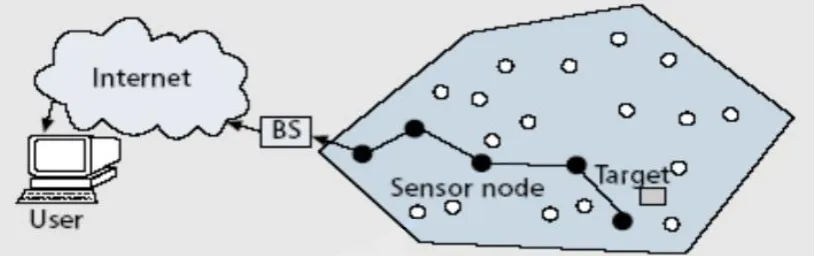
Wireless sensor network is a network system that formed by a number of sensor nodes working together for gathering information from the surroundings of an environment and then transmitting the data to a base station in order to process the received information (X. Zhang, 2012). After collecting the information from the environment and sending them to the base station, which provides a connection to the wired world, the collected data is processed, analyzed and presented into useful applications as shown in Figure 1.1.
[image:15.595.117.525.573.701.2]The sensor node is a distinct small device that usually consists of four main units which are sensing, processing, communication and power supply (GUPTA & SINHA, 2014). Wireless sensor network (WSN) may be deployed using hundreds or thousands of these tiny sensor nodes in order to monitor a certain physical phenomena or to detect and track a certain objects in the area of interest. These WSNs have gained worldwide attention in recent years specially with the increasing in micro-electro-mechanical systems (MEMS) technology, wireless communications and digital electronics that enabled the development of a low-cost, low-power, multifunctional and smart sensor nodes which are small in size and communicate untethered in short distances (Akyildiz, Su, Sankarasubramaniam, & Cayirci, 2002).
Smart sensor nodes are low power devices which equipped with one or more sensors, a processor, memory, a power supply, a radio, and an actuator. Different types of sensors, which are mechanical, thermal, biological, chemical, optical, and magnetic, might be attached to the sensor node for measuring the properties of the environment. Since the sensor nodes have limited memory and are typically deployed in difficult-to-access locations, a radio is implemented for wireless communication to transfer data to a base station (e.g., a laptop, a personal handheld device, or an access point to a fixed infrastructure). Battery is the main power source in a sensor node. Secondary power supply that harvests power from the environment such as solar panels may be added to the node depending on the appropriateness of the environment where the sensor will be deployed. Depending on the application and the type of sensors used, actuators may be incorporated in the sensors (Yick, Mukherjee, & Ghosal, 2008).
battery-powered, which will limit the energy capacity significantly. Thus, energy efficiency becomes one of the main challenges that need to be taken into account. For this project, the application used in wireless sensor networks will be for measuring humidity. Since the major contribution of this research is saving the power of the sensor nodes and prolong the lifetime of the sensor network in term of mobility, it will be better to assume a simple application measurement, which is humidity, so that sensing, communication and computation mode will not consume too much power.
1.2 Problem Statement
The advances in Micro-Electro-Mechanical Systems, digital electronic and wireless communication have led to emergence of wireless sensor networks (WSNs), which consist of a large number of sensing devices each capable of sensing, processing and transmitting environmental information. A single sensor node may only be equipped with limited computation and communication capabilities. However, these approaches are not energy efficient (Guide to Wireless Sensor Networks - Google Books, n.d.).
The problem in the proposed algorithm is that it does not take into account the existence of obstacles in the sensing field, which means the nodes deployed in a free space. Therefore, in this thesis we will show the consequences of the original algorithm by applying obstacles in the sensing field. Then, try to come up with a suitable modification to the original algorithm to make it suitable for both environments, which are the free space environment and obstacle existence environment, in term of power consumption and finally compare the results of the original algorithm of (Qu & Georgakopoulos, 2012) and the modified algorithm.
1.3 Objectives
The objectives of this project are:
1. To study the power consumption technique of the sensor nodes in the original algorithm once without obstacles in the sensing field, which is assumed to be case 1, and another time in a field where obstacles are considered in the sensing field, which is assumed to be case 2.
2. Develop an algorithm to save the energy of the sensor node to be suitable for both cases, which are in free space and in obstacles existence environment, and also compare between these cases.
1.4 Scope of Study
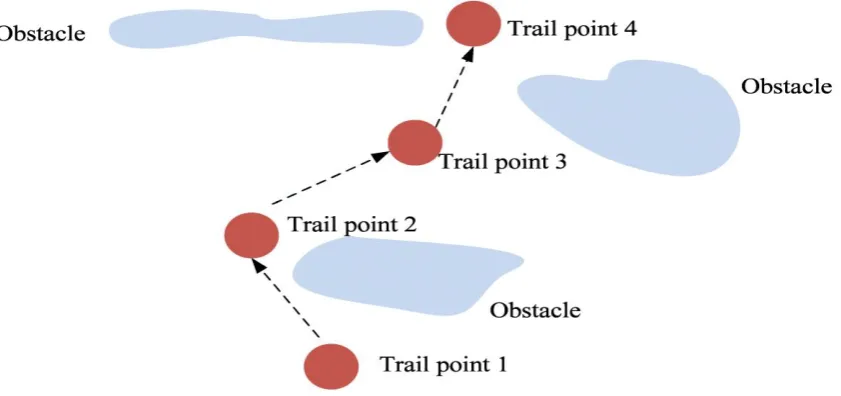
[image:19.595.121.542.322.520.2]By setting a sensing field with obstacles exist in it, consider that the obstacle will be in the way of the movement of the sensor node as shown in Figure 1.2. So, if the initial deployment position of a sensor exists for example in the opposite of the obstacle and the destination (final) position of that sensor exists behind that obstacle, it means that the mobile sensor can't move at line of sight from its initial position to its final position, therefore we will prepare a set of algorithms to solve this problem.
Figure 1.2: The problem of obstacles existence in the sensing field
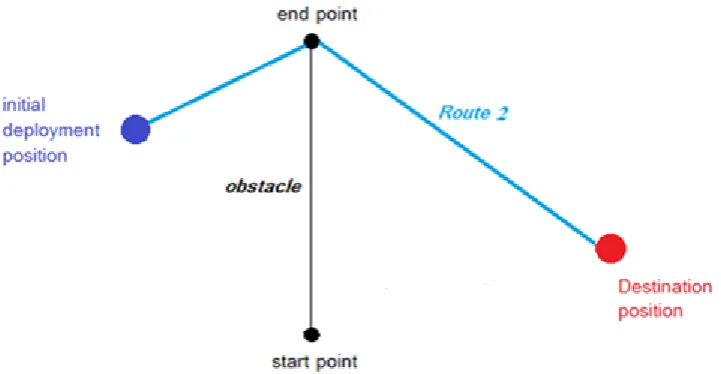
In case of the existence of obstacles in front of the sensor node, the procedure is taking the shortest route around the obstacle as in Figure 1.3. The shortest route will be determined by calculating the traveling distance from the initial position to destination position using the Euclidian equation in order to reduce energy consumption and lead to prolong the lifetime of the sensor network.
Figure 1.3: the proposed routs of the discussed problem in case of one obstacle existence
In addition to the calculation of traveling distance and power consumption, models and diagrams will be used like the sensing model, which responsible for calculation the sensing radius of each sensor and also Voronoi diagram has been used to make sure that sensors will cover the whole sensing field. Moreover, particle swarm optimization will be used in order to minimize the fitness function.
Since the aiming to reduce energy consumption and prolong the lifetime of the sensor network by optimizing both of sensing radius and travel distance, we can suppose that the travel distance of mobile sensor would not exceed a squared area from its center of the initial deployment position of that sensor with its side length is L meter. We will use the concept of this area to initialize the particles, and we expect that PSO algorithm with this modification will reach the solution faster than the
1.5 Thesis Organization
CHAPTER 2
LITERATURE REVIEW
2.1 Introduction
This chapter provides insights about the major challenges and issues in wireless sensor network, energy consumption in different modes of the sensor node, energy conservation techniques that used in a previous researches, particle swarm optimization methods in WSN, and localization algorithms for understanding the lifetime extension of the sensor network.
2.2 Major Challenges and Issues in Wireless Sensor Networks
2.2.1 Hardware of the Sensor Node in WSNs
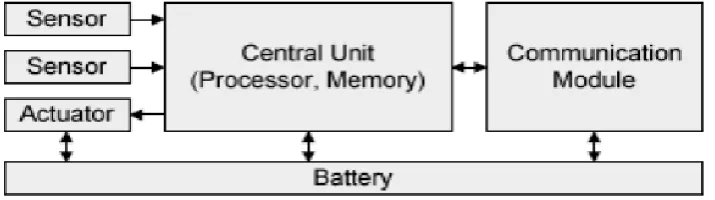
[image:23.595.141.499.290.390.2]As explained before, the mobile sensors are tiny devices that use for sensing, processing and transmitting the sensed data from the physical environment that used in many applications and these sensors called nodes. A sensor node consists of processor, memory, battery, A/D converter for connecting to a sensor and a radio transmitter for forming an ad hoc network (Vieira, Coelho, Da Silva, & Da Mata, 2003). The structure of the sensor node is as shown in Figure 2.1.
Figure 2.1: Structure of Sensor Node
(Bansal, 2015)
The hardware design issues in the these sensor nodes are (P. Zhang, Sadler, Lyon, & Martonosi, 2004):
1. Radio Range of nodes should be high (1-5 kilometers). Radio range is crucial for ensuring network connectivity and data gathering in a network as the environment being examined may not have an installed infrastructure for communication.
2. Sensor Networks consists of hundreds of thousands of nodes. It is preferred only if the node is cheap like using a flash memory as a chip of memory because it is reprogramed, inexpensive and non-volatile.
3. The central processing unit of sensor node determines energy consumption and computational capabilities of a node.
microcontroller by designing it in three states, which are active, sleep and idle. Also, various schemes to conserve node power consumption and node optimization and simple modulation schemes may also be considered for sensor nodes.
2.2.2 Operating System and Software Programming
Operating System architecture for the sensor nodes is usually separated (independent) from the hardware of these nodes. It plays an important role in solving many important design issues regarding memory management and resource management. Generally, the operating system (OS) should be less complex than the general operating systems and must have an easy programming model due to power, processing and storage constraints that require power efficiency (Eswaran, Rowe, & Rajkumar, 2005), reactivity, mobility, fault tolerance, and concurrency. There are various operating systems developed for sensor nodes and the most known types of these operating systems are: Mantis-OS (Abrach et al., 2003), Nano-Qplus (Abrach et al., 2003) and Tiny-OS (Levis et al., 2004), which is implemented in NesC language (Gay et al., 2003).
On the other hand, programmers deal with too many low levels details regarding sensing and communication of software programming in the sensor nodes. For example, they typically deal with particular node to node communication and deal with sensing, fusing and moving data and also. Researches in programming abstractions for WSN can be categorized into 7 areas: environmental, middleware APIs, database centric, event based, virtual machines, script and component-based. As an example, consider an environmental based abstraction called Enviro-Track (Abdelzaher et al., 2004).
2.2.3 Wireless Radio Communication
Performance of wireless sensor networks depends on the quality of wireless communication yet wireless communication in sensor networks is known for its unpredictable nature. The main issues of the wireless communication in WSN are (Vieiral et al., 2003):
1. Facilitating low duty cycle operation, local signal processing, to in order to lower the consumption of the power.
2. Distributed sensing effectively towards various environmental obstacles and this will affect the strength of the signal and the effective radio range.
3. Multi-hop networking may be adapted among sensor nodes to reduce
communication link range and also density of sensor nodes should be high. 4. Long range communication is typically point to point and requires high
transmission power, with the danger of being eavesdropped. 5. Errors during the wireless communications.
Research areas include designing low power consuming communication systems and complementary metal oxide semiconductor (CMOS) circuit technique specifically optimized for sensor networks, designing new architecture for integrated wireless sensor systems and modulation method and data rate selection.
2.2.4 Architecture
update messages being transmitted. It also must be flexible to meet the wide range of target application scenario. The architecture must decouple the data path speed and the radio transmission rate with the control of transmission timing because direct coupling between processing speed and communication bit rates can lead to suboptimal energy performance (Duan & Yuan, 2006) (Hill, 2003).
2.2.5 Wireless Network Layers Issues
The data transfer in wireless sensor network also based on standard layered architecture where each layer has issues as follows (Potnis & Rajeshwari, 2015).
1. Physical Layer: Types of sensors, distance between sensor nodes, path loss, reflection, absorption and scattering loss, interference like co-channel and inter-channel interferences, modulation techniques, signal quality and strength are the major issues related to the physical layer data transfer.
2. Data Link Layer: Data link layer’s major responsibility is to ensure interoperability amongst communication between nodes. This layer deals error detection and correction, flow control, multiplexing for WSN. Moreover, to create secure key during network deployment and maintenance, some scientist suggested the probable use of public key cryptography, and secure code distribution (Pathan, Lee, & Hong, 2006).
3. Network Layer: Optimized path selection for the packet routing is the major responsibility of network layer. Network layer works for routing the data from node to node, node to sink, node to base station, node to cluster head and vice versa .Identification number based protocols and data centric protocols are used by WSN for routing mechanism. Due to the broadcast nature of transmission for WSN, secure routing protocol is an essential requirement.
Separate encryption and decryption techniques are utilized for secure routing 4. Transport Layer: As external sensor network connected to the internet can use
5. Application Layer: Application layer is used to display ultimate yield by guarantee reliable data flow to lower layers. This layer is in charge of data collection, management and processing of the data by using the application software to obtain reliable data transmission.
2.2.6 Deployment
Deployment means positioning the wireless sensor network in real world environmental locations (Ringwald & Romer, 2007). It is very laborious and cumbersome activity and depends on the demographic location of the application and it has no influence over the quality of wireless communication. The deployment is either deterministic (fixed), by placing one node after the other in the sensing field, or it is random, by dropping them from a plane.
Energy management issues like battery recharge and changing are challenges in real world scenarios and this will lead to wrong sensor readings when the sensor node deployed. Deployment of sensor networks results in network congestion due to many concurrent transmission attempts made by several sensor nodes. Low data yield is a problem in real world scenario as network delivers insufficient amount of information (Jinghao et al., 2006) (Ahmed, Ali, Raza, & Abbas, 2007).
2.2.7 Synchronization and Localization Issues
Time Synchronization in a sensor network aims to provide a common Time-scale for local clocks of nodes in the network. A global clock in a sensor system will help process and analyze the data correctly and predict future system behavior. Some applications that require global clock synchronization are environment monitoring, navigation guidance, vehicle tracking etc (PalChaudhuri, Saha, & Johnson, 2004).
Energy utilization in some synchronization schemes is more compared to other schemes due to energy consumption equipment like GPS (Global Positioning System) receivers or NTP (Network Time Protocol). Sensor nodes need to collaborate and coordinate for achieving the data fusion and to avoid inaccurate data estimation. Some synchronization protocols have high accuracy so they need more resources which results in energy loss. So, synchronization needs to be implemented correctly based on the application (Sivrikaya & Yener, 2004) (Elson & Kay, 2002).
Various research issues include building analytical model for
synchronization, improving the radio communication in the existing synchronization protocols like RBS (Reference Broadcast Synchronization) and LTS (Light-Weight Tree Based Synchronization).
On the other hand, sensor localization is a fundamental and essential issue for network management and operation. In many of the real world scenarios, the sensors are deployed without knowing their positions in advance and also there is no supporting infrastructure available to locate and manage them once they are deployed. So, localization method used in order to determine the physical location of the sensors after they have been deployed (Hu & Evans, 2004).
information from signal strength and time of arrival require specialized hardware that is typically not available on sensor nodes (Xia & Chen, 2007). In addition, it is shown in (Savvides, Han, & Strivastava, 2001) that the precision of the localization increases with the number of beacons. A beacon is a node which is aware of its location. But the main problem with increased beacons is that they are more expensive than other sensor nodes and once the unknown stationary nodes have been localized using beacon nodes then the beacons become useless.
The research on mobile nodes localization will continue to grow as sensor networks are deployed in large numbers and as applications become varied. Scientists in numerous disciplines are interested in methods for tracking the movements and population counts of animals in their habitat i.e. passive habitat monitoring. Another important application is to design a system to track the location of valuable assets in an indoor environment. We need to improve the maximum likelihood estimation in a distributed environment like sensor networks. Developing mobile assisted localization is another important research area. One needs to improve the localization accuracy which depends on ToA or TDoA.
2.2.8 Security Issues
Security is important as power consumption and it is a challenging issue in WSN. Since sensor networks are still a developing technology, researchers and developers agree that their efforts should be concentrated in developing and integrating security from the initial phases of sensor applications development because they hope to provide a stronger and complete protection against illegal activities and maintain stability of the systems at the same time (Wang, Attebury, & Ramamurthy, 2006).
that the data received was really sent by a trusted sender and not by an adversary that tricked legitimate nodes into accepting false data. A false data can change the way a network could be predicted. Also, Integrity of data should be maintained. Data should not change and accurate data must reach at user end (Madhav, Rajendra, & Selvaraj, 2010). Different types of threats in sensor networks are spoofing and altering the routing information, passive information gathering, node subversio, sinkhole attacks, sybil attacks, Denial of service attack and jamming.
The security issues posed by sensor networks are a rich field for research problems. Designing routing protocols that consisting security features, which is a new symmetric key cryptography for sensor networks, designing secure data aggregation protocols, designing intrusion detection systems, and security systems for multimedia sensors.
2.2.9 Energy Issues
Sensors require power for various operations. Energy is consumed in data collection, data processing, and data communication (Mohammad Hossein Anisi Abdul Hanan Abdullah, 2011); also, continuous listening to the medium for faithful operation demands a large amount of energy by node components (CPU, radio, etc.) even if they are idle. Batteries providing power need to be changed or recharged after they have been consumed. Sometimes it becomes difficult to recharge or change the batteries because of demographic conditions (Dargie, n.d.). The most crucial research challenge for the WSN researchers is to design, develop and implement energy efficient hardware and software protocols for WSNs.
2.3 Energy Consumption in Wireless Sensor Network Modes
Energy consumption is the most important factor to determine the life of a sensor network because generally sensor nodes are determined by battery and have very low power resources. This makes energy optimization more complex in sensor networks since it implicated not only in diminution of energy utilization but also prolonging the life of the network in so far as doable. This can be done by having energy awareness in every aspect of design and operation. The sensor nodes operate in the three modes of sensing, computing and communications, and all of which consume energy.
2.3.1 Mobility Mode
The nodes in WSN can move from one location to another. This movement of nodes is helping in effectively avoiding the network disconnection due to node failures making the network fault tolerant. The mobility of nodes helps achieve scalability and energy efficiency. Mobility can be associated with sinks and nodes. When sink moves around in the network, the data collection from nodes will be easy and increases the efficiency of the network. Mobile nodes can replace the nodes dead due to exhaustion of battery. The mobility in WSN is deliberate and hence the movement of nodes can be controlled and coordinated (Patil & Vijayakumar, 2016).
2.3.2 Sensing Mode
It consists of a group of sensors and actuators that links the node to the outside world (Science, Bhopal, Science, & Bhopal, n.d.). The sensing unit is entrusted with the responsibility to detect the physical characteristics of the environment and has an energy consumption that varies with the hardware nature and applications. However, sensing energy represents a mere percentage of the entire energy consumption within the entire WSN. In comparison, computations energy is much more. Energy consumption can be reduced by using low power components and saving power at the cost of performance which is not required (Tarannum, 2010).
2.3.3 Communication Mode
Communication energy contributes to data forwarding and it is determined with the transmission range that in-creases with the signal propagation in an exponential way. The energy consumption model includes the five states: Acquisition, Transmission, Reception, Listen and Sleep. These states are described as followed (Handbook of Sensor Networks: Compact Wireless and Wired Sensing Systems - Google Books, n.d.):
Acquisition: The acquisition state includes sensing, A/D conversion, pre-processing and eventually storage of these data.
Reception: The transmission state includes processing, packet forming,
encoding, framing, queuing and base band adapting to RF circuits.
Transmission: This state is responsible for low noise amplification, down converter oscillator, filtering, detection, decoding, error detection, address checking and random reception.
Sleep: The sleep state expends least energy as compared to the other states.
It is important to completely shut down the radio rather than put it in the idle mode when it is not transmitting or receiving because of the high power consumed in this mode. Also, There are some elements in the sensor node that consume power like the protocol layers as the physical protocol, data-link protocol, networking protocol, transport protocol, and application protocol and also the cross-layer (Aslam, Farooq, & Sarwar, 2009).
2.3.4 Computation Mode
It consists of a microprocessor (microcontroller unit, MCU) which is responsible for the control of the sensors and effecting of communication protocols. MCU’s by and large maneuver beneath various operating modes for power management purposes. But shuttling among these operating modes involves utilization of power, so the energy consumption levels of the various modes should be considered while looking at the battery lifetime of each node (Science et al., n.d.).
2.4 Energy Conservation Techniques
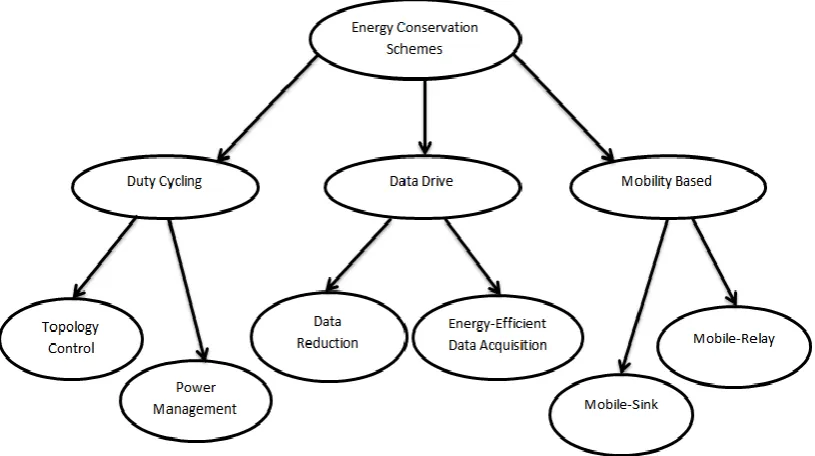
Figure 2.2: approaches to energy saving in sensor networks
2.4.1 Duty-Cycling
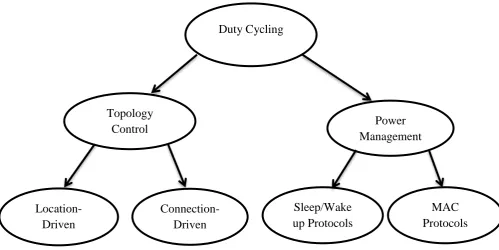
As shown in Figure 2.3, duty cycling can be achieved through two different and complementary approaches. From one side, it is possible to exploit node redundancy, which is typical in sensor networks, and adaptively select only a minimum subset of nodes to remain active for maintaining connectivity. Nodes that are not currently needed for ensuring connectivity can go to sleep and save energy. By finding the optimal subset of nodes that guarantee connectivity is referred to as topology control. Therefore, the basic idea behind topology control is to exploit the network redundancy to prolong the network longevity, typically increasing the network lifetime by a factor of 2–3 with respect to a network with all nodes always on (Ganesan et al., 2003).
Therefore, topology control and power management are complementary techniques that implement duty cycling with different granularity. Power management techniques can be further subdivided into two broad categories depending on the layer of the network architecture they are implemented at. As shown in Figure 2.3, power management protocols can be implemented either as independent sleep/wakeup protocols running on top of a MAC protocol (typically at the network or application layer), or strictly integrated with the MAC protocol itself. The latter approach permits to optimize medium access functions based on the specific sleep/wakeup pattern used for power management. On the other hand, independent sleep/wakeup protocols permit a greater flexibility as they can be tailored to the application needs, and, in principle, can be used with any MAC protocol.
Figure 2.3: Duty cycling schemes Duty Cycling
Location-Driven
MAC Protocols Power
Management Topology
Control
Connection-Driven
2.4.2 Data-Driven Approaches
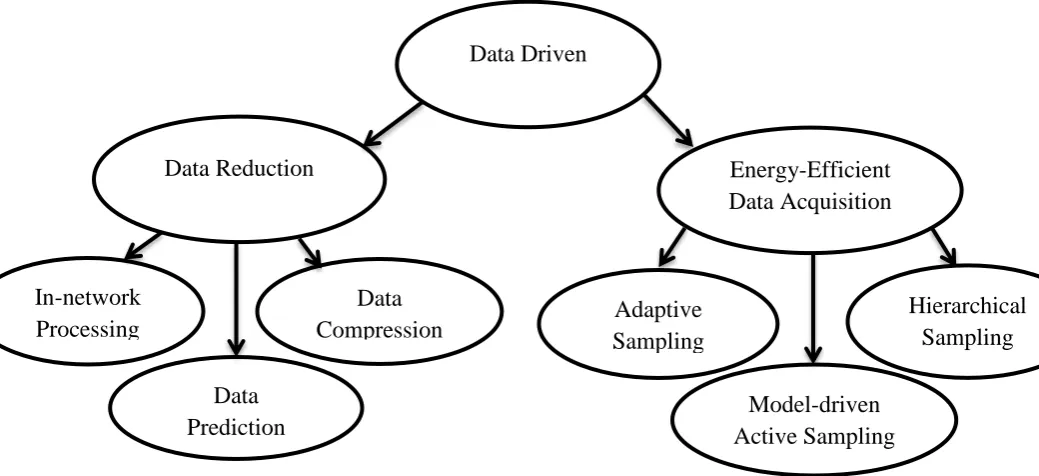
Data-driven approaches in Figure 2.4 can be divided according to the problem they address. Specifically, data-reduction schemes address the case of unneeded samples, while energy-efficient data acquisition schemes are mainly aimed at reducing the energy spent by the sensing subsystem. However, some of them can reduce the energy spent for communication as well. Also in this case, it is worth discussing here one more classification level related to data-reduction schemes, as shown in Figure 2.4. All these techniques aim at reducing the amount of data to be delivered to the sink node. However the principles behind them are rather different. In-network processing consists in performing data aggregation (e.g., computing average of some values) at intermediate nodes between the sources and the sink. In this way, the amount of data is reduced while traversing the network towards the sink. The most appropriate in-network processing technique depends on the specific application and must be tailored to it. As data aggregation is application-specific, in the following we will not discuss it (Pradhan & Ramchandran, 2003).
Data compression can be applied to reduce the amount of information sent by source nodes. This scheme involves encoding information at nodes which generate data, and decoding it at the sink. As compression techniques are general (i.e. not necessarily related to WSNs), so it is better to focus on other approaches specifically tailored to WSNs (Min, Kim, & Kwon, 2012).
the number of information sent by source nodes and the energy needed for communication as well.
[image:37.595.43.563.489.727.2]An emerging class of applications is actually sensing-constrained. This is in contrast with the general assumption that sensing in not relevant from energy-consumption standpoint. In fact, the energy energy-consumption of the sensing subsystem not only may be relevant, but it can also be greater than the energy consumption of the radio or even greater than the energy consumption of the rest of the sensor node (Alippi & Anastasi, 2007). This can be due to many different factors like power hungry transducers, power hungry A/D converters, active sensors and long acquisition time. In this case reducing communications may be not enough, but energy conservation schemes have to actually reduce the number of acquisitions (i.e. data samples) Figure 2.4. It should also be pointed out that energy-efficient data acquisition techniques are not exclusively aimed at reducing the energy consumption of the sensing subsystem. By reducing the data sampled by source nodes, they decrease the number of communications as well. Actually, many energy-efficient data-acquisition techniques have been conceived for minimizing the radio energy consumption, under the assumption that the sensor consumption is negligible (Raghunathan, Generiwal, & Srivastava, 2006).
Figure 2.4: Data-driven approaches to energy conservation Data Driven
In-network Processing
Model-driven Active Sampling Energy-Efficient Data Acquisition Data Reduction
Data
Compression Adaptive
Sampling Data
Prediction
2.4.3 Mobility-Based Schemes
As shown in Figure 2.5, mobility-based schemes can be classified as mobile-sink and mobile-relay schemes, depending on the type of the mobile entity. It is worth pointing out that, when considering mobile schemes, the important issue is the type of control the sensor-network designer has on the mobility of nodes. Mobile nodes can be divided into two broad categories: they can be specifically designed as part of the network infrastructure, or they can be part of the environment. When they are part of the infrastructure, their mobility can be fully controlled as they are, in general, robotized. When mobile nodes are part of the environment they might be not controllable. If they follow a strict schedule, then they have a completely predictable mobility (e.g., a shuttle for public transportation). Otherwise they may have a random behavior so that no reliable assumption can be made on their mobility. Finally, they may follow a mobility pattern that is neither predictable nor completely random (Conti, Passarella, & Pelusi, 2009).
REFERENCES
Abdelzaher, T., Blum, B., Cao, Q., Chen, Y., Evans, D., George, J., … Wood, A. (2004). EnviroTrack: towards an environmental computing paradigm for distributed sensor networks. 24th International Conference on Distributed Computing Systems, 2004. Proceedings., 582–589. https://doi.org/10.1109/ICDCS.2004.1281625
Abrach, H., Bhatti, S., Carlson, J., Dai, H., Rose, J., Sheth, A., … Han, R. (2003). MANTIS: system support for multimodAl NeTworks of in-situ sensors.
Proceedings of the 2nd {ACM} International Conference on Wireless Sensor Networks and Applications, 50–59. https://doi.org/10.1145/941350.941358 Afzal, S. (2012). A Review of Localization Techniques for Wireless Sensor
Networks. Journal of Basic and Applied Scientific Research, 2(8), 7795–7801. Ahmed, A., Ali, J., Raza, A., & Abbas, G. (2007). Wired vs wireless deployment
support for wireless sensor networks. IEEE Region 10 Annual International Conference, Proceedings/TENCON, 11–13. https://doi.org/10.1109/TENCON.2006.343679
Akyildiz, I. F., Su, W., Sankarasubramaniam, Y., & Cayirci, E. (2002). Wireless
sensor networks: a survey. Computer Networks, 38(4), 393–422.
https://doi.org/10.1016/S1389-1286(01)00302-4
Alippi, C., & Anastasi, G. (2007). Adaptive sampling for energy conservation in wireless sensor networks for snow monitoring applications. …Adhoc and Sensor
…, 0–5. https://doi.org/10.1109/MOBHOC.2007.4428700
conservation in wireless sensor networks: A survey. Ad Hoc Networks, 7(3), 537–568. https://doi.org/10.1016/j.adhoc.2008.06.003
Anastasi, G., Conti, M., Francesco, M. Di, & Passarella, A. (2008). Energy conservation in wireless sensor networks: A survey. Ad Hoc Networks, 7(3), 537–568.
Aslam, S., Farooq, F., & Sarwar, S. (2009). Power consumption in wireless sensor networks. Proceedings of the 6th International Conference on Frontiers of Information Technology - FIT ’09, 1. https://doi.org/10.1145/1838002.1838017 Aspnes, J., Eren, T., Goldenberg, D. K. D. K. D. K., Morse, A. S. S. S., Whiteley,
W., Yang, Y. R. Y. R. R. Y. R., … Belhumeur, P. N. P. N. P. N. (2006). A Theory of Network Localization. IEEE Transactions on Mobile Computing,
5(12), 1663–1678. https://doi.org/10.1109/TMC.2006.174
Aziz, N. A. B. A., Mohemmed, A. W., & Sagar, B. S. D. (2007). Particle Swarm Optimization and Voronoi diagram for Wireless Sensor Networks coverage optimization. 2007 International Conference on Intelligent and Advanced Systems, 961–965. https://doi.org/10.1109/ICIAS.2007.4658528
Bansal, S. (2015). Issues and Challenges in Wireless Sensor Networks,
112(December 2013), 26–32. https://doi.org/10.1109/ICMIRA.2013.18
Bojkovic, Z., & Bakmaz, B. (2008). A survey on wireless sensor networks
deployment. WSEAS Transactions on Communications, 7(12), 1172–1181.
Boukerche, A., & Nakamura, E. (2007). Localization systems for wireless sensor
networks. IEEE Wireless Communications, 14(6), 6–12.
https://doi.org/10.1109/MWC.2007.4407221
Cardei, M., Wu, J., Lu, M., & Pervaiz, M. O. (2005). Maximum network lifetime in
wireless sensor networks with adjustable sensing ranges. 2005 IEEE
International Conference on Wireless and Mobile Computing, Networking and Communications, WiMob’2005, 3(2), 438–445. https://doi.org/10.1109/WIMOB.2005.1512935
Conti, M., Passarella, A., & Pelusi, L. (2009). Mobile-relay forwarding in opportunistic networks. … Techniques in Wireless Networks (M. …, 1–43. https://doi.org/10.1201/9781420046106
Dhawan, A., Vu, C. T., Zelikovsky, A., Li, Y., & Prasad, S. K. (2006). Maximum lifetime of sensor networks with adjustable sensing range. Proc. - Seventh ACIS Int. Conf. on Software Eng., Artific. Intelligence, Netw., and Parallel/Distributed Comput., SNPD 2006, Including Second ACIS Int. Worshop on SAWN 2006, 2006(July), 285–289. https://doi.org/10.1109/SNPD-SAWN.2006.46
Duan, S., & Yuan, X. (2006). Exploring Hierarchy Architecture for Wireless Sensor Networks Management. 2006 IFIP International Conference on Wireless and Optical Communications Networks, 6 pp. https://doi.org/10.1109/WOCN.2006.1666538
Elson, J., & Kay, R. (2002). Wireless Sensor Networks : A New Regime for Time Synchronization. First Workshop on Hot Topics In Networks (HotNets-I).
Eswaran, A., Rowe, A., & Rajkumar, R. (2005). Nano-RK: An energy-aware resource-centric RTOS for sensor networks. Proceedings - Real-Time Systems Symposium. https://doi.org/10.1109/RTSS.2005.30
Ganesan, D., Cerpa, A. E., Ye, W., Yu, Y., Zhao, Y., & Estrin, D. (2003). Title: Networking Issues in Wireless Sensor Networks, (December 2003). Retrieved from http: //www.escholarship.org/help_copyright.html#reuse
García-hernández, C. F., Ibargüengoytia-gonzález, P. H., García-hernández, J., & Pérez-díaz, J. a. (2007). Wireless Sensor Networks and Applications : a Survey.
Journal of Computer Science, 7(3), 264–273. https://doi.org/10.1109/MC.2002.1039518
Garg, V., & Jhamb, M. (2013). A Review of Wireless Sensor Network on Localization Techniques. International Journal of Engineering Trends and Technology, 4(April), 1049–1053. Retrieved from http://www.ijettjournal.org Gay, D., Levis, P., von Behren, R., Welsh, M., Brewer, E., & Culler, D. (2003). The
nesC language. Proceedings of the ACM SIGPLAN 2003 Conference on
Programming Language Design and Implementation - PLDI ’03, 1. https://doi.org/10.1145/781131.781133
Guide to Wireless Sensor Networks - Google Books. (n.d.). Retrieved from https://books.google.com.my/books
GUPTA, S., & SINHA, P. (2014). Overview of Wireless Sensor Network: A Survey.
Engineering, 3(1), 5201–5207. https://doi.org/10.5772/2604
Handbook of Sensor Networks: Compact Wireless and Wired Sensing Systems - Google Books. (n.d.). Retrieved from https://books.google.com.my/books Heinzelman, W. R., Chandrakasan, A., & Balakrishnan, H. (2000). Energy-Efficient
Communication Protocol for Wireless Microsensor Networks
Hill, J. L. (2003). System Architecture for Wireless Sensor Networks. Spring, 186. Hong, T. P., & Shiu, G. N. (2007). Allocating multiple base stations under general
power consumption by the particle swarm optimization. Proceedings of the 2007 IEEE Swarm Intelligence Symposium, SIS 2007, (Sis), 23–28. https://doi.org/10.1109/SIS.2007.368022
Hu, L., & Evans, D. (2004). Localization for mobile sensor networks. Proceedings of the 10th Annual International Conference on Mobile Computing and Networking - MobiCom ’04, (October), 45. https://doi.org/10.1145/1023720.1023726
Jangra, A. (2010). Wireless Sensor Network (WSN): Architectural Design issues and
Challenges. (IJCSE) International Journal on Computer Science and
Engineering, 2(9), 3089–3094. Retrieved from http://search.ebscohost.com/login.aspx?direct
Jeril Kuriakose, Sandeep Joshi, R. Vikram Raju, and A. K. (2014). A Review on Localization in Wireless Sensor Networks. Advances in Intelligent Systems and Computing, 1(10), 599–610.
Jinghao, L., Yuebin, B., Haixing, J., Jihong, M., Yong, T., & Depei, Q. (2006). POWER: Planning and deployment platform for wireless sensor networks.
Proceedings - Fifth International Conference on Grid and Cooperative Computing, GCC 2006 - Workshops, 432–436. https://doi.org/10.1109/GCCW.2006.73
Kulkarni, R. V, & Venayagamoorthy, G. K. (2009). Particle Swarm Optimization in Wireless Sensor Networks : A Brief Survey. IEEE Transactions on Systems, Man, and Cybernetics, 1–7. https://doi.org/10.1109/TSMCC.2010.2054080 Levis, P., Madden, S., Gay, D., Polastre, J., Szewczyk, R., Woo, A., … Culler, D.
(2004). The emergence of networking abstractions and techniques in TinyOS.
http://dl.acm.org/citation.cfm?id=1251175.1251176
Li, J., Li, K., & Zhu, W. (2007). Improving sensing coverage of wireless sensor
networks by employing mobile robots. 2007 IEEE International Conference on
Robotics and Biomimetics, ROBIO, 899–903. https://doi.org/10.1109/ROBIO.2007.4522282
Madhav, K. V, Rajendra, C., & Selvaraj, R. L. (2010). A study of security challenges in Wireless Sensor Networks. Journal of Theoretical and Applied Information Technology, 20(1), 39–44. Retrieved from http://www.scopus.com/inward/record.url
Mao, G., Fidan, B., & Anderson, B. D. O. (2007). Wireless sensor network
localization techniques. Computer Networks, 51(10), 2529–2553.
https://doi.org/http://dx.doi.org/10.1016/j.comnet.2006.11.018
Min, J., Kim, J., & Kwon, Y. (2012). Data compression techniques for wireless
sensor networks. Lecture Notes in Computer Science. Convergence and Hybrid
Technology, 7425/2012(1), 9–16. Retrieved from http://www.springerlink.com/content/207v8637w40144k8/
Mohammad Hossein Anisi Abdul Hanan Abdullah, S. A. R. (2011). Energy-Efficient Data Collection in Wireless Sensor Networks. Wireless Sensor Network, 3,(October), 329–333. https://doi.org/10.4236/wsn.2011.310036
PalChaudhuri, S., Saha, A. K., & Johnson, D. B. (2004). Adaptive clock synchronization in sensor networks. Proceedings of the Third International Symposium on Information Processing in Sensor Networks - IPSN’04, 340. https://doi.org/10.1145/984622.984672
Pandey, M. (2011). Energy Consumption Patterns for Different Mobility Conditions
in WSN. Wireless Sensor Network, 3(12), 378–383.
https://doi.org/10.4236/wsn.2011.312044
Pathan, A.-S. K., Lee, H.-W. L., & Hong, C. S. (2006). Security in wireless sensor networks: issues and challenges. 8th International Conference Advanced Communication Technology, 2, 1043–1048. https://doi.org/10.1109/ICACT.2006.206151
https://doi.org/10.1109/ICMIRA.2013.18
Piontek, H., Seyffer, M., & Kaiser, J. (2007). Improving the Accuracy of Ultrasound-based Localisation Systems. Personal Ubiquitous Comput., 11(6), 439–449. https://doi.org/10.1007/s00779-006-0096-1
Potnis, A., & Rajeshwari, C. S. (2015). Wireless Sensor Network : Challenges , Issues and Research, 224–228.
Pradhan, S. S., & Ramchandran, K. (2003). Distributed source coding using
syndromes (DISCUS): design and construction. IEEE Transactions on
Information Theory, 49(3), 626–643. https://doi.org/10.1109/TIT.2002.808103 Qu, Y., & Georgakopoulos, S. V. (2012). A centralized algorithm for prolonging the
lifetime of wireless sensor networks using Particle Swarm Optimization.
WAMICON 2012 IEEE Wireless & Microwave Technology Conference, 1–6. https://doi.org/10.1109/WAMICON.2012.6208432
Raghunathan, V., Generiwal, S., & Srivastava, M. (2006). Emerging Techniques for
Long Lived Wireless Sensor Networks. IEEE Communications Magazine,
44(4), 108–114. https://doi.org/10.1109/MCOM.2006.1632657
Rajagopalan, R., & Varshney, P. K. (2006). Data-aggregation techniques in sensor networks: A survey. IEEE Communications Surveys and Tutorials, 8(4), 48–63. https://doi.org/10.1109/COMST.2006.283821
Ringwald, M., & R??mer, K. (2007). Deployment of sensor networks: Problems and
passive inspection. Proceedings of the 5th International Workshop on
Intelligent Solutions in Embedded Systems, WISES 07, (5005), 179–192. https://doi.org/10.1109/WISES.2007.4408504
Savvides, A., Han, C.-C., & Strivastava, M. B. (2001). Dynamic fine-grained localization in Ad-Hoc networks of sensors. Proceedings of the 7th Annual International Conference on Mobile Computing and Networking - MobiCom ’01, 166–179. https://doi.org/10.1145/381677.381693
Savvides, A., Savvides, A., Park, H., Park, H., Srivastava, M. B., & Srivastava, M. B. (2002). The Bits and Flops of the N-hop Multilateration Primitive For Node Localization Problems. 1st ACM Int.\ Workshop on Wireless Sensor Networks and Application (WSNA 2002), 112–121. https://doi.org/10.1145/570738.570755
Wireless Sensor Network for Energy Consumption PG Scholar , Department Of Computer Science & ENGG , TIT BHOPAL.
Shang, Y., Ruml, W., Zhang, Y., & Fromherz, M. P. J. (2003). Localization from
mere connectivity. ACM International Symposium on Mobile Ad Hoc
Networking & Computing, 201. https://doi.org/10.1145/778435.778439 Sivrikaya, F., & Yener, B. (2004). Networks: Survey.
Tarannum, S. (2010). Energy Conservation Challenges in Wireless Sensor Networks:
A Comprehensive Study. Wireless Sensor Network, 2(6), 483–491.
https://doi.org/10.4236/wsn.2010.26060
Vieira, M. A. M., Coelho, C. N., Da Silva, D. C., & Da Mata, J. M. (2003). Survey
on wireless sensor network devices. IEEE International Conference on
Emerging Technologies and Factory Automation, ETFA, 1(January), 537–544. https://doi.org/10.1109/ETFA.2003.1247753
Vieiral, M. A. M., Jr, C. N. C., Cecilio, D., Junio, S., Mata, J. M., Vieira, M. A. M., … da Mata, J. M. (2003). Survey on wireless sensor network devices. EFTA 2003. 2003 IEEE Conference on Emerging Technologies and Factory Automation. Proceedings (Cat. No.03TH8696), 1, 537–544. https://doi.org/10.1109/ETFA.2003.1247753
Wang, Y., Attebury, G., & Ramamurthy, B. (2006). A survey of security issues in wireless sensor networks. IEEE Communications Surveys Tutorials, 8(2), 2–23. https://doi.org/10.1109/COMST.2006.315852
Xia, Z., & Chen, C. (2007). A localization scheme with mobile beacon for wireless sensor networks. ITST 2006 - 2006 6th International Conference on ITS Telecommunications, Proceedings, 1017–1020. https://doi.org/10.1109/ITST.2006.288725
Yick, J., Mukherjee, B., & Ghosal, D. (2008). Wireless sensor network survey.
Computer Networks, 52(12), 2292–2330. https://doi.org/10.1016/j.comnet.2008.04.002
Zhang, P., Sadler, C. M., Lyon, S. A., & Martonosi, M. (2004). Hardware design experiences in ZebraNet. Proceedings of the 2nd International Conference on Embedded Networked Sensor Systems - SenSys ’04, 7, 227. https://doi.org/10.1145/1031495.1031522
distributed wireless sensor network. Retrieved from http://epublications.bond.edu.au/cgi/viewcontent.cgi
ZHONG, Z., LUO, D.-Y., LIU, S.-Q., FAN, X.-P., & QU, Z.-H. (2010). An Adaptive Localization Approach for Wireless Sensor Networks Based on Gauss-Markov Mobility Model. Acta Automatica Sinica, 36(11), 1557–1568. https://doi.org/http://dx.doi.org/10.1016/S1874-1029(09)60062-8
Zou, Y., & Chakrabarty, K. (2003). Sensor Deployment and Target Localization
Based on Virtual Forces. Twenty-Second Annual Joint Conference of the IEEE