Gender mainstreaming in disaster
reduction: Why and how?
Ginige, K, Amaratunga, RDG and Haigh, RP
Title
Gender mainstreaming in disaster reduction: Why and how?
Authors
Ginige, K, Amaratunga, RDG and Haigh, RP
Type
Conference or Workshop Item
URL
This version is available at: http://usir.salford.ac.uk/9808/
Published Date
2008
USIR is a digital collection of the research output of the University of Salford. Where copyright
permits, full text material held in the repository is made freely available online and can be read,
downloaded and copied for noncommercial private study or research purposes. Please check the
manuscript for any further copyright restrictions.
Gender mainstreaming in disaster reduction: why
and how?
Kanchana Ginige,
Research Institute for the Built and Human Environment, University of Salford (email: [email protected])
Dilanthi Amaratunga,
Research Institute for the Built and Human Environment, University of Salford (email: [email protected])
Richard Haigh,
Research Institute for the Built and Human Environment, University of Salford (email: [email protected])
Abstract
The significant losses in human life and livelihoods, the destruction of economic and social infrastructure and damage to the environment caused by disasters in the past decade has increased the necessity for proper disaster reduction and risk management strategies. A disaster is shown as a combination of a trigger agent and vulnerabilities. Since vulnerabilities are the dependant component of a disaster, they should be managed and minimised in order to reduce disasters. Disaster reduction policies and measures, which ensure a decrease in vulnerabilities, need to be formed and implemented to achieve a sustainable and consistent plan of disaster management. Since women are more vulnerable in a disaster, their needs and concerns should be widely integrated into risk reduction plans and procedures from both perspectives of women as beneficiaries and decision makers. Gender mainstreaming is considered an important element in disaster reduction policy making to integrate a gender equality perspective in all policies at all levels. Gender mainstreaming in disaster reduction refers to promoting awareness about gender equity and equality, to help reduce the impact of disasters and to incorporate gender analysis in disaster management, risk reduction and sustainable development to decrease vulnerability. This paper reviews literature on disaster reduction and gender mainstreaming to emphasise why gender mainstreaming has become a necessity in disaster reduction attempts and to highlight the ways in which it can be achieved.
Keywords: Disaster reduction, Gender mainstreaming, Women.
1. Background
1.1 Introduction
environmental losses and these losses always go beyond the capacity of the affected society to cope with its own resources [15],[27]. According to McEntire [17], any disaster is a combination of a triggering agent and a set of vulnerabilities – and it is these vulnerabilities, the conditions, which affect the capacity of a society to respond to the triggering agent which is the controllable component of a disaster. Since disasters cause large-scale damage to human life, their livelihoods, economic and social infrastructure and environment [11],[28] and these damages have shown a significant increase in the last one and a half decades [28], the world is in serious need of a sustained and comprehensive disaster reduction strategy. In achieving this, the needs and concerns of all social groups such as poor, rich, men, women, young, old, indigenous or non-indigenous must be necessarily integrated into the disaster reduction policies and measures because the level of vulnerability depends on these social aspects [11]. The Secretariat of the United Nations International Strategy for Disaster Reduction [8] emphasises that the vulnerability of women to disasters is greater mainly because of the social values.
The main aims of this paper are to highlight the importance of gender mainstreaming in disaster reduction policymaking and to discuss ways of mainstreaming gender. In order to make the path of achieving this aim clearer, this paper gives an account of the nature and types of disasters and the world’s movement towards disaster reduction in its early sections. The next section characterises and classifies disasters as a preface to the disaster reduction trend and practices, which are described later. The third section focuses on gender mainstreaming, its importance and proposed means of integrating it into disaster reduction policies and measures. This paper is based on a review of academic literature, papers and reports produced by the United Nations International Strategy for Disaster Reduction (UN/ISDR) and various other institutions.
1.2
The way disasters
are seen
1.2.1 Defining disasters
et al. [28] indicates none of these definitions of disasters are universally accepted yet. The way that the disasters are explained varies according to the discipline in which they have been defined. Generally, there are four main bases for defining disasters as technical, sociological, political and medicinal [29]. However, almost all the definitions describe a disaster as an event, which disturbs the social structure or the environment, causes a significant loss and needs external assistance in recovery.
1.2.2 Types of disasters
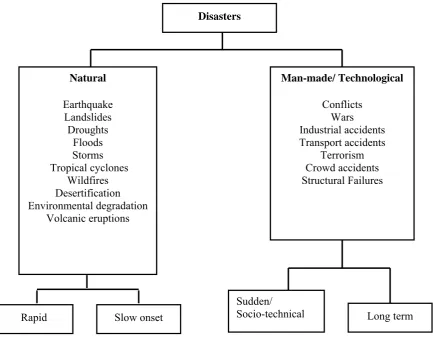
Disasters are often divided into two main categories - as natural or man-made according to their cause [28],[15],[23],[27]. Figure 1 illustrates this. In addition to the two main categories of disaster, Shaluf [28] and Shaluf and Ahmadun [27] indicate that there can be a third category of disasters as hybrid disasters, which occur as a combination of natural and man-made disasters. Further, Shaluf and Ahmadun [27] show that natural and/or man-made disasters can trigger subsequent disasters as well.
Disasters are classified into three groups by Jaya Kumar [14] referring to the spatial dimensions of disasters as small, localised or large and regional disasters. On the other hand, disasters can be categorized into two, based on their spatial and socio economic characteristics as exogenous disasters and endogenous disasters [14] (p.75).
• Exogenous disasters- which relates to an energy that is external to society and which injure, destroy and affect everyone trapped within the spatial or temporal dimension. This can be defined as an event concentrated in time and space in which a community or a society experiences and shares severe danger, injury and destruction or disruption of the social structure and essential function of the society.
Figure 1: Categorization of disasters according to their cause
1.2.3 Occurrence of disasters
Initially, scholars and policy makers gave attention to disasters concentrating mainly on hazards giving an implication that the hazard agent was the disaster [19]. UN/ISDR [12] describes hazard as a potentially damaging physical event, phenomenon or human activity that may cause the loss of life or injury, property damage, social and economic disruption or environmental degradation. Furthermore, hazards can include latent conditions that may represent future threats and can have different origins: natural (geological, hydro-meteorological and biological) or induced by human processes (environmental degradation and technological hazards) [12]. However, this initial perspective on disasters was problematic because natural occurrences such as tornados in uninhabited plains may not be seen as a disaster and some hazards such as floods and fires can even be beneficial for the environment (e.g. providing rich, fertile soils for farming and forest rejuvenation) [19]. Therefore, the subsequent viewpoint that all disasters irrespective of whether they are natural or man made emerge as a combination of a triggering agent/hazard and vulnerabilities [17],[24] is more rational. With the establishment of the latter view, the emphasis on vulnerabilities in the context of disasters was raised gradually.
Disasters
Natural
Earthquake Landslides Droughts
Floods Storms Tropical cyclones
Wildfires Desertification Environmental degradation
Volcanic eruptions
Man-made/ Technological
Conflicts Wars Industrialaccidents Transportaccidents
Terrorism Crowdaccidents Structural Failures
Slow onset
Rapid Long term
1.2.4 Vulnerabilities
Vulnerability is known as a set of conditions that affect the ability of countries, communities and individuals to prevent, mitigate, prepare for and respond to hazards [1]. It is seen that all individuals and communities are to varying degrees vulnerable to hazards and all have intrinsic capacities to reduce their vulnerability [34]. Apropos, vulnerability is given various definitions in disaster research since 1980 [33]. Similarly the disaster definitions vary according to the discipline they are based on and the way in which vulnerability is seen depends on the respective discipline [19]. UN/ISDR [12] defines vulnerability as the conditions determined by physical, social, economic, and environmental factors or processes which increase the susceptibility of a community to the impact of hazards. Based on the above explanation, the Working Group on climate change and disaster risk reduction of the Inter Agency Task Force on Disaster Reduction [34] illustrates the different dimensions of vulnerabilities as follows.
• Physical vulnerability refers to susceptibilities of the built environment and may be described as “exposure”.
• Social factors of vulnerability include levels of literacy and education, health infrastructure, the existence of peace and security, access to basic human rights, systems of good governance, social equity, traditional values, customs and ideological beliefs and overall collective organisational systems.
• Economic vulnerability characterises people less privileged in class or caste, ethnic minorities, the very young and old, the disadvantaged, and often women who are primarily responsible for providing essential shelter and basic needs.
•
Environmental vulnerability refers to the extent of natural resource degradation.On the other hand, McEntire [17] categorizes the variables, which interact to produce a future of increased vulnerabilities under physical, social, cultural, political, economic, and technological headings as given in the following list. This classification splits the social vulnerability in the earlier categorization into three separate groups as social, cultural and political dimensions of vulnerabilities. In addition, the environmental dimensions are brought under the physical variables here in contrast to the earlier division.
•
Physical
o the proximity of people and property to triggering agents o improper construction of buildings
o inadequate foresight relating to the infrastructure o degradation of the environment.
•
Social
o limited education (including insufficient knowledge about disasters) o inadequate routine and emergency health care
o massive and unplanned migration to urban areas o marginalisation of specific groups and individuals
•
Cultural
o public apathy towards disaster
o dependency and an absence of personal responsibility.
•
Political
o minimal support for disaster programmes amongst elected officials o inability to enforce or encourage steps for mitigation
o over-centralisation of decision making o isolated or weak disaster related institutions
•
Economic
o growing divergence in the distribution of wealth o the pursuit of profit with little regard for consequences o failure to purchase insurance
o sparse resources for disaster prevention, planning and management
•
Technological
o lack of structural mitigation devices
o over-reliance upon or ineffective warning systems o carelessness in industrial production
o lack of foresight regarding computer equipment/programmes
McEntire [17] explains that vulnerability acts as the dependant component while the triggering agent stands as the independent component of a disaster. This dependant component is determined by the degree of risk, susceptibility, resistance and resilience [17]. Therefore, vulnerabilities should be managed in order to mitigate disasters. McEntire [17] shows invulnerable development or vulnerability management as a process whereby decisions and activities are intentionally designed and implemented to take into account and eliminate disaster to the fullest extent possible.
2. An overview of disaster reduction
Disaster preparedness through minimising vulnerabilities has been identified as a better approach to face disasters than post-disaster responsiveness [9],[24]. According to Goodyear [6], creating a culture of prevention is essential to address everyday hazards and the consequences of a disaster. Disaster risk reduction is defined as the conceptual framework of elements considered with the possibilities to minimise vulnerabilities and disaster risks throughout society, to avoid (prevention) or to limit (mitigation and preparedness) the adverse impacts of hazards, within the broad context of sustainable development [12]. Therefore, disaster risk reduction must be more decisively incorporated as an essential component of all development strategies, policies, programmes and investments for national and local governments [26]. In other words, disaster reduction incorporates taking measures in advance, addressing risk reduction, involving environmental protection, social equity and economic growth, the three cornerstones of sustainable development, to ensure that development efforts do not increase the vulnerability to hazards [11].
as an integral component of sustainable development and it promotes following four objectives for disaster reduction.
• Increase public awareness to understand risk, vulnerability and disaster reduction globally.
• Obtain commitment from public authorities to implement disaster reduction policies and actions.
• Stimulate interdisciplinary and intersectoral partnerships, including the risk reduction networks.
•
Improve scientific knowledge about disaster reduction.A close inter-relationship is shown between disaster reduction and sustainable development in disaster management research. Stenchion [31] determines that a number of development activities have a great responsibility and inter-relationship with disaster risk reduction because both development and disaster management are aimed at vulnerability reduction. Further, it is indicated that development can increase and/or decrease disaster vulnerability [18]. It is essential, therefore, to take measures of disaster risk reduction into consideration in all development activities. The framework for Action 2005-2015: Building the Resilience of Nations and Communities to Disasters states, “there is now international acknowledgement that efforts to reduce disaster risks must be systematically integrated into policies, plans and programmes for sustainable development and poverty reduction, and supported through bilateral, regional and international cooperation, including partnerships. Sustainable development, poverty reduction, good governance and disaster risk reduction are mutually supportive objectives. In order to meet the challenges ahead, accelerated efforts must be made to build the necessary capacities at the community and national levels to manage and reduce risk” [13].
3. Gender mainstreaming and disaster reduction
3.1 Gender and disasters
“Disasters affect women and men differently because of the distinct roles they occupy and the different responsibilities given to them in life and because of the differences in their capacities, needs and vulnerabilities” [1] (p.51). UN/ISDR [8] indicates that women are more vulnerable in disasters and they are the most affected. The poor and predominantly female and elderly populations are characterised by higher economic vulnerability as they suffer proportionally larger losses in disasters and have limited capacity to recover [34]. Enarson [4] identifies the following points as the reasons for women’s higher vulnerability in disasters.
• Women have less access to resources.
• Women are primarily responsible for domestic duties such as childcare and care for the elderly or disabled and they do not have the liberty of migrating to look for work following a disaster.
• As housing is often destroyed in the disaster, many families are forced to relocate to shelters.
•
When women’s economic resources are taken away, their bargaining position in the household is adversely affected.In addition to the above factors, Enarson [4] points out that disasters themselves can increase women’s vulnerability not only because they increase female headed households but sexual and domestic violence are also increased following a disaster.
According to, Enarson [4] and Khatun [16], although women are at greater risk than men in disasters, it is the women who make it possible for the community to cope with disasters because their social role is central to the management of a disaster coping strategy. However, women’s abilities to mitigate hazards and prevent disasters and to cope with and recover from the effects of disasters have not sufficiently been taken into account or developed [1]. As Ariyabandu and Wickramasinghe [1] indicate, in current practice of disaster reduction women are seen as helpless victims and their capacities, knowledge and skills in each stage of the disaster cycle are not recognised. The gender differences in the disaster mitigation have been discussed primarily in the context of vulnerability or community involvement. The absence of women in decision making positions in emergency and recovery planning is not effectively addressed. Therefore, a gender perspective should be integrated into all disaster reduction policies and measures in order to decrease women’s susceptibility in disasters. However, gender equality in disaster reduction requires empowering women to have an increasing role in leadership, management and decision making positions because women are not only victims of disasters but they can act as agents of change in disaster reduction planning [8],[11].
3.2 Gender mainstreaming
The Platform for Action (PfA) at the Fourth World Conference on Women in Beijing in 1995 brought up the concept of gender mainstreaming, the commitment to integrate gender perspective in all forms of development and political processes of governments [22]. UN/ISDR [11] elaborates gender mainstreaming as the process of bringing a gendered perspective into the mainstream activities of governments at all levels, as a means of promoting the role of women in the field of development and integrating women’s values into development work. Although, the ultimate aim of gender mainstreaming is to achieve gender equality, it is not for promoting equality to the implementation of specific measures to help women; it is to achieve equality in all general policies and measures by actively and openly taking the possible effects on the respective situation of men and women into account at the planning stage [5].
• Policy design • Decision-making • Access to resources • Procedures and practices • Methodology
• Implementation
•
Monitoring and evaluationTherefore, gender mainstreaming is necessary to incorporate in the policies and programmes related to disaster reduction mainly because “gender shapes capacity and vulnerability to disasters” [2] as discussed earlier. As the United Nations Office of the Special Adviser on Gender Issues and Advancement of Women [22] explains, gender mainstreaming can promote gender equality and women's empowerment, particularly where there are glaring instances of persistent discrimination of women and inequality between women and men. Gender mainstreaming can be used as an effective tool to reduce the vulnerability of women, which arise due to various factors including less access to resources and to bring more women in to disaster reduction policy making process.
However, promoting gender mainstreaming is a long, slow process requiring inputs on many fronts over a long period of time, including advocacy, advice and support, competence development, development of methods and tools and vigilance in following up and evaluating progress [22].
3.3 Gender mainstreaming in disaster reduction
According to the definition given by the International Labour Organisation [7] for gender mainstreaming, it is bringing the experience, knowledge, and interests of women and men to bear on the development agenda and identifying the need for changes in that agenda in a way which both women and men can influence, participate in, and benefit from development processes. Accordingly, mainstreaming gender perspectives into disaster risk reduction should concern women in development processes as equal partners to men as both decision makers and beneficiaries [1].
According to Carolyn Hannan, Director of the UN Division for the Advancement of Women [7], the following basic principles should be set up for mainstreaming gender.
• Adequate accountability mechanisms for monitoring progress need to be established. • The initial identification of issues and problems across all area(s) of activity should be
such that gender differences and disparities can be diagnosed.
• Assumptions that issues or problems are neutral from a gender-equality perspective should never be made.
• Clear political will and allocation of adequate resources for mainstreaming, including additional financial and human resources if necessary, are important for translation of the concept into practice.
•
Efforts to broaden women's equitable participation at all levels of decision-making should be taken.Therefore, mainstreaming gender in to disaster reduction policies and measures translates into identifying the ways in which women and men are positioned in society [11]. In other words, in the context of disaster risk reduction, gender mainstreaming refers to fostering awareness about gender equity and equality, etc, to help reduce the impact of disasters, and to incorporate gender analysis in disaster management, risk reduction and sustainable development to decrease vulnerability [11]. Gender mainstreaming can be used to bring equality into disaster management through considering the specific needs and interests of vulnerable women before, during and after disasters.
The United Nations International Strategy for Disaster Reduction [11] shows gender mainstreaming in disaster reduction as a parallel but inter-linked process to the mainstreaming of disaster reduction into sustainable development policies and activities while recommending to integrate gender, development and environmental management and disaster risk reduction both in research and practice. It further recommends that efforts should be made to increase a gender balance in decision-making positions to deal with disaster risk management. There is a need for a focus on the disaster and sustainable development planning processes and ensure a participatory approach and involvement of non-traditional/non-conventional ideas and partners.
4. Conclusions
Disasters, which disrupt society with enormous damage to the human life, environment and economic resources treat women and men differently. Women are more vulnerable to the consequences of disasters because of their social role. This emphasises the need to achieve gender equality in disaster reduction and integrate a gendered perspective to all policies and measures implemented in disaster management context.
5. The way forward
This paper focused to give an account for the importance of gender mainstreaming in disaster reduction through a discussion of literature findings on disasters, the types of disasters, different categories of disaster vulnerabilities and gender mainstreaming and its role in disaster reduction process. Apropos, gender mainstreaming in disaster reduction facilitates non-traditional ideas and parties to participate in disaster reduction and sustainable development planning while empowering women to develop their leadership qualities and other special skills in the decision making process.
Therefore, the study which was the basis for this paper aims to continue researching in the future on:
• establishing a relationship among disaster reduction, construction and gender,
• demonstrating the importance of gender in the context of disaster reduction construction,
• understanding the need for mainstreaming women in construction in disaster reduction,
•
identifying the ways of mainstreaming women in construction in the disaster reductiondecision making process.
References
[1] Ariyabandu, M.M. and Wickramasinghe, M. (2003) Gender Dimensions in Disaster Management – A Guide for South Asia, Colombo: ITDG South Asia.
[2] Childs, M. (2006) Not through women’s eyes: photo-essays and the construction of a gendered tsunami disaster, Disaster Prevention and Management, Vol. 15, No. 1, pp. 202-212.
[3] Employment and European Social Fund (2005) Equal-Guide on gender mainstreaming, Luxembourg: European Communities.
[4] Enarson, E. (2000) “Gender and Natural Disasters”, IPCRR Working Paper no.1, International Labour Organisation (available online
http://www.ilo.org/public/english/employment/recon/crisis/publ/index.htm [accessed on 02/06/2007])
[5] European Commission, (1996), Gender Mainstreaming (available online http://ec.europa.eu/employment_social/equ_opp/gms_en.html [accessed on 10/06/2007])
[7] International Labour Organization, Definition of gender mainstreaming (available online http://www.ilo.org/public/english/bureau/gender/newsite2002/about/defin.htm [accessed on 26/06/2007])
[8] Inter-agency Secretariat for the International Strategy for Disaster Reduction, (2002) Women, disaster reduction and sustainable development, Geneva: UN/ISDR.
[9] International Strategy for Disaster Reduction, (1994) Yokohama Strategy and Plan of Action for a Safer World – Guidelines for Natural Disaster Prevention, Preparedness and Mitigation, World Conference on Natural Disaster Reduction, 23-27 May 1994, Yokohama, Japan.
[10] International Strategy for Disaster Reduction, (1999) Mission and objectives (available online http://www.unisdr.org/eng/about_isdr/isdr-mission-objectives-eng.htm [accessed on 22/05/2007])
[11] International Strategy for Disaster Reduction, (2002) Gender mainstreaming in disaster reduction, Geneva: UN/ISDR.
[12] International Strategy for Disaster Reduction, (2004) Terminology: Basic terms of disaster risk reduction (available online http://www.unisdr.org/eng/library/lib-terminology-eng%20home.htm [accessed on 18/06/2007])
[13] International Strategy for Disaster Reduction, (2005) Hyogo Framework for Action 2005-2015: Building the Resilience of Nations and Communities to Disasters, Final Report of the World Conference on Disaster Reduction, 18-22 January 2005, Kobe, Hyogo, Japan.
[14] Jaya Kumar, G.S. (2000) Disaster Management and Social Development, International Journal of Sociology and Social Policy, Vol.20, No.7, pp. 66-81.
[15] Kelman, I. and Pooley, S. (eds.). (2004), Disaster Definitions, (available online http://www.ilankelman.org/miscellany/DisasterDefinitions.rtf [accessed on 20/10/2007])
[16] Khatun, H. (2003) Livelihood strategies in disaster risk reduction in Bangladesh, In: Sahni, P. and Ariyabandu, M. M.(eds.), Disaster Risk Reduction in South Asia, New Delhi: Prentice Hall of India Private Limited.
[17] McEntire, D.A. (2001) Triggering agents, vulnerabilities and disaster reduction: towards a holistic paradigm, Disaster Prevention and Management, Vol. 10, No. 3, pp. 189-196.
[19] McEntire, D.A. (2005) Why vulnerability matters - Exploring the merit of an inclusive disaster reduction concept, Disaster Prevention and Management, Vol. 14, No. 2, pp. 206-222.
[20] McEntire, D.A., Fuller, C., Johnson, C.W. and Weber, R. (2002) A comparison of disaster paradigms: the search for a holistic policy guide, Public Administration Review, Vol. 62, No. 3, pp. 267-281.
[21] Office of the Special Adviser on Gender Issues and Advancement of Women, (2001) Gender mainstreaming-concepts and definitions, (available online
http://www.un.org/womenwatch/osagi/gendermainstreaming.htm [accessed on 26/06/2007]) [22] Office of the Special Adviser on Gender Issues and Advancement of Women, (2001) Supporting gender mainstreaming - The work of the Office of the Special Adviser on Gender Issues and Advancement of Women, (available online http://www.un.org/womenwatch/osagi/pdf/report.pdf [accessed on 26/06/2007])
[23] Osorio, N.L. and Hurych J. (2004) Literature of disasters from the human factors point of view: a descriptive analysis, Collection Building, Vol. 23, No. 2, pp. 64-72.
[24] Sahni, P. and Ariyabandu, M. M. (2003) Introduction, In: Sahni, P. and Ariyabandu, M. M. (eds.), Disaster Risk Reduction in South Asia, New Delhi: Prentice Hall of India Private Limited.
[25] Schmidt-Thome, P. and Schmidt-Thome, K. (2007) Natural hazards and climate change: stakeholder communication and decision making processes – An analysis of the outcomes of the 2006 Davos Conference on Disaster Reduction, Management of Environmental Quality: An International Journal, Vol. 18, No. 3, pp. 329-339.
[26] Secretary-General, (2006) Implementation of the International Strategy for Disaster Reduction: Report of the Secretary-General to the UN General Assembly, (available online www.unisdr.org/eng/about_isdr/basic_docs/SG-report/SG-report-61-229-eng.pdf [accessed on 26/06/2007])
[27] Shaluf, I. M. and Ahmadun, F. (2006) Disaster types in Malaysia: an overview, Disaster prevention and Management, Vol. 15, No. 2, pp. 286-298.
[28] Shaluf, I.M., Ahmadun F. and Said A.M. (2003) A review of disaster and crisis, Disaster Prevention and Management, Vol. 12, No. 1, pp. 24-32.
[29] Siriwardena, N.U., Haigh, R. and Ingirige, M.J.B. (2007). Disaster! In search of a definition: specific to construction industry. Proceedings of the 7th International Postgraduate
[30] Stanganelli, M. (2007). A new pattern of risk management: The Hyogo Framework for Action and Italian Practise, Socio-Economic Planning Sciences, Article in press.
[31] Stenchion, P. (1997) Development and disaster management, Australian Journal of Emergency Management, Vol.12, No. 3, pp .40-44.
[32] United Nations Development Programme, (2007) A Global Review: UNDP Support to Institutional and Legislative Systems for Disaster Risk Management, UNDP.
[33] Weichselgartner, J. (2001) Disaster mitigation: the concept of vulnerability revisited, Disaster Prevention and Management, Vol. 10, No. 2, pp. 85-94.