International Journal of Emerging Technology and Advanced Engineering
Website: www.ijetae.com (ISSN 2250-2459,ISO 9001:2008 Certified Journal, Volume 3, Issue 8, August 2013)
86
Improving the Performance of Genetic Algorithm by Reducing
the Population Size
Vishnu Raja.P.
1, Murali Bhaskaran.V.
21
Assistant Professor, Kongu Engineering College, Perundurai-52. 2Principal, Dhirajlal Gandhi College of Technology, Salem.
Abstract— Generally, in the search process, the entire population is considered in identifying the best population using Genetic Algorithm (GA). It reduces the efficiency of the algorithm if the entire population is considered, because the population has both good and bad individuals. If the population has only good individuals, the performance is improved better. Hence a new PR method is proposed in order to identify the best individuals from the initial population.
Keywords— Genetic Algorithm, Population Reduction, Premature convergence, Diversity, Initial Population.
I. INTRODUCTION
Generally the genetic algorithms are well suited for solving the problems when the population size is large. Previous research analysis (Lima 2005) shows that population size is one of the major factor which affects the performance of the algorithm. If the population size is large, the time taken to find the optimal solution will be large ie., convergence velocity is reduced. Similarly if the population size is small, there is a chance to have premature convergence. Hence it is necessary to have good population to produce optimal result in quick time. The optimal solution of the algorithm mainly depends on the chromosomes which are in the initial search space [1]. If the initial population has both good and worst individuals, there is a chance of selecting the worst individuals in processing, this may reduce the convergence of the algorithm. Hence it is necessary to provide good chromosomes in the search space [2], [3].
Many researches had produced different techniques to identify best chromosomes for the search space [4]. Many of the techniques use random search method to identify the best individuals. In some research methods, the techniques identify all the possible good chromosomes for the search space. If population size is large with good chromosomes it is difficult to identify the best chromosomes among them.
Based on the user requirements and problem many approaches are initiated to identify the good chromosomes for the initial search space [5]. Instead of using the random search, any search mechanism can be used to identify the best chromosome from the search space.
Generally Roulette Wheel Selection, Rank Based Selection and Tournament selection are used to identify the best fit chromosomes in the current population. Any one of these search mechanisms can be used to identify the groups of best individuals from the search space.
To identify the correct selection mechanism, the mechanisms are executed with fixed number of generations and variable number of generations for fixed number of individuals.
Fixed Number of Generations
With the fixed number of generations the algorithm is executed many times with the population size of 200 with common genetic parameters.
The parameter set used for the execution of the algorithm are
Number of objects: 200
Crossover type: Uniform Crossover
Crossover Rate: 0.90
Mutation type: Flap Mutation
Mutation Rate: 0.20
The various Selection mechanisms like Roulette Wheel Selection, Rank based Selection and Tournament Selection
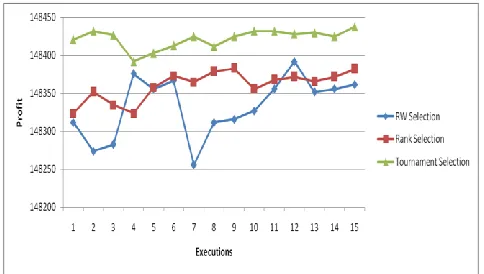
[image:1.612.324.566.559.696.2]The various Selection mechanisms like Roulette Wheel Selection, Rank based Selection and Tournament Selection [6] mechanism are applied and the values are plotted and shown in the Figure 1.
International Journal of Emerging Technology and Advanced Engineering
Website: www.ijetae.com (ISSN 2250-2459,ISO 9001:2008 Certified Journal, Volume 3, Issue 8, August 2013)
87 Variable Number of Generations
[image:2.612.45.290.252.390.2]In Fixed number of generations, Tournament selection method produced the best profit. Similarly the algorithm should also be checked for the variable number of generations. The same experiment setup is maintained for the variable number of generations. The profit obtained are noted and shown in the Figure 2 and the number generations required to identify the best individual are noted and shown in the Figure 3.
Figure 2:Profit obtained in Variable number of Generations.
Figure 3: Convergence Obtained in Variable number of Generations.
From Figure 2 and Figure 3 it is inferred that Tournament selection produces better profit with less convergence. In both Fixed number of generations and Variable number of generations, tournament selection mechanism performs well. So with the help of tournament selection mechanism we can identify good chromosomes from the initial search space.
II. POPULATION REDUCTION METHOD
The main objective of the research is to identify good chromosomes from the search space.
The identified chromosomes are then introduced as the initial population for the genetic process. This method helps us to separate the best individuals from the initial search space.
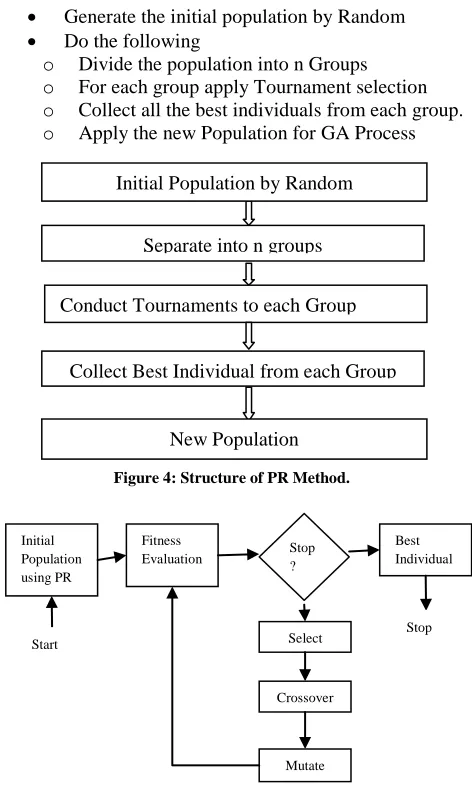
The main idea in our proposed methodology is that the initial population is separated into ‗n‘ groups. In each group the tournament selection is applied to identify the best chromosomes in each group. After several tournaments has made in each group, collection of best individuals is obtained then these individuals are then processed with usual GA process.
[image:2.612.328.564.286.682.2]The Methodology followed in PR Method is shown in Figure 4.
Generate the initial population by Random
Do the following
o Divide the population into n Groups o For each group apply Tournament selection o Collect all the best individuals from each group. o Apply the new Population for GA Process
[image:2.612.50.296.422.543.2]Figure 4: Structure of PR Method.
Figure 5: Structure of GA with PR Method.
Initial Population using PR
Fitness Evaluation
Select Parent Crossover
Mutate
Best Individual
Start
Stop Stop
?
Separate into n groups
Conduct Tournaments to each Group
Collect Best Individual from each Group Initial Population by Random
International Journal of Emerging Technology and Advanced Engineering
Website: www.ijetae.com (ISSN 2250-2459,ISO 9001:2008 Certified Journal, Volume 3, Issue 8, August 2013)
88 The pseudo code of the proposed GA using Population Reduction Method is as follows:
1. [ Initialization ]
Generate the initial population by random.
2. [ Population Reduction ]
Generate new population by applying Tournament Selection Mechanism
3. [ Fitness Evaluation ]
Calculate the fitness value of each individual in the population.
4. [ Breeding ]
Select the parents from the population using selection mechanisms.
Mate the parents to produce new offsprings.
Mutate the new offsprings.
Calculate the fitness of offspring.
Replace the offspring. 5. [ Termination ]
Repeat the process from step -3 till the termination condition is reached.
Select the best solution from the current population.
III. PERFORMANCE ANALYSIS
The performance of the approach is examined with 0/1 knapsack problem[8],[9]. Several experiments has been carried out to analyse the performance and to find the optimal parameters of the approach. The initial population was generated randomly. The following genetic parameters are performed on it.
Impact of Different Selection Mechanisms
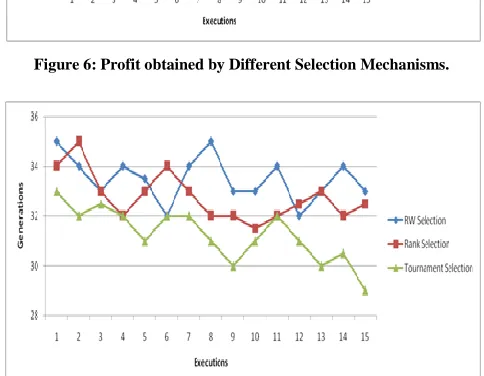
[image:3.612.323.566.133.266.2]The commonly used selection schemes like Roulette Wheel selection, Rank based selection method and Tournament selection method are applied. The experiment is carried out for the population size 200. 15 different executions were made and the performance is analysed for the selection mechanisms. The Figure 6 and Figure 7 shows the profit and the convergence obtained on applying different selection schemes on this approach.
Figure 6: Profit obtained by Different Selection Mechanisms.
All title and author details must be in single-column
Figure 7: Convergence obtained by Different Selection Mechanisms
Impact of Different Population Size
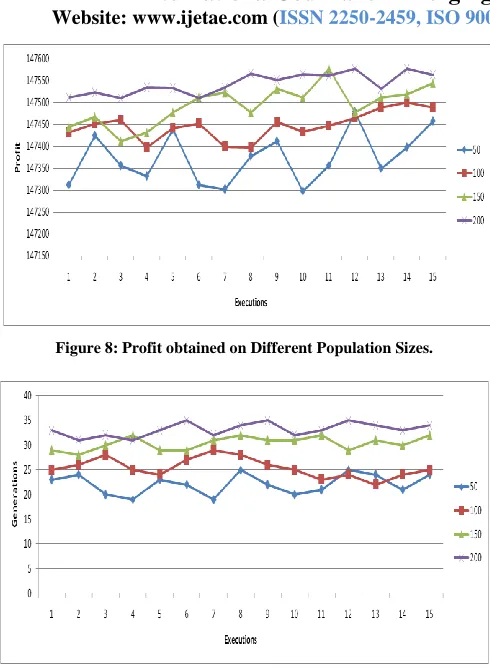
The population size [7] considered also affects the impact of the solution. If the population size is very less, there is a chance to have premature convergence and if is high, unnecessary executions takes place to complete the process. Convergence velocity automatically increased. Hence correct optimal population size should be identified.
[image:3.612.323.565.239.427.2]International Journal of Emerging Technology and Advanced Engineering
Website: www.ijetae.com (ISSN 2250-2459,ISO 9001:2008 Certified Journal, Volume 3, Issue 8, August 2013)
[image:4.612.46.291.116.451.2]89
[image:4.612.317.567.124.286.2]Figure 8: Profit obtained on Different Population Sizes.
Figure 9: Convergence Obtained on Different Population Sizes.
Impact of Different Crossover
[image:4.612.326.568.444.597.2]Various crossover methods like single point crossover, two point crossover and uniform crossover are applied and the analysis of the algorithm is made based on profit and convergence velocity. The values obtained during the execution are shown in the Figure 10 and Figure 11.
Figure 10: Profit obtained on Different Crossover.
Figure 11: Convergence obtained on Different Crossover.
From the Figure 10 and Figure 11, it is illustrated that uniform crossover produces better profit in quick convergence. Hence uniform crossover is identified as an optimal parameter for the proposed approach.
Impact of Different Crossover Rate
Generally the crossover rate varies from 0.80 to 0.95, to make all the individuals to take part in the genetic process. Hence different crossover rates are studied and the profit obtained shown in the Figure 12 and generations required to identify the profit in each execution is shown in Figure 13.
Figure 12: Profit obtained during Different Crossover rates.
[image:4.612.50.299.550.699.2]International Journal of Emerging Technology and Advanced Engineering
Website: www.ijetae.com (ISSN 2250-2459,ISO 9001:2008 Certified Journal, Volume 3, Issue 8, August 2013)
[image:5.612.325.571.118.278.2]90
Figure 13: Convergence obtained on Different Crossover Rates
Impact of Different Mutation Rate
[image:5.612.46.299.128.283.2]Mutation rate (Mr) is the deciding factor in producing new genetic traits. If the Mr is high, chance to alter the characteristics of good chromosomes. If it is very low, the offspring replicate the characteristics of the parent. Hence optimal mutate rate is necessary. Generally the mutation rate varies from 0.5% to 2%. Various experiments are conducted on this range and the profit obtained on various mutation rates are shown in Figure 14 and the convergence obtained is shown in Figure 15.
Figure 14: Profit obtained on Different Mutation Rates.
Figure 14 and Figure 15 shows the profit and convergence obtained on different mutation rates. From the figures it is inferred that the mutation rate 0.15 produces better result compared to other mutation rates.
Figure 15: Convergence obtained during Different Mutation Rates.
IV. OPTIMAL PARAMETERS FOR PRMETHOD
From the above experiments the optimal parameters that well suit for Population Reduction method are
No of Individuals: 200
Selection Mechanism: Tournament Selection
Crossover Type: Uniform Crossover
Crossover Rate: 0.90
Mutation Type: Flap Mutation
Mutation Rate: 0.15
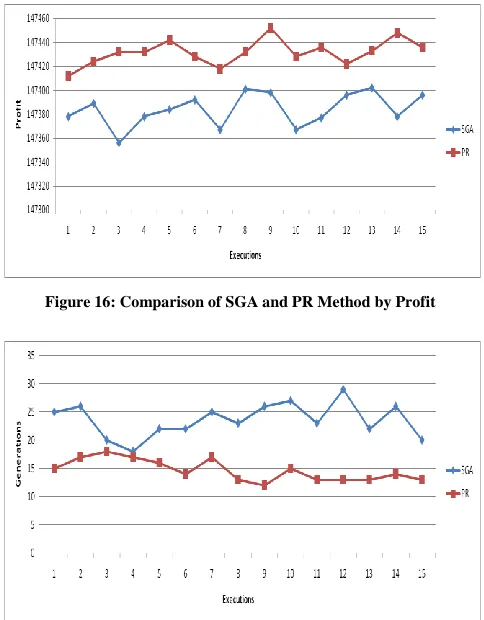
With the above mention parameter set the comparison is made between standard genetic algorithm (SGA) and the proposed Population Reduction method (PR).
Comparison of SGA and PR Method
To examine the performance of the proposed Population Reduction Method and SGA with optimal parameter set values the algorithm were executed several times. Comparison was done based on profit obtained in each generation and also based on execution time. The initial population was generated randomly with number of objects as 200.
[image:5.612.50.290.435.585.2]International Journal of Emerging Technology and Advanced Engineering
Website: www.ijetae.com (ISSN 2250-2459,ISO 9001:2008 Certified Journal, Volume 3, Issue 8, August 2013)
[image:6.612.48.290.139.449.2]91
Figure 16: Comparison of SGA and PR Method by Profit
Figure 17: Comparison of SGA and PR Method by Convergence.
The results show that the proposed Population Reduction Method (PR) performs significantly better than Standard Genetic Algorithm (SGA). This shows that the PR method is able to produce better quality solutions compared to SGAs in a fixed time period.
V. CONCLUSION
Being an evolutionary algorithm, Genetic algorithm can find the best optimal solution if best individuals (Chromosomes) are loaded in the initial population.
To identify the group of best individuals, using selection mechanism the entire population is reduced to a group of best individuals by Population Reduction (PR) method. From the Experimental results it is identified that Tournament selection mechanism is well suited for the proposed PR method compared to Roulette Wheel Selection and Rank based selection method.
The result shows that PR method produces best optimal results compared to standard genetic algorithm. PR method also increases the convergence velocity to reach the optimal solution.
REFERENCES
[1] Alhaikhli, I.F., ― A Practical Method for the Analysis of Genetic Algorithms‖, Journal of Advanced Computer Science and Technology Research, Vol. 1, pp. 1-9, 2011.
[2] Shahsavar, M., Naijafi, A.A., and Nikai, S.T.A., ― Statistical Design
of Genetic Algorithms for Combinatorial Optimization Problems‖, Mathetical Problems in Engineering Volume, Volume ID-872415, pp. 1-17, 2011.
[3] Preuss, M., and Beielstein T.B. ― Sequential parmeter Optimization
applied to self adaptation for binary coded evolutionary algorithms‖, Journal of parameter settings and Evolutionary Algorithms, Springer, Berlin, Germany, pp.91-119, 2007.
[4] He, H. And Tan, H., ― A Two Stage Genetic Algorithm for
automatic clustering‖, Journal of Neurocomputing, Vol-81, pp. 49-59, 2012.
[5] Eiben, A.E., Schut, M.C and Wilde, A.R., ― Boosting Genetic
Algorithms with Self-adaptive Selection‖, IEEE Congress on Evolutionary Computation, Sheraton, Canada, pp. 1584-1589, 2007.
[6] Back,T.,‖ Evolutionary algorithms in theory and practice‖, Oxford
University , Press,1996.
[7] Guy Knaepkens et al, 2004 , ―Relationship between population size
and genetic diversity in endangered populations of the European bullhead (Cottus gobio): implications for conservation‖, Elesvier, Biological conservations, Volume 115, Issue 3, February 2004, Pages 403–410.
[8] Martello, s. And Toth, P., ― Knapsack Problems: Algorithms and
Computer Implementations‖, J.Wiley & Sons, 1990.
[9] Simeos, A., and Costa, E., ― An Evolutionary Approach to the