© 2015, IRJET ISO 9001:2008 Certified Journal
Page 1377
Power flow Controller of PV System
B.AFIF
1, A. BENHAMOU
2, T. ALLAOUI
31
B. Afif, Department of Electrical Engineering, E.N.P Oran BP 1742 El’ M’naouer, Oran, Algeria.
2A. Benhamou,
energetic department, Boumerdes University, Algeria
3
T. Allaoui, electrical engineering department, Tiaret University- Algeria.
---***---Abstract -
Photovoltaic cell generation is thetechnique which uses photovoltaic cell to convert solar energy into electrical energy. Now a day, the photovoltaic generation is developing increasingly fast as a renewable energy source. The functioning of a photovoltaic cell as the power generator is equivalent to an electric circuit containing a current generator, diode, series and shunt resistance. This paper presents a modeling and simulation of a photovoltaic system constitutes of a generator photovoltaic (PVG), DC-DC converter (boost chopper) to transfer the maximum power to a base transmitter station. The temperature and irradiance effects on the PVG will be studied, particularly on the variables such as the short circuit current Icc, the open circuit voltage Voc. Depending on the load (BTS, I=60A, V=48V) profile and climatic factors influencing, we can find a highly gap between the maximum power supplied by the PVG and that actually transferred to the BTS. A maximum power point tracker (MPPT) based on a boost converter commanded by a Pulse Width Modulation (PWM) is used for extracting the maximum power from the PVG. Thus, a real time tracking of the optimal point of functioning is necessary to optimize the efficiency on the system. The modeling and simulation of the system (PVG, boost converter, PWM and MPPT algorithm of Perturbation and Observation P&O) is then made with Matlab/Simulink software.
Key Words:
Photovoltaic Generator, Boost Converter,
PWM,
1. Introduction
For two centuries, the world has used its energy almost exclusively from the combustion of coal, oil and gas represent today 80% of global energy consumption marketed. But coal, oil and gas are fossil energy that are not renewed. This energy is the principal cause of global
warming, is now a major environmental and economic problem affecting the perspectives of sustainable development. The use of solar energy to produce electricity by a photovoltaic panel requires no fuel. So there is no issue or producing toxic gases from the combustion of coal which has the effect of increasing the temperature of the earth by greenhouse gases. Solar energy is a clean and inexhaustible excellent alternative. In addition, there is no waste from this technique of energy production and not reject polluting and toxic substances in the soil. In this study, we model and optimize a system comprising a photovoltaic generator connected to a boost converter for a best transfer the power drawn from the sun and converted into electricity, without burning coal.
2. Modeling of a Photovoltaic Cell
In the ideally a photovoltaic cell (PV) can be summarized by an ideal current source produces a current proportional to the Iph incident light power, in parallel with a diode[1]-[3]. If we connect a resistive load to the terminals of the GPV, latter is delivers a portion of current I and the rest Id, current in the diode. For an ideal GPV, the voltage at the terminals of the resistance is equal to that at the terminals of the led: V=Vd and the nonlinear diode I-V characteristic is given by the relation.
0exp
1
akT
I
R
V
q
I
I
sd
(1)
p s s
d
R I R V akT
I R V q I I
I
0 exp 1
(2)
© 2015, IRJET ISO 9001:2008 Certified Journal
Page 1378
Fig -1: Model of PV cell with inclusion of voltage loss andleakage current.
According the law of Kirchhofff, we have:
I
PV
I
d
I
Rp
I
(3)
p s Rp
R
IR
V
I
(4)In the ideal, Rstends towards 0 and Rp to infinity. And
in the real, these resistors provide an assessment of the imperfections of the diode; considering that the resistance Rs has a low value. Using a numerical method (the method of Newton-Raphson for example) and under illumination, the slopes of the I-V characteristics are calculated at I0
open circuit and short circuit V0 and respectively give
the inverse of series and shunt resistance values[4]-[7].
3-
I
NFLUENCE OF LIGHT AND TEMPERATURE ON THE CHARACTERISTICI(V)
The response of a PV cell at different light energy figure (1). Shows that irradiation has a significant effect on the current open-circuit. That is the curve of the I-V characteristic and relatively horizontal, while the effect on the voltage in open circuit, i.e. the slope of the I-V curve and relatively vertical, which is quite low[8]-[15]. With regard to the maximum power of a photovoltaic cell, when the illumination is highest, the cell generates more power. The temperature has a very important effect on the open circuit voltage and a no remarkable effect on the short circuit of cell ( Fig. 2).
4- MODELING OF BOOST CHOPPER
[image:2.595.53.255.112.264.2]A DC/DC converter is a chopper transistor type parallel voltage booster used to increase the output voltage from the source, the schematic diagram is shown in (fig. 2).
Fig -2: Model of a DC/DC chopper
It is sized for a 3 kW power that corresponds to the values nominal I=170, V=17.64 V, on the side of the generator, and Vs=50V, Is=60 A, load side. His transformation ratio is the duty cycle (ratio of time during which the transistor is closed, the period hash as α << 1
The chopper forces the GPV to operate at maximum power, whatever the illumination and transfer to the load for a duty cycle defined. This chopper has four components: An inductance L, a diode, a capacitor C and a switch that takes two states, S=1 and S=0. When the switch S is closed, the diode D is polarized in opposite the load is therefore isolated[15]-[24]. The source provided energy to the inductance. If the switch S is open, the output stage receives energy from the source and inductor where an increase in the output voltage. Ideally, all components are ideal; the boost chopper can be modeled using the following ordinary differential equations:
L i i
c I I
dt dV C
I1 1
(5)
0 0 2
2 I
dt dV C
Ic
(6)
i L
L V
dt dI L
V
[image:2.595.333.552.180.365.2]© 2015, IRJET ISO 9001:2008 Certified Journal
Page 1379
L i i
c I I
dt dV C
I1 1
(8)
0 0
2
2 I I
dt dV C
Ic L
(9)
0 V V dt dI L
V L i
L
(10)
We added to the previous model a resistance RL internal inductance and resistance Rc internal capacity, so the (9) and (10) become:
[image:3.595.331.538.108.462.2]MODELING OF THE COMMANDS
Fig -3: Schema of Simulation GPV and boost chopper with MPPT.
0 0.05 0.1 0.15 0.2 0
5 10 15 20 25 30
T
e
n
si
o
n
V
i
[V
]
0 0.05 0.1 0.15 0.2 0
10 20 30 40 50 60 70
T
e
n
si
o
n
V
o
[
V
]
0 0.05 0.1 0.15 0.2 0
20 40 60 80 100 120 140 160 180 200
Temp [S]
P
u
issa
n
ce
P
[
W
[image:3.595.56.281.360.531.2]]
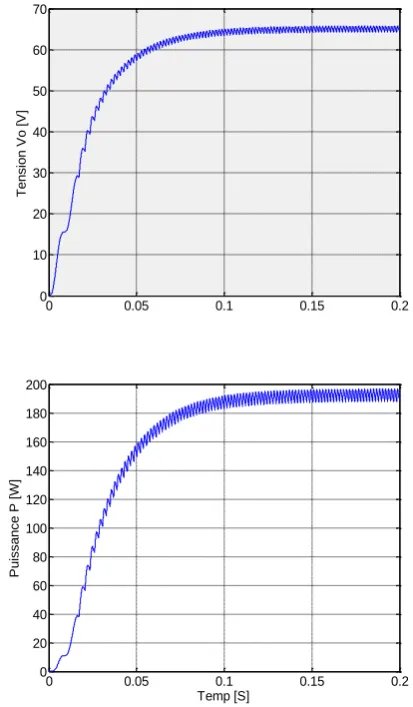
Fig -4: Details of the waveforms of the input voltage, output voltage and the output power for a sampling
frequency of 20KHz.
5- Control by Pulse Width Modulation (PWM)
The PWM control is to cut the output voltage generated by the converter into a series of elementary patterns with low period, and variable duty cycle in time. The temporal change of the duty cycle of each switch is then determined by a modulating signal which is selected generally sinusoidal. The control commands of each cell are generated by the intersection between a triangular carrier and the modulating signal. According to the strategy, it can be sampled synchronously with the triangular carrier, or directly compared. Each switch is switched at a rate imposed by the carrier[23]-[28].
© 2015, IRJET ISO 9001:2008 Certified Journal
Page 1380
6- CONCLUSIONThe consumption of fossil energy is a major source of environmental degradation. The Photovoltaic can be used in various applications. This type of application can be installed on the roof of private homes (an average of 3 kW). There are also systems of larger size, up to several megawatts. And to obtain the best power transfer between the PV generator GPV and the load, we modeled the entire conversion chain in Matlab and the search algorithm of maximum power point tracking (MPPT) has been designed and simulated. It forces the GPV to work at its Maximum Power Point (MPP), leading to an overall improvement of performance of electrical conversion system. Although satisfactory for direct GPV-BTS connection, improved P & O algorithm may be necessary in the case of sudden changes of temperature and insolation.
REFERENCES
[1] D Saheb-Koussa, M Haddadi. “Modélisation d’un générateur photovoltaïque dans l’environnement”. 4th International Conference on Computer Integrated Manufacturing CIP, 03-04, 2007.
[2] R Chenni, L Zarour, E Matagne T Kerbache.
“Optimisation d’un système de pompage
photovoltaïque”. Sciences & Technologie B –No 26, décembre 2007.
[3] A Meflah, T Allaoui. “Commande d’une chaîne de pompage photovoltaïque au fil du soleil”. Revue desEnergies Renouvelables. 2012; 15(3).
[4] J Surya Kumari and Ch Sai Babu. “Mathematical
Modeling and Simulation of Photovoltaic Cell using Matlab- Simulink Environment”. International Journal of Electrical and Computer Engineering. 2012; 2(1): 26~34.
[5] R Chenni, M Makhlouf, T Kerbache, A Bouzid. “A
detailed modeling method for photovoltaic cells Energy”. 2007; 32: 1724 – 1730.
[6] [6] Soltane BELAKEHAL. “Conception & commande
des machines à aimants permanents dédié aux energies renouvelables”. Thèse, Faculté des sciences de Constantine, 2010.
[7] C Boisvineau, M Nougaret et J Perard. “optimisation du
fonctionnement d’un générateur photovoltaïque : Asservissement extrémal de la puissance”. Revue Phys.1982; 17: 329-336.
[8] Thi Minh Chau LE. “Couplage Onduleurs
Photovoltaïques et Réseau, aspects
contrôle/commande et rejet de perturbations”. Thèse université De Groneble, 2012.
[9] M.Hatti, IEEE Member. “Contrôleur Flou pour la
Poursuite du Point de Puissance Maximum d’un
Système Photovoltaïque”. JCGE'08 LYON, 16 et 17 décembre 2008.
[10]Nur Mohammad, Md Asiful Islam, Tarequl Karim,
Quazi Delwar Hossain. “Improved Solar Photovoltaic Array Model with FLC Based Maximum Power Point Tracking”. International Journal of Electrical and Computer Engineering. 2012; 2(6): 717~730.
[11]Martin AIMÉ. “Évaluation et optimisation de la bande
passante des convertisseurs statiques Applicationaux nouvelles structures multicellulaires”. Thèse Ecole Centrale de Lille, 2003.
[12]Fernando Lessa Tofoli, Julio Cesar Sconell, Carlos
Alberto Gallo, Sergio Manuel Rivera Sanhuenza, A
LOW COST SINGLE-PHASE GRID-CONNECTED
PHOTOVOLTAIC SYSTEM WITH REDUCED
COMPLEXITY, IEEE 978-1-4244-3370-4/09,2009.
[13][2] Yishu Zhao, Yan Zhang, Depeng Wang, Jie Zhan,
THE CIRCUIT TOPOLOGY FOR SINGLE-PHASE GRID
CONNECTED SYSTEM AND THE CONTROL
TECHNOLOGY ON CONVERTERS, IEEE
TRANSECTIONS ON ELECTRONIC DEVICES,VOL 48,NO.5,2001.
[14][3] D.Barater, G. Franceschini, E.Lorenzani, UNIPOLAR
PWM FOR TRANSFORMER LESS GRID-CONNECTED CONVERTERS IN PHOTOVOLTAIC PLANTS, IEEE 978-1-4244-2544-0/08, 2009
[15] Muhammad H. Rashid, “Power electronic Circuits,
Devices and Application Handbook”, Third Edition, Chapter 3, page no 108-111, Page no 250-253
[16] Paul C. Krause, Oleg Wasynczuk, Scott D. Sudhoff,
“Analysis of Electrical Machinery And Drive Systems, Wiley Student Edition, second edition,Chapter 1, page no1-8
[17]M D Singh, K B Khanchandani, “POWER
ELECTRONICS”, TATA McGRAW HILL company, Second edition,Chapter9, page no 540- 570
[18] Soeren Baekhoej Kjaer, John K. Pedersen,Frede
Blaabjerg, A Review of Single-Phase Grid-Connected
Inverters for Photovoltaic Modules, IEEE
TRANSECTIONS ON INDUSTRY APPLICATION VOL. 41 NO.5 SEPTEMBER/OCTOBER2005
[19][8] Pedro Gomes Barbosa, Henrique Antonio
CarvalhoBarga, Marcio do Carmo Bardosa Rodrigues, Estevao Coelho Teixeria, Boost Current Multilevel Inverter and Its Application on Single-Phase
Grid-Connected Photovoltaic Systems, IEEE
TRANSACTIONS ON POWER ELECTRONICS VOL.21 NO.4 JULY 2006
[20]Yilmaz Sozer and David A. Torrey, Modeling and
Control of Utility Interactive Inverters, IEEE TRANSACTIONS ON POWER ELECTRONICS VOL.24 NO.11, NOVEMBER 2009
© 2015, IRJET ISO 9001:2008 Certified Journal
Page 1381
[22]Roberto Gonzalez, Jesus Lopez, Pablo Sanchis and Luis
Marroyo, Transformerless Inverter for Single-Phase Photovoltaic Systems, IEEE TRANSACTONS ON POWER ELECTRONICS, VOL.22 NO.2, MARCH 2007.
[23] Michale E. Ropp and Sigifredo Gonzalez, Development
of a MATLAB/Simulink Model of a Single-Phase Grid-Connected Photovoltaic System, IEEE TRANSACTIONS ON ENERGY CONVERSION
[24]D. Gorinevsky, S. Boyd, and G. Stein, Design of Low-Bandwidth Spatially Distributed Feedback, IEEE Transactions on Automatic Control, Vol. 53(Issue 1):257-272, February 2008.
[25]D.E. Dudgeon, R.M. Mersereau, Multidimensional
Digital Signal Processing (Prentice-Hall, 1984).
[26]D.E. Dudgeon, R.M. Mersereau, Multidimensional
Digital Signal Processing (Prentice-Hall, 1984, pp. 581-600).
[27]J. Williams, Narrow-band analyzer, Ph.D. dissertation,
Dept. Elect. Eng., Harvard Univ., Cambridge, MA, 1993.
[28]D. Gorinevsky, S. Boyd, G. Stein, Optimization-based
tuning of low-bandwidth control in spatially distributed systems, American Control Conference, Vol. 3, pp. 2658–2663, Denver, CO, June 2003.
BIOGRAPHIES
B. Afif was born in Tiaret in Algeria, in 1976. He received his BS degree in electronics engineering from University of Tiaret (Algeria) in 2001, the MS degree in engineering control from University of Tiaret (Algeria) in 2008, and the PhD degree in engineering control from (Algeria) in 2011. His research interests are non linear control and observers applied in induction motor and renewable energies.
A.Benhamou: born in Tlemcen ,
Algeria, June.08th ; 1974,
Organization:Boumerdes
University,Algeria. Doctor; maitre de conference; chief of groups; research LaboratoryExperience: Large experience in research, CDER , UDES, engineering in Sonatrach General Manager of SUNDOUS ENERGY Main range of scientific interests:Renewable
energy,SolarDrying,Thermodynamic properties of Food, Food storage Heat transfer; electricity and wavelet, signal treatment.
T. Allaoui was born in Tiaret Algeria, in 1973. He received his engineer degree in electrical engineering from the Ibn Khaldoun University of Tiaret in 1996 and his master degree from the University of Science and Technology of Oran Algeria in 2002. His is currently a lecturer at the Ibn Khaldoun University of Tiaret, Algeria. His
research interests include