Niraj Pathak1, R. K. Sharma2, V. O. Thomas3
1Department of Mathematics, Dharmsinh Desai University, Nadiad, India 2Department of Aerospace Engineering, Karunya University, Coimbatore, India
3Department of Mathematics, Faculty of Science, The Maharaja Sayajirao University of Baroda,
Vadodara, India
Received 12 January 2016; accepted 12 June 2016; published 15 June 2016
Copyright © 2016 by authors and Scientific Research Publishing Inc.
This work is licensed under the Creative Commons Attribution International License (CC BY). http://creativecommons.org/licenses/by/4.0/
Abstract
We analyze the periodic orbits, quasi periodic orbits and chaotic orbits in the photo gravitational Sun-Saturn system incorporating actual oblateness of Saturn in the planar circular restricted three body problem. In this paper, we study the effect of solar radiation pressure on the location of Sun centered and Saturn centered orbits, its diameter, semi major axis and eccentricity by taking different values of solar radiation pressure q and different values of Jacobi constant “C”, and by considering actual oblateness of Saturn using Poincare surface of section (PSS) method. It is ob- served that by the introduction of perturbing force due to solar radiation pressure admissible range of Jacobi constant C decreases, it is also observed that as value of C decreases the number of islands decreases and as a result the number of periodic and quasi periodic orbits decreases. Fur- ther, the periodic orbits around Saturn and Sun moves towards Sun by decreasing perturbation due to solar radiation pressure q for a specific choice of Jacobi constant C. It is also observed that due to solar radiation pressure, semi major axis and eccentricity of Sun centered periodic orbit reduces, whereas, due to solar radiation pressure uniform change in semi major axis and eccen- tricity of Saturn centered periodic orbits is observed.
Keywords
Restricted Three Body Problem, Sun-Saturn System, Periodic Orbits, Quasi Periodic Orbits, Chaotic Orbits, Photo Gravitation, Oblateness, Poincare Surface Section
1. Introduction
and centrifugal forces. He identified location of equilibrium points, periodic orbits.
The study of periodic orbits plays an important role in the understanding of the general properties of different dynamical systems. A large number of periodic orbits were generated by [5] in the framework of RTBP using numerical techniques. [6] Surface of section (PSS) is widely used for analysing periodic, quasi periodic orbits and chaotic orbits. [7] have given a detailed analysis of periodic orbits using PSS. Chaotic behaviour of bodies can also be studied using PSS, Liapunov characteristic numbers, Fourier transform techniques and numerical ir-reversibility technique. The study of quasi-periodic orbits is important due to its application in space mission. One way of reducing fuel consumption is to place the spacecrafts on quasi-periodic orbits, thus maintaining a maximum separation. There have been numerous studies targeted at finding the quasi-periodic orbits around the libration points.
The set of stable periodic and quasi-periodic trajectories define regions of regular motion or stability “islands” that spread in a chaotic “sea” made of trajectories with high sensitivity with respect to the initial condition. As per Kolmogorov-Arnold-Moser (KAM) theory, the point represents a periodic orbit in the rotating frame, and the closed curves around the point correspond to the quasi-periodic orbits.
PSS gives a qualitative picture of stability regions in the planar problems. [8], employed multiple PSS method to find quasi-periodic orbits around the libration points L1 and L2 in the Sun-Earth system. [9] studied the loca-tion and stability of periodic and quasi-periodic orbits in the Earth-Moon system. [10] and [11] analysed the PSS for Earth-Moon system and Sun-Mars system. They have identified periodic, quasi-periodic solutions and cha-otic regions. [12]and [13] also studied PSS for Saturn-Titan system for periodic orbits, quasi-periodic and cha-otic regions.
In this paper we have studied PSS method for Sun-Saturn system for periodic and quasi-periodic orbits. This work is mainly concentrated on two major islands, one gives Sun centered orbit and other gives Saturn centered orbit. Since these two islands are major islands they are available in each PSS corresponding to different solar radiation pressure q with different Jacobi constant C. So, effect of perturbation on two different family of peri-odic orbit can be analysed by obtaining PSS. This paper is organised as follows. The basic equations of motion incorporating the perturbed force due to radiation and oblateness is given in Section 2. The PSS method is de-scribed in Section 3. Computational techniques are used to obtain PSS and periodic as well as quasi-periodic or-bits in Section 4 and conclusions of the study are presented in Section 5.
2. Equation of Motion
Restricted three-body problem describes the motion of an infinitesimal mass which moves under the gravita-tional effect of two finite masses called primaries. The primaries are moving in circular orbits around their cen-tre of mass on account of their mutual attraction and the infinitesimal mass not influencing the motion of the primaries.
We consider the case when bigger primary (Sun) is source of radiation and smaller primary (Saturn) is oblate spheroid. We consider that the equatorial plane of the Saturn is coincident with the plane of the motion and study only the planar case.
2 1
2
n = + A ,
where 2 2 2 2 5 AE AP A R − = .
Here, AE and AP represent equatorial and polar radii of Saturn and R is the distance between Sun and Saturn. Choose the unit of mass equal to the sum of the primary masses, the unit of length is equal to their separation and the unit of time is such that Gaussian constant of gravitation is unity. The usual dimensionless synodic co-ordinate system Oxy is used to express this motion. The origin of this system is positioned on the center of mass of the primaries while the bigger and smaller primaries always lie on the Ox axis at P(−μ, 0)and at Q(1 − μ, 0), respectively.
Following [15] the equations of motion of the infinitesimal mass are
2 , 2 .
x ny y nx
x y
∂Ω ∂Ω
− = + =
∂ ∂
(1)
where,
(
)
(
)
2
2 2 2
1 2 3
1 2 2
1 1 . 2 2 q A n r r
r r r
µ µ µ
µ µ −
Ω = − + + + + (2)
Here,
(
)
22 2
1
r = x−µ +y (3) and,
(
)
22 2
2 1 .
r = x+ −µ +y (4)
By integrating, we get,
2 2 2
x +y = Ω −C (5)
where, C is the Jacobi constant of integration.
(
)
(
)
(
)
2 2 2 2 2 2
1 2 3
1 2 2
1
1 2q 2 A .
C n r r x y
r r r
µ µ µ
µ µ −
= − + + + + − − (6)
3. Poincare Surface of Section
The Poincare surface of section (PSS) method is used for determining the regular or chaotic nature of the trajec-tory. The numerical method of PSS is used to generate orbits and to study the location and stability of orbits in various systems.
4. Computational Technique
For Sun-Saturn system the mass of sun m1 = 1.9881 × 1030 kg, m2 = 568.36 × 1024 kg. Thus, µ=m2/(m1 + m2) = 0.0002857696. Also equatorial radius of Saturn is 60268 km, polar radius of Saturn is 54,364 km. and distance
between sun and Saturn is 1433000000 km. So, according to the formula,
2 2 2 2 5 AE AP A R −
= , oblateness coeffi-
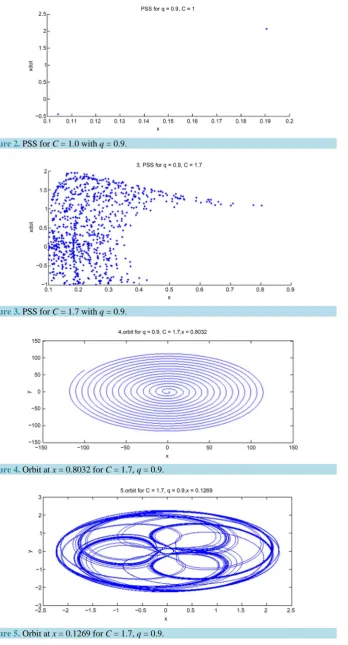
cient A2 = 6.59158 × 10⁻¹¹. We have explored the Sun-centered and Saturn-centered orbits in the Sun-Saturn system and variations in them due to solar radiation pressure. For different solar radiation pressure we have dif-ferent range of Jacobi constant C. For each value of q, we can find maximum value of C using equation (6), such that y2 is positive. In other words, we can find admissible value of C such that velocity of infinitesimal mass is real. q = 0.9 gives maximum value of Jacobi constant C as 2.807 such that infinitesimal mass having real ve-locity within region between two primaries, Sun and Saturn. In other words, for q = 0.9, admissible range of C lie in the interval [1, 2.807] for values of x in the interval [0, 1]. If C = 2.808 then for same q, y2 becomes negative for x in the range [0.9290, 0.9510]. This is excluded region for infinitesimal mass as velocity becomes complex. For q = 0.9, we have analysed the PSS for 1≤ C ≤ 2.8 and ∆C = 0.1. PSS for C = 1.0 contains only 2 points as shown inFigure 2. PSS from C = 1.0 to C = 1.7 contains only fuzzy distribution of points without any indication of islands which gives only chaotic orbits. PSS for C = 1.7 is shown inFigure 3. Chaotic orbits for C = 1.7, q = 0.9 and x = 0.8032 and time t = 500 and for C = 1.7, q = 0.9 and x = 0. 1269 and time t = 500 are shown inFigure 4andFigure 5 respectively.
[image:4.595.61.541.527.705.2]First quasi periodic orbit obtained at x = 0.1168 for C= 1.8 when q = 0.9. This orbit is located at the center of the island as shown in Figure 6. Which is first Sun centered quasi periodic orbit when q = 0.9.
Figure 2. PSS for C = 1.0 with q = 0.9.
Figure 3. PSS for C = 1.7 with q = 0.9.
[image:5.595.151.500.80.726.2]Figure 4. Orbit at x = 0.8032 for C = 1.7, q = 0.9.
Figure 6. PSS for C = 1.8, q = 0.9 and orbit corresponding to point x = 0.1168, t = 1000.
By observing PSS for different values of Jacobi constants from C = 1.0 to C = 2.8 we conclude that as value of C increases, the number of islands increases and as a result periodic orbits and quasi periodic orbits increase.
4.1. Sun Centered Periodic Orbits
Here, we mainly concentrate on one of the major island which gives sun centred orbit and analyze its nature for different Jacobi constant C.
Figure 7(a)andFigure 8(a)show PSS for q = 0.9 with Jacobi constant C = 2.79, 2.8 respectively. Each PSS is formed between two primaries Sun and Saturn located at x = 0 and x =1 respectively.Figure 7(b) and Figure 8(b) show enlarged view of the island on which study is focused.Figure 7(c) and Figure 8(c) show prograde Sun centered periodic orbit corresponding to the center of the island.
Figure 9depicts variation in location of Sun centered periodic orbit with C for q = 0.9. It can be observed that as C increases location of periodic orbit moves towards 1. From analysis of one of the major island and Sun centered periodic orbit corresponding to center of the island when q = 0.9, it is concluded that as C increases lo-cation of periodic orbit moves towards Saturn.
Semi-major axis “a” and eccentricity “e” of the Sun centered orbit are obtained by Murraay and Dermott (1999) as 1 2 1 2 1 V a r µ − = − −
(
)
2 1 1 h e a µ = − −(
)
(
2)
2 2
V = x + y+ +x µ
(
2)(
)
h= x+µ y+ +x µ
(
)
22 2
1
r = x+µ +y
For Sun centered periodic orbits, Figure 10andFigure 11 show that as Jacobi constant C increases semi ma-jor axis increases and eccentricity decreases.
By reducing perturbation due to solar radiation pressure (q = 0.9845) using same procedure admissible range of Jacobi constant C is [1, 2.985]. C = 2.986 gives negative 2
Figure 7. (a) PSS for C = 2.79 with q = 0.9, (b) island near x = 0.32 and (c) center of the island showing Sun centered peri-odic orbit at x = 0.3249, t = 1000.
Figure 8. (a) PSS for C = 2.8 with q = 0.9; (b) island near x = 0.33 and (c) center of the island showing Sun centered periodic orbit for x = 0.33286, t = 1000.
[image:7.595.197.533.514.709.2]Figure 10. Variation in semi major axis for q = 0.9.
Figure 11. Variation in eccentricity for q = 0.9.
Figure 12(a) andFigure 13(a) shows PSS for q = 0.9845 with Jacobi constant C = 2.985 and 2.975 respec-tively. When we neglect the perturbation due to solar radiation pressure (i.e.q = 1) using same procedure admis-sible range of Jacobi constant C is [1, 3.018]. C = 3.019 gives negative y2
within region x = 0.946 to x = 0.964 which is excluded region for infinitesimal mass as velocity becomes complex. Here it is observed that excluded region becomes larger. With reduced perturbation, analysis of same island and periodic orbit corresponding to its center gives conclusion that increment in value of Jacobi constant is responsible for shifting of location of periodic orbits towards Saturn which is shown inFigure 16.
For Sun centered periodic orbits, Figure 17andFigure 18shows that as Jacobi constant C increases semi major axis orbit increases and eccentricity decreases. By neglecting the solar radiation pressure (q = 1) the maximum value of Jacobi constant increases up to 3.018. But for analyzing the effect of solar radiation pressure on Sun centered periodic we consider the same Jacobi constants as above.
Figure 12. (a) PSS for C = 2.985 with q = 0.9845; (b) island near x = 0.355 and (c) center of the island showing Sun centered periodic orbit for x = 0.352983, t = 1000.
Figure 13. (a) PSS for C = 2.975 with q = 0.9845; (b) island near x = 0.34 and (c) center of the island showing Sun centered periodic orbit for x = 0.3449, t = 1000.
[image:9.595.108.526.516.691.2]Figure 15. (a) PSS for C = 2.975 with q = 1; (b) island near x = 0.3235 and (c) center of the island showing Sun centered pe-riodic orbit for x = 0.32335, t = 1000.
concluded that solar radiation pressure is responsible for shifting location of periodic orbits towards Saturn which is shown in Figure 16.
It is observed fromFigure 17 that as Jacobi constant C increases semi major axis increases. It is clearly ob-served that as perturbation due to solar radiation pressure decreases semi major axis of periodic orbits for same Jacobi constant C increases.
Figure 18shows that as Jacobi constant C increases, eccentricity decreases. It is concluded that solar radia-tion pressure is responsible for reducing eccentricity of Sun centered periodic orbit for same C.
4.2. Saturn Centered Periodic Orbits
By considering q = 0.9345, admissible range of Jacobi constant C is [1, 2.88]. C = 2.881 gives negative y2 within region x = 0.937 to 0.956 which is excluded region for infinitesimal mass as velocity becomes complex. Also, for q = 0.9645 admissible range of Jacobi constant C is [1, 2.943]. C = 2.944 gives negative y2 within region x = 0.945 to 0.957 which is excluded region for infinitesimal mass as velocity becomes complex. It is observed that excluded region becomes smaller. It is slightly shifted towards Saturn.
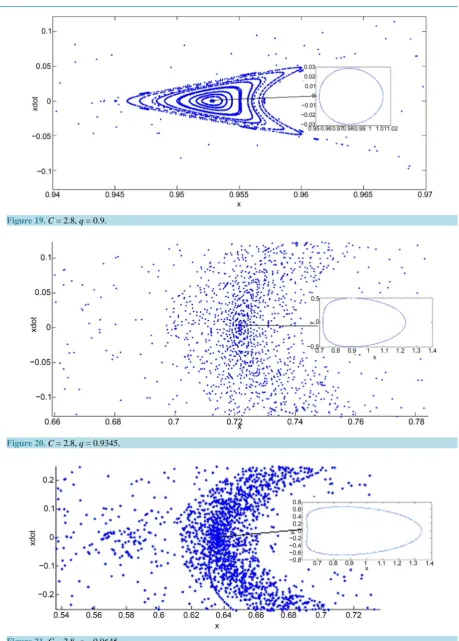
PSS of island corresponding to Saturn centered periodic orbit for C = 2.8 with q = 0.9, 0.9345, 0.9645 and 1 are shown in Figures 19-22 respectively. Center of the island gives Saturn centered periodic orbit at x = 0.95285, x = 0.72165, x = 0.6365, and at x = 0.56455 respectively.
Figures 23-26show PSS for island corresponding to Saturn centered periodic orbit for C = 2.79 with q = 0.9, 0.9345, 0.9645 and 1 respectively. Center of the island gives Saturn centered periodic orbit at x = 0.8957, 0.70345, 0.62315 and at 0.55435 respectively.
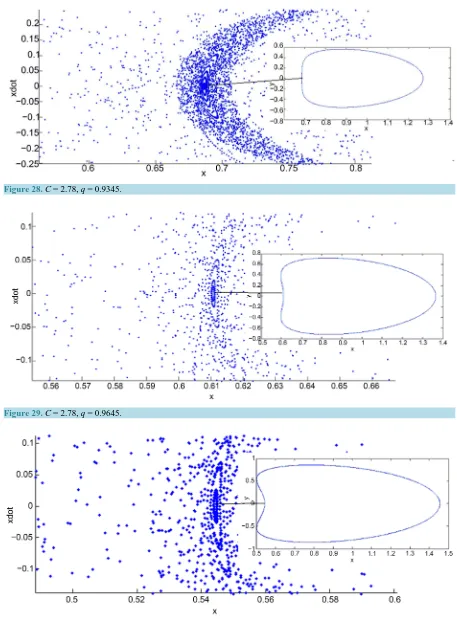
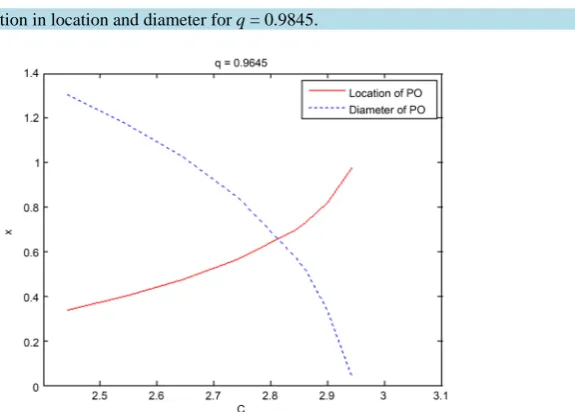
Figures 27-30depict PSS of island for C = 2.78 with q = 0.9, 0.9345, 0.9645 and 1 respectively. Center of the island gives Saturn centered periodic orbit at x = 0.8429, 0.68645, 0.61065, and at x = 0.5444 respectively. From this it is observed that for a given C by decreasing perturbation due to solar radiation pressure Saturn centered periodic orbit moves towards Sun. This is the effect of solar radiation pressure on retrograde Saturn centered pe-riodic orbits. FromFigure 19, Figure 23 andFigure 27 it can be observed that for q = 0.9, by decreasing Jacobi constant C, Saturn centered periodic orbit moves towards Sun. Similar results can be observed in Figure 20, Figure 24andFigure 28 for q = 0.9345, in Figure 21,Figure 25 andFigure 29 for q = 0.9645 and inFigure 22, Figure 26and Figure 30 for q = 1. This is the effect of Jacobi constant on Saturn centered retrograde peri-odic orbits. The shifting of Saturn centered retrograde periperi-odic orbits towards Saturn by increasing Jacobi con-stant C is plotted as dark line inFigures 31-35 for q = 1, q = 0.9845, q = 0.9645, q = 0.9345, q = 0.9 respective-ly. The increase in diameter associated with a decrease in the Jacobi constant C is plotted by dotted line. It should be noted that for plotting graphs in Figures 31-36the same scale is used.
Figure 16. Variation in location of periodic orbit for q = 0.9845 and q = 1.
Figure 17. Variation of semi major axis for q = 0.9845 and q = 1.
[image:11.595.190.483.489.711.2]Figure 19.C = 2.8, q = 0.9.
[image:12.595.80.540.71.713.2]Figure 20. C = 2.8, q = 0.9345.
Figure 22.C = 2.8, q = 1.
[image:13.595.82.539.78.729.2]Figure 23.C = 2.79, q = 0.9.
Figure 25.C = 2.79, q = 0.9645.
[image:14.595.86.540.78.719.2]Figure 26. C = 2.79, q = 1.
Figure 28.C = 2.78, q = 0.9345.
Figure 29. C = 2.78, q = 0.9645.
Figure 31.Variation in location and diameter for q = 1.
[image:16.595.198.486.496.702.2]Figure 32. Variation in location and diameter for q = 0.9845.
Figure 34. Variation in location and diameter for q = 0.9345.
[image:17.595.202.454.85.272.2]Figure 35.Variation in location and diameter for q = 0.9.
[image:17.595.197.456.509.710.2]Figure 41shows uniform change in semi major axis of Saturn centered periodic orbits. From Figures 37-41 it is observed that as q moves from 1 to 0.9, sudden change in semi major axis of Saturn centered periodic orbit
[image:18.595.169.493.275.719.2]Figure 37. Semi major axis for q = 1.
Figure 39. Semi major axis for q = 0.9645.
[image:19.595.158.508.73.714.2]Figure 40. Semi major axis for q = 0.9345.
bit for q = 0.9345. It is clear from the graph that as C increases eccentricity decreases. Figure 46shows the var-iation of eccentricity of Saturn centered periodic orbit for q = 0.9. It is clear from the graph that when C increas-es eccentricity decreasincreas-es. But in this case the sudden change in the graph occurs between C = 2.795 and C = 2.8. For C =2.795 eccentricity is 0.0274 and for C = 2.8 it is 0.0469. It is for the same value of C for which
Figure 42. Eccentricity for q = 1.
Figure 44. Eccentricity for q = 0.9645.
Figure 45. Eccentricity for q = 0.9345.
Jacobi constant C increases Sun centered periodic orbit and Saturn centered periodic orbits shift towards Saturn for a given perturbation due to solar radiation pressure q. It means Jacobi constant C acting opposite to gravita-tional force. For a given C, as q tends to 1, location of Sun centered and Saturn centered periodic orbits moves towards Sun. That is solar radiation pressure is responsible for shifting periodic orbits towards Saturn which is expected as solar radiation pressure is opposite to gravitational attraction of Sun. Thus, by decreasing perturba-tion due to solar radiaperturba-tion pressure, effect of gravitaperturba-tional attracperturba-tion increasing and as a result periodic orbit shift towards Sun. For a given q, as C increases semi major axis increases and eccentricity of Sun centered periodic orbits decreases. For a given q and its corresponding maximum value of Jacobi constant C Saturn centered peri-odic orbit showing sudden change in semi major axis and eccentricity. It is observed that semi major axis in-creases uniformly up to certain value of C and then shows a sharp increase, where as eccentricity decreases uni-formly up to certain value of C and then shows a sharp increase. When the solar radiation pressure q tends to 0.9, this sharp change in the semi major axis and eccentricity graphs becomes smooth. Thus, it is concluded that perturbation due to solar radiation pressure reduces sudden change in semi major axis and eccentricity of Saturn centered periodic orbits. It is further observed that as q tends to 1, semi major axis and eccentricity of Sun cen-tered periodic orbit increases for given C. In other words, due to solar radiation pressure, semi major axis and eccentricity of Sun centered periodic orbit reduces.
References
[1] Szebehely, V. (1967) Theory of Orbits. Academic Press, San Diego.
[2] Poynting, J.H. (1904) Radiation in the Solar System: Its Effect on Temperature and its Pressure on Small Bodies. Phi-losophical Transactions of the Royal Society A: Physical Sciences and Engineering, 202, 525-552.
http://dx.doi.org/10.1098/rsta.1904.0012
[3] Robertson, H.P. (1937) Dynamical Effects of Radiation in the Solar System. MonthlyNoticesoftheRoyal Astronomi-calSociety, 97, 423-438. http://dx.doi.org/10.1093/mnras/97.6.423
[4] Abouelmagd, E.I. (2013) The Effect of Photogravitational Force and Oblateness in the Perturbed Restricted Three- Body Problem. Astrophysics and Space Science, 346, 51-69. http://dx.doi.org/10.1007/s10509-013-1439-9
[5] Broucke, R.A. (1968) Periodic Orbits in the Restricted Three-Body Problem with Earth-Moon Masses. Technical Re-port, No. 32, Jet Propulsion Laboratory, Pasadena.
[6] Poincare, H. (1892) Les Methodes Nouvelles de la Mechanique Celeste. Vol. 1, Gauthier-Villas, Paris, 82.
[7] Murray, C.D. and Dermot, S.F. (1999) Solar System Dynamics. Cambridge University Press, Cambridge.
[8] Kolmen, E., Kasdin, N.J. and Gurfil, P. (2007) Quasi-Periodic Orbits of the Restricted Three-Body Problem Made Easy. New Trends in Astrodynamics and Applications III, Vol. 886, Melville, 16-18 August 2006, 68.
http://dx.doi.org/10.1063/1.2710044
[9] Winter, O.C. (2000) The Stability Evolution of a Family of Simply Periodic Lunar Orbits. Planetary and Space Science, 48, 23-28. http://dx.doi.org/10.1016/S0032-0633(99)00082-3
[10] Dutt, P. and Sharma, R.K. (2010) Analysis of Periodic and Quasi-Periodic Orbits in the Earth-Moon System. Journal of Guidance, Control, and Dynamics, 33, 1010-1017. http://dx.doi.org/10.2514/1.46400
[11] Dutt, P. and Sharma, R.K. (2011)Evolution of Periodic Orbits in the Sun-Mars System. Journal of Guidance, Control,