MAZA at SemEval-2016 Task 11: Detecting Lexical Complexity Using
a Decision Stump Meta-Classifier
Shervin Malmasi
Macquarie University Sydney, NSW, Australia [email protected]
Marcos Zampieri
Saarland Unviersity Saarbr¨ucken, Germany [email protected]
Abstract
This paper describes team MAZA entries for the 2016 SemEval Task 11: Complex Word Identification (CWI). The task is a binary clas-sification task in which systems are trained to predict whether a word in a sentence is con-sidered to be complex or not. We developed our two systems for this task based on classi-fier stacking using decision stumps and deci-sion trees. Our best system, using contextual features, frequency information, and word and sentence length, achieved91.2%accuracy and
30.8%F-Score. The system ranked 4thamong
the 38 entries in the CWI task in terms of F-Score.
1 Introduction
Lexical simplification is a popular task in natural language processing and it was the topic of a suc-cessful SemEval task in 2012 (Specia et al., 2012). It consists of applying computational methods to sub-stitute words or short phrases for simpler ones to improve text readability and comprehension aimed at a given target population (e.g. children, lan-guage learners, people with reading impairment, etc.). Lexical simplification is considered to be the sub-task of text simplification that deals with the lexicon while other sub-tasks address, for example, complex syntactic structures (Siddharthan, 2014).
To perform lexical simplification efficiently, com-putational methods should be first applied to identify which words in a text pose more difficulty to readers and they therefore good candidates for substitution (Shardlow, 2013). This task is called complex word
identification (CWI) and it is the topic of the 2016 SemEval Task 11 with the same name.
The CWI shared task is modeled as a binary text classification task. Participants are provided with training data containing sentences and a label for each word in them containing a value of either 1 (for complex words) or 0 (for simple words). The la-bel was attributed according to the judgment of hu-man annotators that were required to indicate which words in the sentences could not be easily under-stood. Below, an example can be found of a sentence from the training set. Complex words are marked in bold.
(1) The name ‘kangaroo mouse’ refers to the species’ extraordinary jumping ability, as well as its habit ofbipedal locomotion.
In the example presented above, the CWI systems should labelextraordinary, bipedal andlocomotion
as complex words.1 To accomplish this task, the
MAZAteam applied a decision stump meta-classifier and a wide set of features that we will describe here.
2 Data
Organizers of the SemEval CWI task provided a training and test set comprising English sentences with each word annotated with a complex or simple label. According to the CWI task website2: ‘400 an-notators were presented with several sentences and asked to select which words they did not understand
1Note that participants are free to considerbipedal
locomo-tionas single words or as a multiword expression.
2http://alt.qcri.org/semeval2016/task11/
their meaning’. There was no scale or gradation, all words should be assigned as simple or complex.
The training set was composed of 2,237 sen-tences. It contains judgments made by 20 annota-tors over a set of 200 sentences. A word is con-sidered to be complex if at least one of the 20 an-notators assigned them as complex. Subsequently a test set with the same format was released contain-ing 88,221 sentences. Accordcontain-ing to the organizers, the test set contains by judgments made over 9,000 sentences by a single annotator.
The proportion of training vs. test instances of 1:40 should also be noted as it represents and ad-ditional challenge to participants. This data split is different from other similar text classification shared tasks which provide much more training than test instances (at least 10:1) (Tetreault et al., 2013; Zampieri et al., 2015). Given the amount of training data, participating teams should employ efficient al-gorithms able to perform generalizations on a much larger test set.3
3 Features
We experimented with two types of features in our submissions. Each of these two classes, as described below, contains several features which we combine using a meta-classifier.
3.1 Frequency and Length Features
These are features based on the occurrence of the target word in a given reference corpus and its length. The idea is inspired by the Zipfian frequency distribution of words that indicate that the most fre-quent words in any language tend to be shorter (e.g. in English some of the most frequent words are: it, the, an, and). If we consider that frequent words are also likely to be short, our assumption is that com-plex words are likely to be, on average, both less frequent and longer than simple ones (Zipf, 1949). This assumption is also related to text readability and it has been tested in an experiment with dyslexic readers concluding that frequent words tend to im-prove readability while shorter words help text com-prehension (Rello et al., 2013).
The reference corpus we used was the English
3As noted by Zampieri and Tan (2014) in the Chinese Error
Correction Shared Task (Yu et al., 2014)
section of the DSL corpus collection (DSLCC) (Tan et al., 2014). This corpus seems to be an appropri-ate choice for our task as it was designed for lan-guage variety discrimination. For this reason, it con-tains English texts from both England and the United States. This ensures a desired variability in terms of spelling and word combination between the two most representative English varieties.
The frequency and length features we use are:
• Word Probability: The probability of the word occurring in the reference corpus.
• Word Length: The number of characters in the word. Our aforementioned intuition is that longer words tend to be both less frequent and more complicated to readers (Zipf, 1935; Zipf, 1949).
• Sentence Length: The number of characters in the sentence to which the target word belongs.
3.2 Context Features
This set of features is based on estimating the like-lihood of the target word within its context in a sen-tence. For a given target wordwi, we calculate six
different types of probability, as described here. The probabilities were extracted using the Mi-crosoft Web N-gram service4 which is based on web-scale data.
• Conditional Probabilities: We estimate the conditional probability ofwi, given its
preced-ing context. Two probabilities are calculated: the probability ofwi given the previous word
and the probability ofwigiven the previous two
words.
• Joint Probabilities Additionally, we also ex-tract the joint probability of w0 and its
sur-rounding words. We derived such joint probabilities for{wi−2, wi−1, wi},{wi−1, wi},
{wi, wi+1}and{wi, wi+1, wi+2}.
4http://research.microsoft.com/en-us/
Input x
Classifier 1 with Parameters
θ1
Final Decision
C1
h1(x, θ1)
Ck−1
hk(x, θk) Ck
Ck−1
CT
First Level Base Classifiers
SecondLevel Meta Classifier
Classifier
T
+
1
with
Parameters
θT+
1
[image:3.612.154.458.57.287.2]hT(x, θT)
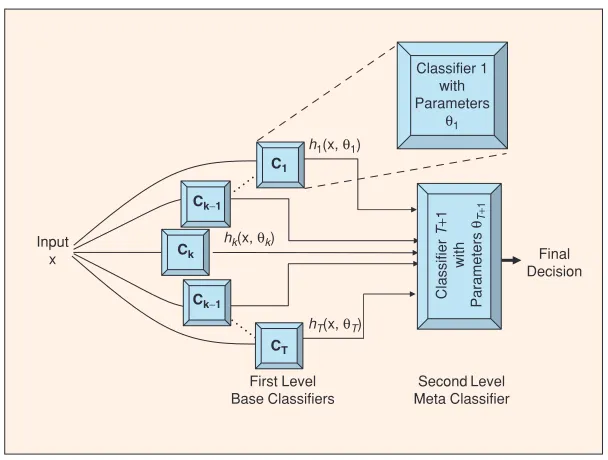
Figure 1:An illustration of a meta-classifier architecture. Image reproduced from Polikar (2006).
4 Experimental Setup
We employed a meta-classifier for our entry, also re-ferred to as classifier stacking. A meta-classifier ar-chitecture is generally composed of an ensemble of base classifiers that each make predictions for all of the input data. Their individual predictions, along with the gold labels are used to train a second-level meta-classifier that learns to predict the final deci-sion for an input, given the decideci-sions of the individ-ual classifiers.
This setup is illustrated in Figure 1. This meta-classifier attempts to learn from the collec-tive knowledge represented by the ensemble of local classifiers. The first step in such a setup is to create the set of base classifiers that form the first layer of the architecture. We describe this process below.
4.1 Ensemble Construction
Our ensemble was created using a set of decision stump classifiers. A decision stump is a decision tree trained using only a single feature (Iba and Langley, 1992); it is usually considered a weak learner.
We used the features listed in Section 3 to create an ensemble of 9 classifiers. Each classifier predicts every input and assigns a probability output to each of the two possible labels.
Classifiers ensembles have proved to an efficient
and robust alternative in other text classification tasks such as language identification (Malmasi and Dras, 2015a) and grammatical error detection (Xi-ang et al., 2015). This motivated us to try this ap-proach in the CWI SemEval task.
4.2 Meta-classifier
For our meta-classifier, we adopted a decision tree with bootstrap aggregating (bagging). The inputs to each decision tree are the two probability outputs from each decision stump in our ensemble, along with the original gold label. 200 bagged decision trees were created using this input. The final label was selected through a plurality voting process over the entire set of bagged decision trees.
4.3 Systems
Using the methods described so far, we created two different systems for the shared task. They are sum-marized next:
• MAZA A:Our first system used only the fre-quency and length features described in Sec-tion 3.1.
• MAZA B:The second system we created com-bined the frequency and length features used in
Rank Team System Accuracy Precision Recall F-score G-score
1 PLUJAGH SEWDFF 0.922 0.289 0.453 0.353 0.608
2 LTG System2 0.889 0.220 0.541 0.312 0.672
3 LTG System1 0.933 0.300 0.321 0.310 0.478
4 MAZA B 0.912 0.243 0.420 0.308 0.575
5 HMC DecisionTree25 0.846 0.189 0.698 0.298 0.765 6 TALN RandomForest SIM.output 0.847 0.186 0.673 0.292 0.750 7 HMC RegressionTree05 0.838 0.182 0.705 0.290 0.766
8 MACSAAR RFC 0.825 0.168 0.694 0.270 0.754
9 TALN RandomForest WEI.output 0.812 0.164 0.736 0.268 0.772
10 UWB All 0.803 0.157 0.734 0.258 0.767
11 PLUJAGH SEWDF 0.795 0.152 0.741 0.252 0.767
12 JUNLP RandomForest 0.795 0.151 0.730 0.250 0.761
13 SV000gg Soft 0.779 0.147 0.769 0.246 0.774
14 MACSAAR NNC 0.804 0.146 0.660 0.240 0.725
15 JUNLP NaiveBayes 0.767 0.139 0.767 0.236 0.767
16 SV000gg Hard 0.761 0.138 0.787 0.235 0.773
17 USAAR entropy 0.869 0.148 0.376 0.212 0.525
18 MAZA A 0.773 0.115 0.578 0.192 0.661
19 BHASHA DECISIONTREE 0.836 0.118 0.387 0.181 0.529
[image:4.612.107.507.56.302.2]20 BHASHA SVM 0.844 0.119 0.363 0.179 0.508
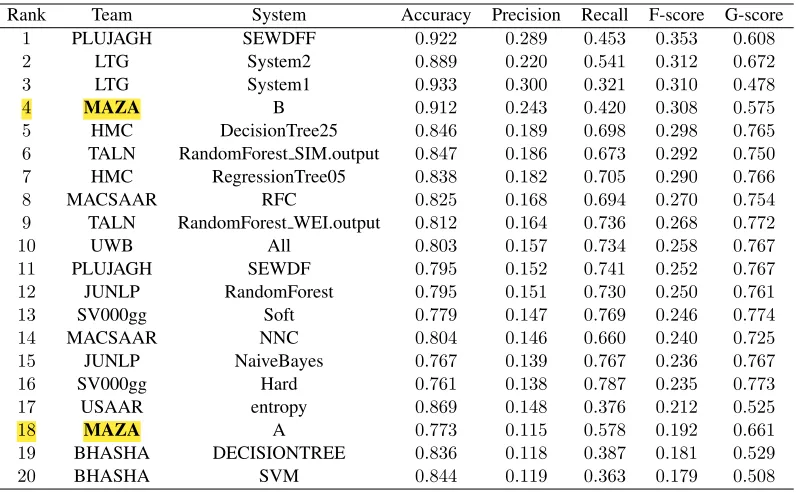
Table 1:The top 20 systems submitted to the shared task, ranked by their F-score.
We expected the systemBto perform better, but we were interested in quantifying the impact of the contextual features on the test set results by the com-paring the two systems.
5 Results
We present in Table 1 the best 20 out of 38 systems ranked by their F-score. We present the results ob-tained in terms of Accuracy, Recall, Precision, F-Score, and G-Score.5 The complete results and more information about the evaluation can be found in the CWI shared task report paper (Paetzold and Specia, 2015).
As expected, our second system,MAZA Bthat in-corporated contextual features along with frequency and length features performed better, ranking in 4th place overall. Our first system, MAZA A obtained performance more than 11 percentage points worse than theBsystem, coming in 18th place.
Our results show that the contextual features we applied in theMAZA Bsubmission are very informa-tive for this task. This suggests that the complexity of a word is strongly tied to the context in which it
5According to the organizers, the G-score is the harmonic
mean between Accuracy and Recall.
is being used and it cannot be solely determined by how frequent or how long the word is.
6 Conclusion
In this paper we described our systems for SemEval 2016 Task 11: Complex Word Identification (CWI). Our best system, MAZA Bwas ranked 4th in terms of F-Score among 38 entries in the shared task. We consider the results we obtained to be very positive given the amount of teams participating in the task.
We applied a meta-classifier approach where each target word is classified by several base classifiers, and another classifier learns to predict the final label using the outputs of those classifiers. Our system’s competitive performance in task suggests that this is a promising approach for this task.
Acknowledgments
We would like to thank the SemEval CWI ers, Gustavo Paetzold and Lucia Specia, for organiz-ing this event. We also thank the anonymous review-ers for their constructive comments.
References
Wayne Iba and Pat Langley. 1992. Induction of one-level decision trees. InProceedings of the ninth inter-national conference on machine learning, pages 233– 240.
Shervin Malmasi and Mark Dras. 2014. Chinese Native Language Identification. InProceedings of EACL. Shervin Malmasi and Mark Dras. 2015a. Language
iden-tification using classifier ensembles. InProceedings of the LT4VarDial Workshop.
Shervin Malmasi and Mark Dras. 2015b. Multilingual Native Language Identification. InNatural Language Engineering.
Gustavo Henrique Paetzold and Lucia Specia. 2015. Se-meval 2016 task 11: Complex word identification. In
Proceedings of SemEval.
Robi Polikar. 2006. Ensemble based systems in deci-sion making. Circuits and Systems Magazine, IEEE, 6(3):21–45.
Luz Rello, Ricardo Baeza-Yates, Laura Dempere-Marco, and Horacio Saggion. 2013. Frequent words improve readability and short words improve understandability for people with dyslexia. InProceedings of INTER-ACT.
Matthew Shardlow. 2013. A comparison of techniques to automatically identify complex words. InProceedings of the ACL Student Research Workshop.
Advaith Siddharthan. 2014. A survey of research on text simplification. ITL-International Journal of Applied Linguistics, 165(2):259–298.
Lucia Specia, Sujay Kumar Jauhar, and Rada Mihalcea. 2012. Semeval-2012 task 1: English lexical simplifi-cation. InProceedings of SemEval.
Liling Tan, Marcos Zampieri, Nikola Ljubeˇsic, and J¨org Tiedemann. 2014. Merging comparable data sources for the discrimination of similar languages: The dsl corpus collection. InProceedings of the BUCC work-shop.
Joel Tetreault, Daniel Blanchard, and Aoife Cahill. 2013. A report on the first native language identification shared task. InProceedings of the BEA Workshop. Yang Xiang, Xiaolong Wang, Wenying Han, and
Qinghua Hong. 2015. Chinese grammatical error di-agnosis using ensemble learning. In Proceedings of the NLP-TEA Workshop.
Liang-Chih Yu, Lung-Hao Lee, and Li-Ping Chang. 2014. Overview of grammatical error diagnosis for learning chinese as a foreign language. In Proceed-ings of ICCE.
Marcos Zampieri and Liling Tan. 2014. Grammatical error detection with limited training data: The case of chinese. InProceedings of ICCE.
Marcos Zampieri, Liling Tan, Nikola Ljubeˇsic, J¨org Tiedemann, and Preslav Nakov. 2015. Overview of the DSL shared task 2015. In Proceedings of the LT4VarDial Workshop.
George Kingsley Zipf. 1935.The Psychobiology of Lan-guage. Houghton Mifflin.