Annotation Projection-based Representation Learning for
Cross-lingual Dependency Parsing
Min Xiao and Yuhong Guo
Department of Computer and Information Sciences Temple University, Philadelphia, PA 19122, USA
{minxiao,yuhong}@temple.edu
Abstract
Cross-lingual dependency parsing aims to train a dependency parser for an annotation-scarce target language by ex-ploiting annotated training data from an annotation-rich source language, which is of great importance in the field of nat-ural language processing. In this paper, we propose to address cross-lingual de-pendency parsing by inducing latent cross-lingual data representations via matrix completion and annotation projections on a large amount of unlabeled parallel sen-tences. To evaluate the proposed learn-ing technique, we conduct experiments on a set of cross-lingual dependency parsing tasks with nine different languages. The experimental results demonstrate the effi-cacy of the proposed learning method for cross-lingual dependency parsing.
1 Introduction
The natural language processing (NLP) commu-nity has witnessed an enormous development of multilingual resources, which draws increasing at-tention to developing cross-lingual NLP adapta-tion systems. Cross-lingual dependency parsing aims to train a dependency parser for a target lan-guage where labeled data is rare or unavailable by exploiting the abundant annotated data from a source language. Cross-lingual dependency pars-ing can effectively reduce the expensive manual annotation effort in individual languages and has been increasingly studied in the multilingual com-munity. Previous works have demonstrated the success of cross-lingual dependency parsing for a variety of languages (Durrett et al., 2012; McDon-ald et al., 2013; T¨ackstr¨om et al., 2013; Søgaard and Wulff, 2012).
One fundamental issue of cross-lingual depen-dency parsing lies in how to effectively transfer the
annotationinformation from the source language domain to the target language domain. Due to the language divergence over the word-level represen-tations and the sentence structures, simply training a monolingual dependency parser on the labeled source language data without adaptation learn-ing will fail to produce a dependency parser that works in the target language domain. To tackle this problem, a variety of works in the literature have designed better algorithms to exploit the an-notated resources in the source languages, includ-ing the cross-linclud-ingual annotation projection meth-ods (Hwa et al., 2005; Smith and Eisner, 2009; Zhao et al., 2009), the cross-lingual direct trans-fer with linguistic constraints methods (Ganchev et al., 2009; Naseem et al., 2010; Naseem et al., 2012), and the cross-lingual representation learn-ing methods (Durrett et al., 2012; T¨ackstr¨om et al., 2012; Zhang et al., 2012).
In this work, we propose a novel representation learning method to address cross-lingual depen-dency parsing, which exploits annotation projec-tions on a large amount of unlabeled parallel sen-tences to induce latent cross-lingual features via matrix completion. It combines the advantages of the cross-lingual annotation projection meth-ods, which project labeled information into the tar-get language domain, and the cross-lingual rep-resentation learning methods, which learn latent interlingual features. Specifically, we first train a dependency parser on the labeled source lan-guage data and use it to infer labels for the un-labeled source language sentences of the parallel resources. We then project the annotations from the source language to the target language via the word alignments on the parallel sentences. Af-terwards, we define a set of interlingual features and construct a word-feature matrix by associat-ing each word with these language-independent features. We then use the original labeled source language data and the predicted (or projected)
beled information on the parallel sentences to fill in the observed entries of the word-feature matrix, while matrix completion is performed to fill the remaining missing entries. The completed word-feature matrix provides a set of consistent cross-lingual representation features for the words in both languages. We use these features as augment-ing features to train a dependency parsaugment-ing system on the labeled data in the source language and per-form prediction on the test sentences in the tar-get language. To evaluate the proposed learning method, we conduct experiments on eight cross-lingual dependency parsing tasks with nine differ-ent languages. The experimdiffer-ental results demon-strate the superior performance of the proposed cross-lingual transfer learning method, comparing to other approaches.
2 Related Work
A variety of cross-lingual dependency parsing methods have been developed in the literature. We provide a brief review over the related works in this section.
Much work developed in the literature is based on annotation projection (Hwa et al., 2005; Liu et al., 2013; Smith and Eisner, 2009; Zhao et al., 2009). Basically, they exploit parallel sentences and first project the annotations of the source guage sentences to the corresponding target lan-guage sentences via the word level alignments. Then, they train a dependency parser in the target language by using the target language sentences with projected annotations. The performance of annotation projection-based methods can be af-fected by the quality of word-level alignments and the specific projection schema. Therefore, Hwa et al. (2005) proposed to heuristically correct or modify the projected annotations in order to in-crease the projection performance while Smith and Eisner (2009) used a more robust tion method, quasi-synchronous grammar projec-tion, to address cross-lingual dependency parsing. Moreover, Liu et al. (2013) proposed to project the discrete dependency arcs instead of the treebank as the training set. These works however assume that the parallel sentences are already available, or can be obtained by using free machine translation tools. Instead, Zhao et al. (2009) considered the cost of machine translation and used a bilingual lexicon to obtain a translated treebank with pro-jected annotations from the source language.
A number of works are developed based on representation learning (Durrett et al., 2012; T¨ackstr¨om et al., 2012; Zhang et al., 2012; Xiao and Guo, 2014). In general, these methods first au-tomatically learn some language-independent fea-tures and then train a dependency parser in this interlingual feature space with labeled data in the source language and apply it on the data in the tar-get language. Durrett et al. (2012) used a bilingual lexicon, which can be manually constructed or in-duced on parallel sentences, to learn language-independent projection features for cross-lingual dependency parsing. T¨ackstr¨om et al. (2012) used unlabeled parallel sentences to induce cross-lingual word clusterings and used these word clus-terings as interlingual features. Both (Durrett et al., 2012) and (T¨ackstr¨om et al., 2012) assumed that the twelve universal part-of-speech (POS) tags (Petrov et al., 2012) are available and used them as the basic interlingual features. Moreover, Zhang et al. (2012) proposed to automatically map language-specific POS tags to universal POS tags to address cross-lingual dependency parsing, in-stead of using the manually defined mapping rules. Recently, Xiao and Guo (2014) used a set of bilin-gual word pairs as pivots to learn interlinbilin-gual dis-tributed word representations via deep neural net-works as augmenting features for cross-lingual de-pendency parsing.
Some other works are proposed based on mul-tilingual linguistic constraints (Ganchev et al., 2009; Gillenwater et al., 2010; Naseem et al., 2010; Naseem et al., 2012). Basically, they first construct a set of linguistic constrains and then train a dependency parsing system by incorporat-ing the lincorporat-inguistic constraints via posterior regular-ization. The constraints are expected to bridge the language differences. Ganchev et al. (2009) au-tomatically learned the constraints by using par-allel data while some other works manually con-structed them by using the universal dependency rules (Naseem et al., 2010) or the typological fea-tures (Naseem et al., 2012).
3 Proposed Approach
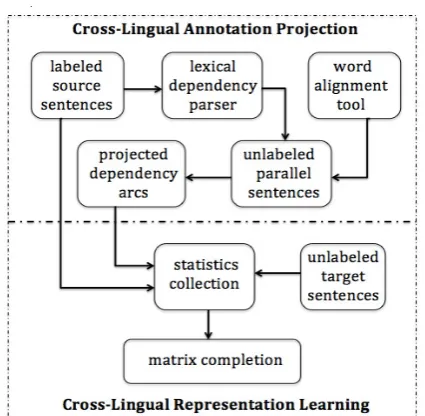
Figure 1: The architecture of the proposed cross-lingual representation learning framework, which consists of two steps, cross-lingual annotation pro-jection and cross-lingual representation learning.
We consider the following cross-lingual depen-dency parsing setting. We have a large amount of labeled sentences in the source language and a set of unlabeled sentences in the target language. In addition, we also have a large set of auxiliary unlabeled parallel sentences across the two lan-guages. We aim to learn interlingual feature rep-resentations such that a dependency parser trained in the source language sentences can be applied in the target language domain. The framework for the proposed cross-lingual representation learn-ing system is given in Figure 1. The system has two steps: cross-lingual annotation projection and cross-lingual representation learning. We present each of the two steps below.
3.1 Cross-Lingual Annotation Projection
In the first step, we employ a large amount of un-labeled parallel sentences to transfer dependency relations from the source language to the target language. We first train a lexicalized dependency parser with the labeled training data in the source language. Then we use this parser to produce parse trees on the source language sentences of the auxiliary parallel data. Simultaneously, we perform word-level alignments on the unlabeled parallel sentences using existing alignment tools. Finally, we project the predicted dependency re-lations of the source language sentences to their
Figure 2: An example of cross-lingual annotation projection, where a partial word-level alignment is shown to demonstrate two cases of annotation projection.
parallel counterparts in the target language via the word-level alignments. Instead of projecting the whole dependency trees, which requires more so-phisticated algorithms, we simply project each de-pendency arc on the source sentences to the target language side.
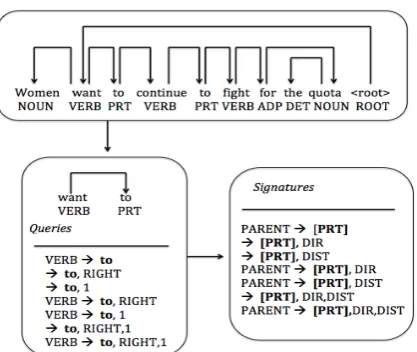
[image:3.595.315.521.65.177.2]Figure 3: Example of how to collect queries for each specific dependency relation and how to ob-tain the abstract signatures (adapted from (Durrett et al., 2012)).
words onto the target language words. Since the word order for each aligned word pair in parallel sentences can be different, we recalculate the de-pendency direction and the dede-pendency distance for the projected dependency arc instance. Note the example in Figure 2 only shows a partial word-level alignment to demonstrate the two cases of the annotation projection. The word alignment tool can align more words than shown in the example.
3.2 Cross-Lingual Representation Learning
After cross-lingual annotation projection, we have a set of projected dependency arc instances in the target language. However, the sentences in the target language are not fully labeled. De-pendency relation related features are not readily available for all the words in the target language domain. Hence, in this step, we first generate a set of interlingual features and then automatically fill the missing feature values for the target language words with matrix completion based on the pro-jected feature values.
3.2.1 Generating Interlingual Features
We use the signature method in (Durrett et al., 2012) to construct a set of interlingual features
for the words in the source and target language domains . The signatures proposed in (Dur-rett et al., 2012) for dependency parsing are universal across different languages, and have numerical values that are computed in specific dependency relations. Here we illustrate the
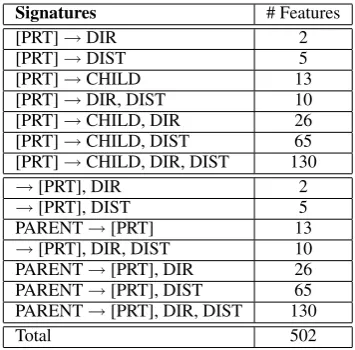
signature generation process by using an example in Figure 3, which is adapted from (Durrett et al., 2012). Note for each dependency relation between a parent (also known as the head) word and a child (also known as the dependent) word, we can collect a number of queries based on the dependency properties. For example, given the dependency arc between “want” and “to” in the English sentence in Figure 3, and assuming we consider the child word “to”, we produce queries by considering a non-empty subset of the dependency properties (the parent POS, the dependency direction, the dependency distance), which provides us 7 queries: “VERB→to”, “→to, RIGHT”, “→to, 1”, “VERB →to, RIGHT”, “VERB→to, 1”, “→to, RIGHT, 1”, “VERB→to, RIGHT, 1”, where VERB is the parent POS tag, RIGHT is the dependency direction and 1 is the dependency distance. Then we can abstract the specific queries to generate the signatures by replacing the considered word (“to”) with its POS tag (“PRT”), and replacing the parent POS tag with “PARENT”, the specific dependency distance with “DIST” and the dependency direc-tion with “DIR”. This produces the following 7 signatures: “PARENT→[PRT]”, “→[PRT], DIR”, “→[PRT], DIST”, “PARENT→[PRT], DIST”, “PARENT→[PRT], DIST”, “→[PRT], DIR, DIST”, and “PARENT→[PRT], DIR, DIST”, where the brackets indicate the POS tags are for the considered word. Similarly, we can perform the same abstraction process for the parent word “want” and get another 7 signatures (see Table 1). Since each signature contains one POS tag and there are 13 different POS types (12 universal POS tags and 1 special type for the “<root>” word), we can get a total of7×2×13 = 182
signatures. These signatures are independent of specific languages, though their numerical values should be computed in a specific dependency relation for each considered target word.
Signatures # Features
[PRT]→DIR 2
[PRT]→DIST 5
[PRT]→CHILD 13
[PRT]→DIR, DIST 10
[PRT]→CHILD, DIR 26
[PRT]→CHILD, DIST 65
[PRT]→CHILD, DIR, DIST 130
→[PRT], DIR 2
→[PRT], DIST 5
PARENT→[PRT] 13
→[PRT], DIR, DIST 10
PARENT→[PRT], DIR 26
PARENT→[PRT], DIST 65 PARENT→[PRT], DIR, DIST 130
[image:5.595.92.270.61.236.2]Total 502
Table 1: The number of induced “features” of each signature for a given word.
DIST” can be instantiated into 5 features since DIST has 5 different values ({1, 2, 3–5, 6–10, 11+}), and its signature “[PRT]→CHILD” can be instantiated into 13 features since CHILD denotes the child word’s POS tags and can have 13 differ-ent values. Hence as shown in Table 1, we can get 502 features from the 14 signatures.
3.2.2 Learning Feature Values with Matrix Completion
The signature-based 502 interlingual features to-gether with the 13 universal POS tag features can be used aslanguage independent features for all the words in the vocabulary constructed across the source and target language domains. In particular, we can form a word-featurematrix with the con-structed vocabulary and the total 515 language in-dependent features. For each word that appeared in the dependency relation arcs, we can use the number of appearances of its interlingual features as the corresponding feature values. However, the sentences in the target language are not fully la-beled. Some words in the target language domain may not be observed in the projected dependency arc instances, and we cannot compute their feature values for the 502 interlingual features, though the 13 universal POS tag features are available for all words. Moreover, since we only have a limited number of projected dependency arc instances in the target language, even for some target words that appeared in the projected arc instances of the parallel data, we may only observe a subset of features among the total 502 interlingual features, with the rest features missing. Hence the con-structedword-feature matrix is only partially
ob-Figure 4: The word-feature matrix. There are three parts of words: the source language words, target language words from the projected depen-dency arc instances, and additional target language words. The signature features are the 502 interlin-gual features and the POS features are the 13 uni-versal POS tags. Solid lines indicate observed tries, dashed lines indicate partially observed en-tries, while empty indicates missing entries.
served, as shown in Figure 4. Furthermore, there could also be some noise in the observed feature values as some word features may not have re-ceived sufficient observations.
To solve the missing feature problem and si-multaneously perform data denoising, we exploit a feature correlation assumption: the 502 con-structed interlingual features and the 13 univer-sal POS tags are not mutually independent; they usually contain a lot statistical correlation infor-mation. For example, for a word “want” with POS tag “VERB”, its feature value for “VERB→
[image:5.595.324.506.63.202.2]fea-ture values in our word-feafea-ture matrix and perform denoising through low-rank matrix completion.
LetM0 ∈ Rn×k denote the partially observed
word-feature matrix in Figure 4, where n is the number of words and k is the dimensionality of the feature set, which is 515 in this study. Let Ω
denote the set of indices for the observed entries. Hence for each observed entry (i, j) ∈ Ω, M0
ij
contains the frequency collected for the j-th fea-ture of the i-th word. We then formulate matrix completion as the following optimization problem to recover a full matrixM from the partially ob-served matrixM0:
min
M≥0γkMk∗+αkMk1,1+
X
(i,j)∈Ω
(Mij−Mij0)2 (1)
where the trace normkMk∗enforces the low-rank
property of the matrix, and kMk1,1 denotes the
entrywise L1 norm. Since many words usually only have observed values for a small subset of the 502 interlingual features due to the simple fact that they are only associated with very few POS tags, a fully observed word-feature matrix is typically sparse and contains many zero entries. Hence we use the L1 norm regularizer to encode the spar-sity of the matrixM. The nonnegativity constraint
M ≥0encodes the fact that our frequency based feature values in the word-feature matrix are all nonnegative. The minimization problem in Eq (1) can be solved using a standard projected gradient descent algorithm (Xiao and Guo, 2013).
3.3 Cross-Lingual Dependency Parsing
After matrix completion, we can get a set of in-terlingual features for all the words in the word-feature matrix. We then use the interlingual fea-tures for each word as augmenting feafea-tures and train a delexicalized dependency parser on the la-beled sentences in the source language. The parser is then applied to perform prediction on the test sentences in the target language, which are also delexicalized and augmented with the interlingual features.
4 Experiments
4.1 Datasets
We used the multilingual dependency parsing dataset from the CoNLL-X shared tasks (Buch-holz and Marsi, 2006; Nivre et al., 2007) and ex-perimented with nine different languages: Dan-ish (Da), Dutch (Nl), EnglDan-ish (En), German (De),
Greek (El), Italian (It), Portuguese (Pt), Span-ish (Es) and Swedish (Sv). For each language, the original dataset contains a training set and a test set. We constructed eight cross-lingual de-pendency parsing tasks, by using English as the label-rich source language and using each of the other eight languages as the label-poor target lan-guage. For example, the taskEn2Da means that we used English sentences as the source language data and Danish sentences as the target language data. For each task, we used the original training set in English as the labeled source language data, and used the original training set in the target lan-guage as unlabeled training data and the original test set in the target language as test sentences. Each sentence from the dataset is labeled with gold standard POS tags. We manually mapped these language-specific POS tags to 12 univer-sal POS tags: NOUN (nouns), NUM (numerals), PRON (pronouns), ADJ (adjectives), ADP (prepo-sitions or postpo(prepo-sitions), ADV (adverbs), CONJ (conjunctions), DET (determiners), PRT (parti-cles), PUNC (punctuation marks), VERB (verbs) and X (for others).
We used the unlabeled parallel sentences from the European parliament proceedings parallel corpus (Koehn, 2005), which contains parallel sentences between multiple languages, as auxil-iary unlabeled parallel sentences in our experi-ments. For the representation learning over each cross-lingual dependency parsing task, we used all the parallel sentences for the given language pair from this corpus. The number of parallel sen-tences for the eight language pairs ranges from
1,235,976 to1,997,775, and the number of to-kens involved in these sentences in each language ranges from31,929,703to50,602,994.
4.2 Representation Learning
Basic Conj with dist Conj with dir Conj with dist and dir
upos h dist, upos h dir, upos h dist, dir, upos h upos d dist, upos d dir, upos d dist, dir, upos d
upos h, upos d, dist, upos h, upos d dir, upos h, upos d dist, dir, upos h, upos d
Table 2: Feature templates for training a basic delexicalized dependency parser. uposstands for the universal POS tag, h stands for the head word, d stands for the dependent word, dist stands for the dependency distance, which has five values{1,2,3−5,6−10,11+}, anddirstands for the dependency direction, which has two values{left, right}.
Tasks Delex Proj1Wikitionary∇ DNN ∇ Proj2 ∇ Parallel DataRLAP ∇ X-lingual
[image:7.595.102.495.62.119.2]En2Da 36.5 41.3 4.8 42.6 6.1 42.9 6.4 43.6 7.1 38.7 En2De 46.2 49.2 3.0 49.5 3.3 49.7 3.5 50.5 4.3 50.7 En2El 61.5 62.4 0.9 63.0 1.5 63.5 2.0 64.3 2.8 63.0 En2Es 52.1 54.5 2.4 55.7 3.6 56.2 4.1 56.3 4.2 62.9 En2It 56.4 57.7 1.3 59.1 2.7 59.2 2.8 60.4 4.0 68.8 En2Nl 62.0 64.4 2.4 65.1 3.1 64.9 2.9 66.1 4.1 54.3 En2Pt 68.7 71.5 2.8 72.4 3.7 71.9 3.2 72.8 4.1 71.0 En2Sv 57.8 61.0 3.2 61.9 4.1 62.9 5.1 63.7 5.9 56.9 Average 55.2 57.8 2.6 58.7 3.5 58.9 3.8 59.7 4.6 58.3
Table 3: Comparison results in terms of unlabeled attachment score (UAS) for the eight cross-lingual dependency parsing tasks (English is used as the source language). The evaluation results are on all the test sentences. TheDelex method uses no auxiliary resource, Proj1andDNNuse Wikitionary as auxiliary resource,Proj2, RLAP, andX-lingualuse parallel sentences as auxiliary resources. ∇denotes the improvements of each method over the baselineDelexmethod. The bottom row contains the average results over the eight tasks.
sentences by using the Berkeley alignment tool (Liang et al., 2006). With the word alignments, we then projected the predicted dependency rela-tions from the source language sentences of the parallel data to the target language side, which produces a set of dependency arc instances in the target language. Finally, we constructed the par-tially observed word-feature matrix from these la-beled data and conducted matrix completion to re-cover the whole matrix. For matrix completion, we used the first task En2Da to perform param-eter selection based on the test performance. We selectedγ from{0.1,1,10}and selected α from
{103,104,105}. The selected values γ = 1 and α= 10−4were then used for all the experiments.
4.3 Experimental Results
4.3.1 Test Results on All the Test Sentences
We first compared the proposed representa-tion learning with annotarepresenta-tion projecrepresenta-tion method,
RLAP, to the following methods in our
experi-ments: Delex, Proj1, Proj2, DNNandX-lingual. TheDelexmethod is a baseline method, which re-places the language-specific word sequence with the universal POS tag sequence and then trains a delexicalized dependency parser. We listed the feature templates used in this baseline delexical-ized dependency parser in Table 2. The Proj1
andProj2methods are from (Durrett et al., 2012). Durrett et al. (2012) proposed to use bilingual lex-icon to learn cross-lingual features and provided two ways to construct the bilingual lexicon, one is based on Wikitionary and the other is based on unlabeled parallel sentences with observed word-level alignments. We used these two ways sepa-rately to construct the bilingual lexicon between the languages for learning cross-lingual features, which are then used as augmenting features for training delexicalized dependency parsers. We denote the Wikitionary-based method as Proj1
Tasks Delex Proj2 ∇ RLAP ∇ USR PGI PR MLC
En2Da 46.7 54.6 7.9 55.7 9.0 51.9 41.6 44.0 -En2De 62.0 63.0 1.0 64.0 2.0 - - 39.6 62.8 En2El 60.9 61.9 1.0 63.2 2.3 - - - 61.4 En2Es 55.2 58.3 3.1 59.6 4.4 67.2 58.4 62.4 57.3 En2It 55.5 56.9 1.4 58.3 2.8 - - - 56.2 En2Nl 60.3 62.5 2.2 63.7 3.4 - 45.1 37.9 62.0 En2Pt 80.2 84.5 4.3 85.7 5.5 71.5 63.0 47.8 83.8 En2Sv 73.4 76.0 2.6 76.4 3.0 63.3 58.3 42.2 74.9 Average 61.8 64.7 2.9 65.8 4.1 - - -
-Table 4: Comparison results on the short test sentences with length of 10 or less in terms of unlabeled attachment score (UAS).∇denotes the improvements of each method over the baselineDelexmethod.
# of Labeled Target Instances
0 500 1000 1500
UAS 35 36 37 38 39 40 41 42 43 44 En2Da Delex Proj2 RLAP
# of Labeled Target Instances
0 500 1000 1500
UAS 45 46 47 48 49 50 51 En2De Delex Proj2 RLAP
# of Labeled Target Instances
0 500 1000 1500
UAS 60 60.5 61 61.5 62 62.5 63 63.5 64 64.5 65 En2El Delex Proj2 RLAP
# of Labeled Target Instances
0 500 1000 1500
UAS 51 52 53 54 55 56 57 En2Es Delex Proj2 RLAP
# of Labeled Target Instances
0 500 1000 1500
UAS 55 56 57 58 59 60 61 En2It Delex Proj2 RLAP
# of Labeled Target Instances
0 500 1000 1500
UAS 60 61 62 63 64 65 66 67 En2Nl Delex Proj2 RLAP
# of Labeled Target Instances
0 500 1000 1500
UAS 67 68 69 70 71 72 73 En2Pt Delex Proj2 RLAP
# of Labeled Target Instances
0 500 1000 1500
[image:8.595.116.484.62.204.2]UAS 56 57 58 59 60 61 62 63 64 En2Sv Delex Proj2 RLAP
Figure 5: Unlabeled attachment score (UAS) on the whole test sentences in the target language by varying the number of labeled training sentences in the target language.
2014), uses Wikitionary to construct bilingual word pairs and then uses a deep neural network to learn interlingual word embeddings as augment-ing features for trainaugment-ing delexicalized dependency parsers. TheX-lingualmethod uses unlabeled par-allel sentences to induce cross-lingual word clus-ters as augmenting features for delexicalized de-pendency parser (T¨ackstr¨om et al., 2012). For X-lingual, we cited its results reported in its original paper. For other methods, we used the MSTParser (McDonald et al., 2005) as the underlying depen-dency parsing tool. To train the MSTParser, we set the number of maximum iterations for the per-ceptron training as 10 and set the number of best-k dependency tree candidates as 1.
We evaluated the empirical performance of each comparison method on all the test sentences. The comparison results on the eight cross-lingual de-pendency parsing tasks in terms of unlabeled at-tachment score (UAS) are reported in Table 3. We can see that the baseline method,Delex, performs
poorly across the eight tasks. This is not surprising since the sequence of universal POS tags are not discriminative enough for the dependency parsing task. Note even for two sentences with the exact same sequence of POS tags, they may have differ-ent dependency trees. By using auxiliary bilingual word pairs via Wikitionary, the two cross-lingual representation learning methods,Proj1andDNN, outperformDelex across all the eight tasks. Be-tween these two methods,DNNconsistently out-performs Proj1, which suggests the interlingual word embeddings induced by deep neural net-works are very effective. By using unlabeled par-allel sentences as an auxiliary resource, the two methods, Proj2 and RLAP, consistently outper-form the baseline Delexmethod, whileX-lingual
outperformsDelexon six tasks. Moreover,Proj2
[image:8.595.86.513.263.415.2]a stronger auxiliary resource than the free Wiki-tionary. Our proposed approach,RLAP, which has the capacity of exploiting the unlabeled parallel sentences, consistently outperforms the four com-parison methods, Delex, Proj1, DNN and Proj2, across all the eight tasks. It also outperforms the
X-lingualmethod on five tasks. The average UAS over all the eight tasks for the RLAP method is 1.4 higher than the X-lingual method. All these results demonstrated the effectiveness of the pro-posed representation learning method for cross-lingual dependency parsing.
4.3.2 Test Results on Short Test Sentences
We also conducted empirical evaluations on short test sentences (with length of 10 or less). We comparedDelex, Proj2andRLAPwith four other methods, USR, PGI, PR and MLC. The USR
method is a cross-lingual direct transfer method which uses universal dependency rules to con-struct linguistic constraints (Naseem et al., 2010). ThePGImethod is a phylogenetic grammar induc-tion model (Berg-Kirkpatrick and Klein, 2010). The PR method is a posterior regularization ap-proach (Gillenwater et al., 2010). The MLC
method is the multilingual linguistic constraints-based method which uses typological features for cross-lingual dependency parsing (Naseem et al., 2012). Here we used this method in our setting with only one source domain. Moreover, since we do not have typological features for Danish, we did not conduct experiment on the first task with
MLC. For the methods ofUSR, PGI andPR, we cited their results reported in their original papers. All the cited results are also produced on the short sentences of the CoNLL-X shard task dataset. We cited them as references on measuring the progress of cross-lingual dependency parsing on each given target language.
The comparison results are reported in Table 4. We can see that the results on the short test sen-tences are in general better than on the whole test set (in Table 3) for the same method across most tasks. This suggests that it is easier to infer the dependency tree for a short sentence than for a long sentence. Nevertheless, Proj2 consistently outperformsDelexandRLAPconsistently outper-formsProj2across all the tasks. Moreover,RLAP
achieves the highest test scores in seven out of the eight cross-lingual tasks among all the compari-son systems. This again demonstrated the efficacy of the proposed approach for cross-lingual
depen-dency parsing.
4.4 Impact of Labeled Training Data in Target Language
We have also conducted experiments for the learn-ing scenarios where a small set of labeled train-ing sentences from the target language is available. Specifically, we conducted experiments with a few different numbers of additional labeled training sentences from the target language, {500, 1000, 1500}, using three methods, RLAP, Delex and
Proj2. The comparison results on all the test sen-tences are reported in Figure 5. We can see that the performance of all three methods increases very slow but in a similar trend with more additional la-beled training instances from the target language. However, bothProj2andRLAPoutperformDelex
with large margins across all experiments. More-over, the proposed method, RLAP, produces the best results across all the eight tasks. The results again verified the efficacy of the proposed method, demonstrated that filling the missing feature val-ues with matrix completion is indeed useful.
5 Conclusion
In this paper, we proposed a novel representation learning method with annotation projection to ad-dress cross-lingual dependency parsing. The pro-posed approach exploits unlabeled parallel sen-tences and combines cross-lingual annotation pro-jection and matrix completion-based interlingual feature learning together to automatically induce a set of language-independent numerical features. We used these interlingual features as augmenting features to train a delexicalized dependency parser on the labeled sentences in the source language and tested it in the target language domain. Our experimental results on eight cross-lingual depen-dency parsing tasks showed the proposed repre-sentation learning method outperforms a number of comparison methods.
Acknowledgments
This research was supported in part by NSF grant IIS-1065397.
References
S. Buchholz and E. Marsi. 2006. CoNLL-X shared task on multilingual dependency parsing. InProc. of the Conference on Computational Natural Lan-guage Learning (CoNLL).
R. Cabral, F. Torre, J. Costeira, and A. Bernardino. 2011. Matrix completion for multi-label image clas-sification. InAdvances in Neural Information Pro-cessing Systems (NIPS).
R. Collobert, J. Weston, L. Bottou, M. Karlen, K. Kavukcuoglu, and P. Kuksa. 2011. Natural lan-guage processing (almost) from scratch. J. of Ma-chine Learning Research (JMLR), 12:2493–2537. G. Durrett, A. Pauls, and D. Klein. 2012.
Syntac-tic transfer using a bilingual lexicon. In Proc. of the Joint Conference on Empirical Methods in ural Language Processing and Computational Nat-ural Language Learning (EMNLP-CoNLL). K. Ganchev, J. Gillenwater, and B. Taskar. 2009.
De-pendency grammar induction via bitext projection constraints. InProc. of the Joint Conference of the Annual Meeting of the ACL and the International Joint Conference on Natural Language Processing of the AFNLP (ACL-IJCNLP).
J. Gillenwater, K. Ganchev, J. Grac¸a, F. Pereira, and B. Taskar. 2010. Sparsity in dependency grammar induction. In Proc. of the Annual Meeting of the Association for Computational Linguistics (ACL). R. Hwa, P. Resnik, A. Weinberg, C. Cabezas, and
O. Kolak. 2005. Bootstrapping parsers via syntactic projection across parallel texts. Natural Language Engineering, 11:11–311.
P. Koehn. 2005. Europarl: A Parallel Corpus for Sta-tistical Machine Translation. In Proc. of the Ma-chine Translation Summit.
P. Liang, B. Taskar, and D. Klein. 2006. Alignment by agreement. In Proc. of the Conference on Hu-man Language Technology Conference of the North American Chapter of the Association of Computa-tional Linguistics (NAACL).
K. Liu, Y. L¨u, W. Jiang, and Q. Liu. 2013. Bilingually-guided monolingual dependency parsing grammar induction. In Proc. of the Conference on Annual Meeting of the Association for Computational Lin-guistics (ACL).
R. McDonald, K. Crammer, and F. Pereira. 2005. Online large-margin training of dependency parsers. In Proc. of the Annual Meeting on Association for Computational Linguistics (ACL).
R. McDonald, J. Nivre, Y. Quirmbach-Brundage, Y. Goldberg, D. Das, K. Ganchev, K. Hall, S. Petrov, H. Zhang, O. T¨ckstr¨om, C. Bedini, N. Castell´o, and J. Lee. 2013. Universal dependency annotation for multilingual parsing. InProc. of the Annual Meeting on Association for Comput. Linguistics (ACL).
T. Naseem, H. Chen, R. Barzilay, and M. Johnson. 2010. Using universal linguistic knowledge to guide grammar induction. InProc. of the Conference on Empirical Methods in Natural Language Processing (EMNLP).
T. Naseem, R. Barzilay, and A. Globerson. 2012. Se-lective sharing for multilingual dependency parsing. InProc. of the Annual Meeting of the Association for Computational Linguistics (ACL).
J. Nivre, J. Hall, S. K¨ubler, R. McDonald, J. Nilsson, S. Riedel, and D. Yuret. 2007. The CoNLL 2007 shared task on dependency parsing. InProc. of the Joint Conference on Empirical Methods in Natural Language Processing and Computational Natural Language Learning (EMNLP-CoNLL).
S. Petrov, D. Das, and R. McDonald. 2012. A uni-versal part-of-speech tagset. InProc. of the Interna-tional Conference on Language Resources and Eval-uation (LREC).
D. Smith and J. Eisner. 2009. Parser adaptation and projection with quasi-synchronous grammar fea-tures. InProc. of the Conf. on Empirical Methods in Natural Language Processing (EMNLP). A. Søgaard and J. Wulff. 2012. An empirical study of
non-lexical extensions to delexicalized transfer. In Proc. of the Conference on Computational linguis-tics (COLING).
O. T¨ackstr¨om, R. McDonald, and J. Uszkoreit. 2012. Cross-lingual word clusters for direct transfer of lin-guistic structure. In Proc. of the Conference of the North American Chapter of the Association for Computational Linguistics: Human Language Tech-nologies (NAACL).
O. T¨ackstr¨om, R. McDonald, and J. Nivre. 2013. Tar-get language adaptation of discriminative transfer parsers. InProc. of the Conf. of the North American Chapter of the Association for Comput. Linguistics: Human Language Technologies (NAACL).
M. Xiao and Y. Guo. 2013. A novel two-step method for cross language representation learning. In Ad-vances in Neural Inform. Process. Systems (NIPS). M. Xiao and Y. Guo. 2014. Distributed word
represen-tation learning for cross-lingual dependency parsing. InProceedings of the Conference on Computational Natural Language Learning (CoNLL).
Y. Zhang, R. Reichart, R. Barzilay, and A. Globerson. 2012. Learning to map into a universal pos tagset. InProc. of the Joint Conf. on Empirical Methods in Natural Language Processing and Comput. Natural Language Learning (EMNLP-CoNLL).