Multi-source morphosyntactic tagging for Spoken Rusyn
Yves Scherrer Department of Linguistics
University of Geneva Switzerland
Achim Rabus
Department of Slavonic Studies University of Freiburg
Germany
achim.rabus@
slavistik.uni-freiburg.de
Abstract
This paper deals with the development of morphosyntactic taggers for spoken va-rieties of the Slavic minority language Rusyn. As neither annotated corpora nor parallel corpora are electronically avail-able for Rusyn, we propose to com-bine existing resources from the etymo-logically close Slavic languages Russian, Ukrainian, Slovak, and Polish and adapt them to Rusyn. Using MarMoT as tagging toolkit, we show that a tagger trained on a balanced set of the four source languages outperforms single language taggers by about 9%, and that additional automat-ically induced morphosyntactic lexicons lead to further improvements. The best ob-served accuracies for Rusyn are 82.4% for part-of-speech tagging and 75.5% for full morphological tagging.
1 Introduction
This paper addresses the development of mor-phosyntactic taggers for spoken varieties of the Slavic minority language Rusyn by leveraging the resources available for the neighboring, etymolog-ically related languages. Due to the lack of anno-tated and parallel Rusyn data, we propose to create Rusyn taggers by combining training data from re-lated resource-richer languages such as Ukrainian, Polish, Slovak and Russian.
We start by giving a brief introduction to the characteristics of Rusyn and present related work in the domain of low-resource language tagging. After describing the training and test data, we present a set of experiments on different multi-source tagging approaches. In particular, we in-vestigate the impact of majority voting, Brown clustering, training corpus adaptation, and the
ad-dition of automatically induced morphosyntactic lexicons. Finally, we give an outlook on future work.
2 Status of Rusyn and corpus data
Rusyn is a Slavic linguistic variety spoken pre-dominantly in Transcarpathian Ukraine, Eastern Slovakia, and Southeastern Poland, and is lin-guistically close to the Ukrainian language. Its sociolinguistic status is disputed insofar as some scholars see Rusyn as a dialect of Ukrainian, oth-ers claim it to be an independent – the fourth East Slavic – language. Despite its closeness to Ukrainian, Rusyn exhibits numerous distinct features on all linguistic levels, which make Rusyn look more “West Slavic” as compared to Ukrainian.1
Nowadays, most speakers of Rusyn are bilin-gual and have native-like command of, e.g., Pol-ish or Slovak. This has an impact on their Rusyn speech and leads to new divergences within the old Rusyn dialect continuum, which can be investigated using the Corpus of Spoken Rusyn (www.russinisch.uni-freiburg. de/corpus) that is currently in the process of be-ing built up. The corpus comprises several hours of transcribed Rusyn speech from the different coun-tries where Rusyn is spoken. This means that both diatopic and individual speaker variation is reflected in the transcription, which is one reason for the fact that the corpus data is orthographi-cally (and morphologiorthographi-cally) heterogeneous. An-other reason is that variation in transcription prac-tices due to several individual transcribers could not completely be avoided.
The goal of the research presented here is to au-tomatically provide morphosyntactic annotations
1For further details on the status and the features of Rusyn
see, e.g., Magocsi (2004), Plishkova (2009), Pugh (2009), Skrypnyk (2013), Teutsch (2001).
PL Na początku było Słowo a Słowo było u Boga, i Bogiem było Słowo. Cyrillicized На почутку было Слово а Слово было у Бога, и Богем было Слово.
RU В начале было Слово, и Слово было у Бога, и Слово было Богом.
SK Na počiatku bolo Slovo a Slovo bolo u Boha a Boh bol to Slovo. Cyrillicized На почиатку боло Слово а Слово боло у Бога а Бог бол то Слово.
UK На початку було Слово, а Слово в Бога було, і Бог було Слово.
RUE На початку было Слово, а Слово было у Бога, і Бог было Слово.
Figure 1: John 1:1 in the Slavic languages used for the experiments.
for the Corpus of Spoken Rusyn. However, there are virtually no NLP resources (annotated cor-pora or tools) available for Rusyn at the moment. The different types of variation present in the data complicate the task of developing NLP tools even more. Crucially, there is no parallel corpus available for Rusyn, which means that the popu-lar projection-based approaches cannot be applied (see below).
Considering the lack of annotated Rusyn data and the etymological situation of Rusyn, our ap-proach consists in training taggers for several re-lated languages – namely, the East Slavic lan-guages Ukrainian and Russian and the West Slavic languages Polish and Slovak – and combining and adapting them to Rusyn. This multi-source setting makes sense, because the Rusyn dialect continuum features both West Slavic and East Slavic linguis-tic traits to a different extent, depending on both the dialect region and the impact of the respective umbrella language. In order to get an idea of the similarities and differences of the Slavic languages involved, compare the different versions of John 1:1 in Figure 1.
3 Related work
The task of creating taggers for languages lack-ing manually annotated trainlack-ing corpora has in-spired a lot of recent research. The most popu-lar line of work, initiated by Yarowsky and Ngai (2001), draws on parallel corpora. They annotate the source side of a parallel corpus with an ex-isting tagger, and then project the tags along the word alignment links onto the target side of the parallel corpus. A new tagger is then trained on the target side, with some smoothing to reduce the noise caused by alignment errors. Follow-up work has focused on the inclusion of several source lan-guages (Fossum and Abney, 2005), more
accu-rate projection algorithms (Das and Petrov, 2011; Duong et al., 2013), the integration of external lex-icon sources (Li et al., 2012; Täckström et al., 2013), the extension from part-of-speech tagging to full morphological tagging (Buys and Botha, 2016), and the investigation of truly low-resource settings by resorting to Bible translations (Agić et al., 2015). A related approach (Aepli et al., 2014) uses majority voting to disambiguate tags proposed by several source languages. However, these projection approaches are not adapted to our setting as no parallel corpora – not even the Bible2 – are electronically available for Rusyn.
Another approach consists in training a model for one language and applying it to another, closely related language. In this process, the model is trained not to focus on the exact shape of the words, but on more generic, language-independent cues, such as part-of-speech tags for parsing (Ze-man and Resnik, 2008), or word clusters for part-of-speech tagging (Kozhevnikov and Titov, 2014). A related idea consists in translating the words of the model to the target language, either using a hand-written morphological analyzer and a list of cognate word pairs (Feldman et al., 2006), or using bilingual dictionaries extracted from parallel cor-pora (Zeman and Resnik, 2008) or induced from monolingual corpora (Scherrer, 2014).
Our work mostly follows the second approach: we train taggers on four resource-rich Slavic lan-guages and adapt them to Rusyn using a variety of techniques.
4 Training data
While morphosyntactically annotated corpora ex-ist for all four source languages, e.g. in the form
2We did not find any Rusyn material in the sources given
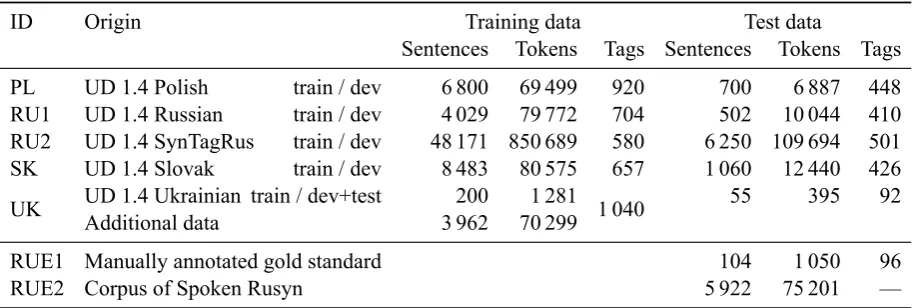
ID Origin Training data Test data
Sentences Tokens Tags Sentences Tokens Tags
PL UD 1.4 Polish train / dev 6 800 69 499 920 700 6 887 448 RU1 UD 1.4 Russian train / dev 4 029 79 772 704 502 10 044 410 RU2 UD 1.4 SynTagRus train / dev 48 171 850 689 580 6 250 109 694 501 SK UD 1.4 Slovak train / dev 8 483 80 575 657 1 060 12 440 426
UK UD 1.4 Ukrainian train / dev+test 200 1 281 1 040 55 395 92
Additional data 3 962 70 299
RUE1 Manually annotated gold standard 104 1 050 96
[image:3.595.72.532.62.216.2]RUE2 Corpus of Spoken Rusyn 5 922 75 201 —
Table 1: Sizes of the training and test corpora used in our experiments.
of national corpora,3 they use disparate tagsets and are often difficult to obtain in full-text for-mat. The MULTEXT-East project (Erjavec et al., 2010; Erjavec, 2012)4provides annotated versions of the novel1984for several Eastern European lan-guages, but Ukrainian and Russian versions are not available.
Fortunately, since version 1.4, the Universal De-pendencies project5contains treebanks for the four relevant languages with unified part-of-speech tags and morphosyntactic descriptions (Nivre et al., 2016; Zeman, 2015). Two corpora are avail-able for Russian, but the Ukrainian corpus is still rather small (see Table 1). Additionally, we were able to obtain more Ukrainian data developed by the non-governmental Institute of Ukrainian6 and planned to be included in one of the upcoming Uni-versal Dependencies releases; we converted these additional data from the MultextEast-style tags to universal tags and morphological features.
As Rusyn is written in Cyrillic script, we con-verted the Slovak and Polish corpora into Cyril-lic script. During this process, we applied cer-tain transformation rules in order to “rusynify” our training data (e.g., transform Polish ć to Cyrillic
тьor Polish ąto Cyrillicу, which is in line with well-known historical phonological processes).
Initial experiments have shown that addi-tional morphological dictionaries, such as those made available for the four languages within the
3
Ukrainian National Corpus: www.mova.info; Rus-sian National Corpus:www.ruscorpora.ru; Polish Na-tional Corpus: www.nkjp.pl/; Slovak National Cor-pus: http://korpus.juls.savba.sk/index_en. html.
4
http://hdl.handle.net/11356/1043
5
www.universaldependencies.org
6https://mova.institute
MULTEXT-East project, do not have a positive impact on Rusyn tagging. We therefore do not in-clude these additional resources (except for the de-rived lexicons discussed in Section 5.5).
We evaluate our methods on a small hand-annotated sample of Rusyn containing 104 sen-tences and 1 050 tokens and 96 distinct tags (henceforth RUE1). At the time of conducting the experiments, the Corpus of Spoken Rusyn (RUE2), which we aim to annotate with the pre-sented methods, contains 5 922 sentences with 75 201 tokens. We also report OOV rates on the latter and use it as additional unlabeled data for some of the adaptation processes described below.
5 Experiments
5.1 The MarMoT tagger
We use the MarMoT tagger for all of our experi-ments. MarMoT (Mueller et al., 2013) is a state-of-the-art toolkit for morphological tagging based on Conditional Random Fields (CRFs). It has been shown to work well on full morphological tag-ging with hundreds of tags (as opposed to part-of-speech tagging, which typically only uses a few dozen tags), thanks to pruning and coarse-to-fine decoding. Unless stated otherwise, we use the de-fault parameters for morphological tagging.
We evaluate the different models on the devel-opment sets of the five source corpora as well as on RUE1. A token is considered correctly tagged if its part-of-speech tag is correct and if all mor-phological features present in the gold annotation are found with the same value.7
7The gold annotation of RUE1 does not distinguish proper
Accuracy (%) OOV rate (%)
PL SK UK RU1 RU2 RUE1 PL SK UK RU1 RU2 RUE1 RUE2
PL 85.87 49.08 39.2 40.47 43.15 49.5±1.0 20.02 60.61 59.0 65.56 60.87 50.5 46.00 SK 46.77 79.87 37.2 41.94 45.54 43.3±0.4 58.05 33.87 57.7 63.72 58.56 53.1 43.73 UK 38.25 35.71 79.8 41.24 44.81 63.4±0.4 63.13 67.98 15.4 69.11 66.07 37.1 39.67
RU1 39.19 42.60 36.5 85.73 79.39 46.0±0.6 64.93 65.14 62.0 24.53 27.51 54.1 46.58 RU2 40.79 46.33 40.8 80.68 93.79 50.9±0.0 59.36 60.35 55.7 19.73 7.98 49.1 42.72
Table 2: Tagging accuracies and OOV rates for single-language taggers. Rows represent models, columns represent test sets.
5.2 Single-language taggers
We start by training five distinct taggers on the five training corpora and apply these taggers to the five source-language test corpora as well as to the Rusyn corpora. The results are shown in Table 2.
Unsurprisingly, each test set is best tagged with the tagger based on its own training set. Polish and Russian fared somewhat better than Slovak and Ukrainian. The differences between RU1 and RU2 give an indication of the loss resulting from an-notation/conversion differences as well as domain differences within the same language. For Rusyn, the best accuracy is obtained using the Ukrainian tagger, which is in line with the claims on linguistic proximity made above, followed by RU2, which is due to its large size rather than to small etymologi-cal distance. Also note that for none of the models, Rusyn is the worst-performing test language, hint-ing at its role as a bridge language between East and West Slavic.
In order to quantify the reliability of the Rusyn tagging results given the somewhat small test cor-pus, we split it into two equally-sized parts and computed the accuracies on both parts. The de-viation of the accuracy values of these parts from the mean accuracy is indicated after the±sign in Table 2.
While no single-language tagger achieves satis-factory accuracy on Rusyn, the results suggest that a combination of the five taggers (or of their train-ing data) could yield improved accuracy on Rusyn. There are essentially two ways of combining tag-gers: using the five source language taggers and choosing the majority vote, or using a single tag-ger trained on merged data from the five source corpora.
5.3 Majority-vote tagging
Aepli et al. (2014) develop a tagger for Macedo-nian by transferring morphosyntactic annotations
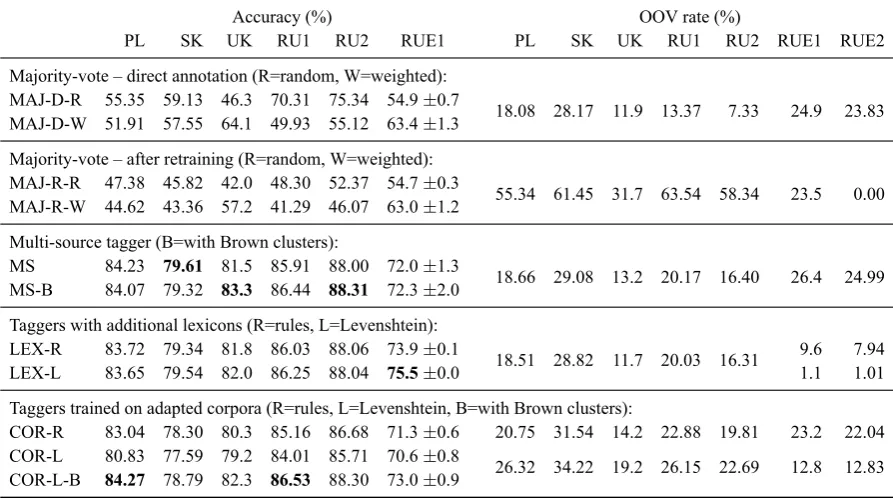
from multiple source languages by word align-ment, choosing one annotation by majority vote, and training a new tagger on the annotated corpus. We follow a similar method. We start by annotat-ing the Rusyn data with the five source language taggers. A majority annotation is determined in two steps: first, the majority part-of-speech tag is determined, and second, the majority morpho-logical features are determined on the basis of the taggers that have predicted the majority part-of-speech tag. We propose two ways of dealing with ties: we either randomly resolve ties (Random) or weight the tags on the basis ofa prioriknowledge about the etymological distances of the languages (Weighted).8
We report results on this direct annotation (see Table 3, rows MAJ-D), but also use the anno-tated RUE2 corpus to retrain a new tagger (see Ta-ble 3, rows MAJ-R). Only the weighted method yields similar tagging accuracies as the best single-language tagger. The impact of retraining is neg-ative, probably due to the fact that the OOV rate on RUE1 hardly decreases. While we could have tuned the weights of the majority-vote models to further improve their accuracy, this option did not look worthwhile in the light of the better results obtained with the approaches discussed below.
5.4 Creating multi-source taggers
For the multi-source tagger, we concatenate the five training sets, using only the first 10% of RU2 in order to keep the distribution better balanced. As shown in Table 3 (row MS), this simple combi-nation of training resources yields better accuracy than all majority-vote systems and outperforms the best single-language model (UK) by nearly 9%, al-though with a high variance between the two parts of the corpus. If only parts-of-speech are
eval-8The following weights are used: PL: 1.5, SK: 3, UK: 4,
Accuracy (%) OOV rate (%)
PL SK UK RU1 RU2 RUE1 PL SK UK RU1 RU2 RUE1 RUE2
Majority-vote – direct annotation (R=random, W=weighted): MAJ-D-R 55.35 59.13 46.3 70.31 75.34 54.9±0.7
18.08 28.17 11.9 13.37 7.33 24.9 23.83 MAJ-D-W 51.91 57.55 64.1 49.93 55.12 63.4±1.3
Majority-vote – after retraining (R=random, W=weighted): MAJ-R-R 47.38 45.82 42.0 48.30 52.37 54.7±0.3
55.34 61.45 31.7 63.54 58.34 23.5 0.00 MAJ-R-W 44.62 43.36 57.2 41.29 46.07 63.0±1.2
Multi-source tagger (B=with Brown clusters):
MS 84.23 79.61 81.5 85.91 88.00 72.0±1.3
18.66 29.08 13.2 20.17 16.40 26.4 24.99 MS-B 84.07 79.32 83.3 86.44 88.31 72.3±2.0
Taggers with additional lexicons (R=rules, L=Levenshtein): LEX-R 83.72 79.34 81.8 86.03 88.06 73.9±0.1
18.51 28.82 11.7 20.03 16.31 9.6 7.94
LEX-L 83.65 79.54 82.0 86.25 88.04 75.5±0.0 1.1 1.01
Taggers trained on adapted corpora (R=rules, L=Levenshtein, B=with Brown clusters):
COR-R 83.04 78.30 80.3 85.16 86.68 71.3±0.6 20.75 31.54 14.2 22.88 19.81 23.2 22.04 COR-L 80.83 77.59 79.2 84.01 85.71 70.6±0.8
[image:5.595.75.522.64.313.2]26.32 34.22 19.2 26.15 22.69 12.8 12.83 COR-L-B 84.27 78.79 82.3 86.53 88.30 73.0±0.9
Table 3: Tagging accuracies and OOV rates for the multi-source tagging experiments.
uated, the multi-source tagger achieves 79.2% of accuracy, compared to 69.7% for the best single-language model (UK).
Following e.g. Owoputi et al. (2013), we include word clusters as an additional feature for tagging. We obtain hierarchical word clusters (c=1 000) with the Brown clustering algorithm (Brown et al., 1992) on the concatenation of all source language and Rusyn texts (1.5M running tokens), and add the clusters as an additional feature to the tagger. This addition yields small improvements for some source languages and for Rusyn (see Table 3, row MS-B), although the latter impact is inconclusive due to the high variance between the two corpus parts. We observe that all word clusters spread over words from more than one language, suggest-ing that the clustersuggest-ing algorithm generalizes well over data from different languages. While larger amounts of unlabeled data will undoubtedly fur-ther increase source language tagging, it is less clear whether this will also have a positive impact on Rusyn tagging. In any case, larger Rusyn cor-pora will be hard to come by.
The idea behind tagger combination was that a lot of Rusyn words can be found in one of the source languages. This has been confirmed, as the OOV rates of the combined taggers (around 24% for Rusyn, see Table 3, rows MAJ-D and MS) are much lower than those of the single language tag-gers (between 37% and 54% for Rusyn, see
Ta-ble 2). However, we assume that even more Rusyn words could be found in a source language if some transformations were applied. In the following two subsections, we investigate two different ap-proaches.
5.5 Adding automatically induced lexicons
In Rabus and Scherrer (2017), we describe the au-tomatic induction of morphosyntactic lexicons for Rusyn. In a nutshell, we match Rusyn words ex-tracted from RUE1 and RUE2 with source lan-guage words extracted from the Polish, Slovak, Ukrainian and Russian MULTEXT-East lexicons as well as the morphological dictionary of UGtag9 (Kotsyba et al., 2011), using vowel-sensitive Lev-enshtein distance, hand-written rules, and a com-bination of both. The Rusyn words are then as-sociated with the morphosyntactic descriptions of the matched source-language words. The result-ing lexicon contains 51 600 token-tag tuples when induced with Levenshtein distance, and 28 900 tu-ples when induced with rules.
Table 3 (rows LEX-R and LEX-L) reports tag-ging results, where one of the induced lexicons is added to the multi-source tagger. As expected, the OOV rates drop considerably.10 Both the
9
UGtag is a tagger specifically developed for Ukrainian, but essentially consists of a large morphological dictionary and a simple disambiguation component.
10OOV rates do not completely drop to 0 because the
rule-induced and the Levenshtein-induced lexicon improve accuracy, the latter by 3.5% to 75.5%, the best observed result. Moreover, these results are stable between the two parts of the RUE1 corpus, with only 0.2% difference for the rule-induced lexicon and less than 0.1% difference for the Levenshtein-induced lexicon. If evaluated on the parts-of-speech only, the accuracies increase from 79.2% to 81.3% for the rule-induced lexicon and to 82.4% for the Levenshtein-induced lexicon. Combinations of rule-induction and Levenshtein-induction do not lead to further tagging improve-ments with respect to the Levenshtein model.
5.6 Adapting the corpora to Rusyn
An alternative to adding Rusyn data in the form of lexicons is to modify the source language train-ing corpora directly by maktrain-ing them look more Rusyn-like. The idea behind this method is to pro-vide the tagger with additional Rusyn tokens in sentential context. We proceed as follows: for each source language word, we search for the most similar Rusyn word in the RUE1 and RUE2 corpora, again using Levenshtein distance or the hand-written rules. If the most similar Rusyn word is different from the source word, we replace the source word with the former.11
As the number of known Rusyn words is small in comparison with the number of source words, there is a risk of replacing a source word by a non-related Rusyn word because the non-related one sim-ply is not known. In this case, we prevent the re-placement whenever another source word is closer to the Rusyn candidate. For example, the word
презыдентin the Polish corpus (converted from
prezydent ‘president’) would be replaced by the most similar Rusyn word, which happens to be the word презентіbut which is unrelated. This re-placement is blocked because another Polish word,
презенты (< prezenty ‘gifts’), is even closer to
презенті. When more than one Rusyn word ex-ists with the same distance, no replacement takes place. This phenomenon mostly occurs with Lev-enshtein distance, where 3-5% of tokens are con-cerned, but more rarely with the rules, where 1-3% of tokens are concerned. In the end, between 8% and 12% of source tokens are replaced with
Lev-words.
11For relative Levenshtein distance, we introduce a
thresh-old at 0.25 – as already in the lexicon induction experiments – above which word matches are considered noise and are dis-carded.
enshtein, and between 1% and 5% of source tokens with the rules.
The results presented in Table 3 (rows COR-R and COR-L) show that these conversions slightly decrease tagging accuracy for the source languages (which is expected, as training corpora now look less like the source languages), but do not improve the accuracy for Rusyn either compared to the sim-ple multi-source model. We also reran the word clustering tool on the Levenshtein-converted data, under the assumption that the increased frequency of the Rusyn words would improve the reliability of the induced clustering. This assumption was in-deed borne out with an accuracy increase of 2.4% absolute (row COR-L-B). However, this result did not surpass the one obtained with induced lexi-cons.
6 Conclusion and future work
We have investigated several approaches to mor-phosyntactic tagging of spoken Rusyn without re-lying on annotated Rusyn training data nor on an-notation projection from aligned parallel data. In-stead, we argued that fair tagging accuracy could be achieved by training taggers on the etymologi-cally related languages Ukrainian, Slovak, Polish and Russian. The experiments also showed that al-though Ukrainian is most closely related to Rusyn, all four related languages are useful for tagging. We have shown that a multi-source tagger trained on a balanced set of source language corpora per-forms rather well and even outperper-forms majority vote approaches. In contrast, Brown clustering has only been modestly useful in our setting, which may be due to the low amount of unlabeled data used.
We have presented two additional techniques to adapt the taggers to the specificities of Rusyn: adding automatically induced morphosyntactic lexicons, or adapting the training corpora. We ori-ented the first technique towards maximising re-call (e.g., keeping all possible readings of a Rusyn word in the induced lexicons) and the second to-wards high precision (e.g., only replacing unam-biguous words in the corpus). The first approach turned out to be more successful.
underesti-mate the impact of the tagger adaptation meth-ods, as it contains only Rusyn varieties spoken in Ukraine, with a low amount of orthographic vari-ation, whereas RUE2 also contains Rusyn from Poland and Slovakia. As an illustration, compare the OOV rates of the UK tagger (Table 2), which is 2.5% higher in RUE2 than in RUE1. A cursory evaluation of the results confirms this hypothesis, but we cannot quantify it at the moment. Only the manual annotation of a balanced subset of the dif-ferent RUE2 parts would provide us with a broader data basis for evaluation.
Second, it is crucial to keep in mind that both RUE1 and RUE2 – as opposed to the training corpora – are oral corpora with distinct features such as corrections, repetitions, incomplete sen-tences, unintelligible words or phrases, markers for pauses, etc. Any tagger trained on written data and applied to oral data will inevitably perform worse than when applied to written data (Nivre and Grönqvist, 2001; Westpfahl, 2014).
The final annotation of the Rusyn corpus is not only expected to consist of morphosyntactic de-scriptions, but also of lemmas. Therefore, we in-tend to train a separate lemmatization model on the tagged Rusyn corpora. The multi-source ap-proach will be more problematic here, as we do not want the predicted lemmas to be a mix of the four source languages. The prediction of Rusyn lemmas is prevented by two factors: none of our Rusyn data are annotated with Rusyn lemmas, and the orthographic variation would also carry over to the lemmas, which we would like to avoid. There-fore, one goal could be to annotate the Rusyn to-kens with Ukrainian lemmas such as those avail-able in the UGtag lexicon.
Finally, all source language corpora used in our experiments are annotated with syntactic depen-dencies. We assume that a Rusyn dependency parser could be created using similar methods as those presented here for morphosyntactic tagging.
Acknowledgments
We would like to thank Christine Grillborzer, Natalia Kotsyba, Bohdan Moskalevskyi, Andri-anna Schimon, Peter Schwarz, and Ruprecht von Waldenfels. The usual disclaimers apply.
Sources of external funding for our research in-clude the German Research Foundation (DFG).
References
Noëmi Aepli, Ruprecht von Waldenfels, and Tanja Samardžić. 2014. Part-of-speech tag disambigua-tion by cross-linguistic majority vote. In Proceed-ings of the First Workshop on Applying NLP Tools to Similar Languages, Varieties and Dialects, pages 76–84, Dublin, Ireland, August. Association for Computational Linguistics and Dublin City Univer-sity.
Željko Agić, Dirk Hovy, and Anders Søgaard. 2015. If all you have is a bit of the Bible: Learning POS tag-gers for truly low-resource languages. In Proceed-ings of the 53rd Annual Meeting of the Association for Computational Linguistics and the 7th Interna-tional Joint Conference on Natural Language Pro-cessing (Volume 2: Short Papers), pages 268–272, Beijing, China, July. Association for Computational Linguistics.
Peter F. Brown, Peter V. de Souza, Robert L. Mer-cer, Vincent J. Della Pietra, and Jenifer C. Lai. 1992. Class-based n-gram models of natural lan-guage. Computational Linguistics, 18(4):467–479.
Jan Buys and Jan A. Botha. 2016. Cross-lingual mor-phological tagging for low-resource languages. In
Proceedings of the 54th Annual Meeting of the As-sociation for Computational Linguistics (Volume 1: Long Papers), pages 1954–1964, Berlin, Germany, August. Association for Computational Linguistics.
Christos Christodouloupoulos and Mark Steedman.
2015. A massively parallel corpus: the Bible in
100 languages. Language Resources and
Evalua-tion, 49(2):375–395.
Dipanjan Das and Slav Petrov. 2011.
Unsuper-vised part-of-speech tagging with bilingual graph-based projections. InProceedings of the 49th An-nual Meeting of the Association for Computational Linguistics: Human Language Technologies, pages 600–609, Portland, Oregon, USA, June. Association for Computational Linguistics.
Long Duong, Paul Cook, Steven Bird, and Pavel Pecina. 2013. Simpler unsupervised pos tagging with bilingual projections. In Proceedings of the 51st Annual Meeting of the Association for Compu-tational Linguistics (Volume 2: Short Papers), pages 634–639, Sofia, Bulgaria, August. Association for Computational Linguistics.
Tomaž Erjavec, Ana-Maria Barbu, Ivan Derzhan-ski, Ludmila Dimitrova, Radovan Garabík, Nancy Ide, Heiki-Jaan Kaalep, Natalia Kotsyba, Cve-tana Krstev, Csaba Oravecz, Vladimír Petkevič, Greg Priest-Dorman, Behrang QasemiZadeh, Adam Radziszewski, Kiril Simov, Dan Tufiş, and Katerina Zdravkova. 2010. MULTEXT-east “1984” anno-tated corpus 4.0. Slovenian language resource repos-itory CLARIN.SI.
languages. Language Resources and Evaluation, 1(46):131–142.
Anna Feldman, Jirka Hana, and Chris Brew. 2006.
A cross-language approach to rapid creation of new morpho-syntactically annotated resources. In Pro-ceedings of the Fifth International Conference on Language Resources and Evaluation (LREC 2006), pages 549–554, Genoa, Italy.
Victoria Fossum and Steven Abney. 2005. Automat-ically inducing a part-of-speech tagger by project-ing from multiple source languages across aligned corpora. InProceedings of the Second International Joint Conference on Natural Language Processing, page 862–873, Jeju Island, Korea.
Natalia Kotsyba, Andriy Mykulyak, and Ihor V.
Shevchenko. 2011. UGTag: morphological
analyzer and tagger for the Ukrainian language.
In Stanisław Goźdź-Roszkowski, editor,
Explo-rations across Languages and Corpora, pages 69– 82, Frankfurt a. M.
Mikhail Kozhevnikov and Ivan Titov. 2014. Cross-lingual model transfer using feature representation projection. InProceedings of the 52nd Annual Meet-ing of the Association for Computational LMeet-inguis- Linguis-tics (Volume 2: Short Papers), pages 579–585, Bal-timore, Maryland, June. Association for Computa-tional Linguistics.
František Krajnjak and Josif Kudzej (transl.). 2009.
Tetrajevanhelije. Svitovŷj kongres Rusyniv, Prešov.
Shen Li, João Graça, and Ben Taskar. 2012. Wiki-ly supervised part-of-speech tagging. InProceedings of the 2012 Joint Conference on Empirical Methods in Natural Language Processing and Computational Natural Language Learning, pages 1389–1398, Jeju Island, Korea, July. Association for Computational Linguistics.
Paul R. Magocsi, editor. 2004. Rusyn’skŷj jazŷk. Na-jnowsze dzieje języków słowiańskich. Uniw. Opol-ski Inst. Filologii PolOpol-skiej, Opole.
Thomas Mayer and Michael Cysouw. 2014. Creating a Massively Parallel Bible Corpus. InProceedings of the Ninth International Conference on Language Resources and Evaluation (LREC’14), pages 3158– 3163, Reykjavik, Iceland.
Thomas Mueller, Helmut Schmid, and Hinrich Schütze. 2013. Efficient higher-order CRFs for morphologi-cal tagging. InProceedings of the 2013 Conference on Empirical Methods in Natural Language Process-ing, pages 322–332, Seattle, Washington, USA, Oc-tober. Association for Computational Linguistics.
Joakim Nivre and Leif Grönqvist. 2001. Tagging a corpus of spoken Swedish. International Journal of Corpus Linguistics, 6(1):47–78.
Joakim Nivre, Marie-Catherine de Marneffe, Filip Gin-ter, Yoav Goldberg, Jan Hajič, Christopher D. Man-ning, Ryan McDonald, Slav Petrov, Sampo Pyysalo, Natalia Silveira, Reut Tsarfaty, and Daniel Zeman. 2016. Universal dependencies v1: A multilingual treebank collection. InProceedings of the Tenth In-ternational Conference on Language Resources and Evaluation (LREC 2016), pages 1659–1666, Por-torož, Slovenia.
Olutobi Owoputi, Brendan O’Connor, Chris Dyer, Kevin Gimpel, Nathan Schneider, and Noah A. Smith. 2013. Improved part-of-speech tagging for online conversational text with word clusters. In
Proceedings of the 2013 Conference of the North American Chapter of the Association for Computa-tional Linguistics: Human Language Technologies, pages 380–390, Atlanta, Georgia, June. Association for Computational Linguistics.
Anna Plishkova. 2009. Language and national
iden-tity: Rusyns south of Carpathians, volume 14 of
Classics of Carpatho-Rusyn scholarship. Columbia University Press and East European Monographs, New York.
Stefan M. Pugh. 2009. The Rusyn language: A
gram-mar of the literary standard of Slovakia with refer-ence to Lemko and Subcarpathian Rusyn, volume
476 ofLanguages of the World/Materials. Lincom
Europa, München.
Achim Rabus and Yves Scherrer. 2017. Lexicon in-duction for spoken Rusyn – challenges and results. InProceedings of the 6th Workshop on Balto-Slavic Natural Language Processing, Valencia, Spain.
Yves Scherrer. 2014. Unsupervised adaptation of su-pervised part-of-speech taggers for closely related
languages. In Proceedings of the First Workshop
on Applying NLP Tools to Similar Languages, Va-rieties and Dialects, pages 30–38, Dublin, Ireland, August. Association for Computational Linguistics and Dublin City University.
H. A. Skrypnyk, editor. 2013. Ukrajinci-Rusyny:
Etnolinhvistyčni ta etnokul’turni procesy v isto-ryčnomu rozvytku. Instytut mystectvoznavstva, fol’klorystyky ta etnolohiji im. M.T. Ryl’s’koho, Kyjiv.
Oscar Täckström, Dipanjan Das, Slav Petrov, Ryan McDonald, and Joakim Nivre. 2013. Token and type constraints for cross-lingual part-of-speech tag-ging. Transactions of the Association for Computa-tional Linguistics, 1:1–12.
Alexander Teutsch. 2001. Das Rusinische der
Ost-slowakei im Kontext seiner Nachbarsprachen, vol-ume 12 ofHeidelberger Publikationen zur Slavistik. A, Linguistische Reihe. Lang, Frankfurt am Main, Berlin, Bern.
spo-ken data. InProceedings of LAW VIII - The 8th Lin-guistic Annotation Workshop, pages 1–10, Dublin, Ireland.
David Yarowsky and Grace Ngai. 2001. Inducing mul-tilingual POS taggers and NP bracketers via robust projection across aligned corpora. InProceedings of NAACL’01, pages 200–207.
Daniel Zeman and Philip Resnik. 2008.
Cross-language parser adaptation between related
lan-guages. InProceedings of the IJCNLP’08 Workshop
on NLP for Less Privileged Languages, pages 35–42.
Daniel Zeman. 2015. Slavic languages in Universal
Dependencies. InSlovko 2015: Natural Language