Proceedings of the 22nd Conference on Computational Natural Language Learning (CoNLL 2018), pages 151–160 151
Active Learning for Interactive Neural
Machine Translation of Data Streams
´
Alvaro Peris and Francisco Casacuberta
Pattern Recognition and Human Language Technology Research Center Universitat Polit`ecnica de Val`encia, Val`encia, Spain
{lvapeab, fcn}@prhlt.upv.es
Abstract
We study the application of active learning techniques to the translation of unbounded data streams via interactive neural machine translation. The main idea is to select, from an unbounded stream of source sentences, those worth to be supervised by a human agent. The user will interactively translate those samples. Once validated, these data is useful for adapt-ing the neural machine translation model.
We propose two novel methods for selecting the samples to be validated. We exploit the information from the attention mechanism of a neural machine translation system. Our ex-periments show that the inclusion of active learning techniques into this pipeline allows to reduce the effort required during the pro-cess, while increasing the quality of the trans-lation system. Moreover, it enables to balance the human effort required for achieving a cer-tain translation quality. Moreover, our neural system outperforms classical approaches by a large margin.
1 Introduction
The translation industry is a high-demand field. Large amounts of data must be translated on a reg-ular basis. Machine translation (MT) techniques greatly boost the productivity of the translation agencies (Arenas,2008). However, despite the re-cent advances achieved in this field, MT systems are still far to be perfect and make errors. The correction of such errors is usually done in a post-processing step, called post-editing. This requires a great effort, as it needs from expert human su-pervisors.
The requirements of the translation industry have increased in the last years. We live in a global world, in which large amounts of data must be pe-riodically translated. This is the case of the Euro-pean Parliament, whose proceedings must be
reg-ularly translated; or the Project Syndicate1 plat-form, which translates editorials from newspapers to several languages. In these scenarios, the sen-tences to be translated can be seen as unbounded streams of data (Levenberg et al.,2010).
When dealing with such massive volumes of data, it is prohibitively expensive to manually re-vise all the translations. Therefore, it is manda-tory to spare human effort, at the expense of some translation quality. Hence, when facing this sit-uation, we have a twofold objective: on the one hand, we aim to obtain translations with the high-est quality possible. On the other hand, we are constrained by the amount of human effort spent in the supervision and correction process of the translations proposed by an MT system.
The active learning (AL) framework is well-suited for these objectives. The application of AL techniques to MT involve to ask a human oracle to supervise a fraction of the incoming data (Blood-good and Callison-Burch,2010). Once the human has revised these samples, they are used for im-proving the MT system, via incremental learning. Therefore, a key element of AL is the so-called sampling strategy, which determines the sentences that should be corrected by the human.
Aiming to reduce the human effort required during post-editing, other alternative frameworks have been study. A successful one is the interactive-predictive machine translation (IMT) paradigm (Foster et al., 1997; Barrachina et al., 2009). In IMT, human and MT system jointly collaborate for obtaining high-quality translations, while reducing the human effort spent in this pro-cess.
In this work, we explore the application of NMT to the translation of unbounded data streams. We apply AL techniques for selecting the instances to
be revised by a human oracle. The correction pro-cess is done by means of an interactive-predictive NMT (INMT) system, which aims to reduce the human effort of this process. The supervised sam-ples will be used for the NMT system to incremen-tally improve its models. To the best of our knowl-edge, this is the first work that introduces an INMT system into the scenario involving the translation of unbounded data. Our main contributions are:
• We study the application of AL on an INMT framework when dealing with large data streams. We introduce two sampling strate-gies for obtaining the most useful samples to be supervised by the human. We compare these techniques with other classical, well-performing strategies.
• We conduct extensive experiments, analyzing the different sampling strategies and studying the amount of effort required for obtaining a certain translation quality.
• The results show that AL succeeds at improv-ing the translation pipeline. The translation systems featuring AL have better quality and require less human effort in the IMT process than static systems. Moreover, the applica-tion of the AL framework allows to obtain a balance between translation quality and ef-fort required for achieving such quality. This balance can be easily tuned, according to the needs of the users.
• We open-source our code2 and use publicly-available corpora, fostering further research on this area.
2 Related work
The translation of large data streams is a problem that has been thoroughly studied. Most works aim to continuously modify the MT system as more data become available. These modifications are usually performed in an incremental way (Leven-berg et al., 2010;Denkowski et al., 2014;Turchi et al., 2017), learning from user post-edits. This incremental learning has also been applied to IMT, either to phrase-based statistical machine transla-tion (SMT) systems (Nepveu et al., 2004; Ortiz-Mart´ınez,2016) or NMT (Peris and Casacuberta, 2018b).
2The source code can be found at: https:
//github.com/lvapeab/nmt-keras/tree/ interactive_NMT.
The translation of large volumes of data is a scenario very appropriate for the AL framework (Cohn et al., 1994;Olsson,2009; Settles, 2009). The application of AL to SMT has been stud-ied for pool-based (Haffari et al., 2009; Blood-good and Callison-Burch,2010) and stream-based (Gonz´alez-Rubio et al.,2011) setups. Later works (Gonz´alez-Rubio et al., 2012; Gonz´alez-Rubio and Casacuberta, 2014), combined AL together with IMT, showing that AL can effectively reduce the human effort required for achieving a certain translation quality.
All these works were based on SMT systems. However, the recently introduced NMT paradigm (Sutskever et al.,2014;Bahdanau et al.,2015) has irrupted as the current state-of-the-art for MT (Bo-jar et al., 2017). Several works aimed at build-ing more productive NMT systems. Related to our work, studies on interactive NMT systems (Knowles and Koehn, 2016; Peris et al., 2017; Hokamp and Liu,2017) proved the efficacy of this framework. A body of work has been done aim-ing to build adaptive NMT systems, which con-tinuously learn from human corrections (Turchi et al., 2017;Peris and Casacuberta,2018b). Re-cently, Lam et al.(2018) applied AL techniques to an INMT system, for deciding whether the user should revise a partial hypothesis or not. How-ever, to our knowledge, a study on the use of AL for NMT in a scenario of translation of unbounded data streams is still missing.
3 Neural machine translation
NMT is a particular case of sequence-to-sequence learning: given a sequence of words from the source language, the goal is to generate another sequence of words in the target language. This is usually done by means of an encoder–decoder architecture (Sutskever et al., 2014; Vaswani et al., 2017). In this work, we use a recur-rent encoder–decoder system with long short-term memory (LSTM) units (Hochreiter and Schmidhu-ber,1997) and an attention mechanism (Bahdanau et al.,2015).
The decoder is a conditional LSTM (cLSTM) network (Peris and Casacuberta, 2018b). A cLSTM network is composed of several LSTM transition blocks with an attention mechanism in between. We use two LSTM blocks.
The output of the decoder is combined together with the attended representation of the input sen-tence and with the word embedding of the word previously generated in a deep output layer (Pas-canu et al., 2014). Finally, a softmax layer com-putes a probability distribution over the target lan-guage vocabulary.
The model is jointly trained by means of stochastic gradient descent (SGD) (Robbins and Monro, 1951), aiming to minimize the cross-entropy over a bilingual training corpus. SGD is usually applied to mini-batches of data; but it can be also applied sample-to-sample, allowing the training of the NMT system in an incremen-tal way (Turchi et al.,2017).
For decoding, the model uses a beam search method (Sutskever et al., 2014) for obtaining the most probable target sentence yˆ, given a source sentencex:
ˆ
y= arg max y
p(y|x) (1)
3.1 Interactive machine translation
As previously discussed, MT systems are not per-fect. Their outputs must be corrected by a human agent in a post-editing stage, in order to achieve high-quality translations.
The IMT framework constitutes a more effi-cient alternative to the regular post-editing. In a nutshell, IMT consists in an iterative process in which, at each iteration, the user introduces a cor-rection to the system hypothesis. The system takes into account the correction and provides an alter-native hypothesis, considering the feedback from the user.
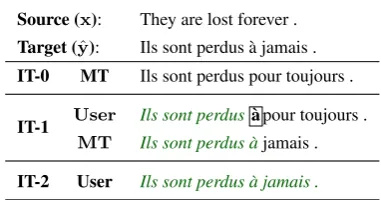
In this work, we use a prefix-based IMT pro-tocol: the user corrects the left-most wrong char-acter of the hypothesis. With this action, the user has also validated a correct prefix. Then, the sys-tem must complete the provided prefix, generating a suitable suffix. Fig. 1shows an example of the prefix-based IMT protocol.
More formally, the expression for computing the most probable suffix (yˆs) is:
ˆ
ys= arg max ys
p(ys|x,yp) (2)
Source (x): They are lost forever .
Target (yˆ): Ils sont perdus `a jamais .
IT-0 MT Ils sont perdus pour toujours .
IT-1 User Ils sont perdus `apour toujours .
MT Ils sont perdus `ajamais .
[image:3.595.320.511.64.164.2]IT-2 User Ils sont perdus `a jamais .
Figure 1: IMT session to translate a sentence from English to French. IT-is the number of iterations of the process. The MT row shows the MT hy-pothesis in the current iteration. In theUserrow is the feedback introduced by the user: the corrected character (boxed). We color in green the prefix that the user inherently validated with the charac-ter correction.
where yp is the validated prefix provided by the
user and xis the source sentence. Note that this expression is similar toEq. (1). The difference is that now, the search space is the set of suffixes that completeyp.
For NMT systems,Eq. (2)is implemented as a beam search, constrained by the prefix provided by the user (Peris et al.,2017;Peris and Casacu-berta,2018b).
4 Active learning in machine translation
When dealing with potentially unbounded datasets, it becomes prohibitively expensive to manually supervise all the translations. Aiming to address this problem, in the AL framework, a sampling strategy selects a subset of sentences worth to be supervised by the user. Once cor-rected, the MT system adapts its models with these samples.
Algorithm 1: Active learning for unbounded data streams with interactive neural machine translation.
input :θ(NMT model)
S (stream of source sentences) ε(effort level desired)
auxiliar :B(block of source sentences)
V ⊆ B(sentences to be supervised by the user
1 begin
2 repeat
3 B=getBlockFromStream(S); 4 V =sampling(B, ε);
5 foreachx∈ Bdo
6 y=translate(θ,x); 7 ifx∈ V then
8 yˆ =INMT(θ,x,y); 9 θ=update(θ,(x,yˆ)); 10 output(ˆy);
11 else
12 output(y);
13 end
14 end
15 untilS 6=∅;
16 end
θ from the NMT model, via SGD. This is done with the function update(θ,(x,yˆ)). Therefore, the NMT system is incrementally adapted with new data. The sentences considered unworthy to be supervised are automatically translated ac-cording to acac-cording Eq. (1), with the function translate(θ,x). Once we finish the translation of the current blockB, we start the process again. Algorithm 1details the full procedure.
5 Sentence sampling strategies
One of the key elements of AL is to have a mean-ingful strategy for obtaining the most useful sam-ples to be supervised by the human agent. This re-quires an evaluation of the informativeness of un-labeled samples. The sampling strategies used in this work belong to two major frameworks: un-certainty sampling (Lewis and Catlett,1994) and query-by-committee (Seung et al.,1992).
As baseline, we use a random sampling strat-egy: sentences are randomly selected from the data streamS. Although simple, this strategy usu-ally works well in practice. In the rest of this sec-tion, we describe the sampling strategies used in
this work.
5.1 Uncertainty sampling
The idea behind this family of methods is to se-lect those instances for which the model has the least confidence to be properly translated. There-fore, all techniques compute, for each sample, an uncertainty score. The selected sentences will be those with the highest scores.
Quality estimation sampling
A common and effective way for measuring the uncertainty of a MT system is to use confidence estimation (Gandrabur and Foster, 2003; Blatz et al.,2004;Ueffing and Ney,2007). The idea is to estimate the quality of a translation according to confidence scores of the words.
More specifically, given a source sentencex =
x1, . . . , xJ and a translation hypothesis y =
y1, . . . , yI, a word confidence score (Cw) as
com-puted as (Ueffing and Ney,2005):
Cw(x, yi) = max
0≤j≤Jp(yi|xj) (3)
wherep(yi|xj) is the alignment probability ofyi
andxj, given by an IBM Model 2 (Brown et al.,
1993). x0 denotes the empty source word. The choice of the IBM Model 2 is twofold: on the one hand, it is a very fast method, which only requires to query in a dictionary. We are in an interactive framework, therefore speed becomes a crucial re-quirement. On the other hand, its performance is close to more complex methods (Blatz et al.,2004; Dyer et al.,2013).
FollowingGonz´alez-Rubio et al.(2012), the un-certainty score for the quality estimation sampling is defined as:
Cqe(x,y) = 1−|{yi∈y|Cw(x, yi)> τw}| |y| (4)
whereτwis a word confidence threshold, adjusted
according to a development corpus. | · | denotes the size of a sequence or set.
Coverage sampling
One of the main issues suffered by NMT sys-tems is the lack of coverage: the NMT system may not translate all words from a source sen-tence. This results in over-translation or under-translation problems (Tu et al.,2016).
system when translating a sentence. Therefore, we modify the coverage penalty proposed byWu et al. (2016), for obtaining a coverage-based uncertainty score:
Ccov(x,y) =
P|x|
j=1log min(
P|y|
i=1αi,j,1)
|x|
(5) whereαi,jis attention probability of thei-th target
word and thej-th source word.
Attention distraction sampling
When generating a target word, an attentional NMT system should attend on meaningful parts of the source sentence. If the system is translating an uncertain sample, its attention mechanism will be distracted. That means, dispersed throughout the source sequence. A sample with a great dis-traction will feature an attention probability distri-bution with heavy tails (e.g. a uniform distribu-tion). Therefore, for the attention distraction sam-pling strategy, the sentences to select will be those with highest attention distraction.
For computing a distraction score, we compute the kurtosis of the weights given by the attention model for each target wordyi:
Kurt(yi) =
1
|x|
P|x|
j=1(αi,j− 1
|x|)4
1
|x|
P|x|
j=1(αi,j− 1
|x|)2
2 (6)
being, as above, αi,j the weight assigned by the
attention model to thej-th source word when de-coding thei-th target word. Note that, by construc-tion of the attenconstruc-tion model, |x|1 is equivalent to the mean of the attention weights of the wordyi.
Since we want to obtain samples with heavy tails, we average the minus kurtosis values for all words in the target sentence, obtaining the atten-tion distracatten-tion scoreCad:
Cad(x,y) =
P|y|
i=1−Kurt(yi)
|y| (7)
5.2 Query-by-committee
This framework maintains a committee of mod-els, each one able to vote for the sentences to be selected. The query-by-committee (QBC) method selects the samples with the largest disagreement among the members of the committee. The level of disagreement of a samplexmeasured according
to the vote-entropy function (Dagan and Engelson, 1995):
Cqbc(x) =−#V(x) |C| + log
#V(x) |C| (8)
where #V(x) is the number of members of the committee that voted x to be worth to be super-vised and |C| is the number of members of the committee. If#V(x)is zero, we set the value of Cqbc(x)to−∞.
Our committee was composed by the four un-certainty sampling strategies, namely quality es-timation, coverage, attention distraction and ran-dom sampling. The inclusion of the latter into the committee can be seen as a way of introducing some noise, aiming to prevent overfitting.
6 Experimental framework
In order to assess the effectiveness of AL for INMT, we conducted a similar experimentation than the latter works in AL for IMT (Gonz´alez-Rubio and Casacuberta,2014): we started from a NMT system trained on a general corpus and fol-lowedAlgorithm 1. This means that the sampling strategy selected those instances to be supervised by the human agent, who interactively translated them. Next, the NMT system was updated in an incremental way with the selected samples.
Due to the prohibitive cost that an experimen-tation with real users conveys, in our experiments, the users were simulated. We used the references from our corpus as the sentences the users would like to obtain.
6.1 Evaluation
An IMT scenario with AL requires to assess two different criteria: translation quality of the system and human effort spent during the process.
For evaluating the quality of the translations, we used the BLEU (bilingual evaluation understudy) (Papineni et al.,2002) score. BLEU computes an average mean of the precision of then-grams (up to order4) from the hypothesis that appear in the reference sentence. It also has a brevity penalty for short translations.
Once the pointer is positioned, the user would in-troduce the correct character. These actions corre-spond to amouse-action and akeystroke, respec-tively.
Therefore, we use a commonly-used met-ric that accounts for both types of interaction: the keystroke mouse-action ratio (KSMR) (Bar-rachina et al.,2009). It is defined as the number of keystrokes plus the number of mouse-actions re-quired for obtaining the desired sentence, divided by the number of characters of such sentence. We add a final mouse-action, accounting for action of accepting the translation hypothesis. Although keystrokes and mouse-actions are different and re-quire a different amount of effort (Macklovitch et al.,2005), KSMR makes an approximation and assumes that both actions require a similar effort.
6.2 Corpora
[image:6.595.80.282.663.750.2]To ensure a fair comparison with the latter works of AL applied to IMT (Gonz´alez-Rubio and Casacuberta, 2014), we used the same datasets: our training data was the Europarl corpus (Koehn, 2005), with the development set provided at the 2006 workshop on machine translation (Koehn and Monz,2006). As test set, we used the News Commentary corpus (Callison-Burch et al.,2007). This test set is suitable to our problem at hand be-cause i. it contains data from different domains (politics, economics and science), which represent challenging out-of-domain samples, but account for a real-life situation in a translation agency; and ii. it is large enough to properly simulate long-term evolution of unbounded data streams. All data are publicly available. We conducted the ex-perimentation in the Spanish to English language direction. Table 1shows the main figures of our data.
Table 1: Corpora main figures, in terms of number of sentences (|S|), number of running words (|W|) and vocabulary size (|V|). k and M stand for thou-sands and millions of elements, respectively.
Corpus Usage |S| |W| |V|
Europarl
Train En 2M 46M 106k
Es 48M 160k
Dev. En 2k 58k 6.1k
Es 61k 7.7k
News
Test En 51k 1.2M 35k
Commentary Es 1.5M 49k
6.3 NMT systems and AL setup
Our NMT system was built using NMT-Keras (Peris and Casacuberta, 2018a) and featured a bidirectional LSTM encoder and a decoder with cLSTM units. FollowingBritz et al.(2017), we set the dimension of the LSTM, embeddings and at-tention model to 512. We applied batch normaliz-ing transform (Ioffe and Szegedy,2015) and Gaus-sian noise during training (Graves,2011). TheL2 norm of the gradients was clipped to5, for avoid-ing the exploitavoid-ing gradient effect (Pascanu et al., 2012). We applied joint byte pair encoding (BPE) (Sennrich et al., 2016) to all corpora. For train-ing the system, we used Adam (Ktrain-ingma and Ba, 2014), with a learning rate of0.0002and a batch size of50. We early-stopped the training accord-ing to the BLEU on our development set. For de-coding, we used a beam of 6.
We incrementally update the system (Line 9in Algorithm 1), with vanilla SGD, with a learning rate of 0.0005. We chose this configuration ac-cording to an exploration on the validation set.
The rest of hyperparameters were set according to previous works. The blocks retrieved from the data stream contained 500samples (according to Gonz´alez-Rubio et al.(2012), the performance is similar regardless the block size). For the quality estimation method, the IBM Model 2 was obtained withfast align(Dyer et al.,2013) andτwwas
set to0.4(Gonz´alez-Rubio et al.,2010).
7 Results and discussion
A system with AL involves two main facets to evaluate: the improvement on the quality of the system and the amount of human effort required for achieving such quality. In this section, we compare and study our AL framework for all our sampling strategies: quality estimation sampling (QES), coverage sampling (CovS), attention dis-traction sampling (ADS), random sampling (RS) and query-by-committee (QBC).
7.1 Active learning evaluation
system without AL was 34.6. Applying AL, we obtained improvements up to4.1points of BLEU.
0 20 40 60 80 100
35 36 37 38 39
Sentences supervised [%]
BLEU
[%]
[image:7.595.74.289.102.281.2]QES ADS CovS QBC RS
Figure 2: BLEU of the initial hypotheses pro-posed by the the NMT system as a function of the amount of data used to adapt it. The percentage of sentences supervised refers to the value ofεwith respect to the block size.
As expected, the addition of the new knowledge had a larger impact when applied to a non-adapted system. Once the system becomes more special-ized, a larger amount of data was required to fur-ther improve.
The sampling strategies helped the system to learn faster. Taking RS as a baseline, the learning curves of the other techniques were better, espe-cially when using few (up to a30%) data for fine-tuning the system. The strategies that achieved a fastest adaptation were those involving the atten-tion mechanism (ADS, CovS and QBC). This in-dicates that the system is learning from the most useful data. The QES and RS required more su-pervised data for achieving the comparable BLEU results. When supervising high percentages of the data, we observed BLEU differences. This is due to the ordering in which the selected sentences were presented to the learner. The sampling strate-gies performed a sort of curriculum learning (Ben-gio et al.,2009).
7.2 Introducing the human into the loop
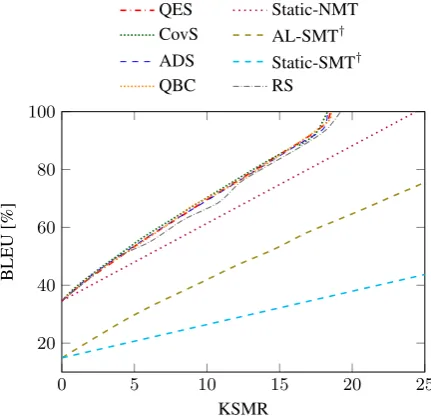
From point of view a user, it is important to assess not only the quality of the MT system, but also the effort spent to obtain such quality. Fig. 3relates both, showing the amount of effort required for ob-taining a certain translation quality. We compared
the results of system with AL against the same NMT system without AL and with two other SMT systems, with and without AL, from Gonz´alez-Rubio and Casacuberta(2014).
Results inFig. 3show consistent positive results of the AL framework. In all cases, AL reduced the human effort required for achieving a certain translation quality. Compared to a static NMT sys-tem, approximately a25%of the human effort can be spent using AL techniques.
0 5 10 15 20 25
20 40 60 80 100
KSMR
BLEU
[%]
QES Static-NMT
CovS AL-SMT†
ADS Static-SMT†
QBC RS
Figure 3: Translation quality (BLEU) as a func-tion of the human effort (KSMR) required. Static-NMT relates to the same Static-NMT system without AL.†denotes systems fromGonz´alez-Rubio and Casacuberta(2014): Static-SMT is a SMT system without AL and AL-SMT is the coverage augmen-tation SMT system.
Regarding the different sampling strategies, all of them behaviored similarly. They provided con-sistent and stable improvements, regardless the level of effort desired (ε). This indicates that, al-though the BLEU of the system may vary (Fig. 2), this had small impact on the effort required for cor-recting the samples. All sampling strategies out-performed the random baseline, which had a more unstable behavior.
Compared to classical SMT systems, NMT per-formed surprisingly well. Even the NMT sys-tem without AL largely outperformed the best AL-SMT system. This is due to several reasons: on the one hand, the initial NMT system was much bet-ter than the original SMT system (34.6 vs. 14.9
[image:7.595.310.526.212.420.2]presumably due to the BPE used in NMT: the data stream contained sentences from different do-mains, but they can be effectively encoded into known sequences via BPE. The SMT system was unable to handle well such unseen sentences. On the other hand, INMT systems usually respond much better to the human feedback than inter-active SMT systems (Knowles and Koehn,2016; Peris et al.,2017). Therefore, the differences be-tween SMT and NMT were enlarged even more.
Finally, it should be noted that all our sampling strategies can be computed speedily. They involve analysis of the NMT attention weights, which are computed as a byproduct of the decoding process; or queries to a dictionary (in the case of QES). The update of NMT system is also fast, taking approx-imately0.1seconds. This makes AL suitable for a real-time scenario.
8 Conclusions and future work
We studied the application of AL methods to INMT systems. The idea was to supervise the most useful samples from a potentially unbounded data stream, while automatically translating the rest of samples. We developed two novel sam-pling strategies, able to outperform other well-established methods, such as QES, in terms of translation quality of the final system.
We evaluated the capabilities and usefulness of the AL framework by simulating real-life sce-nario, involving the aforementioned large data streams. AL was able to enhance the performance of the NMT system in terms of BLEU. More-over, we obtained consistent reductions of approx-imately a25%of the effort required for reaching a desired translation quality. Finally, it is worth noting that NMT outperformed classical SMT sys-tems by a large margin.
We want to explore several lines of work in a future. First, we intend to apply our method to other datasets, involving linguistically diverse lan-guage pairs and low-resource scenarios, in order to observe whether the results obtained in this work hold. We also aim to devise more effective sam-pling strategies. To take into account the cogni-tive effort or time required for interaccogni-tively trans-lating a sentence seem promising objective func-tions. Moreover, these sampling strategies can be used as a data selection technique. It would be in-teresting to assess their performance on this task. We also want to study the addition of
reinforce-ment or bandit learning into our framework. Re-cent works (Nguyen et al.,2017;Lam et al.,2018) already showed the usefulness of these learning paradigms, which are orthogonal to our work. Fi-nally, we intend to assess the effectiveness of our proposals with real users in a near future.
Acknowledgments
The research leading this work received funding from grants PROMETEO/2018/004 and CoMUN-HaT - TIN2015-70924-C2-1-R. We also acknowl-edge NVIDIA Corporation for the donation of GPUs used in this work.
References
Ana Guerberof Arenas. 2008. Productivity and quality in the post-editing of outputs from translation mem-ories and machine translation. Localisation Focus, 7(1):11–21.
Dzmitry Bahdanau, Kyunghyun Cho, and Yoshua Ben-gio. 2015. Neural machine translation by jointly learning to align and translate. arXiv:1409.0473.
Sergio Barrachina, Oliver Bender, Francisco Casacu-berta, Jorge Civera, Elsa Cubel, Shahram Khadivi, Antonio Lagarda, Hermann Ney, Jes´us Tom´as, En-rique Vidal, and Juan-Miguel Vilar. 2009. Statistical approaches to computer-assisted translation. Com-putational Linguistics, 35(1):3–28.
Yoshua Bengio, J´erˆome Louradour, Ronan Collobert, and Jason Weston. 2009. Curriculum learning. In
Proceedings of the 26th annual international con-ference on machine learning, pages 41–48.
John Blatz, Erin Fitzgerald, George Foster, Simona Gandrabur, Cyril Goutte, Alex Kulesza, Alberto Sanchis, and Nicola Ueffing. 2004. Confidence es-timation for machine translation. InProceedings of the international conference on Computational Lin-guistics, pages 315–321.
Michael Bloodgood and Chris Callison-Burch. 2010. Bucking the trend: Large-scale cost-focused active learning for statistical machine translation. In Pro-ceedings of the 48th Annual Meeting of the Associa-tion for ComputaAssocia-tional Linguistics, pages 854–864.
Ondˇrej Bojar, Christian Buck, Rajen Chatterjee, Chris-tian Federmann, Yvette Graham, Barry Haddow, Matthias Huck, Antonio Jimeno Yepes, Philipp Koehn, and Julia Kreutzer, editors. 2017. Proceed-ings of the Second Conference on Machine Transla-tion.
Peter F. Brown, Vincent J. Della Pietra, Stephen A. Della Pietra, and Robert L. Mercer. 1993. The mathematics of statistical machine translation: Pa-rameter estimation. Computational Linguistics, 19(2):263–311.
Chris Callison-Burch, Cameron Fordyce, Philipp Koehn, Christof Monz, and Josh Schroeder. 2007. (Meta-) evaluation of machine translation. In Pro-ceedings of the Workshop on Statistical Machine Translation, pages 136–158.
David Cohn, Les Atlas, and Richard Ladner. 1994. Im-proving generalization with active learning. Ma-chine learning, 15(2):201–221.
Ido Dagan and Sean P Engelson. 1995. Committee-based sampling for training probabilistic classifiers. InMachine Learning Proceedings 1995, pages 150– 157.
Michael Denkowski, Chris Dyer, and Alon Lavie. 2014. Learning from post-editing: Online model adaptation for statistical machine translation. In
Proceedings of the 14th Conference of the European Chapter of the Association for Computational Lin-guistics, pages 395–404.
Chris Dyer, Victor Chahuneau, and Noah A Smith. 2013. A simple, fast, and effective reparameteriza-tion of IBM Model 2. InProceedings of the 2013 Conference of the North American Chapter of the Association for Computational Linguistics: Human Language Technologies, pages 644–648.
George Foster, Pierre Isabelle, and Pierre Plamon-don. 1997. Target-text mediated interactive machine translation. Machine Translation, 12:175–194.
Simona Gandrabur and George Foster. 2003. Confi-dence estimation for text prediction. InProceedings of the Conference on Computational Natural Lan-guage Learning, pages 315–321.
Jes´us Gonz´alez-Rubio and Francisco Casacuberta. 2014. Cost-sensitive active learning for computer-assisted translation. Pattern Recognition Letters, 37:124–134.
Jes´us Gonz´alez-Rubio, Daniel Ortiz-Mart´ınez, and Francisco Casacuberta. 2010. Balancing user effort and translation error in interactive machine trans-lation via confidence measures. InProceedings of the Annual Meeting of the Association for Computa-tional Linguistics, pages 173–177.
Jes´us Gonz´alez-Rubio, Daniel Ortiz-Mart´ınez, and Francisco Casacuberta. 2011. An active learning scenario for interactive machine translation. In Pro-ceedings of the 13th international conference on multimodal interfaces, pages 197–200.
Jes´us Gonz´alez-Rubio, Daniel Ortiz-Mart´ınez, and Francisco Casacuberta. 2012. Active learning for in-teractive machine translation. InProceedings of the Conference of the European Chapter of the Associa-tion for ComputaAssocia-tional Linguistics, pages 245–254.
Alex Graves. 2011. Practical variational inference for neural networks. InAdvances in Neural Information Processing Systems, pages 2348–2356.
Gholamreza Haffari, Maxim Roy, and Anoop Sarkar. 2009. Active learning for statistical phrase-based machine translation. InProceedings of Human Lan-guage Technologies: The 2009 Annual Conference of the North American Chapter of the Association for Computational Linguistics, pages 415–423.
Sepp Hochreiter and J¨urgen Schmidhuber. 1997. Long short-term memory. Neural Computation, 9(8):1735–1780.
Chris Hokamp and Qun Liu. 2017. Lexically con-strained decoding for sequence generation using grid beam search. arXiv:1704.07138.
Sergey Ioffe and Christian Szegedy. 2015. Batch nor-malization: Accelerating deep network training by reducing internal covariate shift.arXiv:1502.03167.
Diederik Kingma and Jimmy Ba. 2014. Adam: A method for stochastic optimization.
arXiv:1412.6980.
Rebecca Knowles and Philipp Koehn. 2016. Neural interactive translation prediction. In Proceedings of the Association for Machine Translation in the Americas, pages 107–120.
Philipp Koehn. 2005. Europarl: A parallel corpus for statistical machine translation. InProceedings of the Machine Translation Summit, pages 79–86.
Philipp Koehn and Christof Monz, editors. 2006. Pro-ceedings on the Workshop on Statistical Machine Translation. Association for Computational Lin-guistics.
Tsz Kin Lam, Julia Kreutzer, and Stefan Riezler. 2018. A reinforcement learning approach to interactive-predictive neural machine translation. In Proceed-ings of the European Association for Machine Trans-lation conference, pages 169–178.
Abby Levenberg, Chris Callison-Burch, and Miles Os-borne. 2010. Stream-based translation models for statistical machine translation. In Human Lan-guage Technologies: The 2010 Annual Conference of the North American Chapter of the Association for Computational Linguistics, pages 394–402.
David D Lewis and Jason Catlett. 1994. Heteroge-neous uncertainty sampling for supervised learning. InMachine Learning Proceedings 1994, pages 148– 156.
Elliot Macklovitch, Nam-Trung Nguyen, and Roberto Silva. 2005. User evaluation report. Technical re-port. Transtype2 (ISR-2001-32091).
Laurent Nepveu, Guy Lapalme, Philippe Langlais, and George Foster. 2004. Adaptive language and trans-lation models for interactive machine transtrans-lation. In
Khanh Nguyen, Hal Daum´e III, and Jordan Boyd-Graber. 2017. Reinforcement learning for bandit neural machine translation with simulated human feedback. InProceedings of the Conference on Em-pirical Methods in Natural Language Processing, pages 1464–1474.
Fredrik Olsson. 2009. A literature survey of active ma-chine learning in the context of natural language pro-cessing. Technical report.
Daniel Ortiz-Mart´ınez. 2016. Online learning for sta-tistical machine translation. Computational Linguis-tics, 42(1):121–161.
Kishore Papineni, Salim Roukos, Todd Ward, and Wei-Jing Zhu. 2002. BLEU: a method for automatic evaluation of machine translation. In Proceedings of the Annual Meeting of the Association for Com-putational Linguistics, pages 311–318.
Razvan Pascanu, Caglar Gulcehre, Kyunghyun Cho, and Yoshua Bengio. 2014. How to construct deep recurrent neural networks. arXiv:1312.6026.
Razvan Pascanu, Tomas Mikolov, and Yoshua Bengio. 2012. On the difficulty of training recurrent neural networks. arXiv:1211.5063.
´
Alvaro Peris and Francisco Casacuberta. 2018a. NMT-Keras: a very flexible toolkit with a focus on interac-tive NMT and online learning. The Prague Bulletin of Mathematical Linguistics, 111:113–124.
´
Alvaro Peris and Francisco Casacuberta. 2018b. On-line learning for effort reduction in interactive neural machine translation. arXiv:1802.03594.
´
Alvaro Peris, Miguel Domingo, and Francisco Casacu-berta. 2017. Interactive neural machine translation.
Computer Speech & Language, 45:201–220.
Herbert Robbins and Sutton Monro. 1951. A stochastic approximation method. The Annals of Mathemati-cal Statistics, pages 400–407.
Mike Schuster and Kuldip K. Paliwal. 1997. Bidirec-tional recurrent neural networks. IEEE Transactions on Signal Processing, 45(11):2673–2681.
Rico Sennrich, Barry Haddow, and Alexandra Birch. 2016. Improving neural machine translation models with monolingual data. In Proceedings of the An-nual Meeting of the Association for Computational Linguistics, pages 86–96.
B. Settles. 2009. Active learning literature survey. Computer Sciences Technical Report 1648, Univer-sity of Wisconsin–Madison.
H Sebastian Seung, Manfred Opper, and Haim Som-polinsky. 1992. Query by committee. In Proceed-ings of the fifth annual workshop on Computational learning theory, pages 287–294.
Ilya Sutskever, Oriol Vinyals, and Quoc V. Le. 2014. Sequence to sequence learning with neural net-works. In Proceedings of the Advances in Neural Information Processing Systems, volume 27, pages 3104–3112.
Zhaopeng Tu, Zhengdong Lu, Yang Liu, Xiaohua Liu, and Hang Li. 2016. Modeling coverage for neural machine translation. InProceedings of the Annual Meeting of the Association for Computational Lin-guistics, volume 1, pages 76–85.
Marco Turchi, Matteo Negri, M Amin Farajian, and Marcello Federico. 2017. Continuous learning from human post-edits for neural machine translation.
The Prague Bulletin of Mathematical Linguistics, 108(1):233–244.
Nicola Ueffing and Hermann Ney. 2005. Application of word-level confidence measures in interactive sta-tistical machine translation. In Proceedings of the European Association for Machine Translation con-ference, pages 262–270.
Nicola Ueffing and Hermann Ney. 2007. Word-level confidence estimation for machine translation.
Computational Linguistics, 33:9–40.
Ashish Vaswani, Noam Shazeer, Niki Parmar, Jakob Uszkoreit, Llion Jones, Aidan N Gomez, Lukasz Kaiser, and Illia Polosukhin. 2017. Attention is all you need. arXiv:1706.03762.