ISSN Online: 2160-8806 ISSN Print: 2160-8792
Evaluation of the Implementation of the WHO’s
2010 Guide on Prevention of Mother To-Child
Transmission (PMTCT) of HIV/Aids: Case of
Two Hospitals in Yaoundé
P. M. Tebeu
1, E. Ngo Um Meka
2*, E. Bechem
3, C. Ndomo
4, F. Essiben
4,5, R. E. Mbu
4,51Yaoundé University Teaching Hospital, Yaoundé, Cameroon
2Yaoundé Gynaeco-Obstetric and Paediatric Hospital, Yaoundé, Cameroon
3Bamenda Regional Hospital, Bamenda, Cameroon
4Faculty of Medicine and Biomedical Sciences, University of Yaoundé 1, Yaoundé, Cameroon
5Yaoundé Central Hospital, Yaoundé, Cameroon
Abstract
Introduction: The prevalence of HIV infection amongst pregnant women in Cameroon is 5.6%. Mother-to-child transmission is a major expansion factor. In 2010, Cameroon adopted new strategies pegged to WHO guidelines. Ob-jectives: The objective of this study was to evaluate the implementation of the new guidelines of prevention of mother to-child transmission (PMTCT) of HIV in the Yaoundé Central Hospital and the Yaoundé Teaching Hospital. Methodology: It was a cross sectional descriptive and prospective study over a period of 6 months in Yaoundé. It included all HIV-positive women, doing their antenatal care in the above cited hospitals, and having given their con-sent. The studied variables included socio demographic features, obstetrical history, the antenatal care, the initiation of anti retroviral (ARV) drugs, the ARV regimen, the number of years on ARV drugs, the mode of delivery and the mother and child outcome. The data was collected using a pre-tested questionnaire. They were obtained by interview of the seropositive pregnant women. Data were analysed using Epi info 3.5.3. Results: We performed 3104 antenatal consultations and 287 women were recruited in the study. The pre-valence of HIV infection was 9.24%. The mean age of women was 28.77 (SD: 5.13) years. The women were aged between 20 and 29 years in 51.20%. Amongst the 156 women who knew their status before pregnancy, 109 (70.50%) had their first ANC in the first trimester. All were managed accord-ing to the 2010 WHO recommendations on PMTCT of HIV. Amongst the women unaware of their status, 25.20% had their booking ANC in the first How to cite this paper: Tebeu, P.M., Me-
ka, E.N.U., Bechem, E., Ndomo, C., Essi- ben, F. and Mbu, R.E. (2017) Evaluation of the Implementation of the WHO’s 2010 Guide on Prevention of Mother To-Child Transmission (PMTCT) of HIV/Aids: Case of Two Hospitals in Yaoundé. Open Jour- nal of Obstetrics and Gynecology, 7, 487- 493.
https://doi.org/10.4236/ojog.2017.75050
Received: November 29, 2016 Accepted: May 13, 2017 Published: May 16, 2017
Copyright © 2017 by authors and Scientific Research Publishing Inc. This work is licensed under the Creative Commons Attribution International License (CC BY 4.0).
http://creativecommons.org/licenses/by/4.0/
trimester, 25.14% started ARVs at 14 weeks, 69.46% at 28 weeks. We had 125 live births, 84.8% by vaginal route, neonatal prophylaxis in all babies was ef-fective. Conclusion: PMTCT of HIV is available and guidelines are well ap-plied in Yaoundé. Late treatment initiation still remains a problem to optim-ize care.
Keywords
HIV, ANC, Prevention of Mother to Child Transmission (PMTCT), ARV
1. Introduction
The acquired immune deficiency syndrome (AIDS) is a major public health problem worldwide and Africa is the most affected continent. According to UNAIDS in 2014, 36.9 million persons where living with the Human Immune- deficiency Virus (HIV) in the world and 24.7 million in Sub Sahara Africa. 70% of persons living with HIV were in Sub-Sahara Africa [1].
The mother-to-child transmission of HIV (MTCT HIV) is one of the major causes of the progression of this affection in the paediatric population with about 430,000 new infections every year [1]. In the absence of preventive meas-ures between 15% - 45% of infants will be infected [2]. In the year 2000 Came-roon elaborated the first national strategic plan for the prevention of mo- ther-to-child transmission of HIV and endorsed the World Health Organisa-tion’s guide in PMTCT of HIV in 2010. This guide included systematic antire-troviral (ARV) drugs to HIV infected pregnant women, ARV to the newborn, formula feeding to the newborn, vulvo-vagina cleaning with chlorhexidine dur-ing vaginal examinations, reduced frequency of vaginal examinations, non-arti- ficial rupture of membranes, abstaining from milk-back of cord blood to the newborn, no systematic aspiration of airways of newborn and systematic wash-ing of newborns in warm chlorhexidine water.
With the endorsement of this 2010 guide, several trainings were carried out on health care providers for its implementation. It was in an attempt to assess the effective implementation of this guide in some hospitals in Yaoundé.
The aim of the study was to describe the socio-demographic and obstetrical profile of pregnant women on ARV drugs, determine the prevalence of HIV in pregnant women, assess the availability, accessibility and application of PMTCT measures during antenatal consultations and delivery; and the different treat-ment regimens used.
2. Methods
We carried out a cross sectional descriptive and prospective study from 1st No-vember 2012 to 30th April 2013 (6 months) in the obstetric/gynaecological unit of the Yaoundé Teaching hospital and Yaoundé Central Maternity.
at-tending antenatal consultations in the place of study during the study period and who gave a written consent.
At the antenatal consultations, variables were socio-demographic characteris-tics, the different therapeutic combinations applied to both mothers and child-ren, initiation and regimen of ARV.
In the labour room, we observed the various preventive gestures, in this par-ticular case the use of the partogram, vaginal examination, duration of labor, measures of labour and outcome, delivery, artificial rupture of the membranes, vulvo-vaginal disinfection with chlorhexidine, the practice of episiotomies and instrumental delivery.
In post partum, our preoccupation was the putting under nevirapine of the newborns, their toilet, and the nutritional option chosen.
These variables were collected by interview using a pretested checklist. Data collected was analysed with computer software Epi info 3.5.3 and Mi-crosoft Excel 2007.
3. Results
During the study period 2104 clients were booked for antenatal consultations in the two hospitals, amongst whom 287 were HIV seropositive (9.24%). The mean age of pregnant women was 28.77 (5.13) years. The age group 20 - 29 years was mostly represented with 51.20% (Table 1).
[image:3.595.206.539.450.549.2]Concerning parity, 244 women (85.02%) had at least one previous pregnancy at term (Table 2).
Table 1. Sociodemographic characteristics of seropositive pregnant women.
Characteristics (Age) Pregnant women with HIV N = 287%
]17 - 19] 12 4.20
[20 - 29] 147 51.20
[30 - 39] 122 42.50
[40 – 43] 6 2.10
Total 287 100
Table 2. Distribution of women considering their obstetric history.
Obstetrical history Women with HIV
N %
Gravidity
≤3 157 54.70
[4 - 6] 115 40.10
[7 – 9] 15 5.20
Parity
0 43 14.98
1 78 27.17
[2 - 3] 158 55.05
[image:3.595.208.537.580.737.2]Amongst the 287 HIV positive pregnant women, 156 of them (54.36%) knew their HIV status before pregnancy and 98 were on ARV drugs; 69 of whom were on ARV for more than 3 years (70.48%) and 84 (85.72%) for more than 5 years (Figure 1).
Of the 131 pregnant women who did not know their HIV status before preg-nancy, only 33 (25.2%) did their booking antenatal consultation in the first tri-mester of pregnancy (Figure 2). Only 29 of the 131 (22.14%) women who were screened for HIV during pregnancy started ARV treatment from 14th week of gestation as recommended by the 2010 guidelines while 91 (69.46%) started from 28th week of gestation (Figure 3). Pregnant women on ARV included those on bi-therapy regimen (60.60%) and tri-therapy (39.40 %) (Table 3).
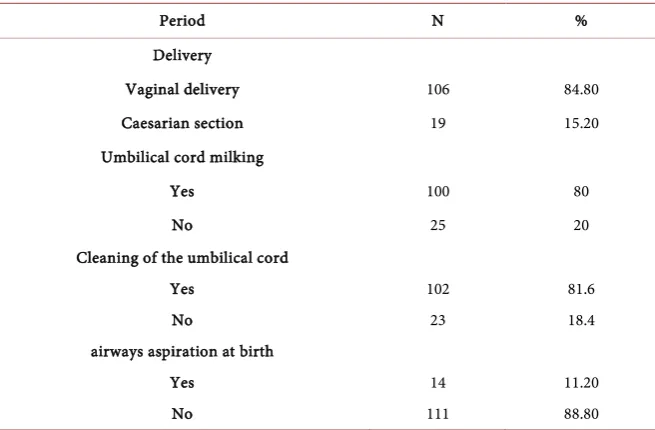
We had a total of 125 live births for which 14 (13.2%) benefited from episi-otomy. Vaginal delivery was conducted in 106 women (84.8%) and caesarean in 19 (15.2%). The four-hourly vaginal digital examination was respected in 99 parturients (86.08%), while vulvo-vagina cleaning with chlorhexidine during va-ginal examination was done in 114 women (99.13%). Fourteen newborns (11.2%) benefited from airways aspiration at birth (Table 4).
At birth, all the 125 newborns (100%) received warm bath in chlorhexidine solution after birth and were given Nevirapine syrup. Formula feeding was the feeding method for 106 cases (84.8%). All mothers received correct information on the duration of the Nevirapine regimen for their babies according to the me-thod of feeding.
4. Discussion
[image:4.595.209.540.504.703.2]On the availability of ARV drugs, our study outlined the effectiveness of the PMTCT of HIV. This finding is similar to that of Doherty T who reported in 2009 that 93% of health facilities in Cameroon had rapid tests and ARV drugs for PMTCT of HIV [3]. In the same year, Labhart in a study to assess the PMTCT
Figure 1. Distribution of the women according to the number of years under ARV before
Figure 2. Distribution of the pregnant women detected in pregnancy according to the trimester.
Figure 3. Distribution of the HIV-positive known pregnant women, according to the beginning of
the ARV.
Table 3. Distribution of women according to the follow-up of the pregnancy.
Variables Women with HIV
N %
Period of diagnosis
Before pregnancy 156 54.36
During pregnancy 131 45.64
Therapeutic combination
Bitherapy 174 60.60
[image:5.595.165.539.586.736.2]Table 4. Distribution according to delivery.
Period N %
Delivery
Vaginal delivery 106 84.80
Caesarian section 19 15.20
Umbilical cord milking
Yes 100 80
No 25 20
Cleaning of the umbilical cord
Yes 102 81.6
No 23 18.4
airways aspiration at birth
Yes 14 11.20
No 111 88.80
services in rural Cameroon found out that rapid tests and material for sampling of venous blood were only in 63% of hospitals and only 23% had ARV drugs for PMTCT HIV [4]. This difference can be explained by the fact that our study was carried out in an urban setting and in only two referral hospitals.
On the treatment with ARV drugs, 62.82% of women screened positive before pregnancy were on ARV triple therapy. This finding is similar to that of others who reported 59.44% and 56.80% [5] [6]. This is the first line treatment for HIV-infected persons recommended by WHO.
All the 287 HIV seropositive pregnant women in our study were on ARV drugs. The problem we identified was between initiation of prophylaxis and treatment which was done late in pregnancy for newly tested pregnant women. For the pregnant women who started their booking antenatal consultation in the second trimester of pregnancy, only 22.14% were initiated to ARV drugs between 14 to 27 weeks of pregnancy. We also observed that only pregnant women screened HIV positive before pregnancy received ARV drugs from their booking antenatal consultation, according to WHO’s recommendation the management of HIV positive pregnant women as soon as they arrive the health facility [7].
We also observed in our study that pregnant women who knew their HIV se-ropositive status before pregnancy started their booking antenatal consultation earlier. 70.21% of these women were booked for ANC in the first trimester against 25.20% of those who ignored their HIV serology before pregnancy ex-plaining their late initiation of ARV drugs. Most pregnant women were on bio-therapy 60.60% while 39.40% were on triple bio-therapy.
Amongst the newly HIV screened pregnant women, 77.89% started ARV drugs from 28th week of pregnancy due to the late HIV screening which is a real problem in our setting.
vaginally. Similar findings were reported by Kantome in Cotonou (83.3%) and Manefoue in Yaoundé (98.8%) [6][8]. These results are different from those of Mandelbrot L who reported 40% to 45% of vaginal birth in HIV seropositive pregnant women between 1999 and 2000 in the USA and 78% in Europe [9] [10]. He reported that elective caesarean deliveries associated to ARV drugs re-duced the rate of mother-to-child transmission of HIV to 2% in developed countries.
5. Conclusion
We can conclude that PMTCT of HIV services is very well presented in the hos-pitals where the study was carried out and that the WHO new directives were applied. Consequently HIV positive pregnant women screened before pregnancy had a better follow-up because they presented early in pregnancy for booking ANC.
Limitations of the Study
Our study was carried out in an urban area and in reference hospitals. The re-sults obtained may include a bias if extrapolated to rural areas that have specific difficulties.
References
[1] Third Demographic Health Survey. Cameroon 2011. [2] UNAIDS: 2014 Global Incidence of HIV. www.unaids.org
[3] Doherty, T., Chopra, M., Nsibande, D. and Mogoma, D. (2009) Improving the Cov-erage of the PMTCT Program through a Participatory Quality Improvement Inter-vention in South Africa. BMC Public Health, 9, 406.
https://doi.org/10.1186/1471-2458-9-406
[4] Labhardt, N.D., Manga, E., Baki, J.R., Bischoff, A. and Stall, B. (2009) Early Assess-ment of the ImpleAssess-mentation of a National Program for the Prevention of Mother to Child Transmission of HIV in Cameroon and the Effects of Staff Training: A Survey in 70 Rural Health Care Facilities. Tropical Medicine & International Health, 14, 288-293. https://doi.org/10.1111/j.1365-3156.2009.02221.x
[5] Diallo, M. (2003) VIIème congrès de la SAGO, IIème congrès de la SOMAGO. Abstract.
[6] Mody, C. Suivi de la PEC des femmes enceintes séropositives au VIH sous trai- tement ARV dans le cadre de la PTME dans le service de gynécologie obstétrique au CHU.
[7] WHO (2015) Prevention of Mother-to-Child Transmission of HIV. www.who.int [8] Kantome, G. (2003) Contribution à l’amélioration du suivi des enfants nés de mères infectés par le VIH dans le cadre de la PTME. Mémoire de santé publique. Cotonou IRSP.
[9] Manefoue, C. Etude épidémiologique de la transmission materno-fœtale du VIH chez les femmes enceintes au centre hospitalier les dominicains Saint-Martin de Porres Yaoundé. Mémoire VIH/SIDA.
Submit or recommend next manuscript to SCIRP and we will provide best service for you:
Accepting pre-submission inquiries through Email, Facebook, LinkedIn, Twitter, etc. A wide selection of journals (inclusive of 9 subjects, more than 200 journals)
Providing 24-hour high-quality service User-friendly online submission system Fair and swift peer-review system
Efficient typesetting and proofreading procedure
Display of the result of downloads and visits, as well as the number of cited articles Maximum dissemination of your research work