*For correspondence:Anthony. [email protected] Competing interests:The authors declare that no competing interests exist. Received:03 May 2018 Accepted:20 August 2018 Published:23 January 2019 Author Keywords:patient safety, education and standards, qualitative research, research methods, care of the elderly, patient groups
Copyrights2019, The Authors; DOI:10.3399/
bjgpopen18X101625
Processing discharge summaries in
general practice: a qualitative interview
study with GPs and practice managers
Rachel A Spencer,
BMedSci, MRCGP1,2,3, Sarah Rodgers,
PhD4,
Ndeshi Salema,
PhD5, Stephen M Campbell,
PhD6,7,8, Anthony J Avery,
PhD9,10*
1
NIHR Career Progression Fellow, Division of Primary Care, School of Medicine,
University of Nottingham, Nottingham, UK;
2NIHR Career Progression Fellow,
Division of Primary Care, University of Warwick, Coventry, UK;
3NIHR Career
Progression Fellow, NIHR School for Primary Care Research, Oxford, UK;
4Principal
Research Fellow, Division of Primary Care, School of Medicine, University of
Nottingham, Nottingham, UK;
5Senior Research Fellow, Division of Primary Care,
School of Medicine, University of Nottingham, Nottingham, UK;
6Professor, Centre
for Primary Care, University of Manchester, Manchester, UK;
7Director, NIHR
Greater Manchester Patient Safety Translational Research Centre, University of
Manchester, Manchester, UK;
8Professor, NIHR School for Primary Care Research,
Oxford, UK;
9Dean of the School of Medicine and Professor of Primary Health Care,
Division of Primary Care, School of Medicine, University of Nottingham,
Nottingham, UK;
10Professor, NIHR School for Primary Care Research, Oxford, UK
Abstract
Background: Discharge summaries are essential for communicating patient information from secondary care to general practice on hospital discharge. Although there has been extensive research into their design and completion in secondary care, very little is known about primary care processing of these documents.
Aim:To explore what general practice staff think are the factors associated with failure to respond to actions requested in discharge summaries and what practices do to mitigate this.
Design & setting: Semi-structured interviews were undertaken with primary care staff in three geographical regions of England.
Method:Interviews with 10 practice managers and 10 GPs (one of each at each of the 10 practices) were undertaken to explore management of discharge summaries.
Results:Five themes emerged from the interviews. The ’secondary care factors’ theme describes participants’ perspectives on the design of summaries, which are inconsistent and often require improvement. The ’safety features of processing systems’ theme focuses on document handling in primary care. A theme devoted to ’medicines reconciliation’ followed. ’Error and harm as a result of faulty processing’ is a theme describing ‘human error’ and other factors that participants believed contributed to failure to respond to requested actions. Finally, the ’strategies for safety improvement’ theme describes initiatives to prevent failures of safer transitions of care.
How this fits in
All GP practices handle discharge summaries for older patients on a daily basis. The authors’ recent paper in the British Journal of General Practice1
shows that discharge summary processing for this cohort is imperfect nearly half of the time, but little is known about why this might be the case. Therefore, the views of key staff in general practices were sought to discover what they believed were the reasons for incorrect processing and how this might be avoided. Based on the findings, a list of recommendations have been built for practices and hospitals to use to achieve safer care transitions.
Introduction
The importance of high-quality safe care transitions, especially for older patients, is well described by public bodies.2,3
Unfortunately, care transitions are not always ideal: one in every five emergency admission patients has been discharged in the previous 48 hours.4
Healthwatch emphasises the importance of support continuing after the discharge event5
and, given the correct communication, general practice can facilitate this support. Discharge summaries, which are an essential link in the care transition information flow chain, have been intensively researched in secondary care,6
but little is known about how they are processed in primary care. Patients are potentially at risk of medica-tions errors and lack of necessary follow-up should discharge summaries fail to be correctly proc-essed. Error reports about discharge processes submitted by GPs to the National Reporting and Learning Service show that over three-quarters of patients involved in these reports had been harmed, but most of these reports focused on secondary care errors.7Previous qualitative research relevant to discharge summaries in primary care has focused on discharge summary design8rather than perceptions of the problems that occur within primary care systems. Previous work studying information flow from secondary to primary care identified common features of GP systems and highlighted the need for further investigation.9
As the burden of administrative workload in general practice increases (including potentially inappropriate delegation from secondary care), the chal-lenge is to process this work safely. There is a paucity of specific guidelines on how to do this (although toolkits and care bundles addressing care transitions do exist).10,11
The qualitative work presented here was part of a wider mixed-methods study showing that fail-ures occur in the processing of almost half of discharge summaries.1
The research question was: what do general practice staff think are the factors associated with failure to respond to actions requested in discharge summaries and what can practices do to mitigate this?
Method
This was a qualitative semi-structured interview study with general practice staff using framework analysis. The mixed-methods approach to the research problem necessitated a practical approach to qualitative epistemology.12 The principles of social constructivism were followed, which allowed healthcare staff to share their stories of ‘why’ they do not adhere to instructions ‘given’ to them. At each site the lead researcher began by scrutinising in detail the information flow systems in opera-tion by observing administrative staff handling paper and electronic mail, including discharge sum-maries (a case-study approach).13
For this reason, administrative staff perspectives were not sought again at interview. Questions about high-level procedural operations were also considered more suited to managerial level interviewees. Field notes were used to construct flow diagrams of each individual practice’s system, using techniques adapted from healthcare failure modes effects analysis.14
To facilitate discussion, these diagrams were sent to participants some weeks before the interview, along with quantitative data1and case vignettes of any harms detected.1
Interviews were conducted at the participating general practices in three areas of England. Ten practices were purposively sampled for the study1 from volunteer sites in the East Midlands, West Midlands, and in the North West to include a range of list sizes and different clinical information technology systems. Participants (senior GPs and practice managers from those 10 practices) were individually consented and none dropped out of the study.
professionally transcribed. To ensure accuracy of transcription, all were checked by the lead researcher, following best practices for framework analysis.15
Transcripts were anonymised and emailed to participants for them to check. Coding was managed in NVivo (version 10). The frame-work was developed by the lead researcher in an iterative process, as described in frame-worked examples provided in framework methodology literature.15A code book was subsequently developed by two members of the practice team. Quality of coding was checked at a face-to-face meeting with co-authors with qualitative expertise.
Results
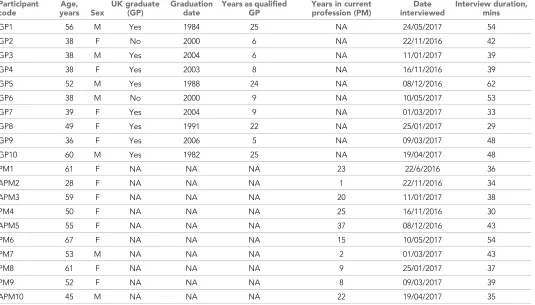
Twenty interviews (of 29–62 minutes duration) were conducted. Descriptions of the practices and participant demographics are shown inBox 1andTable 1respectively.
Five main themes emerged from the interviews; these are detailed, along with their subthemes, inBox 2. The order of the themes follows the journey of the discharge summary document, from creation in secondary care through primary care administrative systems, to clinical processing (where error or harm might occur), and finally to strategies for safety improvement, where system redesign in response to these errors has happened. Most themes map closely to the original semi-structured interview schedule, but ‘secondary care factors’ emerged de novo. Some minor subthemes are not reported on here owing to word limit constraints (seeBox 2subthemes in brackets).
Secondary care factors
Despite secondary care issues not being directly raised by the interviewer, it was clear that GPs, in particular, wanted to highlight some of their frustrations with discharge summaries and make sug-gestions for improvement. GPs felt strongly about delegation of workload from secondary to pri-mary care. Delegation (of referrals and tests) was cited in four harm cases discussed during the interviews. Most GPs reluctantly accepted delegation as part of their working lives, sometimes citing that they might be the best placed clinician to undertake the actions requested of them:
Box 1. Descriptions of participating general practices
Practice
number Description
1 An urban training practice in the East Midlands with an average list size using SystmOne 2 A suburban training practice in the East Midlands with a larger than average list size using
SystmOne
3 A rural training practice in an affluent (IMD <10) area of the East Midlands, with a larger than average list size using SystmOne
4 An urban training practice in a socioeconomically deprived (IMD >40) area of the East Midlands with an average list size using Emis Web
5 A suburban practice in a socioeconomically deprived (IMD >40) area of the East Midlands with an average list size using SystmOne
6 An urban training practice in a socioeconomically deprived (IMD >40) area of the West Midlands with a smaller than average list size using Emis Web
7 An urban training practice in the West Midlands with an average list size using SystmOne 8 A suburban practice in the East Midlands with an average list size using SystmOne
9 A suburban training practice in the North West with a smaller than average list size using Emis Web
10 An urban training practice a socioeconomically deprived (IMD >40) area of the North West. ‘Super-surgery’ (list size >20 000) using Emis Web
’Two people who[request]loads of actions for us. . . that is the renal physicians and the falls team. Okay, so there is always like five actions every time they write to you but at least you know that and you know there is a section that says GP action, okay and so you go: "Oh god another one of these, okay let’s do all of their actions for them."’(GP1, 56 year old male)
[image:4.612.39.574.70.375.2]A few GPs were active in their rebuttal of work, particularly chasing test results, but admitted that this probably took up more of their time than just completing the required activity. There was con-cern among practice managers that poor understanding of healthcare finances might lead to inap-propriate delegation:
Table 1.Participant demographics
Participant code
Age, years Sex
UK graduate (GP)
Graduation date
Years as qualified GP
Years in current profession (PM)
Date interviewed
Interview duration, mins
GP1 56 M Yes 1984 25 NA 24/05/2017 54
GP2 38 F No 2000 6 NA 22/11/2016 42
GP3 38 M Yes 2004 6 NA 11/01/2017 39
GP4 38 F Yes 2003 8 NA 16/11/2016 39
GP5 52 M Yes 1988 24 NA 08/12/2016 62
GP6 38 M No 2000 9 NA 10/05/2017 53
GP7 39 F Yes 2004 9 NA 01/03/2017 33
GP8 49 F Yes 1991 22 NA 25/01/2017 29
GP9 36 F Yes 2006 5 NA 09/03/2017 48
GP10 60 M Yes 1982 25 NA 19/04/2017 48
PM1 61 F NA NA NA 23 22/6/2016 36
APM2 28 F NA NA NA 1 22/11/2016 34
APM3 59 F NA NA NA 20 11/01/2017 38
PM4 50 F NA NA NA 25 16/11/2016 30
APM5 55 F NA NA NA 37 08/12/2016 43
PM6 67 F NA NA NA 15 10/05/2017 54
PM7 53 M NA NA NA 2 01/03/2017 43
PM8 61 F NA NA NA 9 25/01/2017 37
PM9 52 F NA NA NA 8 09/03/2017 39
APM10 45 M NA NA NA 22 19/04/2017 35
Practice 1 is the working site of GP1 and practice manager 1, practice 2 is the working site of GP2 and PM2, and so on. APM = assistant practice manager. NA = not applicable. PM = practice manager.
Box 2. Main themes and subthemes (subthemes in brackets are not reported on in this article)
1.Secondary care factors: ‘ideal’ discharge summary, delegation, (safety of transfer and NHS pressures)
2.Safety features of discharge summary processing systems: continuity of care, (team-working), protocols and procedures, training, staff numbers, and workflow targets
3.Medicines reconciliation: communication with patients, (medicine and/or patient related factors), pharmacy intervention, and prescribing roles 4.Error and harm as a result of faulty processing of discharge summaries: causes of error and/or harm, time and/or workload pressures, communication about error and/or harm, and harm severity and/or preventability
’They are very quick to throw it to primary care without even understanding what costings we have in our budgets to actually do some of the things they request us to do and I think that is where some of the problems lie.’(PM9, 52 year old female)
Standardisation of the structure of a discharge summary was highlighted as an important issue with emphasis on clarity and the need for a ‘GP action’ box:
Depending on how they’re written, there should be a GP action point at the bottom. . . that would be the best place to put things, not in the ‘this is what happened’, big paragraph at the front.’(GP8, 49 year old female)
The accuracy of the medications reconciliation part of the discharge summary was a recurrent frustration, even in the East Midlands where substantial efforts had been made to standardise it by assigning codes to medications to indicate whether medications are new, changed, or unchanged:
16
’Having the thing in the medication where there was something new or added or changed, that was quite helpful, certainly people can then pick it up from there but you have a degree of scepticism to make sure you have checked everything else as well because they can get it wrong sometimes.’(GP2, 38 year old female)
The accuracy of the medications reconciliation section of the summary appeared worse in the other geographical regions, especially in the West Midlands, where there was a particular problem with the pharmacist’s hand annotations in coloured pen, which frequently scanned poorly:
Sometimes the discharge letter tells you ‘new’ tablets. . .but it doesn’t sort of say stop other ones that they might already be on. . .Sometimes you can’t read them, if they are written they are absolutely horrendous.(PM6, 67 year old female)
The simple intervention or alphabetisation of the medications reconciliation part of the summary was mentioned by several participants. This would then place the drugs in the same order as that occurring on the GP’s system.
Safety features of discharge summary processing systems
Continuity of care emerged as a major subtheme in relation to the systems practices had for proc-essing discharge summaries, where sending the summary to the ‘right’ clinician was an integral part of the process. Clinicians felt they could offer an enhanced service for patients they knew better, expressing personal pride and professional curiosity in following up certain patients, particularly when significant diagnoses had been made:
’I just kind of see the names, if I recognise them it makes it so much easier. . .I would give them a call, especially if knew them or whoever had been looking after them, I would say we need to call this person because they have developed cancer or whatever.’(GP7, 39 year old female)
A trade-off was described between getting the ‘right’ clinician for the summary versus the need to process it in a timely fashion. Four of the 10 practices had systems that ensured discharge summa-ries were processed by clinicians on the day of arrival. In the other practices, participants felt that a week was a reasonable target for clinical processing. Managers described difficulties with getting the document to the ‘usual’ or referring clinician, but felt the effort was required for better patient care:
’It[work-flowing the summary]feels such a trivial. . . well it is not trivial because it should go back to the person that referred them, but you know sometimes trying to unpick all of that is an onerous task.’(PM8, 61 year old female)
Medicines reconciliation
strategy to improve patient safety at discharge from hospital,18
and guidance for general practice does exist.19
Some responders felt it was impracticable to discuss medicines reconciliation with patients or carers following hospital discharge, but frequently expressed hope that it had been done in hospital:
’Well I would hope that the hospital have discussed their medicine changes if they initially prescribed them . . . not just wandered around randomly giving them something to take or something taken off.’(GP8, 49 year old female)
At the same time, participants identified problems with this approach, particularly in relation to vulnerable patients and their carers. Time was cited as a barrier to calling patients about medicines reconciliation, but the majority view was that this would be desirable:
I think ideally that[calling patients]would be great. . .that is an additional workload. . .it is a definite positive if it was feasible to do it. . .for a lot of people it probably would either be a reassurance or flag up if they are aware of what the change has been from hospital.(GP4, 38 year old female)
The prevailing view of practice managers was that medicines reconciliation was outside the role of practice receptionists, although participants did acknowledge that, with appropriate training, pre-scriptions clerks could undertake this role:
’It is an awful risk isn’t it? Putting new medication on? You have no idea what these things are for or. . .any dangers about dosage or, you know, no it is absolutely a no-no ... we decided doctors put it on, because. . .if they have got to check it, they may as well do it.’(PM8, 61 year old female)
One practice had already invested heavily in training their receptionists to manage medicines rec-onciliation, but the GP described some resistance to the changes:
’What we keep telling[them], because some of them were reluctant to make changes, is that the final responsibility lies with the GP so you know nothing gets filed until we sign it off so if there is any medication errors we should be double-checking. . .there is always the safety net.’(GP3, 38 year old male)
Participants were generally positive about having a pharmacist in practice to perform medicines reconciliation, but most cited lack of funding as a major barrier:
’It would be a very useful role but it would cost the same as having another doctor and another doctor would probably be more useful.’(GP1, 56 year old male)
Error and harm as a result of faulty processing of discharge summaries
Participants described a number of interrelated active and latent failures20
across a broad range of activities.21For example, distraction as an element of slips and lapses was described, alongside time and workload pressures in the working environment:
It is not an ideal world and things do. . .either get missed or I am going to do that in a minute and then something else happens and. . . you know you sort of forget about what you were going to deal with because something else has cropped up.(PM6, 67 year old female)
GPs described slips and lapses occurring owing to overfamiliarity with the work:
’We become a bit snow blind that we sort of read of "Oh yes somebody in with an infection exacerbated their COPD and blah, blah, blah. P.S. They were in acute renal failure please check their U&Es[urea and electrolytes]again."’(GP5, 52 year old male)
’You have got like 130 to go through, some people may not be as careful as others and that is human.’(APM3, 59 year old female)
The majority of practices did not have dedicated time for GPs to do administrative work, necessi-tating GPs to process summaries in what was already a very full day, taking advantage of ’the squeezed in-between time’(GP4, 38 year old female), or resorting to after-hours working:
I have a laptop that has access to the medical record which I take home, so nine o’clock at night, ten o’clock at night, I do it.(GP5, 52 year old male)
Many GPs described acceptance of the increasing problems of trying to keep on top of their workload:
’I used to love trying to clear my inbox but I just accepted I am never going to do it. . .we have sort of a warning system where we have to clear them within so many days so I get those done and the rest can wait until the next tranche, you know.’(GP10, 60 year old male)
The mismatch between Electronic Document Management Systems (EDMS) and clinical IT sys-tems was often implicated as contributing to errors:
’It is sometimes difficult on a, you know, electronic format that you’re flitting between screens trying to see what is going on and you sometimes will miss stuff.’(GP5, 52 year old male)
Strategies for safety improvement
Opinion on which personnel should process summaries was divided. Some were vehemently against the extension of administrative staff roles owing to safety concerns stating that’Important things like discharge letters should be scanned to the GP,’(GP8, 49 year old female) while others could see time and efficiency savings from engaging administrative staff but still had concerns about safety, duplication of workload, medicolegal issues, and training:
’I think that would need protected time as well so I don’t think I would mind it if they could dedicate their full attention to it but definitely not as a sideline, as they are answering the phones and on reception.’(APM2, 28 year old female)
Methods to improve discharge summary processing suggested by participants included: priority scanning, priority marking in the EDMS, and creation of an on-the-day workflow. Although clinical IT was reported as having potential to improve the processing of summaries, two practices had reverted to paper systems for discharge summaries specifically, and many GPs were printing summa-ries in order to reconcile medications. Electronic ‘task’ systems were both the solution to, and the cause of, problems with summary processing.
Read-coding actions was a strategy at one practice, which ran daily searches for codes (such as requirement for blood tests), which were inputted by their doctors when processing a summary. The administrative team at another practice used the ‘diary’ function of their clinical systems in a similar manner, checking for completed actions regularly and sending them back to clinicians. Using IT strat-egies to improve medicines reconciliation was considered desirable, as was alignment of primary and secondary care IT systems. Positive experiences of the Salford integrated care record22
were described by some participants:
Discussion
Summary
Twenty in-depth interviews were conducted with senior general practice staff in three different parts of England on a novel topic. Participants identified concerns with design and completion of dis-charge summaries. They offered reasons for incorrect processing in general practice and described strategies they had used to mitigate against this. Recommendations for safer management based on the findings are described inBox 3.
Strengths and limitations
Using a single interviewer helped to ensure consistency; the lead researcher had already investigated the practices’ systems and was able to approach the interviews fully informed of this information. The team approach to the interview schedule design and subsequent quality-checking during the analysis of data served to minimise bias. A GP interviewer and the lack of anonymity could be seen as limitations but, as the results suggest, practice staff were able to speak candidly about a taboo subject. Indeed, participants may have been more welcoming of analysis of their highly personal sys-tems by a perceived ‘insider’. The occurrence of de novo themes and the presence of divergent views are indicative of theoretical saturation that allowed a narrative to be developed. The in-depth interviews were adequate in length and conducted with appropriate participants from a culturally cohesive sample. Thematic saturation has been achieved, evidenced by no new ideas emerging
Box 3. Recommendations for safer processing of discharge summaries
Discharge summary design
. Standardised structure . ‘GP action’ box
. Alphabetisation of medications listing
. Highlight changed medication (for example by using standard codes) . Do not allow ‘hand annotations’
Primary care administration team
. On-the-day workflow system for electronic documents . Priority scanning for paper discharge summaries
. Priority flag discharge summaries within the electronic mailbox
. Protected time and workspace for administrators involved in processing discharge summaries
. Aim for usual or referring GP to process the discharge summary unless this will lead to potentially hazardous delay
Primary care clinical team (or trained administrative personnel)
. Prioritise higher-risk patients and/or carers to contact for medications reconciliation
. Consider making free-text entries about clinical decisions taken after reading the discharge summary (this could be recorded at the place where
the discharge summary document can be seen in the facing electronic record)
. Consider using a clinical pharmacist to assist with medicines reconciliation . Use IT to track actions; for example, electronic tasks, coded actions, diary functions
. Protected time and workspace for GPs and other colleagues involved in taking action in relation to requests in discharge summaries
Wider systems redesign
. Enable visualisation of discharge summary and electronic health record at same time (split screen or two screens)
. Consider creating a template or consultation style in the electronic record (where possible, Read coded) to process the discharge summary; for
example, data-entry points for diagnosis, significant test results, medication changes, discussions with patients and/or carers, and outstanding actions
. Interoperability of primary and secondary care IT systems to allow for co-creation of the discharge summary. GPs would be able to comment on
toward the end of the interview (except in the ‘improvement strategies’ theme, where it was not anticipated).
Comparison with existing literature
Participants felt that electronic discharge summary design had scope for improvement, echoing pre-vious findings.21
Delegation of workload to primary care remains a contentious issue, as demon-strated in other primary care provider interviews23,24 and, despite guidelines to the contrary,25 some participants felt that hospitals were not taking responsibility for follow-up of diagnostic test results at discharge from hospital.
Participants had strong feelings that discussion of medicines changes initiated by hospitals should be discussed with patients by secondary care staff at the point of discharge. GP participants did not feel they could rely on the hospital to do this, but noted a lack of time to do it themselves. National Institute for Health and Care Excellence (NICE) guidelines19 state that medicines reconciliations should be discussed with patients and carers. International attempts to impose requirement to dis-cuss medicines reconciliation with patients in hospital have not always proved successful,26,27 although clear efforts are being made by secondary care to standardise the discharge experience.16
Direction of resources into primary care could allow GPs to perform the quality medi-cines reconciliation that they are perhaps best placed to deliver. The prevailing view of the partici-pants was against delegation of prescribing responsibility to non-clinicians (mainly owing to safety and medicolegal concerns). The new ’pharmacist in general practice’ role was clearly welcomed by participants as a resource in medicines reconciliation, but funding was considered a barrier,28 espe-cially at smaller practices. The roll out of the pharmacists in general practice scheme may help to generate evidence, which might overcome these concerns.29
Participants were able to identify a broad range of error-producing conditions, but did not dem-onstrate a sophisticated understanding of how and why they occurred. They struggled to connect active failures on a particular discharge summary to broader latent failures within practice systems. Organisational factors20
were particularly hard to demonstrate as participants were almost entirely uncritical of their own practice systems. There was a reluctance by participants to discuss the role of the individual in the occurrence of error, perhaps because of the widely established concept that patient safety should not be a punitive field.31,32
Current political thinking on medical errors empha-sises the need for the NHS to move away from a blame culture toward a learning culture.33
Systems need to be developed to mitigate human error, particularly to anticipate distraction from competing workload and time pressures (‘paperwork’ is GPs’ fourth most likely job stressor).34
Cultural norms in general practice may make it challenging to promote interventions that prioritise dedicated time for paperwork. Responsibility for processing clinical documents in general practice is increasingly becoming an administrative role35
as promoted by the prime minister’s challenge fund,22
but as par-ticipants described, GPs would struggle to hand over control of discharge summaries to non-clinical staff for fear of missing out on important clinical information.
Participants described IT interventions to reduce error: streamlining existing task and diary sys-tems and using Read-coded actions as failsafes for other syssys-tems. Interoperability of clinical syssys-tems both between secondary and primary care, and between practice clinical systems and EDMS, was considered highly desirable by the participants and is evidently achievable.36
IT systems for medi-cines reconciliation do exist in the US,37but adaptation to the UK would need careful consideration and input from stakeholders. Most practices in the study were employing safety systems that they had ‘invented’ in-house to address particular local problems; sharing these examples using the Royal College of General Practitioners ‘bright ideas’ scheme,37
could facilitate spread of the best of these interventions.
Implications for practice
Findings from the ’secondary care’ theme suggest that there needs to be improvements in the qual-ity of discharge summaries that are sent out from secondary care. Specific recommendations for dis-charge summary design, which are based on recurring subthemes present in the interview data, are included in Box 3. Hospitals should strive for standardisation and be reasonable in the requests made of primary care teams, particularly aiming to eliminate requests for follow-up of results of tests originating in secondary care.38Box 3
administrative team — such as protected time and/or workspace, and aiming for continuity of care while preserving timely transfer to doctors — and, for clinicians, suggestions about when and how decisions relating to discharge summaries should be documented. The participants were concerned about responsibility for medicines reconciliation, and this issue needs legal clarification as a follow-up to the Care Quality Commission report of 2011,30
with consideration of the role of the pharma-cist both in primary and secondary care. Strategies captured in the ’safety improvement’ theme indi-cate that there are implications for improvement of general practice systems (including IT) providing important opportunities for future research (see ‘wider systems redesign’,Box 3). More funding to alleviate pressure in general practice might allow practitioners to dedicate more time to tasks, such as carefully checking discharge summaries, thereby addressing the workload concerns of partici-pants. Indeed, establishing administrative time for GPs (similar to that given to consultants as part of their Supporting Programmed Activities)39
might help embed this activity into the working week of GPs and help them to maintain personal responsibility for clinically important administrative work, which the participants desired. If processing discharge summaries becomes a task for administrative staff then resources need to be directed to set aside protected time for this activity in order to address the participants’ concerns on this matter.
This study has shown that general practice staff can identify where processes for managing dis-charge summaries might be improved by better documentation; development of IT; protection of workspace and time; and by enhanced communication with patients. The participants describe a need for consistency in the use of information in discharge summaries by secondary care, especially about results handling and medicines reconciliation. Such consistency and easy-to-understand stand-ardisation should be assigned ‘Always Events’ status (a strategy to ’accelerate improvement efforts to enhance experiences of care for patients’).39
More work is needed to characterise the safety interventions already in place in practices across the UK and to identify how actions can be proc-essed most reliably and effectively in general practice.
Funding
This work was completed as part of an NIHR School for Primary Care Research Career Progression Fellowship awarded to the lead author, Rachel Spencer. Additional funding to undertake the work was received from the NIHR Greater Manchester Patient Safety Translational Research Centre (NIHR Greater Manchester PSTRC). The views expressed are those of the author(s) and not necessarily those of the NHS, the NIHR or the Department of Health.
Ethical approval
Ethical approval was given by NHS research ethics committee (15/WM/0442) and Confidential Advi-sory Group (16/CAG/0007).
Provenance
Freely submitted; externally peer reviewed.
Acknowledgements
The authors would like to express their thanks to the GPs and practices managers who participated in the study, Christina Sheehan for help and advice on gaining ethical approval, Claire Poxon for transcribing the audio files, and the National Institute for Health Research for funding this work.
References
1. Spencer RA, Spencer SEF, Rodgers S, et al. Processing of discharge summaries in general practice: a retrospective record review.Br J Gen Pract 2018;68(673):576–585.
2. National Institute for Health and Care Excellence. Transition between inpatient hospital settings and community or care home settings for adults with social care needs. [NICE Clinical Guideline No G27]. 2015. https://www.nice.org.uk/guidance/ng27/chapter/Recommendations#discharge-from-hospital(accessed 9 Jan 2019).
3. Kings Fund Report. Making our health and care systems fit for an ageing population. 2014.https://www. kingsfund.org.uk/publications/making-our-health-and-care-systems-fit-ageing-population(accessed 9 Jan 2019).
5. Healthwatch. What happens when people leave hospital and other care settings? Findings from the Healthwatch network. 2017.https://www.healthwatch.co.uk/sites/healthwatch.co.uk/files/20171004
_what_happens_when_people_leave_care.pdf. (accessed 16 Jan 2019).
6. Kripalani S, LeFevre F, Phillips CO, et al. Deficits in communication and information transfer between hospital-based and primary care physicians: implications for patient safety and continuity of care.JAMA
2007297(8):831–841.doi: 10.1001/jama.297.8.831
7. Williams H, Edwards A, Hibbert P,et al. Harms from discharge to primary care: mixed methods analysis of incident reports.Br J Gen Pract2015;65(641):e829 e837.doi: 10.3399/bjgp15X687877
8. Yemm R, Bhattacharya D, Wright D,et al. What constitutes a high quality discharge summary? A comparison between the views of secondary and primary care doctors.Int J Med Educ2014;5:125–131.doi: 10.5116/ ijme.538b.3c2e
9. Crowe S, Tully MP, Cantrill JA. Information in general medical practices: the information processing model.
Fam Pract201027(2):230–236.doi: 10.1093/fampra/cmp102
10. Royal College of General Practitioners. Patient Safety Toolkit for General Practice. 2017.http://www.rcgp. org.uk/clinical-and-research/toolkits/patient-safety.aspx(accessed 9 Jan 2019).
11. Healthcare Improvement Scotland ihub. Scottish patient safety programme: primary care. Safety across the interface.https://ihub.scot/spsp/primary-care/safety-across-the-interface/. (accessed 15 Jan 2019).
12. Creswell JW, Plano Clark VL. Examining preliminary considerations. In: Creswell JW, Plano Clark VLeds
Designing and conducting mixed methods research. Thousand Oaks, CA: Sage Publications. 2007. 20–37. 13. Baxter P, Jack S. Qualitative case study methodology: Study design and implementation for novice
researchers.Qual Rep2008;13(4):544–559.
14. Dean Franklin B, Shebl NA, Barber N. Failure mode and effects analysis: too little for too much?BMJ Qual Saf201221(7):607–611.doi: 10.1136/bmjqs-2011-000723
15. Gale NK, Heath G, Cameron E,et al. Using the framework method for the analysis of qualitative data in multi-disciplinary health research.BMC Med Res Methodol2013;13(1):117.doi: 10.1186/1471-2288-13-117 16. Mehta RL, Baxendale B, Roth K,et al. Assessing the impact of the introduction of an electronic hospital discharge system on the completeness and timeliness of discharge communication: a before and after study.
BMC Health Serv Res2017;17(1):624.doi: 10.1186/s12913-017-2579-3
17. Institute for Healthcare Improvement. Medication reconciliation to prevent adverse drug events. 2019. http://www.ihi.org/Topics/ADEsMedicationReconciliation/Pages/default.aspx(accessed 21 Jan 2019). 18. Kwan JL, Lo L, Sampson M,et al. Medication reconciliation during transitions of care as a patient safety
strategy: a systematic review.Ann Intern Med2013;158.(5_Part_2): 397–403.doi: 10.7326/0003-4819-158-5-201303051-00006
19. National Institute for Health and Care Excellence. Medicines optimisation: the safe and effective use of medicines to enable the best possible outcomes [NICE Clinical Guideline No 5]. 2015.http://www.nice.org. uk/guidance/NG5/chapter/1-recommendations#medicines-related-communication-systems-when-patients-move-from-one-care-setting-to-another(accessed 9 Jan 2019).
20. Reason J. The contribution of latent human failures to the breakdown of complex systems.Philos Trans R Soc B Bio Sci1990;327(1241):475–484.doi: 10.1098/rstb.1990.0090
21. Makeham MA, Stromer S, Bridges-Webb C, et al. Patient safety events reported in general practice: a taxonomy.BMJ Qual Saf2008;17(1):53–57.doi: 10.1136/qshc.2007.022491
22. Salford CCG. Salford integrated record. Sharing patient information locally. 2017.www.salfordccg.nhs.uk/ download.cfm?doc=docm93jijm4n524.pdf&ver=680(accessed 11 Jan 2019).
23. NHS England. Standards for the communication of patient diagnostic test results on discharge from hospital. 2016. https://www.england.nhs.uk/patientsafety/wp-content/uploads/sites/32/2016/03/discharge-standards-march-16.pdf(accessed 9 Jan 2019).
24. Go¨bel B, Zwart D, Hesselink G,et al. Stakeholder perspectives on handovers between hospital staff and general practitioners: an evaluation through the microsystems lens.BMJ Qual Saf2012;21(Suppl 1):i106– i113.doi: 10.1136/bmjqs-2012-001192
25. van Sluisveld N, Zegers M, Natsch S,et al. Medication reconciliation at hospital admission and discharge: insufficient knowledge, unclear task reallocation and lack of collaboration as major barriers to medication safety.BMC Health Serv Res2012;12:170.doi: 10.1186/1472-6963-12-170
26. Greenwald JL, Halasyamani L, Greene J,et al. Making inpatient medication reconciliation patient centered, clinically relevant and implementable: A consensus statement on key principles and necessary first steps.J Hosp Med2010;5(8):477–485.doi: 10.1002/jhm.849
27. Avery AJ. Pharmacists working in general practice: can they help tackle the current workload crisis?Br J Gen Pract2017;67(662):390–391.doi: 10.3399/bjgp17X692201
28. NHS England. Clinical pharmacists in general practice 2018. https://www.england.nhs.uk/gp/gpfv/ workforce/building-the-general-practice-workforce/cp-gp/(accessed 9 January 2019).
29. Leape LL. A systems analysis approach to medical error.Journal of Evaluation in Clinical Practice1997;3(3): 213–222.doi: 10.1046/j.1365-2753.1997.00006.x
30. British Medical Association NHS Employers. A guide to consultant job planning. 2011.https://www.ed.ac. uk/files/imports/fileManager/national-job-planning-guide-consultants.pdf(accessed 11 Jan 2019).
32. Department of Health and Social Care. The plan to reduce medication errors: Q&A with Jeremy Hunt and Professor Dame Sally Davies. 2018.https://www.youtube.com/watch?v=VxfgjM_iZGg(accessed 21 Jan 201 9).
33. Gibson J, Checkland K, Coleman A,et al. Eighth national GP worklife survey. http://www.population-health.manchester.ac.uk/healtheconomics/research/Reports/EighthNationalGPWorklifeSurveyreport/ EighthNationalGPWorklifeSurveyreport.pdf(accessed 21 Jan 2019).
34. NHS Networks. Medical assistants — workflow redirection in Brighton and Hove. 2016. https://www. networks.nhs.uk/nhs-networks/releasing-capacity-in-general-practice/documents/4-5-medical-assistants-workflow-redirection-in-brighton-and-hove/view(accessed 11 January 2019).
35. England NHS. Training for reception and clerical staffhttps://www.england.nhs.uk/gp/gpfv/redesign/gpdp/ reception-clerical/. 2018;.
36. Schnipper JL, Liang CL, Hamann C,et al. Development of a tool within the electronic medical record to facilitate medication reconciliation after hospital discharge.J Am Med Inform Assoc2011;18(3):309–313. doi: 10.1136/amiajnl-2010-000040
37. Royal College of General Practitioners. Bright ideas. 2017. http://www.rcgp.org.uk/clinical-and-research/ bright-ideas.aspx. (accessed 16 Jan 2019).
38. Care Quality Commission. National Study: Managing patient’s medications after discharge from hospital. 2009.http://webarchive.nationalarchives.gov.uk/20101122140156/http://www.cqc.org.uk/_db/_documents/ Managing_patients_medicines_after_discharge_from_hospital.pdf. (accessed 16 Jan 2018)
39. Institute for Healthcare Improvement for NHS England. Always Events Toolkit. 2018 https://webcache. googleusercontent.com/search?q=cache:XEE9mau8neEJ:https://www.england.nhs.uk/wp-content/