ISSN Online: 2327-5227 ISSN Print: 2327-5219
DOI: 10.4236/jcc.2019.72002 Feb. 11, 2019 23 Journal of Computer and Communications
An Efficient Identity-Based Homomorphic
Broadcast Encryption
Mei Cai
IT Department, Jinan University Library, Guangzhou, China
Abstract
Broadcast encryption (BE) allows a sender to broadcast its message to a set of receivers in a single ciphertext. However, in broadcast encryption scheme, ciphertext length is always related to the size of the receiver set. Thus, how to improve the communication of broadcast encryption is a big issue. In this paper, we proposed an identity-based homomorphic broadcast encryption scheme which supports an external entity to directly calculate ciphertexts and get a new ciphertext which is the corresponding result of the operation on plaintexts without decrypting them. The correctness and security proofs of our scheme were formally proved. Finally, we implemented our scheme in a simulation environment and the experiment results showed that our scheme is efficient for practical applications.
Keywords
Identity-Based, Broadcast Encryption, Homomorphic, Communication
1. Introduction
After been introduced by Fiat and Naor [1], broadcast encryption (BE) is widely studied and improved. BE allows a sender to broadcast its message to a set of re-ceivers in a single ciphertext. Compared with generating individual ciphertext for each of receivers, BE scheme is much efficient in terms of storage and com-putation. Due to the advantages, BE scheme is widely used in many applications, such as TV services [2], Cloud Storage [3], Emails [4] and so on. In order to eliminate the complicated certificate management of BE scheme in traditional public key setting, Baek et al. extended BE into identity-based setting and pro-posed the first identity-based broadcast encryption (IBBE) scheme [5].
Instead of using receivers’ public keys, the sender can encrypt its message un-der receivers’ identity set in IBBE scheme. This eliminates traditional public key infrastructure (PKI) for managing user’s public key. This scheme brings
con-How to cite this paper: Cai, M. (2019) An Efficient Identity-Based Homomorphic Broadcast Encryption. Journal of Computer and Communications, 7, 23-30.
https://doi.org/10.4236/jcc.2019.72002
Received: January 8, 2019 Accepted: February 8, 2019 Published: February 11, 2019
Copyright © 2019 by author(s) and Scientific Research Publishing Inc. This work is licensed under the Creative Commons Attribution International License (CC BY 4.0).
http://creativecommons.org/licenses/by/4.0/
DOI: 10.4236/jcc.2019.72002 24 Journal of Computer and Communications
venience, but the efficiency is not practical since the ciphertext size is related to size receiver set. To solve this problem, Delerablée proposed the first constant size ciphertext IBBE scheme [6]. After that, Gentry etal. focused on the security of IBBE scheme and proposed the first IND-CAP secure IBBE scheme in stan-dard model [7]. Their scheme also has short ciphertext. In 2016, He et al. pro-posed an efficient IBBE scheme which achieves anonymous and IND-CCA secu-rity simultaneously [8]. The ciphertext size of their scheme is not constant. However, due to their promising construction, the running time of decryption of their scheme is almost constant.
Although BE and IBBE schemes have many advantages for practical applica-tions, it is still not enough for variety of applications. Now we consider a sub-scription system. The service provider encrypts its different kinds of messages under corresponding subscribers’ identity sets and sends ciphertexts through networks. For one receiver, who subscribes two different messages, it must re-ceive two ciphertexts and decrypt them respectively.
However, in some scenarios, these two messages should be calculated into one. If the network devices, such as a gateway or a fog node, can calculate ci-phertexts and transforms them into a new one without decrypting them, the communication cost will be significantly reduced. Unfortunately, there is still no concrete identity-based homomorphic broadcast encryption construction.
In this paper, we propose present the formally definition of identity-based homomorphic broadcast encryption (IBHBE). Then we give a concrete con-struction based on [8]. The proposed scheme is formally proved for correctness and security, which achieves IND-CPA security in random oracle model. Finally, we also show that our scheme is efficient for practical applications.
The remainder of the paper is organized as followed. In Section 2, we review the preliminaries used in this paper. Then we propose our IBHEB construction and prove the correctness and security in Section 3. The performance evaluation is given in Section 5. Finally, we conclude this paper in Section 5.
2. Preliminaries
2.1. Bilinear Maps
On defining a group generator , it takes a security parameter and outputs a description of a bilinear map group =
(
p, , T,e)
, where p is a prime,
and T are multiplicative cyclic groups of order p, and e is a map
: T
e × → , such that:
Bilinearity: For all u v, ∈ and ∀a b, ∈p, there has
(
a, b)
( )
, ab e u v =e u v . Non-degeneracy: For any generator g of
,(
,)
1 T e g g ≠ . Computability: ∀u v, ∈, there exists an efficient algorithm to compute
( )
,e u v .
2.2. Decisional Bilinear Diffie-Hellman Problem
DOI: 10.4236/jcc.2019.72002 25 Journal of Computer and Communications
Definition 1. (Decisional Bilinear Diffie-Hellman Problem). Given a group generator , and its output =
(
p, , T,e)
. For a b c, , ∈p, a generator g of
and(
g g g
a,
b,
c)
, define whetherZ
=
e g g
( )
,
abc or not. For a probabilistic polynomial time (PPT) adversary , the advantage of solving the DBDH prob-lem is:(
)
(
, , , , , abc)
1(
, , , ,)
1 ,DBDH a b c a b c
Adv = Pr g g g g e g g = − Pr g g g g Z =
where $
T
Z← .
We say the DBDH problem holds in bilinear map =
(
p, , T,e)
if for anyPPT adversary, the advantage of solving DBDH problem DBDH
Adv is negligible.
2.3. Identity-Based Homomorphic Broadcast Encryption
An identity-based homomorphic broadcast encryption (IBHBE) scheme is an identity-based encryption, which supports a set of receivers to decrypt cipher-text. Suppose that the message space is , an identity-based broadcast encryp-tion has four probability polynomial time (PPT) algorithms and one protocol: Setup (λ). It takes input a security parameter λ, and outputs the public
parameter pp and a master secret key msk.
Extract (msk, ID). It takes input a master secret key msk and an identity ID, and outputs a private key skID.
Encrypt (pp, S, m). It takes input the public parameter pp, a receiver set S, and a message m, and outputs a ciphertext CT.
Decrypt (pp, skID, CT). It takes input the public parameter pp, a secret key 𝑠𝑠𝑠𝑠𝐼𝐼𝐼𝐼, and a ciphertext CT, and outputs a message m.
Eval (pp, CT0, CT1). By interacting with a receiver with identity ID∈S0S1, any entity can use the evaluation protocol to a helper value t for these two ciphertexts. Then the entity can use the helper value to calculate the two ci-phertext into a new one, which is a valid cici-phertext of the corresponding op-eration result of the two plaintexts of ciphertext.
Correctness. For all identity sets S S0, 1, messages m m0, 1, identity ID, if
(
pp msk,)
←Setup( )
λ , skID ←Extract msk ID(
,)
,(
)
0 , 0, 0
CT ←Encrypt pp S m , and CT1←Encrypt pp S m
(
, 1, 1)
, there has If ID S∈ 0, then Decrypt pp sk(
, ID,CT0)
=m0. If ID∈S0S1, then
Decrypt pp sk
(
,
ID,
Eval pp CT CT sk
(
,
0,
1;
ID)
)
=
m
0+
m
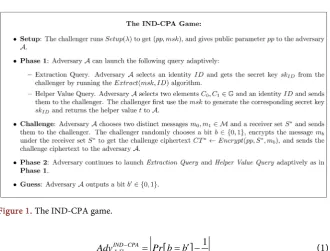
1. Security Model of IBBE. We consider IBBE under IND-CPA security model, which is captured in the following game (Figure 1).Note that, in Challenge step, the adversary cannot choose a receiver set * S which contains any identity is queried in Phase 1. Similarly, in Phase 2, the ad-versary cannot launch Extraction Query on any identity belonged to the receiver set *
S or any Helper Value Query on the challenge ciphertext.
Definition 2. We say an IBBE scheme
Π
is IND-CPA secure, if for any probabilistic polynomial time (PPT) adversary , the advantage to win the IND-CPA Game-, IND CPA
DOI: 10.4236/jcc.2019.72002 26 Journal of Computer and Communications
Figure 1.The IND-CPA game.
[
]
,
1 2
IND CPA
AdvΠ− = Pr b=b′ − (1)
3. Identity-Based Homomorphic Broadcast Encryption
In this section, we first introduce our identity-based homomorphic broadcast encryption. Then we give the correctness and security proofs of the construction.
3.1. Our Construction
Our IBHBE scheme contains four PPT algorithm and a one-round protocol. Setup (λ): The algorithm takes input a security parameter λ, and outputs a
bilinear map
(
p, , T,e)
←( )
λ . Here, p is a prime number,
andT
are p order multiplicative cyclic groups, and e is a bilinear map
(
)
: , T
e → . Then, it randomly picks generator g∈ and α ∈p, computes g1 g
α
= . It also defines message space =q and two secure
hash functions
H
1: 0,1
{ }
*→
, H2:T →q, where q is a prime number.Then it sets the master secret key msk=
α
and opens the public parameterpp as
(
p, , T, , , ,e q g g H H1, 1, 2)
. Extract (msk, ID): For a system user with identity ID, the algorithm gene-rates the user’s secret key as 1
( )
1( )
msk ID
sk
=
H ID
=
H ID
α. Encrypt (pp, S, m): Any user can run the encryption algorithm. For a mes-sage m∈ and a receiver set S=
{
ID ID1, 2,,IDn}
, the algorithm firstchooses random number r∈p, and computes r
C=g . Then for each
i
ID ∈S, it computes 2
(
(
1( )
, 1)
)
ri i
t =H e H ID g ,
( )
1(
)
mod
n i i
F x
=
∏
=x t
− +
m
q
. It computes the expansion formula of F x( )
as( )
0 modn j
j j
F x =
∑
= a ⋅x q. Then the ciphertext is CT=(
C,A)
, whereA
is a vector,
(
a a0, 1, ,an)
=
A (2)
DOI: 10.4236/jcc.2019.72002 27 Journal of Computer and Communications
ID
sk , the algorithm first computes
τ
=
H e sk
2(
(
ID,
C
)
)
. Then it sets a vectorT
as(
0 1)
, ,
,
n.
τ τ
τ
=
T
(3)Finally, it outputs the message as m= ⋅A Tmodq.
Eval (pp, CT0, CT1): Parse CT0 and C1 as
(
C A0, 0)
and(
C A1, 1)
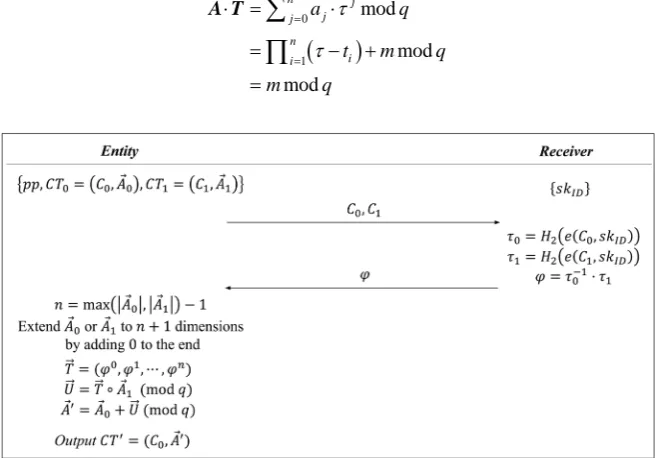
, which are encrypted under identity sets S0 and S1 respectively. Then, an external entity, such as a gateway, can generate a new ciphertext for a specified re-ceiver with identity ID∈S0S1. This protocol is shown in Figure 2. Here, the operation means the hadamard product of two vectors.(
A B) (
i = A Bi⋅ i)
.3.2. Correctness Proof
As claimed in Section 2.3, the correctness of our IBHBE scheme has two aspects. Next we give the detailed proof.
Proof. The correctness proof is described as follows.
For the first aspect, the condition to decrypt a ciphertext under identity set 0
S is that the receiver can computer a valid value x equaled one of ti. When a receiver with identity ID tries to decrypt a ciphertext CT0=
(
C,A)
en-crypted under identity set S0, it computes
(
)
(
)
(
(
( )
)
)
( )
(
)
(
)
(
(
( )
)
)
2 2 1
2 1 2 1 1
, ,
, , .
r ID
r r
H e sk C H e H ID g
H e H ID g H e H ID g α
α
τ = =
= =
If ID∈S0, the value τ must be one of ti to construct F x
( )
. Then we have(
)
0
1
mod
mod
mod
n j
j j n
i i
a q
t m q
m q
τ
τ
=
=
⋅ = ⋅
= − +
=
∑
∏
[image:5.595.209.537.476.705.2]A T
DOI: 10.4236/jcc.2019.72002 28 Journal of Computer and Communications Now we consider the second aspect. Suppose two ciphertexts CT CT0, 1 are encrypted under two identity sets S S0, 1. If the receiver’s identity ID is in
0 1
S S , then it can compute τ0 and τ1 which can be used to decrypt CT0 and CT1 respectively. Suppose the new ciphertext output from evaluation protocol is CT′=
(
C0,A′)
. The receiver first computes τ τ= 0, then decrypts the ciphertext by calculating(
)
(
)
(
)
0
0, 0 0, 0 0 0,
0 0
0 0 1,
0 0 1,
1 0 0 1, 0 1
0 1
mod
mod / / ,
mod
mod
mod / /
n j
j
n j n j
j j j j
j j
n j j
j j j n j j n j j j j j a q
a u q a a u
m a q
m a q
m a q
m m
τ
τ τ
ϕ τ ϕ τ
τ ϕ τ τ
= = = = = − = ′⋅ = ′⋅ ′ ′ = ⋅ + ⋅ = + = + = + ⋅ ⋅ = + ⋅ ⋅ = + ⋅ = ⋅ = +
∑
∑
∑
∑
∑
∑
A TA A U
Then we finish the correctness proof of our IBHBE scheme construction.
3.3. Security Proof
In this section, we give the formalized security proof of our IBHBE scheme un-der random oracle model.
Theorem 1. Suppose H1 and H2 are random oracles, and the DBDH problem holds, then our IBHBE construction is IND-CPA secure.
Proof. Suppose there exists a PPT adversary has non-negligible advantage to win the IND-CAP game, then an other PPT adversary can use ’s abil-ity to break the DBDH problem.
Note that, the first part of a valid ciphertext is a mask value of a valid cipher-text of Boneh and Franklin’s identity-based encryption scheme [9]. Since the scheme [9] is IND-CPA secure against PPT adversary, then the no one can dis-tinguish random values between tis, which are used to construct the function
( )
F x .
Now we focus on the elements of . We have 0 1
( )
ti i
a
=
∑
=− +
t
m
. As weal-ready know ti is indistinguishable from random number. Therefore, no one can restore even one-bit information of m from a0 since 1
( )
n i i=
−
t
∏
is also random.4. Performance
In this section, we give the performance experiments of our construction. All the programs were executed on a personal laptop equipped with Ubuntu 16.04 op-eration system, Inter(R) Core(TM) i5-8200 CPU @ 2.5 GHz processor and 8G DDR3-RAM. A 1000 Mbps LAN is used to support the evaluation protocol. The programs are implemented with java (JDK 1.8) and jPBC library [10]. We set security parameter with λ=80, choose bilinear group with a 160-bit, and
512
p = q = . All experiment results are averaged over 1000 runs.
DOI: 10.4236/jcc.2019.72002 29 Journal of Computer and Communications (a) (b)
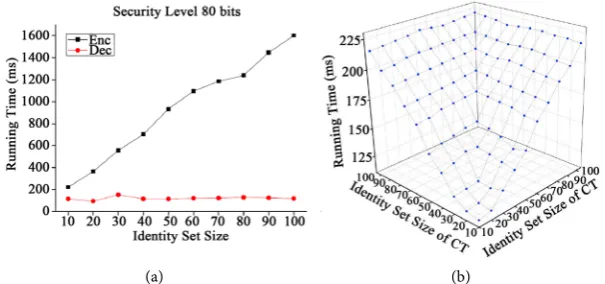
Figure 3.Experimental results. (a) Running time of enc and Dec protocol; (b)Running time of eval protocol.
decryption algorithm is constant complexity and the encryption algorithm is li-nearly dependent with the size of identity set. The result also indicates that our scheme is efficient since the running time of encrypting a message under 50 re-ceivers set is also less than 1 second.
Then we demonstrate the evaluation protocol. As shown in Figure 3(b), the running time of evaluation protocol is related to the max size of two identity sets of ciphertexts. However, it is easy to learn from the result that the growth rate of the running time is very low. The running time of two identity sets up to 10 is less than 125 ms and it is less than 225 ms when identity sets up to 100. This re-sult shows that the evaluation protocol is very efficient and has some complexity since heavy operations, i.e. bilinear pairing, do not increase with the size of re-ceiver sets.
5. Conclusions
In this paper, we propose an identity-based homomorphic broadcast encryption scheme. In this IBHBE scheme, an external entity can transform two ciphertext into one new ciphertext without decrypting them, which can be decrypt by a re-ceiver who belongs to the two rere-ceiver sets of the two ciphertexts. We also give formal proofs to prove that our scheme is correct and secure. The performance experiments show that our scheme is efficient for practical applications.
In our scheme, the evaluation on ciphertexts needs interactive between the executor and the receiver. Besides, our scheme is proved in random oracle mod-el, which is an ideal model. Therefore, we leave an open problem here: how to construct a non-interactive IBHBE scheme in standard model?
Acknowledgements
We thank for editors and reviewers’ valuable comments.
Conflicts of Interest
DOI: 10.4236/jcc.2019.72002 30 Journal of Computer and Communications
References
[1] Fiat, A. and Naor, M. (1993) Broadcast Encryption. Proceedingsofthe 13thAnnual InternationalCryptologyConference, Santa Barbara, 22-26 August 1993, 48-491. [2] Delerablée, C., Paillier, P. and Pointcheval, D. (2007) Fully Collusion Secure
Dy-namic Broadcast Encryption with Constant-Size Ciphertexts or Decryption Keys. ProceedingsoftheFirstInternationalConferenceofPairing-BasedCryptography, Tokyo, 2-4 July 2007, 39-59.
[3] Jiang, L.M. and Guo, D.H. (2017) Dynamic Encrypted Data Sharing Scheme Based on Conditional Proxy Broadcast Re-Encryption for Cloud Storage. IEEEAccess, 5, 13336-13345.https://doi.org/10.1109/ACCESS.2017.2726584
[4] Xu, P., Jiao, T.F., Wu, Q.H., Wang, W. and Jin, H. (2016) Conditional Identity-Based Broadcast Proxy Re-Encryption and Its Application to Cloud Email. IEEE Transac-tionsonComputers, 65, 66-79. https://doi.org/10.1109/TC.2015.2417544
[5] Baek, J., Safavi-Naini, R. and Susilo, W. (2005) Efficient Multi-Receiver Identi-ty-Based Encryption and Its Application to Broadcast Encryption. Proceedingsof the 8thInternationalWorkshoponTheoryandPracticeinPublicKey Cryptogra-phy, Les Diablerets, 23-26 January 2005, 380-397.
[6] Delerablée, C. (2007) Identity-Based Broadcast Encryption with Constant Size Ci-phertexts and Private Keys. Proceedingsofthe 13thInternationalConferenceonthe TheoryandApplicationofCryptologyandInformationSecurity, Kuching, 2-6 De-cember 2007, 200-215.
[7] Gentry, C. and Waters, B. (2009) Adaptive Security in Broadcast Encryption Sys-tems (with Short Ciphertexts). Proceedingsofthe 28thAnnualInternational Con-ference onthe Theory and Applicationsof Cryptographic Techniques, Cologne, 26-30 April 2009, 171-188.
[8] He, K., Weng, J., Liu, J.-N., Liu, J.K., Liu, W. and Deng, R.H. (2016) Anonymous Identity-Based Broadcast Encryption with Chosen-Ciphertext Security. Proceedings ofthe 11thACMonAsiaConferenceonComputerandCommunicationsSecurity, Xi’an, 30 May-3 June 2016, 247-255.
[9] Boneh, D. and Franklin, M.K. (2001) Identity-Based Encryption from the Weil Pairing. Proceedingsofthe 21stAnnualInternationalCryptologyConference, Santa Barbara, 19-23 August 2001, 213-229. https://doi.org/10.1007/3-540-44647-8_13