Charles R. G. Guttmann, Sungkee S. Ahn, Liangge Hsu, Ron Kikinis, and Ferenc A. Jolesz
PURPOSE: To characterize temporal changes in signal intensity patterns of multiple sclerosis lesions on serial MR. METHODS: T1-, T2-, proton density–, and contrast-enhanced T1-weighted MR was performed on five patients with relapsing-remitting multiple sclerosis at least 22 times in the course of 1 year. RESULTS: Forty-three enhancing lesions and 1 new lesion that never showed enhancement were detected and followed for periods ranging from approximately 4 weeks to 1 year (total of 702 time points). At first detection the center of new lesions was brighter than the periphery (20 of 24 new lesions on proton density–weighted and 19 of 23 new lesions on contrast-enhanced images). On contrast-contrast-enhanced images, ring hyperintensity was predominant at time points later than 29 days. As lesions aged, a residual rim of “nonenhancing” hyperintensity often was noted on contrast-enhanced images. Some older lesions (.1 year) showed similar appearance on unenhanced T1-weighted images. On proton density–weighted images ring hyperintensity was most frequent 2 to 4 months after lesion detection. The estimated average duration of gado-pentetate dimeglumine enhancement was 1 to 2 months. CONCLUSIONS: A lesion evolution pattern relevant to MR was inferred. We believe that specific information about the histopathologic evolution of a lesion may be extracted not only from contrast-enhanced but also from nonenhanced serial MR. Assessment of drugs targeting specific phases of lesion evolution could benefit from quantitative pattern analysis of routine MR images.
Index terms: Sclerosis, multiple; Brain, magnetic resonance
AJNR Am J Neuroradiol16:1481–1491, August 1995
Direct correlation of the magnetic resonance (MR) appearance of focal brain lesions in mul-tiple sclerosis to histopathologic findings has been reported (1–5), albeit only occasionally, because of the difficulty in obtaining MR-corre-lated biopsy or autopsy samples. The histologic course of the disease has been so far inferred mainly from the heterogeneous appearance of lesions on postmortem specimens (6) and from animal studies of experimental allergic enceph-alitis (7–10). From such studies, it appears that
focal lesions evolve in a concentric fashion. This lesion evolution is associated with changes in concentration and compartmentation of water and lipid protons and therefore could possibly be reflected on routine MR images. In this paper, we present an analysis of the appearance of individual white matter abnormalities in multi-ple sclerosis, as observed on serially acquired MR studies. We have followed 44 distinct white matter MR abnormalities for periods ranging from approximately 4 weeks to 1 year (total of 702 time points). Two independent observers described the MR appearance of these lesions at each time point by distinguishing lesions with a hyperintense center from lesions with a dark center surrounded by a brighter ring. The find-ings are discussed here in the light of neuro-pathologic and MR studies reported in the liter-ature. In vivo determination of lesion com-position and of changes therein could improve the understanding of multiple sclerosis patho-genesis and allow an MR-based classification of multiple sclerosis manifestation that is more
re-Received September 13, 1994; accepted after revision February 6, 1995.
This work was supported in parts by the National Institutes of Health (contract no. N01-NS-0-2397) and the National Multiple Sclerosis Society (grant no. RG 2318-A-1); Charles R. G. Guttmann, MD, was supported in part by a fellowship from the Swiss National Science Foundation.
From the Department of Radiology, Brigham and Women’s Hospital and Harvard Medical School, Boston, Mass.
Address reprint requests to Charles R. G. Guttmann, MD, Department of Radiology, Brigham and Women’s Hospital, 221 Longwood Ave, Boston, MA 02115.
AJNR 16:1481–1491, Aug 1995 0195-6108/95/1607–1481
qAmerican Society of Neuroradiology
flective of distinct disease mechanisms, stages, and prognosis.
Methods
Patients
The subjects of this work were the first to complete a larger prospective follow-up study of 46 multiple sclerosis patients. Five patients with clinically ascertained relaps-ing-remitting multiple sclerosis were included in this anal-ysis: 4 women and 1 man, with ages ranging from 27 to 43 years. Patients had not been previously treated with cyto-toxic or immunomodulatory drugs. Patients may have been treated in the past with corticosteroids but not within 2 months of the first MR. One patient received three courses of oral prednisone (tapering down over a 10- to 12-day period from initial daily dosages of 60 or 80 mg) during the 1-year follow-up.
Each patient was observed with MR weekly for an initial period of 8 weeks, followed by a once-every-2-weeks schedule for 16 weeks and a subsequent monthly obser-vation until the completion of 1 year. Additional imaging sessions were performed when disease activity was ob-served clinically or radiologically.
MR Examinations (Data Acquisition)
MR images were acquired on a 1.5-T system. Proton density–weighted and T2-weighted images were obtained using two interleaved dual-echo long-repetition-time se-quences (3000/30,80/0.5 [repetition time/echo time(s)/ excitations]). Contiguous 3-mm-thick sections covered the whole brain from foramen magnum to the higher con-vexity with an in-plane voxel size of 0.94 3 0.94 mm (24-cm field of view with a 2563192 acquisition matrix). Scan duration was kept at 11 minutes and 36 seconds by using the1⁄2Fourier technique.
Postcontrast T1-weighted (contrast-enhanced) images resulted from a 600/19/1 spin-echo sequence. Section thickness was 4 mm, with a 1-mm gap between sections. A 2563192 matrix was used with a 24-cm field of view. The phase-offset multiplanar (POMP) option enabled the acquisition of 24 sections. Ten milliliters of 500 mmol/L gadopentetate dimeglumine was administered intrave-nously immediately before the axial T1-weighted data ac-quisition. Identical parameters were used for an unen-hanced T1-weighted sagittal localizer sequence, which was performed at the beginning of each study.
Image Analysis
Images from MR studies performed at 116 time points were analyzed. At each time point, approximately 52 double-echo and 24 contrast-enhanced sections were acquired. More than 8000 images were included in this evaluation. Newly appearing abnormalities or changes in preexisting abnormalities were detected by two neuroradi-ologists comparing new images with images acquired at
the previous time point as well as images obtained at the first time point in the follow-up of the patient. The com-parison of the baseline study with all subsequent images was performed to avoid missing subtle gradual changes, which could nevertheless result in substantial cumulative differences.
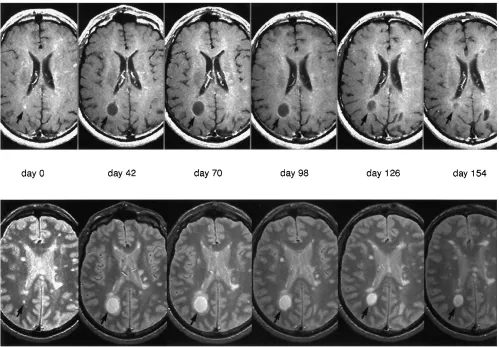
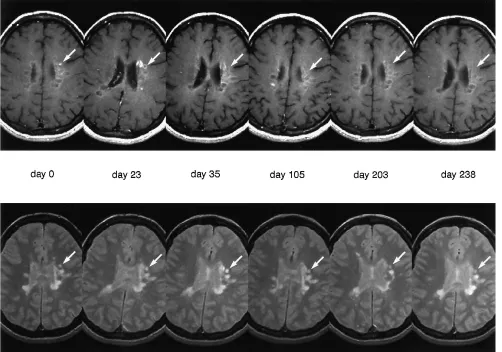
New lesions were defined as lesions not detected on the first study but seen on any subsequent proton density– weighted or contrast-enhanced studies in the series. En-hancing lesions were defined as those that demonstrated high signal, consistent with enhancement, on the contrast-enhanced images at any time in the course of the study. The location of these signal abnormalities was retrieved on each study, and the appearance of the area of the lesion was described (Figs 1 and 2). The image of a lesion at 1 time point is called alesion time point(LTP) hereafter. An estimate of lesion size (largest diameter) and presence of contrast enhancement were noted. Lesion patterns were observed using display utilities of the Research Worksta-tion image analysis software (MrX) (GE Medical Systems, Milwaukee, Wis) installed on SUN workstations (SUN Microsystems, Mountain View, Calif). After adjustment of the observable signal intensity range (level and width) such that high contrast between single pixels in the area of abnormal signal intensity was obtained, two independent readers assigned each abnormality to one of two types: central hyperintensity or ring hyperintensity. Abnormali-ties that could not be assigned to one of these classifica-tions were called indeterminate in signal intensity pattern. This analysis was performed on the proton density– weighted and on the contrast-enhanced images. Unless otherwise specified, lesion age was calculated from the time of a lesion’s first detection on MR, irrespective of the time elapsed since the preceding MR.
Nonparametric Wilcoxon’s rank sum statistics were ap-plied to assess the significance of noted age-dependent differences in signal intensity patterns (11). Significance probabilities (Pvalues) were calculated using the normal approximation of the Wilcoxon distribution. Differences were considered significant at the .05 level. Only LTPs at which both raters agreed on the pattern classification were included in the statistical evaluation.
Results
Forty-three enhancing lesions and 1 new le-sion that never enhanced during the whole pe-riod of follow-up were detected in four of the five patients examined and were followed for a total of 702 LTPs. One patient showed no new le-sions during the observed period. Lele-sions per patient are given in the Table.
were unable to define the abnormality as one individual or two confluent focal lesions. The remaining 24 new lesions, followed over a total of 251 LTPs, were selected for the following evaluation.
Intensity Pattern of New Lesions at First Detection
On proton density–weighted images 20 of 24 new lesions were classified by both raters as having central hyperintensity pattern at the time of first detection. Two of the four remaining new lesions were classified as centrally hyperintense by only one of the two raters at their first LTP. Statistical comparison of LTPs before 30 days
with those on or after 30 days showed that the earlier LTPs demonstrated central hyperinten-sity classification on proton denhyperinten-sity–weighted images significantly more frequently than later LTPs (P 5 .0008). This relationship remained statistically significant (P , .0001) when only abnormalities with diameters greater than 4 mm were considered, to reduce bias attributable to lesion size.
[image:3.612.58.557.101.448.2]On contrast-enhanced images the two raters were in agreement on classifying the newly en-hancing lesions as centrally hyperintense in 19 of the 23 enhancing lesions. One other lesion was classified as centrally hyperintense by only one of the two observers. Again, central hyper-intensity pattern was found to be significantly
Five patients with relapsing-remitting multiple sclerosis
Patient Age, y Sex MR Exams, n New
Lesions, n
Confluent Lesions*,
n
Enhancing Lesions, n
Lesions Not Enhancing at 1st Detection on Proton Density–Weighted Images, n
A 36 F 23 7 — 13 —
B 27 F 22 1†
— 1 —
C 43 F 23 0 — 0 —
D 40 F 24 4 — 4 —
E 37 M 24 14 2 25 7
* New lesions appearing to be issuing from the confluence of multiple individual focal lesions were excluded from signal intensity pattern analysis.
[image:4.612.58.560.103.455.2]†This new lesion never demonstrated contrast uptake and was detected solely on proton density–weighted images.
more frequent in lesions observed less than 30 days after first detection than at later time points (P,.0001 without size cut-off,P5.0005 when considering only lesions with a diameter .4 mm).
On both proton density–weighted and con-trast-enhanced images, newly detected lesions showed higher signal intensity at their centers (compared with their peripheries).
Subacute and Chronic Changes in Signal Intensity Patterns
We wanted to know what proportion of these lesions show a change in pattern (ie, change from central hyperintensity to ring hyperinten-sity and/or indeterminate) in the course of their
evolution. We considered a change in pattern to be “true” only if both observers noted one at the same time point and assigned identical classification. With this stringency, 13 of the 20 lesions unanimously classified as central hy-perintensity at the time of appearance on pro-ton density–weighted images subsequently changed their signal intensity pattern to ring hyperintensity (7 lesions) and/or to indetermi-nate (8 lesions). Two of the remaining seven lesions with initial central hyperintensity but subsequently unchanged pattern on proton density–weighted images were followed for only 28 days, because they were detected close to the end of the 1-year follow-up period. Three other unchanging lesions maintained a 2-mm diameter during the course of follow-up.
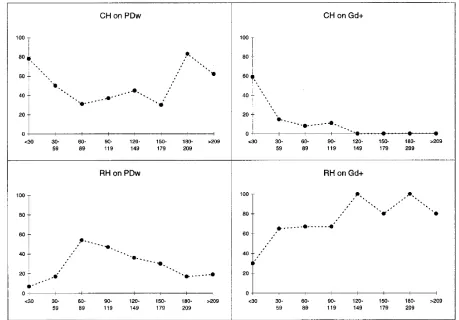
[image:5.612.97.556.322.642.2]dotally, it might be of interest to note that two of these three lesions were under oral prednisone treatment during the first 2 weeks after detec-tion. Of the 7 lesions that changed to ring perintensity, only one reverted to a central hy-perintensity pattern. Figure 3 is a representation of the signal intensity pattern distribution of LTPs as a function of their age and includes all time points of the evaluated lesions for which the raters were concordant in their pattern clas-sification. From Figure 3, it appears that on proton density–weighted images, the fraction of LTPs with a central hyperintensity pattern de-creases to reach a minimum between 2 and 4 months of age. The difference between the fre-quency of central hyperintensity patterns in this 2-month period and both that in the first 2 months after lesion detection (P 5 .0021 [no size cutoff] and P 5 0.0014 [lesions .4 mm]) and that after 179 days (P 5 .0170 [no size cutoff] and P 5 .0322 [lesions .4 mm]), was statistically significant. There was no statisti-cally significant difference between 2- to 4-month old and 4- to 6-month-old abnormali-ties (P 5 .409 [no size cutoff] and P 5 .0918 [lesions.4 mm]).
The inverse was true for the ring hyperinten-sity pattern: its frequency increased to peak in LTPs between 60 and 119 days (Fig 3). In this interval, ring hyperintensity was more frequent than it was before 60 days (P 5.0006 [no size cutoff] and P , .0001 [lesions .4 mm]) and after 179 days (P5.0197 [no size cut off] andP 5.0154 [lesions.4 mm]). The group of obser-vations between 120 and 179 days demon-strated a statistically significant difference in the proportion of ring hyperintensity patterns when lesions 4 mm or smaller (ie, less than 5 pixels in diameter) were excluded (P 5 .0154). Statisti-cally significant difference with the latter age group was not seen without the size cutoff (P5
.1562).
On contrast-enhanced images, 15 of 19 le-sions changed from central hyperintensity to ring hyperintensity (9 lesions) and/or indeter-minate (9 lesions) patterns. Some lesions showed a bright rim (ring hyperintensity pat-tern) that was not ascribed to gadopentetate dimeglumine accumulation and persisted long after enhancement had subsisted. The general trend is one of transition from a majority of centrally hyperintense early LTPs to later ones showing a predominant pattern of ring hyperin-tensity (Fig 3 and Fig 5). LTPs after 1 month
presented a centrally hyperintense pattern on contrast-enhanced images in only approxi-mately 10% of the cases (Fig 3). Ring hyperin-tensity pattern was significantly more frequent in LTPs after 29 days than on or before 29 days (P , .0001 [no size cutoff] and P 5 .0026 [le-sions .4 mm]) (Fig 4).
The time course of two lesions is depicted in Figures 1 and 2. Both raters agreed on classifi-cations in 158 (64%) of 247 LTPs on proton density–weighted images (lesions were not seen by one or both raters in 4 of 251 follow-up LTPs) and 112 (77.8%) of 144 LTPs on contrast-en-hanced images.
Lesion Size
The next question we addressed was the in-fluence of lesion size on classification. A mea-sure of lesion size was given by estimating the largest diameter. Not surprisingly, smaller le-sions were classified much more frequently as having a pattern of central hyperintensity on proton density–weighted images: in 93.9% of all LTPs at which lesions were smaller than 4 mm (major diameter), they were considered cen-trally hyperintense. We therefore computed all statistics with and without inclusion of LTPs at which lesions had maximal diameter 4 mm and smaller. The overall conclusions reached above remained true even after exclusion of these LTPs of smaller lesions. On average, lesions reached their maximum diameter on proton density–weighted images at about 26.9 days after their first detection on MR.
Contrast Enhancement
Duration of gadopentetate dimeglumine en-hancement was estimated for each observed lesion (Fig 5). The longest period of enhance-ment in a lesion appeared to be 98 days after first detection on MR. On average, the latest observation of contrast enhancement was 31.9 days after first detection of a new lesion on MR. The average interval between the last exam demonstrating contrast enhancement in a le-sion and the subsequent nonenhancing exam was 20.6 days. The average interval between the first exam demonstrating contrast enhance-ment in a lesion and the previous nonenhancing exam was 23 days.
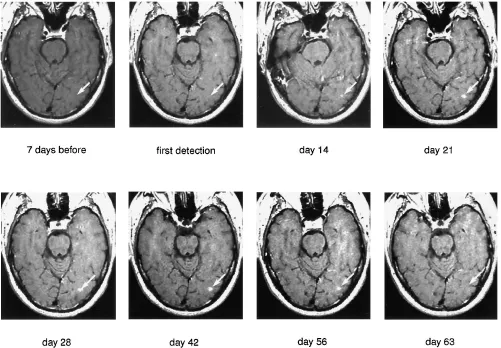
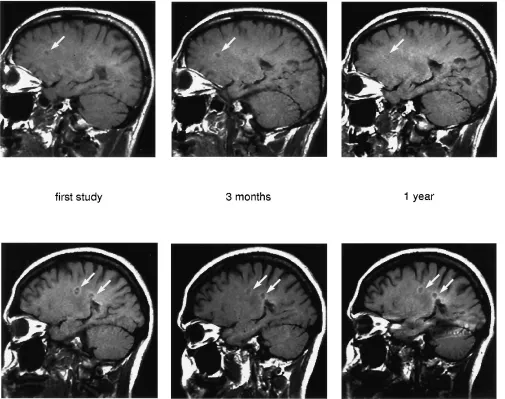
observed on our T1-weighted sagittal localizer images. Figure 6 shows examples of “ring” le-sions on unenhanced T1-weighted images that persisted over the whole year of follow-up. Eleven lesions on contrast-enhanced and 10 lesions on proton density–weighted images demonstrated ring hyperintensity also at time points without evident contrast enhancement of the lesion.
Discussion
The results presented here indicate consis-tency in the pattern of presentation of newly appearing lesions on MR, namely a pattern of central hyperintensity. This was seen in the ma-jority of new lesions, both on proton density– and contrast-enhanced T1-weighted images.
A large proportion of these lesions showed changes in signal intensity pattern in the course of follow-up. The sequence and timing of these pattern changes, however, were not consistent, and we were unable to determine a clear-cut model for the course of evolution of these le-sions, as seen on MR. Nevertheless, an average lesion course can be inferred in the framework of current neuropathologic and neuroradiologic knowledge, the need for further experimental confirmation notwithstanding.
One of the earliest steps in lesion formation is the breakdown of the blood-brain barrier, which translates into high signal on proton density– weighted as well as on contrast-enhanced im-ages (12, 13). It has been proposed that the blood-brain barrier breakdown in multiple scle-rosis is related primarily to perivenular
[image:7.612.58.559.101.449.2]cytic damage, while sparing the vascular endo-thelium of the venules, which are typically located in the center of lesions (6, 14). An al-ternate view involves functional impairment of morphologically intact endothelial cells show-ing increased pinocytotic activity (15). In both scenarios, the considerable swelling of astroglia and endothelium accompanying this phenome-non is likely to reinforce early T2 prolongation because of local increase of water content (16). Oligodendrocyte damage, which is of central relevance in the development of nerve-conduc-tion impairment and therefore of neurologic symptoms (17), also appears to be a very early event of lesion formation (5). The ensuing de-myelination appears to progress over a period of several weeks, typically by contiguous
[image:8.612.58.559.100.456.2]spread irrespective of nerve fiber orientation (6). This process is accompanied by the ap-pearance of swollen oligodendroglia, cellular in-filtration (lymphocytes and lipid-engulfing mac-rophages known as Gitter cells), and expansion of the extracellular spaces, as evidenced by op-tical as well as electron microscopic studies of multiple sclerosis plaques (6, 18 –20). In-creased signal on long-repetition-time images is consistent with these phenomena (21–23). The pattern of central hyperintensity we ob-served on proton density–weighted images in the early course of multiple sclerosis lesion for-mation may therefore be tentatively ascribed to the combined influences of increased extracel-lular and intracelextracel-lular spaces (demyelination and inflammatory cell swelling and infiltration)
concomitant with a decrease in the fraction of faster-relaxing bound water associated with the decrease in biomembrane surfaces. The pattern of central contrast enhancement on contrast-enhanced images may reflect the impairment of the blood-brain barrier at the central venule and/or capillary levels, indicating either blood-brain barrier breakdown as a consequence of a multiple sclerosis–specific primary damage or secondary to a primarily intraparenchymatous inflammatory reaction.
After the progressive and centrifugal disap-pearance of oligodendrocytes, fibrillary astrocy-tosis and bouts of remyelination fill the gaps. T2 shortening can be expected to accompany
these phenomena, because of local decrease in water content and increased water immobiliza-tion by increasing membrane surfaces (16). This would fit the appearance of relatively dark lesion centers on proton density–weighted im-ages in a phase of lesion evolution at which active inflammation and demyelination at the lesion’s outer bounds coexist with repair pro-cesses at its pathogenetically older center (Figs 1 and 2). This ring shape appeared to peak for the average lesion around the age of 3 months (see Fig 3).
Ring enhancement has been previously de-scribed (2, 12, 24 –26). However, to our knowl-edge, no conclusive explanation has been
[image:9.612.58.563.102.501.2]vided for the mechanism of how the contrast reaches the lesion margin. It appears unlikely for a central venule to be the origin of such leakage, as appears to be the case in acute lesions. We speculate that the distribution pat-tern of contrast agent in older lesions, with pe-ripheral inflammatory activity, rather could be ascribed to secondary capillary hyperemia and/or damage. This view is consistent with histopathologic findings of capillary alterations in multiple sclerosis plaques (15) and is also supported by dynamic MR studies of contrast accumulation in multiple sclerosis lesions, which demonstrated initial ring enhancement with subsequent filling in of the central disk (27). Following this hypothetical model, it can be expected that ring hyperintensity on proton density–weighted images, reflecting peripheral enlargement of the extracellular space around freshly demyelinated naked nerve fibers and presence of inflammatory and reactive cells, would be apparent longer than contrast en-hancement on contrast-enhanced images, symptomatic of a leaking blood-brain barrier. Indeed, this sequence of events was apparent in 10 of the lesions we followed for a sufficient period of time. These were seen as ring hyper-intensity on proton density–weighted images, whereas at the same time no enhancement was detected on contrast-enhanced images. Our data on duration of enhancement are consistent with previous reports (24, 28 –30). No lesion showed enhancement later than 14 weeks after detection, in agreement with the report by Har-ris et al (28). Given the average length of ob-served gadopentetate dimeglumine enhance-ment (31.9 days) and the average length of “blind” intervals between first enhancing exam and previous nonenhancing exam (23 days) and between last observed enhancement and subsequent negative follow-up exam (20.6 days), we estimate that new multiple sclerosis lesions demonstrate gadopentetate dimeglu-mine uptake for 1 to 2 months on average. Several authors have described a pattern of ring hyperintensity on unenhanced T1-weighted im-ages and suggested the presence of free radi-cals in infiltrating macrophages as the likely cause (2, 31, 32). In 11 lesions, we observed ring hyperintensity on postcontrast T1-weighted images that was not ascribed to con-trast leakage. This pattern persisted long after cessation of evident enhancement attributable to the contrast agent and even in lesions older
than 200 days (Figs 5 and 6). We also observed multiple lesions on unenhanced T1-weighted images that persisted with a ring hyperintensity pattern for at least 1 year (Fig 6). It is question-able that the sustained presence of this pattern should be ascribed solely to the macrophage activity. Further evaluation would be needed to associate unequivocally such long-term persis-tence of hyperintense rims on unenhanced T1-weighted images with the presence of free rad-icals in active macrophages, and alternate explanations should be explored. These obser-vations, however, underline the potential impor-tance of unenhanced T1-weighted images for complete lesion characterization in imaging protocols of therapeutic trials involving immu-nomodulatory drugs that might influence phagocytic activity.
On proton density–weighted and contrast-enhanced images, a majority of lesions were centrally hyperintense at early time points and subsequently changed pattern of appearance in the course of follow-up. On proton density– weighted images, ring hyperintensity was most frequent at LTPs 2 to 4 months (60 to 119 days) after lesion detection. Ring hyperintensity was seen at the majority of LTPs after 1 month on contrast-enhanced images. It was estimated that new multiple sclerosis lesions demonstrate gadopentetate dimeglumine uptake, on aver-age, during a period of 1 to 2 months. The hyperintensity on contrast-enhanced images was not always ascribed to gadopentetate dimeglumine accumulation, and ring hyperin-tensity was chronically detected during a whole year on unenhanced T1-weighted images as well. These data appear consistent with current neuropathologic knowledge. We believe that, with further experimental evaluation, specific information about the histopathologic evolution of multiple sclerosis lesions could be extracted not only from contrast-enhanced but also from nonenhanced serial MR. This information could be of use in the evaluation of treatments target-ing specific pathogenetic components of multi-ple sclerosis.
Acknowledgments
References
1. Katz D, Taubenberger J, Raine C, McFarlin D, McFarland H. Gadolinium-enhancing lesions on magnetic resonance imaging: neuropathological findings.Ann Neurol1990;28:243
2. Nesbit GM, Forbes GS, Scheithauer BW, Okazaki H, Rodriguez M. Multiple sclerosis: histopathologic and MR and/or CT correlation in 37 cases at biopsy and three cases at autopsy. Radiology 1991;180:467– 474
3. Estes ML, Rudick RA, Barnett GH, Ransohoff RM. Stereotactic biopsy of an active multiple sclerosis lesion: immunocyto-chem-ical analysis and neuropathologic correlation with magnetic res-onance imaging.Arch Neurol1990;47:1299 –1303
4. Newcombe J, Hawkins CP, Henderson CL, et al. Histopathology of multiple sclerosis lesions detected by magnetic resonance imag-ing in unfixed postmortem central nervous system tissue.Brain 1991;114:1013–1023
5. Rodriguez M, Scheithauer BW, Forbes G, Kelly PJ. Oligodendro-cyte injury is an early event in lesions of multiple sclerosis.Mayo Clin Proc1993;68:627– 636
6. Lumsden CE. The neuropathology of multiple sclerosis. In: Vinken PJ, Bruyn GW (eds).Handbook of Clinical Neurology. Amster-dam: North-Holland Publishing Co, 1970;9:217–309
7. Hawkins CP, Munro PMG, MacKenzie F, et al. Duration and selec-tivity of blood-brain barrier breakdown in chronic relapsing exper-imental allergic encephalomyelitis studied by gadolinium-DTPA and protein markers.Brain1990;113:365–378
8. Raine CS. Multiple sclerosis and chronic relapsing EAE: compar-ative ultrastructural neuropathology. In: Hallpike JF, Adams CWM, Tourtellotte WW (eds).Multiple Sclerosis: Pathology, Diag-nosis and Management. Baltimore: Williams & Wilkins, 1983: 413– 460
9. Shaw CM, Alvord EC, Jr. A morphologic comparison of three experimental models of experimental allergic encephalomyelitis with multiple sclerosis. In: Alvord EC Jr, Kies MW, Suckling AJ (eds).Experimental Allergic Encephalomyelitis: A Useful Model for Multiple Sclerosis.New York: Alan R Liss, Inc, 1984:61– 66 10. Grossman RI, Lisak RP, Macchi PJ, Joseph PM. MR of acute
experimental allergic encephalomyelitis.AJNR Am J Neuroradiol 1987;8:1045–1048
11. Lehmann EL. Nonparametrics: statistical methods based on ranks. New York: McGraw-Hill, 1975:1–23
12. Grossman RI, Gonzalez-Scarano F, Atlas SW, Galetta S, Silber-berg DH. Multiple sclerosis: gadolinium enhancement in MR im-aging.Radiology1986;161:721–725
13. Kermode AG, Thompson AJ, Tofts PS, et al. Breakdown of the blood-brain barrier precedes symptoms and other MR signs of new lesions in multiple sclerosis: pathogenetic and clinical impli-cations.Brain1990;113:1477–1489
14. Broman T. Blood-brain barrier damage in multiple sclerosis: su-pra-vital test observations. Acta Neurol Scand 1964;40(Suppl 10):21–24
15. Brown WJ. The capillaries in acute and subacute multiple sclero-sis plaques: a morphometric analysclero-sis.Neurology1978;28:84 –92 16. Cameron IL, Ord VA, Fullerton GD. Characterization of proton NMR relaxation times in normal and pathological tissues by cor-relation with other tissue parameters.Magn Reson Imaging1984; 2:97–106
17. Namerow NS. The pathophysiology of multiple sclerosis. In: Wolf-gram F, Ellison GW, Stevens JG, Andrews JM (eds.).Multiple Sclerosis: Immunology, Virology, and Ultrastructure (UCLA Fo-rum in Medical Sciences, Number 16).New York and London: Academic Press, 1972;16:143–172
18. Traugott U, Reinherz EL, Raine CS. Multiple sclerosis distribution of T-cells, T-cell subsets, and la-positive macrophages in lesions of different ages.J Neuroimmunol1983;4:201–221
19. Olvera-Rabiela JE, Rabiela-Cervantes MT, Feria-Velasco A, Marquez-Padilla H, Gonza´lez-Angulo A. Multiple sclerosis in Mex-ico: light- and electron-microscopic study of two cases. Neurol-ogy1971;21:720 –727
20. Pe´rier O, Gre´goire A. Electron microscopic features of multiple sclerosis lesions.Brain1965;88:937–952
21. Teresi LM, Hovda D, Seeley AB, Nitta K, Lufkin RB. MR imaging of experimental demyelination.AJNR Am J Neuroradiol1989;10: 307–314
22. Jolesz FA, Polak JF, Ruenzel PW, Adams DF. Wallerian degen-eration demonstrated by magnetic resonance: spectroscopic measurements on peripheral nerve.Radiology1984;152:85– 87 23. Jolesz FA, Polak JF, Adams DF, Ruenzel PW. Myelinated and nonmyelinated nerves: comparison of proton MR properties. Ra-diology1987;164:89 –91
24. Miller DH, Rudge P, Johnson G, et al. Serial gadolinium enhanced magnetic resonance imaging in multiple sclerosis.Brain1988; 111:927–939
25. Barkhof F.Gadolinium Enhanced Magnetic Resonance Imaging in Multiple Sclerosis.Amsterdam: VU University Press; 1992 26. Capra R, Marciano` N, Vignolo LA, Chiesa A, Gasparotti R.
Gado-linium-pentetic acid magnetic resonance imaging in patients with relapsing remitting multiple sclerosis.Arch Neurol1992;49:687– 689
27. Kermode AG, Tofts PS, Thompson AJ, et al. Heterogeneity of blood-brain barrier changes in multiple sclerosis: an MR study with gadolinium-DTPA enhancement. Neurology1990;40:229 – 235
28. Harris JO, Frank JA, Patronas N, McFarlin DE, McFarland HF. Serial gadolinium-enhanced magnetic resonance imaging scans in patients with early, relapsing-remitting multiple sclerosis: im-plications for clinical trials and natural history.Ann Neurol1991; 29:548 –555
29. Koopmans RA, Li DKB, Oger JJF, Mayo J, Paty DW. The lesion of multiple sclerosis: imaging of acute and chronic stages. Neurol-ogy1989;39:959 –963
30. Grossman RI, Braffman BH, Brorson JR, et al. Multiple sclerosis: serial study of gadolinium-enhancing MR imaging. Radiology 1988;169:117–122
31. Drayer BP. Magnetic resonance imaging of multiple sclerosis. Barrow Neurol Inst Q1987;3:65–73