Original Research Article
Knowledge, attitude and practices about rabies prophylaxis
among medical officers
Ashvini C. Jidge*, Hemlata G. Rokade, Suresh K. Mangulikar
INTRODUCTION
Rabies word originates from the Latin word Rabere which means „to rave‟ or from Sanskrit word Rabhas meaning „to rage‟.1 This disease was reported in India
even before 2300 BC.
Rabies is present on all continents, except Antartica, with over 95% of human deaths occurring in Asia and Africa.2 According to WHO, the deaths from rabies per year in India is 20,565 as against 55,000 deaths worldwide.2 A person sustains an animal bite every 2 seconds and someone dies from rabies every 30 minutes.2
It is one of the most important endemic zoonotic disease caused by lyssavirus, which is fatal following the onset of clinical symptoms.2 Prompt administration of CCEEVs after exposure, combined with proper wound management and simultaneous administration of rabies immunoglobulins where indicated is almost invariably effective in preventing rabies, even after high risk exposure.3 Rabies predominantly affects poor and vulnerable populations who live in remote rural areas.2 Therefore, to have effective control on rabies, it is imperative to assess the awareness regarding Rabies and its management amongst medical officers practicing in rural areas. This study will also highlight the current
ABSTRACT
Background: One of the important requirements to achieve “Zero Human rabies deaths by 2030” is to build awareness of the PEP and care for exposed victims. So, this study was undertaken with the aim and objective to study knowledge, attitude and practices related to animal bite transmitting rabies, amongst medical officer.
Methods: A cross sectional study was done among 95 medical officer. Pretested and structured questionnaire was prepared related to training sessions conducted and their knowledge, attitude and practices (KAP) related to rabies prophylaxis. Data was entered and analysed using Microsoft Excel 16 version. Percentages were calculated and appropriate statistical test were applied.
Results: None of them had received training on rabies prophylaxis. Regarding WHO categorization of animal bite, 69.5% participants had sufficient knowledge about category III, 47.4% about category II and 42.10% about Category I. Only 4.21% participants were aware of the preexposure prophylaxis and 29.47% participants had sufficient knowledge about intradermal (ID). schedule. Attitude was poor (47.40%) regarding willingness of administrating equine antirabies serum at their setup. 81% practiced immediate wound toileting and 45.30% of participants administered ARV by intradermal route. All patients were referred to tertiary care centre for administration of ARS and 82.10% of participants referred the patients immediately.
Conclusions: There was an apparent lack of awareness seen in rabies prophalaxis and management. Effort should be taken to emphasize the importance PEP management through regular reorientation programs.
Keywords: Rabies PEP, KAP study, Medical Officer, ID schedule
Department ofCommunity Medicine, Vaishampayan Government Medical College, Solapur, Maharashtra, India
Received: 25 March 2019
Accepted: 12 April 2019
*Correspondence:
Dr. Ashvini C. Jidge,
E-mail: [email protected]
Copyright: © the author(s), publisher and licensee Medip Academy. This is an open-access article distributed under the terms of the Creative Commons Attribution Non-Commercial License, which permits unrestricted non-commercial use, distribution, and reproduction in any medium, provided the original work is properly cited.
scenario of health services imparted to animal bite patients. So this study was undertaken with the aim and objective to study knowledge, attitude and practices related to animal bite transmitting rabies, amongst medical officer practicing in rural areas of western Maharashtra.
METHODS
Study design
Descriptive, cross sectional study.
Sampling frame
All medical officers working in primary health centres (PHCs) in the western Maharashta District.
Sample size
Medical officers who had attended monthly meeting at district training center i.e. 95.
Study period
3 months i.e. 1st November 2016 to 31st January 2017. Prior permission of the DHO was taken. List of all Medical Officers was retrieved from District health office of Solapur district. After gaining the approval of institutional ethical committee the study was commenced. The study was conducted during the monthly meeting of all the medical officers. The study was explained to them. They were also informed that the personal information will be kept anonymous. After informed consent, only willing medical officers were included in the study and those who were absent were excluded from the study. There were 95 medical officers who participated in the study. All were distributed with the questionnaire at the same time and were instructed to fill the proforma in the allotted time. They were observed by our team to avoid any manipulation in attempting the questionnaire. Pretested and structured questionnaire was prepared related to their training sessions on Rabies and regarding knowledge, attitude and practices (KAP) related to rabies prophylaxis. To assess knowledge the participants (medical officers) were asked about the route of transmission of rabies virus, classification and management of animal bite cases, intradermal (ID) and intramuscular (IM) and pre-exposure schedules and doses and site of administration was asked.
Participants who were able to give above information according to National guidelines for rabies prophylaxis or WHO guidelines were considered to have sufficient knowledge and rest were considered to have insufficient knowledge.3,4
Statistical analysis
The data collected were entered into excel sheet and analysed using SPSS (Statistical Package for Social Sciences) version 16. The frequency tables for all collected variables were computed. Appropriate statistical test applied wherever required.
RESULTS
There were 95 doctors who participated in this study. None of them had received any training or attended CME on Rabies in their tenure of service.
There were 62 (65.26%) participants who were aware that rabies is 100% fatal and 41 (43.15%) knew it was preventable by proper post-exposure vaccination.
Almost all participants 95 (100%) knew that dog bite and cat bite can transmit rabies disease whereas 92 (96.84%) mentioned wild animals, 72 (75.78%) mentioned pet animals like cow, goat etc. and 63 (66.31%) mentioned unboiled milk consumption as a source of transmission of rabies virus.
Figure 1: Correct knowledge about transmission of rabies.
There was high level of awareness regarding transdermal route of transmission of rabies in 71 (74.7%) followed by transmucosal 64 (64.2%) and organ transplant 25 (27%), aerosol 16 (16.8%) (Figure 1).
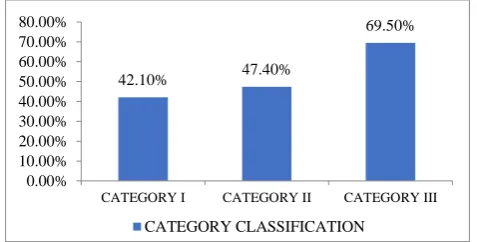
Figure 2: Correct knowledge about WHO classification of animal bite cases.
0.0% 10.0% 20.0% 30.0% 40.0% 50.0% 60.0% 70.0% 80.0%
74.7% 64.20%
27%
16.80% 11.60%
42.10% 47.40%
69.50%
0.00% 10.00% 20.00% 30.00% 40.00% 50.00% 60.00% 70.00% 80.00%
CATEGORY I CATEGORY II CATEGORY III
There were 66 (69.5%) participants who had knowledge about category III, 45 (47.4%) about category II classification and 40 (42.10%) about category I classification (Figure 2).
Figure 3: Correct knowledge regarding WHO category wise treatment against animal bite.
Figure 4: Awareness regarding pre-exposure schedule of animal bite.
Figure 3 shows that majority of the participants 86 (90.5%) had sufficient knowledge to manage Category III wounds whereas only 53 (55.80%) knew about Category II and 40 (42.10%) knew about category I management. There were only 4 (4.21%) participants who were aware of the preexposure prophylaxis.
Figure 5: Awareness regarding post-exposure schedule of animal bite.
Figure 5 shows that, there were only 28 (29.47%) participants who had knowledge about ID schedule whereas 46 (48.42%) were aware about IM schedule for post-exposure prophylaxis. Very few participants 10 (10.53%) had right knowledge about re-exposure vaccination.
Figure 6: Attitude of medical officers regarding rabies prophylaxis.
It was observed that (Figure 6), majority of the participants 91 (95.8%) had positive attitude towards conducting health education campaign, 89 (93.7%) participants were positive towards counselling of the patients and 78 (82.10%) acceptance for intradermal schedule for postexposure prophylaxis. Whereas less than half of the participants i.e. 45 (47.40%) were willing to administer injection equine antirabies serum at their setup.
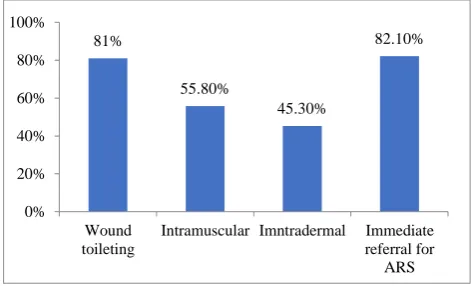
There were only 77 (81%) of participants who practiced immediate wound toileting. Not a single participant administered Equine ARS to patients at their health care facility. All patients were referred to the tertiary care hospital. There were only 78 (82.10%) of participants who referred the patients immediately for administration of Equine ARS.
Figure 7: Rabies prophylaxis practices carried out at PHC level.
It was observed that only 43 (45.30%) of participants administered ARV by intradermal route as against 53
0.00% 20.00% 40.00% 60.00% 80.00% 100.00%
I II III
42.10%
55.80%
90.50%
4.21%
95.79%
Pre-exposure schedule
Aware Not aware
29.47
48.42
0 10 20 30 40 50 60
id im
Pe
rc
en
ta
g
e
95.80% 93.70%
82.10%
47.40%
0.00% 20.00% 40.00% 60.00% 80.00% 100.00% 120.00%
Like to take health education campaign abt
rabies vaccination
Like to do counselling
abt compliance to treatment
Like to follow id schedule
willing to give ARS at
PHC
81%
55.80%
45.30%
82.10%
0% 20% 40% 60% 80% 100%
Wound toileting
Intramuscular Imntradermal Immediate referral for
(55.80%) still followed intramuscular schedule (Figure 7).
DISCUSSION
The effectiveness of the rabies prevention and control program can be achieved if the public health expert‟s capacity on prevention and management is enhanced through CME or reorientation program. In our study, none of the participants received any training on rabies PEP.
In our study, regarding categorization of animal bite according to WHO, it was found that 65.5% participants had right knowledge of category III whereas only 47.4% and 42.1% had right knowledge about category II and I respectively. Even Ravish et al found that 61% participants had right knowledge regarding categorization of animal bite.6
There were 95.5% participants who had right knowledge regarding category III wound management whereas only 58.8% and 42.10% participants had knowledge regarding management of category II and category I respectively. In our study there were only 4.21% participants who were aware about schedule for pre-exposure prophylaxis which was comparable with Bhalla et al (4%) whereas Singh et al and Nayak et al found better knowledge about pre-exposure prophylaxis which was 32% and 21% respectively.5-7
In our study it was observed that 81% participants practiced immediate cleaning of wound, while Bhalla et al5 reported 95% which was higher as compared to our study whereas and Nayak et al reported only 66.6% and Singh et al6 reported only 47%.7 Animal experiments have shown that local wound treatment can reduce the chances of developing rabies by up to 80%.8 So, it is important that 100% health workers should give prompt and appropriate wound toileting procedure as described by WHO.4
Our study found out that 29.47% and 48.42% participants were aware about ID and IM post-exposure prophylaxis schedule respectively. The awareness regarding i.m schedule was almost comparable with Nayak et al (42 percent) while it was 39% in Singh et al and 24% Bhalla et al.5-7
In our study 10 (10.53%) participant had right knowledge about re-exposure vaccination but none mentioned practicing it while Ravish et al in his study mentioned that 68.90% participants practiced giving re-exposure vaccination.9
It was found that attitude of participants was good regarding conducting IEC activities to increase community awareness on rabies prophylaxis (95.8%), regarding proper counselling and compliance to treatment
(93.7%) and willingness to practice id schedule (82.1%) but only 47.4% were willing to give ARS at their center. Prompt PEP following severe exposures is 100% effective in preventing rabies.4 But this study reveals that almost 82.1% participants referred animal bite cases to tertiary care center. So to prevent delay in treatment and loss to follow up they should be motivated to administer ARS at their center. This will also reduce the out of pocket expenditure of patients.
There was 81% of practitioner who advised immediate wound toileting. There were 55.8% who practiced IM schedule. In our study only 45.3% participants practiced ID schedule. Treating rabies exposure in Africa or Asia where the average daily income may be as low as one dollar per person can represent catastrophic financial burden. The average cost of PEP rabies is 49 dollars in Asia.10 Therefore it is advisable to use ID regimen as it is cost effective as compared to IM schedule.
CONCLUSION
The study suggests that, there was an apparent lack of awareness among the medical officers regarding epidemiology of the disease, appropriate categorization and management of animal bites transmitting rabies. They should be motivated for administrating of ARS immediately at their health center and practice cost effective ID regimen.
TheWHO envisions elimination of human dog mediated rabies deaths by 2030. To achieve this, it is of utmost important that the practitioners are trained adequately to control and prevent the disease. Therefore, effort should be taken to emphasize the importance PEP management through regular reorientation programs and continued medical education amongst them..
Funding: No funding sources Conflict of interest: None declared
Ethical approval: The study was approved by the Institutional Ethics Committee
REFERENCES
1. Leung AKC, Davis HD, Hon KLE. Rabies: Epidemiology, pathogenesis, and prophylaxis. Advances in Therapy. 2007;24(6):1340-7.
2. WHO. Available at: https://www.who.int/news-room/fact-sheets/detail/rabies. Accessed on 3 June 2018.
3. National Rabies Control Programme; National Guidelines On Rabies Prophylaxis: 2015.
4. WHO Expert Consultation on Rabies 1012. 2018: 47.
city regarding animal bite. Indian J Community Med. 2005;30:94-6
6. Singh A, Bhardwaj A, Mithra P, Siddiqui A, Ahluwalia SK. A cross sectional study of the knowledge, attitude and practice of general practioners regarding dog bite management in nothern India. Med J DY Patil Univ. 2013;6:142-5. 7. Nayak RK, Walvekar PR, Mallapur MD.
Knowledge, attitude and practices regarding rabies among general practitioners of Belgaum city. AI Ameen J Med Sci. 2013;6(3):265-7.
8. Park K. Park‟s Textbook of preventive and social medicine. Jabalpur, India, Banarsidas Bhanot Publishers. 2015: 276-281.
9. Shankaraiah RH, Bilagumba G, Narayana DH, Annadani R, Vijayashankar V. Brief
Communication (Original). Knowledge, attitude, and practice of rabies prophylaxis among physicians at Indian animal bite clinics. Asian Biomed. 2013;7(2):237-42.
10. WHO factsheet available on WHO/RABIES. Available at: www.who.int/mediacentre/factsheets/ fso99/en. Accessed on 08 February 2017.