CHROMOSOME NUMBERS AND KARYOTYPES OF EURYCOMA LONGIFOLIA JACK AND EURYCOMA APICULATA A.W. BENN (SIMAROUBACEAE)
Zulfahmi1*, Aidelia Rahmasari1, Mokhamad Irfan1, Rosmaina1, Muhammad Nazir2
1Faculty of Agriculture and Animal Science, Universitas Islam Negeri Sultan Syarif Kasim Riau, Pekanbaru 28293, Riau, Indonesia. 2Faculty of Teacher Training and Education, Universitas Islam Negeri
Sultan Syarif Kasim Riau, Pekanbaru 28293, Riau, Indonesia. Email: *[email protected].
Article received 29.9.2018, Revised 14.12.2018, Accepted 18.12.2018
ABSTRACT
Knowledge of chromosome cytology of the Eurycoma longifolia and Eurycoma apiculata was limited. The goal of this study was to investigate number, size, karyotype, and ideogram of chromosomes of E. longifolia and E.
apiculata. The total of chromosome lengths, relative lengths, the ratio of long arm to short arm, and index of
centrometric of somatic cell chromosomes were measured. The basic number of chromosomes of both species was x=7, chromosome counting displayed that E. longifolia and E. apiculata were diploid. Somatic chromosome numbers that are found were 2n = 2x = 14 for both species. The total chromosome length was ranged from 5.33 to 9.22 µm for E. longifolia and ranged from 4.15 to 10.52 µm for E. apiculata. Karyotype formula of E. longfolia and
E. apiculata was 2n = 2x = 14 = 6m + 1sm and 2n = 2x = 7m, of which six pairs metacentric chromosomes and one
pair submetacentric chromosome in E. longifolia and seven pairs metacentric chromosomes in E. apiculata
respectively. Based on Eroglu’s classification, karyotype symmetric/asymmetric index (S/AI) value of the E.
apiculata was 1.0 and was classified into perfectly symmetric karyotype that is characterized by completely
metacentric chromosomes, while S/AI value of E. longifolia was 1.14 and was grouped as symmetric karyotype.
Key words: Eurycoma, chromosome, karyotype. symmetric and asymmetric index
INTRODUCTION
Eurycoma spp belongs to Simaroubaceae fam-ily. This genus consisted of three species, namely Eurycoma longifolia Jack, Eurycoma apiculata A. W. Benn and Eurycoma harmandiana Pierre. E. longifolia was generally found in tropical forest of Southeast Asian countries, encompass Indonesia, Malaysia, Myanmar, Cambodia, and Thailand (Nooteboom, 1962), E. apiculata was only distri-buted in Sumatra-Indonesia and Malaysia penin-sular (Nooteboom, 1962) while E. harmandiana was only reported growing in Thailand and Laos (Kanchanapoom et al., 2011). They are known as tropical medicinal plant having numerous types of important bioactive compounds which are mostly found in root part. It has been utilized as antioxi- dant (Varghese et al., 2013), antimicrobial (Kha-nam et al., 2015), antimalarial, a booster of male sexual health and etc. (Kanchanapoom et al., 2011; Thu et al., 2017; Abubakar et al., 2017). Although they are important medicinal plants, information on chromosome number of Eurycoma spp is poorly known and no literature reported on detailed cytological data of Eurycoma spp. There-fore, the cytogenetic study of these species is imp-ortant to be implemented, which one of the main aims was the identification of chromosome and composes the karyotype based on microscopic morphological characteristics of the chromoso-mes. Chromosomes are hereditary material pres-ent inside the plant cell for carrying genetic infor-mation through generations. Knowledge of chro-mosome morphology description is required to
characterize genomes of plants and this informa-tionis important for plant systematic (Stace, 2000) evolutionary analysis (Baltisberger and Horandl, 2016), and adaptability of the environment (Wang et al., 2011). In addition, in plant breeding, parent plants cytogenetic information is very useful for determining suitable parent combinations and for tracking parent markers in hybrid plants.
The karyotype is a complete-chromosomes col-lection of the species; it is built to reflect the size, shape, and number of chromosome complement, where each chromosome that identified is related to theirmorphologicalcharacteristics. The number, size, and asymmetry of chromosomes were bene-ficial traits in cytotaxonomy of plant and were important to explain the plant origin, plant speci-ation, and genetic relationships among plants (Stebbins, 1971).
In this study, we conducted a cytological anal-ysis for two species of Eurycoma, namely Eury-coma longifolia Jack and Eurycoma apiculata A.W. Benn. The goal of this study was to inves-tigate number, size, karyotype, and ideogram of chromosomes of E. longifolia and E. apiculata.
MATERIALS AND METHODS
Root tips meristems were collected directly from the seedling that were maintained in Labora-tory.Chromosomepreparationwasfollowed(Jahier and Tanguy 1996) method with modifications. Root tips were soaked in 45% glacial acetic acid solution for 30 minutes at 4oC. Subsequently, root tipsweretaken out and washed with distilled water and hydrolyzed in 1N HCl for 55 minutes at 55oC. After hydrolyzed, they were rinsed with distilled water three times and then transferred into stain-ing solution (2% aceto-orcein) for 20 minutes at room temperature, root tips were mounted on the slide and a drop acetic acid (45%)-glycerol mixt-ure (9:1) and squashed with a glass cover.
The chromosome slides were observed under a Nikon AFX II microscope, and five well-scatt- ered metaphase plates were chosen to be analyzed. The selected metaphase plates were photographed and arranged the karyotype based on their length. Chromosomes were measured and paired using Photoshop CS 5.0 software. The several paramet-ers including total chromosome length (TCL), long arm length (LAL) and short arm length (SA-L) were measured for each chromosome while arm ratios (R=LAL/SAL) and index of centrom-eric (IC=[SAL/TCL] x 100) were calculated. Arm ratio was used to classify the chromosome based on the system proposed by Levan et al. (1964), namely metacentric for arm ratio of 1.0–1.69, sub-metacentric for arm ratio of 1.7–2.99, subtelo-centric for arm ratio of 3.0–7.0, telosubtelo-centric for arm ratio of above 7.0. The number of
chromo-some assigned was based on the descending order of chromosome length.
The intra-chromosomal and inter-chromoso-mal karyotype asymmetries were obtained from mean centromeric asymmetry (MCA) and the coef- ficient of variation of chromosome length (CVCL) according to Peruzzi and Eroglu (2013) and Paszko (2006). MCA was obtained from the mean (LAL-SAL)/LAL+SAL) x 100, where, for each chromosome, LAL is long arm length and SAL is short arm length; whereas CVCL was obtained from the standard deviation of (LAL+SAL) divi-ded by the mean (LAL+SAL) x 100. Beside that, we also determined the index of karyotype symm-etric/asymmetric (S/AI) according to Eroglu (2015), this index was calculated as, S/AI = [(1 x M) + (2 x SM) + (3 x A or ST) + (4 x T)] / 2n, where M was chromosome number of metacen-tric; SM was chromosome number of submetacen-tric; ST was chromosome number of subtelocen-tric; A was chromosome number of acrocensubtelocen-tric; T was chromosome number of telocentric, and 2n was chromosome number of diploid.
RESULTS AND DISCUSSIONS
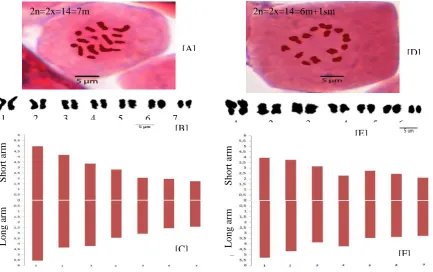
In this study, the number, size, karyotype and ideogram of chromosomes of two species of Eurycoma were determined. The cytological data of E. longifolia and E. apiculata were the first reports. Mitotic metaphase chromosomes of both speciesare given in Figure 1.
1 2 3 4 5 6 7 2n=2x=14=7m
Sh
o
rt a
rm
(µm
)
L
o
n
g
a
rm
(µm
)
1 2 3 4 5 6 7
2n=2x=14=6m+1sm
Sh
o
rt a
rm
(µm
)
L
o
n
g
a
rm
(µm
)
[A]
[C] [B]
[F] [E]
[D]
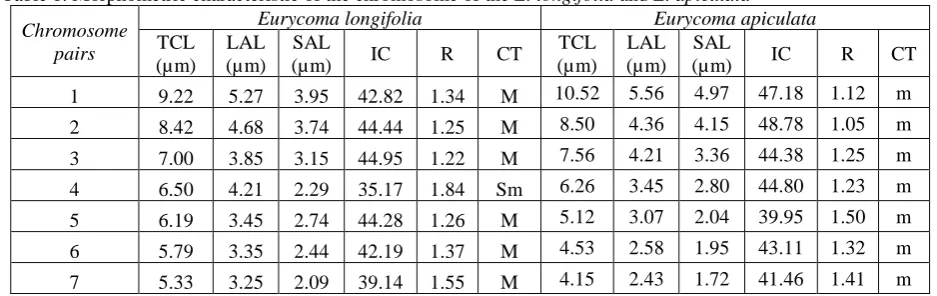
Analysis of somatic metaphases displayed that E. longifolia and E. apiculata represented diploid species with basic number chromosome (x) of 7 and number of chromosomes of both species were similar, namely 2n = 2x = 14. The chromosomes measurement data of E. longifolia and E. apicu-lata are shown in Table 1. Both species exhibited low variation in chromosome sizes. The length of chromosomes of E. longifolia was ranged from 5.33 to 9.22 µm with the mean length of chromo-somes of 6.92 µm. The length of long arm was varied from 3.25 to 5.27 µm and length of short arm was varied from 2.09 to 3.95 µm. The index of centromere (IC) varied from 35.17 to 44.95 that
showed centromeres located at the median and sub-median of chromosomes. Arm ratio was ran-ged from 1.22 to 1.84 so that chromosome types of E. longifolia was metacentric and sub-meta-centric. The length of chromosomes of E. apicu-lata varied from 4.15 to 10.52 µm with a mean length of chromosomes of 6.66 µm. The long arm ranged from 2.43 to 5.56 µm while short arm ranged from 1.72 to 4.97 µm. The IC varied from 39.95 to 48.78 that showed a predominantly cent-romeres located at the median. The arm ratio of E. apiculata was ranged from 1.05 to 1.54, so that chromosome types of E. apiculata was metac-entric (Table 1).
Table 1. Morphometric characteristic of the chromosome of the E. longifolia and E. apiculata
Chromosome pairs
Eurycoma longifolia Eurycoma apiculata
TCL (µm)
LAL (µm)
SAL
(µm) IC R CT
TCL (µm)
LAL (µm)
SAL
(µm) IC R CT
1 9.22 5.27 3.95 42.82 1.34 M 10.52 5.56 4.97 47.18 1.12 m
2 8.42 4.68 3.74 44.44 1.25 M 8.50 4.36 4.15 48.78 1.05 m 3 7.00 3.85 3.15 44.95 1.22 M 7.56 4.21 3.36 44.38 1.25 m 4 6.50 4.21 2.29 35.17 1.84 Sm 6.26 3.45 2.80 44.80 1.23 m 5 6.19 3.45 2.74 44.28 1.26 M 5.12 3.07 2.04 39.95 1.50 m
6 5.79 3.35 2.44 42.19 1.37 M 4.53 2.58 1.95 43.11 1.32 m 7 5.33 3.25 2.09 39.14 1.55 M 4.15 2.43 1.72 41.46 1.41 m Note: TCL: Total chromosome length; LAL: long arm length; SAL: short arm length; IC: index of centromere; R:
ratio of long arm to short arm; CT: chromosome types; m = metacentric; sm = submetacentric Karyotype formula for E. longifolia was 2n =
2x = 14 = 6m + 1sm, which consisted of six pairs of metacentric chromosome and one pair of subm-etacentric chromosome. Karyotype formula for E. apiculata was 2n = 2x = 14 = 7m which all chro-mosome types of E. apiculata were metacentric (m) (Table 1). Differences of karyotype can occur within or among species and that has been repor-ted in some of the species such as Phlomis olivieri (Yousefi et al., 2018); Ocimum basilicum (Edet and Aikpokpodion, 2014) and genus Vernonia (Kemka-Evans and Bosa,2013).Kangetal., (2008) stated that karyotype divergence among species occurred due to rearrangement of the chromo-some, such as the event of translocation, deletion, and inversion, but interspecific hybridization can also change karyotypes. Futhermore, Seijo and Fernandez (2003) stated that among species are found differences in the number of the chromoso-mes, formula of karyotype and indexes of asymm-etric that may create to the distinction of genus.
Eroglu (2015) expressed that in karyotype research, karyotype asymmetry is the essential parameter to determine. CVCL and MCA were a reliable parameter to determine the karyotype asy-mmetry (Peruzzi and Eroglu, 2013). .MCA values
chro-mosome within a taxon (genus or species) can alter from symmetry to asymmetry karyotype that reflected from increasing the ploidy level of species.Weiss-SchneeweissandSchneweiss(2013) explained that change in karyotype symmetry often involves modification in chromosome size and morphology usually caused by DNA sequence expansion or deletions or by centric fusion/fission (accompanied by dysploidy). In addition, rearran-gements chromosomes via an event of inversion of pericentric, unequal translocation, fission, and fusion centric can alter the morphology of chro-mosomes (Moraes et al., 2016) so that occurs acc-umulation of variation of relative sizes of chromosomes that tend to create the karyotype more heterogeneous and increased asymmetry.
On the other hands, we also estimated the karyotype symmetric/asymmetric index based on Eroglu (2015). He proposed new classification model to determined the level of karyotype sym-metric/asymmetric, through calculating the karyo-types Symmetric/Asymmetric (S/AI), with catego-rized full symmetric (S/AI =1); symmetric (1.0 < S/AI ≤ 2.0); between symmetric and asymmetric (2.0 < S/AI ≤ 3.0); asymmetric (3.0 < S/AI < 4.0); and full asymmetric (S/AI = 4). Based on Eroglu’s classification S/AI value of E. apiculata was 1.0 and was classified as perfectly symmetric karyo-type that is characterized by completely metacen-tric chromosomes, while S/AI value of E. longi-folia was 1.14 and was grouped as symmetric karyotype. These results also explained that E. apiculata is more primitive than E. longifolia due to E. apiculata have full symmetric karyotype. Stebbins (1971) stated that karyotype evolution in higher plants is commonly derived from symme-try karyotype to asymmesymme-try karyotype. In other words, species that are considered primitive have larger symmetrical chromosomal karyotype wher-eas non-primitive species tend to have more asymmetric karyotypes. The result of the study of Medeiros-Neto et al. (2017) also supported Steb-bins’ hypothesis that asymmetric karyotypes deri-ved from a symmetric karyotype.
This study concluded that the basic number of chromosomes of E. longfolia and E. apiculata were same, with x=7, karyotype formula was 2n = 2x = 14 =6m + 1sm for E. longfolia and 2n = 2x = 7m for E. apiculata. Karyotype of the E. longi-folia was symmetric while E. apiculata was full or perfectly symmetric.
REFERENCES
Abubakar, B.M., F.H. Salleh and A. Wagiran, Chemical composition of Eurycoma longifolia (Tongkat Ali) and the Quality Control of its
Herbal medicine products. J. Appl. Sci. 17: 324-338 (2017).
Baltisberger, M. and E. Horandl, Karyotype evolution supports the molecular phylogeny in the genus Ranunculus (Ranunculaceae). Pers-pect. Plant Ecol. Evol. Syst. 18: 1–14 (2016). Edet, O.U. and P.O. Aikpokpodion, Karyotype Analysis of Ocimum basilicum in South-East- ern Nigeria. Am. J. Plant Sci. 5: 126-131 (2014).
Eroglu, H.E., Which chromosomes are subtelo-centric or acrosubtelo-centric? A new karyotype sym-metry/asymmetry index. Caryologia. 68(3): 239-245 (2015).
Jahier, J. and A.M. Tanguy, Observation of Chro-mosomes: Basic Techniques (Mitosis) of Plants Cytogenetics. Science Publishers Inc. New Hampshire. USA. pp 3-5 (1996).
Kemka-Evans, C. I. and O. Bosa, Chromosome numbers and karyotype in three species of the genus Vernonia Schreber in Southern Niger-ian. Afr. J. Plant. Sci. 7(11): 538-542 (2013). Kang S.K., D.H. Lee, H.J. An, J.H. Park, S.H.
Yun, Y. Moon, J.W. Bang, Y. Hur and D.H. Koo, Extensive Chromosomal Polymorphism Revealed by Ribosomal DNA and Satellite DNA Loci in 13 Citrus Species. Mol. Cells. 26: 319-322 (2008).
Kanchanapoom, T., R. Kasai, P. Chumsri, Y. Hiraga and K. Yamasak, Canthin-6-one and b-carboline alkaloids from Eurycoma harm-andiana. Phytochemistry. 56: 383-386 (2001). Khanam, Z., C.S. Wen and I.U.H. Bhat,
Phyto-chemicalscreening andantimicrobial activity of root and stem extracts of wild Eurycoma longifolia Jack (Tongkat Ali). J. King Saud. Univ. Sci. 27: 23–30 (2015).
Levan, A., K. Fredga and A.A. Sandberg, Nomen-clature for centromeric position on chromo-somes. Hereditas. 52: 201–220 (1964).
Nooteboom, H.P, Simaroubaceae. In: van Steenis C.G.G.J. (Eds.), Flora Malesiana. Series 1, Vol. 6. Wolters Noordhoff, Groningen, the Netherlands. pp.193-226 (1962).
Medeiros-Neto, E., F. Nollet, A.P. Moraes and L.P. Felix. Intrachromosomal karyotype asy-mmetry in Orchidaceae. Genet. Mol. Biol. 40 (3): 610-619 (2017).
Moraes, A.P., A.O. Simŏes, D.I.O. Alayon, F. Barros and E.R. Forni-Martins, Detecting mechanism of karyotype evolution in Heterotaxis (Orchidaceae). PloS One, 11: e01 65960 (2016).
Peruzzi, L. and H.E. Eroğlu, Karyotype asymm-etry: again, how to measure and what to measure? Comp. Cytogen. 7: 1-9 (2013). Ramesh, A., Karyotype analysis in three species
of Allium and their some varieties. Int. Res. J. Biol. Sci. 4(9): 1-9 (2015).
Stace, C.A., Cytology and cytogenetics as a fun-damental taxonomic resource for the 20th and 21st centuries. Taxon. 49: 451-477 (2000). Stebbins, G.L., Chromosomal evolution in higher
plants. Edward Arnold, London, pp. 87–93 (1971).
Seijo, G.S. and A. Fernandez, Karyotype analysis and chromosome evolution in South Ameri-can species of Lathyrus (leguminosae). Am. J. Bot. 90: 980-987 (2003).
Thu, H.E., I.N. Mohamed, Z. Hussain, P.A Jayusman and A.N Shuid, Eurycoma longifo-lia as a potensial adoptogen of male sexual health: a systemtic review on clinical studies. Chin. J. Nat. Med. 15(1): 0071-0080 (2017). Varghese, CP., C. Ambrose, S.S. Jin, Y.J. Lim
and T. Keisaban. Antioxidant and anti-imfla-mmatory activity of Eurycoma longifolia Jack, A traditional medicinal plant in Malay-sia. Int. J. Pharm Sci. Nanotech. 5(4): 1875-1878 (2013).
Venkatesh, K.H. and Munirajappa, Studis on Morpho-Criteria and Karyotype Analysis in TwoMurberry Cultivars (Morus spp.). Global. J. Bioscience. Biotech. 3(3): 255-258 (2014). Wang X., T. Zhang, Z. Wen, H. Xiao, Z. Yang, G.
Chen and X. Zhao. The chromosome number, karyotype and genome size of the desert plant diploid Reaumuria soongorica (Pall.) Maxim. Plant. Cell. Rep. 30: 955–964 (2011).
Weiss-Schneeweiss, H. and G. Schneeweiss, Kar-yotipe diversity and evolutionary trend in Angiospermae. In: Greilhuber J. Dolezel J and Wendel JF (eds) Plant Genome Diversity vol.2 Springer, Viena. Pp. 209-230 (2013). Ye. J.Q., Y.Y. Jia, K. Fan, X.J. Sun and X.M.
Wang, Karyotype analysis of Rheum palma-tum. Genet. Mol. Res. 13(4): 9056-9061 (2014).
Yousefi, H., A.Amirahmadi, R. Naderi and M. Atri, Choromosome numbers and kartotypes features of Phlomis olivieri Benth (Lami-aceae) from Iran. Acta. Bot. Croat. 77(1): 93-96 (2018).