D. Satyavati et al. J Sci Res Pharm, 2018;7(11):124-129
World Inventia Publishers
Journal of Scientific Research in Pharmacy
http://www.jsrponline.com/
Vol. 7, Issue 11, 2018 ISSN: 2277-9469
USA CODEN: JSRPCJResearch Article
VALIDATED RP-HPLC METHOD FOR SIMULTANEOUS ESTIMATION OF CHLORTHALIDONE AND CILNIDIPINE IN
API AND TABLET DOSAGE FORM
D. Satyavati 1 *, G. Akshay Kumar 1, B. Madhavi Latha 1, A. Madhukar 2
1 Department of Pharmacy, Brilliant Grammar School Educational Society, Group of Institutions Integrated Campus
(Faculty of Engineering & Faculty of Faculty), Abdullapurmet, Hyderabad, Telangana, INDIA.
2 Professor, MRM College of Pharmacy, Chinthapallyguda, Ibrahimpatnam, R.R. Dist., Hyderabad, Telangana, INDIA.
Received on: 17-10-2018; Revised and Accepted on: 05-11-2018
ABSTRACT
A
rapid and precise reverse phase high performance liquid chromatographic method has been developed for the validated of Cilnidipine andChlorthalidone, in its pure form as well as in tablet dosage form. Chromatography was carried out on a Symmetry C18 (4.6 x 150mm, 5µm) column using a mixture of Methanol: TEA pH 4.2 (40:60) as the mobile phase at a flow rate of 1.0ml/min, the detection was carried out at 272nm. The retention time of the Cilnidipine and Chlorthalidone was 2.781, 4.048 ± 0.02min respectively. The method produce linear responses in the concentration range of 7.5-37.5ppm of Chlorthalidone and 5-25ppm of Cilnidipine. The method precision for the determination of assay was below 2.0 %RSD. The method is useful in the quality control of bulk and pharmaceutical formulations.
KEYWORDS: Chlorthalidone, Cilnidipine, RP-HPLC, Validation.
INTRODUCTION
C
hlorthalidone is chemically 2-chloro-5-(1-hydroxy-3-oxo-2H - isoindol - 1 - yl) benzenesulfonamide and it is in the sulfamoyl benzamide class. As it lacks the benzothiadiazine structure of the thiazide-type diuretics, it is called a thiazide-like diuretic [1].Chlortalidone is freely soluble in dimethylacetamide (DMA), dimethylformamide (DMF), dimethylsulfoxide (DMSO), and methanol; it is also soluble in warm ethanol [2].
Cilnidipine is chemically 3-O-(2-methoxyethyl)-5-O-[(E)-3-phenylprop - 2 - enyl] - 2, 6 - dimethyl - 4 - (3 - nitrophenyl) - 1, 4 - dihydropyridine-3,5-dicarboxylate and it is a calcium channel blocker, calcium antagonist accompanied with L-type and N-type calcium channel blocking functions [3].
Literatures available on various UV methods are reported in the literature for the estimation of Cilnidipine and Chlorthalidone individually and in-combination with other drugs [4] and on various
RP-HPLC methods are reported [5-7]. According to literature survey there is
no official method for the simultaneous estimation of Cilnidipine and Chlorthalidone by RP-HPLC in combined tablet dosage forms. In this study, an HPLC method was optimized and validated for simultaneous estimation and validation of Cilnidipine and Chlorthalidone in tablet formulation in accordance with the ICH guidelines [8, 9].
*Corresponding author:
Dr. D. SatyavatiDepartment of Pharmacy,
Brilliant Grammar School Educational Society, Group of Institutions Integrated Campus (Faculty of Engineering & Faculty of Faculty), Abdullapurmet, Hyderabad, Telangana, INDIA.
* E-Mail: [email protected]
DOI:https://doi.org/10.5281/zenodo.1489499
Fig. 1: chemical Structure of Chlorthalidone
Fig. 2: chemical Structure of Cilnidipine
MATERIALS AND METHODS
Chemicals & Reagents used:
Cilnidipine, Chlorthalidone, Water and Methanol for HPLC, Acetonitrile for HPLC.
Instrumentation:
software. The column used was C18 column, ODS and Zodiac column. SymmetryC18 (4.6×150mm, 5µ).
Method Development:
Preparation of Triethylamine (TEA) buffer (pH-4.2):
Dissolve 1.5ml of Ttiethyl amine in 250 ml HPLC water and adjust the pH 4.5. Fliter and sonicate the solution by vaccum filtration and ultrasonication.
Preparation of mobile phase:
Accurately measured 400 ml (40%) of Methanol and 600 ml of TEA buffer (60%) a were mixed and degassed in digital ultrasonicater for 10 minutes and then filtered through 0.45 µ filter under vacuum filtration.
Diluent Preparation:
The Mobile phase was used as the diluent.
Preparation of Standard Solution:
Accurately weigh and transfer 10 mg of Chlorthalidone and 10mg of Cilnidipine working standard into a 10ml of clean dry volumetric flasks add about 7mL of Diluents and sonicate to dissolve it completely and make volume up to the mark with the same solvent. (Stock solution)
Further pipette 0.15ml of Chlorthalidone and 0.225ml of Cilnidipine from the above stock solutions into a 10ml volumetric flask and dilute up to the mark with diluents.
Preparation of Sample Solution:
Take average weight of Tablet and crush in a mortar by using pestle and weight 10 mg equivalent weight of Chlorthalidone and Cilnidipine sample into a 10mL clean dry volumetric flask and add about 7mL of Diluent and sonicate to dissolve it completely and make volume up to the mark with the same solvent.
Further pipette 0.225ml of the above stock solution into a 10ml volumetric flask and dilute up to the mark with diluent.
Method Validation: Linearity:
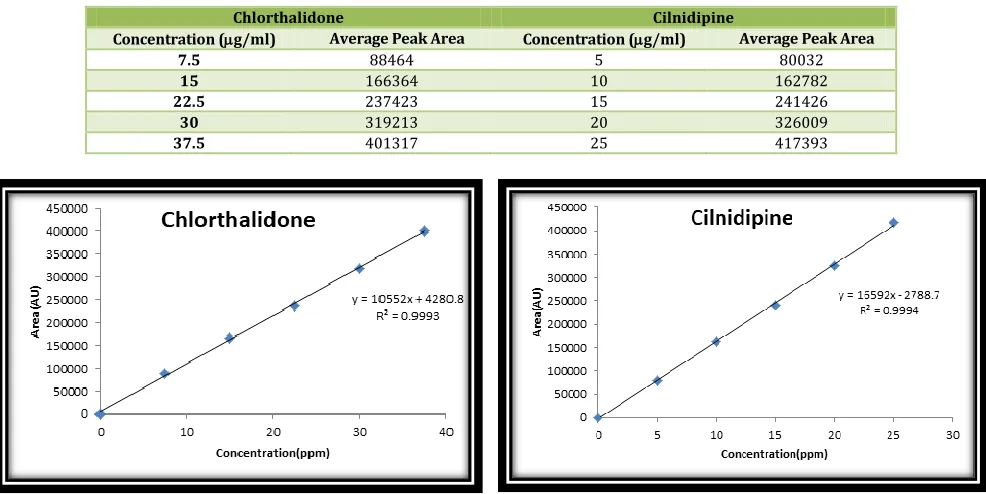
To establish the linearity a series of dilutions ranging from 7.5-37.5 µg/ml for Chlorthalidone and 5-25µg/ ml of Cilnidipine were prepared separately and calibration graph was plotted between the mean peak area Vs respective concentration and regression equation was derived.
Accuracy:
The accuracy of the method was carried out by adding known amount of each drug corresponding to three concentration levels 50%, 100% and 150% of the label claim along with the excipients in triplicate.
Precision:
Precision of the method was checked by analyzing the samples on different times of the same day as well as on different days.
Limit of Detection and Limit of Quantization:
LOD and LOQ are calculated by using the values of slopes and intercepts of the calibration curves for both the drugs.
Robustness:
Robustness was performed by deliberately changing the chromatographic conditions. The flow rate of the mobile phase was changed and composition of the buffer in mobile phase was changed.
Ruggedness:
Ruggedness of the method was performed by two different analysts using same experimental and environmental conditions.
RESULTS AND DISCUSSION
T
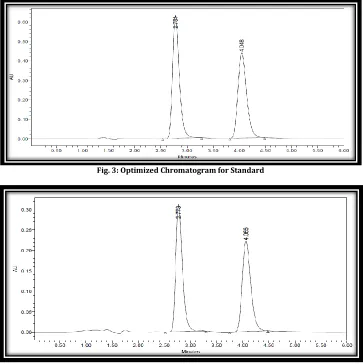
he proposed chromatographic system was found suitable for effective separation and quantization of Chlorthalidone and Cilnidipine was 2.781, 4.048min respectively.Specificity:
The ICH documents define specificity as the ability to assess unequivocally the analyte in the presence of components that may be expected to be present, such as impurities, degradation products, and matrix components (Table No. 4).
Analytical method was tested for specificity to measure accurately quantitate Chlorthalidone and Cilnidipine in drug product.
Precision:
The precision of an analytical procedure expresses the closeness of agreement (degree of scatter) between a series of measurements obtained from multiple sampling of the same homogeneous sample under the prescribed conditions (Table No. 6 & 7).
Repeatability:
Obtained Five (5) replicates of 100% accuracy solution as per experimental conditions. Recorded the peak areas and calculated % RSD.
Limit of Detection:
The detection limit of an individual analytical procedure is the lowest amount of analyte in a sample which can be detected but not necessarily quantitated as an exact value of 1.1µg/ml for Chlorthalidone and 0.75µg/ml for Cilnidipine.
Limit of Quantitation:
The quantitation limit of an individual analytical procedure is the lowest amount of analyte in a sample which can be quantitatively determined as an exact value of 3.6µg/ml for Chlorthalidone and 2.45µg/ml for Cilnidipine.
Robustness:
The robustness was performed for the flow rate variations from 0.9ml/min to 1.1ml/min and mobile phase ratio variation from more organic phase to less organic phase ratio for Chlorthalidone and Cilnidipine. The method is robust only in less flow condition and the method is robust even by change in the Mobile phase ± 5%. The standard and samples of Chlorthalidone and Cilnidipine were injected by changing the conditions of chromatography. There was no significant change in the parameters like resolution, tailing factor, asymmetric factor, and plate count.
Table No. 1: Optimized Chromatographic Conditions
Mobile phase Methanol: TEA pH 4.2 (40:60) Column Symmetry C18 (4.6×150mm, 5.0 µm)
Flow rate 1 ml/min
Wavelength 272 nm
Column temp 40ºC
Injection Volume 10 µl
Fig. 3: Optimized Chromatogram for Standard
Fig. 4: Optimized Chromatogram Sample
Validation: System suitability:
Table No. 2: Results of system suitability for Chlorthalidone
S.No Name Rt Area Height USP plate count USP Tailing 1
Chlorthalidone
2.782 2762937 357421 6344.7 1.3 2 2.766 2774613 388745 6344.2 1.3 3 2.767 2762937 399854 6300.1 1.3 4 2.795 2774613 386542 6344.7 1.3 5 2.768 2776429 364121 6344.2 1.3
Mean 2770306
Std. Dev 6767.495
% RSD 0.2
Table No. 3: Results of system suitability for Cilnidipine
S.No Name Rt Area Height USP plate
count Tailing USP Resolution USP 1 Cilnidipine 4.049 2540214 236741 5937.7 1.3 4.6 2 4.025 2541284 226745 5008.8 1.3 4.7 3 4.029 2534375 210326 5937.7 1.3 4.6 4 4.067 2526189 226741 5008.8 1.3 4.7 5 4.030 2546248 231494 5990.7 1.3 4.7
Mean 2537662
Std. Dev 7677.647
Table No. 4: Peak results for assay sample
S.No Name RT Area Height USP Resolution USP Tailing USP Plate Count
1 Chlorthalidone 2.764 2732203 294531 1.3 6314
2 Cilnidipine 4.012 2507543 216321 4.6 1.3 5954
3 Chlorthalidone 2.767 2751843 286473 1.3 6369
4 Cilnidipine 4.016 2509101 216354 4.6 1.3 5944
5 Chlorthalidone 2.764 2744776 312684 1.3 6329
6 Cilnidipine 4.013 2515628 206571 4.6 1.3 5990
Linearity:
Table No. 5: Linearity results of Chlorthalidone and Cilnidipine
Chlorthalidone Cilnidipine
Concentration (g/ml) Average Peak Area Concentration (g/ml) Average Peak Area
7.5 88464 5 80032
15 166364 10 162782
22.5 237423 15 241426
30 319213 20 326009
37.5 401317 25 417393
Fig. 5: calibration graph for Chlorthalidone Fig. 6: calibration graph for Cilnidipine
Table No. 6: Results of repeatability for Chlorthalidone
S.No Name Rt Area Height USP plate count USP Tailing 1
Chlorthalidone
2.766 2766870 294578 6684 1.3 2 2.774 2771971 286541 6347 1.3 3 2.770 2771958 302657 6674 1.3 4 2.772 2780299 293412 6451 1.3 5 2.771 2789695 283154 6678 1.3
Mean 2776159
Std. Dev 8969.896
% RSD 0.3
Table No. 7: Results of method precession for Cilnidipine
S.No Name Rt Area Height USP plate
count Tailing USP Resolution USP 1 Cilnidipine 4.025 2534539 193240 5761 1.3 4.7 2 4.040 2539247 201647 5489 1.3 4.6 3 4.032 2544661 193472 5367 1.3 4.6 4 4.041 2548839 196475 5845 1.3 4.6 5 4.036 2558822 201394 5347 1.3 4.7
Mean 2545222
Std. Dev 9329.852
Intermediate precision:
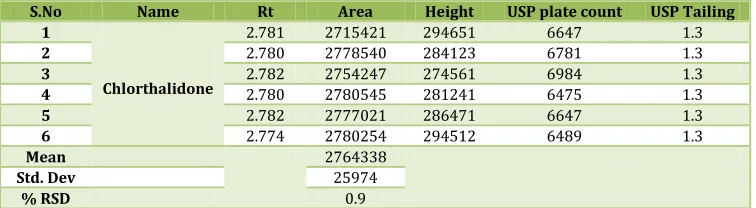
Table No. 8: Results of Intermediate precision for Chlorthalidone
S.No Name Rt Area Height USP plate count USP Tailing 1
Chlorthalidone
2.781 2715421 294651 6647 1.3 2 2.780 2778540 284123 6781 1.3 3 2.782 2754247 274561 6984 1.3 4 2.780 2780545 281241 6475 1.3 5 2.782 2777021 286471 6647 1.3 6 2.774 2780254 294512 6489 1.3
Mean 2764338
Std. Dev 25974
% RSD 0.9
Table No. 9: Results of Intermediate precision for Cilnidipine
S.No Name Rt Area Height USP plate
count Tailing USP Resolution USP 1
Cilnidipine
4.048 2506927 211541 5495 1.4 4.6 2 4.050 2504522 206141 5694 1.4 4.6 3 4.049 2541270 198641 5785 1.4 4.7 4 4.050 2507885 206741 5947 1.4 4.6 5 4.049 2504587 209487 5742 1.4 4.6 4.040 2504780 193481 5914 1.4 4.6
Mean 2511662
Std. Dev 14572.01
% RSD 0.5
Table No. 10: The accuracy results for Chlorthalidone
%Concentration (at
specification Level) Area Added (ppm) Amount Amount Found (ppm) % Recovery Mean Recovery 50% 1382603 11.25 11.23 99. 8
99.3%
100% 2777270 22.5 22.1 98.2
150% 41448756 33.75 33.73 99.9
Table No. 11: The accuracy results for Cilnidipine
%Concentration (at
specification Level) Area Amount Added (ppm) Amount Found (ppm) % Recovery Mean Recovery
50% 1306990 7.5 7.5 100
99.4%
100% 2510628 15 14.8 98.6
150% 3777999 22.5 22.46 99.8
CONCLUSION
I
n the present investigation, a simple, sensitive, precise and accurate RP-HPLC method was developed for the quantitative estimation of Chlorthalidone and Cilnidipine in bulk drug and pharmaceutical dosage forms. This method was simple, since diluted samples are directly used without any preliminary chemical derivatisation or purification steps.The RP-HPLC method is more sensitive, accurate and precise compared to the Spectrophotometric methods. This method can be used for the routine determination of Cilnidipine and Chlorthalidone in bulk drug and in Pharmaceutical dosage forms.
REFERENCES:
1. National Center for Biotechnology Information. PubChem Compound Database;
CID=2732, https://pubchem.ncbi.nlm.nih.gov/compound/2732. 2. Singer, Jeff M, Michael J. O'Hare, Carl R. Rehm and John E. Zarembo. "Chlorthalidone." In Analytical Profiles of Drug Substances, 1985;14:1-36. Academic Press.
https://doi.org/10.1016/S0099-5428(08)60575-4.
3. https://en.wikipedia.org/wiki/Cilnidipine.
4. Snehal N. Patel, Madhuri A. Hinge, Varsha M.Bhanushali.
Development and validation of an UV spectrophotometric method for simultaneous determination of cilnidipine and chlorthalidone. J Pharm Res 2015;9(1):41-45.
5. N. Sunitha, Subash C. Marihal, J. Sai sravanthi, A. Venu, BV. Narasimha Rao and B. Appa Rao. Method Development and Validation of RP-HPLC Method for the Simultaneous Estimation of Olmesartan and Cilnidipine in Bulk and Formulations. Int J Pharm Res Allied Sci 2015;4(3):127-135.
6. ARUNA G, BHARATHI K, KVSRG PRASAD. Development and Validation of Bioanalytical HPLC Method for Simultaneous Estimation of Cilnidipine and Nebivolol in Human Plasma.Int J Pharm Pharm Sci 2017;9(10):253-259.
7. Mayank Bapna, Bhoi Khushbu Girishbhai. Development and Validation of Analytical Method for Simultaneous Estimation of Cilnidipine and Chlorthalidone in their Combined Dosage Form. Int J Ayu Pharm Chem 2015;2(3):51-58.
9. International Conference on Harmonisation, Validation of
Analytical Procedures: Text and Methodology, in ICH Harmonized Tripartite Guidelines Q2 (R1) 2005.
How to cite this article:
D. Satyavati et al. VALIDATED RP-HPLC METHOD FOR SIMULTANEOUS ESTIMATION OF CHLORTHALIDONE AND CILNIDIPINE IN API AND TABLET DOSAGE FORM. J Sci Res Pharm 2018;7(11):124-129.DOI:https://doi.org/10.5281/zenodo.1489499