Pak. J. Anal. Environ. Chem. Vol. 8, No. 1 & 2, (2007)
Computational Evaluation of N,N-Dimethylaminophenyl
Methyl Ether and Crown Ether for Metal Selective Sensor
Development
Margarita Dunina-Barkovskaya
1, D. Max Roundhill
2,
Shahabuddin Memon
*3, M. I. Bhanger
3and Mustafa Yilmaz
41
Department of Chemistry & Biochemistry, Texas Tech University, Lubbock, TX 79409-1061 USA 2
Present address at Chem. Consulting, 13325 Black Canyon Drive, Austin, TX 78729-7481 USA 3National Center of Excellence in Analytical Chemistry, University of Sindh, Jamshoro-76080, Pakistan
4
Department of Chemistry, Selçuk University, Konya-42031, Turkey
---
Abstract
The present computational study describes some representative contributions in metal selective sensor development. During the course of study, charge densities have been calculated for a series of dimethylamino methyl ether and crown ether metal complexes. For the dimethylamino methyl ether metal complexes the charges on ether oxygen and amine nitrogen have been calculated for both the free dimethylamino methyl ether and its metal complex. Similar calculations have been carried out for crown ether metal complexes and dimethylamino crown ether metal complexes. The metal ions have been chosen because they cover a wide range of charge densities as well as having strategic significance. Therefore, their extraction, separation, purification and analytical determination are of continuing importance. However, for the crown ether metal complexes the charge on the metal ion and, for the dimethylamino crown ether metal complexes, as well as the charge on metal ion and on the dimethylamino nitrogen in the complex are calculated. The change in charge on the dimethylamino nitrogen after complexation of the ether oxygen(s) is presented and discussed with respect to the combination of a crown receptor and an alkylamine reporter being an effective system for the design of a chemosensor.
Keywords: calixarene, N,N-dimethylaminophenyl methyl ether, crown ether, metal complex,
cation charge, chemosensor.
--- Introduction
Computational approaches have been successfully used as a powerful tool to obtain valuable insight into the reactivity and mechanism of several synthetic reactions of high interest. Chemosensors for metal ions have both receptor and reporter combinations that act in a complementary manner [1-4]. The receptor functions to bind the analyte, and the reporter signals this binding event. In order for selectivity to be achieved, the receptor must have specific binding properties, and the reporter must effectively communicate with the receptor. One strategy to achieve this complementary goal is to design a receptor-reporter combination that is in a coupled electronic conjugation via a -system.
However, such a chemosensor system 1 has been found to be selective for calcium(II) over other metal ions. This chemosensor has a calixcrown receptor and a conjugated azo system as the reporter. The function of this chemosensor can be explained on the basis of charge effects whereby the calixcrown complexed metal ion induces a charge in the electronic structure of the reporter 2, resulting in a change in its charge density distribution and its electronic spectrum [5]. If such an explanation is valid, complexation of metal ions having different sizes and charges should lead to different charges at the metal center and any heteroatoms that are present on the complexant. Such a model should have generality, and not be limited to calixcrowns. Both simple ethers and crown ether
O X
N N
O N
N
1
X =
O O OO O O
NMe2 O
O
O O
Mn+
3
macrocycles can be expected to show similar properties. In this paper we report our results on both simple ether and crown ether metal complexes where the charge on the metal ion is calculated for ether molecules having different size and structure. The oxygen atom of an ether will bind with hard metals such as alkali metal ions, and the crown ethers are chosen because they strongly bind these metal ions within their ring system [6-11].
For example, in the dibenzocrowns 3, the influence of metal ion complexation on an amino group bound to be the aromatic moiety is also investigated in regard to the involvement of the two tautomeric forms 4.
Calixarenes [12-14] and calixcrowns [15-16] also complex metal ions into their narrow rim cavity.
The metal ions are chosen because of a combination of the availability of force fields in the software, a wide range of charges and charge densities, and in their uses and analytical and environmental importance. Lithium and gallium are used in medicine, and magnesium and tin are widely used metals in a range of different industrial applications. Enriched lithium-6 is important because of its potential use in a thermonuclear device. As a result there is interest in its selective extraction and determination. The analytical chemistry of gallium has also assumed increased importance because it is a component of nuclear weapons. The reduction in such weapons is leading to the component materials in the decommissioned devices being used in electric power generation. Since, however, gallium alloys with most other metals, it must be removed before the recovered pit material can be used in commercial reactors [17]. Magnesium is a commercially useful metal in the manufacture of light alloys, especially in the aircraft industry. Tin has many uses. Among these are electro-plating and the manufacture of alloys such as soft solder, pewter and bronze. Since, each of these metals has strategic significance; therefore their extraction, separation, purification and analytical determination are of continuing importance.
O X
N N
O N
N
2
X =
O O OO O O
Ca2+
-NMe
2NMe
2O
O
O
O
M
n+O
O
O
O
M
(n-1)+4
+
Results
Calculations were carried out using programs in the SPARTAN software package. Since compounds 1 and 2 could not be successfully minimized with the programs in the software package used, we have carried out calculations on model systems. These systems include both open chain compounds and macrocyclic crown ether compounds, and their metal complexes. Both density functional and molecular mechanics calculations have been performed. The density functional calculations were carried out using the SVWN/DN* model. This is a local density model combined with the DN* numerical basis set. DN* is a representation in which the valence shell of all atoms is split into “inner” and “outer” parts, and polarization functions have then been added to all atoms except hydrogen [18]. This model gives nearly identical results for calculated atomic charges as do other density functional models such as the Becke-Perdew (pBP/DN**) model. The molecular mechanics calculations were carried out using the PM3 semi-empirical model. This model is chosen because it can be used with heavier elements, and because it gives values for atomic charges that are close to those obtained with HF/6-31G* calculations [19]. Since, however, it is neither possible to measure individual charges nor to calculate them uniquely, the reliability of charge calculations are judged by how reasonable the charges appear to be. In Table 1 are collected the charges, sizes, and charge densities of the individual metal ions that are complexed to the N,N-dimethylaminophenyl methyl ether and crown ether hosts. The charge density is calculated as the ratio of the formal charge to the cation radius in . The charge densities of the chosen ions range from 1.01 to 7.27 charge/radius in . The results of our calculations for the cation charges on both the nitrogen and the complexed metal ion when the metal ion is bound to ether oxygen(s) are collected in Tables 2 through 6.
Table 1. Cation Radii and Cation Charge Densities
Cation
Formal Charge
Cation Radius () 20
Cation Charge Density
Li+ +1 0.59 1.69
Na+ +1 0.99 1.01
Mg2+ +2 0.57 3.51
Ga3+ +3 0.47 6.88
Sn4+ +4 0.55 7.27
Table 2. Cation Charge in 12-Crown-4 Complexes
Cation
Molecular Mechanics (PM3)
Density Functional Theory (DN*)
Li+ 0.54 0.68
Na+ - 0.62
Mg2+ 0.91 0.98
Ga3+ 1.49 1.00
Sn4+ 1.81 (deformed structure) 0.81
Table 3. Cation Charge in 14-Crown-4 Complexes
Cation
Molecular Mechanics (PM3)
Density Functional Theory (DN*)
Li+ 0.55 0.57
Na+ - 0.61
Mg2+ 1.16 0.95
Ga3+ 0.45 0.32
Table 4. Cation Charge in Dibenzo-14-Crown-4 Complexes Cation Molecular Mechanics (PM3) Density Functional Theory (DN*)
Li+ 0.52 0.64
Na+ - 0.73
Mg2+ 1.13 0.94
Ga3+ 0.62 0.29
Sn4+ 1.35 0.58
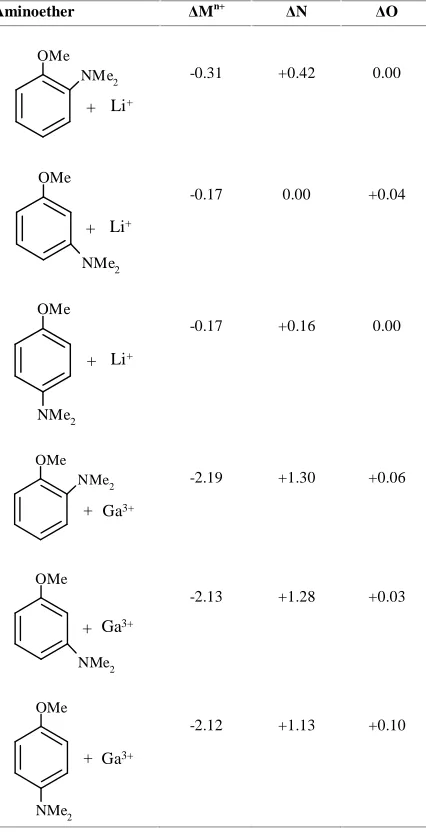
Table 5. Charge Changes (ÄMa, ÄNb, ÄOb) by PM3 for Lithium
(I) or Gallium (III) bound to the oxygen of N,N-dimethylaminophenyl methyl ether
Aminoether ÄMn+ ÄN ÄO
OMe NMe2
Li+ +
-0.31 +0.42 0.00
OMe
NMe2
Li+ +
-0.17 0.00 +0.04
OMe
NMe2
Li+ +
-0.17 +0.16 0.00
OMe NMe2
Ga3+ +
-2.19 +1.30 +0.06
OMe
NMe2
Ga3+ +
-2.13 +1.28 +0.03
OMe
NMe2
Ga3+ +
-2.12 +1.13 +0.10
a. ÄM assumes the charges on either Li+ and Ga3+ to be +1.00 and
+3.00 respectively.
b. The charges on both N and O are calculated in both the complexed and free aminoether.
The results in Tables 2 and 3 show the effective charge that resides on the metal ion after it is complexed into an aliphatic crown ether. In each case this charge on the complexed metal ion is significantly reduced from that in the free ion form. The results in Table 4 show similar charge changes for metal ions complexed by dibenzo-14-crown-4. A very low cationic charge on the complexed Ga3+ ion is observed. This may be due to a combination of the small cation radius and high charge density of this ion, but the case of the Ga3+ ion will be discussed more fully in the Discussion section. In Table 5 are collected data obtained for the Li+ and Ga3+ ions complexed to the ether oxygen of N,N-dimethylaminophenyl methyl ethers. The change in the charge on both oxygen and nitrogen has been calculated using both DN* and PM3 methods. In Table 6 are shown data obtained for the series of metal ions complexed to the ether oxygens of dimethylaminodibenzo-14-crown-4. For these metal complexes the charge on both the metal ion and the nitrogen has been calculated using both DN* and PM3 methods.
Table 6. Charge on both Cation and Nitrogen in
Dimethylaminodibenzo-14-crown-4 Complexes using Density Functional Theory (DN*) and Molecular Mechanics (PM3) Methods
Cation Metal Ion Charge Nitrogen Charge
DN* PM3 DN* PM3
No metal ion - - -0.06 -0.60
Li+ 0.55 0.46 -0.21 -0.53
Mg2+ 0.87 1.02 -0.14 -0.35
Ga3+ 0.54 0.72 0.19 0.64
Sn4+ 0.87 1.44 0.24 0.64
Discussion
Metal ions bind into the macrocyclic cavity of crown ethers. Crown ethers have been primarily used for the selective complexation of Group 1 and 2 metal ions, although other metal ions will bind. Coordination occurs via the ether oxygens. The selectivity toward individual metal ions is influenced by the cavity size within the macrocycle, but other factors such as the number of oxygen donors within the ring system can also be important [4].
and density functional theory agree reasonably well. No charge densities can be obtained for sodium by molecular mechanics PM3 methods because the suite of programs used does not have any parameters included for this metal. The large discrepancy between the values found for Sn4+ results from the molecular mechanics PM3 method minimizing into deformed structures. Such deformed structures for crown ether complexes of Sn4+ have also been observed crystallographically [21].
The data shown in Table 4 for are for the dibenzo-14-crown-4 complexes of these metal ions. Although this dibenzo-14-crown-4 host molecule is similar in the size of the cavity to 14-crown-4, the aromatic systems confer more rigidity to the crown ring system than do the fully aliphatic ring systems. Again the data show that the charge on the bound metal ion is lowered from the formal charge on the free ion. These data, as well as those in Tables 2 and 3, show an unusually small charge density on Ga3+, especially for the calculations carried out by the density functional theory methods. In the Results section we suggested that both the small cationic radius and the high charge density of the Ga3+ ion may be factors, but the high oxophilicity of Ga3+ is also likely to be a factor. The Ga3+ ion is strongly oxophilic, which is shown by the high stability of its hydroxide salt and by its strong tendency to form complexes with phenolates [22].
Since the reason for initiating this study was to investigate the effect of the charge on a metal bound to ether oxygens on a peripheral nitrogen on an aromatic system, both open chain aminoethers and crown ethers having dimethylamino moieties appended to their periphery have been investigated. In Table 5 are collected data for open chain dimethylamino ethers having either Li+ or Ga3+ bound to the ether oxygen. This group of open chain dimethylamino ethers has been investigated to evaluate whether there is any significant communication between an amine nitrogen and a metal ion binding to an ether oxygen through an aromatic moiety. The charges on the metal ion, the ether oxygen, and the dimethylamino nitrogen have then been calculated, and the charges on the ether oxygen, and the dimethylamino nitrogen then compared with those on the uncomplexed dimethylamino ether molecule. The results in Table 5 are presented as ÄMn+,
ÄN and ÄO, with an increase in the charge being
expressed as a positive number. The results show that complexation of either Li+ or Ga3+ to the ether oxygen leads to a decreased negative charge on the dimethylamino nitrogen. As expected the decrease is greater for Ga3+ than it is for Li+, and there is a somewhat greater effect when the methyl ether and the dimethylamino are in mutually ortho positions. This
latter effect is likely due to the proximity of the ether complexed metal ion to the dimethylamino group.
The data in Table 6 are for dimethylamin-odibenzo-14-crown-4 complexes of the metal ions. In the absence of a metal ion the complexant shows a negative charge on the amine nitrogen. When the metal ion is complexed into the crown ether host there is a change in the charge on both the metal ion and the dimethylamino nitrogen. For the molecular mechanics PM3 calculations there is a progressive decrease of the negative charge on nitrogen along the series Li+, Mg2, Ga3+, Sn4+. This decrease corresponds with an increase in the metal cation charge density along the series. For the apo dimethylaminodibenzo-14-crown-4 the charge on nitrogen is calculated to be –0.60, increasing to 0.64 for the complexes with Ga3+and Sn4+. For the DN* calculations the data are not progressive along this group of metal ions, but now for the apo dimethylaminodibenzo-14-crown-4 the charge on nitrogen is calculated to be –0.06, increasing to 0.24 for the complex with Sn4+, again showing an increase. The calculations, especially those using molecular mechanics PM3, show that complexation of a metal ion into a crown ether binding site can lead to a selective change in the charge of a peripheral nitrogen of a dimethylamino moiety.
Conclusion
When the metal ions Li+, Na+ Mg2+ Ga3+ and Sn4+ are individually bound into the cavity of a crown ether host there is a decrease in the positive charge on the metal ion, although this decrease does not linearly correlate with the initial charge or charge density of the metal ion. Open chain aminoethers with these metal ions bound to the ether oxygen show that there is a decrease in the negative charge on the amine nitrogen. This decrease is metal ion dependent. Similarly when these metal ions are individually bound into the cavity of a crown ether host that has an amine substituent there is also a decrease in the negative charge on the amine nitrogen, which is again metal ion dependent. This work shows that because of this metal ion dependency on the decrease in the negative charge on the amine nitrogen, amine substituted crown ether hosts can be used in metal ion selective sensor systems.
Acknowledgments
References
1. D. M. Roundhill, Optoelectronic Properties of Inorganic Compounds, D. M. Roundhill and J. P. Fackler, eds., Chapter 9: Optical Sensors with Metal Ions, Plenum, 1998.
2. V. Felix, M. G. B. Drew, P. R. A. Webber, P. D. Beer, Phys. Chem, Chem. Phys., 8 (2006) 521. 3. P. R. A. Webber, A. Cowley, P. D. Beer, JCS,
Dalton Trans., (2003) 3922.
4. V. Felix, S. E. Matthews, P. D. Beer, M. G. B. Drew, Phys. Chem, Chem. Phys., 4 (2002) 3849. 5. Y Kubo, S. Obara, S. Tokita, JCS, Chem.
Comm., (1999) 2399.
6. G. Gokel, Crown Ethers & Cryptands, Monographs in Supramolecular Chemistry, J. Fraser Stoddart, Editor, Royal Society of Chemistry, 1991.
7. M. L. Dietz, A. H. Bond, B. P. Hay, R. Chiarizia, A. W. Huber, A. W. Herlinger, JCS, Chem.
Comm., (1999) 1177.
8. J. C. Bryan, B. P. Hay, Structural Chem., 12 (2001) 283.
9. M. Takagi, H. Nakamura, J. Coord. Chem. 15 (1986) 53.
10. B. P. Hay, R. D. Hancock, Coord. Chem. Rev., 212 (2001) 61.
11. B. P. Hay, Coord. Chem. Rev., 126 (1993) 177. 12. C. D. Gutsche, Calixarenes Revisited, Royal
Society of Chemistry: Cambridge, 1998.
13. Calixarenes 2001, Z. Asfari, V. Böhmer, J. McB. Harrowfield, J. Vicens: (eds.), Kluwer Academic, Dordrecht, 2001.
14. L. H. Delmau, J. C. Bryan, B. P. Hay, N. L. Engle, R. A. Sachleben, B. Moyer, ACS Sympos.
Ser., Calixarene Molecules for Separations, 757
(2000) 86.
15. R. A. Sachleben, J. C. Bryan, Engle, N. L.; T. J. Haverlock, B. P. Hay, A. Urvoas, B. Moyer, Eur.
J. Org. Chem., 24 (2003) 4862.
16. R. A. Sachleben, A. Urvoas, J. C. Bryan, T. J. Haverlock, B. P. Hay, B. Moyer, JCS, Chem.
Comm., (1999) 1751.
17. F. Koch, L. A. Girard, D. M. Roundhill, C. V. Philip, R. G. Anthony, W. W. Pitt, C. Beard,
Atomic Spectroscopy, 20 (1999) 30.
18. W. J. Hehre, L. Lou, A Guide to Density Functional Calculations in SPARTAN, Wavefunction, Inc., Irvine, CA, (1997) 11. 19. W. J. Hehre, J. Yu, P. E. Klunzinger, A Guide to
Molecular Mechanics and Molecular Orbital Calculations in SPARTAN, Waveform Inc., Irvine, CA, (1997) 98.
20. R. D. Shannon, Acta Cryst., A32 (1976) 751. 21. P. A. Cusack, B. N. Patel, P. J. Smith, D. W.
Allen and I. W. Nowell, J. Chem. Soc., Dalton
Trans., (1984) 1239.
22. J. E. Bollinger, J. T. Mague, C. J. O,Connor, W. A. Banks and D. M. Roundhill, J. Chem. Soc.,