IJSRR, 8(2) April. – June., 2019 Page 497
Research article Available online www.ijsrr.org
ISSN: 2279–0543
International Journal of Scientific Research and Reviews
Design and analysis of Biodegradable Organic Substrate based
Resonator
Chandni Upadhyaya
P M Institute of Biosciences, SardarPatel University, Anand Email: [email protected]
ABSTRACT:
The paper presents design of biodegradable resonator working at ISM band frequency. The
outer area of resonator is 57.26 x 66.36 mm2 whereas the surface area of resonator is 48.36 x 39.5 mm2. The paper is utilized as substrate and think copper sheets are utilized as resonator which are soluble in the water. The bandwidth of the resonator is 7.61% and peak gain of the resonator is
1.26dBi. The environment friendly and low cost resonator presents ability to be surface mountable
on human body.
KEYWORDS:
biodegradable resonator, surface mountable, soluble, environment friendly*Corresponding author:
Chandni Upadhyaya
P M Institute of Biosciences,
Sardar Patel University, Anand
IJSRR, 8(2) April. – June., 2019 Page 498
INTRODUCTION:
The need of surface mountableresonatoris increasing significantly due to demand of
body-centric wireless communication1. Paper is quite compatible with the recent resonator printing environments such as inkjet, direct-write and copper lamination2. Due to compact size and light weight it offers direct application to surface mountable body-centric devices and wireless sensor
motes. Several articles have been presented in design of resonator using paper substrate3-10.
The paper an organic soluble substrate is widely available and it presents ease in integration
with wearable devices being a low profile substrate. The mass production is also easy and cheaper.
The paper dissipation factor is around 0.065 - 0.075 for frequencies ranging from 1 GHz to 2.6 GHz,
the proposed resonator application frequency lies in this range. For the lower frequency resonator
paper size becomes significantly high to achieve target application requirements hencethere are
fewer resonators in sub-1GHz regime. Due to high dissipation factor the antenna gain shall be
limited, however, it can effectively be used in short range communication for wireless sensor
network motes. There are also other green energy based resonators proposed in the literature such as
optically transparent antenna using PET and glass substrates11-14. This paper presents the paper substrate based resonator for WiFi communication systems.
DESIGN, RESULTS AND DISCUSSION:
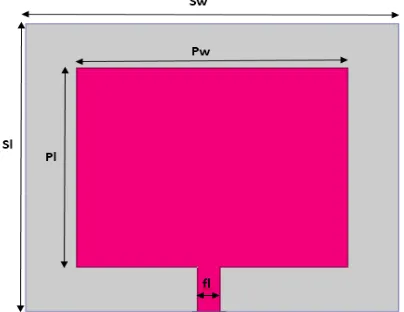
The biodegradable organic substrate based resonator is illustrated in Figure 1. The height of
the substrate was kept as 3 mm. This is based on standard 3 mm thick paper. Dielectric constant of
used organic material is 2.34 and it has loss tangent of 0.065. The paper material is quite lossy which
reduces overall radiation out of the resonator. The substrate width (Sw) was kept as 57.26 mm and
substrate length (Sl) is kept at 66.36 mm. The resonator patch which is copper thin sheets has length
Pl of 39.5 mm and width Pw of 48.36mm. The resonator patch was fed through microstripfeed line
having width fl of 4mm.
IJSRR, 8(2) April. – June., 2019 Page 499 Figure 2: Reflection Coefficient of Resonator
Figure 2 illustrate the reflection coefficient of proposed resonator. As apparent from the
figure resonator is resonating at ISM band of 2.5 GHz. The simulated bandwidth of the resonator is
around 7.61% at target resonant frequency. The VSWR level of the proposed resonator is much
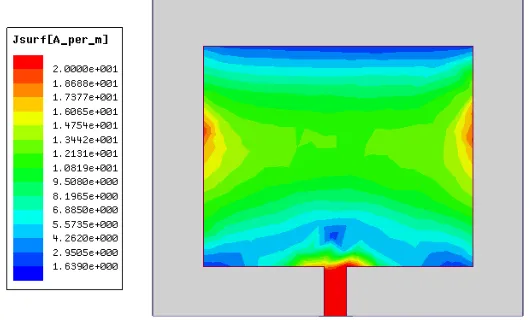
better than 1.5 dB level which is required for Wireless communication devices. Figure 3 illustrates
the surface current distribution of the proposed resonator. The device has maximum surface current
at the feed line and near the radiating edges. The current distribution is least at the non-radiating
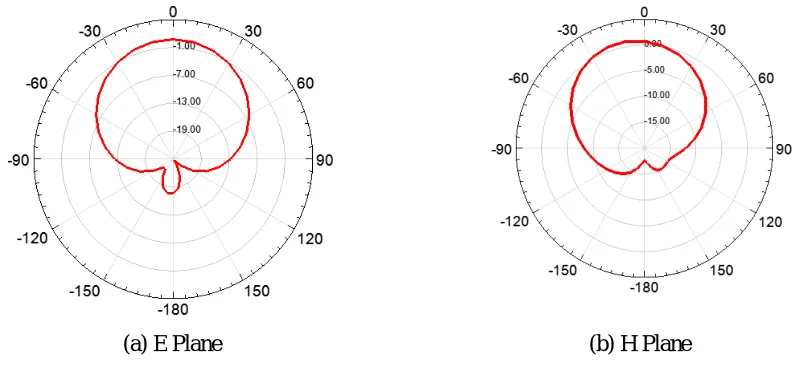
edges. Figure 4 depicts the E-plane and H-plane radiation patterns of the antenna. Since the ground
plane is completely covered with conducting copper sheet, the resonator has directive radiation
properties. The peak simulated gain of the antenna is 1.26 dBi. The reduction in the antenna radiation
and hence gain is due to high loss tangent of the paper which is utilized as a substrate.
Figure 3: Surface Current Distribution of the resonator -30 -25 -20 -15 -10 -5 0
1 1.5 2 2.5 3 3.5 4
IJSRR, 8(2) April. – June., 2019 Page 500
(a) E Plane (b) H Plane
Figure 4: Radiation Patterns of the Proposed Antenna
CONCLUSION:
A Biodegradable paper based resonator was presented. The soluble resonator is extremely
low-profile. The resonator is operating with wide bandwidth of 7.61% and has peak gain of 1.26 dBi.
The low-profile resonator has capability to be surface mountable and presents potential application to
ISM band communication devices.
REFERENCES:
1. Abbasi QH, Rehman MU, Qaraqe K, Alomainy A. Advances in body-centric wireless
communication: Applications and state-of-the-art. Institution of Engineering and Technology;
2016 Jul 6.
2. Hall PS. Antennas and propagation for body-centric wireless communications. Artech house;
2012.
3. Anagnostou DE, Gheethan AA, Amert AK, Whites KW. A direct-write printed antenna on
paper-based organic substrate for flexible displays and WLAN applications. Journal of
Display Technology. Nov 2010;6(11):558-64.
4. Vyas R, Rida A, Yang L, Tentzeris MM. Design and development of a novel paper-based
inkjet-printed RFID-enabled UHF (433.9 MHz) sensor node. In2007 Asia-Pacific Microwave
Conference Dec 11 2007 ; 1-4. IEEE.
5. Shaker G, Safavi-Naeini S, Sangary N, Tentzeris MM. Inkjet printing of ultrawideband
(UWB) antennas on paper-based substrates. IEEE Antennas and Wireless Propagation
Letters. 2011;10:111-4. .
6. Rida, Amin H. "Conductive inkjet printed antennas on flexible low-cost paper-based
substrates for RFID and WSN applications." PhD diss., Georgia Institute of Technology,
IJSRR, 8(2) April. – June., 2019 Page 501
7. Lakafosis, Vasileios, Amin Rida, RushiVyas, Li Yang, Symeon Nikolaou, and Manos M.
Tentzeris. "Progress towards the first wireless sensor networks consisting of inkjet-printed,
paper-based RFID-enabled sensor tags." Proceedings of the IEEE98, no. 2010; 9: 1601-1609.
8. Rida, Amin, Li Yang, and Manos M. Tentzeris. "Design and characterization of novel
paper-based inkjet-printed UHF antennas for RFID and sensing applications." In 2007 IEEE
Antennas and Propagation Society International Symposium, 2007; 2749-2752. IEEE,.
9. Maza AR, Cook B, Jabbour G, Shamim A. based inkjet-printed ultra-wideband fractal
antennas. IET microwaves, antennas & propagation. Sep 18, 2012;6(12):1366-73.
10.Russo A, Ahn BY, Adams JJ, Duoss EB, Bernhard JT, Lewis JA. Pen‐on‐paper flexible
electronics. Advanced materials. Aug 9, 2011;23(30):3426-30.
11.Desai, A., Upadhyaya, T., Palandoken, M., Patel, R. and Patel, U., November. Dual band
optically transparent antenna for wireless applications. In IEEE Asia Pacific Microwave
Conference (APMC) 2017; 960-963. IEEE.
12.Upadhyaya, T., Desai, A., Patel, R., Patel, U., Kaur, K.P. and Pandya, K., 2017, November.
Compact transparent conductive oxide based dual band antenna for wireless applications. In
Progress in Electromagnetics Research Symposium-Fall (PIERS-FALL) 2017; 41-45. IEEE.
13.Desai, A. and Upadhyaya, T., Transparent dual band antenna with μ negative material
loading for smart devices. Microwave and Optical Technology Letters, 2018; 60(11)
2805-2811.
14.Desai, A., Upadhyaya, T., Palandoken, M. and Gocen, C., Dual band transparent antenna for