238 |
P a g e
EFFICIENT ADSORPTION OF LEAD ION FROM
AQUEOUS SOLUTION TO EXPLOIT FABRIC FLY ASH
AS ADSORBENT
1
Priyanka Lahot,
2DP Tiwari
1
Chemical Engg Department, Deenbandhu Chhotu Ram University of Science and Technology,
Murthal Sonipat Haryana (India)
2
Chemical Engg Department, Deenbandhu Chhotu Ram University of Science and Technology ,
Murthal Sonipat Haryana (India)
ABSTRACT
Adsorption performance by fabric fly ash for removal of lead ion from aqueous solution was analyzed. As forces of
attraction between lead and fly ash exist and due to this heat energy released. Batch experiments were conducted
included various influence of parameters like initial metal ion concentration, ph, and adsorbent dose under different
conditions. Kinetic study were explained by pseudo second order reaction and high rate of adsorption explained by
well fitted weber morris model at two temperatures 35° C and 45° C. Equilibrium study well explained by Temkin
isotherm. Thermodynamic study revealed spontaneity and endothermic behavior for the process.
Keywords:
Adsorption, Kinetic, Fly Ash, Heavy Metal.
I.
INTRODUCTION
To make better safe and eco-friendly environment, water pollution [1, 2] should be decreased from industrial point
of view. As many industrial sectors use heavy metals for processing and their waste effluent contains those heavy
metals contaminates used in processing [3-5]. A toxic metal are lead, manganese, chromium, copper, mercury,
nickel and cadmium etc. consummated by human bodies as well as animals and also causes chronicle diseases as
kidney, liver, blood pressure problems. So to overcome from these problems should maintain the balance of
environment [6, 7].
From literature it is clear that many techniques available for removal of heavy metals. Techniques as precipitation,
titration, electro dialysis, ion exchange and adsorption. Adsorption is efficient and reliable method for removal of
239 |
P a g e
As many adsorbents have been exploited by many researchers and they have also introduced better and efficientadsorption capacity as activated charcoal, biochar, zeolites, ashes etc[8-13]. Presented paper introduces the fabric fly
ash as low cost adsorbent. Waste fabric used to make fly ash in presence of air. Main aim of study to find out a
cheap adsorbent that give better sorption characteristics of Lead metal ion with respect to parameter influence,
equilibrium study and kinetic study.
II. EXPERIMENTAL
Materials
Waste fabric fly ash is used as adsorbent for adsorption of lead ions. Firstly waste fabric collected and then dried
fabrics in sunlight for 4 to 5 days and completely burned in open atmosphere. After cooling by one night collected
this fly ash in container. Stock solution of Lead (25ppm) was prepared by dissolving calculated amount of PbNO3 in
distill water. This stock solution was used for preparing different working solutions to know effect of parameters
effect of temperature and effect of residence time.
Method
Batch Adsorption set up was used for all parameter study. Adsorption is like very efficient technique to remove
heavy metals. Effects of initial metal ion concentration, effect of pH, effect of adsorbent dose were studied. Effect of
metal ion concentration by varying only concentration 5, 10, 15, 20 ppm all other factors fixed. Effect of pH by
adjusting pH 2, 4, 6, 8, and 10 by 0.1 N HCl and 0.1N NaOH while all others fixed. Likewise, effect of adsorbent
dose by 0.1g, 0.2g and 0.3g of adsorbent quantity. All these parameters were evaluated to know the optimum range
of these parameters [14].
III. RESULTS AND DISCUSSION
3.1 Effect of initial metal ion concentration
To analyse the result of initial metal ion concentration, varying concentration from 5 to 25 ppm and by adding 0.2g
of adsorbent per 20ml of the solution. After 2 hr constant stirring at room temperature on rotary shaker then
analysed by uv vis spectrophotometer ultra 3660. From figure observations as concentration is varying from 5 to
25ppm, amount adsorbed per gram of the adsorbent is also increasing for 20 ppm amount adsorbed was 3.25 mg/g
and for 25ppm amount adsorbed was 3.82 mg/g due to effect of more active sites present initially then on high
concentration all active sites are completely occupied by adsorbate. Similar type of behavior reported in
240 |
P a g e
Figure 1. Effect of initial metal ion concentration on adsorption of lead ion
3.2 Effect of pH
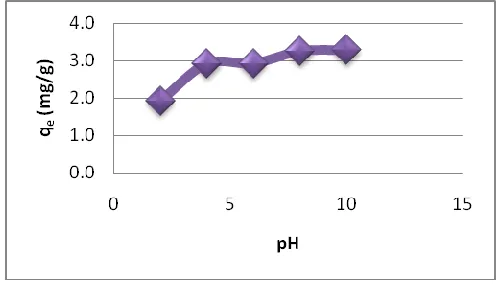
To know the optimum value of pH test analysis was done. On adjusting pH by 0.1N acid /base solution per 20ml of
solution with respect to varying pH and adding 0.2g of adsorbent constant stirring for 2hr gives values upon
analysis. From figure at low pH 2, number of negative charged ion release less and high value of pH 8 and pH 10
negative charged ion release more which totally favors the adsorption. Adsorption capacity is increasing at high pH
as comparison to low pH values due to surface negative charged ion present. Therefore optimum pH range is
6.5.[17, 18]
Figure 2. Effect of pH on adsorption of Lead ion
3.3 Effect of adsorbent dose
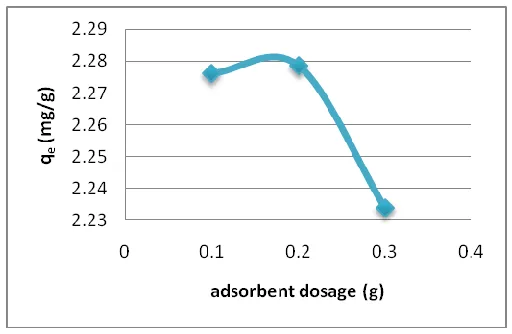
Adsorbent dose plays a key role in adsorption of heavy metals. Adsorbent dose decide the optimum quanity of
adsorbent required for efficient adsorption. Experiment was done by three quantities 0.1g, 0.2g and 0.3g of
241 |
P a g e
then for 0.2g amount adsorbent increased and for 0.3g amount adsorbed was decreased. It revealed that for 0.1g and0.2g more surface active sites present to adsorb but for 0.3g layer after layer formation found that shows blocking of
active sites as active sites more but adsorbate was less.
Figure 3. Effect of adsorbent dose on adsorption of lead ion
Kinetic study
3.3 Effect of contact time
The role of contact time was studied using 50 mg/l lead ion concentration and by adding adsorbent dose. At different
interval of time samples were collected and analysed. Contact time basically decides the order of reaction and time
variation adsorption shows. Results revealed that as the residence time increased adsorption capacity also increased.
From initial, rapid adsorption takes place then after 120 min adsorption attained equilibrium. This is all because of
242 |
P a g e
Figure 4. Effect of contact time on adsorption of lead ion
Pseudo Second order reaction
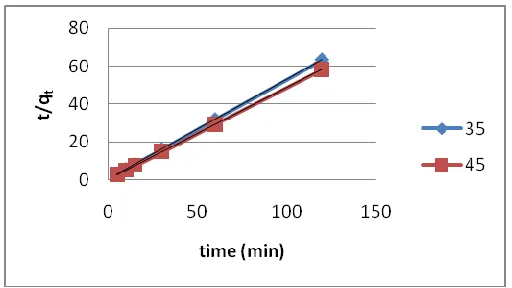
Langregen pseudo second order behavior is given by equation
t/qt = 1/(K2qe2) + t/qe
Where K2 second order rate constant (g mg-1 min-1).
Second order behavior is followed by chemisorption process. When plot between time and t/qt this type of behavior
is revealed that correlation coefficient gives value exactly equal to 1. Linearity gives that adsorption of lead by
fabric fly ash followed second order reaction.
243 |
P a g e
Weber morris model
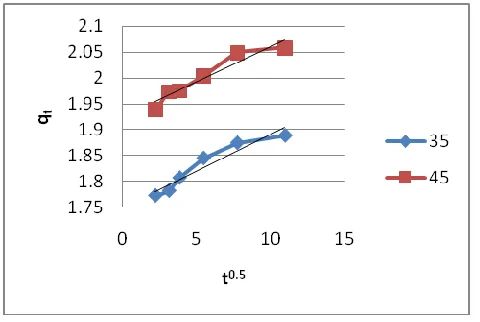
Weber morris model also known as intra-particle diffusion model which gives value of intra particle diffusion
constant. [20, 21]
qt = Ki*t0.5
Where Ki intra diffusion rate constant (mg g-1 min-1/2)
Figure 6. Intra-particle diffusion behavior of lead ion
On plotting results revealed that it gives a linear relationship and these curves don’t cross the origin due to boundary
effect. Higher values of K gives high rate of adsorption.
Table 1.
Constants evaluated by second order equation and Weber Morris model.model Pseuo second order Weber
Morris
model
paramters qe (mg/g) K (g mg-1
min-1)
K (mg g-1
min-1/2)
35° C 2.070 15.040 1.749
244 |
P a g e
3.4 Effect of temperature
Effect of temperature were studied on three different temperatures 35° C 45° C and 55° C. Varying concentration 5,
10, 15, 20 mg/l were used with respect to different temperature behavior. Maximum adsorption capacity was found
to be 1.300 for temperature 35° C , 1.470 for temperature 45° C and 1.518 for 55° C. Highest adsorption capacity
increased as concentration increased.
Figure 7. Effect of temperature with initial concentration at different temperatures
Temkin isotherm
Temkin isotherm contains a factor that explicitly takes into the account of adsorbent-adsorbate interactions. If plot
between qe and ln Ce then this plot gives the value of slope and intercept and this slope and intercept values further
gives the parameters. The parameters heat of adsorption evaluated are 1.168, 1.315, and 1.580 with varying
temperature.
The equation is
qe = ln
qe = ln At + ln Ce
qe = B ln At + B ln Ce
245 |
P a g e
Figure 8. Temkin isotherm plot of lead metal ion at different temperatures
Thermodynamic study
Thermodynamic study tells the feasibility, nature and spontaneity of the reaction. All parameters calculated by
thermodynamic equation decide the process behavior. Each parameter change in gibbs free energy, change in
enthalpy, change in entropy gives a constant value with respect to adsorption of lead ion. Equation is
ΔG° = -RT ln Ko
Where Ko is equilibrium constant. Gibbs free energy change is directly related to change in enthalpy and change in
entropy. Three temperatures 35°C 45°C and 55°C gives different value for each parameter presented in Table 2.
Negative value of gibbs free energy change describe the endothermic behavior process.
Table 2. Thermodynamic constant for lead metal ion at different temperatures.
Temperature Δ G° (cal/mol) Δ H° (cal/mol) Δ S° (cal/mol.K)
35° C -1385.76 40697.03 146.8252
45° C -2278.00
55° C -2692.38
IV. CONCLUSION
1. Fabric fly ash proved as low cost adsorbent for adsorption of lead ion.
246 |
P a g e
3. Effect of parameters on adsorption of lead ion decides the optimum range for each of parameter.4. Kinetic study gives second order behavior followed and Weber Morris model also gives satisfied result in
terms of diffusion constant.
5.
Equilibrium study followed by Temkin isotherm and Thermodynamic study proves spontaneity andendothermic behavior of the process.