Volume 2, Issue 6, December 2014
Abstract— Electrical discharge machining (EDM) is widely used process in the production of mould / dies, aerospace, automobile and electronics industries where intricate complex shapes need to be machined in very hard materials.[23] This
paper presents investigation and optimization of Electric Discharge Machining (EDM) parameters using Taguchi method. Four process parameters chosen were Discharge current (or pulse current), Voltage (V), Pulse on-time (Ton), Pulse off-time and An L25 orthogonal array was selected to study the effect of main factors and interaction between factors on the
response variable i.e. surface roughness. Signal to Noise (S/N) ratios of the response variable for all experiments were calculated. The contribution of the main factors and interaction between them to the optimal surface roughness were determined by using Analysis of Variance (ANOVA). The experimental results revealed that discharge current 4A, voltage 3V, pulse off time 225µs and pulse on time 104µs A yielded the optimal i.e. minimum surface roughness. Electronic Electra plus PS 50 EDM machine was used for this experiment. Experimental results confirm that this approach is simple, effective and efficient for simultaneous optimization of multiple quality characteristics i.e. MRR and surface finish in EDM.
Index Terms—Electrical Discharge Machine, Orthogonal Array, D2 Steel, Surface Roughness, Taguchi’s Method,
Anova.
I. INTRODUCTION
EDM( Electrical Discharge Machining ) is very widely used in Industary these days. EDM is a machining method primarily used for hard metals or those that would be very difficult to machine with traditional techniques.[2] EDM typically works with materials that are electrically conductive. EDM can cut intricate contours or cavities in pre-hardened steel without the need of heat soften and re-harden them[20]. Material used for this work is High-carbon, High-chromium Steel, refers to as a cold work steel. Cold work steels include the high-carbon, high chromium steels or group D steels. Various EDM parameters like Current, Voltage, Pulse On and Pulse off are taken as process parameters and Surface roughness are taken as Output Parameters. The influences of these parameters have been optimized by Taguchi methodology. Taguchi Method is used to formulate the experiment, to analyse the effect of each parameters such as peak current, voltage, pulse on and puse off. L25 Orthogonal array is made for this work. For each and every step weight of material and tool is measured before and after the operation. Time for each operation was fixed as 5 mintues.
IMPORTANTS PARAMETERS IN EDM
On-time or pulse time: It is the duration of time (μs) for which the current is allowed to flow per cycle. Material removal is directly proportional to the amount of energy applied during this on-time.
Off-time Or Pause time: It is the duration of time between the sparks. This time allows the molten material to solidify and to be wash out of the arc gap.
Discharge current (current Ip): Current is measured in amp Allowed to per cycle. Discharge current is directly proportional to the Material removal rate.
Arc Gap: It is the distance between the electrode and the work piece during the process of EDM. It may be called as the spark gap.
The Effect of Die Sinking Process Paramters on
Surface roughness of D2 Steel Using Taguchi’s
Method
Volume 2, Issue 6, December 2014
Duty Cycle: It is the percentage of on-time relative to total cycle time. This parameter is calculated by dividing the on-time by the total cycle time (on-time plus off-time). The result is multiplied by 100 for the percentage of efficiency or the so called duty cycle.
Intensity: It points out the different levels of power that can be supplied by the generator of the EDM machine. Voltage (V): It is a potential that can be measure by volt it is also effect to the material removal rate and allowed to per cycle. Voltage is given by in this experiment is 50 V.
II. LITERATURESURVEY
A literature survey was made on the various optimization techniques that have been used for these EDM process parameters. All have used different material for their work. So some of them are as:
M. Durairaj et al [1] (2013), Analysis of Process Parameters in EDM with Stainless Steel using Single Objective Taguchi Method and Multi Objective Grey Relational Grade. This paper summarizes the Grey relational theory and Taguchi optimization technique, in order to optimize the cutting parameters in EDM for SS304. The objective of optimization is to attain the minimum kerf width and the best surface quality simultaneously and separately. In this present study stainless steel 304 is used as a work piece, brass wire of 0.25mm diameter used as a tool and distilled water is used as the dielectric fluid. For experimentation L16, orthogonal array has been used. The input parameters selected for optimization are gap voltage, wire feed, pulse on time, and pulse off time. Dielectric fluid pressure, wire speed, wire tension, resistance and cutting length are taken as fixed parameters. For each experiment surface roughness and kerf width was determined by using contact type surf coder and video measuring system respectively. By using multi objective optimization technique grey relational theory, the optimal value is obtained for surface roughness and kerf width and by using Taguchi optimization technique, optimized value is obtained separately. Additionally, the analysis of variance (ANOVA) is too useful to identify the most important factor.
M.A. Ali et al [2] (2013), The effect of EDM Die-sinking parameters on Material Removal Rate of Beryllium Copper was studied. The appropriate parameters were selected to study the influence of operating parameters on MRR. It was found that peak current was the most significant factor affecting the MRR. Further, pulse on time and pulse off time must be combined with other factors in order to influence the machining characteristics.
Raghuram S. et al [3] (2013), Optimization of EDM parameters using Taguchi Method for Steel IS 2026. This paper aims to investigate the optimal set of process parameters such as current, pulse ON and pulse OFF time in Electrical Discharge Machining (EDM) process to identify the variations in three performance characteristics such as rate of material removal, wear rate on tool and surface roughness value on the work material for machining Mild steel using copper electrode. Based on the experiments conducted on L9 orthogonal array, analysis has been carried out using Taguchi method.
Sanjay Kumar Majhi et al [4] (2013), This paper presents a hybrid optimization approach for the determination of the optimal process parameters which maximize the material removal rate and minimize surface roughness & the tool wear rate. The input parameters of electrical discharge machining considered for this analysis are current, pulse duration and pulse off time. The influences of these parameters have been optimised by multi response analysis. The designed experimental results are used in the gray relational & the weight of the quality characteristics are determined by the entropy measurement method. The effects of the parameters on the responses were evaluated by response surface methodology, which is based on the optimization results.
Volume 2, Issue 6, December 2014
V. Hydrochloric acid with 5 per cent concentration is used as electrolyte. Work piece and cathode separation is of the order of 600 m.
A Thillaivanan, P.Asokan et al [6] (2010), Optimization of operating parameters for EDM process based on the Taguchi Method and Artificial Neutral Network. In this paper the complexity of electrical discharge machining process which is very difficult to determine optimal cutting parameters for improving cutting performance has been reported. Optimization of operating parameters is an important step in machining, particularly for operating unconventional machining procedure like EDM. An approach to determine parameters setting is proposed. Based on the Taguchi parameter design method and the analysis of variance, the significant factors affecting the machining performance such as total machining time, oversize and taper for a hole machined by EDM process, are determined.
Ashok Kumar et al [7] (2007), Experimental Investigation of Machine parameters for EDM using U shaped electrode using Taguchi experiment. Where diameter of U-shaped electrode, current and pulse on time are taken as process input parameters and material removal rate, tool wear rate overcut on surface of work piece are taken as output parameters. Taguchi method of eighteen experiments were performed on electronic make smart CNC electric discharge machine and relationships were developed between input and output parameters. The study indicates that MRR increased with the discharge current (Ip). As the pulse duration extended, the MRR decreases monotonically. In the case of Tool wear rate the most important factor is discharge current then pulse on time and after that diameter of tool. In the case of over cut the most important factor of discharge current then diameter of the tool and no effect on pulse on time.
Ajeet Bergaley, Narendra Sharma et al [8] (2013), Optimization of Electrical and Non Electrical factors in EDM for machining Die steel using copper electrode by adopting Taguchi Technique. This paper presents a work on the performance parameter optimization for material removal rate (MRR) and electrode wear rate (EWR). There are electrical and non-electrical factors which influences MRR and EWR such as voltage, current, pulse on time, pulse off time, dielectric fluid material, flushing pressure, tool rotation etc. in this paper both the electrical factors and non-electrical factors has been focused which governs MRR, EWR and there optimization. This was based on design on experiments and optimization of EDM process parameters. The technique used is Taguchi technique which is a statistical decision making tools help in minimizing the number of experiments and the error associated with it.
Nikhil Kumar, Lalit Kumar et al [9] (2012), Comparative study for MRR on Die-sinking EDM using electrode of copper & graphite. In their research Die-sinker EDM using copper and graphite electrode experiment has been done for optimizing Performance parameters and reducing cost of manufacturing, finally it is found that a silver electrode give better performance in certain characteristics but the cost become high for machining so keeping in mind cost and other some characteristics a graphite electrode is more suitable than copper electrode in case of both MRR and TWR.
III. EXPERIMENTALSETUP
D2 Tool steel is one of the cold work (high carbon, high chromium) type tool steels. This alloy is a deep hardening, highly wear resistant alloy. It hardens upon air cooling so as to have minimum distortion after heat treatment. The effects of process parameters current, voltage, pulse off and pulse on MRR and Surface roughness can be accessed after reviewing the literature. In order to optimize the experimental results, application of Design of Experiments Taguchi’s Method and RSM partial or full factorial are sufficiently found in literature. The effects of each parameter on obtained results were determined for different materials, tools and machining operations. So on the base of above literature study effort has been made to bring optimization of EDM parameters on D2 tool steel while
Volume 2, Issue 6, December 2014
Fig .1: Electrical Discharge Machine setup[1] TECHNICAL SPECIFICATIONS
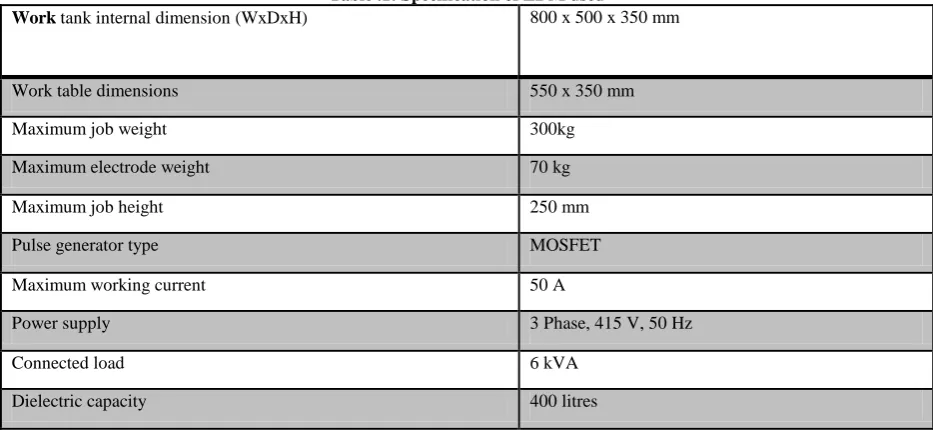
Table .1: Specification of EDM used
Work tank internal dimension(WxDxH) 800 x 500 x 350 mm
Work table dimensions 550 x 350 mm
Maximum job weight 300kg
Maximum electrode weight 70 kg
Maximum job height 250 mm
Pulse generator type MOSFET
Maximum working current 50 A
Power supply 3 Phase, 415 V, 50 Hz
Connected load 6 kVA
Dielectric capacity 400 litres
Mechanical Properties of material: Table Listed below:
Table .2 Mechanical Properties of D2 tool Steel
Hardness, Knoop 769
Hardness, Rockwell C 62
Hardness, Vickers 748
Poisson’s Ratio 0.20-0.30
Elastics modulus 190-210 Gpa
SURFACE ROUGHNESS (Ra)
Volume 2, Issue 6, December 2014
surface profile, roughness can be measured at right angles to the surface in terms of the wave amplitude and parallel to the surface in terms of the surface wavelength. The latter one is also recognized as texture.
Fig .2: Surface roughness measuring instrument (source: DBU, Mandi Gobindgarh, Punjab)
The technique used to measure roughness in any of these two planes will have certain limitations. The smallest amplitude and wavelength that the instrument can detect correspond to its vertical and horizontal resolution respectively. Similarly, the largest amplitude and wavelength that can be measured by the instrument are the vertical and horizontal range. The first amplitude parameter used for roughness measurements was the vertical distance between the highest peak and the lowest valley of the unfiltered profile point the designation of this parameter was subsequently changed to right when electrical filters were incorporated. Surface topography or surface roughness ,also known as surface texture are terms used to express the general quality of a machined surface, which is concerned with the geometric irregularities and the quality of a surface Roughness measure as the arithmetic average, Ra (μm).
PROCESS VARIABLES AND THEIR LIMITS
Experimentation has been done by considering the following levels of process variables. These parameters has been decided by referring M. Durairaj[1] and S Sivakiran[11].
Table 3 Process variables and their Limits
Process variables Level 1 Level 2 Level 3 Level 4 Level 5
Current(Amp) 4 8 12 16 20
Voltage(V) 3 4 5 6 7
Pulse On(µs) 125 150 175 200 225
Pulse Off(µs) 100 125 150 175 200
IV. CONDUCTOFEXPERIMENT
D2 tool Steel is used as the work piece of dimension 40x20x10 mm and copper as tool. D2 tool steel is the most commonly used steel among the group steel. D2 tool steel can be used for long run tooling applications, where wear resistance is important, such as blanking or forming dies and thread rolling dies. In present work, attempt has been made to machine the D2 tool Steel using copper electrode on Electrical Discharge Machine. Where peak Current, Voltage, Pulse off, Pulse on are taken as process parameters and surface roughness are taken as response parameters. The influences of these parameters have been optimized by Taguchi Methodology. The Taguchi method is used to formulate the experiment, to analyze the effect of each parameter such as peak current, voltage,
pulse off and pulse on. Taguchi method used L25 orthogonal array of input variables using Design of Experiments.
Volume 2, Issue 6, December 2014
Dr. Taguchi of Nippon[9] Telephones and the Telegraph Company, Japan had developed method based on
"ORTHOGONAL ARRAY" experiments which gives us much reduced "variance" for the experiment with "optimum settings" of control parameters. Thus the marriage of Design of Experiments with optimization of control parameters to obtain the BEST results is achieved in the Taguchi Method. "Orthogonal Arrays" (OA)[12] provide a set of well balanced (minimum) experiments and Signal-to-Noise ratios (S/N), which are log functions of desired output, serve as objective functions for optimization, help in data analysis and prediction of optimum result.
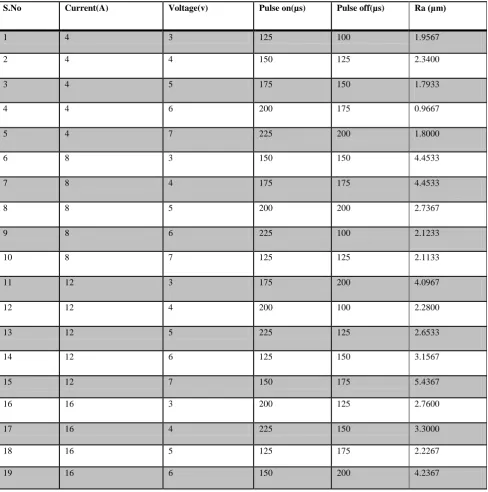
Experiments have been carried out using Taguchi’s Method, experimental design which consists of 25 combinations of current, voltage, pulse off and pulse on were varied to conduct 25 different experiments and the weights of the work piece and tool were taken for calculation of Ra. Experiments are executed as per the orthogonal matrix generated by Taguchi method with 5 levels.
Table 4. Execution of Experiments
S.No Current(A) Voltage(v) Pulse on(µs) Pulse off(µs) Ra (μm)
1 4 3 125 100 1.9567
2 4 4 150 125 2.3400
3 4 5 175 150 1.7933
4 4 6 200 175 0.9667
5 4 7 225 200 1.8000
6 8 3 150 150 4.4533
7 8 4 175 175 4.4533
8 8 5 200 200 2.7367
9 8 6 225 100 2.1233
10 8 7 125 125 2.1133
11 12 3 175 200 4.0967
12 12 4 200 100 2.2800
13 12 5 225 125 2.6533
14 12 6 125 150 3.1567
15 12 7 150 175 5.4367
16 16 3 200 125 2.7600
17 16 4 225 150 3.3000
18 16 5 125 175 2.2267
Volume 2, Issue 6, December 2014
20 16 7 175 100 2.8233
21 20 3 225 175 5.6667
22 20 4 125 200 3.3900
23 20 5 150 100 3.4267
24 20 6 175 125 2.8367
25 20 7 200 150 2.4333
The experiments were conducted under various parameters setting of Discharge Current (Ip), Voltage (v), Pulse On-Time (Ton) ad Pulse off time (Tof). L-25 OA based on Taguchi design was performed for Minitab software was used for analysis the result and these responses were partially validated experimentally.
V. ANALYSISOFSURFACEROUGHNESS
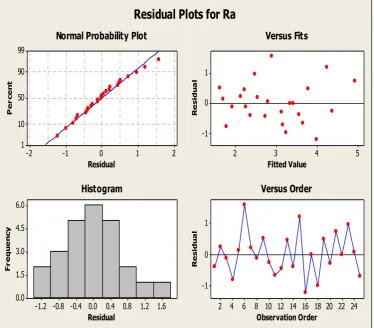
After having values of Ra for each experiment now time to analyze the data. So data has been analyzed for its normality by probability plot (as shown in figure 3). As shown in Normal Probability plot data points are distributed all along the normal line except few two or three data points, so data can be concluded as normally distributed. In the second plot versus fits data points are not along the line. This plot doesn’t show any trend while plotting residual versus fitted values of data which implies RSM model chosen is well fitted with given data set. Third plot is frequency histogram showing data distribution and at last residue order versus order plot highlights the random data points which signifies non-significance of experimental order as far as first response (MRR) is concerned. 2 1 0 -1 -2 99 90 50 10 1 Residual P e r c e n t 5 4 3 2 1 0 -1 Fitted Value R e s id u a l 1.6 1.2 0.8 0.4 0.0 -0.4 -0.8 -1.2 6.0 4.5 3.0 1.5 0.0 Residual F r e q u e n c y 24 22 20 18 16 14 12 10 8 6 4 2 1 0 -1 Observation Order R e s id u a l
Normal Probability Plot Versus Fits
Histogram Versus Order
Volume 2, Issue 6, December 2014
Table 5 ANOVA to check SRM Statics for Ra (Minitab Data)
Here is one work piece on which experiment is done. We can see how cleanly the experiment is done on the specimen.
Fig 4. Work piece before and after experiment (mobile picture)
GRAPHICAL INFERENCES FOR Ra
Volume 2, Issue 6, December 2014
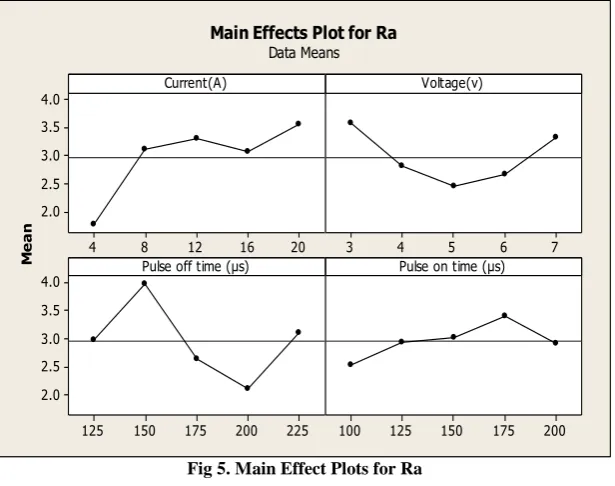
In second plot of voltage we can see that value of surface roughness is less at middle of curve i.e. at voltage 5V. In the third plot pulse off time there is increase in Ra when pulse off time increase, and it drops at pulse off time 200µs. In the fourth plot of Pulse on time the value of surface roughness is less at pulse on time 100µs.
20 16 12 8 4 4.0 3.5 3.0 2.5 2.0 7 6 5 4 3 225 200 175 150 125 4.0 3.5 3.0 2.5 2.0 200 175 150 125 100 Current(A) M e a n Voltage(v)
Pulse off time (µs) Pulse on time (µs)
Main Effects Plot for Ra Data Means
Fig 5. Main Effect Plots for Ra
VI. CONCLUSION
1. According to our objective, yes it is feasible of machining D2 tool steel using tubular copper electrode and internal flushing by electric discharge machine.
2. By the Use of the Taguchi design approach (Minitab software) experiment design is done and then calculate the values of Ra of all 25 experiments.
4. After then draw all the graphs which shows the influence of current, Voltage, Pulse on and Pulse off on Ra. As we know that minimum Ra is necessary for the work piece.
5. The best combination of EDM parameters for AISI-D2 high-carbon, high-chromium steel are; discharge current 4A, voltage 3V, pulse off time 225µs and pulse on time 104µs. It has been also found that individual parameters like discharge current and voltage are more influencing than other parameters like pulse off time and pulse on time. This study has not only formulated statistical optimizing equations for Surface roughness (Ra) for AISI-D2 high-carbon, high-chromium steel, but also tries hard to define relation between them through co-relation.
REFERENCES
[1] M. Durairaj, D. Sudharsun, N. Swamynathan,”Analysis of Process Parameters in EDM with Stainless Steel using Single Objective Taguchi Method and Multi Objective Grey Relational Grade” Procedia Engineering 64 (2013) 868 – 877. International Conference on DESIGN AND MANUFACTURING, IConDM 2013 (868 – 877).
[2] M.A Ali, M. Samsul, R.izamshah, M. Hardzley,”The Effect of EDM Dis-sinking parameters on Material Removal Rate of Beryllium Copper” Middle-East Journal of Scientific Research 16 (1): 44-50, 2013.
[3] Raghuram S, Thiruppathi K, Panneerselam T, Santosh,”OPTIMIZATION OF EDM PARAMETERS USING TAGUCHI METHOD AND GREY RELATIONAL ANALYSIS FOR MILD STEEL IS 2026”. International Journal of Innovative Research in Science, Engineering and Technology, Vol. 2, Issue 7, July 2013.
[4] Sanjay Kumar Majhi, M.K Pradhan, Hargovind Soni,”Optimization of EDM parameters using RSM, GRA and Entropy method”. International Journal of Applied Research in Mechanical Engineering (IJARME) ISSN: 2231-5950, Volume-3, Issume-1, 2013.
Volume 2, Issue 6, December 2014
[6] A.Thillaivanan, P.Asokan, K.N.Srinivasan, R, Saravanan,”Optimization of Operating parameters for EDM process based on the Taguchi method”. International Journal of Engineering Science and Technology, Vol. 2(12), 2010, 6880-6888.
[7] Ashok Kumar, Kuldeep Singh Bedi, Karaj Singh Dhillo, Rashpal Singh,” Experimental Investigation of Machine parameters for EDM using U shape electrode”. International journal of Engineering Research and applications (IJERA), Vol. 1, Issue 4, pp.1674-1684.
[8] Ajeet Bergaley, Narendra Sharma,” Optimization of Electrical and Non electrical factors in EDM for machining die steel using copper electrode by Adopting Taguchi Technique”. International Journal of Innovative Technology and Exploring Engineering (IJITEE) ISSN: 2278-3075, Volume-3, Issue-3, August 2013.
[9] Nikhil Kumar, Lalit Kumar, Harichand Tewatia, Rakesh yadav,”COMPARATIVE STUDY FOR MRR ON DIE-SINKING EDM USING ELECTRODE OF COPPER & GRAPHITE”. International Journal of Advanced Technology & Engineering Research (IJATER) , VOLUME 2, ISSUE 2, MAY 2012.
[10]V.Chandrasekaran, D.Kanagarajan, R.Karthikeyan,” Optimization of EDM Characteristics of WC/5ni Composites Using Response Surface Methodology”. International Journal of Recent Technology and Engineering (IJRTE) ISSN: 2277-3878, Volume-2, Issue-5, November 2013.
[11]S Sivakiran, C.Bhaskar Reddy, C.Eswara Reddy,” Effect Of Process Parameters On Mrr In Wire Electrical Discharge Machining Of En31 Steel”. Research and Applications (IJERA) ISSN: 2248-9622, Vol. 2, Issue 6, November- December 2012, pp.1221-1226.
[12]Shaliendra Kumar Singh, Narinder Kumar,” Optimizing the EDM parameters to improve the Surface roughness of Titanium alloy”. International Journal of Emerging Science and Engineering (IJESE) ISSN: 2319–6378, Volume-1, Issue-10, August 2013.
[13]Mohd Amri Lajis, H.C.D Mohd Radzi, A.K.M Nural Amin,” The Implementation of Taguchi Method on EDM process of Tungsten Carbide”. European Journal of Scientific Research ISSN 1450-216X Vol.26 No.4 (2009), pp.609-617.
[14]Amandeep Singh, Neel kanth Grover, Rakesh Sharma,” Recent Advancement in Electric Discharge Machining A Review”. International Journal of Modern Engineering Research (IJMER), Vol.2, Issue.5, Sep-Oct. 2012 pp-3815-3821.
[15]Pichai Janmanee, Apiwat Muttamara,” Optimization of Electrical Discharge Machining of composite 90WC-10Co base on Taguchi approach”. European Journal of Scientific Research ISSN 1450-216X Vol.64 No.3 (2011), pp. 426-436.
[16]J.A. McGeough, “Advanced Methods of Machining”, Chapman and Hall, New York, 1998.
[17]B.H. Yan, C.C. Wang, W.D. Liu and F.Y. Huang, “Machining Characteristics of Al2O3/6061Al Composite using Rotary EDM with a Disklike Electrode”, The International Journal of Advanced Manufacturing Technology, 16:322-333, 2000.
[18]Ranjit K.Roy, “A Premier On The Taguchi Method”, Van Nostrand Reinhold, New York, 1996.
[19]Ranjit K.Roy,”Design of Experiments Using the Taguchi Approach”, John Wiley & Sons, New York, 2001.
[20]Glen Stuart Peace, “Taguchi Methods”, Addison-Wesley Publishing, inc, 1993.
[21]D.Scott, S. Boyina and K.P. Rajurkar, “Analysis and Optimization of Parameter Combination in Wire Electrical Discharge”, International Journal of Production Research, 29, pp. 2189-2207, 1991.
[22]J. Murdoch and J.A. Barnes, “Statistical Tables”, Macmillan, London, 1986.
[23]Azizul Bin Mohamad, Arshad Noor Siddiquee, Ghulam Abdul Quadir, Zahid A. Khan and V.K. Saini , “Optimization of EDM process parameters using Taguchi method”, International conference on Applications and design in Mechanical and Engineering 2012 (ICADME 2012) 27-28 February 2012, Penag Malaysia.
[24] J.L. Lin, K.S. Wang, B.H. Yan and Y.S. Tang, “An Investigation into Improving Worn Electrode Reliability in the Electrical Discharge Machining Process”, The International Journal of Advanced Manufacturing Technology, 16:113-119, 2000.
[25]B. Thomas, “The Technology of Electrical Discharge Machining”, Maho Hansen GmbH Co., 1991 K.P. Rajurkar and G.F. Royo, “Effect of R.F. Control and Orbital Motion on Surface Integrity of EDM components”, Journal of Mechanical Working Technology, 20(1989) 341-352.
Volume 2, Issue 6, December 2014
[27]Karthikeyan R, Lakshmi Narayanan, P.R. and Naagarazan, R.S., 1999. Mathematical modeling for electric discharge machining of aluminium-silicon carbide particulate composites. Journal of Materials Processing Technology, 87(1-3), 59-63.
[28]Mohan, B., Rajadurai, A. and Satyanarayana, K.G., 2002. Effect of sic and rotation of electrode on electric discharge machining of Al-sic composite. Journal of Materials Processing Technology, 124(3), 297-304.
[29]Vijay kumar , Naveen Beri, Anil and Paramjit singh, July- sept. 2010some study of electric discharge machining of hastelloy using powder metallurgy electrode, International journal of advanced engineering technology, E-ISSN 0976-3945.
[30]H.K Kansal, sahijpal singh & Pardeep kumar, 13 june 2006, International journal of engineering & material sciences, performance parameters optimization (multi-characteristics) of powder mixed electric discharge machining through taguchi method and utility concept, vol. 13.
[31]Yan, B.H., Wang, C.C., Chow, H.M. and Lin, Y.C., 2000. Feasibility study of rotary electrical discharge machining with ball burnishing for Al2O3/6061Al composite. International Journal of Machine Tools and Manufacture, 40(10), 1403-1421.
[32]Yan-Cherng Lin, Yuan-feng chen, Ching-tien Lin, AND Hsinn-jyh Tzeng Feasibility study of rotary electrical discharge machining with ball burnishing for Al2O3/6061Al composite 2008, vol.23: 391–399,.
[33]Puertas, I. And Luis, C.J., 2004. A study of optimization of machining parameters for electrical discharge machining of boron carbide. Materials and Manufacturing Processes, 19(6), 1041-1070.
[34]Tsai, H.C., Yan, B.H. and Huang, F.Y., 2003. EDM performance of Cr/Cu-based composite electrodes. International Journal of Machine Tools and Manufacture, 43(3), 245-252.
[35]Saha, S.K. and Choudhury, S.K., 2009. Experimental investigation and empirical modeling of the dry electric discharge machining process. International Journal of Machine Tools and Manufacture, 49(3-4), 297-308.
[36]Lin and Tung-Han United States Patent 6,768,077 Lin July 27, 2004.
AUTHOR BIOGRAPHY
Varinder khurana. M.tech Student. College name: Chandigarh engineering college, landran, Punjab. Paper submitted: 02
Harsimran Singh sodhi. Asst professor at Chandigarh University, gharun, Punjab.