Master's Theses Theses, Dissertations, Capstones and Projects
Fall 12-2015
Muslim Brothers or Overstaying Guests? The
Reception of Syrian Refugees in Southeastern
Turkey
Irem Karaçizmeli
Follow this and additional works at:https://repository.usfca.edu/thes Part of theInternational and Area Studies Commons
This Thesis is brought to you for free and open access by the Theses, Dissertations, Capstones and Projects at USF Scholarship: a digital repository @ Gleeson Library | Geschke Center. It has been accepted for inclusion in Master's Theses by an authorized administrator of USF Scholarship: a digital repository @ Gleeson Library | Geschke Center. For more information, please [email protected].
Recommended Citation
Karaçizmeli, Irem, "Muslim Brothers or Overstaying Guests? The Reception of Syrian Refugees in Southeastern Turkey" (2015).
Master's Theses. 162.
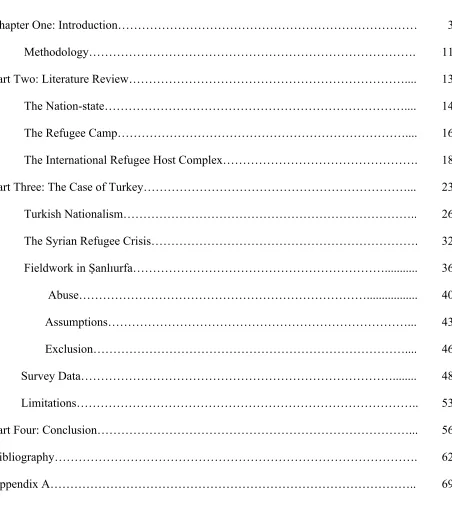
Table of Contents
Chapter One: Introduction……… 3
Methodology………. 11
Part Two: Literature Review……….... 13
The Nationstate……….... 14
The Refugee Camp……….... 16
The International Refugee Host Complex………. 18
Part Three: The Case of Turkey………... 23
Turkish Nationalism……….. 26
The Syrian Refugee Crisis………. 32
Fieldwork in Şanlıurfa………... 36
Abuse………... 40
Assumptions………... 43
Exclusion……….... 46
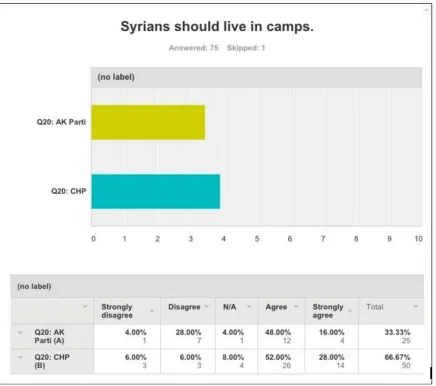
Survey Data………... 48
Limitations……….. 53
Part Four: Conclusion………... 56
Bibliography………. 62
Appendix A……….. 69
Chapter One: Introduction
The civil war in Syria has displaced 11 million people worldwide since its breakout in
2011. Four million of these have dispersed through six continents as refugees, with
approximately 100 countries becoming their hosts (UNHCR, 2014a). Three neighboring
countries of Syria Lebanon, Jordan and Turkey have taken the lead in the number of Syrian
refugees hosted during the war. This thesis focuses on Turkey, a country that has been directly
shaken by the war in Syria. Turkey had traditionally been a transit country for migrants, refugees
and asylees attempting to move to Europe via Greece. The Syrian crisis has become the push
factor to shift the country’s position from a historical transit base, into a refugee haven. Its
geographical location, multiethnic cities and a welcoming national discourse adopted by the
government towards Syrian refugees has made Turkey a popular destination for those seeking
safety. Over two million Syrian refugees have arrived in Turkey since 2011, making it the host to
the largest refugee population in the world (UNHCR, 2014b).
The Syrian refugee context in Turkey is a multifaceted issue marked with contradictions.
The tension between the Turkish past as a Muslim empire, and Turkish present as a laic 1
nationstate comes to the fore in Turkish refugee policy. The government’s rhetoric towards
Syrians arriving at the Turkish border during the Syrian war has been highly Islamicized, with
abundant references to the Ottoman era, when Turks and Arabs lived together for three centuries
1 Laicism signifies the separation of religion from state affairs. It is different from secularism mainly because it gives
under a Sunni Muslim state, and with cultural notions of hospitality. The founder of Turkey’s
ruling Islamist party Adalet ve Kalkınma Partisi 2, the AKP, and incumbent president Recep
Tayyip Erdogan has often referred to Syrian refugees as ‘Muslim brother’ (Arutz Sheva, 2015).
According to Erdogan and his party, it is a religious duty inherited from the Ottoman past to
make the ‘brother’ comfortable during the period of his guesthood. Romanticization of the
Ottoman era is not peculiar to the ruling party officials in Turkey. It has, in fact, become a
rhetorical practice for the Islamists in the country to glorify the Ottoman Empire; life in a Sunni
Muslim state, where not nation but religion defined the citizen.
The Republic of Turkey was founded in 1923 upon different values than those of the
Ottoman Empire, with the biggest shift being secular nationalism taking the place of religion as
the underlying foundation of the state. The country of Turks was now a nationstate, and a laic
democracy which pushed Islam into the private sphere. Under the proWesternization founders,
Turkey experienced a construction of a new political identity free from religion. However, it was
a struggle for this new identity to be accepted by all citizens. The Islamists and Kurds protested,
and the state, in return, denounced them as the enemy. The Turkish Islamists were considered a
danger for the country’s laicist future, and the Kurds a threat to the homogenous unification of
the ethnic Turkish nation.
The year 2002 signified a major shift in Turkey’s political history, declaring the success
of the Islamist AKP in the elections and switching the political powerholder in the country from
laicists to Islamists. With the AKP’s rule, the manifestation of Muslim identity has reached its
between a Muslim and a Turk has been highly promoted by the AKP, especially by its founder
Erdogan who has many times voiced his dedication to raise a religious youth (NTV, 2012).
Government officials have openly identified themselves as pious Muslims, explicitly
distinguishing themselves from the laicists while revealing strong ties back to the wider umma .3
Such an open declaration of religious identity represented at the government level has generated
serious concerns among laicists in Turkey over the comeback of Ottoman state tradition and
sharia law. Speculations over the AKP’s loyalty to the 92 yearold laicist nationstate rule have
remained eversince.
The Syrian refugee crisis that began as the Islamist ruling party was growing in strength
with each election has raised many questions: Could the success of the Islamists mean a
comeback of the Ottoman traditions that the Islamists in Turkey have always idolized? Does the
government and the Islamists in the country in general see the Syrian refugee crisis as an
opportunity to transform the state tradition? Is the 92year old laic nationstate tradition declining
in conjunction with the arrival of 2.2 million Syrians, most of whom are Sunni Muslims? This
thesis argues that the Syrian crisis, and the government’s response to it bring these questions
about Turkish national identity to the foreground of sociopolitical discourse. The Islamist party’s
practice of shaping the state’s refugee response in Ottomanstyle politics may reveal a crack in
their investment to the laic nationstate tradition. However, the Islamist sense of Ottomanism
would require the local integration of Syrians, and superiority of in the eyes of the polity
(McCarthy, 1997: 128). The current Islamist government has put for only temporary measures to
deal with the crisis, and demonstrated its reticence to fully integrate Syrians into the political
fold. While the Islamic rhetoric of the government promised the best for the ‘brother’, the
practice has appeared to be in favor of the ‘his’ return.
Turkish engagement with the crisis initiated with building stateoftheart refugee camps.
Turkey was praised for realizing an ideal by the New York Times which published an article titled
‘How to Build a Perfect Refugee Camp’ praising Turkey (New York Times, 2014). Syrians have
also been allowed to settle freely in urban areas; in fact, 90% of them have chosen
selfsettlement over these ‘perfect’ camps (Al Jazeera Turk, 2015a). Increasing selfsettlement,
has generated further problems such as the Syrian expansion in the informal economy, where the
employee rights of the refugee are often violated. Syrians’ rejection of settling in the camps has
also brought about changes in local host attitudes. In this context, an antirefugee climate has
been born.
This thesis finds that such a turn of events is deeplyrooted in Turkish attempts to locate
the larger issue of hosting refugees into cultural notions of ‘guesthood’ rather than a developed
refugee rights framework. The 1951 United Nations Convention relating to the Status of
Refugees defines the refugee as a person who "owing to a wellfounded fear of being persecuted
for reasons of race, religion, nationality, membership of a particular social group or political
opinion, is outside the country of his nationality, and is unable to, or owing to such fear, is
unwilling to avail himself of the protection of that country” (UNHCR, 2010). However, due to a
geographical limitation set forth in the Convention, Turkey only grants the refugee status, and
the rights that come along with it, to those fleeing persecution in Europe. The limitation requires
that other persons with legitimate claims for refugee status are transferred to the United Nations
nonEuropean origin, Syrians fall under the legal category of those under temporary protection,
formally referred to as ‘guests’ or ‘asylees’ under Turkish law.
The cultural norm of guesthood is an extremely valued concept in Islam , but something 4
that remains insufficient as a political response to a major refugee crisis. Islamic ideology
requires welcoming the guest unconditionally (ElAbed, 2014: 86); Turkish Islamists explicitly
reference this injunction in their public discourse. Double imperative of hospitality, on the other
hand, is often neglected. The expression of hospitality is made possible through one side’s
superiority that comes as a result of “ownership of place” (Brun, 2010: 347). The ethical form of
hospitality, however, is challenged in the presence of a threat to the superior’s control over its
territory (ElAbed, 2014: 86).
Permanent stay, or owning property, is not expected of a guest. The protracted nature of
the Syrian refugee crisis has indicated to the limits of the applicability of notions of hospitality in
an international refugee situation. As refugees have dispersed all over Turkey, they have become
more visible. Refugee rejection of camps has remained incomprehensible for many Turks that
expected Syrians to behave as guests and to stay in camps, where shelter had been provisioned.
Selfsettlement has been considered a betrayal to many with contradicting expectations of
guesthood rather than understood within a framework of refugee rights. Why were ‘the guests’
not content with the services the Turks had spent so much money to provide? Why were they
wanting more and being disrespectful? 5
4 As exemplified by the words of Prophet Muhammad: “Let him who believes in Allah and the Last Day speak good,
or keep silent; and let him who believes in Allah and the Last Day be generous to his neighbour; and let him who believes in Allah and the Last Day be generous to his guest." Imaam AnNawawi, “AnNawawi's Forty Hadith”, BeMuslim at Smashwords. Accessed November, 21, 2015.
file:///Users/Irem/Google%20Drive/Downloads/annawawisfortyhadith.pdf
The government itself has perpetuated such notions of guesthood with its policies. The
Islamist government has based its rhetoric for welcoming the refugees on the Ottoman past, but
has not fully implemented an Ottoman vision in its refugee policy; as the state neither integrated
Syrians into the polity, nor granted them a privileged position in society for being Muslim. While
failing to enact on Ottoman mold, the government has also not lived up to modern democratic
ideals, by failing to institutionalize international refugee law. By locating refugee rights within
notions of guesthood, the government denies refugees an opportunity for full local integration
with concomitant links to establishing selfsustaining households. Lack of government oversight
and regulation has increased local hostility toward Syrian refugees, severely undermining the
guest model.
The Syrian refugee situation in Turkey is fraught with policy ambiguities, while durable
solutions remain elusive. Refugees’ ties to Turkey are interrupted, because their stay is
timerestricted. Strict laws towards the newcomers of the country render the establishment of
permanent residence nearly impossible. The de facto strategy of the government in its response
to the crisis has been building refugee camps. This thesis problematizes the notion of a camp that
is increasingly referred to as ‘warehousing’ (Smith, 2004). Both the UNHCR, and refugee
hosting governments have for a long time favored the camp model to respond to refugee crises.
Camps are characterized by the separation of refugees from locals, government control, and
easier coordination of relief activities often in a secluded territory. For decades, camps have been
the most commonlyused formal strategy for hosting refugees. Although warehousing refugees in
a designated area may not be financially advantageous as involving them in the country’s
Karen Jacobsen has found that camps are favored, because they prevent refugees from
enjoying the rights they would not enjoy in their country of origin (Jacobsen, 2002: 111).
Refugee camps, therefore, have been viewed as eliminating the obstacles to return of refugees
back to their home countries. Camps have also been seen as saving the government from
skyrocketing spending while helping refugees retain their own traditions (Kibreab, 1989: 470).
As central as camps have been to refugee policies, restricted movement and exclusion from
economic and personal independence have rendered these areas in the periphery nonhabitable.
As a result, some two thirds of the world’s refugees have chosen selfsettlement, mostly in the
urban areas (UNHCR, 2015a).
Referred to as urban refugees, refugee selfsettlers challenge the traditional construction
of a nationstate. The nationstate legitimizes the construction of an ‘insider’ and an ‘outsider’,
the former being a member of the body politic, while the latter does not have member status or
the rights that go with it. As a group having different historical and cultural values, urban
refugees bring heterogeneity into the country, contradicting with the nationstate ideal of a
homogenous unification within the claimed territory. The isolating nature of the refugee camps,
on the other hand, ensures the continued purity of the state. The camp model suggests that what
is expected of a refugee is to passively wait in the periphery until conditions improve in the
country of origin and repatriation begins. These expectations are interlinked to the nationstate
construction of the immobility of identity (Malkki, 1992: 29). Refugees are considered to have
placed their identity on hold, for identity is increasingly pictured as something that stays within
This thesis is based on field research conducted in the summer of 2015 in southeastern
Turkey. With electricity, hot water, playgrounds, schools and job training courses provided in the
camps, the government of Turkey has undoubtedly built exceptional camp infrastructure. Almost
all of the Syrian refugee participants in this study compared Turkey with Lebanon, Egypt and
Jordan and expressed their gratitude for Turkish efforts. The findings of the fieldwork illustrate,
however, that the quality of camps does not make the conditions of encampment more attractive
for the refugee. The services provided in camps have not changed the constraining nature of a
refugee camp, or concealed the effort of the Turkish nationstate to keep the city ‘sterile’. With
obscure policies, and transient approaches to the Syrian refugee issue like building refugee
camps, the government of Turkey has indicated that it is reluctant to allow refugees to integrate
within the country. Enhancing the quality of camps while failing to improve quality of life for
urban refugees indicates that Turkey despite being hailed as a model for refugee reception
exhibits characteristic of a failed host policy. This thesis refers to these characteristics as the
international refugee host complex, which will be explained in detail in Part II.
There is growing evidence that Turkey’s refugee policy is inadequate. The life of
refugees living in urban or semiurban areas is extremely difficult. Out of the 20 interviewed
Syrian refugees for this study, almost all indicated a contrast between past and present, referring
to the past in Syria as ‘normal’ while characterizing the present in Turkey as ‘abnormal’. UN
reports have illustrated the will of a considerable number of refugees to depart from Turkey in
lifejeopardizing ways, showing the desperation that refugees in Turkey feel. The number of
Within the first 10 months of 2015, 600,000 people have taken a smuggler boat from Turkey;
approximately 200 of those were dead as a result (UNHCR, 2015b).
Methodology
This thesis is based on field research conducted in the summer of 2015 in southeastern
Turkey. The field research location was chosen due to the significant number of refugees hosted
in the area. A total of 20 interviews were conducted with selfsettled Syrian refugees with the
assistance of an Arabic interpreter. Throughout the process, the research relied primarily on 6
qualitative methods using a semistructured interview techniques. Questions asked during the
interviews included: ‘Can you define difficulties of life in a noncamp setting?’, ‘Have you had
access to aid coming from national or international resources?’, ‘Why have you chosen
selfsettlement over camps?’, ‘How has your overall experience been with the host community?’,
and ‘Have you suffered from prejudice or acts of aggression?’ along with unstructured interview
interactions. In addition to the interviews with Syrians, ethnographic observations of the locals in
southeastern Turkey were recorded through notetaking. An online survey was also conducted
with Turkish citizens via SurveyMonkey, through which 164 responses were collected. The
questions in the matrixquestionsurvey included the age and sex of the participant, their
location, concerns about having Syrians in Turkey, security issues with the presence of Syrians,
refugee camps, begging, effects on the Turkish economy, and on Turkey’s laicism (see Appendix
A).
This thesis contextualizes the Syrian refugee issue in Turkey, and aims to provide a
deeper understanding of the underlying motives behind the national rhetoric and practice adopted
towards the country’s new demographic. The research question it addresses is stated as ‘ How
does the Syrian refugee crisis intersect with competing formulations of Turkish politics and
national identity?’
Part II will address the literature on major concepts this thesis problematizes: the
nationstate and the refugee camp. A comparison of refugee situations throughout the world has
also taken place in order to better locate Turkey in the worldwide discussion of refugee and host
community relations. The patterns mostly signifying a set of failures found in the acts of
major refugee hosts in the world which entails patterns of exclusion, abuse and false assumptions
will be investigated. Part III will cover the history of Turks which includes the country’s deeper
connection to Syrians. The section will also study the data obtained from the fieldwork to
provide the context of Syrian refugees in Turkey. Part IV includes conclusion remarks,
highlighting that the contradicting nature of Turks’ past within an Islamic empire and present in
a laic nationstate further obscures the present and future of Syrian refugees in Turkey.
Part Two: Literature Review
This section will review the literature surrounding three main subjects: the nationstate,
international refugee host complex, and refugee camps. The question of how these three are
interlinked, and their significance will be addressed.
Turkish engagement with the 2.2 million Syrian refugee population should be evaluated
under two areas rhetoric and practice and in two different time periods the beginning and
later days of the crisis. The government’s rhetoric towards Syrians arriving at the Turkish
borders during the war has been highly Islamicized, with references to the Ottoman era and
cultural notions of hospitality. The government’s strong Islamic rhetoric and concerns over how
the Syrian refugee population may be used as a political tool have heightened tensions among
Turks. A yearlong study of the media coverage of the Syrian refugee crisis in Turkey has found
that the newspaper representing the view of the laicists, the Cumhuriyet, criticized the
government for its Syrian refugee policy:
The general attitude of Cumhuriyet newspaper is to criticize the government over Syrians. The common concern of Turkish public on Syrians such as ‘they are becoming Turkish citizens’; ‘they will be able to vote in elections’; ‘they are allowed to establish private enterprises’; were reported as problematic issues and the government is blamed for opening the doors to Syrians (Karakus and Yaylaci, 2015: 244).
Despite these concerns over de facto integration of Syrian refugees, government policy is
in fact oriented toward exclusion, through both camp segregation and urban marginalization.
Today, 90% of Turkey’s Syrian refugees live in urban and semiurban areas. Urban refugee
regulation in the city has caused numerous problems both for Syrians themselves and for the
local community. Begging as a strategy of survival has increased among Syrians; though rare,
some Syrians have taken part in cases of burglary and stealing (Cumhuriyet, 2015). Such events
have led to hostility and a negative representation of the Syrian population for many members of
the local community. A major shift in public discourse on Syrians is now apparent: from
empathy into resentment. Such a change of attitude in the Turkish community translates to a
strong division between the early and later days of the crisis, the former referring to a relatively
stable environment, and the latter to increasing unrest.
Because the Syrian refugee crisis is ongoing and relatively new, the literature focusing
on the refugee context in Turkey is very sparse. With data drawn from interviews with local
agents of refugee settlement, observations, survey and an analysis of history, this thesis
endeavors to reveal the refugee experience on the ground while also highlighting its connection
to the larger tensions and contradictions in Turkish political history. The case in Turkey has in
fact been very similar to what this thesis defines as the international refugee host complex, the
tendency of host communities to repeat unsuccessful approaches in refugee situations.
The Nationstate
The nationstate is a fairly new political model, dating back to the demise of empires in
the 19 th century. Benedict Anderson begins to codify the motives of a nationstate by first
defining what a nation is. His definition suggests that the nation is something imagined existing
The members of even the smallest nation will never know most of their fellowmembers, meet them, or even hear of them, yet in the minds of each lives the image of their communion. (Anderson, 2006: 22)
The nationstate, then, is the idealized unification of an imagined community claiming
sovereign territory. The nationstate legitimizes its power in terms of territorialization of a shared
culture and history of a dominant population; the state is tied to a particular ethnic identity
(Basch et al. 1994: 40). Anthropologist Liisa Malkki writes that thenowterritorialized concept
of a nation encourages the construction of a notion of “rootedness” (Malkki, 1992: 27). Nations
naturalize their ties to territory through botanical metaphors, in which people are likened to
plants which grow in certain land. Identity is thus spatialized value, becoming immovable
beyond the boundaries of the nationstate (Malkki, 1992: 28). Those who cannot claim ancestral
ties to the territory with its shared history and language are presumed to have rootedness in other
territories and are thus excluded. These claims intersect with ethnocentric notions of national
superiority, so outsiders in the nationstate are perceived as interior, burdensome and threatening.
The nationstate thus legitimizes the construction of an ‘insider’ and an ‘outsider’, the former
being a rightful member of the state, while the other constitutes a threat. Hannah Arendt points
out the problematic construction of ‘the other’ for the acquisition of rights by human beings in
their capacity as citizens of the nationstate. Since rights are guaranteed by the state, refugees
find themselves in a precarious position, being outside the country of their nationality due to
persecution; therefore forced to seek rights through the vehicle of another state in which he or
she is not a citizen. Arendt says that human rights becomes a questionable topic in the presence
of the clearcut boundaries within the nationstate on what makes one a rightful insider or a
national rights, protecting the insider but remaining passive for the outsider; a tendency she
refers to as ‘perversion’ (Arendt, 1973: 230231).
The Refugee Camp
The dysfunctional human rights in the presence of the other, as theorized by Arendt,
intersects with the traditional ways of engaging politically with refugee crises around the world.
The refugee camp is a physical representation of ‘human rights versus national rights’
discussion, as perhaps the most controversial strategy to host refugees. Refugees are traditionally
considered as a threat to the nationstate ideal to a homogenous unification of the nation.
Refugees bring heterogeneity into the host country as a result of their distinct rootedness in a
different territory, while the nationstate dreams of purity (Diken, 2004: 92). The refugee camps
are an attempt to maintain purity, enclosing refugees in a space characterized with extreme
restriction of movement. With the nationstate legitimizing the construction of the refugee as ‘the
outsider inside’ (Diken, 2004: 88), refugees are isolated in camps. Usually located in the
periphery, refugee camps are criticized for transgressing the doctrine of international human
rights, since they violate the internationally recognized human right to freedom of movement
(UDHR, Article 13).
The UNHCR and national governments have for a long time favored the camp model
based on a political calculation. Gaim Kibreab describes this calculation, arguing that letting
refugees enjoy the rights of the locals would encourage them to stay even when the conditions in
tool to ensure the temporary nature of refugee stay. Kibreab also justifies the camp model
presuming that integration is an idea based on the wishful thinking of resourcerich Europe
(Kibreab, 1989: 474). Some portray a milder approach to refugee camps, thinking that camps do
not always represent the worst option where the real question is “not whether or not there should
be camps but to ensure that camps meet the highest possible standard and provide refugees with
optimal living conditions” (Crisp and Jacobsen, 1998: 27). The Turkish example, however,
stands as a case that refutes such argument. With power, hot water, schools, playgrounds, and job
training courses provided in the camps, Turkey gained international praise for building the
“perfect refugee camps” (The New York Times, 2014). Irrespective of the conditions within,
however, 90% of refugees in Turkey have chosen selfsettlement mainly in urban areas, rejecting
the camp option. The Turkish case, therefore, suggests that restriction of movement, isolation
and a passive life render camps undesirable; and there is no such thing as a perfect camp.
The majority of scholars criticize the camp model of engaging with refugee crises.
Merrill Smith has referred to the refugee camp as the “warehousing” model where “refugees
become spectators to their own lives rather than active participants in decisionmaking” (Smith,
2004). Critics have mentioned that “the confinement of refugees to camps, are not in the interest
of the refugees, local populations, host governments or donor states” (Kuhlman, 2002: 7),
highlighting that refugees can be selfsustaining and contribute to the vitality of the host
country’s economy (Campbell, 2006). Using the Foucauldian idea that restriction of movement is
an ensured way to discipline the body (Foucault, 1979: 136), Barbara HarrellBond describes
refugee camps as places of discipline and control (HarrellBond, 2002: 57). As HarrellBond
camps in Turkey. Turkish soldiers and security personnel are involved in the everyday life of a
campsettler, sometimes imposing violence, as Senay Ozden reports from the Kilis camp in
Turkey:
Some Syrians had complaints about the presence of Turkish soldiers at the camp gates. The soldiers are not allowed to walk around in the camp, but they are responsible for the security at the entrance. Besides hearing stories from Syrians residing in the camps, I have also observed that soldiers sometimes treat the Syrians in a nonhumanitarian fashion, for example, insulting them, shouting at them and waving their guns at them. Camp residents argue that the presence of armed soldiers have negative psychological effects, especially for children, who have witnessed and escaped from violence in Syria. (Ozden, 2013: 7)
While approaching the refugee camp as a space of control that reifies the power of the
host, Barbara HarrellBond also points to the politics of giftgiving within these structures. The
passive refugee is further infantilized with the ‘giving’ nature of the camp that does not allow its
settlers to be productive (HarrellBond, 2002: 54). The refugee is considered the constant
consumer of the gift in this case the camp services and aid; whereas the gift giver the UNHCR
and the host country are rendered the generous provider, and controlling structures requiring
obedience.
The International Refugee Host Complex
Reviewing the literature of refugee studies from multiple countries, this thesis finds that
three main issues appear to remain unresolved in host communityrefugee relations: exclusion,
abuse and false assumptions. Similar cases around the world suggest that refugee hosts
host complex in an effort to capture these complex patterns in refugeehost community
encounters.
Host communities have many times turned into places of discrimination, rights violation,
and stigma for refugees, but the current literature does not identify a widespread pattern of
unsuccessful host community practices. Many scholars have agreed that local integration should
be a key policy objective in engaging with refugee crises ( DrydenPeterson and Hovil, 2004;
Ward, 2014; Morris, 2010; Smith, 2004; Bakewell, 2000; Rantac, 2014; Kuhlman, 2002;
Campbell, 2006). Local integration is in fact one of the three durable solutions along with
resettlement and repatriation suggested by the UNHCR. Host countries and the UNHCR have a
major role in promoting integrationoriented projects within sectors such as education,
employment and health. Lack of sufficient funding, however, presents great obstacles to
achieving success. Africa, for example, has been home to cancelled integrationpromoting
projects as a result of financial difficulties (Ward, 2014: 87). Even mature democracies, such as
the UK, Australia and Sweden have not been able to avoid the trap of exclusion, abuse and false
assumptions in hosting refugees (Ager and Strang, 2008; Kampmark, 2006; Eastmond, 1998).
The problems instigated by inefficient and unsustainable refugee policies are especially evident
in the case of the world’s biggest refugee hosts. The case of Yemen sets one of the greatest
examples.
The UNHCR describes the refugee context in Yemen as an “extremely delicate” case
(UNHCR, 2012: 23). The refugee population of Yemen is highly diverse including Somalis,
Iraqis and Eritreans (UNHCR, 2015c). Although the country is signatory to the 1951 Convention
durable solution. Tim Morris explains the refugee context in Yemen as abundant in acts of
hostility for a “oncewelcoming host community” (Morris, 2010: 36). He points out the presence
of abuse, where Somalis are not allowed to enjoy the same rights as nationals in society,
especially at the workplace (Morris, 2010: 37). A onemonth research study finds that the
government turns a blind eye to the abuse of refugees at the workplace in order to “maintain a
supply of lowwage labor for the economy and protect higher wage jobs for Yemeni nationals”
(Hughes, 2002: 28). Stopping refugees at checkpoints and asking for bribes is not uncommon
among the Yemeni police, because refugees fear deportation and thus are unlikely to resist
authorities (Hughes: 2002: 35). The report also reveals that arbitrary actions of the police and
government officials are interlinked with the assumptions that refugees are criminals (Hughes,
2002: 42).
Another example is provided by the Pakistani case. With the second largest refugee
population in the world, Pakistan shows a significant shift over time in locals’ behaviour towards
Afghan refugees. Sanaa Alimia writes that the Pakistani although at first welcoming toward
Afghans has structured a “good Muslim” and a “bad Muslim” conception, the former
Pakistani, and the latter Afghan (Alimia, 2014: 163). Characterizations that portray the Afghan
refugee as malevolent legitimates policies such as arbitrary detention and mass arrest of Afghans
by the police, at considerably high rates (Alimia, 2014: 163). In this case, Western perceptions
and portrayals of Afghans affected Pakistani public discourse. After 9/11 the Afghan was
suddenly considered a terrorist, a negative representation also perpetuated by the media. As a
result, Afghans were excluded from society. Fear of harassment by the police led many Afghan
Jordan, another major host of refugees as a historic home for Palestinians after the
creation of Israel and now Syrians since 2011 also falls prey to the international refugee host
complex. Jordan is in many ways similar to Turkey in its response to Syrian refugees. The
government and the public of Jordan also frames refugee status as legal ‘guests’ within cultural
notions of hospitality. Jordan has a firm stance on antiintegration policies (Ward, 2014: 87).
Jordan has also chosen to implement the camp model to house refugees; although Jordanian
camps have previously been found to negatively affect the psychological wellbeing of Iraqi
refugees (Crisp, 2009). Legal employment is not a possibility for refugees in Jordan; so that
refugees are compelled to find work in the informal economy where they are vulnerable to
workplace abuses (Arneberg, 1997:7). Literature also indicates that false assumptions shape 7
Jordanian opinions towards refugees. Mercy Corps reports that Jordanians mistakenly assume
that Syrians are thriving financially in Jordan supported by international aid:
The Syrians’ coping strategies for earning income have had the unintended consequence of further provoking Jordanian resentment; the sight of Syrian refugees selling food received from aid organisations, and household goods has generated the impression that many Syrians in Mafraq are doing quite well – much better, in fact, than the majority of local residents (Mercy Corps, 2012: 4).
Lucy Hovil finds similar experiences in the case of Uganda. Although settlement outside
the refugee camps is forbidden in Uganda, there are many refugees that illegally do nevertheless.
Excluded from local economy and society within Uganda, refugees here also suffer from similar
problems of abuse in the job environment. Some of the members of the local community argue
that “refugees are better off at camps for the country’s security, and their own security” (Hovil,
7 It should also be noted that refugee participants of this study mentioned that Syrians had been excluded from
2007: 604605). Refugees in Uganda are seen as a burden and, therefore, a body deserving
containment. Like many other scholars working in Africa (Campbell, 2006; Bakewell, 2000)
Hovil refutes this argument with data from ethnographic fieldwork indicating the economically
selfsustaining practices of refugees (Hovil, 2007).
The construction of the other, with its negative image in the eye of the nationstate, has
encouraged government passivity to prevent exclusion, abuse and false assumptions towards
refugees. The state itself is a source of these divisive practices. With perpetuated notions of the
refugee as a threat to the idealized homogenous nation, the nationstates of the world, even those
countries with welcoming discourse, have continued to isolate refugees in camps. Camps are
places of absolute exclusion from society often located in the periphery. These places are built on
an assumption that refugees would not return if they are allowed to incorporate in city life.
Camps are also places that abuse the vulnerability of refugees as a result of the politics of
giftgiving within these structures, a way of reiterating the power of the host. As a country that
also utilizes the camp model to engage with a refugee crisis, Turkey exhibits the features of the
international refugee host complex, as well. The next section discusses the presence of these
features in the case of Turkey more broadly, as well as exploring the government’s investment to
the nationstate model.
Part Three: The Case of Turkey
This section focuses on the ways the Syrian crisis intersects with Turkish state and
society, drawing on fieldwork conducted in the summer of 2015. The Turks originated as
nomadic tribes in Central Asia. As a result of close contacts with Arabs and Persians, Turks
started converting to Islam in the 10 th century, but tribal independence and lack of a state concept
made Turkish Islamization a gradual process. The first concept of a state was introduced with the
Seljuks. Themselves once a Turkish tribe, the Seljuks founded and ruled the Great Seljuk Empire
which considered itself a Sunni Muslim power . Defeating the Byzantines in Mazikert (or
Malazgirt) in 1071, they helped move Turks from Central Asia to Anatolia. Other tribes were
allured by this constantly expanding state; as a result, conversion to Islam gained great
popularity. One of the reasons of supporting Turkic conversion was the commonality Islam
shared with Turks’ indigenous mystic Goktanri beliefs. The Great Seljuk Empire and its8
counterpart Rum Seljuks, were shaken by the difficulties of preserving militarybased rule,
taxing each tribe within their borders, and a growing Mongolian threat (McCarthy, 1997: 12).
After the fall of the Seljuks, Mongols invaded Anatolia, breaking down the empire into
smaller pieces. Referred to as beyliks, these pieces of land functioned like small emirates that
were ruled by beys. With inherited war skills from the Seljuks, the emirate that was named after9
its ruler Osman rose to power. It obtained other Turkic emirates as well as surrounding states
with Jewish and Christian populations, and eventually transformed into an empire referred to as
Devleti Aliyyei Osmaniye (meaning the Great Country of Osman’s Dynasty), later translated
into English as the Ottoman Empire.
Ottomans shared a major commonality with the Seljuks: the religion. The Ottoman
regime was formed around religion; state rule and policy decisions about the country’s subjects
were based on Islamic sharia law. Religion was central to the regulation of internal affairs; the 10
empire established the institution of millet in order to define the citizen (Chatty, 2013: 38).
Though the literal translation of millet is ‘nation’, it refers to peoples rather than the nationstate
familiar to the post19 th century world. The empire encompassed as many as 60 ethnic and
linguistic groups in its golden years (Karpat, 1974: 2), but the law did not recognize notions of
ethnicity. Instead, the institution of millet was used, and it referred to each religious group within
the empire. Jews, for example, constituted a separate millet , as well as Catholic Christians and
the Orthodox Christians (McCarthy, 1997: 128). Dawn Chatty explains the concept of millet and
how it played out among Muslims:
A Muslim, of any ethnic background, enjoyed precisely the same rights and privileges as any other Muslim. The various sects of Islam such as Shi’a, Alawi, and Yazidi had no official status and were all considered being part of the Muslim millet (Chatty, 2013: 40).
As central as Islam was to Ottoman rule, the Ottoman state was nevertheless known for
the relatively pluralistic environment it fostered toward its nonMuslim subjects in an era of
widespread intolerance (McCarthy, 1997: 127). Though Muslims were certainly superior in
belief was a matter of individual choice. The importance given to tolerance in society can be
considered a product of Turkish forms of Islamic practice. Turks are highly influenced by
Sufism, or mystical Islam. In Sufi practice, Muslims are enjoined to work on their heart as a way
of getting closer to the Divine (Baldick, 2012: 44). Sufism teaches the merit of having a
harmonious system which promoted respect to other faiths in society (Begum and Awan, 2015:
23). In many ways, Sufi practice lies in contrast to other powerful branches of Islam such as
Wahhabism, which developed in 18 th century Saudi Arabia. Wahhabism is highly focused on
outward form and practice rather than inner spiritual life. It also rejects the doctrine of Sufism,
and approaches it as a practice of infidels (Armstrong, 2014: 26). 11
Ottomans experienced a golden age after the acquisition of Istanbul in 1453. Istanbul was
of great importance for the umma because Prophet Muhammad is believed to have said that the
city would be conquered by Muslims. The conquest signified a success both embraced by the
Turks and the world of Islam in general as a validation of Muhammad’s prophecy. By this time,
Ottomans were acknowledged as the leaders of the umma. The years 1516 and 1517 solidified
Ottomans’ leadership as they defeated the Mamluks, acquiring Egypt and laying claim to the
Caliphate (Deringil, 1991: 346). By defeating the Mamluks, the Ottomans also acquired Syria.
These years, therefore, also signify Turks’ first interaction with Syrians under the Ottoman
Empire. Turkish history depicts those days as peaceful, with significant respect paid to the Arabs
as the people who were given the holy book of Muslims, the Quran. Kathleen Reedy’s findings
in her 2010 study reveal that Syrians do not necessarily romanticize those days as a result of the
11 Many of the violent selfproclaimed religious fighters of the 21st century like ISIS have roots in Wahhabism
autocratic nature of the Ottoman rule, while also pointing to the relative unity and harmony of
that period:
The Ottoman era was also described by my informants as “400 years of oppression.” However, these negative descriptions were meant to characterize the rulers rather than the general populace, which was portrayed instead as unified and peaceful. (Reedy, 2010: 94)
Beginning with a failed siege of Vienna in 1683, growing disorder in the army and rising
nationalism eventually precipitated the weakening of the Ottoman empire. Secession of
nonMuslim nations from the Ottoman Empire began with the Greeks (1829) and continued with
the Serbs (1877), resulting in a loss of Ottoman influence in Europe (McCarthy, 1997: 337). In a
major shift from the Ottoman golden age, the country now associated nonMuslims with the
curse of disintegration. Eventually, a strong focus on the umma to bring back the years of
success prevailed. However, the nationalistic wave hit the Arabs, too. With Arabia separating
from the Ottomans in the 20th century, the hopes of umma unification reached a deadend.
Turkish Nationalism
The heavy defeat of World War I brought and jeopardized Turkish rule even on the
relatively circumscribed territory remaining under their control, and brought the 600year reign
of Ottoman supremacy to an end. The Ottomans were compelled to accept the conditions of a
punitive treaty by the Allies, the Treaty of Sevres, which mandated the dismemberment of the
empire. Provisions of the treaty stipulated that the control over the majority of Ottoman land
would be transferred to English, Greek, Armenian, Italian and French control (McCarthy, 1997:
militarily (McCarthy, 1997: 376). As a result, Kuvayi Milliye (The National Salvation Army)
was established on a wave of heated Turkish nationalism. The Salvation War started by this army
soon gained success under its commander Mustafa Kemal, who later assumed the name Ataturk
father of the Turks. The war changed Turks’ fundamental markers of identity, as explained by
historian Justin McCarthy:
Turks themselves had changed in the wars. They now identified themselves as Turks. Through the Ottoman centuries the Turks had been the mainstay of a great empire. The Ottoman Empire long had been called ‘Turkey’ in the West, and the sultans were indeed proud of their Turkish nomadic ancestors, but the Ottomans never identified themselves as a Turkish empire. They were an Islamic Empire, the last in a succession of great Muslim empires that had begun with the Prophet Muhammad’s successors. (McCarthy, 1997: 388)
Ataturk became the founder of the Republic of Turkey in 1923. A number of
reformations followed the establishment of the country, starting with the abolition of the
sultanate and caliphate; an end to the leadership status Turks had held for centuries among
Muslims; and finally, elimination of the phrase in the new constitution that had identified Islam
as the state’s religion. In its place, a new article was added, which stated that the Republic of
Turkey was a laicist country. In the Frenchimported laicist order, religion cannot influence a
state’s decisions and approach to its citizenry, but the state does possess control of the acts of
religious institutions in order to safeguard the political regime (Kadioglu, 2010: 489). The
country was thus founded on a widely diverging set of values compared to its antecedent. A form
of Turkish nationalism that flared in the Empire’s final years was more dominant in government
rule. The definition of a Turk was now in transition. Furthermore, in the eyes of the state, a Turk
The Turkish nationstate held an image of itself as freeing the dominant social group, the
Turks, but this was not the case for ‘the other’. As revolutions heighten tensions between various
social groups one’s revolution become another’s nightmare, particularly for the Kurds, and pious
Turks in this case. The disappointment of the Kurds began when they were not ceded the land
they had been promised as a result of their participation in the War of Salvation in alliance with
Turks. Kurds, longterm native inhabitants of Anatolia, were also disappointed with
Westernization movements happening at an extreme pace, for they strongly identified themselves
as pious Muslims (Gunter, 2004: 199200). Another group that was considered problematic for
the state were the pious Turks who did not embrace the elimination of Islam as the state’s
religion. Protests were staged by both groups which were suppressed by the state with extreme
measures. One such measure included the establishment of Independence Tribunals, which gave
enormous power to military personnel to judge and execute designated enemies of the new
Turkish state (Barkey and Fuller, 1997: 63).
After the establishment of the Republic of Turkey, the country was ruled by Ataturk’s
party, the Republican People’s Party, for 23 years. A shift to a multiparty policy did not take
place due to intense protests and fears of a return to sharia law. The first free elections were held
in 1950, when the winner was announced as Adnan Menderes and his Democrat Party. Adnan
Menderes was interested in voicing the expectations of the pious. However, Menderes’ execution
following a coup d’etat in 1960 and a subsequent period of martial law defied a
longromanticized image of a stable democratic Turkey. The influence of the army affected
every segment of society but laicists were allowed to possess power in the political arena
among the left and right, and the establishment of an armed Marxist organization by the
longoppressed Kurds, the PKK, further kept Turkey from reaching its democratic ideals. The
strong Ottoman idealization of Turkish Islamists today is highly linked to this period. In the
Ottoman Empire, expression of Islamic identity could be practiced with great liberty. Under the
Ottomans, Islam permeated and regulated daily life. Muslims were expected to perform
individual religious duties such as praying five times a day and fasting during Ramadan, along
with communal and political responsibilities like abiding by Islamic law in public behavior and
governance. Since Islamic law integrates all aspects of life from religion to politics freedom of
Islamic expression can be tied to an Islamic state under sharia law.
Another reason for the idealization of the empire is its association with political and
economic success. The nationstate of Turkey has never been as wealthy as the Ottoman Empire.
For Turkish Islamists, therefore, being subjects of a religious state signified an era of political
and financial glory as well as complete religious freedom. The Turkish nationstate has limited
religious freedom for the pious and excluded them from public life. For years the Islamists were
not allowed to be represented at the government level; their parties were closed, and their
participation in Turkish democracy was continuously interrupted.
The Islamic struggle in Turkey continued in the 1990s with perhaps the most Islamist
prime minister Turkey had ever seen, Necmettin Erbakan. Erbakan had to step down due to army
pressure after only one year in office. One of his students Recep Tayyip Erdogan, the mayor at
the time, was jailed because he read a poem that compared religious values with those of the
army’s. After Erdogan served his jail time he founded a new Islamist party in 2001, and named it
elected as the ruling party for four successive elections. The party became not only the strongest
Islamist party in the country, but the overall winner among all parties, Islamist and laicist. This
victory was historic for shifting political power in Turkey from laicists to Islamists.
The incorporation of religion into national and political narratives has been tangible with
AKP rule. Islam now enjoys increased importance and visibility in state and society; the
manifestation of Muslim identity has reached its strongest position in the political sphere in the
history of Turkey. Erdogan has often made references to controversial topics such as his
dedication to raise a religious youth, as well as targeting laicist protesters and referring to them
as ‘looters’ (The Independent, 2013). He also openly supported the idea of eliminating the
position of the prime minister, voicing his willingness to become the first President of Turkey.
With his explicit intent to switch into a oneman executive model, Erdogan’s rule has become
increasingly autocratic. His actions have raised questions about Turkey’s return to an Ottoman
age in which Muslim identity brought about a privileged position. The Syrian civil war was
catalyzed in the same period when Turkish public suspicions over Erdogan and his party’s
loyalty both to the laicist regime and the nationstate model were high. From the beginning of the
crisis in Syria, Erdogan’s administration practiced an opendoor policy toward Syrians fleeing as
a result of the war. Erdogan also heavily criticized Syrian President Bashar al Assad for attacking
his people, and started openly supporting with arms and training the Free Syrian Army
opposition fighters (Reuters, 2015). The Turkish state became increasingly linked with Syrian
refugees politically, because it was now militarily involved in the crisis. Turkey’s policy was not
just a humanitarian mission to host the Syrians as a reaction to the war; it was also a consequence
Erdogan’s opponents have linked his autocratic practices to his Islamist politics, and are
suspicious of the political instrumentality of his welcoming messages to ‘Sunni Muslim brothers
and sisters’ embodied by Syrian refugees. When asked why he had preferred involvement with
the crisis, Erdogan referred to the Muslim Ottoman past, saying “Because we are a country
established upon the remnants of the Great Country of Osman’s Dynasty. We are the grandsons
of Seljuks and Ottomans” (Hurriyet, 2012).
As Erdogan continues to refer to a romanticized image of the Ottomans in the context of
Syrian crisis, uncertainty has remained high over the AKP’s loyalty to the 92 yearold laicist
nationstate model. Are the Islamists engaged in a project to resurrect the Ottoman religious state
model that they have long idolized? Do the Islamist government and its supporters see the Syrian
refugee crisis as an opportunity to generate a transformation in state tradition? The rhetoric of the
Turkish government seems to support this hypothesis. State have spent millions out of the
treasury responding to the needs of Syrian refugees. Erdogan consistently refers to Syrian
refugees as the ‘Muslim brother’. According to Erdogan and his party, it is their religious duty
inherited from the Ottoman past to make the ‘brother’ comfortable during his guesthood. In the
first years, Turkey even rejected the UN offer for assistance in registering Syrians because the
country saw the problem as related to its inner politics, which gave Turkey a reason to avoid
international intervention or meddling (T24, 2013). This thesis argues, however, that the
practices of the Turkish government has signaled its commitment to nationalism, and the
The Syrian Refugee Crisis
Before the Syrian civil war broke out in 2011, Turkey had not been a traditional
destination for fleeing populations but, rather, a migrantsending country into Europe (Alimia,
2014: 159). The last four years have brought Turkey the biggest refugee flow in its 92 year
history; it now hosts the greatest number of refugees worldwide with its Syrian population of 2.2
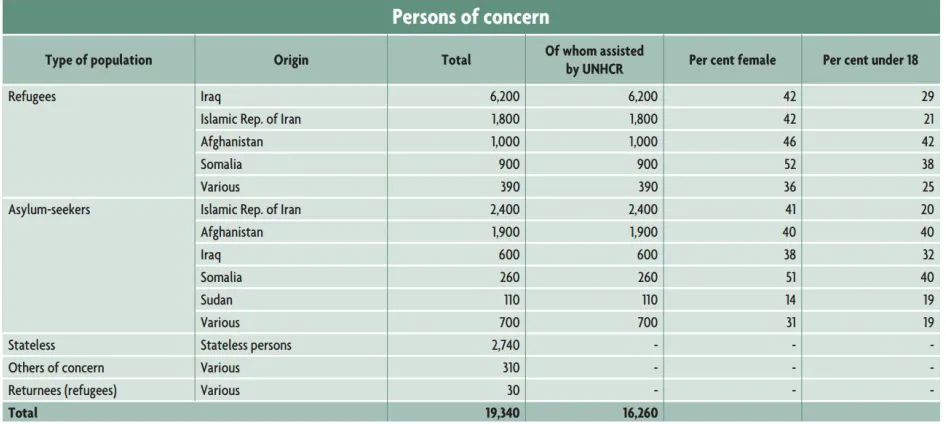
million. UNHCR statistics (Table 1) illustrate the small number of refugees and asylum seekers
16,260 individuals Turkey hosted in 2009, just before the conflict in Syria began.
Table 1: Persons of Concern in Turkey 2009 Source: UNHCR, http://www.unhcr.org/4c08f2f69.html
Nevertheless, researchers have indicated that better planning for an influx of refugees
does not necessarily come with greater experience. Countries like Jordan, Uganda, and Pakistan
have hosted refugees numerous times, but their refugee regimes have remained relatively weak,
population into their economic development strategies, and they have not come up with strong
integration solutions (Hovil, 2007; Ward, 2014; Alimia, 2014). Inexperienced as it is, Turkey has
not fully lived up to its potential, either. Though appreciation for the country’s leadership was
expressed by nearly every one of the Syrian refugee participants of this study, Turkish
engagement with the crisis has been problematic in many ways. Officials say Turkey has
delivered $7.6 billion in aid to Syrian refugees (Al Jazeera, 2015). The amount is clearly
generous for a country whose per capita GDP is less than onequarter that of strong European
states like Germany and France. However, sustainability of this major financial support is 12
highly questionable. Reports reveal that much of that amount has been spent on stateoftheart
refugee camps that most of the refugees reject (Brookings Institution, 2013). It is also a matter of
consideration that Turkey’s strict laws disallow permanent residence to its refugees; plans
oriented towards the integration of refugees has not been of priority from the outset.
Turkish impediments to affording full refugee rights begin with the country’s relationship
to international refugee law. Turkey became signatory to the 1951 United Nations Convention
relating to the Status of Refugees, which specifically dealt with the plight of European refugees
from World War II (UNHCR, 2010). In 1967, the Protocol Relating to the Status of Refugees
designed to eliminate the geographic and temporal constraints of the 1951 Convention was put in
force (UNHCR, 2010). Although Turkey ratified the 1967 Protocol, it retained the geographical
limitation that it would only accept refugees from Europe. Turkey has integrated international
refugee law on nonrefoulement 13 into state law ( Law on Foreigners and Interna tional Protection,
12 Turkey’s GDP per capita between the years 2011 and 2015 is reported to be $10,529.6; whereas that of France is
$42,732.6, and of Germany is $47,627.4. “GDP per capita (current US$)”, World Bank, accessed November 3, 2015, http://data.worldbank.org/indicator/NY.GDP.PCAP.CD
2014), but the geographical limitation it retained requires that someone of nonEuropean origin
cannot stay permanently in Turkey. In this case, persons with legitimate refugee claim would be
transferred to the UNHCR for thirdcountry resettlement.
Syrians in Turkey who arrived as a result of the Syrian civil war are referred to as
‘refugees’ in this thesis, but as persons of nonEuropean origin these individuals are classified
only as misafirler (guests) or siginmacilar (asylees) under temporary protection in Turkish law.
The lack of the legal refugee designation entails a lack of rights, and therefore is extremely
problematic. Persons granted refugee status have internationallyrecognized rights including the
right to cross an international border without documentation while seeking protection, right to
work, housing, education, public relief and assistance, fair trial, freedom of movement, and the
issuance of identity and travel documents (UNHCR, 2011). Syrians in Turkey are not granted
these rights, and often have their rights violated on a dailybasis. One of the consequences of this
policy, for example, is that Syrians are compelled to seek work in the informal economy, which
is unregulated and in which they have no rights or protections.
Establishing camps has been the model Turkey focused on in its refugee response. The 24
camps built by the Turkish government are unlike standard refugee camps around the world. The
Brookings Institute writes of the surprising capacity of camps:
Camps were designed to have primary and secondary education facilities, health clinics, supermarkets, playgrounds for children and laundry rooms. Refugees were given refrigerators and heaters along with hot water. Some even had televisions and air conditioners. (Brookings Institute, 2013)
Turkish reception of Syrian refugees has demonstrated the government is influenced by
the history and religion Syrians shared with Turks in its welcoming rhetoric and opendoor