SINGLE-VALUED NEUTROSOPHIC LINE GRAPHS
S. NAZ1, M. A. MALIK1,
§
Abstract. In this paper, the concept of a single-valued neutrosophic line graph (SVNLG)
of a single-valued neutrosophic graph (SVNG) is introduced and its properties are inves-tigated. We state a necessary and sufficient condition for a SVNG to be isomorphic to its corresponding SVNLG. Moreover, a necessary and sufficient condition for a SVNG to be the SVNLG of some SVNG is given. The notion of a single-valued neutrosophic clique (SVNC) is introduced. A complete characterization of the structure of the SVNC is presented.
Keywords: Neutrosophic set, single-valued neutrosophic set, single-valued neutrosophic graph, single-valued neutrosophic line graph, single-valued neutrosophic clique.
AMS Subject Classification: 05C99
1. Introduction
In 1965, Zadeh [25] originally introduced the concept of fuzzy set, characterized by a membership function in [0,1], which shows great advantages in expressing vague in-formation when accurate judgments to the things cannot be given. But sometimes, to explain the characters of things, membership function of the fuzzy set is not adequate. To overcome this shortcoming of the fuzzy set, Atanassov [5] proposed an extension of fuzzy set by introducing a non-membership and a hesitancy function, and defined intuitionis-tic fuzzy set (IFS) which has been applied in many areas, such as pattern recognition, decision making, medical diagnosis and cluster analysis. Atanassov and Gargov [6] in-troduced interval-valued intuitionistic fuzzy set (IVIFS) which consists of a membership function and a non-membership function, whose values are intervals rather than exact numbers. The IVIFS comprehensively depicts the characters of things. However IFSs and IVIFSs cannot deal with all types of uncertainty, such as indeterminate information and inconsistent information, which exist commonly in different real-world problems.
To effectively accommodate such situations, Smarandache [21] firstly proposed neutro-sophic set theory from philoneutro-sophical point of view. Its prominent characteristic is that a truth-membership degree, an indeterminacy-membership degree and a falsity-membership degree, in non-standard unit interval ]0−,1+[, are independently assigned to each element in the set. Gradually, it has been discovered that without a specific description, neutro-sophic sets are difficult to apply in the real applications. After analyzing this difficulty, Wang et al. [23] initiated the concept of a single-valued neutrosophic set (SVNS) from
1 Department of Mathematics, University of the Punjab, Quaid-e-Azam Campus, Lahore-54590, Pakistan.
e-mail: [email protected]; ORCID: https://orcid.org/0000-0001-6550-9607. e-mail: [email protected]; ORCID: https://orcid.org/0000-0003-4434-7893.
§ Manuscript received: December 18, 2016; accepted: January 04, 2017.
TWMS Journal of Applied and Engineering Mathematics Vol.8, No.2 cI¸sık University, Department of Mathematics, 2018; all rights reserved.
scientific or engineering point of view, as an instance of the neutrosophic set and an exten-sion of IFS, and provided its various properties. SVNSs represent uncertainty, incomplete, inconsistent, and imprecise information which exist in real world.
The concept of fuzzy graphs was initiated by Kaufmann [11], based on Zadeh’s fuzzy relations. Later, another elaborated definition of fuzzy graph with fuzzy vertex and fuzzy edges was introduced by Rosenfeld [18] and obtaining analogs of several graph theoretical concepts such as paths, cycles and connectedness etc, he developed the structure of fuzzy graphs. Some remarks on fuzzy graphs were given by Bhattacharya [7]. Fuzzy line graphs were studied in [12] by Mordeson. Nair and Cheng [13] defined the concept of a fuzzy clique consistent with the definition of fuzzy cycles in fuzzy graphs. Intuitionistic fuzzy graphs with vertex sets and edge sets as IFS were introduced by Akram and Davvaz [1]. Sahoo and Pal [19, 20] introduced some new concepts of intuitionistic fuzzy graphs. Naz et al. [3, 16, 17] put forward many new concepts concerning the extended structures of fuzzy graphs. Kandasamy et al. [22] put forward the notion of neutrosophic graphs. Neutrosophic graphs, particularly SVNGs [2, 4, 8, 9, 14, 15] have attracted significant interest from researchers in recent years. In literature, the study of SVNLGs and SVNCs is still blank. To fill this vacancy, we shall focus on the study of SVNLGs and SVNCs, in this paper.
The paper is structured as follows: Section 2 contains a brief background about SVNSs and SVNGs. Section 3 introduces the concept of SVNLG of a SVNG and, investigates their properties. In Section 4, the notion of SVNC consistent with single-valued neutrosophic cycles in SVNGs is proposed and a complete characterization of the structure of the SVNC is presented, and finally we draw conclusions in Section 5.
2. Preliminaries
In the following, some basic concepts on SVNSs and SVNGs are reviewed to facilitate next sections.
A graph is a pair of sets G= (V, E), satisfyingE ⊆V ×V. The elements of V and E
are the vertices and edges of the graphG, respectively. The line graph L(G) of G is the graph whose vertices are the edges of G, two vertices of L(G) being adjacent if and only if the corresponding edges ofGare adjacent. A connected graph is isomorphic to its line graph if and only if it is a cycle [10]. The idea of line graph of any graph is so natural that many authors have discovered it independently.
Consider a graph G= (V, E), where V = {v1, v2, . . . , vn}. Let Si = {vi, xi1, . . . , xipi}
wherexij ∈E hasvi as a vertex,i= 1,2, . . . , n;j = 1,2, . . . , pi.Let S={S1, S2, . . . , Sn}
and T = {SiSj | Si, Sj ∈ S, Si∩Sj 6= ∅, i 6= j}. Then Ω(S) = (S, T) is an intersection
graph andG∼= Ω(S).
For a graph G, the line graph L(G) is the intersection graph of the set of lines of G. That is, L(G) = (Z, W) where Z = {{x} ∪ {ux, vx} | x ∈ E, ux, vx ∈ V, x = uxvx} and W ={SxSy |Sx∩Sy 6=∅, x, y∈E, x6=y}, withSx={x} ∪ {ux, vx}, x∈E.
A clique in a graph G is a complete subgraph of G. A subgraph H of a graph G
is a disjoint union of cliques if V(H) can be partitioned into H1, H2, . . . , Hk such that xy∈E(H) for allx, y∈V(H) if and only if {x, y} ⊆Hi,for somei, i= 1,2, . . . , k [13].
allx, y∈V. A fuzzy graph is a pair G = (η, µ), where η is a fuzzy subset of a set V and µis a (symmetric) fuzzy relation on η.
Definition 2.2. [5] An IFS X in V is an object having the form
X={hx, µX(x), νX(x)i | x∈V},
where the functions µX : V → [0,1] and νX : V → [0,1] define the degree of
mem-bership and degree of non-memmem-bership of the element x ∈ V, respectively, such that
0≤µX(x) +νX(x)≤1 for allx∈V.
For each IFS X in V, πX(x) = 1−µX(x)−νX(x) is called a hesitancy degree of x in X. If πX(x) = 0 for allx∈V, then IFS reduces to Zadeh’s fuzzy set.
Definition 2.3. [21] Let V be a space of points (objects), with a generic element in V denoted byx. A neutrosophic set X in V is characterized by a truth-membership function TX, an indeterminacy-membership function IX and a falsity-membership function FX. TX(x), IX(x) and FX(x) are real standard or non-standard subsets of ]0−,1+[. That is, TX :V →]0−,1+[, IX :V →]0−,1+[and FX :V →]0−,1+[.
There is no restriction on the sum ofTX(x), IX(x)andFX(x),therefore0−≤supTX(x)+
supIX(x) + supFX(x)≤3+.
Definition 2.4. [23] Let V be a space of points (objects), with a generic element in V denoted by x. A SVNS X in V is characterized by a truth-membership function TX, an indeterminacy-membership function IX and a falsity-membership function FX. For each pointx∈X, TX(x), IX(x), FX(x)∈[0,1]. Therefore, a SVNS X in V can be written as
X ={hx, TX(x), IX(x), FX(x)i |x∈V},
Definition 2.5. [24]A SVNSY inV×V is said to be a single-valued neutrosophic relation in V, denoted by
Y ={hxy, TY(xy), IY(xy), FY(xy)i |xy ∈V ×V}
where TY : V ×V → [0,1], IY : V ×V → [0,1] and FY : V ×V → [0,1] represent the truth-membership, indeterminacy-membership and falsity-membership function of Y, respectively.
Definition 2.6. [8, 14] A single-valued neutrosophic graph (SVNG) on a non-empty set V is a pair G = (X, Y), where X is a SVNS in V and Y is a single-valued neutrosophic relation onV such that
TY(xy)≤min{TX(x), TX(y)},
IY(xy)≥max{IX(x), IX(y)},
FY(xy)≥max{FX(x), FX(y)}
for all x, y ∈ V. X and Y are called the single-valued neutrosophic vertex set and the single-valued neutrosophic edge set ofG, respectively. HereY is a symmetric single-valued neutrosophic relation on X.
3. Single-valued neutrosophic line graphs
This section proposes the concept of a SVNLG of a SVNG based on the extension of the concept of a fuzzy line graph of a fuzzy graph which was proposed by Mordeson [12], and investigates its properties.
Definition 3.1. Let Ω(S) = (S, T) be an intersection graph of a graph G = (V, E) and let G = (X1, Y1) be a SVNG with underlying set V. A SVNG of Ω(S) is a pair (X2, Y2),
where X2 =hTX2, IX2, FX2i and Y2 =hTY2, IY2, FY2i are SVNSs of S and T, respectively,
such that
(i): TX2(Si) =TX1(vi), IX2(Si) =IX1(vi) and FX2(Si) =FX1(vi) for all Si, Sj ∈S,
(ii): TY2(SiSj) =TY1(vivj), IY2(SiSj) = IY1(vivj) and FY2(SiSj) =FY1(vivj) for all
SiSj ∈T.
That is, any SVNG of intersection graphΩ(S)is a single valued neutrosophic intersection graph ofG.
Definition 3.2. Let L(G) = (Z, W) be a line graph of a graph G = (V, E). A SVNLG of a SVNG G = (X1, Y1) (with underlying set V) is a pair L(G) = (X2, Y2), where X2 = hTX2, IX2, FX2i and Y2=hTY2, IY2, FY2i are SVNSs of Z and W, respectively, such that
TX2(Sx) =TY1(x) =TY1(uxvx), IX2(Sx) =IY1(x) =IY1(uxvx) and FX2(Sx) =FY1(x) =FY1(uxvx) for allSx, Sy ∈Z,
TY2(SxSy) = min{TY1(x), TY1(y)}, IY2(SxSy) = max{IY1(x), IY1(y)} and FY2(SxSy) = max{FY1(x), FY1(y)} for all SxSy ∈W.
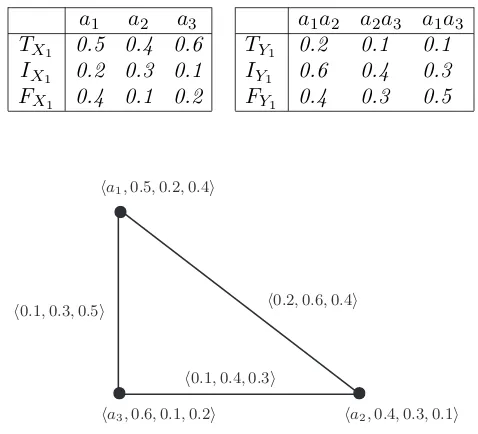
Example 3.1. Consider a graph G = (V, E), where V = {a1, a2, a3} and E = {x1 =
a1a2, x2 = a2a3, x3 = a1a3}. Let G = (X1, Y1) be a SVNG of G, as shown in Figure 1,
defined by
a1 a2 a3
TX1 0.5 0.4 0.6
IX1 0.2 0.3 0.1
FX1 0.4 0.1 0.2
a1a2 a2a3 a1a3
TY1 0.2 0.1 0.1
IY1 0.6 0.4 0.3
FY1 0.4 0.3 0.5
ha2,0.4,0.3,0.1i ha3,0.6,0.1,0.2i
ha1,0.5,0.2,0.4i
h0.1,0.3,0.5i
h0.1,0.4,0.3i
h0.2,0.6,0.4i
Figure 1. Single-valued neutrosophic graph G= (X1, Y1).
Sx3Sx1}. Let L(G) be the SVNLG, as shown in Figure 2. Then, we have
TX2(Sx1) = 0.2, IX2(Sx1) = 0.6, FX2(Sx1) = 0.4,
TX2(Sx2) = 0.1, IX2(Sx2) = 0.4, FX2(Sx2) = 0.3,
TX2(Sx3) = 0.1, IX2(Sx3) = 0.3, FX2(Sx3) = 0.5.
TY2(Sx1Sx2) = 0.1, IY2(Sx1Sx2) = 0.6, FY2(Sx1Sx2) = 0.4,
TY2(Sx2Sx3) = 0.1, IY2(Sx2Sx3) = 0.4, FY2(Sx2Sx3) = 0.5,
TY2(Sx1Sx3) = 0.1, IY2(Sx1Sx3) = 0.6, FY2(Sx1Sx3) = 0.5.
hSx2,0.1,0.4,0.3i hSx3,0.1,0.3,0.5i
hSx1,0.2,0.6,0.4i
h0.1,0.6,0.5i
h0.1,0.4,0.5i
h0.1,0.6,0.4i
Figure 2. Single-valued neutrosophic line graphL(G).
Proposition 3.1. A SVNLG is always a strong SVNG.
Proof. It is obvious, therefore omitted.
Proposition 3.2. If L(G) is a SVNLG of SVNGG. Then L(G) is the line graph of G.
Proof. Since G= (X1, Y1) is a SVNG of Gand L(G) = (X2, Y2) is a SVNG of L(G),
TX2(Sx) =TY1(x), IX2(Sx) =IY1(x), FX2(Sx) =FY1(x) for all x∈E and soSx∈Z if and only if x∈E.Also
TY2(SxSy) = min{TY1(x), TY1(y)}, IY2(SxSy) = max{IY1(x), IY1(y)},
FY2(SxSy) = max{FY1(x), FY1(y)} for allSxSy ∈W
and soW ={SxSy |Sx∩Sy 6=∅, x, y∈E, x6=y}. Hence proved.
Proposition 3.3. Let L(G) = (X2, Y2) be a SVNG of L(G). Then L(G) is a SVNLG of
some SVNG of Gif and only if
TY2(SxSy) = min{TX2(Sx), TX2(Sy)}, IY2(SxSy) = max{IX2(Sx), IX2(Sy)},
FY2(SxSy) = max{FX2(Sx), FX2(Sy)} for all SxSy ∈W.
Proof. Suppose thatTY2(SxSy) = min{TX2(Sx), TX2(Sy)}, IY2(SxSy) = max{IX2(Sx), IX2(Sy)},
FY2(SxSy) = max{FX2(Sx), FX2(Sy)} for allSxSy ∈W.Define
Then
TY2(SxSy) = min{TX2(Sx), TX2(Sy)}= min{TY1(x), TY1(y)},
IY2(SxSy) = max{IX2(Sx), IX2(Sy)}= max{IY1(x), IY1(y)},
FY2(SxSy) = max{FX2(Sx), FX2(Sy)}= max{FY1(x), FY1(y)} for all SxSy ∈W. Any SVNSX1 that yields the propertyTY1(uv)≤min{TX1(u), TX1(v)},IY1(uv)≥ max{IX1(u), IX1(v)} and FY1(uv) ≥ max{FX1(u), FX1(v)} will suffice. The converse is
immediate. Hence proved.
The following theorem shows that when a SVNG is a SVNLG of some SVNG.
Theorem 3.1. L(G) is a SVNLG if and only if L(G) is a line graph and
TY2(uv) = min{TX2(u), TX2(v)}, IY2(uv) = max{IX2(u), IX2(v)},
FY2(uv) = max{FX2(u), FX2(v)} for all uv ∈W.
Proof. Straightforward using Propositions 3.2 and 3.3.
Definition 3.3. A homomorphism χ :G1 → G2 of two SVNGs G1 = (X1, Y1) and G2 = (X2, Y2) is a mapping χ:V1 →V2 such that
(a): TX1(x1)≤TX2(χ(x1)),IX1(x1)≥IX2(χ(x1)),FX1(x1)≥FX2(χ(x1)) for allx1∈
V1,
(b): TY1(x1y1)≤TY2(χ(x1)χ(y1)),IY1(x1y1)≥IY2(χ(x1)χ(y1)),FY1(x1y1)≥FY2(χ(x1)χ(y1))
for all x1y1 ∈E1.
Definition 3.4. A (weak) vertex-isomorphism is a bijective homomorphism χ:G1 → G2
such thatTX1(x1) =TX2(χ(x1)),IX1(x1) =IX2(χ(x1)),FX1(x1) =FX2(χ(x1)) for allx1∈
V1.
A (weak) line-isomorphism is a bijective homomorphismχ:G1 → G2 such thatTY1(x1y1) =
TY2(χ(x1)χ(y1)),IY1(x1y1) = IY2(χ(x1)χ(y1)),FY1(x1y1) = FY2(χ(x1)χ(y1)) for all x1y1 ∈
E1.
If χ:G1 → G2 is a (weak) vertex-isomorphism and a (weak) line-isomorphism, then χ is called a (weak) isomorphism.
The following proposition shows that any SVNG is isomorphic to a single-valued neu-trosophic intersection graph.
Proposition 3.4. Let G = (X1, Y1) be a SVNG with underlying set V. Then
(i): (X2, Y2) is a SVNG of Ω(S),
(ii): (X1, Y1)∼= (X2, Y2).
Proposition 3.5. Let G and G0 be SVNGs of G and G0, respectively. If χ :G → G0 is a weak isomorphism, then χ:G→G0 is an isomorphism.
Proof. Let χ :G → G0 be a weak isomorphism, then v ∈ V if and only if χ(v)∈ V0 and
uv∈E if and only if χ(u)χ(v)∈E0.
Hence proved.
Now we provide a necessary and sufficient condition for a SVNG to be isomorphic to its corresponding SVNLG.
Proposition 3.6. Let G= (V, E) be a connected graph. Suppose thatL(G) = (X2, Y2) is
(i): there exists a weak isomorphism of G onto L(G) if and only if Gis a cycle and for all v ∈V, x ∈ E, TX1(v) = TY1(x), IX1(v) = IY1(x), FX1(v) = FY1(x), that is,
X1=hTX1, IX1, FX1i and Y1 =hTY1, IY1, FY1i are constant functions on V andE,
respectively, taking on the same value.
(ii): If χ:G →L(G) is a weak isomorphism, thenχ is an isomorphism.
Proof. Suppose thatχ:G →L(G) is a weak isomorphism. From Proposition 3.5, it follows that G = (V, E) is a cycle. Consider V = {v1, v2, . . . , vn} and E = {v1v2 = x1, v2v3 =
x2, . . . , vnv1=xn}, wherev1v2, . . . , vnv1 is a cycle. Let
TX1(vi) =si, IX1(vi) =s
0
i, FX1(vi) =s
00 i, TY1(xi) =ri, IY1(xi) =r
0
i, FY1(xi) =r
00 i
i= 1,2, . . . , n, vn+1=v1.Then fors1 =sn+1, s
0
1 =s
0 n+1, s
00
1 =s
00 n+1,
ri ≤min{si, si+1}, r
0
i ≥max{s
0 i, s
0 i+1}, r
00
i ≥max{s
00 i, s
00
i+1}i= 1,2, . . . , n. (1) NowZ ={Sxi |i= 1,2, . . . , n}and W ={SxiSxi+1 |i= 1,2, . . . , n−1}.
Also for r1 =rn+1, r
0
1=r
0 n+1, r
00
1 =r
00 n+1,
TX2(Sxi) =TY1(xi) =ri,
IX2(Sxi) =IY1(xi) =r
0 i, FX2(Sxi) =FY1(xi) =r
00 i,
TY2(SxiSxi+1) = min{TY1(xi), TY1(xi+1)}= min{ri, ri+1},
IY2(SxiSxi+1) = max{IY1(xi), IY1(xi+1)}= max{r
0 i, r
0 i+1},
FY2(SxiSxi+1) = max{FY1(xi), FY1(xi+1)}= max{r
00 i, r
00 i+1} for alli= 1,2, . . . , n, wherevn+2=v2.
Sinceχis an isomorphism ofGontoL(G),χmapsV one-to-one ontoX2. Alsoχpreserves adjacency. Henceχinduces a permutation π of {1, 2, . . . ,n}such that χ(vi) =Sxπ(i) and
xi =vivi+1 →χ(vi)χ(vi+1) =Sxπ(i)Sxπ(i+1), i= 1,2, . . . , n−1. Now
si =TX1(vi)≤TX2(χ(vi)) =TX2(Sxπ(i)) =rπ(i),
s0i =IX1(vi)≥IX2(χ(vi)) =IX2(Sxπ(i)) =r
0 π(i),
s00i =FX1(vi)≥FX2(χ(vi)) =FX2(Sxπ(i)) =r
00 π(i) and
ri =TY1(xi) ≤ TY2(χ(vi)χ(vi+1)) =TY2(Sxπ(i)Sxπ(i+1)) = min{TY1(xπ(i)), TY1(xπ(i+1))}
= min{rπ(i), rπ(i+1)},
r0i=IY1(xi) ≥ IY2(χ(vi)χ(vi+1)) =IY2(Sxπ(i)Sxπ(i+1)) = max{IY1(xπ(i)), IY1(xπ(i+1))}
= max{r0π(i), rπ0(i+1)},
r00i =FY1(xi) ≥ FY2(χ(vi)χ(vi+1)) =FY2(Sxπ(i)Sxπ(i+1)) = max{FY1(xπ(i)), FY1(xπ(i+1))}
That is,
si ≤rπ(i), s
0
i ≥r
0 π(i), s
00
i ≥r
00
π(i), (2)
and
ri ≤min{rπ(i), rπ(i+1)}, r
0
i ≥max{r
0 π(i), r
0
π(i+1)}, r
00
i ≥max{r
00 π(i), r
00
π(i+1)}. (3)
From (3), we get ri ≤ rπ(i), r
0
i ≥ r
0 π(i), r
00
i ≥r
00
π(i) and so rπ(i) ≤rπ(π(i)), r
0
π(i) ≥ r
0 π(π(i)),
r00π(i) ≥ r00π(π(i)) i = 1,2, . . . , n. Continuing, we have ri ≤ rπ(i) ≤ . . . ≤ rπj(i) ≤ ri, r 0
i ≥
r0π(i) ≥ . . . ≥ r0πj(i) ≥ r 0
i, r
00
i ≥ r
00
π(i) ≥ . . . ≥ r
00
πj(i) ≥ r 00
i and so ri = rπ(i), r
0
i = r
0 π(i),
r00i =r00π(i) for all i = 1,2, . . . , n, where πj+1 is the identity map. Again, from 3, we get
ri ≤ rπ(i+1) = ri+1, r
0
i ≥ r
0
π(i+1) = r
0 i+1, r
00
i ≥ r
00
π(i+1) = r
00
i+1 for all i = 1,2, . . . , n where
rn+1=r1.
Hence from (1), (2) and (3),
r1 =. . .=rn=s1 =. . .=sn, r 0
1 =. . .=r
0
n=s
0
1 =. . .=s
0
n, r
00
1 =. . .=r
00
n=s
00
1 =. . .=
s00n.
Hence X1 and Y1 are constant functions and we have also proved that (2) holds. The converse part is obvious.
Hence proved.
Proposition 3.7. Let G= (X1, Y1) andG
0
= (X10, Y10) be the SVNGs of connected graphs Gand G0, respectively. Let L(G) = (X2, Y2) and L(G
0
) = (X20, Y20) denote respectively the SVNLGs corresponding toG andG0. Assume that it is not the case that one ofG and G0 is complete graph K3 and the other is bipartite complete graph K1,3. If L(G) and L(G
0
)
are isomorphic, then G and G0 are line-isomorphic.
Proof. Suppose that L(G) ∼= L(G0), then by Proposition 3.5,L(G) ∼=L(G0). Since L(G) andL(G0) are respectively the line graphs ofG and G0, so, G∼=G0.
Letφ1:L(G)→L(G
0
) and φ2:G→G
0
be the isomorphisms. Then
TX2(Suv) =TX0
2(φ1(Suv)) =TX
0
2(Sφ2(u)φ2(v)),
IX2(Suv) =IX20(φ1(Suv)) =IX20(Sφ2(u)φ2(v)), FX2(Suv) =FX0
2(φ1(Suv)) =FX
0
2(Sφ2(u)φ2(v)).
Therefore,TY1(uv) =TY10(φ2(u)φ2(v)),IY1(uv) =IY10(φ2(u)φ2(v)),FY1(uv) =FY10(φ2(u)φ2(v)).
Hence,G1 and G2 are line-isomorphic. Hence proved.
4. Single-valued neutrosophic cliques
In this section, we propose the notion of SVNC consistent with single-valued neutro-sophic cycles in SVNGs and present a complete characterization of the structure of the SVNC. To do this, we firstly introduce the concept of single-valued neutrosophic cycles.
Definition 4.1. Let G = (X, Y) be a SVNG. Then
(i): G is a cycle if and only if G= (V, E) is a cycle.
(ii): G is called a single-valued neutrosophic cycle if and only if G is a cycle and there does not exist unique edgelm of G such that
TY(lm) = min{TY(xy) | xy∈E}, IY(lm) = max{IY(xy) |xy ∈E},
and FY(lm) = max{FY(xy) |xy∈E}.
Example 4.1.Consider a graphG= (V, E), whereV ={a1, a2, a3}andE ={a1a2, a2a3, a1a3}.
Let G be a SVNG of G, given in Figure 3.
ha1,0.4,0.5,0.3i
h0.2,0.5,0.4i
ha2,0.3,0.4,0.3i ha3,0.2,0.4,0.1i
h0.2,0.5,0.4i h0.1,0.6,0.7i
Figure 3. Not a single-valued neutrosophic clique.
TakeS =V, then H is the same as G. Routine computations show that H is a cycle but not a single-valued neutrosophic cycle. HenceH is a clique but not a SVNC.
Example 4.2. Consider a graph G = (V, E), where V = {a1, a2, a3, a4} and E = {a1a2, a2a3, a3a4, a4a1, a1a3, a2a4}. Let G be a SVNG ofG, given in Figure 4.
ha1,0.5,0.2,0.3i
h0.1,0.4,0.6i h0.4,0.2,0.3i
h0.2,0.3,0.5i
h0.1,0.4,0.6i h0.2,
0.3,
0.5i
h0.1 ,0.
4, 0.6
i
ha3,0.5,0.2,0.3i ha4,0.5,0.2,0.3i
ha2,0.5,0.2,0.3i
Figure 4. Single-valued neutrosophic clique.
TakeS =V, then H is the same as G. Routine computations show that every cycle in H is a single-valued neutrosophic cycle. Hence H is a clique and is also a SVNC.
Theorem 4.1. Let G= (X, Y) be a SVNG of a graphG= (V, E) and H= (X0, Y0) be a subgraph induced byS ⊆V. Then H is a SVNC if and only if every cycle of length 3 in H is a single-valued neutrosophic cycle.
Proof. Suppose that H is a SVNC. Then by above definition every cycle in H is a single-valued neutrosophic cycle and so every cycle of length 3 in H is also a single-valued neutrosophic cycle.
neutrosophic cycle. Letv0, v1, ..., vn, vn+1 be any cycle Cn+1 of lengthn+ 1 in H. Since
H is a clique, H contains a cycle Cn of length n i.e v0, v1, ..., vn and is a single-valued
neutrosophic cycle inH. Therefore ∃ at least two edges, say e1 and e2 in a single valued neutrosophic cycle Cn such that
TY(e1) = TY(e2) = min{TY(e) |eis an edge inCn}, IY(e1) = IY(e2) = max{IY(e) |eis an edge in Cn}, FY(e1) = FY(e2) = max{FY(e) |eis an edge inCn}.
Also v0, vn, vn+1 is a single-valued neutrosophic cycle and hence∃ at least two edges, say
e3 and e4 in a single-valued neutrosophic cyclev0, vn, vn+1 such that
TY(e3) = TY(e4) = min{TY(e)|e is an edge inv0, vn, vn+1},
IY(e3) = IY(e4) = max{IY(e) |eis an edge in v0, vn, vn+1},
FY(e3) = FY(e4) = max{FY(e) |eis an edge inv0, vn, vn+1}.
Then two cases arise, firstly, if one of the edgese1 ore2 is the same as one of the edges e3 ore4. In this case, take e1=e3. Then e2 and e4 are the edges inCn+1 such that
TY(e2) = TY(e4) = min{TY(e) |eis an edge inCn+1},
IY(e2) = IY(e4) = max{IY(e) |eis an edge in Cn+1},
FY(e2) = FY(e4) = max{FY(e) |eis an edge inCn+1} as required.
Secondly, all four edgese1, e2, e3, e4 are edges inCn+1 and either
TY(e1) = TY(e2) = min{TY(e) |eis an edge inCn+1},
IY(e1) = IY(e2) = max{IY(e) |eis an edge in Cn+1},
FY(e1) = FY(e2) = max{FY(e) |eis an edge inCn+1} or
TY(e3) = TY(e4) = min{TY(e) |eis an edge inCn+1},
IY(e3) = IY(e4) = max{IY(e) |eis an edge in Cn+1},
FY(e3) = FY(e4) = max{FY(e) |eis an edge inCn+1}.
Hence in both cases,H is a SVNC.
Lemma 4.1. Let G = (X, Y) be a SVNG of a graph G = (V, E) and H = (X0, Y0)
be a subgraph induced by S ⊆ V. Then every cycle of length 3 in H is a single-valued neutrosophic cycle if and only if for any three vertices u, v, w in H such that the edges uv, vw∈E(Ht) implies uw∈E(Ht) for all t∈[0,1].
Lemma 4.2. Let G = (X, Y) be a SVNG of a graph G= (V, E) and H = (X0, Y0) be a subgraph induced by S ⊆V. Then H is a disjoint union of cliques if and only if for any three verticesu, v, w in H such that the edges uv, vw∈E(Ht) implies uw∈E(Ht) for all t∈[0,1].
As a consequence of Lemmas 4.1 and 4.2, we obtain
5. Conclusions
Single-valued neutrosophic models are more flexible and practical than fuzzy and in-tuitionistic fuzzy models. In this paper, we have introduced the concept of SVNLG of a SVNG and discussed some of their desirable properties. We have introduced the notion of SVNC and presented a complete characterization of the structure of the SVNC. SVNGs can be used in computer technology, networking, communication, economics, genetics, lin-guistics, sociology, etc, when the concept of indeterminacy is present. We are extending our research work to (i) Interval-valued neutrosophic line graphs, (ii) Intuitionistic neu-trosophic line graphs, (iii) Vague neuneu-trosophic line graphs, and (iv) Bipolar neuneu-trosophic line graphs.
References
[1] Akram, M. and Davvaz, B., (2012), Strong intuitionistic fuzzy graphs, Filomat, 26 (1), pp. 177-196. [2] Akram, M. and Shahzadi, S., (2017), Neutrosophic soft graphs with application, Journal of Intelligent
and Fuzzy Systems, 32 (1), pp. 841-858.
[3] Akram, M. and Naz, S., (2018), Energy of Pythagorean fuzzy graphs with applications, Mathematics, 6(8), pp. 1-27.
[4] Ashraf, S., Naz, S., Rashmanlou, H. and Malik, M. A., (2017), Regularity of graphs in single-valued neutrosophic environment, Journal of Intelligent and Fuzzy Systems, 33(1), pp. 529-542.
[5] Atanassov, K. T., (1986), Intuitionistic fuzzy sets, Fuzzy Sets Syst., 20 (1), pp. 87-96.
[6] Atanassov, K. and Gargov, G., (1989), Interval-valued intuitionistic fuzzy sets, Fuzzy Sets Syst., 31 (3), pp. 343-349.
[7] Bhattacharya, P., (1987), Some remarks on fuzzy graphs, Pattern Recognition Letters, 6 (5), pp. 297-302.
[8] Broumi, S., Talea, M., Bakali, A. and Smarandache, F., (2016), Single-valued neutrosophic graphs, Journal of new theory, pp. 86-101.
[9] Dhavaseelan, R., Vikramaprasad, R. and Krishnaraj. V., (2015), Certain types of neutrosophic graphs, Int. J. of Mathematical Sciences and Applications, 5 (2), pp. 333-339.
[10] Harary, F., (1972) Graph Theory, 3rd Edition, Addison-Wesley, Reading, MA.
[11] Kaufmann, A., (1973), Introduction a la Theorie des Sour-ensembles Flous, Masson et Cie 1. [12] Mordeson, J. N., (1993), Fuzzy line graphs, Pattern Recognition Letters, 14, pp. 381-384. [13] Nair, P. S. and Cheng, S-C. Cliques and fuzzy cliques in fuzzy graphs, IEEE 2001.
[14] Naz, S., Rashmanlou, H. and Malik, M. A., (2017), Operations on single-valued neutrosophic graphs with application, Journal of Intelligent and Fuzzy Systems, 32(3), pp. 2137-2151.
[15] Naz, S., Akram, M. and Smarandache, F., (2018), Certain notions of energy in single-valued neutro-sophic graphs, Axioms, 7(3), pp. 1-30.
[16] Naz, S., Malik, M. A. and Rashmanlou, H., (2018), Hypergraphs and transversals of hypergraphs in interval-valued intuitionistic fuzzy setting, The Journal of Multiple-Valued Logic and Soft Computing, 30 (4-6), PP. 399-417.
[17] Naz, S., Ashraf, S. and Akram, M., (2018), A novel approach to decision-making with Pythagorean fuzzy information, Mathematics, 6(6), pp. 1-28.
[18] Rosenfeld, A., (1975), Fuzzy graphs, Fuzzy Sets and their Applications (L. A. Zadeh, K. S. Fu, M. Shimura, Eds.) Academic Press, New York, pp. 77-95.
[19] Sahoo, S. and Pal, M., (2015), Intuitionistic fuzzy competition graphs, J. Appl. Math. Comput., 52 (1), pp. 37-57.
[20] Sahoo, S. and Pal, M., (2017), Intuitionistic fuzzy tolerance graph with application, Journal of Applied Mathematics and Computing, 55 (1-2), pp. 495-511.
[21] Smarandache, F., A unifying field in logics. Neutrosophy: neutrosophic probability, set and logic, American Research Press, Rehoboth, 1999.
[22] Vasantha Kandasamy, W. B., Ilanthenral, K. and Smarandache, F., (2015), Neutrosophic Graphs: A New Dimension to Graph Theory, kindle Edition.
[24] Yang, H. L., Guo, Z. L., She, Y. and Liao, X., (2016), On single-valued neutrosophic relations, Journal of Intelligent and Fuzzy Systems, 30, pp. 1045-1056.
[25] Zadeh, L. A., (1965), Fuzzy sets, Information and Control, 8(3), pp. 338-353.
Sumera Nazreceived her M.Sc. and M.Phil degrees from Department of Mathematics, University of the Punjab, Lahore, Pakistan. Recently, she received her Ph.D. degree in mathematics from University of the Punjab, Lahore. Her current research interests include fuzzy logic, fuzzy graphs and multi-attribute decision analysis. She has published 9 research articles in international peer-reviewed journals.