DESERT
Desert
Online at http://desert.ut.ac.ir
Desert 24-1 (2019) 43-49
The effect of simulated dust storm on wood development and leaf
stomata in
Quercus
brantii
L.
H.R. Naji
a*, M. Taherpour
aa
Department of Forest Sciences, Ilam University, Ilam, Iran
Received: 11 June 2018; Received in revised form: 31 December 2018; Accepted: 20 February 2019
Abstract
Dust storms are increasingly threatening the forest ecosystem in Western Iran. Due to its coverage of vast area of Zagros forest, the Quercus brantii is at the front line of the attack. Most tree deaths in this forest are from this species. This study aims to investigate the effect of simulated dust on wood development and leaf stomata from seedlings of Persian oak. The oak seedlings were put in a chamber and dusted from 9 a.m. until 6 p.m. at three different days with an interval of 12 days. They were under three increasing concentrations of dust (5000, 7000, and 9000 mg/m3). Leaf and wood samples of about 10 seedlings were collected, and the leaf stomatal features, growth
ring and vessel features of both treated and untreated seedlings were examined. The results showed no variations in stomatal features except for pore aperture. As for wood features, growth ring, vessel number and diameter considerably changed. In treated seedlings, the growth ring and vessel diameter were smaller and the number of vessels was higher than in the untreated seedlings. No detection of differences in stomatal features could be tracked due to the short-period of treatment. The usual seedlings’ annual growth could be altered by treatment affecting on both annual growth ring and vessel features. To sum up, it can be concluded that dust storm has strong effect on seedling’s growth as can limit wood formation.
Keywords: Dust Storm; Wood Anatomy; Leaf Features; Growth Ring; Persian Oak
1. Introduction
Dust phenomenon has been considered as a serious natural threat during the past few decades (Omidvar, 2006). In fact, dry and semi-dry lands in the world have been expanding due to the increasing process of global warming global increasing in Earth’s temperature, reduction in precipitation, climate change, increased evapotranspiration, as well as excess and misusage of water resources in different activities carried out by mankind. These conditions give rise to new sources of dust and amplify the influence of dust storms (Liu et al., 2003). Tiny dust particles in the air - “particulate matter" (PM) - is a kind of air pollution that comprises of a mixture of some varying particles suspending in the atmosphere. In general, PM is a complex of fine solid materials like soil dust,
Corresponding author. Tel.: +98 911 458-9774
Fax: +98 84 59241550
E-mail address: [email protected]
different types of micro-organisms, ashes, plant pollens, soot, and many other minute particles. PM may arise from different sources such as anthropogenic activities or natural sources (Schelle-Kreis et al., 2007). In the Middle East, especially in Iran, most dust storms originating from the deserts of neighboring countries like Saudi Arabia, Syria, and Iraq destructively attack the West and South-West of the country and have had enormous effects on many aspects of plant, animal, and human life (Omidvar, 2006). In addition, about one-fourth of Iran is located in the dry and desert belt of the world, therefore they are inevitably attacked by dust storms. However, the severity and duration of the local storms are too weak and are not as important as the storms originating from neighboring countries (Ghaffari and Mostafazadeh, 2015).
Naji & Taher Pour / Desert 24-1 (2019) 43-49 44
Singh and Rao, 1981), but there are few studies that show changes in anatomical features. Insights into plant variations against environmental changing have mainly been recognized through cellular comparative studies between affected and non-affected plant individuals on contrasting sites or situations. Yet, a plant’s growing response to environmental conditions is a key factor in determining whether that species can persist environmental changes or is influenced detrimentally by them (Ben Rejeb et al., 2014).
Understanding the anatomical features of a leaf helps better identify the effect of pollutants. The absorption of particulate matters is related to leaf structure. The density and size of the stomata indicate the leaf adaptation to pollutants (Gostin, 2009). The size and frequency of trichomes is of key trait to take and keep the dust (Muneer et al., 2013). Stomatal conductance is influenced by environmental factors, position at the canopy, and the age of the leaves. Dust-covered leaves receive less light for photosynthesis, which in turn affects leaf stomatal conductance, plant biomass, and the rate of photosynthesis. Furthermore, leaves covered with dust absorb more solar radiation that increases leaf temperature (Wijayratne et al., 2009). In addition, fine dust may clog the stomatal openings leading to adverse effect on photosynthesis and leaf temperature. Other factors such as sandblasting result in the loss of plant leaves which decrease photosynthetic activities and production of grains or fruits (Zia-Khan et al., 2015). Shrivastava and Mishra (2018) reported changes in the stomatal size of some plants induced by air pollution.
Persian oak (Quercusbrantii) trees are one of the most important woody plant species in the Zagros forest, in Western Iran (Browicz, 1982). This tree acts as a great filter for purifying air from pollutants, particularly dust storm. For thousands of years, they have adapted to habitats, thus small changes in environmental conditions would affect their performances. Unfortunately, great numbers of trees have disappeared in wide parts of these forests because of destructive parameters (Moradi et al., 2017). Our observation based on field trips has shown a high rate of Persian oak mortality in different sites.
To the best of our knowledge, there is no specific report on the effect of dust storms on leaf stomata and wood anatomical properties. Therefore, due to lack of laboratory information, we selected Persian oak (Quercusbrantii Lindl.) to examine leaf stomata and wood radial growth variation to simulated dust storms.
2. Materials and Methods
A total of 30 two-years-old Persian oak (Q. brantii) seedlings were provided from Eyvan Nursery, a main governmental seedling provider in Ilam, Iran. The seedlings were then transported to the pilot nursery of Ilam University (Table 1). The plastic pots were replaced by bigger holding of about 3 kg air-dried soil with a mixture of plow layer of field soil: manure: gravel (2:1:1). To adapt with the new situation, appearance, and maturation of the leaves, the seedlings were placed in the yard and irrigated by tap water for three months.
Table. 1 The basic information of study place in University of Ilam, Iran
Latitude Longitude Altitude (m) a.s.l Ave. Pre. mm Min. T. C Max. T. C
33 21´ 30″ 45 41´ 07″ 1427 581 -13 42
Ave. Pre. = Average Precipitation; Min. T.= Minimum Temperature; Max. T.= Maximum Temperature
2.1. Dust preparation
The dust for the experiment was collected from the desert around the city of Dehloran, southern part of Ilam. The desert is very close to that of the neighboring country’s (Iraq) that likely is more similar to the dust originated from natural sources. In the laboratory, the dust was ground and passed through a series of sieves
meshes numbers of 35, 80, 200, and 400. Finally, dust particles with the size of less than 40 µm were collected. The size of fine dust affecting the plants’ organs is usually less than 40 μm (Shams and MohamadZadeh, 2013). Some characteristics of prepared dust are presented in the Table 2 that are almost similar to the dust with Arabian origin (Modaihsh, 1997; Modaihsha and Mahjoub, 2013).
Table 2. Some chemical characteristics of prepared dust
Sand % Silt % pH EC (ds/m) CaCO3)%( CaCO4)%( Cl¯Mg/L Texture
49.16 39.18 7.36 2.53 51.75 30.10 0.8 Loam
Naji & Taher Pour / Desert 24-1 (2019) 43-49 45
2.2. Simulated Dust Chamber
In order to investigate the effect of dust on the Persian oak seedlings, a chamber with the dimensions of 200×200×200 cm was designed. After leaf maturation on the last days of May, the seedlings were put inside the dusting chamber. For longer suspension of dust, we provided three small barbeque fans at different parts of the chamber. In addition, to avoid any stress on the seedlings, the air flow did not contact the leaves. The chamber was covered by polyethylene plastic sheet and to ventilate the room, some small holes were made at two corners of the chamber. To prevent the adverse effect of the sun on the seedlings, the chamber was put under a covered yard. Similarly, a same chamber was provided for the untreated (control) seedlings.
2.3. Dusting Process
The dusting process was taken out for three periods. At first, the seedlings with a diameter of about 1 cm and a height of about 100 cm were treated during one day by about 220 g dust from 9 a.m. until 6 p.m. for six series of 1.5 hours. During each series of dusting, about 36 g of dust was added to the chamber to maintain the dust concentration. Likewise, 10 seedlings as control group were put inside the control chamber. The second and third periods of dusting were also similar to the first one, but with an interval of 12 days between the periods and with an increased dust concentration of 330 and 440 g. According to the Department of Environment, Ilam (2017), the concentrations of dust in the air of Ilam in most of the polluted days (more than 50 days from April-November) have been about 5000 mg/m3 and more. The dust concentrations for three dusting periods were 5000, 7000, and 9000 mg/m3, respectively. One week after the last period, some wood specimens were taken from the stem, five cm above the collar of treated and untreated seedling samples. Meanwhile, for stomata analyses, some matured leaves from middle part of the crown were sampled from both treated and untreated seedlings.
2.4. Wood Samples Processing and Variables Measures
To obtain more detailed information on the effects of dust storms on the wood structure of Persian oak, the stems of 10 seedlings were cut into blocks with about 10×5×5 mm, and then a
microscopic slide was prepared from each seedling as following: To soften the wood samples, they were first boiled for about 30 minutes and then 20-25µm thick transverse sections were cut by a rotary microtome (MK 1110, China). The sections were stained by Safranin O and dehydrated by a series of ethanol from 50% up to 100%. The stained sections were transferred onto the glass slide and mounted with Canada balsam glue and analyzed under a light microscope (Olympus, CX 22), equipped with a digital microscope camera. Image acquisition and measurements were performed by the software (TrueChrome Metrics). Only the last growth ring attached to the bark was considered. Measures were averaged for the following variables: width of growth ring; the number; the seriate; and the tangential diameter of early-wood vessels.
2.5. Leaf Sample Preparation
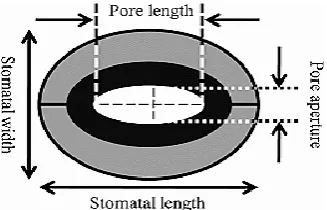
Due to lack of stomata on the adaxial surface of the leaf blade, the study was merely focused on the abaxial surface. Small pieces of the leaf were cut with a dimension of about 5×5 mm from the middle part and near the mid vein of the leaf blade. There was some difficulty to observe the stomata on the abaxial surface due to huge numbers of trichomes. Therefore, they were removed by a safety razor and paper adhesive tape. To remove the chlorophyll, the leaf samples were boiled in a mixture of acetic acid and hydrogen peroxide (1:5) for 60 min. The bleached samples were stained by Safranin O for 15 min. and then dehydrated by a series of ethanol of 85%, 95%, and 100%. Finally, permanent slides were prepared (Camargo and Marenco, 2011). The stomatal features, as Figure 1, were measured by light microscope with magnification of ×1000. The measurements of the stomata features were centered on 50 stomata.
2.6. Statistical analysis
Naji & Taher Pour / Desert 24-1 (2019) 43-49 44
Fig. 1. Schematic representation of the stomatal and pore dimensions as measured by image analyzer
3. Results
3.1. Tree Ring Growth
In both, treated and untreated seedlings, growth rings formed during the progress of treatment. Whereas, a clear reduction in the width of annual ring of dusted seedlings was obviously observed (Figure 2 a-c). The average ring width of treated and untreated seedlings was 528 (±34) µm and 880 (±56) µm, respectively. Therefore, the growth ring in treated seedlings decreased by about 40% compared to the untreated ones.
3.2. Vessel Anatomy
The number of vessels within the annual ring increased in treated seedlings, from 15 (±2.7) in untreated to over 20 (±4.1) in treated seedlings. Furthermore, the tangential diameters of the vessels pore along the boundary of the rings were 252 (±27.2) µm to 206 (±18.7) µm in untreated and treated seedlings, respectively. The
reduction of vessel pores was about 18%. Therefore, the high level of dust was associated with significant change in vessel features, as the number and diameter of vessels in untreated seedlings were, respectively, lower and bigger.
The ring porous nature of the Quercusbrantii wood for generating vessels in some seriates close to boundary of the ring was clear both in treated and untreated seedlings. The treatment did not change the number of vessel seriate, as they were almost in 2-3 seriates (Figure 2 a-b).
3.3. Stomatal Variation
The Abaxial side of Persian oak is fully covered by stomata (Figure 3). Variations in stomatal parameters, including stomatal density (SN), stomatal length (SL), stomatal width (SW), pore length (PL), and pore aperture (PA) of Q. brantii showed that their responses to dusting were not associated with increasing the dust concentration (Table 3). As shown in the Table, the variation among the stomatal features were insignificant. Pore aperture were closed in treated compared to open stomata in control plants.
Fig. 2. Variation in wood of treated and untreated seedlings of Quercusbrantii by dust storm in simulated condition. a: normal growth ring (GR) in untreated seedling. b and c: narrow growth ring in the treated seedlings. Scale bar=75μm
Table. 3 Mean value (±SD) of different features of stomata at seedlings treated and untreated by dust
Treatment SN(N. µm2) SL(µm) SW(µm) PL(µm) PA†(µm)
Treated 15.20 (±2.44) 21.02 (±2.85) 14.08 (±1.70) 10.60 (±2.10) --
Control 14.62 (±1.98) 20.06 (±2.39) 15.32 (±1.93) 9.40 (±2.08) 1.06 (±0.42)
SN, Stomatal density; SL, Stomatal length; SW, stomatal width; PL, pore length; PA, pore aperture. Values are means of 50 replicates. SD, Standard deviation. Due to clogging of the pore by dust (Moradi et al., 2017), it was impossible to measure their size by light microscope, therefore no value was recorded
Naji & Taher Pour / Desert 24-1 (2019) 43-49 45
Fig. 3. The arrangement of stomata in untreated seedlings. a and b, low (×100) and high (×1000) magnifications of stomata
4. Discussion
The knowledge of a tree species’ growth features and effects of environmental variables, as well as silviculture on it could be a key matter for evaluating and preserving the long-life of the forests. This is the case with the Persian oak (Quercusbrantii) of Zagros forest which is under huge pressure of dust storms coming from domestic (dried lands of the country) and external (deserts of neighboring countries) resources that may be a cause of growth decline (Rasooli et al., 2011). However, very little is known on Persian oak growth, mainly on the wood cells, their growth and development and nothing so far has been published on the response of wood anatomy to dust storms.
Generating the secondary tissues of the woody stem is an active process that is considerably influenced by whole-tree physiology, which is consecutively controlled by environmental parameters. The effect of these parameters on secondary growth is always recorded within the wood cells and revealed in the tree-ring structure (Scarpella and Meijer, 2004). In this study, an obvious variation of some wood biometric traits was observed in Persian oak seedlings influenced by dust deposition in the current year. Dust deposition on the oak leaves gradually changes the seedlings' activities, and such had a negative impact on ring width and vessel features. The formation of an appropriate network of vessels during generating annual wood ring is an essential parameter for effective water transport in trees. The reduction in the width of annual ring was pronounced in dusted seedlings. This suggests the weakening of water transportation to the leaves leading to lessen the growth of apical meristem as stated by Tulik et al., (2017) on ash dieback. Furthermore, formation of no latewood from stress has also been reported by Asshoff et al., (1999) in Spanish chestnut.
The results of this paper show that dusted seedlings produced vessels with reduced size but increased density. Environmental conditions occurring during the early wood vessel formation change the cell size by affecting the rate of cell division and differentiation (Fonti and García‐
González, 2004; Fonti and García‐González, 2008). These adjustments via tree physiological alterations are to adapt to new conditions. Correspondingly, cambial activity and wood cell development are highly related to the accessibility of photo-assimilates. By inducing environmental stresses such as dust storms, the photosynthesis rate is decreased and assimilate translocation is adjusted, which finally impacts cambial activity (Eilmann et al., 2006). Dust treatment can directly impact cells undergoing differentiation and consequently produce a lot more lignified cells around the vessel pores (Glerum and Farrar, 1966). In addition, the results of the current research are in line with the hypothesis that any decrease in growth ring and vessel size could be related to a change in hormonal regulation for cambial activity and wood formation (Aloni and Zimmermann, 1983). The large number of small vessels in the growth ring seems to be related to induced stress (Sousa et al., 2015). There is an adverse relation between vessel number vs. vessel size and area as described by Pourtahmasi et al. (2011).
Accordingly, dust deposition should affect the availability of light for photosynthesis and clogs the stomatal pore for air exchange and thus increases stress on plant metabolism (Keller and Lamprecht, 1995; Anthony, 2001). In this case, Kushwaha et al., (2018) stated that significant changes in the stomata size in plants affected by dust pollution. However, concerning the stomatal features, no changes were observed in the stomata from treated and untreated seedlings. This might be due to the short-time period of dusting, in which the seedlings had no enough time to adopt to the new condition induced on it. The only clear difference is related to the
a b
7 µ
m 75 µm
Naji & Taher Pour / Desert 24-1 (2019) 43-49 45
stomatal pore aperture as stated earlier in the results.
5. Conclusion
In this study, we investigated the effect of dust on current year growth ring, early-wood vessels and leaf stomata traits of Persian oak in a simulated condition of a dusting chamber. The results revealed that dust storm as an environmental pollution can adversely affect the oak tree growth with a reduction in the width of growth ring and vessel features. However, no changes in the leaf features were observed. To precise evaluation of alterations in leaf features, it may need to induce the dust storm in simulated conditions for longer period of time.
Acknowledgements
We would like to thank Miss Afrooz Havasi and Mr. Farshad Roushani Nia for their kind help and contribution for laboratory works, and also Prof. Nigel Chaffey from Bath Spa University for the valuable comments and suggestions on the manuscript. Furthermore, this paper benefitted from comments made by three anonymous reviewers.
References
Aloni, R., M.H.Z. Immermann, 1983. The control of vessel size and density along the plant axis. A new hypothesis. Differentiation, 24; 203-208.
Anthony, P., 2001. Dust from walking tracks: Impacts on rainforest leaves and epiphylls. Cooperative Research Centre for Tropical Rainforest Ecology and Management, Australia. Available from http://www.rainforest-crc.jcu.edu.au. Accessed 19th July 2018.
Asshoff, R., F.H. Schweingruber, B. Wermelinger, 1999. Influence of a Gypsy moth (Lymantria dispar L.) outbreak on radial growth and wood anatomy of Spanish Chestnut (Castane sativa Mill.) in Ticino (Switzerland), Dendrochronologica, 16-17;133-145. Ben Rejeb, I., V. Pastor, B. Mauch-Mani, 2014. Plant Responses to Simultaneous Biotic and Abiotic Stress: Molecular Mechanisms. Plants, 3; 458–475. DOI: 10.3390/plants3040458.
Browicz, K., 1982. Chorology of trees and shrubs in south-west Asia and adjacent region. Polish Academy of Science, Institute of Dendrology, 1, 170 p. Camargo, M.A.B., R.A. Marenco, 2011. Density, size and distribution of stomata in 35 rainforest tree species in Central Amazonia. Acta Amazonica, 41; 205–212. DOI: 10.1590/S0044-59672011000200004. Chaturvedi, R.K., S. Prasad, S. Rana, S.M. Obaidullah, V. Pandey, H. Singh, 2012.Effect of dust load on the leaf attributes of the tree species growing along the roadside. Environmental Monitoring Assessment. 185; 381-391. DOI: 10.1007/s10661-012-2560-x.
Department of Environment, Ilam, 2017. Daily reports. https://www.doe.ir/Portal/home/. Retrieved 12. Dec.2016.
Eilmann B., P. Weber, A. Rigling, D. Eckstein, 2006. Growth reactions of Pinussylvestris L. and Quercus pubescens Willd. To drought years at a xeric site in Valais, Switzerland. Dendrochronologia, 23; 121– 132. DOI: 10.1016/j.dendro.2005.10.002.
Fonti, P., I. García‐González, 2004. Suitability of chestnut earlywood vessel chronologies for ecological studies. New Phytologist. 163; 77–86. DOI: 10.1111/j.1469-8137.2004.01089. x.
Fonti, P., I. García‐González, 2008. Earlywood vessel size of oak as potential proxy for spring precipitation in mesic sites. Journal of Biogeography, 35; 2249– 2257. DOI: 10.1111/j.1365-2699.2008.01961.x. Ghaffari, D., R. Mostafazadeh, 2015. An investigation on sources, consequences and solutions of dust storm phenomenon in Iran, Journal of Conservation and Utilization of Natural Resources, 4; 107-125. Glerum, C., J.L. Farrar, 1966. Frost ring formation in the stems of some coniferous species. Canadian Journal of Botany, 44; 879-876.
Gostin, I.N., 2009. Air Pollution effects on the leaf structure of some Fabaceae species, Notulae Botanicae Horti Agrobotanici, 7; 57-63.
Keller, J., R. Lamprecht, 1995. Road dust as an indicator for air pollution transport and deposition: An application of SPOT imagery. Remote Sensing Environment. 54; 1–12.
Kushwaha, U., R. Shrivastava, A. Mishra, 2018. Dust Pollution Effects on the Leaves Anatomy of CatharanthusRoseus and NeriumOleander Growing Along the Road Side of Rewa City. The International Journal of Engineering and Science, 7; 01-07. Liu, M., D.M. Westphal, Sh. Wand, A. Shimizu, N. Sugimoto, J. Zhou, Y. Chen, 2003. A high-resolution numerical study of the Asian dust storms of April. Journal of Geophysical Research, 108; 1-23. DOI: 10.1029/2002JD003178.
Modaihsh, A.S., 1997. Characteristics and composition of the falling dust sediments on Riyadh city, Saudi Arabia. Journal of Arid Environments, 36; 211-223. Modaihsha, A.S., M.O. Mahjoub, 2013. Falling Dust Characteristics in Riyadh City, Saudi Arabia During Winter Months. APCBEE Procedia 5; 50-58. Moradi, A., K. Taheri Abkenar, M. Afshar Mohammadian, N. Shabanian, 2017. Effects of dust on forest tree health in Zagros oak forests. Environmental Monitoring Assessment, 189; 549- 559. DOI: 10.1007/s10661-017-6262-2.
Munir, M., M.A. Khan, M. Ahmed, A. Bano, S.N. Ahmed, K. Tariq, S. Tabassum, T. Mukhtar, M. Ambreen, M. S. Bashir, 2011. Foliar epidermal anatomy of some ethnobotanically important species of wild edible fruits of northern Pakistan. Journal of Medicinal Plants Research, 5; 5873-5880.
Omidvar, K. 2006. Synoptic analysis of sand storms in Yazd desert- Ardakan. Georesearch, 21; 43-58. Pourtahmasi, K., N. Lotfiomaran, A. Brauning, D. Parsapajouh, 2011. Tree-ring width and vessel characteristics of oriental beech (Fagus orientalis) along an altitudinal gradient in the Caspian forests, Northern Iran. IAWA Journal, 32; 461-473. DOI: 10.1163/22941932-90000071.
Rasooli, A., B. Sari Saraf, Q.H. Mohammadi, 2011. The analysis of process and appearance of dust, as a continental phenomenon, in Western regions of Iran
48
Naji & Taher Pour / Desert 24-1 (2019) 43-49 46
in recent 55 years using non-parametric statistic fashions. Physical Geography Research, 9; 15–28. Scarpella, E., A.H. Meijer, 2004. Pattern formation in the vascular system of monocot and dicot plant species. New Phytologist, 164; 209–245. DOI: 10.1111/j.1469-8137.2004.01191. x.
Schelle-Kreis, J., M. Sklorz, H. Herrmann, R. Zimmermann, 2007. Sources, Occurrences, Compositions, Atmospheric aerosols. Chemie in Unserer Zeit, 41; 220-230.
Singh, S.N., D.N. Rao, 1981.Certain responses of wheat plants to cement dust pollution. Environmental Pollution Series a. 24; 75–81.
Shams, S.B., A. Mohamad Zadeh, 2013. Investigation of optical properties, dust size and their associations by AERONET data. Applied Advanced Geology, 10; 54- 63.
Shrivastava, R., A. Mishra, 2018. Air pollution induced changes in foliar micro-morphology of road side shrub species The Vetiaperuviana and Plumeriaalba
in Rewa City, MP, India. International Research Journal, 7; 1-7.
Sousa, V.B., J.L. Louzada, H. Pereira, 2015. Earlywood vessel features in Quercus faginea: relationship between ring width and wood density at two sites in Portugal. iForest, 8; 866-873. DOI: 10.3832/ifor1346- 008.
Tulik, M., J. Zakrzewski, J. Adamczyk, A. Tereba, B. Yaman, J.A. Nowakowska, 2017. Anatomical and genetic aspects of ash dieback: a look at the wood structure. iForest, 10; 522-528. DOI: 10.3832/ifor2080-010.
Wijayratne, U.C., S.J. Scoles-Scilla, L.A. Defalco, 2009. Dust deposition effects on growth and physiology of the endangered Astragalus jaegerianus (Fabaceae). Madrono, 56, 81–88. DOI: 10.3120/0024-9637- 56.2.81.
Zia-Khan, S., W. Spreer, Y. Pengnian, X. Zhao, H. Othmanli, X. He, J. Müller, 2015. Effect of Dust Deposition on Stomatal Conductance and Leaf Temperature of Cotton in Northwest China. Water, 7, 116-131. DOI: 10.3390/w7010116.