Diagnostic analysis of RO desalting treated
wastewater
A. Zach-Maor a*, R. Semiatb, A. Rahardiantoc, Y. Cohenc, S. Wilsond , S.R. Gray a* aInstitute for Sustainability and Innovation, Victoria University, Melbourne VIC, 8001, Australia. Tel: (03) 99198097, Fax (03) 99197696, E-mail: [email protected], [email protected] bRabin Desalination Laboratory, Grand Water Research Institute, Department of Chemical Engineering,
Technion- Israel Institute of Technology, Haifa 32000, Israel
cWater Technology Research (WaTeR) Center, Chemical and Biomolecular Engineering Department, University of California, Los Angeles, CA 90005-1592, United States
d
Melbourne Water, Melbourne VIC 3001,Australia. *Corresponding author.
Abstract
Diagnostic analysis of reverse osmosis membranes that are fed with Western Treatment Plant (WTP) recycled water was investigated by both thermodynamic calculations and laboratory experiments, in order to predict the feasibility of RO desalting for WTP. The thermodynamic calculations suggested that RO recoveries of 80-85% were feasible with careful control of feed water pH and the use of chemical additives such as antiscalants and chelating agents, it also predicted the major minerals of concern to be silica, calcium fluoride, calcium carbonate, and calcium phosphate. Following the thermodynamic simulations, diagnostic laboratory experiments were undertaken. The experiments showed that the major contributor to scale formation was indeed calcium phosphate and possibly another calcium based compound, which was strongly suspected to be calcium carbonate. Based on previously published literature that indicated anti-scalants did not substantially decrease the scaling effect of calcium phosphate and laboratory tests that indicated controlling the pH to 6.4 in the feed water dramatically reduced scaling formation, it was suggested that the feed water could be controlled by pH adjustments only. Inter-stage pH correction was suggested as an optional technique to enhance the overall water recovery to above 95%.
Keywords: scaling propensity, calcium phosphate, supersaturation, pH adjustment
1.
Introduction
1.1. Developing an assessment tool
recovery limit. However, currently, there is no satisfactory laboratory test for characterization of the threshold limits of scaling and for confident selection of the most cost effective chemical additives. The only reliable technique involves time consuming pilot plant tests [2].
The aim of the current work was to investigate the potential of scale formation with water from the WTP using a relatively quick and simple assessment tool which will assist in designing a possible full scale plant. That was achieved by combining thermodynamic simulation of scale precipitation with a simple proven laboratory procedure [3].
1.2.Calcium Phosphate Scaling
The scaling species generally encountered in the desalination of seawater and brackish water feeds, mostly CaCO3, CaSO4 and silica, are commonly controlled by a wide variety of inhibiting compounds (‘‘antiscalants’’). However, the major difficulty in wastewater effluent purification by RO lies in effective control of calcium phosphate scaling [4]. Field experience reported in recent publications is somewhat confusing. Some reports provide experimental evidence on the failure of antiscalants to mitigate calcium phosphate precipitation, while in some major RO effluent projects it is claimed that calcium phosphate scaling can be managed by the use of antiscalants with control of pH and limiting the water recovery. A RO pilot plant in Israel [5] examined effluents containing 12–31 mg/L PO4, 90–120 mg/L SO4, 100–130 mg/L Ca and having a pH in the range of 6.7–8.0. It was concluded that prevention of calcium phosphate scaling might be achieved through a combination of antiscalant dosage, lowered pH and low water recovery. Currently, it is far from clear if calcium phosphate scaling can be reliably inhibited by addition of antiscalants. In a recent study [6] five available antiscalants were tested and all proved to be ineffective over most solution compositions. The experimental data indicated that antiscalants are likely to prove ineffective when the operating conditions are as follows: solution pH above 7.0–7.2, permeate flux above 40 L/m2 h and concentration polarisation (CP) modulus higher than approximately 1.5. With current state of art antiscalants it seems that control of phosphate scaling by antiscalants is problematic and must be very carefully monitored.
2. Experimental
Modelling provided a first-order indication of the process limitations and the minerals of major concern, thereby drastically reducing the number of bench scale experiments that followed.
2.1 Step 1 – Thermodynamic simulation
2.1.1 Model calculations
x x
spx IAP SI
K
=
SIx: Saturation index for mineral x
IAPx: Ion activity product relevant to mineral x Kspx: Solubility product for mineral x
Concentration Factor (CF): The concentration factor is the ratio of the salt concentration in the brine concentrate compared to the feed water.
Definitions:
1 (1
1
C W
F W
C R R
CF
C R
− −
= =
−
)
S
1
1
1 if S
W
CF R
R
≈ ≈
−
CF: Concentration Factor
CC: Concentration of concentrate CF: Concentration of feed
RW: Fractional water recovery RS: Fractional salt rejection
Water quality data that correspond to the WTP reclaimed water quality was supplied by Melbourne Water (Table 1) and this was used for the thermodynamic modelling. The data in Table 1 is averaged water quality data from two sets of monitoring data.
The thermodynamic calculations make several assumptions, and the following points should be noted.
1. The CF used in the calculations represents a lower concentration factor relative to the concentration expected at the membrane surface, as concentration polarization at the membrane surface is not accounted for. The analysis can be refined to account for actual performance conditions given specific membrane performance data and module configuration. 2. Kinetic effects are not reflected in the calculations. Despite favourable
thermodynamics, certain minerals may not form or will form very slowly due to slow kinetics.
3. The presence of natural organic matter (NOM) may hinder the formation of certain minerals (thermodynamically and kinetically). The effects of organics were not considered in the calculations.
Table1 Feed water quality assumed for thermodynamic calculations (Concentration Factor (CF) = 1)
Component mg/L
NH4+ 10.2
SiO2 14.3
Mn+2 0.11
Fe+2 0.24
Pb+2 0.0013
Ni+2 0.019
K+1 24.0
Na+1 281.2
Zn+2 0.018
Cu+2 0.006
Mg+2 22.1
Cr+2 0.0033
Ca+2 30.6
Al+3 0.11
Ba+2 0.009
Cl-1 381.5
NO3-1 15.9
NO2-1 20.0
SO4-2 41.1
HPO4-2 28.6 HCO3-1 237.4
F-1 2.3
pH 7.80 Units
T 15 oC
Alkalinity 205 mg/L CaCO3
P 13.6 Atm
TDS 1066 mg/L
Density 1.00039 g/mL
2.2 Step 2 – Diagnostic lab experiments
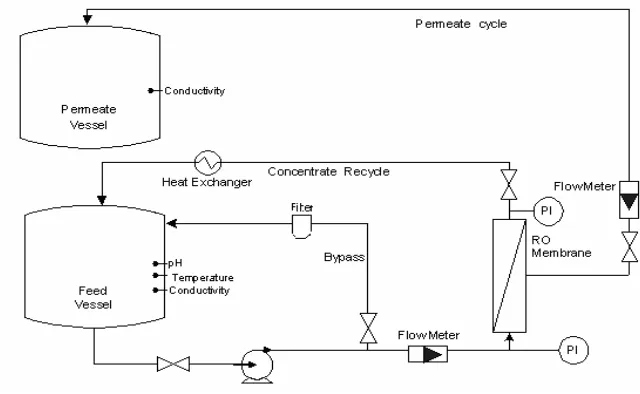
A simple laboratory procedure was found to be quite useful for characterizing the scaling propensity of calcium based compounds [3]. The procedure consists of recycling the feed solution while continuously withdrawing permeate. The salts were concentrated as the permeate was removed, progressively increasing the scaling potential. The sharp drop in membrane permeability at the onset of scaling can be used to determine the value of a limiting fractional water recovery. The relative inhibitory effectiveness of various chemical additives can be then be assessed by comparing the limiting fractional water recovery achieved with the various inhibitors.
constructed from stainless steel and had a variable speed pump to control the feed flow rate.
Figure 1 Experimental RO system
2.2.1 Experimental routine
The system was operated under the following conditions: • Feed flow rate of 200 L/hr.
• Applied Feed and Concentrate pressure was 15.5 Bar (i.e. No significant pressure drop across the membrane module).
• Feed temperature was in the range 16-22 oC.
• A total volume of approximately 200L was progressively added to the system via the 93L feed tank.
Two types of experiments were performed, a natural pH run (pH=8.2, total running time was 4.5 hours) and a corrected pH run, (pH=6.4, total run time was 2.6 hours). For the corrected pH run, the pH as controlled by adding an initial 50 mg/L of hydrochloric acid at the start of the experiment. The pH was corrected to 6.4 again after 30 minutes operation, as the pH had risen due to CO2 passage through the membrane, to simulate pH correction between RO stages.
2.2.2 Monitoring the scaling process
3. Results and Discussion
3.1 Thermodynamic Model results
3.1.1 Effect of pH on SI – Feed water
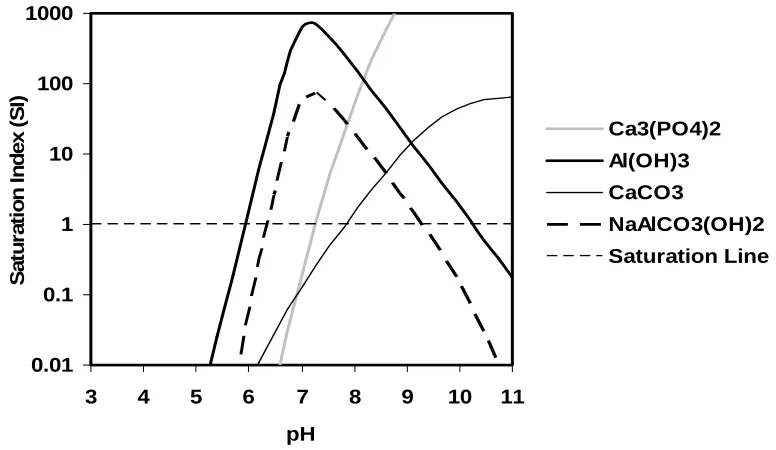
The figure below (Fig. 2), demonstrates the importance of feed water pH control to minimize the potential of scaling/fouling in WTP water by aluminium, phosphate, and carbonate minerals. Based on thermodynamic calculations, over saturation (SI>1) with respect to these minerals can be avoided by controlling feed water pH below approximately 5.5. It may be possible to operate at higher pH with the aid of chelating agents and/or antiscalants.
0.01 0.1 1 10 100 1000
3 4 5 6 7 8 9 10 11
pH
S
a
tu
ra
ti
o
n
In
d
e
x
(
S
I)
Ca3(PO4)2
Al(OH)3
CaCO3
NaAlCO3(OH)2
Saturation Line
Figure 2 Effect of pH on saturation indices at CF = 1.
3.1.2 Potential of mineral scaling during RO desalination at various water recoveries
Thermodynamic calculations were performed for various CF values and for three pH values (5, 6, and 7). The results at each CF correspond to a concentrate solution from a hypothetical RO desalination process operated with complete salt rejection, Rs = 1. These strict conditions results in a conservative analysis with respect to the formation of mineral salts. The saturation index, SI, as a function of water recovery was first calculated assuming the absence of precipitation. The composition and the total weight of major minerals that may potentially form mineral scale were then predicted assuming equilibrium conditions between the solid and liquid phases. The total weight of minerals were considered in terms of total solids precipitated per unit volume of RO feed water (at CF=1); these provide a measure of the precipitation potential of the concentrate for various water recoveries.
control is very important so as to control the precipitation of calcium phosphate and calcium carbonate. At the low pH range, it is possible to mitigate calcium carbonate and calcium phosphate scaling with water recoveries reaching greater than 95%. Although the aluminium precipitation potential is quite low (<0.5 mg/L-feed), some degree of control might be necessary, either through pH adjustment and/or the use of chelating agent. The pH value, however, provides little control over CaF2 and silica precipitation. The potential of scaling by CaF2 and silica becomes noticeable at water recoveries around 40% and 84%, respectively. It is noted that some antiscalant manufacturers have claimed that calcium fluoride precipitation can be mitigated by using antiscalants provided that the saturation index for this mineral is less than about 120 (i.e., SICaF2<120). This SI is reached in the concentrate at around 90% recovery. Similar claims have also been made for barium sulphate (also for SI<60). Silica, however, is much more difficult to control because of its complex chemistry and literature data on silica precipitation in multi-ion systems is limited.
0.1 1 10 100 1000
0% 10% 20% 30% 40% 50% 60% 70% 80% 90% Water Recovery
S
a
tu
ra
tion Inde
x
(
S
I)
Al(OH)3
BaSO4
CaCO3
CaF2
Ca3(PO4)2
Mg3(PO4)2.82H2O
SiO2
Saturation Line
Figure 3 Saturation indices versus water recovery at constant pH = 7.
3.2 Diagnostic laboratory experiments
0 10 20 30 40 50 60 70 80 90 100 0
0.1 0.2 0.3 0.4 0.5 0.6 0.7 0.8 0.9 1 1.1
pH 8.2 pH 6.4
Recovery (%)
Nor
m
alized Flow
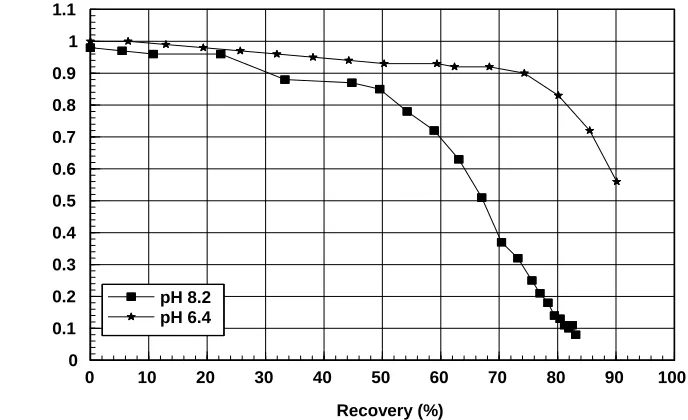
Figure 4 Normalized permeate flow in different pH levels (8.2 – without pH adjustment, 6.4 – with pH adjustment)
Lowering the pH to 6.4 delayed the onset of scaling to a water recovery of 80% compared to 45% with the natural pH of 8.2. Furthermore, the rejection of salts was maintained at >95% for the entire range of water recoveries investigated. Clearly acidic pH conditions improve membrane performance, in-line with the higher solubility values for scaling salts at these pH values.
3.1.2 Permeate decay and ions concentration, in different pH
0 20 40 60 80 100 Recovery (%) 0 5 10 15 20 25 30 35 40 45 50 55 60 65 70 75 80 P e rm e a te F lo w ( l/ h r) 0 50 100 150 200 250 300 350 P O 4 a n d C a c o n c e n tr a tio n s ( m g /l) Po4 (mg/l) PO4 Calc. Permeate flow Ca (mg/l) Ca Calc.
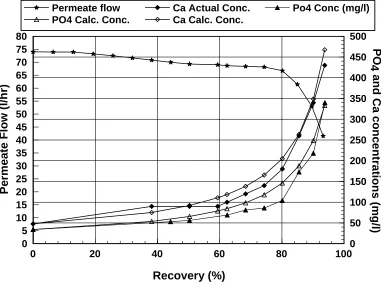
Figure 5 Calculated and measured PO4 and Ca concentrations in feed, pH=8.2
0 20 40 60 80 100
Recovery (%) 0 50 100 150 200 250 300 350 400 450 500 P O 4 a n d C a c o n c e n tr a tio n s ( m g /l) 0 5 10 15 20 25 30 35 40 45 50 55 60 65 70 75 80 P e rm e ate F lo w ( l/ h r) Permeate flow PO4 Calc. Conc.
Ca Actual Conc. Ca Calc. Conc.
Po4 Conc (mg/l)
These results (Figs 5-6) indicate that without pH correction, Ca, PO4 and possibly CO3 precipitate on the membrane and that this leads to a dramatic decrease in permeate flux at approximately 45% recovery. In figure 5, it is clear that calcium phosphate as the only significant scaling compound could not be supported by the results, as the actual Ca concentration in the water begins to deviate from the theoretical Ca concentration at lower recoveries than deviations between the phosphate concentrations. Furthermore, the deviation between the actual and theoretical curves for the Ca concentration begins at the same recovery as the permeate flow rate begins to decline, and before the decline in phosphate concentration. Due to the nature of the experiment and the accuracy of the analysis which was below the ability to detect changes in the mass balance, a definite answer with regards to the additional scaling compound could not be determined. However, it is clear that another Ca containing scaling compound was also playing a role in scaling of RO fed by WTP effluent. According to thermodynamic analysis, it is most likely that with WTP water the additional calcium contained scaling compound would be calcium carbonate, which has a tendency to reach high SI levels at these pH and recovery levels.
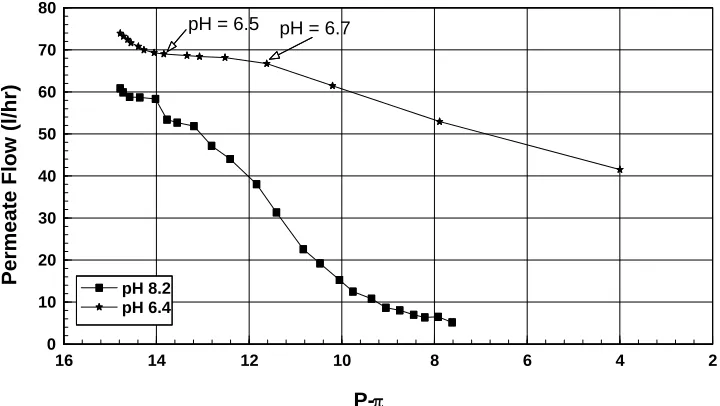
In figure 6, the changes between the theoretical curve and the experimental curve were negligible at high recoveries, indicating that calcium phosphate was not a cause for scaling at this pH and that the additional scalant observed in Figure 5 was not present at the lower pH. Indeed no scaling had occurred and the permeate flow decrease was delayed and started at 80% recovery. Scaling is not the only reason for permeate decreases, and this decrease is a result of the increasing osmotic pressure that occurs when the feed is recirculated without the permeate. The increase in osmotic pressure lowers the overall driving force (P-π), resulting in a lower permeate flow.
In the figure below (Fig. 7), the permeate flow is expressed as a function of NDP for the two pH conditions. It is clear from the results that in the case of the pH=6.4 run we had postponed the scale formation by adjusting the pH. It is also clear that as the pH gradually goes up, membrane performance decreases due to scale formation.
2 4
6 8
10 12
14 16
0 10 20 30 40 50 60 70 80
pH 8.2 pH 6.4
P-π
Permeate Flow (l/hr)
pH = 6.7 pH = 6.5
Therefore, in order to maintain high recovery level with WTP water, pH control is critical to the performance of RO, as pH was shown to significantly affect the scaling rate. A continuous stabilising approach was proposed, in which pH correction is applied not only at the membrane entrance but also between RO stages. That will reduce pH increases through the membrane system, and may permit recoveries higher than 95%. There is no need to change the pH for recoveries up to 40%, as no scaling of the membranes was observed at these recoveries. As most of the H+ passes through the membrane to the permeate side, controlling the pH from 40% recovery to the end of the membrane system may reduce the acid consumption compared to pH correction before entering the RO system.
4. Conclusions
Thermodynamic calculations and pilot experiments identify that low pH operation successfully avoided scaling at high recoveries on WTP recycled water. The major contributors to scale formation are calcium phosphate and possibly calcium carbonate. Previous work has shown that regular antiscalants and even specific calcium phosphate anti-scalants, are not very effective in preventing precipitation of calcium phosphate [4]. This suggests that the feed water could be controlled by pH adjustment alone. However, this would need to be confirmed by longer term experiments to account for the potentially slower rate of precipitation of silica, calcium fluoride and other scaling components.
It should be mentioned that the scaling technique presented in the current paper simulates in time, the recovery and operation along a membrane system. However, the technique uses short operating times and therefore information regarding fouling over long periods of time is not obtained. Nonetheless, the technique may be used to screen the operational conditions, type and concentration of antiscalans etc. The screening experiments are useful, if properly applied to real operational systems, namely, after identification of the preferred operational conditions. The results should be applied in real systems at relatively low recovery levels, watching the system carefully while gradually increasing the recovery.
Acknowledgements
The authors wish to acknowledge with thanks the partial support of Melbourne Water.
References
[1] R. Semiat, D. Hasson and D. Bramson, Proc., Membrane Technology Conference AWWA, New Orleans, 1997, pp. 1013-1027.
[4] Y. Mansdorf and I. Sutzkover, Pretreatment options for effluent desalination in Israel, Proc. of the 5th Annual IDS Conference, Technion, Haifa (2002) 48–55.
[5] D. Meyer and Y. Egozi. Effluent desalination by UF/RO – pilot plant studies, Proc. of the 6th annual IDS conference, Ben-Gurion University, Beer Sheva, (2003) 118– 123.
[6] G. Greenberg, D. Hasson and R. Semiat. Limits of RO recovery imposed by calcium phosphate precipitation. Desalination 183 (2005) 273-288.