VOLUME 6
January 1953
Number 1
In this Issue
Editorial-Men with a Purpose... Robert S. Campbell
1
The Sixth International Grassland Congress
M.W. Talbot
3
Rayless Goldenrod-A Poisonous Range Plant in Texas
Omer E. Sperry
6
Management of Reseeded Range and Its Place in Ranch
Operation .... ... H.B. Passey and D.S. Winn
11
Control of Jack Rabbits and Prairie Dogs on Range Lands
Edson Fichter
16
Forage Intake and Grazing Performance by Dairy Cows
Marshall E. McCullough, et al.
25
Consumption of Native Forage Species by Captive Mule
Deer During Summer ... .. Arthur D. Smith
30
Herbage Production on Bluestem Range in Central Louisiana
John T. Cassady
38
The Range Story of the Land Utilization Projects
Edward G. Grest
44
Effects of Grazing Intensity upon the Nutritive Value of
Range Forage ... ... C.Wayne Cook et al.
51
Effect of Contour Dykes and Furrows on Short-Grass Prairie
William A. Hubbard and Sylvester Smoliak 55
Book Reviews:
Texas Range Grasses (Tharp) ... C.A. Rechenthin
63
The Grass Crop: Its Development, Use and Maintenance
(Davies) ... ... ... D.W. Hedrick
64
Current Literature... ... Robert R. Humphrey
67
News and Notes . ... ... ... ... 71
With the Sections... ... ... ... 73
Society Business ... ... ... ... 76
Published Quarterly by
DEPOSITORY
LIBRARY
SOLICITS
PUBLICATIONS
The AMERICAN SOCIETY OF RANGE MAN- AGEMENT has established a Depository Li- brary in cooperation with the Library of Utah State Agricultural College at Logan, Utah.
Your range books, journals, bulletins, and other historical material are needed. See full
report and instructions on page 76 0-f this issue.
AMERICAN
SOCIETY
OF
RANGE
MANAGEMENT
0
Albuquerque, New Mexico January
20
to23,1953
0
Headquarters for the meeting will be in the Hilton Hotel.
Make your own reservations. Informa- tion concerning hotel and motel rates will be furnished by the Executive Secretary.
See complete Program on page 78 of this issue.
The Board of Directors, including newly elected officers, will meet on Janu- ary 19.
agement. Attractive cut of “The Trail Boss” on letterheads and envelopes,
Introductory Offer, post paid
200 Sheets, 6” X 7” and 150 envelopes $2.06 300 sheets, 6” X 7” and 150 envelopes 2.75 200 sheets, 8-l/2” X 11” and 150 envelopes 2.50 300 sheets, 8-l/2” X 11” and 150 envelopes 3.50
Please print your name and address plainly.
Mail to Cascade Print
Orchards Washington
PRACTICAL
GRASSLAND MANAGEMENT By B. W. ALLRED
Regional Range Conservationist, U. S. Soil Conservation Service, Fort Worth, Texas
Most Practical Grass Book Published!
Written for students and ranchmen, this book has 15 well-illustrated, readable chapters on growth, care, and management of the country’s most valuable crop- grass.
FEATURES.. . latest facts about economic and conser- vation values of important range plants.. . guide for seeding 64 native and domestic grasses.. . glossary of range terms.. . check list of nearly 1000 important range plants, with common and scientific names.
The first printing was sold out within six months. Im- mediately adopted as text by the Veterans’ Vocational Training program, many colleges and schools in west and southwest.
COMMENTS.. . “Of all the trained men in range man- agement, I know of no one individual better qualified through professional training and applied experience to write a book on the subject of Practical Grassland Management. . . “VERNON A. IYOUNG, Head, Dept. of Range and Forestry, A & M College of Texas.
$5.00 PP. Second Printing
Publisher:
SHEEP AND GOAT RAISER
San Angelo, Texas
RANCH or Management Service * Consulting & Appraisals * Reseeding Contractors * Investment Agents
Throughout the Western States & Canada Call or Wire: R. B. (Dick) Peck, WESTERN RANCHING SERVICES
HERBAGE ABSTRACTS
This quarterly journal, issued by the Commonwealth Bureau of
Pastures and Field Crops, Aberystwyth, Great Britain, provides you
with abstracts from the world’s current literature on grassland hus- bandry and fodder-crop production, both temperate and tropical. Agriculturists who need to keep abreast of the latest research and development in these fields, but who are unable to read the thousands , of agricultural publications now appearing annuallyT will find it well
worth while to scan this abstract journal each quart’er. The annual indexes, dating from 1930, form a valuable source of reference to past work.
Obtainable from: Commonwealth Agricultural Bureaux, Cen- tral Sales Branch, Farnham Royal, Bucks., England, price $6.30 or
45s. per annum, including author and subject indexes. One-sided
copies, from which the abstracts can be cut for sticking on index cards, can be supplied at $7.70, or 55 shillings, per volume.
Rdnge
Students!
JOIN THE AMERICAN SOCIETY OF RANGE MANAGEMENT
Students in Range, Botany, Ecology, Pasture Management and similar courses are invited to
join the American Society of Range Management as student members at] t,he reduced rate of
$3.00 per year. The applicant, must] he a student or graduate student and the address for
mailing his Journal of Range Management) must be in care of his professor or class room.
1.
APPLICATION FOR STUDENT MEMBERSHIP AMERICAN SOCIETY OF RANGE MANAGEMENT
Date Name.-______
(I~RINT OR TYPE)
School _. -.-~ 3. Major course__ --
Professor 5. Year 1, 2, 3, 4, Graduate Student (CHECK ONE)
I’ermanent, or home address -____ ~--
Address to which Journal of Range Management is to he mttiled --__
(PRINT OR TYPE)
(SIGNATURE)
AMERICAN SOCIETY OF RANGE MANAGEMENT W. T. WHITE, Exectctiue Secretary
209 S. W. Fifth Avenue Portland 4, Oregon
AI1IERICAN
SOCIETY
OF RANGE MANAGEMENT
OBJECTIVES
To foster advancement in the science and art of grazing land management, to promote progress in the conservation and greatest sustained use of forage and soil resources, to stimulate discussion and understanding of scientific and practical range and past)ure problems, to provide a medium for the exchange of ideas and facts among society members and with allied technologists, and to
, encourage professional improvement of its members.
MEMBERSHIP
Persons shall be eligible for membership who are int!erested in or engaged in practicing range or pasture management or animal husbandry; administering grazing lands; or teaching, or conducting research, or engaged in extension activities in range or pasture management or related subjects.
OFFICERS
PRESIDENT: L. A. Stoddart, Dept. of Range Management, Utah State Agricultural College, Logan, Ut)ah
VICE-PRESIDE.NT: B. W. Allred, U. S. Soil Conservation Service. Fort Wort,h 1, Texas
EXECUTIVE SECRETARY: W. T. White, 209 S.W. 5th Ave., Portland 4, Oregon
ROARD OF DIRECTORS
PAST PRESIDENT: Dan ,4. Fulton, Ismay, Montana
1950-52
.J. A. Campbell, Dept. of Lands and Forests, Edmonton, Alberta, Canada
.J. S. McCorkle, U. S. Soil Conservation Service, Albuquerque, New Mexico
1951-53
A. P. Atkins, I’. 0. Bos 270, Guymon, Oklahoma
Fred H. Kennedy, U. S. Forest Service, Denver, Colorado
19ti2-54
E. .J. Dyksterhuis, IT. S. Soil Conservation Service, Lincoln 1, Nebraska Harold F. Heady, School of Forestry, University of California,
Berkeley 4, California
The most significant development
in
AIfuIfu in 20 years..
.RHIZOMA
i
_
_
The tap root system for sub soil moisture.
The Rhizoma system for surface moisture and new stems.
Courtesy of the Canadian Experiment Station of the University of British Columbia. Note how well this vital living part of the plant is organized for production
Rhizoma illjalja is the ultimate result of continuous breeding since 1917 under the direction of the University of British Columbia in Canada. The object was to produce a very hardy Jaybrid alfalfa ze&ich would spread and compete with grass by means of underground RHIZOMES; which would stand up well for hay production, and which would withstand heavy grazing. This result Jaas finally been obtained in RHIZOMA Alfalfa through the selective crossing of Grimm Alfalfa with the yellow- flowered creeping Falcata (semi-Palstinsk) which was introduced from Siberia by Prof. Hanson in the
early 1900’s. We are proud of the part -we are able to play in the distribution of this new alfalfa.
THE MOST SIGNIFICANT DIFFERENCES BETWEEN RHIZOMA ALFALFA AND ORDINARY VARIETIES ARE :
(1) The multiple root system (2) the low set crown (at or slightly below the surface).
Primarily because of these new developments RHIZOMA means:
MORE GRAZING The crowrl is below the ground surface-so plant cannot be injured by overgrazing or trampling. Stands actually thicken with grazing. Competes with grass.
MORE HAY Rh’ lzoma Alfalfa stands up to 42 in. high. In actual tests-outyielded Grimm with leafier, finer alfalfa of higher protein.
LESS SEED NEEDED Because of its spreading habits Rhizoma should be planted at only x to g the normal alfalfa seeding rate in your area.
GREATEST RESISTANCE TO WINTER KILLING In field tests in the Canadian Peace River Valley it survived: (1) 60” below zero temperatures (2) Flooding (3) Ice sheets
We firmly believe in the proposition that grassland farming-calling for the wise use of selected improved grasses and legumes in any cropping procedure-is the best system of soil management ever proposed.
BOBER'S
l*-
a
house nationaIIy recognized for hardynorthern grown grasses and legumes.
COSSACK, LADAK, RANGER ALFALFA . CRESTED,
TALL, INTERMEDIATE
WHEATGRASS
. MADRID
EVERGREEN,
HUBAM, LADINO, YELLOW CLOVER
For further information
write
BOBER’S
;:;!cZy
. a . . . .
Journal
of
RANGE
MANAGEMENT
2 ROBERT S. CAMPBELL
searcher gives to the limit of time and thought in serving range management through his job and through the Ilange Society.
Range conservation and extension workers and teachers likewise must deal in facts so as to impart a basic under- standing of grassland problems and practices to ranchers and to students, as well as the general public. The good range management teacher trains his students how to think, talk, and act on the basis of facts, not personal beliefs or prejudices. Equally important, the teacher must inspire his students with that devotion which is so characteristic of workers in the whole conservation movement, teach them to become “Men with a purpose.” A definite part of this training should be student membership in the Range Society, for which special provision has been made to early ac- custom students to organized activity in range affairs.
The public range land administrator is bound to supervise the lands under his care with technical skill, fairness to the user, and consideration for the public interest. He must keep up with current advances through the Journal and other- wise. In dealing with his land use prob- lems, he must seek out all the facts on the ground and look at all sides of each question confronting him. Finally, he must work with the range users toward a positive program of grassland improve- ment and management-a program with endless opportunities.
Rancher members are indispensable in the Range Society. They naturally are eager for facts that will help improve the efficiency of production on their own range lands. But their responsibility goes far beyond the fenced boundaries of their own spreads. Rancher members can and should “foster advancement of grazing land management,” by constructive and friendly counsel with the public range land administrators and all other range men. Above all, ranchers must help keep Range Society programs and activities practical and down to earth.
Finally, all members have a duty to support and actively work for the Range Society. The spirit of cooperation de- veloped in Society Meetings can be in- valuable to all classes of members in their regular work of planning and carrying out a national grassland program. Ac- ceptance of office and committee assign- ments, aggressive support and participa- tion in Society work are needed from every member. Enthusiastic section ac- tivity is essential to continued growth and alert leadership by the Society in range affairs. The national and section officers, and the Journal can reflect only the activity of individuals and sections. Let each member, like the far-seeing “Trail Boss” on our Journal cover, show himself to be “a man with a purpose.“-
M. W. TALBOT
:1osocinfe Director, California Forest and Range Experiment Station 71. S. Forest Service, Berkeley
T
HIS Congress, sponsored jointly by the FAO of the United Nations, and the United States government, held at Pennsylvania State College, August 17 t)o 23, 1952, was a noteworthy milestone in grassland agriculture. The main pur- pose of the Congress was to bring to- gether from all over the free world people who are interested in promoting bettell grasslands, in exchanging ideas and in observing grassland farming in action.This was the first such congress held in America. All previous ones have been held in Europe. Following the first meet- ing in Leipsig, Germany in 1927, subse- quent meetings were held in Uppsala, Sweden in 1930, in Zurich, Switzerland in 1934, in Aberystwyth, Wales in 1937 and in Noordwijk, Netherlands in 1949. Following the disruptions incident to war, the Sixth Congress was back on the original schedule of meetings at intervals of three years.
The international scope of this meeting was reflected in the total attendance of more than 1500 from the following coun- tries and the United Nations.
Australia France Pam*rna Austria Germany Peru Belgium Greece Philippines Uolivia Honduras Portugal Brazil India s L p,tin Canada Iran Sweden Chile Israel Switzerland China Iraq Thailand Columbia Italy Turkey Costa Rica Japan Union of South Cuba Jordan Africa Denmark Korea United King- Dominican Mexico dom
Republic Netherlands United States Ecuador New Zealand Uriguay J%YPt Nicaragi1.i Venezuel:l El Salvador N?rwvy \71ig9*lavi:l Finland I’ak:>tsn
The large number of foreign partici- pants insured the bringing together of
3
the latest world-wide findings from ex- periments and experience on grassland agriculture. In general the attention of the Congress was focused on grasslands for (1) a more abundant production of meat, wool, milk, and other livestock products, (2) a more balanced agriculture, and (3) wise use of soil and water re- sources.
4 M. w.
to the meeting from countlries other than the United States.
The Sixth International Grassland Congress represented a vast cooperative undertaking. Collaborating agencies in- cluded (1) Department of State, Depart- ment of Interior, Department of Agricul- ture, and Mutual Security Agency; (2) the Land Grant Colleges and Universities of the United States; and (3) nearly 100 scientific, industrial and trade organiza- tions.
In this short, highlight article mention of any names can only be made at the cost of omissions of others of equal merit. Nevertheless, even a fragmentary under- standing of the organization of the Congress necessitates mention of a few officers, from among the scores, even hundreds, of officials of public and private organizations who gave unspar- ingly of time and effort to make this Sixt)h Congress such a real success. At the opening ceremonies Dr. Philip 17. Cardon, Chairman of the U. S. delegation and of the organ&ing committee, was elected permanent President of the Con- gress. Two j’ice-Presidents were also elected: Dr. C. A. Volia, Minister of Agriculture of Costa Rica and Dr. J. Griffit)hs Davies, Chairman of the Aus- tralian delegation. Dr. William M. Myers, University of ,Minnesota, was named Secretary General of the Congress. Dep- uty Secretaries General were Dr. Clark L. Willard, Department of St,ate; Dr. Her- bert! It. Albrecht, Pennsylvania State College; and Mr. W. It. Chapline, Chief of the Division of Range Research, U. S. Forest Service, who had also labored for months as executive secretary of the organizing committee.
As an overall observation, the meeting was ably organized and smoothly handled. Simultaneous translation, a special com- munication syst,em resembling the United Xations set-up, was used wit)h translators passing along talks in French, Spanish,
TrZLBOT
and German to those who did not under- stand English, by way of earphones and miniature radios. Translation itself was handled by a special team provided by the Department of State.
In view of its pioneer work in grass- land research and its ample facilities, Pennsylvania State College was especially appropriate as the meeting place of the Sixth Congress. In dealing with the mul- titudinous details of housing, dining, meeting rooms, campus tours, student guides, and the many other requirements, this largest of the agricultural colleges of the United States proved to be a splendid host.
Technical summarization of this Con- gress is not possible here. It is hoped, however, that sketchy review of a fen selected highlights particularly pertinent to rangelands may reflect the significant tone of the meeting: optimism over t,he world-wide possibilities of increasing food production from grasslands-the major expandable agricultural resource.
For example, range-plant improvement -through genetics and breeding holds
equal promise to the success stories of other groups of crop plants. Along with the rather orthodox objectives of forage plant improvement go requirements for high maintenance of grassland productiv- ity, such as the selection or development of suitable legumes which are still lack- ing over vast grassland areas of the earth. Various speakers reiterated t)his theme : It is fundamental, always and every- where, that range improvement and management must) be based on solid ecological principles.
Significant, too, was the repeated re- minder that such practices as artificial reseeding and weed control should be re- garded as valuable supplements to, rather than substitutes for, good management) of grazing lands.
well established rules for success, but also for increased production of seed of authentic strains and for improved scien- tific standards to safeguard their purity. Trends in weed control, a . rapidly growing range management practice, include a gradual widening of the scope of biological control, and an expanding use and development of herbicides ap- plied from the ground and air.
Numerous speakers stressed the uni- versal and increasing need for site evalua- t,ion as the only sound basis for efficient application of range improvement prac- t,ices, and for most successful integration of grazing and other agricultural produc- tion.
Especially significant, also, from the standpoint of global land use and maxi- mum food production for a growing population, was the conclusion that good range management usually is good water- shed management. In other words, a well-husbanded cover of grassland vegeta- tion will also be satisfactory for erosion control and water yield.
“Stump-jumping” rangeland plows, brush-removal equipment of great weight, and increasing employment of aircraft for reseeding, fertilizing, and spraying, all attest to recent rapid advances in machinery for range improvement. Most needed, apparently, are new develop- ments in ground rigs for rough use on rough range land.
The session devoted to improvement and management of tropical grasslands proved of especial interest, from stand- points of newness of subject matter, variety of formidable problems, and high potentials for increased food production.
Recent advances in experimental pro- cedure in grassland research were pre- sented and discussed; and the vital re- lated techniques of disseminating research findings strikingly illustrated by the Agri- cultural Extension Service in connection
with t,he annual field day held during the Grassland Congress and attended by 15,- 000 farmers.
An imposing array of exhibits set up by about 65 companies and agencies afforded members of the Congress an opportunity to review and, in many cases, to see in action modern grassland eciuipment and recent scientific developments.
Following the conclusion of the formal sessions, four specially arranged and guided tours were conducted to afford opportunities for foreign participants to see samples of scientific advances and field experiments in grassland farming as well as their practical application under varied conditions. These 2-week tours traversed four major grassland areas of the United States: the Midwest, the Northeast, the South, and the West.
Proceedings of the Congress, which will include all papers presented and other Congress developments, will be published this winter in a 2-volume set of approxi- mately 800 pages each.
By and large this Sixt]h International Grassland Congress was a most signifi- cant demonstration of notable advances in grassland agriculture. Such a full and free exchange of technical experience and knowledge, cannot help but have divi- dends beyond the very worthy theme of (‘more and better grass.” Working to- gether as a cooperative team, appraising the world-wide situation, obtaining a bett$er understanding of other nations’ viewpoints, and establishing personal and oflicial channels for future interchange of ideas for meeting common problems, are bound, not, only to further grassland agriculture but also in the words of Presi- dent Cardon, to “contribute so;llldly to the advancement of human welfare the world over.” May it not) well be possible that this will prove to be the most impor- tant result of the Congress?
Rayless Goldenrod-A
Poisonous Range Plant
in Texas
OMER E. SPERRY
l’rofessor, Range and Forestry, Texas A. & M. College, College Station
R
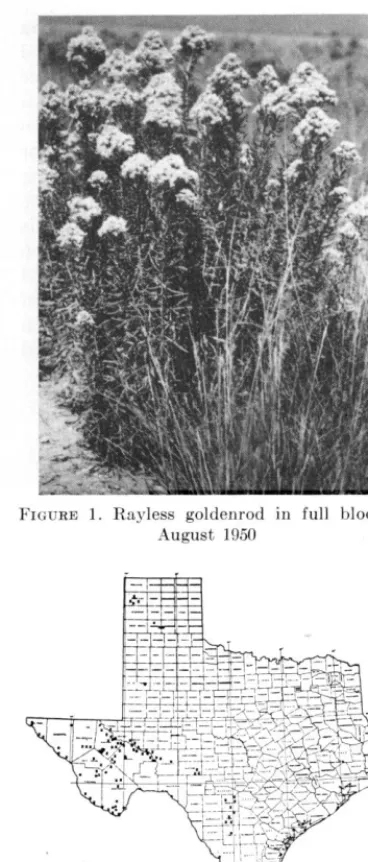
AYLESS goldenrod (Aplopappus heterophyllus), has been recognized as a poisonous plant on Texas ranges for more than forty years. In some areas it is called jimmy weed, in others alkali weed. Rayless goldenrod is a member of the composite family; a bushy halfshrub with numerous upright branches arising from a perennial woody root crown, but not a true goldenrod. Most branches, which range in height from 2 to 4 feet and give rise to numerous yellow flower heads, die back to the crown each year. Growth on Texas range areas starts in early spring and flowering begins in late summer. Figure 1 shows a plant in full bloom in August.
DISTRIBUTION
Marsh (1921) and Marsh et al. (1926) gave the distribution range of rayless goldenrod from Northern Colorado to the Texas Panhandle, south and west t)o Sonora and Chihuahua, Mexico and Arizona. It grows around springs, water- ways, and in irrigated areas of southwest Texas and has been observed or collected in the Panhandle, the Edwards Plateau and is abundant in the Pecos river valley and around watered sites of the Trans Pecos. Figure 2 is a distribution map showing field observation records and herbarium collections in Texas.
TOXICITY
Rayless goldenrod is poisonous to cattle, horses, and sheep. On heavily grazed ranges and during snow and ice storms it has caused much sickness and
a high mortality. Tremetol (C16H2203) is the toxic principle found in rayless goldenrod, both in green and dry plant material (Couch 1929, 1930). Cattle have become sick from eating 1.5 pounds daily per 100 pounds live weight over a period of 11 days. Sheep require the con- sumption of 1.25 pounds of material per 100 pounds body weight daily over a period of 3 weeks to become sick. Horses were made sick on a daily dose of 1 pound per 100 pounds of body weight over a period of 18 days (Marsh et al., 1926). It is evident that the poison is cumulative even though there is some elimination (Marsh et al., 1926). The poison may be transmitted through the milk or meat of the animal, and thus endanger the consuming human, who may develop the disease known as milk- sickness or trembles (Couch, 1930). .
The internal symptoms as given by Marsh and co-workers (Marsh et al., 1926) are a congestion of the digestive tract, usually a congested spleen and an abnormal supply of blood in the pancreas. The liver is generally pale while the bile is thick and dark and the gall bladder distended.
infestation. One of the more common practices is to fence off hazard Rites xhich may be limited to localized areas or may
involve several sections of land. Such
isolated zwas are thus producing a good
crop of rayless goldenrod erer,y year
whereas these respective sites could
produce a good grass crop. Some ranrh-
men keep animals off infested areas
during late fall and winter, the periods
when poisoning is most apt to occur,
but this practice is hazardous as animals have been observed browsing the heed at all seasons of the year.
An average condition existent in much of the infested range area is show1 in Figure 3 (left). Over 7.5 percent, by ocular
determination, of the herbaceous vegeta-
tion in this area was rayless goldenrod. Figure 3 (right) was taken a few miles sway and shows a good cover of alkali sac&on (Sporobolus airoides). This latter site is somewhat isolated but does show
that protection and management could
be applied to much of the area and thus produce much forage for livestock.
Irrigated farming is carried on in parts of the area infested with rayless golden- rod. When row crops such as cotton are raised, the veed can be fairly well con- trolled, but when alfalfa is grown on the areas the plant becomes a serious pest. When rayless goldenrod is fed in hay to animals, it will kill them as readily as if eaten green. It must thus be grubbed out of the alfalfa fields before mowing. Seeds
are carried by mater following heavy
rain and by irrigation, and infestation on BRZU retired from irrigation is often very severe. Several areas which had been out of cultivation for several years have been examined and no apparent retreat of the
weed has been noted. Eradication is
apparently needed in addition to de-
ferment in these areas. Since most of the original grass cover has been lost through
cultivation and overgrazing, reseeding
FKXJRE 2. Map showing herbarium (solid
dottr) snd field observations (x) of raylese
goldenrod in Texas. Other infestations un- doubtedly exist over much of the western part of the State.
and the development of corns. is noticeable before death.
MANAGEMENT
The management and control of rayless
8 “MEK E
will be necessary in addition to eradica- tion, to bring about productivity. More field experimental vork is necrssary to est,ablish the most adaptive species for reseeding hut it appears to t,he writer that spwies native to the area should be given first consideration. III addition to alkali sac&on, black grama (Houleloun
eriopoda), pink pappus (Pnppophorum
hicolor), sand dropseed (Sporoholus crypt- andrus), and huffalo grass (Buchloe dacty- loides) are the most frequently observed.
Grubbing is practiced by some op- erators to clear hazard sites. Two pre-
WERRY
1949 to determine the value of 2,4-D as a control measure. The first treatment was applied on January 31 while the plants were leafless and dormant. Sub- sequent treatments were applied on March 4, April 12, May 11, and June 9. An ester of 2,4-D was applied in water at the rates of 2000 and 4000 parts per million by weight (PPM) at each treat- ment. The object was to determine the concentrations and season of growth for the most effective kill. The plots were 7.5 X 75 feet each and the area had an average of 9055 rayless goldenrod plants to the acre on the basis of plant counts in the plots. The experimental area was also infested with mesquite. Alkali saca- ton, locally called salt grass, was the predominant grass of the area. The results as based on counts made on November 21, 1949 are shown in Table 1. All plants in the plots were apparently
TABLE 1
Rayless goldenrod treated with 9,4-D at intervals from Januaq 31 to June 9, 1949.. The percent killed was determined from counts made on November 21, 1949.
PLOT NO.
1 2000 l/31 31 60
2 4000 1,/31 18 55
3 2000 3/4 28 48
4 4000 3/4 18 45
5 2000 4/12 7 84
6 4000 4/12 7 62
7 2000 5/11 1 58
8 4000 5/11 0 30
9 2000 6/9 16 56
10 4000 S/9 16 62
2,4-D DATE LIVE DEAD
PPM TREATED PLANTS PLANTS
- - ‘ERCENT KILLED 66 75.3 62 71.4 92.4 90 98.3 100 77.7 79.5
weakened, but were counted alive if any green growth was present. Since approximately 70 percent of the weeds were killed in the January and early March treatments, control work could conceivably be done with herbicides during these months in crop producing areas. The best first season kills were
AREA 20 A.
1. 2. 3. 4. Check Area
obtained during April and May and these data thus indicate this period of plant growth would be the best time for her- bicidal control on range areas in which crop damage is not a problem. None of the plants survived the second growing season and no live plants were present on the treated plots when examined in October 1950, although normal live plants were present in the check plots and were growing normally adjacent to the treated plots.
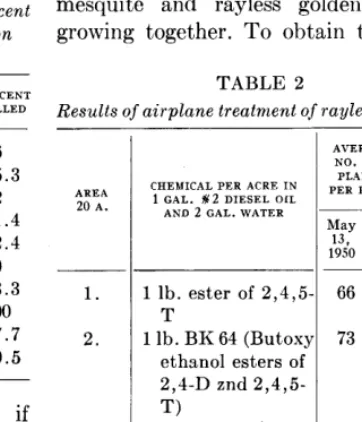
The data obtained in 1949 indicated that the concentrations were of about equal efficiency in final kill, but treating in April and May gave better first year reductions than treatments applied at other periods. Experiments by other workers in spraying mesquite indicated that May was also the best time to apply chemical treatment in this area. With this in mind a project was set up in 1950 with formulations that could possibly be used in one application to control both mesquite and rayless goldenrod when growing together. To obtain this objec-
TABLE 2
Results of airplane treatment of rayless goldenrod
CHEMICAL PER ACRE IN 1 GAL. #2 DIESEL OIL AND 2 GAL. WATER
AVERAGE NO. LIVE PLANTS PER PLOT* PER-
CENT
1 KILLED
May
1 lb. ester of 2,4,5- T
1 lb. BK 64 (Butoxy ethanol esters of 2,4-D znd 2,4,5- T)
3ct.
13, 30,
1950 1950
66 33 50.0
73 1 98.6
35 lb. ester of 2,4- D
85
1 lb. ester of 2,4-D None, on leeward
side, thus no drift 145 57 11 70 51 87.0 51.7 1.0
10 OMER E . SPERRY
tive, four areas of 20 acres each were check areas to reach final conclusions. treated by airplane on May 13, 1950. However, the report at this .time seems Table 2 gives the data obtained from the to be in order since the data indicated check plots located on each of the 20 that herbicides can be used successfully acre areas. Due to the location of the to control rayless goldenrod. The usual experimental area and costs of treatment, precautions in the use of herbicides must a complete screening of all probable be followed, however, if areas to be herbicides was not possible. Since the treated are adjacent to or in cultivated ester of 2,4,5-T had shown the greatest crop areas.
promise on mesquite and since BK 64
had given favorable results, these were LITERATURE CITED
added to the previously tested 2,4-D COUCH, JAMES F. 1929. Tremetol, the com- compounds. The fastest and highest pound that produces sickness). Amer. Chem. Sot. Jour. 51: “Trembles” (milk- first season kill was obtained with the 3617-3619.
butoxy ethanol esters of 2,4-D and 2,4,5- COUCH, JAMES F. 1930. The toxic constituent T as present in BK 64. All treatments of rayless goldenrod (Aplopappus hetero- defoliated the mesquite, but the final COUCH, JAMES F. 1933. Trembles phyllus) . Jour. Agr . Res. 40 : 649-658. (or milk- results will be reported elsewhere. sickness). U.S.D.A. Cir. 306. 11 pp.
Drought during the growing periods MARSH, C. D. 1921. The “Alkali Disease” of 1951 and 1952 prevented final evalua- of livestock in the Pecos Valley U.S.D.A. tion of the results of the airplane treat- MARSH, C. D. Cir. 180.8 pp. 1929. Trembles. U.S.D.A. ment as no live plants were observed in Farmers’ Bul. 1593. 10 pp.
the treated areas when examined in MARSH, C. DWIGHT, G. C. ROE, AND A. B. October 1951 and again in June 1952, CLAWSON. 1926. Rayless goldenrod (Ap- , and there was not enough growth in the lopappus plant. U.S.D.A. Bul. 1391.24 pp. heterophyllus) as a poisonous
4%
BRIEFS
A man could retire comfortably in his old age on his experience-if he could only dispose of it for what it cost him.
Success is a fraud after all. By the time you’re rich enough to sleep late you’re so old you wake up early.
The mind is a wonderful thing. It starts working the minute you’re born and never stops- until you stand up in public.-Transit Riders’ Digest, New Orleans Public Service.
&
Life is easier to take than you think; all that is necessary is to accept the impossible, do without the indispensable, and bear the intolerable.-Kathleen Norris.
in Ranch Operation
H. B. PASSEY AND D. S. WINN
Range CoAservationists, U. S. Soil Conservation Service; Coalville and Ogden, Utah
(Paper presented at the. Fifth Annual Meeting of The American Society of Range Management, Boise, Idaho, February 1, 1952).
D
URING the past decade or so, range seeding has become a matter of popular interest among ranchers, farmers, range workers, and some segments of the general public. Many glowing accounts of amazing benefits from seeding have been related.In addition to the many direct returns from seeding such as increased grazing capacity, increased lamb and calf weights and so on, there may often be many in- direct benefits. For example, the seeding of a depleted spring range may result in improvement to adjacent summer range because the increased forage pro- vided by the seeding permits the operator to keep his livestock on the lower ranges until the summer range forage is ready for grazing. Seeded ranges are usually ready for grazing earlier than native ranges, a fact which is especially impor- tant during the critical spring grazing period in many parts of the intermountain range country. Seeding of key areas often makes it possible for the rancher to stabi- lize his livestock operations and may make it possible for him to adopt better grazing management practices on the balance of his lands.
Seeding does not take the place . of
proper management and, in fact, the seed- ing itself may actually complicate the management problem.
As an example of the part seeding plays in range improvement, let us examine a
case history of one range area in Utah. While this example may be somewhat unique in that it consists of a group of individuals working together, it ,brings out some of the important points to be considered in the use and management of range seeding.
The East Hoytsville Range Company operates approximately 7,200 acres of privately-owned range land near the small community of Hoytsville in the moun- tainous part of northeastern Utah. The land consists of three contiguous units. Approximately 2,000 acres are high summer range, mostly aspen; 1,800 acres are intermediate elevation ridges and benchlands; and the remaining 3,400 acres are foothills, canyon sides, and low benches.
Elevations range from 5,800 feet to nearly 9,000 feet. Annual precipitation varies from 14 inches on the lower range to over 25 inches at the higher elevations. Except for the benchlands, much of the range is steep and rough.
The Company was organized in 1934 by nine farmer-ranchers whose grazing lands had formerly been included in a large cattle grazing association. Under the previous management, these grazing lands had been badly depleted. The members of the new company changed from cattle to sheep shortly after organ- ization because sheep could more easily be handled both on the range and on the farms.
Each company member operates his farm individually. He feeds his own sheep on the farm during the winter and
12 H. B. PASSEY AND D. S. WINN shed lambs in mid-April. The sheep of
all individual owners are thrown together into the company herd at the beginning of the grazing season. Lambs are sold directly from the summer range. Each man’s lambs are sold as a separate lot although they are all sold at the same time and usually to the same buyer. At the end of the grazing season the sheep are brought in from the range and are separated by ownership so that each company member can take his sheep back to his farm. Breeding takes place on the farm so each owner can use the breed and quality of rams that he wishes. Assessments to cover company operat- ing costs (herding, taxes, range improve- ment’s, etc.) are made on the basis of the number of shares each owner has in the company. The number of shares deter- mines the number of sheep each owner is permitted to graze with the company herd. Except for occasional hire of heavy earth-moving equipment, all labor and equipment is supplied by the company members. The members take turns at camp moving and other chores, but they all pitch in together on the larger jobs and when handling the sheep at shearing, dipping, and lamb selling time. The herder is the only salaried employee of the company.
From the beginning, a determined effort was made to improve the company range. The number of sheep was kept as low as economic conditions permitted. The sheep were kept on the farm as late as June 1, before being turned onto the range. Lambs were sold early and the grazing season was shortened. But still the shortage of spring and early summer range feed made it necessary to move onto the high range too early. Little, if any, forage improvement was noted. Besides this, the sheep were on the farms too late in the spring and too early in the fall, crop yields were decreasing, general
farming work was delayed, and winterfeed costs were much too high.
The company then rented 2,400 acres of spring range in a nearby canyon to take the pressure off their own range. The lighter and later use brought about marked improvement of the higher range where rainfall and soil conditions were most favorable but very, little recovery was noted on the foothill and intermediate elevation ranges.
In 1935, the company bought two sacks of the then new crested wheatgrass (Agropyron cristatum) seed. This seed was broadcast over several small areas with no seedbed preparation. Although some grass became established, the num- ber of plants did not justify the high cost of the seed and seeding was discarded as a means of range improvement.
In 1944, company members discussed methods of range improvement, including seeding, with technicians of the Soil Conservation Service and the Forest Service as well as with the County Agent. They also talked with Tom Moore of Coalville, then chairman of the board of supervisors of the Summit County Soil Conservation District, who had done some successful seeding on his own range. As a result of these talks and of further investigations, the company de- cided to try seeding again. The Soil Conservation District was requested to assist in preparing a range conservation plan. The plan was primarily concerned with proper grazing use of the native vegetation, but included provisions for seeding approximately 400 acres of a 900 acre pasture in the lower part of the ranch. (This plan has since been amended to add a considerably greater acreage of seeding.)
RESEEDING METHOD
cereale). A good stand of grass \vas evi- dent in the spring of 1945, and the entire area was protected from grazing for a full year. After the grass had gotten off to a good start in 1946, the area was grazed by the company herd for 45 days without apparent damage to the grass. This same pasture, hefore seeding, furnished only t,hree to live herd-days feed each year. Encouraged hy these and subsequent result,s, the company has nov seeded nearly 3,000 acres of their foothill and int,ermediate range. Seed mixtures have rhanged as additional information and experience indicated. The species seeded
period provided by the seeded range. Seeding xv-as done by drilling wherever possihle and it is surprising to note the very steep and rough slopes that have been seeded. Slopes up to 40 percent have been drilled successfully by horse-drawn drills. The company members all helped with the drilling; they have had as many its seven drills operating at one time. Most of the seeded land was formerly covered by medium to heavy stands of sagebrush (Artemisia tridentata) (Fig. 1, left). Controlled burning, usually during the last week of .4ugust, removes the sagebrush and permits unobstructed drill-
were carefully selected and the exact mixture vas det,erminrd only after con- sidering soil types, elerat,ion, precipita- tion, cupoawe, and the grazing period during which additional feed \>-a8 needed. Yellov s\\-eet clover (‘llezizofus ofii- nalis) was added to all mixtures. The amount of smooth brome was increased and crested vheatgrsss reduced on areas of higher elevation and rainfall. Orchard grass (Dac!~lis glomerala) was added to the mixture on nort,h and east exposures. Limited amounts of intermediate r-heat- grass (Agropyvn intermrdium) and pubes- cent wheatgrass (-4, trichoph,onm) mere
used as seed became available. The ad- justment in seed mixtures had the effect
ing. Because of the slope and the stoni- ness of much of the land, hurning isthe most practical means of seedhed prepara- tion. Company members ahide hy the regulations of the Utah State Board of Forestry and Fire Control in conducting their burning. Drilling is alrays done during the fall of the same year each area is burned.
Average cost of all seeding, including seed, clearing, labor, and equipment is about $4.00 per acre. A part of this cost was offset by conservation payments pro-
vided by the Production and Marketing Administration.
14 H. B. PASSEY AND D. S. WINN
the building of roads and trails has kept pace with the seeding program.
MANAGEMENT OF RESEEDED RANGE Since the first seeded area was grazed, management has been based upon the condition and requirements of the grass itself. The company has thrown the calen- dar away and the herd is moved in ac- cordance with the degree of use of the grass rather than by the date. Regardless of the date, grazing does not begin in the spring until the grasses have made substantial growth and the soil has be- come firm.
A rotation-deferred system of grazing is practiced on each unit of the range. No areas are grazed at the same stage of growth during successive years. Each portion of the range is periodically de- ferred until after seed maturity. Areas grazed heavily in the spring are not used at all in the fall, thus, each area is per- mitted to make some regrowth after grazing each year. Several areas of native range in poor condition are given com- plete protection from grazing. Sheep are bedded down wherever night over- takes the herd. Trailing is held to a bare minimum.
In answer to the question of “How do you determine when an area has been grazed sufficiently?“, Heber Sargent, company president, replied: “We move the sheep while there is still plenty of grass stubble left to cover the ground and enough foliage left to support the plants for the rest of the year. We pay more attention to the amount of the plant that is left and to our soil condition than to the amount of feed we should take. We usually figure about when an area will be properly grazed and then move the sheep a couple or three days sooner. We know that this seeded grass can be killed out just as easily as the native feed was
killed so we just don’t take any chances.” (Fig. 1, right).
Observations during the past several years indicate that the grazing use of the seeded grasses is between 50 and 60 percent of the current year’s production.
On areas which are partly seeded and partly of native feed, grazing is based on the seeded range. Sheep will normally take the introduced grasses and clover more readily than the native grasses. This practice often requires the sacrifice of part of the native feed, but is necessary if the seeded stand is to be maintained. For the most part, however, seeded and native areas are in separate blocks so that each can be managed separately.
In the final analysis, the management of seeded ranges is not essentially differ- ent from that of native ranges. Proper management of both should be based upon proper use of the forage plants.
At Hoytsville, the recovery of the summer range has been brought about by improved management which was made possible by the seeding and wise use of the lower ranges. It is difficult to believe that this high country, now considered by many ranchers as some of the best summer range in Utah, was at one time almost barren of livestock feed.
Since the seeding program was under- taken, range feed production has in- creased until there is more feed than the company herd can fully utilize. As Mr. Sargent puts it: “This is just the way we like it because management isn’t much of a problem when you have more feed than you need.”
Instead of keeping their sheep on the farm until the first of June, the Hoyts- ville owners are now able to turn onto the range in late April. Also, the sheep don’t have to leave the range until breeding time in the late fall.
erosion. There are still a few sore spots but even these are gradually being covered with vegetation. Company mem- bers report that wet-weather springs and seeps are holding up better than ever before.
BENEFITS OF RESEEDING A poll of the members of the company on their evaluation of their range im- provement program brought about the following list of direct and indirect benefits: s
1. Grazing capacity has increased. Prior to 1946, the company used 1.47 acres per sheep month of grazing (includ- ing the rented land). In 1951, only .85 acre per sheep month was required and then some areas were underutilized.
(The company herd has increased by 100 head .)
2. The grazing season has been length- ened from four and one-half to more than six months.
3. There are more and heavier lambs. In 1942, for example, the lamb crop of 1253 lambs averaged 79 pounds. In 1951, 1465 lambs averaged 90 pounds. At the 1951 selling price of $31.50 per cwt., the additional 11 pounds per lamb would amount to $5,076.23.
4. The ewes are on good feed and, consequently, are in better condition for breeding and produce a higher percent lamb crop.
5. Death losses are lower.
6. Farm production has increased ma- terially since the grazing season has been lengthened. (This was reported as a major item by all company members.)
7. The winter feeding period has been shortened. This, along with the fact that the ewes come into the feedlot in top condition, has reduced the amount of feed required to winter the herd.
8. The productive life of the average ewe has been increased.
9. It is no longer necessary to rent outside range.
10. The per-unit cost of production is much lower and the per-unit margin of profit is higher.
11. Erosion and flood damage hazards are much lower.
Control of Jack Rabbits and Prairie Dogs
”on Range Lands
EDSON FICHTER
Associate Professox of Zoology, Idaho State College, Pocatello
(Based upon a paper entitled “Jack
Rabbits and Prairie Dogs: Control Meas- ures and Eflects on Range Lands”, pre- sented at the Fifth Annual Meeting of The American Society of Range Manage- ment, Boise, Idaho, January 31, 1952.)
I T seems clear that changes in popula- tions of wild animals occur as effects of both natural and artificial causes. Apparently much less clear, or largely ignored, have been the possibilities (1) that increases in populations of unwanted species may be the natural results of man’s abuse of the land, (2) that some artificially induced changes may in- evitably serve naturally to trigger further changes, and (3) that these further effects may be of such compensatory nature as to obviate the values claimed for the changes initially forced by artificial means, i.e., by so-called control pro-
grams. 4
Changes in wild populations have been described frequently and sometimes well by field biologists. Some students of wild- life are expressing the conviction, how- ever, that the usefulness of such de- scriptive information in the designing of management operations may be ap- proaching a plateau. They believe that sound methods for the manipulations of populations of some species will be built only upon an understanding .of the causes and methods of the population changes that can be seen, measured, and de- scribed. They further believe that such essential knowledge can be disclosed only by virtue of intensive considerations of
fundamental biological functions of the individual animal in relation to popula- tion forces. It might be said that these biologists are not letting the fact of population changes dim a growing con- ciousness that t)he methods of change are not now clearly comprehended; they have not become so enamored of effects that they can comfortably continue to ignore the need for exploration into the realm of prerequisite causes. They have felt the challenge voiced by the late Aldo Leopold when he called for deeper-digging research.
Probably no phase of wildlife manage- ment has suffered from less deep-digging research than that which has come to be known as control. It may be that more preconception, more appeasement, more rat-hole dollars, and less data have gone into control programs than into any other government-promoted attempts at ma- nipulating populations of wild animals.
SOME FUNDAMENTALS
Contemplation of jack rabbits and prairie dogs, their relations to range lands, and the biology of man’s attempts to control those relations in such a way as to benefit his interests, reveals certain manifestations which appear to be basic to any serious exploration of the problems presented by these so-called range forage pests. That these manifestations are all identifiable as phenomena of the biotic community seems to be significant. Of far greater significance, however, is the resultant concept that the solution of such problems will be found in compre-
hension and application of the natural laws which govern those community phenomena. The ultimate objective of this exploration, therefore, must be a common meeting ground for fundamental ecological truths, as we may come to understand them, and man’s economic demands upon western grazing lands. That there is in almost any given area of the earth’s surface an aggregation of living things is self-evident. That such collections of individuals and species are mutually interdependent because they have become organized into self-sus- taining entities, is somewhat less ap- parent. Wherever observations on natural history are made, it is found that plants and animals-rarely plants or animals alone-are not segregated into dissociated units, but form natural groups. Upon this universality of natural assemblages of organisms rests, in large measure, the community concept of modern ecology (Allee, Emerson, Park, Park, and Schmidt, 1949).
The community concept seems to be well established in the thinking of biolo- gists, both academicians and field men. It is in keeping wit)h a binding principle of many phases of biology, namely, the integration of individual units into larger entities, and is looked upon as one of the most fruitful ideas contributed by biolo- gical science to modern civilization-and especially to the practice of land manage- ment. The security of terrestrial com- munities is dependent upon the soil, that dynamic system the existence of which, in turn, is dependent upon the communi- ties of plants and animals that live within and upon it. The existence of any species population comprising part of the com- munity “is possible only by the con- tinued existence of other species popula- tions of the community, since the life of each organic member of a species depends
upon the fulfillment of two necessities”, food and shelter (Allee et al., 1949).
Competition among animals is one function which helps to “determine both the species and the number of individ- uals” in a given community. “There is a general balance” in “the whole composi- tion of a biotic community”, i.e., in kinds and numbers of plants and animals, so that the changes continually occa- sioned “by death or increase cause only relatively slight fluctuations about a mean. This equilibrium, however, is unstable. It is disturbed through the variations in the habitat conditions them- selves, which undergo fluctuations. When the numbers of a single species change, the intimate nature
qf
the internal relations within a community causes the othermembers to change.” The members of a
biotic community are, in other words, “conditioned by their biotic interrela- tionships.” (H esse, Allee, and Schmidt, 1951). (Italics mine.)
18 EDSON FICHTER
demands exceed the supply-the amount being the function of (1) relative popula-
tion weights and densities, and (2) in the case of competition for food, the degree of overlapping of food preferences. It is generally conceived that the struggle for existence, i.e., competition, is keener the more nearly identical the demands, and hence that competition is usually greatest between individuals of the same species. The results of competition are, in turn, determined largely by its intensity and its duration (Allee et al., 1949; Clements and Shelford, 1939; Oosting, 1948).
Little detailed information is available regarding the course and outcome of competition between animals under na- tive conditions. It seems obvious, how- ever, that overstocking with domestic mammals has forced a pattern of compe- tition upon many biotic communities that is progressively harmful in its effects. Those effects we call damage, depletion, or deterioration. Deterioration of plant cover with its many attendant and ex- pensive evils, is the consequence of dis- balance in the biotic community. In the semi-arid regions of the west, where use of the land depends on careful utiliza- tion of whatever water is available, climax vegetation maintains its structure by a very narrow margin. Here a delicate balance exists between the biotic com- munity and the physical factors of the environment and here man’s use of the land is most precarious (Graham, 1947). Under original conditions, say Taylor, Vorhies, and Lister (1935), such species as prairie dogs and jack rabbits “were in fluctuating equilibrium with the range forage, which they were powerless to injure seriously.” The introduction of livestock replaced the large, native, grazing, wild mammals with a weight of herbivores in many cases out of all pro- portion to the carrying capacity of the
range. Man’s demands upon the land brought an increasingly intensified and continuing competition to the grassland, and in many areas deterioration was under way, through the process of retro- grade replacement of the vegetation. This reversal in succession was marked by reduction in or complete elimination of climax vegetation, the appearance of “an abundance of annual, weedy forbs and short-lived, unpalatable perennials” (Weaver and Clemebrts, 1939), the open- ing of cover, denuding of soil, a decrease in humus and infiltration capacity, in- creased water loss, erosion, invasion of plants of variable and even dangerous quality as cover and forage, and the prosperity of jack rabbits and certain species of rodents, including prairie dogs.
INDICATOR VALUES
Bond (1945) and Norris (1950) have pointed out that several investigators have furnished evidence which indicates that these small vegetarian mammals tend to be more numerous on ranges depleted under impact of overgrazing by livestock than on ranges in climax or near climax condition, i.e., that large popula- tions of these “range pests” are more of- ten an effect rather than a primary cause of range deterioration, and are therefore symptoms of poor range conditions.
Taylor and Davis (1947) state that “there is almost universal agreement that after its range was used by domestic livestock, the prairie dog increased in numbers.” Osborn and Allen (1949) have summarized the indications offered by several earlier authors that the numbers of prairie dogs increased and the species spread eastward as an invader of true prairie under conditions created by over- grazing by livestock following settlement by the white man.
reaching their maximum numbers (in the southwest, at least) on grazed areas where “a moderate amount of forage still is available,” but decrease in num- bers when overgrazing goes so far that there is but little valuable forage left (Taylor, Vorhies, and Lister, 1935).
Two reasons for such increases in both prairie dogs and jack rabbits have been suggested: (1) Removal of the taller grasses by grazing, allowing greater visi- bility which apparently has some survival value for both species, and (2) the in- crease of preferred food plants on de- pleted and weedy range. These range relationships have been reviewed in some detail by Bond (1945).
As a member species of the natural community, and as the only thinking animal, what has been man’s responses to these functions of disbalance? We have blamed the rabbits and rodents for the obvious range depletion for which our exploitation has been responsible. We have been quick to look about for a scapegoat. We have assigned certain effects to prairie dogs and jack rabbits which might have been attributed with more ecological honesty to our ignorance of or refusal to obey a few fundamental laws of the natural community. And out of this confusion has come the stop-gap magic of artificial control, prompted by the fuzzy logic that “they are rodents; therefore they are destructive; therefore we should kill them,” as stated by Vorhies (1936), perpetuated by the naive notion that treating a symptom will cure the disease, and given impetus by Compound 1080.
Certain readily discernible differences between jack rabbits and prairie dogs contribute importantly to the patterns of pressure exerted by these animals, and to the patterns of attempted control of those pressures. The gregarious habit of the prairie dog, on the one hand, localizes
its pressure on the range and makes drastic decimation of its numbers by artificial measures relatively simple. Evi- dence is convincing that pressure by this animal can be reduced effectively and economically by poison, and its populations kept low indefinitely by periodic light follow-up.
The picture of jack rabbit pressure on range lands and its control is strikingly different. This more mobile, wider-ranging mammal, although not evenly distributed over any large area of range land, and showing definite, albeit shifting concen- trations, is markedly less vulnerable to significant destruction by poison bait techniques than is the colonial prairie dog. Any allegation of control of jack rabbit damage to range forage is open to question. Damage to field and row crops, orchards, and windbreaks by jack rab- bits is usually well circumscribed and readily discernible and definable; control in these instances by artificial methods is not without promise. Pressure on forage over endless miles of range, and control of that pressure, is another story.
20 EDSON FICHTER
Vorhies (1936) has beautifully epito- mized this situation. If there is merit in the view that injurious increases in jack rabbits and some species of rodents are in many instances an effect rather than a cause, then to attempt restoration of ranges, i.e., damage control, by artificially “destroying those animals is precisely like attempting to improve the range by sending out men with hoes to chop the weeds from thousands of square miles. The weeds, as we all know, will reappear so long as overgrazing is continued, and so will rabbits and rodents.” Any asser- tion that’ control of damage to range by jack rabbits can be effected by artificial campaigns needs examination because such programs fail to consider funda- mental functions of the biotic community.
Failure to comprehend the function of disbalance or the assumption that poison can eliminate disbalance, i.e., that it can eliminate a cause by being directed at the effect, has given artificial control measures a perenni+l pattern that sug- gests that they are self-perpetuating. It is not news that one artificial control program is often followed by the need for another. Artificial control of rodents and rabbits on numerous ranges of the Ft. Collins area of Colorado is reported to have apparently precipitated predation on lambs by golden eagles which, before the cont)rol program, preyed on jack rabbits and prairie dogs. What now? It is interesting, if not significant, to note in passing that the protagonists of poison repeatedly declare that natural predation does not effect populations of jack rabbits to an extent that forage is benefitted, but that artificial predation does !
THE ANSWER
What is the answer? Range manage- ment has begun to find it!
“No jack rabbit problem on ranges
in good to excellent condition,” reports a southwestern informant. “Depleted range lands recover to good and excellent con- dition without rabbit control, through range management. Result: Rabbits de- cline. ” Studies by Taylor and Lay (1944), Taylor, Vorhies, and Lister (1935), and Vorhies and Taylor (1933) indicate that jack rabbits are of no concern to the .rancher in well managed grasslands. Os- born and Allen (1949) have published data indicating that, plant succession, following reduction of grazing pressure, may eliminate prairie dog colonies, under certain conditions.
Here is evidence that ecologically sound land use-i.e., maintenance of livestock pressure within the biological limits of the land-will not only permit a good stand of perennial grasses with consequent reduction in erosion and pro- duction of better lambs and calves, but may force a decrease in population densi- ties of range forage pests. These indica- tions rest firmly upon the concept of equilibrium in the community of plants and animals, and point with some prom- ise to ecological, or biological, or natural control of organisms potentially inimical to our economics.