
Revisiting Full-PRF-Secure PMAC and Using It
for Beyond-Birthday Authenticated Encryption
Eik List1and Mridul Nandi2 1 Bauhaus-Universit¨at Weimar, Germany
eik.list(at)uni-weimar.de
2 Applied Statistics Unit, Indian Statistical Institute, Kolkata, India mridul.nandi(at)gmail.com
Version of June 20, 2017
Abstract. This paper proposes an authenticated encryption scheme, calledSIVx, that preserves BBB security also without the requirement for nonces. For this purpose, we propose a single-key BBB-secure message authentication code with 2n-bit outputs, called PMAC2x, based on a tweakable block cipher.PMAC2x is motivated by PMAC TBC1k by Naito; we revisit its security proof and point out an invalid assumption. As a remedy, we provide an alternative proof for our construction, and derive a corrected bound forPMAC TBC1k.
Keywords: Symmetric cryptography·message authentication codes·authenticated encryption·provable security.
1
Introduction
Parallelizable MACs in Authenticated Encryption. Block-cipher-based message authentication codes (MACs) are important components not only for authentication, but also as part of AE schemes, where they are used to derive an initialization vector (IV) that is then used for encryption. In particular, paral-lelizable MACs likePMAC[7] allow to process multiple blocks in parallel, which is beneficial for software performance on current x64 processors. Since PMAC has several further desirable properties, e. g. being online and incremental, it is not a surprise that all the CAESAR candidates cited above essentially combine a variant of PMAC(or its underlying hash function) with a block-cipher-based mode of operation for efficiently processing associated data and message.
Beyond-Birthday-Bound AE. Besides performance, the quantitative secu-rity guarantees are important aspects for AE schemes. The privacy and authen-ticity guarantees of the AE schemes cited above are limited by the birthday bound ofO(ℓ2/2n), wherendenotes the state size of the underlying primitive, andℓ the number of blocks processed over all queries. Since the schemes above possess ann-bit state, a state collision that leads to attacks has significant prob-ability after approximately 2n/2blocks have been processed under the same key. To address this issue, Peyrin and Seurin presented Synthetic Counter in Tweak (SCT) [22], a beyond-birthday-bound (BBB) AE scheme based on a tweak-able block cipher under a single key. Internally, SCT is a MAC-then-Encrypt composition: the MAC part is a PMAC-like construction, calledEPWC. The encryption part is Counter-in-Tweak (CTRT), an efficient mode of operation that takes ann-bit nonce and an n-bit IV. BothEPWCandCTRTguarantee BBB security as long as nonces never repeat. However, the security of the nonce-IV-basedCTRTdegrades to the birthday bound with an increasing number of nonce reuses; even worse, the security ofEPWC(and consequently that ofSCT) immediately reduces to the birthday bound if a single nonce repeats once. In [23, p.7], the extended version of [22], the authors remarked therefore (among oth-ers) the following open problem: “[...]to construct an AE scheme which remains BBB-secure even when nonces are arbitrarily repeated. The main difficulty is to build a deterministic, stateless, BBB-secure MAC, which is known to be notably hard”. Intuitively, an efficient block-cipher-based BBB-secure MAC with 2nbit output length could allow to construct such a deterministic AE scheme.3 Thus, this work will put a large focus on the construction of BBB-secure MACs.
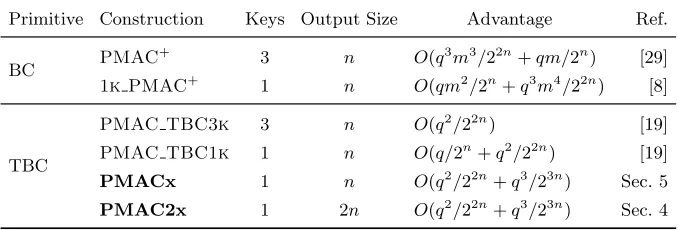
Table 1: Previous parallel BBB-secure MACs. (T)BC = (tweakable) block cipher,q
= max. #queries,m= max. #blocks per query,ℓ= max. total #blocks.
Primitive Construction Keys Output Size Advantage Ref.
BC PMAC
+ 3 n O(q3m3/22n+qm/2n) [29]
1k PMAC+ 1 n O(qm2/2n+q3m4/22n) [8]
TBC
PMAC TBC3k 3 n O(q2/22n) [19]
PMAC TBC1k 1 n O(q/2n+q2/22n) [19]
PMACx 1 n O(q2/22n+q3/23n) Sec. 5
PMAC2x 1 2n O(q2/22n+q3/23n) Sec. 4
that the analysis in [19] assumed internal values to be independent, which—as we will show—cannot always be guaranteed. Since the proof depended largely on this aspect, we developed an alternative analysis for our construction and derived a corrected bound for aPMAC TBC1k-like variant withn-bit output. So, despite the assumption in the original proof, we confirm that Naito’s MAC is secure for close to 2n−2 blocks processed under the same key.
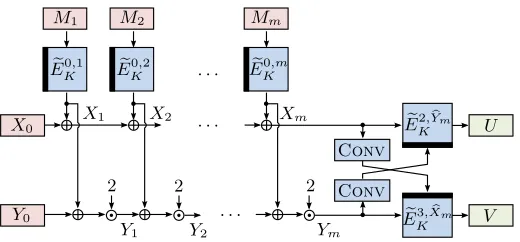
Contribution. Our contributions are threefold: first, we propose a BBB-secure parallelizable MAC, calledPMAC2x, which produces 2n-bit outputs and bases on a tweakable block cipher. Figure 1 provides a schematic illustration. As our second contribution, we briefly revisit the analysis by Naito onPMAC TBC1k and show that we can easily adapt our proof forPMAC2xand derive a secure variant that we callPMACxwhich XORs both its outputs and produces onlyn -bit tags. Table 1 compares our constructions to earlier parallelizable BBB- secure MACs. As our third contribution, we combine PMAC2x with the purely IV-based variant of Counter-in-Tweak to a single-primitive, single-key deterministic authenticated encryption scheme, which we callSIVx, and which provides BBB-security without assumptions about nonces.
M1 M2 Mm
2 2 2
. . .
. . . . . . e
E0,1
K Ee
0,2
K Ee
0,m K
e
E2,Ybm
K
e
E3,Xbm
K
U
V X0
X1 X2 Xm
Y0
Y1 Y2 Ym
Conv Conv
Fig. 1:Processing a messageM withPMAC2xwhereM hasmblocks (M1, . . . , Mm) after appending a 10∗padding toM.Ee:{0,1}k× {0,1}d× {0,1}t× {0,1}n→ {0,1}n
denotes a tweakable block cipher,Conv:{0,1}n
→ {0,1}t a regular function, and
⊙ multiplication in Galois-FieldGF(2n).
internal state, there also exist slightly less efficient proposals with smaller state. Yasuda [30] introducedPMACwith parity (PMAC/P), which processes each sequence ofrconsecutive message blocks inPMAC-like manner, but inserts the XOR sum of thoserblocks as an additional block. Zhang’s PMACX construc-tion [31] generalizedPMAC/Pby multiplying the input with an MDS matrix before authentication. In a similar direction goesLightMAC[14], a lightweight variant similar to Bernstein’s PCS. However, the security guarantees of all earlier parallelizable MACs in this paragraph are far from the optimal PRF bound.
2
Preliminaries
General Notation. We use lowercase lettersx, y for indices and integers, up-percase lettersX, Y for binary strings and functions, calligraphic uppercase let-ters X,Y for sets;XkY for the concatenation of binary stringsX andY, and
X⊕Y for their bitwise XOR. We indicate the length of X in bits by|X|, and write Xi for the i-th block, X[i] for the i-th most-significant bit of X, and
X[i..j] for the bit sequenceX[i], . . . , X[j]. We denote byX ևX thatX is
cho-sen uniformly at random from the set X. We define Func(X,Y) for the set of all functions F : X → Y, Perm(X) for the set of all permutations π: X → X, and Perm](T,X) for the set of tweaked permutations over X with tweak space T. We define byX1, . . . , Xj
x
←−X an injective splitting of a stringX into blocks ofx-bit such thatX =X1k · · · kXj,|Xi|=xfor 1≤i≤j−1, and|Xj| ≤x. For two sets X and Y, let X ←∪− Y denote X ← X ∪ Y. A uniform random functionρ:X → Y is a random variable uniformly distributed overFunc(X,Y). Given a functionF :X → Y, we writedomain(F) for the set of all inputsX ∈ X toF that occurredbefore (i.e., excluding) the current query; similarly, we write
then we denote byQ|Y,Z ={(Y, Z)| ∃X : (X, Y, Z)∈ Q}the restriction ofQ to valuesY ∈ Y andZ ∈ Z. This generalizes in the obvious way.
For an eventE, we denote by Pr[E] the probability ofE. We writehxin for the binary representation of an integerxas ann-bit string, or shorthxiifnis clear from the context, in big-endian manner, e. g.,h1i4 would be encoded to (0001).
Adversaries. An adversaryAis an efficient Turing machine that interacts with a given set of oracles that appear as black boxes to A. We denote by AO the
output ofAafter interacting with some oracleO. We write ∆A(O1;O2) for the
advantage ofAto distinguish between oraclesO1 andO2. All probabilities are defined over the random coins of the oracles and those of the adversary, if any. We write AdvXF(q, ℓ, θ) := maxA{AdvXF(A)} for the maximal advantage over allX-adversariesAonF that run in time at mostθand pose at mostqqueries of at mostℓ blocks in total to its oracles. Wlog., we assume thatAnever asks queries to which it already knows the answer.
We will provide pseudocode descriptions of the oracles, which will be referred to as games, according to the game-playing framework by Bellare and Rogaway [4]. Each game consists of a set of procedures. We define Pr[G(A)⇒x] as the probability that the gameGoutputsxwhen givenAas input.
Definition 1 (TPRP Advantage). Let Ee : K × T × X → X be a
tweak-able block cipher with non-empty key space K and tweak space T. Let A a computationally bounded adversary with access to an oracle, where K և K
and eπ և Perm](T,X). Then, the TPRP advantage of A on Ee is defined as
AdvTPRPEe (A) := ∆A(EeK;eπ).
A MAC is a tuple of functions F : K × X → Y with non-empty key space K, and a generic verification functionVerify:K × X × Y → {1,⊥}, where for all
K∈ K andX ∈ X, VerifyK(X, Y) returns 1 iffFK(X) =Y and ⊥otherwise. We use⊥, when in place of an oracle, to always return the invalid symbol⊥. It is well-known that if F is a secure PRF, it is also a secure MAC; however, the converse statement is not necessarily true.
Definition 2 (PRF Advantage). LetF :K × X → Y be a function with
non-empty key space K, and A a computationally bounded adversary with access to an oracle, whereKևK andρևFunc(X,Y). Then, the PRFadvantage of A
on F is defined as AdvPRFF (A) := ∆A(FK;ρ).
3
Definition of PMAC2x and PHASHx
This section defines the genericPMAC2xconstruction and its underlying hash function PHASHx. Fix integersk, n, t, d, withd≥2. LetK={0,1}k andT = {0,1}tbe non-empty sets of keys and tweaks, respectively. Moreover, derive a set of domainsD:={0,1,2,3}={0,1}dwhich are encoded as their respectived-bit values, and a domain-tweak setT′:=D×T. LetM ⊆({0,1}n)∗denote an input
Algorithm 1 Definition of PMAC2x[Ee] and its internal hash function PHASHx[Ee] with a tweakable block cipherEe:K × {0,1}d× {0,1}t× {0,1}n→ {0,1}n.n,t, and ddenote state, tweak and domain sizes, respectively.
11: functionPMAC2x[EKe ](M) 12: (Xm, Ym)←PHASHx[EKe ](M) 13: Xmb ←Conv(Xm)
14: Ymb ←Conv(Ym) 15: U←Ee2,Ybm
K (Xm)
16: V ←Ee3,Xbm
K (Ym)
17: return(UkV)
21: functionConv(X) 22: if t≥nthen 23: returnX
24: returnX[1..t]
31: functionPHASHx[EKe ](M) 32: X0←0n;Y0←0n
33: M∗←Mk10∗ 34: (M1, . . . , Mm)
n
←−M∗
35: fori←1tomdo 36: Zi←EeK0,hii(Mi)
37: Xi←Xi−1⊕Zi 38: Yi←2·(Yi−1⊕Zi) 39: return(Xm, Ym)
41: functionEeD,T K (X)
42: Te← hDidkT[1..t]
43: returnEeTe K(X)
We will often write EeKD,T(·) as short form ofEe(K, D, T,·).K∈ K,D∈ D, and
T ∈ T denote key, domain, and tweak, respectively.Conv:{0,1}n→ {0,1}tbe a regular function4 which is used to convert the outputs of PHASHx,X
m and
Ym, so they can be used as tweaks ofEe in the finalization step. We denote by PMAC2x[Ee] and PHASHx[Ee] the instantiation of PMAC2x and PHASHx withEe. Both are defined, with a default instantiation ofConv, in Algorithm 1. The message M is always padded toM∗←Mk10pby appending first a single 1-bit and thenp0-bits wherepis the smallest possible number of zero bits such that the length ofM∗ is a multiple ofnbit.
4
Security Analysis of PMAC2x
Theorem 1. LetEe andPMAC2x[Ee]be defined as in Section 3. Letd+t=n,
and letm <2tdenote the maximum number of n-bit blocks of any query. Then
AdvPRFPMAC2x[E]e(q, ℓ, θ)≤ 2 2dq2
2·(2n−q)2 +
2dq3 3·22n(2n−q)+
2dq2 2n(2n−q) +AdvTPRPEe (ℓ+ 2q, O(θ+ℓ+ 2q)).
The final term results from a standard argument after replacing the tweakable block cipherEe by a random tweakable permutationπeևPerm](T′,{0,1}n).
LetA be an adversary that makes at mostqqueries of at most m blocks each and of at mostℓ blocks in total. We assume, Adoes not ask duplicate queries and has the goal to distinguish between aPMAC2x[eπ] oracle with an internally sampled tweaked permutationπeand a random functionρ:{0,1}∗→ {0,1}2n.
Algorithm 2 Main Game, initialization, finalization, and subroutines. Boxed statements belong exclusively to the real world.
1: procedure Initialize
2: badU←false;badV ←false;Q ← ∅
3: X0←0n;Y0←0n;bև{0,1}
11: functionFinalize(b′)
12: bad←badU∨badV
13: returnb′=b∨ bad
21: functionOracle(M)
22: (Xm, Ym)←PHASHx[eπ](M) 23: Xmb ←Conv(Xm)
24: Ymb ←Conv(Ym) 25: Uև{0,1}n 26: V և{0,1}n
27: if (Xm,b Ymb )∈ Q|Xbm,Ybm then 28: (U, V)←Case1(Xm, Ym,Xm,b Ymb ) 29: else if U ∈range(eπ2,Ybm)∧
30: V ∈range(πe3,Xbm)then
31: (U, V)←Case2(Xm, Ym,Xm,b Ymb ) 32: else if U ∈range(eπ2,Ybm)∧
33: V 6∈range(eπ3,Xbm)then 34: (U, V)←Case3(Xm,b Ym, U, Vb ) 35: else if U 6∈range(eπ2,Ybm)∧ 36: V ∈range(πe3,Xbm)then 37: (U, V)←Case4(Xm,b Ym, U, Vb ) 38: else if U 6∈range(eπ2,Ybm)∧ 39: V 6∈range(eπ3,Xbm)then 40: (U, V)←Case5(Xm,b Ym, U, Vb ) 41: Q←∪− {(Xm,b Ym, U, Vb )}
42: eπ2,Ybm[Xm]←U 43: eπ3,Xbm[Ym]←V 44: return(UkV)
95: functionCase5(Xm,b Ym, U, Vb ) 96: return(U, V)
51: functionCase1(Xm, Ym,Xm,b Ymb ) 52: if Xm∈domain(eπ2,Ybm)then 53: U ←πe2,Ybm[Xm]
54: else
55: U և{0,1}n\range(eπ2,Ybm) 56: if Ym∈domain(eπ3,Xbm)then 57: V ←eπ3,Xbm[Ym]
58: else
59: V և{0,1}n\range(eπ3,Xbm) 60: badU ←badV ←true
61: return(U, V)
71: functionCase2(Xm, Ym,Xm,b Ymb )
72: Uև{0,1}n\range(eπ2,Ybm) 73: V և{0,1}n\range(πe3,Xbm) 74: badU ←badV ←true
75: return(U, V)
81: functionCase3(Xm,b Ym, U, Vb )
82: Uև{0,1}n\range(eπ2,Ybm) 83: badU ←true
84: return(U, V)
91: functionCase4(Xm,b Ym, U, Vb )
92: V և{0,1}n\range(πe3,Xbm) 93: badV ←true
94: return(U, V)
We consider the game described in Algorithm 2. The game without the boxed statements coincides with a random function ρ, whereas the game with them exactly representsPMAC2x[πe], performing lazy sampling for the permutations
e
π2,Ybm(·) andeπ3,Xbm(·), for allXb
m,Ybm∈ {0,1}t. Both algorithms differ only when
badevents occur. Hence, by the fundamental lemma of game playing [5], it holds
Pr[APMAC2x[π](e ·)⇒1]−Pr[Aρ(·)⇒1]≤Pr[Asetsbad].
– Case1: (Xbm,Ybm)∈ Q|Xbm,Ybm.
– Case2: (Xbm,Ybm)6∈ Q|Xbm,Ybm∧U ∈range(eπ
2,Ybm)∧V ∈range(eπ3,Xbm).
– Case3: (Xbm,Ybm)6∈ Q|Xbm,Ybm∧U ∈range(eπ
2,Ybm)∧V 6∈range(eπ3,Xbm).
– Case4: (Xbm,Ybm)6∈ Q|Xbm,Ybm∧U 6∈range(eπ
2,Ybm)∧V ∈range(eπ3,Xbm).
– Case5: (Xbm,Ybm)6∈ Q|Xbm,Ybm∧U 6∈range(eπ
2,Ybm)∧V 6∈range(eπ3,Xbm).
We list Case 5 only for the sake of completeness. It is easy to see that in Case 5, the output of the game is indistinguishable between the worlds. We useMi,Xbi
m,
b Yi
m, Ui, Vi to refer to the respective values of the i-th query, wherei ∈[1, q], and assume it is the current query of the adversary. Additionally, we will use indicesj andk, wherej, k∈[1, i−1], to refer to previous queries.
Case1: For this case, we revisit the fact that for two fixed disjoint queries Mi
andMj, the valuesX
mand Ym are results of two random variables. A variant of the proof is given e.g. in [19, Sect. 3.3], and revisited in the following only for the sake of completeness. Fix query indices i∈ [1, q] and j ∈[1, i−1]. Let
mandm′ denote the number of blocks of thei-th andj-th query, respectively;
moreover, letXi
m,Ymi denote the valuesXmandYmof thei-th query andXmj′,
Ymj′ those of thej-th query, respectively.Xmi ,Ymi,Xmj, andYmj result from:
Xmi =C1i⊕C2i⊕ · · · ⊕Cmi Ymi = 2mC1i⊕2m−1C2i⊕ · · · ⊕2·Cmi ,
Xmi′ =C j 1⊕C
j
2⊕ · · · ⊕C j
m′ Y
j m′ = 2
m′
C1j⊕2m ′−1
C2j⊕ · · · ⊕2·C j m′.
So, we want to bound the probability for the following equational system:
C1i⊕C2i⊕ · · · ⊕Cmi =C j 1⊕C
j
2⊕ · · · ⊕C j m′
2mC1i⊕2m−1C2i⊕ · · · ⊕2·Cmi = 2m ′
C1j⊕2m ′−1
C2j⊕ · · · ⊕2·C j m′.
There exist three distinct subcases which cover all possibilities:
– Subcase 1: m6=m′. In this case, the equations above provide a unique
solution set for two random variables; thus, the probability that the equations hold for two fixed queries is upper bounded by 1/(2n−(i−1))2.
– Subcase 2: m=m′ and there existsα∈[1,m]s.t. Ci
α6=Cjα and for
all β∈[1,m] with β6=α:Ci
β=C j
β. In this case, both messages share
only a single different output block. Thus, the equations above never hold.
– Subcase 3: m=m′ and there exist distinct β∈[1,m] with β6=α:
Ci
β=C
j
β. In this case, the equations provide a unique solution set for two
random variables, so the probability that they hold is bounded by 1/(2n− (i−1))2.
So, the probability for two fixed disjoint queries Mi andMj that (Xi
m, Ymi) = (Xmj′, Y
j
m′) holds, is bounded by 1/(2n−q)2. SinceXbmi andYbmi are derived from
Xi
from Xmj′ andY j
m′, respectively), it follows that the probability of (Xb i
m,Ybmi) = (Xbmj′,Yb
j
m′) to hold for thei-th and j-th query, withj∈[1, i−1], is at most
(i−1)· 2 d
(2n−q)· 2d (2n−q) =
22d(i−1) (2n−q)2.
Remark 1. In its initial version,PMAC2x employed a different tweak domain
e
E1,· if the last message block was partial, i.e., if |M
m| < n. This approach allowed birthday-bound collisions for the result of two messages with fullMmand partial M′
m sinceEe0,m and Ee1,m defined different permutations, contradicting Subcase 2. Therefore, this revised version employs instead the approach that has also been used by Naito, i.e., to always pad the messageM∗←(Mk10∗) before
using it, which ensures that Subcase 2 holds.
Case2: In this case, there exists some previous query (Xbj
m′,Yb j
m′, Uj, Vj) s.t.
U = Uj ∧Yb
m = Ybmj′, and a distinct previous query (Xbmk′′,Ybmk′′, Uk, Vk) s.t.
V =Vk ∧Xb
m =Xbmk′′. From our assumption (Xbm,Ybm)6∈ Q|Xbm,Ybm, it follows thatj6=k; otherwise, the current query would have stepped intoCase1instead. We can bound the probability by
Prh(U =Uj∧Ybm=Ybmj′)∧(V =V k∧Xb
m=Xbmk′′)
i
≤PrhU =Uj∧Ybm=Ybmj′∧V =V k|Xb
m=Xbmk′′
i .
U andV are chosen independently and uniformly at random from{0,1}neach, and can collide with at mosti−1 previous valuesUjand at mosti−1 previous valuesVk, respectively. For fixed j and k, the probability forU to collide with
Ujis upper bounded by 1/2n, and independently, the probability forV to collide withVk is also 1/2n. Since the game choosesU andV independently fromY
m, the probability thatYbmcollides withYbmj′is at most 2d/(2n−q) since we assumed that the adversary poses no duplicate queries, and therefore, Ym and Ymj′ are results of two random variables. Since the collision ofU =Uj already fixes the colliding query pair, there is no additional factor (i−1) for the choice of which pairs of Ybm and Ybmj′ to collide. It follows that the probability for this case to occur at thei-th query is upper bounded by
i−1 2n ·
i−2 2n ·
2d 2n−q ≤
2d(i−1)2 22n(2n−q).
Case3: In this case, there exists some previous query (Xbj
m′,Yb j
m′, Uj, Vj) s.t.
U =Uj∧Yb
m=Ybmj′. From our assumption (Xbm,Ybm)6∈ Q|Xbm,Ybm andYbm=Yb j m′ follows thatXbm6=Xbmj′ holds, like inCase2. We can bound the probability by
PrhU =Uj∧Ybm=Ybmj′∧V 6∈range(eπ 3,Xbm)
i
≤PrhU =Uj∧Yb
m=Ybmj′|V 6∈range(eπ 3,Xbm)
For a fixed j-th query, the probability that Ybm collides with Ybmj′ is at most 2d/(2n−q). Since U is chosen uniformly at random from{0,1}n and indepen-dently fromYm,U can collide withUjwith probability 1/2n. So, the probability of this case to occur for thei-th query can be upper bounded by
2d 2n−q ·
i−1 2n =
2d(i−1) 2n(2n−q).
Case4: In this case, it holds that V = Vj∧Xb
m = Xbmj′. From (Xbm,Ybm) 6∈ Q|Xbm,Ybm and Xbm = Xb
j
m′ follows here that Ybm 6= Yb j
m′ holds, analogously to
Case2andCase3. We can bound the probability by
PrhV =Vj∧Xbm=Xbmj′∧U 6∈range(πe 2,Ybm)
i
≤PrhV =Vj∧Xbm=Xbmj′|U 6∈range(eπ 2,Ybm)
i .
Obviously, this case can be handled similarly as Case3. For a fixed j-th query, the probability that Xbm collides with Xbmj′ is at most 2
d/(2n−q). Since V is chosen uniformly at random from {0,1}n and independently from X
m, V can collide with Vj with probability 1/2n. So, the probability of this case to occur for thei-th query can also be upper bounded by
2d(i−1) 2n(2n−q).
Taking the terms from all cases and the union bound over at most q queries gives
Pr [Asetsbad]≤ q
X
i=1
22d(i−1) (2n−q)2 +
2d(i−1)2 22n(2n−q)+ 2·
2d(i−1) 2n(2n−q)
≤ 2
2dq2
2·(2n−q)2 +
2dq3 3·22n(2n−q)+
2dq2 2n(2n−q).
5
Security Analysis of PMACx
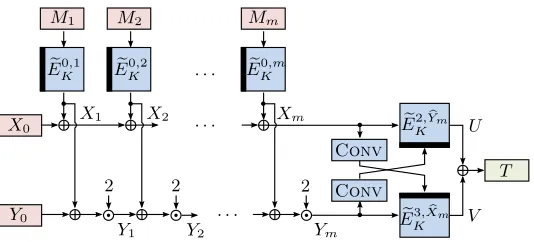
This section considers a variant ofPMAC2x,PMACx, that adds a final XOR to produce only ann-bit tag, following the design ofPMAC TBC1k. A schematic illustration is given in Figure 2. We revisit the assumption by Naito, and show that our proof of PMAC2xneeds only a slight adaption forPMACx.
M1 M2 Mm
2 2 2
. . .
. . . . . . e
E0,1
K Ee
0,2
K Ee
0,m K
e
E2,Ybm
K
e
E3,Xbm
K U
V T X0
X1 X2 Xm
Y0
Y1 Y2 Ym
Conv Conv
Fig. 2: PMACx, the variant of PMAC2xwith n-bit output, following the design of PMAC TBC1k.
andξdenote positive integers and define three setsX,Y, andQwhich store the valuesXbi
m, Ybmi, and the tuples (Xmi ,Ybmi), respectively, of the queries 1≤i≤q.
mcoll1:= (∃Xbm1, . . . ,Xbmρ ∈ X s.t.Xbm1 =. . .=Xbmρ)∨ (∃Ybm1, . . . ,Ybmρ ∈ Y s.t.Ybm1 =. . .=Ybmρ),
mcoll2:=∃(Xm1,Ybm1), . . . ,(Xmξ,Ybmξ)∈ Qs.t. (Xm1,Ybm1) =. . .= (Xmξ,Ybmξ).
The original proof further defined a monotone compound eventmcoll:=mcoll1∨
mcoll2 and used the fact that
Pr [Asets bad] = Pr [Asetsbad∧mcoll] + Pr [Asetsbad∧ ¬mcoll] ≤Pr [mcoll1] + Pr [mcoll2] + Pr [Asetsbad|¬mcoll].
The analysis in [19] bounds Pr[mcoll1] as
Pr[mcoll1]≤2·2t·
q ρ ·
2n−t 2n−q
ρ
≤2t+1·
2n−t·eq
ρ(2n−q)
ρ
,
using Stirling’s approximationx!≥(x/e)xfor anyx. Note, inPMAC TBC1k, the domain size in PMAC2x is fixed to d = 2 bits. The bound above con-sists of the probability that ρ values are all equal, (2n−t/(2n −q))ρ; the fact that there are 2t tweak values; and the q
ρ
possible ways to chooseρ out of q
values. However, the bound holds only if the ρ colliding tweaks stem from ρ
linearly independent random variables, which isnot necessarily the case. Imag-ine a sequence of 2mqueries which combine pair-wise distinct blocks {M
i, Mi′} with Mi 6= Mi′, for 1 ≤ i ≤ m position-wise, i. e., we have 2m queries of
m blocks each: Q0 = (M
1, M2, M3, . . . , Mm), Q1 = (M1′, M2, M3, . . . , Mm),
Q2= (M
1, M2′, M3, . . . , Mm), . . . ,Q2 m−1
= (M′
1, M2′, M3′, . . . , Mm′ ). When used as queries toPMAC TBC1k, the 2mresulting values Xi
m, for 0≤i≤2m−1, depend on the linear combination of only 2mrandom variables. A similar argu-ment holds for the valuesYi
Algorithm 3 The updated game for the security proof of PMACx. Only the double-boxed statement changes compared with the game in Algorithm 2.
21: functionOracle(M) 22: . . .
42: πe2,Ybm[Xm]←U 43: πe3,Xbm[Ym]←V 44: return T ←U⊕V
Fixing the Analysis. From our proof for PMAC2x, we can now derive a corollary for a similar security bound for PMACx, which again can be easily transformed into a bound forPMAC TBC1k.
Corollary 1. LetEeandPMAC2x[Ee]be defined as in Section 3. Letd+t=n,
and let m <2t denote the maximum number ofn-bit blocks of any query. Then, it holds that AdvPRFPMACx[E]e(q, ℓ, θ)≤AdvPRFPMAC2x[E]e(q, ℓ, θ).
The proof can use a game almost identical to that in Algorithm 2, where we only modify Line 44 to return the XOR of U andV. This is shown in Algorithm 3. All further procedures and functions remain identical to those in Algorithm 2. If (UkV) is indistinguishable from outputs of a 2n-bit random functionρ, then each of the n-bit outputs U and V can be considered random. It follows, if
U is indistinguishable from n-bit values, then the XOR sum of U ⊕V is also indistinguishable from a randomn-bit value. Hence, the PRF advantage of A
onPMACxis upper bounded by that of an adversaryA′ onPMAC2xwith an
equal amount of resources asA; hence, the corollary follows.
PMACx and PMAC TBC1k differ in two aspects: (1) PMACx defines a genericd-bit domain encoding and defines a conversion function Conv for de-riving the inputs for the finalization; and (2) PMACx adds a final doubling for a simpler and consistent description. Clearly, none of the differences af-fects the distribution of final chaining values Xbm and Ybm. Hence, when fixing
d= 2, a security result for PMACxcan be easily carried over to a bound for PMAC TBC1k.
6
Definition and Security Analysis of SIVx
This section defines and analyzes the deterministic AE scheme SIVx, a com-position of a variant of PMAC2xwith the IV-based Counter-in-Tweak mode IVCTRT. We recall the definitions of IV-based encryption and Deterministic AE security in Appendix C. Note that it is straight-forward to derive a nonce-based AE scheme by fixing the nonce length over all queries and always appending the nonce to the associated data.
IVCTRT. IVCTRTdenotes the purely IV-based version of Counter in Tweak
A∗1 A∗2 A∗a
2
2 2
2 2
2
2
X0
Y0
Xa
Xa
Ya
Ya M∗
1 M2∗ Mm∗ |M|
U
U
V V
V
V
. . . . . .
. . . . . .
. . .
. . . . . .
e
E0K,1 Ee0K,2 EeK0,a
e
E0,a+1
K Ee
0,a+2
K Ee
0,a+m
K Ee
0,a+m+1
K
Conv Conv
Conv′
e
E2
K
e
E3
K
T
M1 M2 Mm
C1 C2 Cm
T EeK1 T+1 EeK1 T+m−1 EeK1
PMAC2x′[Ee]
IVCTRT[Ee]
Fig. 3: Encryption of associated dataA and message M with the deterministic AE schemeSIVxfrom the composition ofPMAC2x[Ee] (top), and theIVCTRT[Ee] mode of encryption (bottom) [22]. A∗ andM∗ denoteA and M after padding them with
10∗so that their lengths are multiples ofnbit each.
encryption. LetT ={0,1}t, andT′ ={0,1}×T. The mode first splits (U, V)←−n IV, and uses a given tweakable block cipherEe:K × T′× {0,1}n → {0,1}n in counter mode, with V as cipher input. Next, it derivesT ←Conv′(U) fromU
with a regular function Conv′ : {0,1}n → T and increments T for every call to Ee using addition modulo 2t. We denote by IVCTRT[Ee] the instantiation of IVCTRT with Ee; from Theorem 1 and Appendix C in [23], we recall the following theorem:
Theorem 2 (ivE Security of IVCTRT). Let πe և Perm](T′,{0,1}n) be an
ideal tweakable block cipher. LetAbe an adversary which asks at mostqqueries of at most 8≤ℓ≤ |T |blocks in total. Then
AdvivEIVCTRT[eπ](A)≤ 1 2n +
1 |T | +
4ℓlogq
|T | +
Algorithm 4Definition ofSIVx[Ee] and its inverse.IVCTRT[Ee] and its inverse IVCTRT−1[Ee] are identical operations. Note thatPMAC2x′ does not pad the inputM∗ since it is padded already inEncode.
11: functionSIVx[EKe ](A, M) 12: X←Encode(A, M) 13: tag←PMAC2x′[EKe ](X)
14: (U, V)←n−tag 15: IV ←Conv′(U)kV
16: C←IVCTRT[EKe ](IV, M) 17: return(C,tag)
21: functionIVCTRT[EKe ](IV, M) 22: (T, V)←IV
23: (M1, . . . , Mm)
n
←−M
24: fori←1 tom−1do 25: Ci←EeK1,T+(i−1)(V)⊕Mi
26: Sm←EeK1,T+(m−1)(V)[1..|Mm|] 27: Cm←Sm⊕Mm
28: returnC←(C1k. . .kCm) 31: functionConv′(U)
32: returnT ←U[1..t]
41: functionSIVx−1[EKe ](A, C,tag) 42: (U, V)←n−tag
43: IV ←Conv′(U)kV
44: M ←IVCTRT−1[EKe ](IV, C) 45: X ←Encode(A, M)
46: tag′←PMAC2x′[EKe ](X)
47: if tag=tag′ then 48: returnM
49: return⊥
51: functionEncode(A, M) 52: ℓa← |A|modn
53: ℓm← |M|modn
54: A∗←(Ak10n−ℓa−1) 55: M∗←(Mk10n−ℓm−1) 56: L← h|M|in
57: return(A∗kM∗kL)
PMAC2x′ and Encode. When processing tuples of associated data A and
messages M, we have to ensure that all distinct inputs (A, M) and (A′, M′)
lead to distinct inputs to PMAC2x. For this purpose, we define an injective encoding function Encode: A × M → {0,1}∗ which is given in Algorithm 4.
Encode always pads A∗ ← Ak10∗ and M∗ ← Mk10∗ so that the lengths
of A∗ and M∗ are the next possible multiple of n bit. It further encodes the
length of M in bit to ann-bit string namedL, and outputs the concatenation of M∗ ←(A∗kM∗kL). Hence, every tuple (A, M) results in a unique output.
PMAC2x′then processes this valueM∗.PMAC2x′
differs fromPMAC2xonly in the fact thatPMAC2x′ omits the padding insidePMAC2x(i.e., Line 33 in Algorithm 1 is omitted) since we already padded it before by Encode, which ensures that all distinct inputs toEncode yields distinct inputs toPMAC2x, and that thePRFproof forPMAC2xstill holds.
Lemma 1. Given any associated dataA, A′∈ Aand messagesM, M′∈ Ms.t.
(A, M)6= (A′, M′). Then, it holds thatEncode(A, M)6=Encode(A′, M′).
Lemma 1 is not difficult to see; a brief proof sketch is given in Appendix D.
Definition of SIVx. We define the deterministic AE scheme SIVx[Ee] as the composition of PMAC2x′[Ee] and IVCTRT[Ee], as given in Algorithm 4. A schematic illustration of the encryption process is depicted in Figure 3. In general, we denote bySIVx[F, Π] the instantiation ofSIVxwith a function F
3 = (0011)2 for the finalization in PMAC2x′. We encode them into the d= 4 most significant bits of the tweak. InsideIVCTRT, we use the single-bit domain 1 in all calls toEefor we lose only a single bit from the IV. For concreteness, we defineX0=Y0= 0n.
Theorem 3 (DAE Security of SIVx). Let F : K1× A × M → {0,1}2n,
and let Π= (Ee,D)e be an IV-based encryption scheme with key spaceK2 and IV space IV. Let K1 ևK1 andK2 ևK2 be independent. Let Conv′ :{0,1}n → {0,1}n−1 be a regular function. LetAbe a DAE adversary running in time at mostθ, asking at mostqqueries of at most 8≤ℓ <2t blocks in total. Then
AdvDAESIVx[F,Π](A)≤AdvivEΠ (θ+O(ℓ), q, ℓ) +AdvPRFF (θ+O(ℓ), q, ℓ) +
q
2n. We defer the proof of Theorem 3 to Appendix C. Inserting the bounds from Theorems 1 and 2, we obtain the corollary below, whereFdenotesPMAC2x′[Ee] andΠ representsIVCTRT[Ee].
Corollary 2. Fix positive integers k, n, t andd = 4. Define d+t=n and let
T ={0,1}tand T′ ={0,1}d× {0,1}t, and IV ={0,1}n−1. Let Ee :K × T′×
{0,1}n→ {0,1}n, andConv′:{0,1}n→ IV be a regular function. LetK
ևK
and A be a DAE adversary that runs in time at most θ, and asks at most q
queries of at most 8≤ℓ <2t blocks in total. Then
AdvDAESIVx[E]e(A)≤ 2
2dq2
2·(2n−q)2+
2dq3 3·22n(2n−q)+
2dq2 2n(2n−q)+
4ℓlogq+ 1 2n−1 +
q+ 1 +ℓlog2(ℓ)
2n +Adv
TPRP e
E (θ+O(2ℓ+ 5q),2ℓ+ 5q). The terms 5q result from the fact that we can have up to five additional calls to Ee inside PMAC2x′ because of the padding of A, M, finalization, and the additionally processed length.
7
Conclusion
Acknowledgments
The authors would like to thank Yusuke Naito and the anonymous reviewers for their fruitful comments that helped improve our work. We address our special thanks to Kazuhiko Minematsu and Tetsu Iwata [17] who pointed out that an earlier conditional padding for partial final blocks to PMAC2x and PMACx and the combination of associated data and message in SIVx was subject to birthday-bound attacks. We revised our padding in PMAC2x and PMACx accordingly and added an injective encoding to its use inSIVx.
Changelog
2017-06-11 Replaced the ePrint reference of Minematsu and Iwata’s paper after
its acceptance in ToSC [17].
2017-03-09 Revised the padding method inPMAC2xandPMACxto always
append a 10∗ padding to the input. Revised the definition of PMAC2xin
SIVxfor processing both associated data and message inSIVx, and added an injective encoding. Revised Subcase 3 in Case 1.
References
1. Elena Andreeva, Andrey Bogdanov, Nilanjan Datta, Atul Luykx, Bart Mennink, Mridul Nandi, Elmar Tischhauser, and Kan Yasuda. COLM v1. 2016. Submission to the CAESAR competition.
2. Mihir Bellare, Anand Desai, E. Jokipii, and Phillip Rogaway. A Concrete Security Treatment of Symmetric Encryption. In FOCS, pages 394–403. IEEE Computer Society, 1997.
3. Mihir Bellare, Roch Gu´erin, and Phillip Rogaway. XOR MACs: New Methods for Message Authentication Using Finite Pseudorandom Functions. In Don Copper-smith, editor,CRYPTO, volume 963 of LNCS, pages 15–28. Springer, 1995. 4. Mihir Bellare and Phillip Rogaway. Code-Based Game-Playing Proofs and the
Security of Triple Encryption. IACR Cryptology ePrint Archive, 2004:331, 2004. 5. Mihir Bellare and Phillip Rogaway. The Security of Triple Encryption and a
Frame-work for Code-Based Game-Playing Proofs. In Serge Vaudenay, editor, EURO-CRYPT, volume 4004 ofLNCS, pages 409–426. Springer, 2006.
6. Daniel J. Bernstein. How to Stretch Random Functions: The Security of Protected Counter Sums. J. Cryptology, 12(3):185–192, 1999.
7. John Black and Phillip Rogaway. A Block-Cipher Mode of Operation for Par-allelizable Message Authentication. In Lars R. Knudsen, editor, EUROCRYPT, volume 2332 ofLNCS, pages 384–397. Springer, 2002.
8. Nilanjan Datta, Avijit Dutta, Mridul Nandi, Goutam Paul, and Liting Zhang. Building Single-Key Beyond Birthday Bound Message Authentication Code.IACR Cryptology ePrint Archive, 2015:958, 2015.
10. Christian Forler, Eik List, Stefan Lucks, and Jakob Wenzel. Efficient Beyond-Birthday-Bound-Secure Deterministic Authenticated Encryption with Minimal Stretch. In Joseph K. Liu and Ron Steinfeld, editors, ACISP (2), volume 9723 ofLNCS, pages 317–332. Springer, 2016.
11. Viet Tung Hoang, Ted Krovetz, and Phillip Rogaway. Robust Authenticated-Encryption AEZ and the Problem That It Solves. In Elisabeth Oswald and Marc Fischlin, editors,EUROCRYPT (1), volume 9056 ofLNCS, pages 15–44. Springer, 2015.
12. J´er´emy Jean, Ivica Nikoli´c, and Thomas Peyrin. Deoxys v1.4. http:// competitions.cr.yp.to/caesar-submissions.html, 2016. Third-round submission to the CAESAR competition.
13. Atul Luykx, Bart Preneel, Alan Szepieniec, and Kan Yasuda. On the Influence of Message Length in PMAC’s Security Bounds. In Marc Fischlin and Jean-S´ebastien Coron, editors,EUROCRYPT (1), volume 9665 ofLNCS, pages 596–621. Springer, 2016.
14. Atul Luykx, Bart Preneel, Elmar Tischhauser, and Kan Yasuda. A MAC Mode for Lightweight Block Ciphers. In Thomas Peyrin, editor, FSE, volume 9783 of LNCS, pages 43–59. Springer, 2016.
15. Avradip Mandal and Mridul Nandi. An Improved Collision Probability for CBC-MAC and PCBC-MAC. IACR Cryptology ePrint Archive, 2007:32, 2007.
16. Kazuhiko Minematsu. Parallelizable Rate-1 Authenticated Encryption from Pseu-dorandom Functions. In Phong Q. Nguyen and Elisabeth Oswald, editors, EURO-CRYPT, volume 8441 ofLNCS, pages 275–292. Springer, 2014.
17. Kazuhiko Minematsu and Tetsu Iwata. Cryptanalysis of PMACx, PMAC2x, and SIVx. IACR Transactions on Symmetric Cryptology, 2017(2):162–176, 2017. 18. Kazuhiko Minematsu and Toshiyasu Matsushima. New Bounds for PMAC, TMAC,
and XCBC. In Alex Biryukov, editor,FSE, volume 4593 ofLNCS, pages 434–451. Springer, 2007.
19. Yusuke Naito. Full PRF-Secure Message Authentication Code Based on Tweakable Block Cipher. In Man Ho Au and Atsuko Miyaji, editors,ProvSec, volume 9451 ofLNCS, pages 167–182. Springer, 2015.
20. Mridul Nandi. A Unified Method for Improving PRF Bounds for a Class of Block-cipher Based MACs. In Seokhie Hong and Tetsu Iwata, editors,FSE, volume 6147 ofLNCS, pages 212–229. Springer, 2010.
21. Mridul Nandi and Avradip Mandal. Improved security analysis of PMAC. J. Mathematical Cryptology, 2(2):149–162, 2008.
22. Thomas Peyrin and Yannick Seurin. Counter-in-Tweak: Authenticated Encryption Modes for Tweakable Block Ciphers. In Matthew Robshaw and Jonathan Katz, editors,CRYPTO I, volume 9814 ofLNCS, pages 33–63. Springer, 2016.
23. Thomas Peyrin and Yannick Seurin. Counter-in-Tweak: Authenticated Encryption Modes for Tweakable Block Ciphers. IACR Cryptology ePrint Archive, 2015:1049, Version from May 27 2016.
24. Phillip Rogaway. Authenticated-Encryption with Associated-Data. InACM Con-ference on Computer and Communications Security, pages 98–107, 2002.
25. Phillip Rogaway. Efficient Instantiations of Tweakable Blockciphers and Refine-ments to Modes OCB and PMAC. In Pil Joong Lee, editor,ASIACRYPT, volume 3329 ofLNCS, pages 16–31. Springer, 2004.
27. Phillip Rogaway and Thomas Shrimpton. A Provable-Security Treatment of the Key-Wrap Problem. In Serge Vaudenay, editor, EUROCRYPT, volume 4004 of Lecture Notes in Computer Science, pages 373–390. Springer, 2006.
28. Thomas Shrimpton and R. Seth Terashima. A Modular Framework for Building Variable-Input-Length Tweakable Ciphers. In Kazue Sako and Palash Sarkar, editors, ASIACRYPT (1), volume 8269 of Lecture Notes in Computer Science, pages 405–423. Springer, 2013.
29. Kan Yasuda. A New Variant of PMAC: Beyond the Birthday Bound. In Phillip Rogaway, editor,CRYPTO, volume 6841 ofLNCS, pages 596–609. Springer, 2011. 30. Kan Yasuda. PMAC with Parity: Minimizing the Query-Length Influence. In Orr
Dunkelman, editor,CT-RSA 2012, pages 203–214. Springer, 2012.
31. Yusi Zhang. Using an Error-Correction Code for Fast, Beyond-Birthday-Bound Authentication. In Kaisa Nyberg, editor,CT-RSA, pages 291–307. Springer, 2015.
Supporting Material
A
Previous BBB-Secure Authenticated Encryption
BBB-secure AE has received attention earlier; at ASIACRYPT’13, Shrimpton and Terashima [28] proposed Protected IV (PIV), a three-pass variable-input-length cipher which can be transformed into a robust AE scheme. Shrimpton and Terashima proposed two variants of PIV, one of which provided beyond-birthday-bound security. Though, it requires one more pass over the message than our proposal, and is composed of a universal hash function to extend the tweak size of the underlying primitive, as has already been stressed by Peyrin and Seurin. Thus, PIV requires rather large keys, plus it is neither single-key nor single-primitive. Furthermore, Forler et al. [10] proposed Deterministic Counter-in-Tweak (DCT), which can be seen as a two-pass variant of Protected IV or the Hash-Counter-Hash design in general.DCTalso employs Counter-in-Tweak for BBB security. Though, that construction is also a composition of a universal hash function to extend the tweak size, plus an encryption scheme, plus an additional call to a 2n-bit permutation. Thus, it is again not single-primitive and requires a hash function to extend the tweak size. In contrast to both PIV and DCT, SCT as well as our proposal SIVx combine all three properties: single-key, a fixed-tweak-length single-primitive, and BBB security.
B
Notions for IV-based Encryption and Deterministic
Authenticated Encryption
We define $O for an oracle that, given an inputX, chooses uniformly at random
a value Y equal in length of the expected output, |Y| = |O(X)|, and returns
Y. We assume that $O performs lazy sampling, i.e., $O(X) returns the same
valueY when queried with the same inputX. We often omit the key for brevity, e.g., $Ee(X) will be short for $EeK(X). If two oracles O
i, Oj represent a family of algorithms indexed by inputs, the indices must match: e. g., whenEeK(A, M) and DeK(A, C, T) represent encryption and decryption algorithms with a fixed key K and indexed by A, then EeK ֒→ DeK says thatA first queries EeK(A, M) and laterDeK(A,E(eA, M)).
An IV-based encryption scheme [2] is a tuple Π = (E,D) of encryption and decryption algorithms E : K × IV × M → C and D : K × IV × C → M, with associated non-empty key space K, non-empty IV space IV, and where M,C ⊆ {0,1}∗ denote message and ciphertext space, respectively.
Definition 3 (ivE Advantage). Let Π = (E,D) be an IV-based encryption
scheme with associated key space Kand IV space IV. Let KևK, and let Abe
a computationally bounded adversary with access to an oracleO. On any input
M ∈ M, the game chooses IV և IV and returns (IV,O(IV, M)). The ivE
advantage of Awith respect toΠ is defined as AdvivEΠ (A) := ∆A(EK; $E).
A deterministic AE scheme (with associated data) is a tuple Πe = (Ee,D) ofe deterministic algorithmsEe:K × A × M → C ∪ T andDe:K × A × C × T → M ∪ {⊥}with non-empty key space K, associated-data space A, message spaceM, ciphertext spaceC, and tag spaceT [27]. We restrict toA,M,C,T ⊆ {0,1}∗. For
eachK ∈ K,A∈ A, andM ∈ M, the output (C, T)←EeK(A, M) is such that |C|=|M|and|T|=τfor fixed stretchτ.DeK(A, C, T) outputs the corresponding messageM iff (A, C, T) is valid, and⊥ otherwise. We assume correctness, i.e., for allK, A, M ∈ K × A × M, it holds thatDeK(A,EeK(A, M)) =M. Moreover, we assume tidiness, i.e., if there exists an M such thatDeK(A, C, T) =M, then it holds that EeK(A,DeK(A, C, T)) = (C, T).
Definition 4 (DAE Advantage [27]).LetΠe = (Ee,D)e be a DAE scheme with
associated key, input, and output spaces as above. LetKևK and letAdenote
a computationally bounded adversary with access to two oraclesO1andO2 each such that A never queries O1 ֒→ O2. Then, the DAE advantages of A with respect to Πe is defined asAdvDAEΠe (A) := ∆A(EeK,DeK; $Ee,⊥).
C
Security Proof of SIVx
Proof. The proof is analogous to the security proof ofNSIV(the generalization of SCT) in [23]. As an initial step, we replaceEe by an ideal tweaked permuta-tioneπևPerm](T′,{0,1}n). Clearly, the maximal advantage for an adversary to
distinguish between both settings is bounded by the last term of our theorem. In the remainder, letΠe =SIVx[F, Π], and denote by E[eFK1,ΠK2] andD[eFK1,
ΠK−12] the encryption and decryption algorithms ofΠe instantiated withF andΠ under independent keysK1andK2, respectively. We will describe a game-based proof over a sequence of three games. We denote by
G1:= (Ee[FK1, ΠK2],D[eFK1, Π
−1 K2]) and G4:= ($Ee,⊥)
the two worlds that A must distinguish between, where $Ee returns on input
(A, M) a tuple of random strings of length 2nand|Ee[FK1, ΠK2](A, M)|, respec-tively. We further use two intermediate worlds
G2:= (E[eρ, ΠK2],D[eρ, Π
−1 K2]) and G3:= (E[eρ, ΠK2],⊥).
InG2andG3, we replaceFK1 by a random functionρևFunc(A × M,{0,1} 2n), in both encryption and decryption algorithms. In G3, we also replace the real decryption algorithmDe by the⊥oracle. We denote by
∆i,j:=
PrAGi⇒1−PrAGj ⇒1
the advantage of Ain distinguishing worldGi fromGj. First, we upper bound
∆3,4:=
PrAG3 ⇒1−PrAG4 ⇒1
Consider the following adversary A′ against the ivE security of Π: Let O ∈
{E[eρ, ΠK2],$Ee} be the first oracle that A′ has access to. A′ runs A. When
A asks an encryption query (A, M), A′ queries O(M) and obtains an answer
(IV, C). It derives (T, V)←IV, samples uniformly at random a valueU in the set of preimages Conv−1(T), derives tag← (UkV), and returns (C,tag) to
A. When Aasks a decryption query, A′ simply returns ⊥. WhenA halts and outputs a bit,A′simply outputs the same bit. Independently from whetherOis the real or random encryption, the functionρoutputs uniformly random values (TkV). Thus,U is also uniformly random sinceConvis a regular function. So,
A′ perfectly simulates G
3 if O is E[eρ, ΠK2], and perfectly simulates G4 ifO is $Ee. Clearly,AandA′ differ neither in the number of asked queries, total blocks
nor maximal query length, but only in the used time thatA′ needs to simulate
A. Hence, it holds that
∆3,4≤AdvivEΠ (A′). Next, we upper bound
∆1,2:=
PrAG1
LetA′′ be aPRFadversary onF. Denote by O ∈ {F
K1, ρ} the oracle thatA
′′
has access to. A′′ chooses a randomK
2 ևK2 and runsA. When Amakes an encryption query (A, M) or a decryption query (A, C,tag),A′′simply executes
SIVxwhere it replaces all calls to FK1(·,·) by a call to its oracleO. WhenA halts and outputs a bit,A′′outputs the same bit. Again,A′′perfectly simulates
G1ifOisFK1 for randomK1, and also perfectly simulatesG2ifOisρ. Clearly,
AandA′differ neither in the number of queries, total blocks nor maximal query
length, but only in the used time thatA′ needs to simulateA. So, it holds that ∆1,2≤AdvPRFF (A′′).
It remains to upper bound
∆2,3:=
PrAG2 ⇒1−PrAG3 ⇒1
Consider G2 as the ideal world and G3 as the real world, and define as bad transcript a transcript that contains a valid decryption query, i. e., the decryption oracle returned some M 6= ⊥ for some decryption query of A. Otherwise, a transcriptτ isgood if all its contained decryption queries were answered by ⊥. We consider two cases here:
– The transcript ofA’s queries contains a valid decryption query.
– The transcript containsno valid decryption query.
The second case is easy to analyze: Since the encryption oracles are equal in both worlds, and since the decryption oracle always outputs⊥in G3, it follows for any good transcriptτ that the advantage ofAto distinguish between both worlds is zero.
It remains to upper bound the probability that a transcript τ from G2 is bad, i. e., contains a valid decryption query (A, C,tag). For such a valid decryp-tion query, we denote tag := (UkV), T := Conv(U), IV := (TkV), and
M := D[eρ, ΠK−12](IV, C). First, assume that there was a previous encryption query (A, M) that returned (C,tag′). Since we assumed that the adversary
never asks a decryption query (A, C,tag′) if a previous encryption query (A, M)
returned (C,tag′), it necessarily holds thattag6=tag′ =ρ(A, M). Thus, the
decryption oracle necessarily returns ⊥ then. So, the adversary cannot profit from results of old queries.
In the opposite case, assume there was no previous encryption query (A, M). Then, the output of ρ(A, M) is sampled at random from {0,1}2n during the decryption of some (A, C,tag). In this case,Ahas to guess the random output of ρ(A, M). Since ρ is a uniform random function, the success probability of
A is at most q/2n over q queries. From the fundamental Theorem of game-playing follows that the advantage of Ato distinguish both worlds is given by the probability that a transcript is bad, which is upper bounded by
∆2,3≤
q
2n.
The result in Theorem 3 follows from applying the triangle inequality:
D
Injectivity of Encode
Proof of Lemma 1.. The proof is easy to see and therefore only brief. First, we recall a well-known property of the 10∗-padding: given any two bit-strings X, X′∈ {0,1}∗of equal length|X|=|X′|. Then, if they are both padded so that
their lengths after padding are the next multiple of some non-negative integer
n, i.e.,X∗←Xk10∗ andX′∗←X′k10∗, then (X∗=X′∗)⇐⇒(X =X′).
Now, we can define non-negative integersa,m,a′,m′ for the numbers of blocks
inA,M,A′, andM′, respectively:A= (A
1, . . . , Aa),M = (M1, . . . , Mm),A′= (A′
1, . . . , A′a′) andM′ = (M1′, . . . , Mm′ ′). ForEncode(A, M) =Encode(A′, M′) to hold, it must hold that (A∗kM∗) = (A′∗kM′∗). We distinguish between two
mutually exclusive cases that cover all possibilities:
Case 1:|A|=|A′|.In this case, the 10∗padding will ensure that|A∗|=|A′∗|. To
have (A∗kM∗) = (A′∗kM′∗), it must hold thatA∗=A′∗, which again implies
A = A′ from our property at the begin of this proof. Since we defined that (A, M)6= (A′, M′), this implies further that M 6=M′. We have two subcases: (1)|M| 6=|M′|and (2)|M|=|M′|. We can instantly exclude Subcase (1) since
in this case, the final blockL6=L′, and therefore, Encode(A, M) never equals
Encode(A′, M′). In Subcase (2), the 10∗padding ensures thatM∗=M′∗holds
iff M =M′. This leads to (A, M) = (A′, M′), which is a contradiction to our
assumption that we want a collision for distinct (A, M)6= (A′, M′).
Case 2: |A| 6=|A′|.SinceAandA′ are always padded with 10∗such that their
respective lengths are the next possible multiples ofn, (A∗kM∗) = (A′∗kM′∗)
can only hold if |M∗| 6= |M′∗|. Since |M∗| and |M′∗| are multiples of n bit,
it follows for the lengths of the original messages that |M| 6= |M′|. Though,
this implies that the length blocks differ: L 6= L′. Therefore, it cannot hold
![Fig. 3: Encryption of associated dataof encryption ( A and message M with the deterministic AEscheme SIVx from the composition of PMAC2x[E �] (top), and the IVCTRT[E �] modebottom) [22]](https://thumb-us.123doks.com/thumbv2/123dok_us/7950337.1319427/13.612.147.465.110.443/encryption-associated-encryption-deterministic-aescheme-composition-ivctrt-modebottom.webp)
