A Framework for Identity-Based Encryption with
Almost Tight Security
Nuttapong Attrapadung∗1, Goichiro Hanaoka†1, and Shota Yamada‡1 1National Institute of Advanced Industrial Science and Technology (AIST).
June 9, 2015
Abstract
We show a framework for constructing identity-based encryption (IBE) schemes that are (almost) tightly secure in the multi-challenge and multi-instance setting. In particular, we formalize a new notion calledbroadcast encoding, analogously to encoding notions by Attrapadung (Eurocrypt ’14) and Wee (TCC ’14). We then show that it can be converted into such an IBE. By instantiating the framework using several encoding schemes (new or known ones), we obtain the following:
• We obtain (almost) tightly secure IBE in the multi-challenge, multi-instance setting, both in com-posite and prime-order groups. The latter resolves the open problem posed by Hofheinz et al (PKC ’15).
• We obtain the first (almost) tightly secure IBE with sub-linear size public parameters (master public keys). In particular, we can set the size of the public parameters to constant at the cost of longer ciphertexts. This gives a partial solution to the open problem posed by Chen and Wee (Crypto ’13).
By applying (a variant of) the Canetti-Halevi-Katz transformation to our schemes, we obtain several CCA-secure PKE schemes with tight security in the multi-challenge, multi-instance setting. One of our schemes achieves very small ciphertext overhead, consisting of less than 12 group elements. This significantly improves the state-of-the-art construction by Libert et al. (in ePrint Archive) which requires 47 group elements. Furthermore, by modifying one of our IBE schemes obtained above, we can make it anonymous. This gives the first anonymous IBE whose security is almost tightly shown in the multi-challenge setting.
Keywords. Tight security reduction, identity-based encryption, multi-challenge security, chosen cipher-text security.
1
Introduction
1.1 Backgrounds
In the context of provable security, we reduce the security of a given scheme to the hardness of a computational problem, in order to gain confidence in the security of the scheme. Namely, we assume an adversaryAwho breaks the scheme and then show another adversaryBwho solves the (assumed) hard problem usingA. Such a reduction should be astightas possible, in the sense thatB’s success probability is as large asA. In this paper, we mostly focus on the tight security reduction in identity-based encryption (IBE) [52].
∗
†
‡
IBE is an advanced form of public key encryption in which one can encrypt a message for a user identity, rather than a public key. The first fully secure (or often called, adaptively secure) construction in the standard model was given in [10]. Later, further developments were made [53,31,7,54]. All the above mentioned papers only deal with the single-challenge, single-instance case. Since it is known that the security in the (much more realistic) multi-challenge and multi-instance setting can be reduced to the security in the single-challenge and single-instance setting [6], these schemes are secure in the former setting in asymptotic sense. However, this reduction incursO(µQc)security loss, whereQcis the number of challenge queries made by
the adversary andµis the number of instances. Since all the above schemes already loose at leastO(Qk)
security in the reductions, whereQkis the number of key extraction queries made byA, theses schemes loose at leastO(µQcQk)security in total.
Recently and somewhat surprisingly, Chen and Wee [18,20] showed the first IBE scheme (CW scheme) whose reduction cost is independent ofQk, resolving an important open question posed in [53]. Subsequently, Blazy et al. [8] were able to obtain anonymous IBE and hierarchical IBE with the same security guarantee. The drawback of these schemes is its large public parameters (master public keys): It is proportional to the security parameter and thus rather large. Note that they only consider the challenge and single-instance setting. Very recently, further important development was made by Hofheinz, Koch, and Striecks [33] who extended the proof technique of Chen and Wee in a novel way and proposed the first IBE scheme (HKS scheme) whose reduction cost is independent from all ofµ,Qc, andQk. However, they only give a construction in composite-order groups and explicitly mention that the construction in prime-order groups remains open. We focus on the following two important open problems in this paper:
• Can we construct a fully, (almost) tightly secure IBE scheme in the multi-challenge and multi-instance setting from a static assumption in the prime-order groups?
• Can we construct a fully, (almost) tightly secure IBE scheme from a static assumption with constant-size public parameters even in the single-challenge and single-instance setting?
1.2 Our Results
New Tightly-Secure IBE Schemes.In this paper, to tackle the above problems, we revisit the proof technique in [18] and [33] and propose a framework for constructing almost tightly secure IBE. The almost tight security means that the reduction cost is independent fromµ,Qc, andQk, and is a small polynomial in the security
parameter. In particular, we formalize the notion of broadcast encoding analogously to Attrapadung [4] and Wee [55]. Then we show that it can be converted into fully, (almost) tightly secure IBE scheme, in the multi-challenge and multi-instance setting. We propose such conversions both in prime-order and composite-order groups. Furthermore, we propose two broadcast encoding schemes satisfying our requirement. By instantiating our generic conversion with these schemes, we obtain several new IBE schemes. In particular,
• We obtain the first IBE scheme inprime-order groupswith almost tight security in the multi-challenge and multi-instance setting. The security of our scheme can be shown under the decisional linear (DLIN) assumption. This resolves the first question above.
• We obtain the first IBE scheme with almost tight security in the multi-challenge and multi-instance setting and withsub-linear public parameter-size(but at the cost of larger ciphertext-size). An IBE scheme with almost tight security and sub-linear public parameter size is not known, even in the single-challenge setting. This partially answers the second question above.
is tightly secure in the multi-challenge and multi-instance setting, the resulting PKE scheme is also tightly secure in the same setting. One of our schemes achieves very compact ciphertext size. The ciphertext over-head of the scheme only consists of 10 group elements and 2 elements inZp. This is much shorter than the
state-of-the-art construction of PKE scheme with the same security guarantee [36]: their scheme requires47
group elements.
Extension to Anonymous IBE.Furthermore, by modifying one of the new IBE schemes obtained above, we obtain the first anonymous IBE scheme with (almost) tight security reduction in the multi-challenge settings for the first time. The security proof is done by carefully combining information-theoretic argument due to Chen et al. [17] and a computational argument.
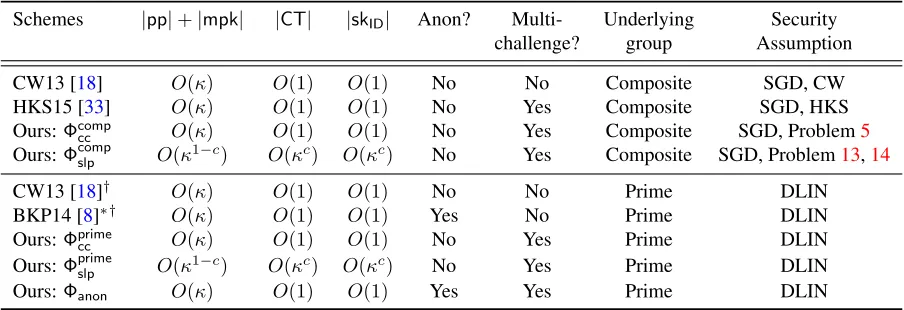
See Table1for overview of our schemes.
Table 1: Comparison of Almost Tight IBE from Static Assumptions
Schemes |pp|+|mpk| |CT| |skID| Anon? Multi- Underlying Security
challenge? group Assumption
CW13 [18] O(κ) O(1) O(1) No No Composite SGD, CW
HKS15 [33] O(κ) O(1) O(1) No Yes Composite SGD, HKS
Ours:Φcomp
cc O(κ) O(1) O(1) No Yes Composite SGD, Problem5
Ours:Φcompslp O(κ1−c) O(κc) O(κc) No Yes Composite SGD, Problem13,14
CW13 [18]† O(κ) O(1) O(1) No No Prime DLIN
BKP14 [8]∗† O(κ) O(1) O(1) Yes No Prime DLIN
Ours:Φprime
cc O(κ) O(1) O(1) No Yes Prime DLIN
Ours:Φprimeslp O(κ1−c) O(κc) O(κc) No Yes Prime DLIN
Ours:Φanon O(κ) O(1) O(1) Yes Yes Prime DLIN
We compare IBE schemes focusing tight security reduction from static assumptions in the standard model. |pp|+|mpk|,
|CT|, and|skID|show the size of the master public keys and public parameters, ciphertexts, and private keys, respectively. To
measure the efficiency, we count the number of group elements. In the table,κdenotes the security parameter. “Anon” shows whether the scheme is anonymous. “Multi-Challenge?” asks whether (almost) tight security reduction in the multi-challenge setting is shown. “SGD” stands for sub-group decision assumptions. “CW” and “HKS” denote specific assumption used in the corresponding paper. ForΦcompslp andΦprimeslp , we can assign any0≤c≤1.
∗
This is the only scheme that can be generalized to HIBE. †
These schemes can be generalized to be secure under thek-linear assumption (k-LIN) [30,51] for anyk ∈ N. In such
a case,|pp|+|mpk|, |CT|, and|skID|are changed to beO(k2κ),O(k), andO(k), respectively. Note that the DLIN
assumption corresponds to the2-LIN assumption.
1.3 Our Techniques
Difficulties.To solve the first question above, natural starting point would be trying to apply the frameworks for composite-order-to-prime-order-conversion dedicated to identity/attribute-based encryption [37,19,3,17, 2] to the HKS scheme [33]. However, security proofs for CW and HKS schemes significantly deviate from the most standard form of dual system encryption methodology [40, 42, 55, 4], only for which the above mentioned frameworks can be applied. Another approach is to try to convert specific assumptions they use into prime-order. In fact, Chen and Wee [18] were able to accomplish such a conversion for their scheme. However, their technique is non-generic and therefore it is highly unclear whether the same argument is possible for the assumptions that HKS use.
reduce the seed length of the Naor-Reingold PRF. However, this is a long-standing open problem and turns out to be quite difficult.
Our Strategy.In this paper, we introduce new proof techniques for IBE schemes (with almost tight security) that relyonly on the subgroup decision assumptions∗. This allows us to use frameworks for composite-order-to-prime-order conversions in the literature [25,47,37,24,28,3,17,2] (to name only a few) which converts subgroup decision assumption into a static assumption in prime-order groups, such as the DLIN assumption. Therefore, using these techniques, we are able to convert a variant of HKS scheme into prime-order. This answers the first question above. Note that in the security proof of HKS (and CW), they rely on some specific assumptions in composite-order groups in addition to subgroup decision assumptions. Because of these, it is unclear how to convert HKS scheme into prime-order.
As for the second question, we view Chen and Wee’s scheme as being constructed from, somewhat sur-prisingly,broadcast encryptionmechanism, instead of (Naor-Reingold) PRF, and hence can avoid the above difficulty regarding PRF. More precisely, we show that the task of constructing almost tightly secure IBE scheme is essentially reduced to a construction of broadcast encryption, and based on this idea, we are able to obtain the first IBE scheme with sub-linear size public parameters and almost tight security. In the following, we explain our technique.
Detailed Overview of Our Technique. Let us start from the following variant of the Chen and Wee’s IBE scheme. Let the identity space of the scheme be{0,1}`. Fori∈ {1,2,3}, letgibe the generator of a subgroup
of orderpiofG, which is bilinear groups of composite orderN =p1p2p3. Let alsohbe a generator of G.
The master public key, a ciphertext, and a private key for an identityIDare in the following form:
mpk = g1, g1w1,0, gw11,1, . . . , g1w`,0, g1w`,1, e(g1, h)α
,
CTID =
gs1, gs
P
i∈[1,`]wi,IDi
1 , e(g1, h)sα·M
, skID=
hα·gr
P
i∈[1,`]wi,IDi
1 , g
−r
1
whereIDi is the i-th bit of ID andM is the message.† Now we are going to show the security. We only
consider the single-challenge and single-instance case here for simplicity. In the security proof, at first, the challenge ciphertext is changed to the following form using a subgroup decision assumption:
gs1·g2ˆs, gs
P
i∈[1,`]wi,IDi
1 ·g
ˆ
sP
i∈[1,`]wi,IDi
2 , e(g
s
1·gs2ˆ, hα)·M
.
Then, we consider`hybrid games. InGamei, all private keys are in the following form:
hα· gbRi(ID|i)
2 ·g
rP
i∈[1,`]wi,IDi
1 , g
−r
1
whereID|i is the lengthiprefix of the identityID andRbi : {0,1}i → N is a random function. Intuitively, through these hybrid games, the randomizing part of the key (highlighted in the box) are gradually randomized and made dependent on more and more bits of each identity. Finally, in Game`, we can argue that any
adversary cannot obtain the information on the messageM, because these randomizing parts prevent it. A crucial part of the security proof is to establish the indistinguishability betweenGamei?−1andGamei?
for alli? ∈[1, `]. For the target identityID? (recall that we are considering the challenge and single-instance case for now), we assume thatb? :=ID?i?is known to the reduction algorithm in advance, since it can
∗
In fact, we also require the decisional bilinear Diffie-Hellman (DBDH) assumption on the composite-order groups (Problem5) in addition to the subgroup decision assumptions. However, the assumption does not use the power of composite-order groups. In other words, it doesnotimply the factoring assumption. Therefore, it is ready to be converted into prime-order.
†
be guessed with probability1/2. At the core of the proof for this is an indistinguishability of the following distributions:
Given
gs1·g2ˆs, gs
P
i∈[1,`]wi,ID?
i
1 ·g
ˆ
sP
i∈[1,`]wi,ID?
i 2
,
gr
P
i∈[1,`]wi,IDi
1 , g
−r
1
c ≈
gαˆ 2 ·g
rP
i∈[1,`]wi,IDi
1 , g
−r
1
(1)
for allID such thatIDi? 6= b?, whereαˆ ←$ ZN. Indistinguishability ofGamei?−1 andGamei? is reduced to
Equation (1). The reduction algorithm can create the challenge ciphertext using the first term in Equation (1). It can also set private key as
hα·gRbi?−1(ID|i?−1)
2 ·g
rP
i∈Swi,IDi
1 , g
−r
1 ifIDi? =b?
hα·gRbi?−1(ID|i?−1)
2 · g2αˆ ·g
rP
i∈Swi,IDi
1 , g
−r
1 ifIDi? 6=b?
whereαˆ = 0orαˆ ←$ ZN. It is clear that the game corresponds toGamei?−1ifαˆ = 0. On the other hand, if ˆ
α←$ ZN, it corresponds toGamei? with
b
Ri?(ID|i?) = (
b
Ri?−1(ID|i?−1) ifIDi? =b?
b
Ri?−1(ID|i?−1) + ˆα ifIDi? 6=b?
.
Ifαˆ is freshly chosen for every distinctID|i?, the simulation is perfect. Therefore, our task of the security
proof is reduced to establish Equation (1). To understand better, we decompose the private key in Equation (1) and restate it again in a slightly stronger form:
Given
g1s·g2ˆs, gs
P
i∈[1,`]wi,ID?i
1 ·g
ˆ
sP
i∈[1,`]wi,ID?i
2
,
g1rwi?,1−b?, g1−r,{grw1 j,b}(j,b)6=(i?,1−b?)
c
≈g2αˆ ·g1rwi?,1−b?, g1−r,{grw1 j,b}(j,b)=(6 i?,1−b?)
.
Let us consider a bijection mapf :{(i, b)}i∈[1,`],b∈{0,1} → [1,2`]and replace(i, b) withf((i, b)). We can further restate the requirement as:
Given g1s·g2ˆs, gs
P
j∈S?wj
1 ·g
ˆ
sP
j∈S?wj 2
,
grwτ ? 1 , g
−r
1 ,{g
rwj 1 }j6=τ?
c
≈gα2ˆ ·grwτ ? 1 , g
−r
1 ,{g
rwj 1 }j6=τ?
(2)
whereS? ={f(i,IDi?)}i∈[`], τ? = f((i?,1−b?)), and thusτ? 6∈ S?.We call the terms in the second line
above as the challenge terms. (It should not be confused with challenge ciphertext.) At this point, we can now see a similarity to broadcast encryption. We consider the following broadcast encryption which captures the essence of the above requirement. Let the set of user index be[1,2`].
mpk = (g1, g1w1, . . . , g
w2`
1 , e(g1, h)α),
CTS = (g1s, g
sP
j∈Swj
1 , e(g1, h)sα·M), skτ = (hαg1rwτ, g
−r
1 ,{g
rwj
1 }j∈[2`]\{τ})
whereCTS is a ciphertext for a setS⊆[2`]andskτ is a private key for a user indexτ ∈[2`]. This is in fact
from a semi-functional private key forτ?. At this point, we are able to understand the core technique in Chen and Wee in terms of broadcast encryption scheme.
However, we have not finished yet. In order to make the proof go through, we argue that an adversary cannot distinguish challenge terms in Equation (2), even if these are given to the adversaryunbounded many timeswith freshly chosen randomness α, rˆ . Such an indistinguishability can be shown by a standard tech-nique [38,55,4] if the challenge term is given to the adversaryonly once. This can be accomplished by the combination of subgroup decision assumption and the parameter-hiding argument. In parameter-hiding argu-ment, a value which is information-theoretically hidden is used to make normal private key semi-functional [40,38,55,4]. At the first glance, this argument does not seem to be extended to the case where many chal-lenge terms are given to the adversary, since entropy of hidden parameters (in this case,w1, . . . , w2` mod p2)
is limited. However, we have to simulate unbounded number of challenge terms. Chen and Wee [18] resolve this problem by using computational argument instead of information-theoretic argument as above. Namely, they assume a variant of the DDH assumption onGp2
‡and embed the problem instance into the above
chal-lenge terms. Indistinguishability of multiple chalchal-lenge terms are tightly reduced to the assumption, using the random self-reducibility of the assumption. On the other hand, our technique for boosting to multi-challenge is much simpler. Our key observation is that the challenge term in Equation (2) can be easily randomized by pickinga←$ ZN and computing
g2αˆ·grwτ ? 1
a
, g−1ra
,{ grwj 1
a
}j6=τ?
=gα2ˆ0 ·gr0wτ ? 1 , g
−r0 1 ,{g
r0wj 1 }j6=τ?
, (3)
wherer0 = arandαˆ0 = aαˆ. It is easy to see thatr0 mod p1 is uniformly random and independent from
anything. We can also see thatαˆ0 mod p2 = 0 ifαˆ = 0andαˆ0 modp2 is uniformly random ifαˆ 6= 0 modp2. By this argument, we can see that indistinguishability of the single-challenge-term case implies that
for the multi-challenge-term case. Based on all the above discussion, we are able to show the security for the above schemeonly using the subgroup decision assumption.
Overview of Our Framework. We refine the idea above and combine it with the technique by HKS to propose our framework for constructing IBE schemes that are (almost) tightly secure in the multi-challenge and multi-instance setting, in both composite and prime-order groups. We first define a broadcast encoding, which is an abstraction of broadcast encryption. The syntax of it is a special case of “pair encoding” in [4] (also similar to “predicate encoding” in [55]). Then, we define perfect master-key hiding (PMH) security and computational-master-key hiding (CMH) security for it. These security notions are also similar to those of [55, 4]. The former is statistical requirement for the encoding, and the latter is computational requirement. We can easily show that the former implies the latter. Then, we also introduce intermediate notion multi-master-key hiding (MMH) security for the encoding. This is more complex notion compared to the PMH and CMH-security, but implied by these, thanks to our boosting technique above. Then, we show that broadcast encoding satisfying the MMH security requirement can be converted into IBE scheme. All these reductions are (almost) tightness-preserving, namely, if the original broadcast encoding is tightly PMH/CMH secure, the resulting IBE scheme is also tightly secure in the multi-challenge and multi-instance setting. Finally, we provide broadcast encoding schemes that satisfy our requirement. One is implicit in Gentry-Waters broadcast encryption scheme [27] and the other is completely new. By instantiating our general framework with the latter construction, we obtain IBE scheme with almost tight security and with sub-linear master public key size.
‡
Of course, in symmetric bilinear groups, the DDH assumption does not hold. They considered a DDH assumption onGp2where
1.4 Related Works
Related Works on IBE.The first realizations of IBE in the random oracle model were given in [12,50,22]. Later, realization in the standard model [15, 9] were given. In the random oracle model, it is possible to obtain efficient and tightly secure IBE scheme [5]. Gentry [26] proposed a tightly secure anonymous IBE scheme under a non-static, parametrized assumption. Chen and Wee proposed the first almost tightly secure IBE scheme under static and simple assumptions [18,20]. Attrapadung [4] proposed an IBE scheme whose security loss only depends on the number of key queries before the challenge phase. Jutla and Roy [34] constructed very efficient IBE scheme from the SXDH assumption, based on a technique related to NIZK. Blazy, Kiltz, and Pan [8] further generalized the idea and show that a message authentication code with a certain specific algebraic structure implies (H)IBE. They further obtained almost tightly secure anonymous IBE and (non-anonymous) HIBE via the framework. Note that all above mentioned schemes only focus on the single-challenge setting.
Related Works on the Multi-Challenge CCA-Secure PKE.Bellare, Boldyreva, and Micali [6] gave a tight reduction for the Cramer-Shoup encryption [23] in the multi-instance (multi-user) and the single-challenge setting. They posed an important open question of whether it is possible to construct tightly CCA-secure PKE scheme in the multi-instance and the multi-challenge setting. The first PKE scheme satisfying the re-quirement was proposed by Hofheinz and Jager [32]. Their scheme requires hundreds of group elements in the ciphertexts. Subsequently, Abe et al. [1] reduced the size by improving the efficiency of the underlying one-time signature. Libert et al. [35] greatly reduced the ciphertext and made it constant-size for the first time. The ciphertext overhead of their scheme consist of68group elements. Very recently, Libert et al. [36] further reduced it to47group elements. Concurrently and independently to us, Hofheinz [29] proposes the first PKE scheme with the same security guarantee and fully compact parameters, which means all parameters are constant-size. While the ciphertext-size (which consists of60group elements) is longer than construction in [36], it achieves much shorter public parameters. We note that while the technique is very powerful, it is unclear how to extend the technique to the IBE setting.
2
Preliminaries
Notation. Vectors will be treated as either row or column vector matrices. When unspecified, we shall let it be a row vector. We denote byei thei-th unit (row) vector: itsi-th component is one, all others are zero. 0denotes the zero vector or zero matrix. For an integern∈ Nand a fieldF,GLn(F)denotes the set of all
invertible matrix inFn×n. For a multiplicative groupG, we denote byG∗ a set of all generatorsinG. We
also denote by[a, b]a set {a, . . . , b}for any integeraandband[n] = [1, n]for anyn ∈ N. We denote by u←$ U the fact thatuis picked uniformly at random from a finite setU.
2.1 Identity-based Encryption
In this section, we define the syntax and security of IBE (in the multi-challenge, multi-instance setting).
Syntax.An IBE scheme with identity spaceIDand message spaceMconsists of the following algorithms:
Par(1κ)→(pp,sp): The parameter sampling algorithm takes as input a security parameter1κ and outputs a public parameterppand a secret parametersp.
Gen(pp,sp)→(mpk,msk): The key generation algorithm takes pp and sp as input and outputs a master public keympkand master secret keymsk.
Ext(msk,mpk,ID)→skID: The user private key extraction algorithm takes as input the master secret key
Enc(mpk,ID,M)→CT: The encryption algorithm takes as input a master public keympk, an identityID, and a messageM∈ M. It will output a ciphertextCT.
Dec(skID,CT)→M: The decryption algorithm takes as input a private key skID and a ciphertext CT. It outputs a messageMor⊥which indicates that the ciphertext is not in a valid form.
We require correctness of decryption: that is, for allκ, allppandspproduced byPar(1κ), all(mpk,msk)
produced byGen(pp,sp), allID∈ ID, allM∈ M, allCTreturned byEnc(mpk,ID,M), and allskIDreturned byExt(msk,mpk,ID),Dec(skID,CT) =Mholds.
In our constructions, we will set identity spaceID = {0,1}` for some` ∈
N. Note that the restriction
on the identity space can be easily removed by applying a collision resistant hash functionCRH:{0,1}∗ → {0,1}`to an identity. Typically, we would set`= Θ(κ)to avoid the birthday attack.
Security Model. We now define(µ, Qc, Qk)-security for an IBEΦ= (Par,Gen,Ext,Enc,Dec). This
secu-rity notion is defined by the following game between a challenger and an attackerA.
Setup. The challenger runs(pp,sp) ←$ Par(1κ)and(mpk(j),msk(j))←$ Gen(pp,sp)forj ∈[µ]. The chal-lenger also picks random coincoin← {$ 0,1}whose value is fixed throughout the game. Then,(pp,{mpk(j)}
j∈[µ])
is given toA.
In the following,Aadaptively makes the following two types of queries in an arbitrary order.
−Key Extraction Query. The adversary Asubmits(Extraction, j ∈ [µ],ID ∈ ID) to the challenger. Then, the challenge runssk(IDj)←$ Ext(msk(j),mpk(j),ID)and returnssk(IDj)toA.
−Challenge Query. The adversary A submits (Challenge, j ∈ [µ],ID ∈ ID,M0,M1 ∈ M) to the
challenger. Then, the challenger runsCT←$ Enc(mpk(j),ID,Mcoin)and returnsCTtoA.
Guess. At last,Aoutputs a guess coin0 forcoin. The advantage of an attackerAin the game is defined as
AdvIBEA,Φ,(µ,Qc,Qk)(κ) =|Pr[coin0 =coin]−12|.
We say that the adversaryAis valid if and only ifAnever queries(Extraction, j,ID)such that it has already queried(Challenge, j,ID,M0,M1)for the same(j,ID)(and vice versa);Ahas made at mostQc
challenge queries; andAhas made at mostQkkey extraction queries.
Definition 1. We say that IBEΦis secure ifAdvIBEA,Φ,(µ,Qc,Qk)(κ)is negligible for any polynomially bounded
µ,Qc,Qk, and any valid PPT adversaryA.
Anonymity. We also consider anonymity for the IBE scheme. To define(µ, Qc, Qk)-anonymity for an IBE
scheme, we change the form of challenge queries in the above game as follows.
−Challenge Query. The adversaryAsubmits(Challenge, j ∈[µ],ID0,ID1 ∈ ID,M0,M1 ∈ M)to the
challenger. Then, the challenger runsCT←$ Enc(mpk(j),IDcoin,Mcoin)and returnsCTtoA.
We say that the adversaryAis valid ifAnever queries(Extraction, j,ID)such that it has already queried
(Challenge, j,ID0,ID1,M0,M1)for the samejandID∈ {ID0,ID1}(and vice versa);Ahas made at most
Qcchallenge queries; andAhas made at most Qkkey extraction queries. We define the advantage ofAin
this modified game asAdvAIBEA,Φ,(µ,Q
c,Qk)(κ) :=|Pr[coin
0 =coin]−1 2|.
Definition 2. We say that IBE Φ is anonymous if AdvAIBEA,Φ,(µ,Q
c,Qk)(κ) is negligible for any polynomially boundedµ,Qc,Qk, and any valid PPT adversaryA.
2.2 Composite-Order Bilinear Groups
We will use bilinear group(G,GT)of composite orderN =p1p2p3p4, wherep1,p2,p3,p4are four distinct
prime numbers, with efficiently computable and non-degenerate bilinear mape(·) :G×G→GT. For each d|N,Ghas unique subgroup of orderddenoted byGd. We letgi be a generator ofGpi. For our purpose,
outputs (N,G,GT, g1, g2, g3, g4, e(·)). Any h ∈ G can be expressed ash = g1a1g
a2 2 g
a3 3 g
a4
4 , where ai is
uniquely determined modulopi. We callgiai theGpi component ofh. We have thate(g
a, hb) =e(g, h)abfor
anyg, h∈G,a, b∈Z,e(g, h)6= 1GT forg, h6= 1G, ande(g, h) = 1GT forg∈Gpi andh∈Gpjwithi6=j.
Let(N,G,GT, g1, g2, g3, g4, e(·))
$
← Gcomp(1κ)andg ←$ G∗. We define advantage functionAdvPAxx(κ)
for Problem xx for any adversaryAas
AdvPAxx(κ) =|Pr[A(g1, g4, g, D, T0)→1]−Pr[A(g1, g4, g, D, T1)→1]|.
In each problem,D, T0, andT1 are defined as follows. In the following, fori, j ∈ [1,4], gij is chosen as
gij ←$ G∗p
ipj.
Problem 1. D=∅,T0
$ ←G∗
p1, andT1
$ ←G∗
p1p2.
Problem 2. D= (g12, g3, g24),T0 ←$ G∗p1p4, andT1
$ ←G∗p
1p2p4.
Problem 3. D= (g13, g2, g34),T0
$ ←G∗
p1p4, andT1
$ ←G∗
p1p3p4.
Problem 4. D= (g12, g23),T0 ←$ G∗p1p2, andT1
$ ←G∗p
1p3.
Problem 5. D= (g2, g3, g2x, g
y
2, g2z),T0 =e(g2, g2)xyz, andT1 =e(g2, g2)xyz+γ, wherex, y, z
$
←ZN and γ ←$ Z∗N.
Problem1 2,3, and4are called sub-group decision problems. Problem5is called the decisional bilinear Diffie-Hellman problem.
Matrix-in-the-Exponent. Given any vector w = (w1, . . . , wn) ∈ ZnN and a group element g, we write gw ∈ Gn to denote (gw1, . . . , gwn) ∈
Gn: we define gA for a matrix A in a similar way. gA·gB
de-notes componentwise product: gA·gB = gA+B. Note that givengA and a matrixB of “exponents”, one can efficiently computegBA andgAB = (gA)B. Furthermore, if there is an efficiently computable map
e : G×G → GT, then given gA andgB, one can efficiently computee(g, g)A
>B
via (e(g, g)A>B)i,j =
Q
ke(gAk,i, gBk,j)whereAi,j andBi,j denotes the(i, j)-th coefficient ofAandBrespectively. We will use e(gA, gB) =e(g, g)A>Bto denote this operation.
3
Broadcast Encoding: Definitions and Reductions
3.1 Broadcast Encoding: Syntax
The broadcast encodingΠconsists of the following four deterministic algorithms.
Param(n, N)→d1 : It takes as input an integernandN and outputsd1 ∈Nwhich specifies the number of
common variables inCEncandKEnc. For the default notation,w= (w1, . . . , wd1)denotes the list of
common variables.
KEnc(τ, N)→(k, d02) : It takes as input τ ∈ [n], N ∈ N, and outputs a vector of polynomials k = (k1, . . . , kd2)with coefficients inZN, andd
0
2 ∈Nthat specifies the number of its own variables. We
as-sume thatd2andd02only depend onnand do not depend onτwithout loss of generality. We require that
each polynomialskis alinear combination of monomialsα,rj,wkrjwhereα, r1, . . . , rd02, w1, . . . , wd1
are variables. More precisely, it outputs{bι}ι∈[d2], {bι,j}(ι,j)∈[d2]×[d02], and {bι,j,k}(ι,j,k)∈[d2]×[d02]×[d1]
inZN such that
kι
α, r1, . . . , rd02, w1, . . . , wd1
=bια+
X
j∈[d02]
bι,jrj
+ X
(j,k)∈[d02]×[d1]
bι,j,kwkrj
forι∈[d2].
CEnc(S, N)→(c, d03) : It takes as input S ⊆ [n], N ∈ N, and outputs a vector of polynomials c = (c1, . . . , cd3)with coefficients inZN, andd
0
3 ∈ Nthat specifies the number of its own variables. We
require that polynomialscin variabless0, s1, . . . , sd0
3, w1, . . . , wd1 has the following form:
There exist (efficiently computable) set of coefficients{aι,j}(ι,j)∈[d3]×[0,d0
3]and{aι,j,k}(ι,j,k)∈[d3]×[0,d03]×[d1]
inZN such that
cι
s0, s1, . . . , sd0
3, w1, . . . , wd1
=
X
j∈[0,d0 3]
aι,jsj
+
X
(j,k)∈[0,d0 3]×[d1]
aι,j,kwksj
forι∈[d3]. We also require thatc1 =s0.
Pair(τ, S, N)→E: It takes as inputτ ∈[n],S ⊆[n], andN ∈Nand outputs a matrixE= (Ei,j)i∈[d2],j∈[d3]∈
ZdN2×d3.
Correctness.The correctness requirement is as follows.
• We require that for anyn,N, d1 ← Param(n, N), k ← KEnc(τ, N), c ← CEnc(S, N), and E ←
Pair(τ, S, N), we have that
kEc>=αs0 whenever τ ∈S.
The equation holds symbolically, or equivalently, as polynomials in variables α, r1, . . . , rd02, s0, s1,
· · ·, sd0
3, w1, . . . , wd1.
• Forp that dividesN, if we let KEnc(τ, N) → (k, d20) andKEnc(τ, p) → (k0, d002), then it holds that
d02 =d002 andk mod p=k0. The requirement forCEncis similar.
Note that sincekEc> = P
(i,j)∈[d2]×[d3]Ei,jkicj, the first requirement amounts to check if there is a
linear combination ofkicj terms summed up to αs0. In the descriptions of proposed broadcast encoding
3.2 Broadcast Encoding: Security
Here, we define two flavours of security notions for broadcast encoding: perfect security and computational security. As we will see, the former implies the latter. In what follows, we denote w = (w1, . . . , wd1),
r= (r1, . . . , rd02), ands= (s0, s1, . . . , sd03).
(Perfect Security.) The pair encoding scheme Π = (Param,KEnc,CEnc,Pair) isQ-perfectly master-key hiding (Q-PMH) if the following holds. For anyn ∈N, primep ∈ N,τ ∈ [n], andS1, . . . , SQ ⊂ [n]such
thatτ 6∈Sj for allj ∈ [Q], letParam(n, p) → d1,(kτ, d02) ← KEnc(τ, p), and(cSj, d
0
3,j) ← CEnc(Sj, p)
forj∈[Q], then the following two distributions are identical:
{cSj(sj,w)}j∈[Q], kτ(0,r,w) and
{cSj(sj,w)}j∈[Q], kτ(α,r,w) (4)
wherew←$ Zdp1,α $
←Zp,r←$ (Z∗p)d
0
2,sj ←$ Zd 0 3+1
p forj∈[Q].
(Computational Security onGp2). We defineQ-computational-master-key hiding (Q-CMH
§) security on
Gp2 for a broadcast encodingΠ = (Param,KEnc,CEnc,Pair)by the following game. At the beginning of
the game, an (stateful) adversaryAis given(1κ, n)and choosesτ? ∈ [n]. Then, parameters are chosen as
(N,G,GT, g1, g2, g3, g4, e(·))
$
← Gcomp(1κ), Param(n, N) → d1, andwˆ
$
← ZdN1. The advantage of Ais
defined as
AdvCMHA,Π,Q,Gp
2(κ) =|Pr[A(1
κ, n)→τ?, A(g
1, g2, g3, g4)
OCMH,C
τ ?,wˆ (·),O
CMH,K
τ ?,wˆ,0(·) →1]−
Pr[A(1κ, n)→τ?, A(g1, g2, g3, g4)
OCMH,C
τ ?,wˆ (·),O
CMH,K
τ ?,wˆ,1(·)→1]|.
In the above,OCMHτ?,wˆ,b,K(·)forb∈ {0,1}are called only once whileO
CMH,C
τ?,wˆ (·)can be called at mostQtimes.
These oracles can be called in any order.
• OCMHτ?,wˆ,C(·) takes S ⊂ [n] such that τ? 6∈ S as input. It then runs CEnc(S, N) → (c, d03), picks ˆs = (ˆs0,sˆ1, . . . ,ˆsd03)
$
← Zd03+1
N , and returns g c(ˆs,wˆ)
2 . We note thatˆsis freshly chosenevery time the
oracle is called.
• OCMHτ?,wˆ,b,K(·) ignores its input. When it is called, it first runs KEnc(τ?, N) → (k, d02) and picksˆr = (ˆr1, . . . ,ˆrd02)
$ ←Zd02
N andαˆ $
←ZN. Then it returns
gk2(b·α,ˆˆr,wˆ)= (
g2k(0,ˆr,wˆ) ifb= 0
g2k( ˆα,ˆr,wˆ) ifb= 1.
We say that the broadcast encoding isQ-CMH secure on Gp2 ifAdv
CMH
A,Π,Q,Gp2(κ)is negligible for all PPT
adversaryA.
(Computational Security onGp3). We define Adv
CMH
A,Π,Q,Gp3(κ) andQ-CMH security on Gp3 via similar
game. The difference from the above game is thatgc2(ˆs,wˆ)andg2k(b·α,ˆˆr,wˆ)above are replaced withgc3(ˆs,wˆ)and
g3k(b·α,ˆˆr,wˆ)respectively.
COMPARISON WITHDEFINITION IN[4]. By settingQ= 1, theQ-PMH and theQ-CMH security defined as above almost correspond to the perfect security and the co-selective security defined in[4]respectively. We
§
need to deal with the case ofQ1in order to handle the multi-challenge setting. Another difference is that we use groups with the order being a product of four primes, while they deal with a product of three primes.
We have the following lemma which indicates that Q-PMH security unconditionally implies Q-CMH security on both ofGp2 andGp3. The proof appears in AppendixA.
Lemma 1. Assume that a broadcast encodingΠsatisfiesQ-PMH security for someQ∈N. Then it follows thatAdvCMHA,Π,Q,Gpi(κ)≤d
0
2/pifori∈ {2,3}.
3.3 Multi-Master-Key Hiding Security in Composite Order Groups
Here, we define multi-master-key hiding security for a broadcast encoding, which is more complex security notion compared to the CMH security. A broadcast encoding scheme that satisfies the security notion can be converted into an IBE scheme as we will show in Section4.
Multi-Master-Key Hiding Security (on Gp2). We define (Qc, Qk)-multi-master-key hiding ((Qc, Qk)
-MMH) security onGp2 for a broadcast encodingΠ = (Param,KEnc,CEnc,Pair). The security is defined
by the following game. At the beginning of the game,Ais given(1κ, n) and choosesτ? ∈ [n]. Then, pa-rameters are chosen as(N,G,GT, g1, g2, g3, g4, e(·))← G$ comp(1κ),g24←$ G∗p2p4,d1 ← Param(n, N), and
w←$ ZdN1. The advantage ofAis defined as
AdvMMHA,Π,(Qc,Qk),
Gp2(κ) =|Pr[A(1
κ, n)→τ?, A(g
1, gw1 , g3w, g24, g3, g4)
OMMH,C
τ ?,w (·),O MMH,K
τ ?,w,0(·)→1]−
Pr[A(1κ, n)→τ?, A(g1, gw1 , g3w, g24, g3, g4)
OMMH,C
τ ?,w (·),O MMH,K
τ ?,w,1(·)→1]|.
In the above,OτMMH?,w,C(·) andOτMMH?,w,b,K(·) forb ∈ {0,1}can be called at mostQc times andQk times,
respectively. They can be called in any order.
• OMMHτ?,w,C(·) takes S ⊂ [n] such thatτ? 6∈ S as input. It then runs CEnc(S, N) → (c, d03), picks
s←$ Zd03+1
N andˆs $
←Zd03+1
N and returnsg c(s,w) 1 ·g
c(ˆs,w) 2 .
• OMMHτ?,w,b,K(·)ignores its input. When it is called, it first runsKEnc(τ?, N) → (k, d02), picksαˆ
$ ← ZN,
r←$ Zd
0 2
N,δ $
←ZdN2. Then it returns
g1k(0,r,w)·g2k(b·α,ˆ0,0)·g4δ= (
g1k(0,r,w)·g4δ ifb= 0
g1k(0,r,w)·g2k( ˆα,0,0)·gδ4 ifb= 1.
In the above, r,αˆ, and δas well as s andˆsare all freshly chosenevery time the corresponding oracle is called. We say that the broadcast encoding is(Qc, Qk)-MMH secure onGp2 ifAdv
MMH
A,Π,(Qc,Qk),Gp2(κ)is
negligible for all PPT adversaryA.
Multi-Master-Key Hiding Security (onGp3).We define(Qc, Qk)-MMH security onGp3andAdv
MMH
A,Π,(Qc,Qk),Gp3(κ)
similarly to the above. The difference is the following.
• The input toAis replaced with(g1, gw1 , g2w, g34, g2, g4).
• g1c(s,w)·gc2(ˆs,w)in the above is replaced withgc1(s,w)·g3c(ˆs,w).
3.4 Reduction from MMH security to CMH security
We then prove that the(Qc, Qk)-MMH security for a broadcast encoding onGp2 (resp. Gp3) can be tightly
reduced to itsQc-CMH security onGp2(resp.Gp3) and the hardness of the Problem2(resp.3).
Theorem 1. For anyi∈ {2,3}, broadcast encodingΠ, and adversaryA, there exist adversariesB1 andB2
such that
AdvMMHA,Π,(Q
c,Qk),Gpi(κ)≤Adv
CMH
B1,Π,Qc,Gpi(κ) + 2Adv
Pxx
B2 + 1
pi
andmax{Time(B1),Time(B2)} ≈ Time(A) + (Qk+Qc)·poly(κ, n) wherepoly(κ, n)is independent of
Time(A). In the above,Pxx =P2 ifi= 2andPxx=P3ifi= 3.
Proof. By the symmetry between the case ofi = 2 andi = 3, it suffices to show the theorem for the case ofi = 2. Here, we introduce Lemma2 and3. The former indicates that (Qc, Qk)-MMH security can be
tightly reduced to(Qc,1)-MMH security. The latter shows(Qc,1)-MMH security can be tightly reduced to
the hardness of the Problem2andQc-CMH security. Combining these lemmas, the theorem follows. ut
Lemma 2. For any broadcast encodingΠand adversaryA, there exists another adversaryBsuch that
AdvMMHA,Π,(Qc,Q
k),Gp2(κ)≤Adv
MMH
B,Π,(Qc,1),Gp2(κ) + 1
p2
andTime(B)≈Time(A) +Qk·poly(κ, n)wherepoly(κ, n)is independent ofTime(A).
Proof. We constructBagainst (Qc,1)-MMH security of the broadcast encoding from Aagainst(Qc, Qk)
-MMH security of the same encoding. At the beginning of the game,A(1κ, n)submits its target indexτ? ∈[n].
Bthen submits the same index and is given(g1, gw1 , g3w, g24, g3, g4). Then,Bsimply pass it toA.Balso calls
OMMHτ?,w,b,K(·)to obtaing
k(0,r,w) 1 ·g
k(b·α,ˆ0,0)
2 ·gδ4. In the following, we assume thatαˆ 6= 0 modp2. This happens
with probability at least1−1/p2. WhenAcallsOMMHτ?,w,C(·)on inputS,Bcalls the same oracle on the same
input and passes what is given from the oracle toA. WhenAcallsOτMMH?,w,b,K(·),B picks randoma
$ ← ZN,
r0 ←$ Zd02
N, andδ
0 $ ←Zd2
N, computes
g1k(0,r,w)·g2k(b·α,ˆ0,0)·gδ4a·g1k(0,r0,w)·gδ40 =gk1(0,ar+r0,w)·g2k(b·aα,ˆ0,0)·ga4δ+δ0,
and returns it toA. Finally,B outputsA’s output as its guess. It is easy to see that the simulation byBis perfect. In particular,Bhas made only single call toOτMMH?,w,b,K(·). Therefore, the lemma follows. ut
Lemma 3. For any broadcast encodingΠand adversaryA, there exist adversariesB1 andB2such that
AdvMMHA,Π,(Qc,1),
Gp2(κ)≤Adv
CMH
B1,Π,Qc,Gp2(κ) + 2Adv
P2
B2
andmax{Time(B1),Time(B2)} ≈Time(A) +Qcpoly(κ, n)wherepoly(κ, n)is independent ofTime(A).
Proof. We prove the lemma via the following sequence of games. We consider following games for b ∈ {0,1}. We writeEventxxto denote the probability thatAoutputs1inGamexx.
Game0,b: This is the(Qc,1)-MMH security game with oraclesOτMMH?,w,C(·)andOτMMH?,w,b,K(·).
Game1,b: In this game, we changeOτMMH?,w,b,K(·)as follows: When it is called,O
MMH,K
τ?,w,b (·)runsKEnc(τ?, N)→
k, picks αˆ ←$ ZN, r,ˆr ←$ Zd02
N, and δ $ ← Zd2
N, and returns g k(0,r,w)
1 · g
k(bα,ˆˆr,w)
2 ·g4δ instead of
We have that
AdvMMHA,Π,(Q
c,1),Gp2(κ) =|Pr[Event0,0]−Pr[Event0,1]|
≤ |Pr[Event1,0]−Pr[Event1,1]|+
X
b∈{0,1}
|Pr[Event0,b]−Pr[Event1,b]|.
Therefore, we complete the proof of the lemma by showing the following claims. ut
Claim 1. (Game0,btoGame1,b).For anyb∈ {0,1}and adversaryA, there exists an adversaryB1such that
|Pr[Event0,b]−Pr[Event1,b]| ≤AdvPB21(κ)andTime(B1)≈Time(A) +Qc·poly(κ, n)wherepoly(κ, n)is independent ofTime(A).
Proof. We constructB1that attacks Problem2fromA. Given the problem instance(g1, g3, g4, g12, g24, g, T)
whereT ←$ G∗p1p4 orT
$
←G∗p1p2p4,B1simulates(Qc,1)-MMH security game forAas follows.
Setup of Parameters.Givenτ?fromA,B1picksw
$
←ZdN1 and gives(g1, g1w, gw3 , g24, g3, g4)toA.
SimulatingOτMMH?,w,C(·). GivenS,B1runsCEnc(S, N)→(c, d03)and pickss0 = (s00, s01, . . . , s0d0 3)
$
←Zd03+1
N .
Then it returnsg12c(s0,w)toA. Letg12 be g12 = g1a1 ·g2a2 (where a1 ∈ Z∗p1 anda2 ∈ Z
∗
p2). Then we have
gc(s
0,w) 12 = g
c(a1s0,w)
1 ·g
c(a2s0,w)
1 . This implicitly sets = a1s0 modp1 andˆs = a2s0 mod p2. Since (s modp1,ˆs mod p2)inGame0,bandGame1,bas well as(a1s0 mod p1, a2s0 mod p2)in the simulation are
uniformly distributed over Zp1 ×Zp2 due to the Chinese Remainder Theorem, B1 correctly simulates the
oracle.
Simulating OMMHτ?,w,b,K(·). When it is called, B1 runs KEnc(τ?, N) → k, picksαˆ0
$
← ZN, r0 ←$ Zd02
N, and δ0 ←$ Zd2
N. Then it returnsTk(0,r
0,w)
·g24k(b·αˆ0,0,0)·g4δ0toA. We claim thatB1simulatesGame0,bifT
$
←G∗p1p4andGame1,bifT
$
←G∗p1p2p4. LetTbeT =g
t1 1 ·g
t2 2 ·g
t4 4
andg24beg24=g2u2gu44. Then we have
Tk(0,r0,w)·g24k(b·αˆ0,0,0)·gδ40 =gk(0,t1r0,w)
1 ·g
k(b·u2αˆ0,t2r0,w)
2 ·g
δ0+k(bu4αˆ0,t4r0,w)
4 . (5)
At first, we observe that theGp4 component of the Equation (5) is uniformly random overG
d2
p4 regardless of
T ←$ G∗
p1p4 orT
$ ←G∗
p1p2p4, as desired.
If T ←$ G∗
p1p4, we have t2 = 0 and therefore Gp2 component of the Equation (5) isg
k(b·u2αˆ0,0,w)
2 =
gk(b·u2αˆ0,0,0)
2 . In this case, B1 implicitly setsr = t1r
0 modp
1, αˆ = u2αˆ0 modp2. It can be seen that
t1r0 mod p1andu2αˆ0 mod p2 are uniformly distributed overZd
0 2
p1 andZp2 respectively. Therefore,B1 has
correctly simulatesOMMHτ?,w,b,K(·)inGame0,b.
In the case ofT ←$ G∗p
1p2p4, B1 implicitly setsr = t1r
0 modp
1,ˆr = t2r0 mod p2, andαˆ = u2αˆ0 modp2. Due to the Chinese Remainder Theorem, (r modp1,ˆr modp2) in Game1,b as well as (t1r0 modp1, t2r0 mod p2)in the simulation are uniformly distributed overZp1 ×Zp2. Furthermore,αˆ =u2αˆ
0
modp2is also uniformly random overZp2. Therefore,B1 correctly simulatesO
MMH,K
τ?,w,b (·)inGame1,b. Guess. Finally, B1 outputs A’s output as its guess. As we have seen, the game corresponds toGame0,b if T ←$ G∗p
1p4 andGame1,b ifT
$ ← G∗p
1p2p4. Thus, we may conclude that |Pr(Event0,b)−Pr(Event1,b)| ≤
AdvP2
B1(κ). ut
Proof. We constructB2againstQc-CMH security of the broadcast encoding fromA.
Setup of Parameters.At the beginning of the game,A(1κ, n)submits indexτ? ∈[n]. B2submits the same
index and is given(g1, g2, g3, g4). Then,B2 picksw¯
$ ← Zd1
N and implicitly setsw = ¯w mod p1,w = ¯w modp3, andw = ˆw mod p2 wherewˆ
$
← ZdN1 is chosen by the game (and is not explicitly known toB2).
By the Chinese Remainder Theorem,wis uniformly distributed overZdN1. B2also picksa $
← Z∗N and gives
(g1, g1w=gw1¯, gw3 =g3w¯, g24= (g2g4)a, g3, g4)toA.
SimulatingOMMHτ?,w,C(·).GivenSfromA,B2calls its oracleOτCMH?,wˆ,C(·)on inputSto obtaing
c(ˆs,wˆ)
2 . Then, it
pickss←$ Zd03+1
N and computesg c(s,w¯)
1 . Finally, it returnsg
c(s,w) 1 ·g
c(ˆs,w) 2 =g
c(s,w¯) 1 ·g
c(ˆs,wˆ) 2 toA.
SimulatingOMMHτ?,w,b,K(·). When it is called,B2 calls its oracleOCMHτ?,wˆ,b,K(·)to obtaing
k(bα,ˆˆr,wˆ)
2 . Then, it picks
r←$ Zd02
N,δ $ ←Zd2
N, computesg k(0,r,w¯)
1 , and givesg
k(0,r,w)
1 ·g
k(bα,ˆˆr,w)
2 ·g4δ=g
k(0,r,w¯)
1 ·g
k(bα,ˆˆr,wˆ)
2 ·gδ4 toA.
Guess.Finally,B2outputsA’s output as its guess. It is easy to see that the view ofAcorresponds toGame1,0
ifb= 0(i.e.,B2is equipped with the oracleOτCMH?,wˆ,,K0(·)) andGame1,1 ifb= 1(i.e.,B2is equipped with the
oracleOCMHτ?,wˆ,,1K(·)). Thus, we may conclude that|Pr[Event1,0]−Pr[Event1,1]| ≤AdvCMHB2,Π,Qc,Gp2(κ). ut
4
Almost Tight IBE from Broadcast Encoding in Composite-Order Groups
In this section, we show a generic conversion from a broadcast encoding scheme to an IBE scheme. An important property of the resulting IBE scheme is that(µ, Qc, Qk)-security of the scheme can be almost
tightly reduced to theQc-CMH security of the underlying broadcast encoding scheme (and Problem1,2,3,4,
and5). In particular, the reduction only incurs small polynomial security loss, which is independent ofµand
Qk. Therefore, if the underlying broadcast encoding scheme is tightlyQc-CMH secure, which is the case for
all of our constructions, the resulting IBE scheme obtained by the conversion is almost tightly secure. Note that in the following construction, we havesp=⊥. This mean that the key generation algorithmPardoes not output any secret parameter. This property will be needed to convert our IBE scheme into CCA secure PKE scheme in Section8.
Construction.Here, we construct an IBE schemeΦcompfrom a broadcast encodingΠ= (Param,KEnc,CEnc, Pair). Let the identity space of the scheme beID = {0,1}`and the message space beM = {0,1}m. We
also letHbe a family of pairwise independent hash functionsH:GT → M. We assume that
q 2m
p2 = 2
−Ω(κ)
so that the left-over hash lemma can be applied in the security proof.
Par(1κ) : It first runs(N,G,GT, g1, g2, g3, g4, e(·))
$
← Gcomp(1κ) andParam(2`, N) → d1. Then it picks
w←$ Zd1
N,a $ ←Z∗
N,H $
← Hand setsh:= (g1g2g3g4)a. Finally, it outputspp= (g1, g1w, g4, h,H)and
sp=⊥.
Gen(pp,sp) : It picksα←$ ZN and outputsmpk= (pp, e(g1, h)α)andmsk=α.
Ext(msk,mpk,ID) : It first setsS = {2i−IDi|i ∈ [`]}whereIDi ∈ {0,1} is thei-th bit ofID ∈ {0,1}`.
Then it runs KEnc(j, N) → kj, d02
and picks rj $ ← Zd
0 2
N and δj $
← ZdN2 for all j ∈ S. It also
picks random{αj ∈ZN}j∈S subject to constraint thatα =
P
j∈Sαj. Then, it computes g
kj(0,rj,w)
1 ,
Pair(j, S, N)→Ej, and
skj =hkj(αj0,0)·g
kj(0,rj,w)
1 ·g
δj
4 (6)
for allj ∈ S. Note that gkj(0,rj,w)
1 can be computed from gw1 and rj = (rj,1, . . . , rj,d02)efficiently
becausekj(0,rj,w) contains only linear combinations of monomialsrj,i,rj,iwj0. Finally, it outputs
Enc(mpk,ID,M) : It first setsS = {2i−IDi|i ∈ [`]}. Then it runs CEnc(S, N) → (c, d03), pickss = (s0, s1, . . . , sd03)
$ ← Zd
0 3+1
N , and computesg c(s,w)
1 . Note thatg
c(s,w)
1 can be computed fromg1wands
efficiently becausec(s,w)contains only linear combinations of monomialssi,siwj. Finally, it outputs
CT=C1 =gc1(s,w), C2 =H e(g1, h)s0α
⊕M. (7)
Here,⊕denotes bitwise exclusive OR of two bit strings.
Dec(skID,CT) : It parsesCT → (C1, C2) and computese(sk>ID, C1>) = e(g1, h)s0α. Then, it recovers the
message byM=C2⊕H(e(g1, h)s0α).
CORRECTNESS. We show the correctness of the scheme. It suffices to show the following.
e(sk>ID, C1>) = e (Y
j∈S
(skj)Ej)>, g c(s,w)> 1
= Y
j∈S
e hkj(αj0,0)·gkj(0,rj,w)
1 ·g
δj 4
>
, gEjc(s,w)> 1
= Y
j∈S e
gkj(aαj,rj,w)
1 ·(g2g3g4)
k(aαj,0,0)·gδj 4
>
, gEjc(s,w)> 1
= Y
j∈S
e(g1, g1)kj(aαj,rj,w)Ejc(s,w) >
= Y
j∈S
e(g1, g1)s0aαj = Y
j∈S
e(g1, h)s0αj =e(g1, h)s0α.
The fifth equation above follows from the correctness of the broadcast encoding.
REMARK. It would be more intuitive to setskIDas{skj}j∈S instead of defined as above. In such a case, the
decryption algorithm first computese((skEjj)>, C1>) = e(g1, g1)k(aαj,rj,w) >E
jc(s,w) = e(g
1, h)s0αj. Then
it computesQ
j∈Se(g1, h)s0αj =e(g1, h)s0α and recovers the message. Since the sameS and{Ej}j∈Sare
always used in the algorithm, it can be accelerated by pre-computingQ
j∈Ssk Ej
j . In our scheme described
above, we use this value as a private key. This optimization not only accelerate the decryption algorithm, but also makes the private key shorter.
Security. The following theorem indicates that the security of the IBE is (almost) tightly reduced to the MMH security of the underlying broadcast encoding onGp2 andGp3 and Problem1,4, and5. Combining the
theorem with Theorem1, the security of the scheme can be almost tightly reduced to theQc-CMH security of
the underlying encoding (and Problem1,2,3,4, and5). The reduction only incursO(`)security loss. The proof will appear in AppendixB.
Theorem 2. For any adversaryA, there exist adversariesBifori∈[1,5]such that
AdvIBEA,Φcomp,(µ,Q
c,Qk)(κ)≤Adv
P1
B1(κ) +Adv
P5
B2(κ) +Qc·2
−Ω(κ)
+`2AdvP4
B3(κ) +Adv
MMH
B4,Π,(Qc,Qk),Gp2(κ) +Adv
MMH
B5,Π,(Qc,Qk),Gp3(κ)
5
Framework for Constructions in Prime-Order Groups
In Section3and4, we show our framework to construct almost tightly secure IBE in composite-order groups. Since we carefully constructed the framework so that we only use the subgroup decision assumptions and the DBDH assumption in the security proof, we can apply recent composite-order-to-prime-order conversion techniques in the literature [19, 3,17,2] to the framework. We choose to use [3], but other choices might be possible. In this section, we show our framework for constructing almost tightly secure IBE in prime-order groups. Our framework is almost parallel to that in composite-prime-order groups. Namely, we define CMH security and MMH security in prime-order groups. Then, we show reduction between them. Finally, we show a generic construction of IBE scheme from broadcast encoding and show that the scheme is (almost) tightly secure if the underlying encoding is tightly CMH secure.
In the following, we will use asymmetric bilinear group(G1,G2,GT)of prime order pwith efficiently
computable and non-degenerate bilinear mape(·) :G1×G2 →GT. For our purpose, we define a prime-order
bilinear group generatorGprimethat takes as input a security parameter1κand outputs(p,G1,G2,GT, g, h, e(·))
wheregandhare random generator ofG1andG2, respectively. Letπ1 :Z4p×4 →Z4p×2,π2 :Zp4×4 →Z4p×1,
andπ3 :Z4p×4 → Zp4×1 be the projection maps that map a4×4matrix to the leftmost2columns, the third
column, and the fourth column, respectively.
Intuition.In prime-order groups, we work with4×4matrix. The first two dimensions serve as “normal space” (corresponding toGp1), while the third and the fourth dimension serve asdouble“semi-functional spaces”
(corresponding toGp2andGp3). There is no corresponding dimension toGp4. While the use of4×4matrices
is similar to Chen and Wee [18,20]¶, conceptually, our techniques are quite different from theirs. They use the first two dimensions as a normal space and the last two dimensions assinglesemi-functional space. In contrast, we introduce additional semi-functional space to be able to prove the multi-challenge security rather than single-challenge security. Furthermore, due to our new proof technique, these semi-functional spaces are smaller compared to those of [18,20].
5.1 Decisional Linear Assumption and Intermediate Problems
Here, we introduce the decisional linear problem (DLIN). Then, we introduce Problem7,8,9,10,11, and12. As we show in AppendixC.1, all of them are reduced toDLIN. These problems are used to prove the security of our proposed schemes in prime-order groups. The reason why we introduce these intermediate problems is to make security proof of our constructions clearer and modular.
We define the decisional-linear problem (DLIN) as follows.
Problem 6. (DLINProblem.)Let(p,G1,G2,GT, g, h, e(·))← G$ prime(1κ). We define advantage function for
any adversaryAas
AdvDLINA (κ) =|Pr[A g, ga1, ga2, ga3, ga1s1, ga2s2, h, ha1, ha2, ha3, ha1s1, ha2s2, T0
→1]−
Pr[A g, ga1, ga2, ga3, ga1s1, ga2s2, h, ha1, ha2, ha3, ha1s1, ha2s2, T 1
→1]|
wherea1, a2, a3, γ
$ ← Z∗
p, s1, s2
$
← Zp, T0 = ga3(s1+s2), and T1 = ga3(s1+s2)+γ. We say that theDLIN assumption holds ifAdvDLINA (κ)is negligible for any PPT adversaryA.
We can also define a slight variant of the above problem where T0 andT1 are set as T0 = ha3(s1+s2)
andT1 = ha3(s1+s2)+γ. We abuse notation and denote the advantage function forAfor the variant also as
AdvDLINA (κ). Note that we can define several weaker variants of the above assumption. For example, one can
¶
removeha1s1 andha2s2 from the input toA. Such a variant is a weaker assumption than the above one. We
define the strongest form of the assumption for the sake of simplicity. However, none of our reductions in this paper needs all terms in the problem instance.
REMARKS. Typically, we samplea1, a2, a3, s1, s2, γ
$
← Zp; this only yields a4/pnegligible difference in
the advantage.
Intermediate Problems. In the following, we introduce intermediate problems. As we show in Appendix
C.1, the hardness of these problems can be tightly reduced to theDLINassumption. We also show that these problems have random self-reducibility in AppendixC.2.
Let(p,G1,G2,GT, g, h, e(·)) ← G$ prime(1κ)andB
$
← GL4(Zp). Also letD ∈ Z4p×4 be a random full
rank diagonal matrix for which the entries(3,3)and(4,4)are1. Then,Z∈Z4×4
p is defined asZ=B−>D.
We define advantage functionAdvPAxx(κ)for Problem xx for any adversaryAas
AdvPAxx(κ) =|Pr[A(g, h, D, T0)→1]−Pr[A(g, h, D, T1)→1]|.
In each problem,D,T0, andT1 are defined as follows.
Problem 7. D= (gB, hπ1(Z)),T0=g
B
t
0 0
, andT1 =g
B
t
ˆ
t
0
wheret←$ Z2×1
p andˆt
$ ←Z∗
p.
Problem 8. D = (gπ1(B), gπ3(B), gB
t
ˆ
t
0
, hZ), T0 = h
Z
u
0 0
, andT1 = h
Z
u
ˆ
u
0
where t,u ←$ Z2×1
p and
ˆ
t,uˆ←$ Z∗p.
Problem 9. D= (gB, hπ1(Z), hθ1,1ˆf+θ2,1˜f, hθ1,2ˆf+θ2,2˜f),T 0 =g
B
t
ˆ
t
0
, andT1 = g
B t
ˆ
t
˜
t
!
wheret←$ Z2p×1,
ˆ
t,˜t←$ Z∗
p,Θ=
θ 1,1 θ1,2
θ2,1 θ2,2
$
←GL2(Zp),ˆf =Ze>3, and˜f =Ze>4.
Problem 10. D= (gB, hπ1(Z), hθ1,1ˆf+θ2,1˜f, hθ1,2ˆf+θ2,2˜f),T 0 =g
B
t
ˆ
t
0
, andT1 =g
B
t
0 ˜
t
wheret←$ Z2×1
p ,
ˆ
t,˜t←$ Z∗p,Θ= θ
1,1 θ1,2
θ2,1 θ2,2
$
←GL2(Zp),ˆf =Ze>3, and˜f =Ze>4.
Problem 11. D= (gx, gy, hz),T0 =e(g, h)xyz, andT1=e(g, h)xyz+γwherex, y, z
$
←Zpandγ ←$ Z∗
p.
Problem 12. D =∅,T0 =gX0, andT1 = gX1 whereX0
$
← Rk2(Z6p×6)andX1
$
← Rk6(Z6p×6). Here, we
denote byRki(Zap×b)the set of alla×bmatrices overZpwith ranki.
Note that quite similar problems to Problem7and8are introduced in [18,19]. The problem9and10
seem to be new. Roughly speaking, Problem7,8,9, and10are analogue of sub-group decision assumption in composite-order groups. The problem11is called the decisional bilinear Diffie-Hellman problem in the literature. Problem12is the Matrix DLIN assumption, which is introduced in [44].
5.2 Computational-Master-Key Hiding Security on Prime Order Groups
Here, we defineQ-computational-master-key hiding (Q-CMH) security on(G1,G2)for a broadcast encoding
At the beginning of the game, an (stateful) adversaryA is given(1κ, n) and choosesτ? ∈ [n]. Then, parameters are chosen as(p,G1,G2,GT, g, h, e(·))← G$ prime(1κ), d1 ← Param(n, p), andwˆ
$
← Zdp1. The
advantage ofAis defined as
AdvCMHA,Π,Q,(
G1,G2)(κ) =|Pr[A(1
κ, n)→τ?, A(g, h)OCMH,C
τ ?,wˆ (·),O
CMH,K
τ ?,wˆ,0(·)→1]−
Pr[A(1κ, n)→τ?, A(g, h)O
CMH,C
τ ?,wˆ (·),O
CMH,K
τ ?,wˆ,1(·)→1]|.
In the above,OCMHτ?,wˆ,b,K(·)forb∈ {0,1}are called only once whileO
CMH,C
τ?,wˆ (·)can be called at mostQtimes.
These oracles can be called in any order.
• OCMHτ?,wˆ,C(·) takes S ⊂ [n]such thatτ? 6∈ S as input. It then runsCEnc(S, p) → (c, d03), picksˆs
$ ←
Zd
0 3+1
p , and returnsgc(ˆs,wˆ).
• OCMHτ?,wˆ,b,K(·)ignores its input. When it is called, it first runsKEnc(τ?, p)→ (k, d02)and picksˆr
$ ←Zd
0 2
p
andαˆ←$ Zp. Then it returnshk(b·α,ˆˆr,wˆ)=
(
hk(0,ˆr,wˆ) ifb= 0
hk( ˆα,ˆr,wˆ) ifb= 1.
We say that the broadcast encoding isQ-CMH secure on(G1,G2)ifAdvACMH,Π,Q,(G1,G2)(κ)is negligible for all
PPT adversaryA. As in composite-order groups,Q-PMH security unconditionally impliesQ-CMH security. The proof of the lemma appears in AppendixD.1.
Lemma 4. Assume that a broadcast encodingΠsatisfiesQ-PMH security for someQ∈N. Then it follows
thatAdvCMHA,Π,Q,(
G1,G2)(κ)≤d
0
2/p.
5.3 Preparation
Here, we introduce notation needed to define multi-master-key hiding (MMH) security in prime-order groups. Here, we assign each variables in polynomialskandcvectors or matrices, rather than scalar values (as in the definition of the CMH security). Letpbe a prime number. We assign each variablewi a matrixWi ∈Z4p×4
fori∈[d1], variableαa column vectorα∈ Z4×1
p , variableria vectorxi ∈Zp4×1fori∈ [d02], and variable
si a vectoryi ∈ Z4p×1 for i ∈ [0, d03]. The evaluation of polynomialskZandcB, which are indexed by an
invertible matrixB∈Z4p×4andZ∈Z4p×4, are defined as follows. In the following, we denote
W = (W1, . . . ,Wd1)∈(Z 4×4
p )d1, X=
x1, . . . ,xd02
∈Z4×d02
p
Y =
y0,y1, . . . ,yd0 3
∈Z4×(d
0 3+1)
p , Z= (B−1)>·D.
whereD∈Z4×4
p is a full-rank diagonal matrix with the entries(3,3)and(4,4)being1. Letk= (k1, . . . , kd2)
be a vector of polynomials in variablesα, r1, . . . , rd02, w1, . . . , wd1 with coefficients inZpsuch that
kι
α, r1, . . . , rd0
2, w1, . . . , wd1
=bια+ X
j∈[d0 2]
bι,jrj
+
X
(j,k)∈[d0 2]×[d1]
bι,j,kwkrj
forι∈[d2]. We definekZ(α,X,W)∈Z4p×d2 askZ(α,X,W) =
kZ,ι
α,X,W
=bια+ X
j∈[d02]
bι,jZxj
+
X
(j,k)∈[d02]×[d1]
bι,j,kW>kZxj
∈Z4p×1
ι∈[d2]
Letc= (c1, . . . , cd3)be a vector of polynomials in variabless0, s1, . . . , sd03, w1, . . . , wd1 with coefficients in
Zpsuch that
cι
s0, s1, . . . , sd0
3, w1, . . . , wd1
=
X
j∈[0,d03]
aι,jsj
+
X
(j,k)∈[0,d03]×[d1]
aι,j,kwksj
forι∈[d3]. We definecB(Y,W)∈Z4p×d3 ascB(Y,W) =
cB,ι(Y,W) =
X
j∈[0,d0 3]
aι,jByj
+ X
(j,k)∈[0,d0 3]×[d1]
aι,j,kWkByj
∈Z4×1
p
ι∈[d3]
.
Restriction on the Encoding.In our framework for prime-order constructions, we define and require regular-ityof encoding similarly to [3], which is needed to prove the security of our IBE obtained from the broadcast encoding. Note that all of broadcast encoding schemes that appear in this paper satisfy the requirement. Compared to the definition in [3], our definition is less general, but simpler and sufficient for our purpose.
Definition 3(Regularity.). We call a broadcast encodingregularif the following hold:
1. Forι ∈ [1, d2], ι0 ∈ [1, d3]such that there is j ∈ [1, d02], k ∈ [1, d1], j0 ∈ [0, d03], k0 ∈ [1, d1]where
bι,j,k6= 0andaι0,j0,k0 6= 0, we require thatEι,ι0 = 0.
2. For allj ∈[1, d02], there isi∈[d2]such thatki =rj. Similarly, for allj0 ∈[0, d30], there isi0 ∈[d3]such thatci0 =sj0.
Correctness of Encoding. Let τ ∈ [n] and S ⊆ [n]be an index and a set such that τ ∈ S. Let also
KEnc(τ, p)→ k, d02
,CEnc(S, p)→(c, d30), andPair(τ, S, p)→E= (Eη,ι)(η,ι)∈[d2]×[d3]∈Zdp2×d3. Then,
by the correctness of the broadcast encoding, we haveP
(η,ι)∈[d2]×[d3]Eη,ιkηcι = αs0 (the equation holds
symbolically). From this, we have the following. (Note that the claim is shown similarly to Claim 15 in [3]. ) The proof will appear in AppendixD.2.
Lemma 5. We haveP
(η,ι)∈[d2]×[d3]Eη,ι·kZ,η(α,X,W)>cB,ι(Y,W) =α>By0.
5.4 Multi-Master-Key Hiding Security in Prime-Order Groups
Here, we define multi-master-key hiding (MMH) security and its variant. The former and the latter are equiv-alent, but it is convenient to define both. Then, we show that the CMH security implies MMH security, similarly to the case of composite-order groups.
MMH Security in Prime-Order Groups. We define(Qc, Qk)-multi-master-key hiding (MMH) security of
a broadcast encodingΠ= (Param,KEnc,CEnc,Pair)(in prime-order groups) by the following game:
At the beginning of the game, A is given(1κ, n) and choosesτ? ∈ [n]. Then, parameters are chosen as(p,G1,G2,GT, g, h, e(·)) ← G$ prime(1κ),d1 ← Param(n, p),B
$
← GL4(Zp),W = (W1, . . . ,Wd1)
$ ←
(Z4p×4)d1. A random full-rank diagonal matrixD ∈ Zp4×4 with the entries(3,3)and(4,4)being 1, is also
chosen. The matrixZ∈Z4×4
p is set asZ:= (B−1)>D. The advantage ofAis defined as
AdvMMHA,Π,(Q
c,Qk),(G1,G2)(κ) =|Pr[A(1
κ, n)→τ?, A(params)Oτ ?,MMHB,,C W(·),O
MMH,K
τ ?,Z,W,0(·)→1]
−Pr[A(1κ, n)→τ?, A(params)O
MMH,C
τ ?,B,W(·),O MMH,K