zymake
: a computational workflow system for machine learning and
natural language processing
Eric Breck
Department of Computer Science Cornell University
Ithaca, NY 14853 USA
Abstract
Experiments in natural language processing and machine learning typically involve run-ning a complicated network of programs to create, process, and evaluate data. Re-searchers often write one or more UNIX shell scripts to “glue” together these various pieces, but such scripts are suboptimal for several rea-sons. Without significant additional work, a script does not handle recovering from fail-ures, it requires keeping track of complicated filenames, and it does not support running pro-cesses in parallel. In this paper, we present
zymakeas a solution to all these problems.
zymake scripts look like shell scripts, but have semantics similar to makefiles. Using
zymakeimproves repeatability and scalabil-ity of running experiments, and provides a clean, simple interface for assembling compo-nents. Azymakescript also serves as doc-umentation for the complete workflow. We present a zymakescript for a published set of NLP experiments, and demonstrate that it is superior to alternative solutions, including shell scripts and makefiles, while being far simpler to use than scientific grid computing systems.
1 Introduction
Running experiments in natural language process-ing and machine learnprocess-ing typically involves a com-plicated network of programs. One program might extract data from a raw corpus, others might pre-process it with various linguistic tools, before finally the main program being tested is run. Further pro-grams must evaluate the output, and produce graphs
and tables for inclusion in papers and presentations. All of these steps can be run by hand, but a more typ-ical approach is to automate them using tools such as UNIX shell scripts. We argue that any approach should satisfy a number of basic criteria.
Reproducibility At some future time, the original researcher or other researchers ought to be able to re-run the set of experiments and produce identical results1. Such reproducibility is a cornerstone of sci-entific research, and ought in principle to be easier in our discipline than in a field requiring physical measurements such as physics or chemistry.
Simplicity We want to create a system that we and other researchers will find easy to use. A system which requires significant overhead before any ex-periment can be run can limit a researcher’s ability to quickly and easily try out new ideas.
A realistic life-cycle of experiments A typical ex-periment evolves in structure as it goes along - the researcher may choose partway through to add new datasets, new ranges of parameters, or new sets of models to test. Moreover, a computational exper-iment rarely works correctly the first time. Com-ponents break for various reasons, a tool may not perform as expected, and so forth. A usable tool must be simple to use in the face of such repeated re-execution.
Software engineering Whether writing shell scripts, makefiles, or Java, one is writing code, and software engineering concerns apply. One key principle is modularity, that different parts of
1
User input presents difficulties which we will not discuss.
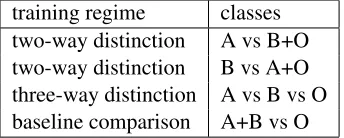
training regime classes two-way distinction A vs B+O two-way distinction B vs A+O three-way distinction A vs B vs O baseline comparison A+B vs O
Table 1: Training regimes
a program should be cleanly separated. Another is generality, creating solutions that are re-usable in different specific cases. A usable tool must encourage good software engineering.
Inherent support for the combinatorial nature of our experiments Experiments in natural language processing and machine learning typically compare different datasets, different models, different feature sets, different training regimes, and train and test on a number of cross-validation folds. This produces a very large number of files which any system must handle in a clean way.
In this paper, we presentzymake2, and argue that is superior to several alternatives for the task of au-tomating the steps in running an experiment in natu-ral language processing or machine learning.
2 A Typical NLP Experiment
As a running example, we present the following set of experiments (abstracted from (Breck et al., 2007)). The task is one of entity identification -we have a large dataset in which two different types of opinion entities are tagged, type A, and type B. We will use a sequence-based learning algorithm to model the entities, but we want to investigate the re-lationship between the two types. In particular, will it be preferable to learn a single model which pre-dicts both entity type A and entity type B, or two separate models, one predicting A, and one predict-ing B. The former case makes a three-way distinc-tion between entities of type A, of type B, and of type O, all other words. The latter two models make a distinction between type A and both other types or between type B and both other types.
Further-2
Any name consisting of a single letter followed bymake already refers to an existing software project. zymakeis the first pronouncable name consisting of a two letter prefix to make, starting from the end of the alphabet. I pronounce “zy-” as in “zydeco.”
more, prior work to which we wish to compare does not distinguish at all between type A and type B, so we also need a model which just predicts entities to be of either type A or B, versus the background O. These four training regimes are summarized in Ta-ble 1.
Given one of these training regimes, the model is trained and tested using 10-fold cross-validation, and the result is evaluated using precision and re-call. The evaluation is conducted separately for class A, for class B, and for predicting the union of both classes.
2.1 Approach 1: A UNIX Shell Script
Many researchers use UNIX shell scripts to co-ordinate experiments3. Figure 1 presents a poten-tial shell script for the experiments discussed in Sec-tion 2. Shell scripting is familiar and widely used for co-ordinating the execution of programs. However, there are three difficulties with this approach -it is difficult to partially re-run, the specification of the filenames is error-prone, and the script is badly modularized.
Re-running the experiment The largest difficulty with this script is how it handles errors - namely, it does not. If some early processes succeed, but later ones fail, the researcher can only re-run the entire script, wasting the time spent on the previous run. There are two common solutions to this problem. The simplest is to comment out the parts of the script which have succeeded, and re-run the script. This is highly brittle and error-prone. More reliable but much more complicated is to write a wrapper around each command which checks whether the outputs from the command already exist before running it. Neither of these is desirable. It is also worth not-ing that this problem can arise not just through error, but when an input file changes, an experiment is ex-tended with further processing, additional graphs are added, further statistics are calculated, or if another model is added to the comparison.
3
for fold in ‘seq 0 9‘; do
extract-test-data $fold raw-data $fold.test for class in A B A+B; do
extract-2way-training $fold raw-data $class > $fold.$class.train train $fold.$class.train > $fold.$class.model
predict $fold.$class.model $fold.test > $fold.$class.out prep-eval-2way $fold.$class.out > $fold.eval-in
eval $class $fold.$class.eval-in > $fold.$class.eval done
extract-3way-training $fold raw-data > $fold.3way.train train $fold.3way.train > $fold.3way.model
predict $fold.3way.model $fold.test > $fold.3way.out for class in A B A+B; do
prep-eval-3way $class $fold.3way.out > $fold.3way.$class.eval-in eval $class $fold.3way.$class.eval-in > $fold.3way.$class.eval done
done
Figure 1: A shell script
Problematic filenames In this example, a filename is a concatenation of several variable filenames
-e.g. $(fold).$(class).train. This is also
error-prone - the writer of the script has to keep track, for each filename, of which attributes need to be specified for a given file, and the order in which they must be specified. Either of these can change as an experiment’s design evolves, and subtle design changes can require changes throughout the script of the references to many filenames.
Bad modularization In this example, the eval
program is called twice, even though the input and output files in each case are of the same format. The problem is that the filenames are such that the line in the script which calls evalneeds to be in-clude information about precisely which files (in one case$fold.3way.$class, and in the other
$fold.$class) are being evaluated. This is
irrel-evant – a more modular specification for theeval
program would simply say that it operates on a
.eval-in file and produces an .eval file. We
will see ways below of achieving exactly this.4
4
One way of achieving this modularization with shell scripts could involve defining functions. While this could be effective, this greatly increases the complexity of the scripts.
%.model: %.train train $< > $@
%.out: %.model %.test predict $ˆ > $@
Figure 2: A partial makefile
2.2 Approach 2: Amakefile
One solution to the problems detailed above is to use a makefile instead of a shell script. Themake
program (Feldman, 1979) bills itself as a “utility to maintain groups of programs”5, but from our per-spective,make is a declarative language for speci-fying dependencies. This seems to be exactly what we want, and indeed it does solve some of the prob-lems detailed above. make has several new prob-lems, though, which result in its being not an ideal solution to our problem.
Figure 2 presents a portion of a makefile for this task. For this part, the makefile ideally matches what we want. It will pick up where it left off, avoiding the re-running problem above. The question of file-names is sidestepped, as we only need to deal with the extensions here. And each command is neatly
5
partitioned into its own section, which specifies its dependencies, the files created by each command, and the shell command to run to create them. How-ever, there are three serious problems with this ap-proach.
Files are represented by strings The first prob-lem can be seen by trying to write a similar line for theeval command. It would look something like this:
%.eval: %.eval-in
eval get-class $ˆ > $@
However, it is hard to write the code represented here asget-class. This code needs to examine the filename string of$ˆor$@, and extract the class from that. This is certainly possible using standard UNIX shell tools or make extensions, but it is ugly, and has to be written once for every time such a field needs to be accessed. For example, one way of writing get-class using GNU make extensions would be:
GETCLASS = $(filter A B A+B,\ $(subst ., ,$(1)))
%.eval: %.eval-in
eval $(call GETCLASS,$@) $ˆ > $@
The basic problem here is that to make, a file is represented by a string, its filename. For machine learning and natural language pro-cessing experiments, it is much more natu-ral to represent a file as a set of key-value pairs. For example, the file 0.B.model might be represented as { fold = 0, class = B,
filetype = model } .
Combinatorial dependencies The second prob-lem with make is that it is very difficult to spec-ify combinatorial dependencies. If one continued to write the makefile above, one would eventually need to write a final all target to specify all the files which would need to be built. There are 60 such files: one for each fold of the following set
$fold.3way.A.eval $fold.3way.B.eval $fold.3way.A+B.eval $fold.A.eval
%.taggerA.pos: %.txt tagger_A $ˆ > $@
%.taggerB.pos: %.txt tagger_B $ˆ > $@
%.taggerC.pos: %.txt tagger_C $ˆ > $@
%.chunkerA.chk: %.pos chunker_A $ˆ > $@
%.chunkerB.chk: %.pos chunker_B $ˆ > $@
%.chunkerC.chk: %.pos chunker_C $ˆ > $@
%.parserA.prs: %.chk parser_A $ˆ > $@
%.parserB.prs: %.chk parser_B $ˆ > $@
%.parserC.prs: %.chk parser_C $ˆ > $@
Figure 3: A non-functional makefile for testing three in-dependent decisions
$fold.B.eval $fold.A+B.eval
There is no easy way inmakeof listing these 60 files in a natural manner. One can escape to a shell script, or use GNUmake’sforeachfunction, but both ways are messy.
Fig-ure 3. The problem is thatmakepattern rules (rules using the%character) can only match the suffix or prefix of a filename6. This makefile does not work because it requires the parser, chunker, and tagger to all be the last part of the filename before the type suffix.
2.3 Approach 3:zymake
zymake is designed to address the problems
out-lined above. The key principles of its design are as follows:
• Likemake,zymakefiles can be re-run
multi-ple times, each time picking up where the last left off.
• Files are specified by key-value sets, not by strings
• zymake includes a straightforward way of
handling combinatorial sets of files.
• zymake syntax is minimally different from
shell syntax.
Figure 4 presents a zymakefile which runs the run-ning example experiment. Rather than explairun-ning the entire file at once, we will present a series of in-creasingly complex parts of it.
Figure 5 presents the simplest possible zymake-file, consisting of onerule, which describes how to create a$().testfile, and one goal, which lists what files should be created by this file. A rule is simply a shell command7, with some number of
in-terpolations8. Aninterpolationis anything between the characters $(and the matching ). This is the only form of interpolation done byzymake, so as to minimally conflict with other interpolations done by the shell, scripting languages such as Perl, etc.
6
Thus, if we were only comparing two sets of items – e.g. parsers and taggers but not chunkers – we could write this set of dependencies by using a prefix to distinguish one set and a suffix to distinguish the other. This is hardly pretty, though, and does not extend to more than two sets.
7
Users who are familiar with UNIX shells will find it use-ful to be able to use input/output redirection and pipelines in zymakefiles. Knowledge of advanced shell programming is not necessary to usezymake, however.
8This term is used in Perl; it is sometimes referred to in other
languages as “substitution” or “expansion.”
extract-test-data $(fold) raw-data $(>).test
extract-2way-training $(fold) raw-data $(class) > $(train="2way").train
extract-3way-training $(fold) raw-data > $(train="3way").train
train $().train > $().model
predict $().model $().test > $().out
prep-eval-3way $(class) $().out > $(train="3way").eval-in
prep-eval-2way $().out > $(train="2way").eval-in
eval $(class) $().eval-in > $().eval
classes = A B A+B ways = 2way 3way
: $(fold = *(range 0 9) class = *classes train = *ways).eval
Figure 4: An example zymakefile. The exact commands run by this makefile are presented in Appendix A.
extract-test-data raw-data $(>).test
: $().test
Figure 5: Simple zymakefile #1
extract-test-data $(fold) raw-data $(>).test
: $(fold=0).test $(fold=1).test
extract-test-data $(fold) raw-data $(>).test
folds = 0 1
: $(fold=*folds).test
Figure 7: Simple zymakefile #3
The two interpolations in this example are file in-terpolations, which are replaced byzymakewith a generated filename. Files inzymakeare identified not by a filename string but by a set of key-value pairs, along with a suffix. In this case, the two in-terpolations have no key-value pairs, and so are only represented by a suffix. Finally, there are two kinds of file interpolations -inputs, which are files that are required to exist before a command can be run, and
outputs, which are files created by a command9. In this case, the interpolation$(>).test is marked as an output by the>character10, while$().test
is an input, since it is unmarked.
The goal of this program is to create a file match-ing the interpolation $().test. The single rule does create a file matching that interpolation, and so this program will result in the execution of the fol-lowing single command:
extract-test-data raw-data .test
Figure 6 presents a slightly more complex zy-makefile. In this case, there are two goals - to create
a .test file with the keyfold having the value
0, and another .test file withfold equal to 1. We also see that the rule has become slightly more complex – there is now another interpolation. This, however, is not a file interpolation, but a variable in-terpolation.$(fold)will be replaced by the value offold.
9
Unlike make, zymake requires that each command ex-plicitly mention an interpolation corresponding to each input or output file. This restriction is caused by the merging of the command part of the rule with the dependency part of the rule, which are separate inmake. We felt that this reduced redun-dancy and clutter in the zymakefiles, but this may occasionally require writing a wrapper around a program which does not be-have in this manner.
10zymake
will also infer that any file interpolation following the>character, representing standard output redirection in the shell, is an output
Executing this zymakefile results in the execution of two commands:
extract-test-data 0 raw-data 0.test extract-test-data 1 raw-data 1.test
Note that the output files are now not just.test
but include the fold number in their name. This is becausezymakeinfers that the fold key, mentioned in the extract rule, is needed to distinguish the two test files. In general the user should specify as few keys as possible for each file interpolation, and allow
zymaketo infer the exact set of keys necessary to
distinguish each file from the rest11.
Figure 7 presents a small refinement to the zy-makefile in Figure 6. The commands that will be run are the same, but instead of separately listing the two test files to be created, we create a variablefolds
which is a list of all the folds we want, and use a
splatto create multiple goals. A splat is indicated by the asterisk character, and creates one copy of the file interpolation for each value in the variable’s list. Figure 4 is now a straightforward extension of the example we have seen so far. It uses a few more features ofzymake that we will not discuss, such as string-valued keys, and therangefunction, but further documentation is available on thezymake
website. zymake wants to create the goals at the end, so it examines all the rules and constructs a di-rected acyclic graph, orDAG, representing the de-pendencies among the files. It then executes the commands in some order based on this DAG – see Section 3 for discussion of execution order.
2.4 Benefits ofzymake
zymakesatisfies the criteria set out above, and han-dles the problems discussed with other systems.
• Reproducibility. By providing a single file which can be re-executed many times,zymake
encourages a development style that encodes all information about a workflow in a single file. This also serves as documentation of the complete workflow.
11
• Simplicity.zymakeonly requires writing a set of shell commands, annotated with interpola-tions. This allows researchers to quickly and easily construct new and more complex exper-iments, or to modify existing ones.
• Experimental life-cycle. zymake can re-execute the same file many times when com-ponents fail, inputs change, or the workflow is extended.
• Software engineering. Each command in a
zymakefile only needs to describe the inputs
and outputs relevant for that command, making the separate parts of the file quite modular.
• Combinatorial experiments. zymakeincludes a built-in method for specifying that a particu-lar variable needs to range over several possi-bilities, such as a set of models, parameter val-ues, or datasets.
2.5 Usingzymake
Beginning to usezymakeis as simple as download-ing a sdownload-ingle binary from the website12. Just as with a shell script or makefile, the user then writes a sin-gle textual zymakefile, and passes it tozymakefor execution. Typical usage ofzymakewill be in an edit-run development cycle.
3 Parallel Execution
For execution of very large experiments, efficient use of parallelism is necessary. zymake offers a natural way of executing the experiment in a maxi-mally parallel manner. The default serial execution does a topological sort of the DAG, and executes the components in that order. To execute in
paral-lel, zymakesteps through the DAG starting at the
roots, starting any command which does not depend on a command which has not yet executed.
To make this practical, of course, remote execu-tion must be combined with parallel execuexecu-tion. The current implementation provides a simple means of executing a remote job using ssh, combined with a simple /proc-based measure of remote cpu uti-lization to find the least-used remote cpu from a
12
Binaries for Linux, Mac OS X, and Windows, as well as full source code, are available at http://www.cs. cornell.edu/∼ebreck/zymake/.
provided set. We are currently looking at
extend-ing zymake to interface it with the Condor
sys-tem (Litzkow et al., 1988). Condor’s DAGMan is designed to execute a DAG in parallel on a set of remote machines, so it should naturally fit with
zymake. Interfaces to other cluster software are
possible as well. Another important extension will be to allow the system to throttle the number of con-current jobs produced and/or collect smaller jobs to-gether, to better match the available computational resources.
4 Other approaches
Deelman et al. (2004) and Gil et al. (2007) describe the Pegasus and Wings systems, which together have a quite similar goal tozymake. This system is de-signed to manage large scientific workflows, with both data and computation distributed across many machines. A user describes their available data and resources in a semantic language, along with an abstract specification of a workflow, which Wings then renders into a complete workflow DAG. This is passed to Pegasus, which instantiates the DAG with instances of the described resources and passes it to Condor for actual execution. The system has been used for large-scale scientific experiments, such as earthquake simulation. However, we believe that the added complexity of the input that a user has to provide overzymake’s simple shell-like syntax will mean a typical machine learning or natural lan-guage processing researcher will findzymake eas-ier to use.
com-ponents written in Java (and in the case of UIMA, C++).zymakeis agnostic as to the source language of each component, making it easier to include pro-grams written by third parties or by researchers who prefer different languages.
make, despite dating from 1979, has proved its usefulness over time, and is still widely used. Many other systems have been developed to replace it, including ant13, SCons14, maven15, and others. However, so far as we are aware, none of these sys-tems solves the problems we have described with
make. As with make and shell scripts, running experiments is certainly possible using these other tools, but we believe they are far more complex and cumbersome thanzymake.
5 Future Extensions
There are a number of extensions tozymakewhich could make it even more useful. One is to allow the dependency DAG to vary during the running of the experiment. At the moment,zymakerequires that the entire DAG be known before any processes can run. As an example of when this is less than ideal, consider early-stopping an artificial neural network. One way of doing this is train the network to full convergence, and output predictions from the inter-mediate networks at some fixed interval of epochs. We would like then to evaluate all these predictions on held-out data (running one process for each of them) and then to choose the point at which this score is maximized (running one process for the whole set). Since the number of iterations to con-vergence is not known ahead of time, at the moment we cannot support this structure in zymake. We plan, however, to allow the structure of the DAG to vary at run-time, allowing such experiments.
We are also interested in other extensions, includ-ing an optional textual or graphical progress bar, providing a way for the user to have more control over the string filename produced from a key-value set16, and keeping track of previous versions of cre-ated files, to provide a sort of version control of the output files.
16This will better allowzymaketo interact with other
work-flows.
6 Conclusion
Most experiments in machine learning and natu-ral language processing involve running a complex, interdependent set of processes. We have argued that there are serious difficulties with common ap-proaches to automating these experiments. In their place, we offerzymake, a new scripting language with shell-like syntax butmake-like semantics. We hope our community will find it as useful as we have.
Acknowledgements
We thank Yejin Choi, Alex Niculescu-Mizil, David Pierce, the Cornell machine learning discussion group, and the anonymous reviewers for helpful comments on earlier drafts of this paper.
A Output of Figure 4
We present here the commands run by zymake
when presented with the file in Figure 4. We present only the commands run for fold 0, not for all 10 folds. Also, in actual executionzymakeadds a pre-fix to each filename based on the name of the zy-makefile, so as to separate different experiments. Fi-nally, note that this is only one possible order that the commands could be run in.
extract-2way-training 0 raw-data A > A.0.2way.train train A.0.2way.train > A.0.2way.model
extract-2way-training 0 raw-data B > B.0.2way.train train B.0.2way.train > B.0.2way.model
extract-2way-training 0 raw-data A+B > AB.0.2way.train train AB.0.2way.train > AB.0.2way.model
extract-3way-training 0 raw-data > 0.3way.train train 0.3way.train > 0.3way.model
extract-test-data 0 raw-data 0.test
predict A.0.2way.model 0.test > A.0.2way.out prep-eval-2way A.0.2way.out > A.0.2way.eval-in eval A A.0.2way.eval-in > A.0.2way.eval
predict B.0.2way.model 0.test > B.0.2way.out prep-eval-2way B.0.2way.out > B.0.2way.eval-in eval B B.0.2way.eval-in > B.0.2way.eval
predict AB.0.2way.model 0.test > AB.0.2way.out prep-eval-2way AB.0.2way.out > AB.0.2way.eval-in eval A+B AB.0.2way.eval-in > AB.0.2way.eval predict 0.3way.model 0.test > 0.3way.out prep-eval-3way A 0.3way.out > A.0.3way.eval-in eval A A.0.3way.eval-in > A.0.3way.eval
prep-eval-3way B 0.3way.out > B.0.3way.eval-in eval B B.0.3way.eval-in > B.0.3way.eval
References
Eric Breck, Yejin Choi, and Claire Cardie. 2007. Iden-tifying expressions of opinion in context. In Pro-ceedings of the Twentieth International Joint Confer-ence on Artificial IntelligConfer-ence (IJCAI-2007), Hyder-abad, India, January.
Hamish Cunningham, Diana Maynard, Kalina Bont-cheva, and Valentin Tablan. 2002. GATE: A frame-work and graphical development environment for ro-bust NLP tools and applications. InProceedings of the 40th Anniversary Meeting of the Association for Com-putational Linguistics (ACL ’02), Philadelphia, July. Ewa Deelman, James Blythe, Yolanda Gil, Carl
Kessel-man, Gaurang Mehta, Sonal Patil, Mei-Hui Su, Karan Vahi, and Miron Livny. 2004. Pegasus : Mapping scientific workflows onto the grid. In Across Grids Conference, Nicosia, Cyprus.
Stuart I. Feldman. 1979. Make-a program for maintain-ing computer programs. Software - Practice and Ex-perience, 9(4):255–65.
David Ferrucci and Adam Lally. 2004. UIMA: an archi-tectural approach to unstructured information process-ing in the corporate research environment. Nat. Lang. Eng., 10(3-4):327–348.
Yolanda Gil, Varun Ratnakar, Ewa Deelman, Gaurang Mehta, and Jihie Kim. 2007. Wings for pegasus: Cre-ating large-scale scientific applications using semantic representations of computational workflows. In Pro-ceedings of the 19th Annual Conference on Innovative Applications of Artificial Intelligence (IAAI), Vancou-ver, British Columbia, Canada, July.