Two Software Normal Basis Multiplication Algorithms for GF(2
n
)
Haining Fan and Yiqi Dai
Abstract -
In this paper, two different normal basis multiplication algorithms for software
implementation are proposed over GF(2
n
). The first algorithm is suitable for high complexity
normal bases and the second algorithm is fast for type-I optimal normal bases and low complexity
normal bases. The ANSI C source program is also included in this paper.
Index Terms -
Finite field, normal basis, multiplication algorithm.
1. Introduction
The arithmetic operations in GF(2
n
) play an important role in coding theory, computer algebra,
and cryptosystems. Among the different types of field representations, normal basis (NB) has
received considerable attention for efficient implementation. For portability as well as for price
reasons, it is often advantageous to realize cryptographic algorithms in software. While many
constructions of VLSI NB multipliers have been proposed recently, few software-efficient NB
algorithms can be found in the open literature. In [1], a software algorithm for type-I optimal
normal bases (ONB) was presented. It can be further improved if the symmetric property
proposed in [2,3] is employed. In [3], Reyhani-Masoleh and Hasan proposed a word-level NB
multiplication algorithm over GF(2
n
), and we denote it as the RH algorithm. The RH algorithm is
designed for working with all NBs. A bit-level NB multiplication algorithm is presented in the
IEEE standard P1363-2000 [4], but it is not efficient for software implementation. Ning and Yin
presented a generalized version of this algorithm in [5], and we denote it as the NY algorithm.
Although the NY algorithm is fast for ONBs, it is slow for nonoptimal normal bases.
__________________________
Haining Fan and Yiqi Dai are with the Department of Computer Science, Tsinghua University, Beijing 100084,
People's Republic of China.
In this paper, two NB multiplication algorithms for software implementation are proposed. The
first algorithm (Algorithm 1) is an improvement on the RH algorithm. The theoretical analysis
shows that it is faster than the RH algorithm. But experimental results show that this is not true for
a few GF(2
n
)s, e.g. GF(2
359
) and GF(2
491
). The reason is that the size of lookup tables of
Algorithm 1 is larger than that of the RH algorithm. The total number of cyclic shift operations
(CSO) needed in the second algorithm (Algorithm 2) is a constant. For type-II ONBs, the NY
algorithm is faster than Algorithm 2, but it is slower than Algorithm 2 for other NBs. Compared to
Algorithm 2, Algorithm 1 is suitable for high complexity NBs. For example, our experimental
results show that it is faster than Algorithm 2 in GF(2
283
) (Type 6 Gaussian NB (GNB)) and
GF(2
571
) (Type 10 GNB).
We also compare these NB algorithms to the polynomial basis multiplication algorithm
presented in [6], i.e., the finite field analogue of the Montgomery multiplication for integers. Our
experimental results show that in some GF(2
n
)s where ONBs or low complexity normal bases
exist Algorithm 2 is faster than the Montgomery algorithm, for example, type 4 GNBs in GF(2
577
),
GF(2
673
) and GF(2
739
).
This paper is organized as follows: Section 2 introduces the RH algorithm and presents a
method to reduce the number of cyclic shift operations. This method may be applied to all NB
multiplication algorithms we discussed. Algorithm 1 and Algorithm 2 are presented in Section 3
and Section 4 respectively. Theoretic analyses and numerical results are presented in Section 5.
Finally, concluding remarks are made in Section 6.
2. Preliminaries
Let
be an element of GF(2
n
), for simplicity, denote
2
iby
i
. Given a normal basis
N=
{
0,
1,
2,...,
n1}
of GF(2
n
) over GF(2), a field element A can be represented by a binary
vector (a0,a1,...,a
n-1
) with respect to this basis as
1
0
n
i i i
a
A
, where
a
iGF
(
2
)
and i = 0,1,...,n-1.
For
1
i
n
1
, let
1 0
, 0
n
j j j i
j
i,
GF(2). Let
S
ij
|
i, j1
and h
i
=|S
i
|. We may rewrite S
i
as
S
i{
w
i,1,
w
i,2,...,
w
i,hi}
, where
1
...
0
w
,1w
,2w
,n
i h i i
i
. (1)
Clearly,
ik i h k w i 1 0 ,
.
Note that for a particular normal basis N the representation of
0
i
is fixed and so is w
i,k
.
In [3] a vector-level normal basis multiplication algorithm over GF(2
n
) is presented. The
algorithm includes two similar versions: one is for n odd and the other is for n even. In this paper,
we assume that n is odd, unless otherwise stated.
Let v=(n-1)/2 and <x> denote the non-negative residue of x mod n. D=AB can be computed by
the following identity [3]:
1
0
1
0
n
i
j
i
j
n
j
i
b
a
AB
D
1
1
2
0
1
0
1
0
1
(
)
n
i
i
j
n
j
j
i
n
i
i
i
i
jb
a
b
a
v
i
h
k
n
j
w
j
j
j
i
j
j
i
n
i
i
i
i
i k ia
b
b
a
b
a
1
1
1
0
1
0
1
,. (2)
Let A
i
=
i
A
2
. If we define B & A
n-i
as B & A
n-i
=
(
a
i
b
0
,
a
i
1
b
1
,...,
a
i
n
1
b
n
1
)
and treat it as the
field element, then
k i k
i
n
i
w
n
j
w
j
j
j
i
b
B
A
a
, ,)
&
(
1
0
. So (2) may be rewritten as follows:
D
v i h k w i n w i n i k i ki
A
B
A
B
A
B
1 1
1
&
,&
,&
(3)
v
i k S
k i n i n i
B
A
A
B
A
B
11
&
&
&
. (4)
Furthermore, Let R
i
=(B & A
n-i
)+(A & B
n-i
), we have
D=(B & A)
1+
vi k S
k i i
R
1)
(
. (5)
Similarly, for even n, we set v= n/2 and have:
D=(B & A)
1+
vi k S
k i i
R
1)
(
, (6)
v v
i n i
n i
B
A
R
v
i
B
A
A
B
R
&
1
1
where
)
&
(
)
&
(
. (7)
Based on (5), the following multiplication algorithm was presented in [3]:
RH Multiplication Algorithm for n odd:
INPUT: A, B, S
i
, where
1
i
v
.
OUTPUT: D=AB.
S1: D := (A & B) >> 1;
S2: U
A
:= A; U
B
:= B;
S3: for i = 1 to v do {
S4: U
A
:= U
A
<< 1 ; U
B
:= U
B
<< 1;
S5: R := (A & U
B
)
(B & U
A
);
S6: for each
k
S
ido D := D
(R >> k); }
S7: Output D ;
Notes: 1. A & B=
(
a
0
b
0
,
a
1
b
1
,...,
a
n
1
b
n
1
)
.
2.
denotes the addition in GF(2
n
).
3. A<<i (resp. A>>i) denotes i-fold left (resp. right) CSO of the coordinates of A.
Obviously, the number of CSO in S4 is n-1. Before introducing the first algorithm, we show
that this number can be further reduced for large values of n.
Let z be the full width of data-path of the general-purpose processor, e.g. z=32 for Pentium
CPU. We assume that z<v.
Let DA
0
= (a
0
,a
1
,...,a
n-1
,a
0
,a
1
,...,a
v-1
) and DA
j
= (a
j
,...,a
n-1
,a
0
,a
1
,...,a
v-1
a
0
,...,a
j-1
), i.e., DA
j
is the
j-fold left cyclic shifts of the (n+v)-bit vector DA
0
, where 0<j<z .
In software implementation, DA is defined as a 2-dimensional array DA[z][
z v
n
], and each
DA
j
is stored in
nzvsuccessive computer words. So for
1
i
v
, A
n-i
is stored in
z nsuccessive computer words starting from DA[s][t] and ending at DA[s][t+
z
n
-1], where t=[i/z],
s=i && (z-1) and && denotes integer bit-wise AND. That is to say, the two indices of A
n-i
can be
address of A
n-i
may be calculated in the precomputation procedure. Similarly, arrays DB
j
's are
defined.
Clearly, the time complexity to compute DA
j
's and DB
j
's (
0
j
z
) is about 3z n-bit CSOs,
and 3zn bits are needed to store these arrays.
3. Algorithm 1
Now we present the first algorithm. It is an improvement on the RH algorithm. The idea is
based on the following observation on (5). For some
1
i
1...
i
ev
,
e
i
i
S
S
1...
may not be
empty. Thus for each
e
i
i
S
S
k
1...
,
e i
i i
i k S
k i
R
,..., 1)
(
can be computed by
e i
i i
i k S
k i
R
,..., 1)
(
=
k i i i i eR
,..., 1. (8)
The saving of the k-fold cyclic shift operation is obvious. The left side of (8) needs e such
operations, while the right side needs only 1.
The correctness of this method is based on the fact that we can interchange the order of
summation in the identity (5). That is to say, since
0
k
n
1
, we have
D=(B & A)
1+
vi k S
k i i
R
1)
(
k nk i i v k S
i i
R
A
B
10 : such that 1 and 1
&
. (9)
Similarly, for even n, we set v= n/2 and have:
D=(B & A)
1+
vi k S
k i i
R
1)
(
k nk i i v k S
i i
R
A
B
10 : such that 1 and 1
&
. (10)
where R
i
is defined in (7).
Based on (9) and the method to compute DA
i
and DB
i
for 0<i<z, we now present Algorithm 1
for odd values of n. For each
0
k
n
1
, the following precomputation procedure is to find all i's
such that
1
i
v
and
i
S
k
.
Precomputation:
INPUT: n, S
i
, where
1
i
v
.
S1: for k = 0 to n-1 do e
k
:=0;
S2: for i = 1 to v do {
S3: for each
k
S
ido {
S4: m[k][e
k
] := i ;
S5: e
k
:= e
k
+1; } }
This procedure outputs e
k
and m[k][j], where
0
k
n
1
and
0
j
e
k1
. e
k
is the total
number of i's such that
1
i
v
and
k
S
i, and m[k][0] to m[k][e
k
-1] store these i's, i.e.,
] ][ [k j m
S
k
for
0
j
e
k1
.
Multiplication Algorithm 1 for n Odd:
INPUT: A, B, e
k
and m[k][j], where
0
k
n
1
and
0
j
e
k1
.
OUTPUT: D=AB.
S1: Compute DA
i
and DB
i
for
0
i
z
;
S2: D := A1
& B
1;
S3: for i = 1 to v do R[i] := (B & A
n-i
)
(A & B
n-i
);
S4: for k = 0 to n-1 do
S5: if e
k
> 0 then{
S6: C := R[m[k][0]];
S7: for j = 1 to e
k
-1 do C :=C
R[m[k][j]];
S8: D := D
(C >> k); }
S9: Output D ;
Notes: Algorithm 1 may be implemented without computing arrays DA and DB. In this
implementation, each R[i] is computed using statements similar to S4 and S5 of the RH algorithm
[5], and the total number of CSO becomes at most 2n. Experimental results indicate that arrays
DA and DB speedup Algorithm 1 by no more than 10% for GF(2
n
)s listed in Table 4 of Section 5.
For example, Algorithm 1 without computing arrays DA and DB performs one multiplication
4. Algorithm 2
From the definition of A&B we know that
(A & B)
i
=
i
B
A
&
)
2(
=
(
a
n
i
b
n
i
,
a
n
i
1
b
n
i
1
,...,
a
n
1
b
n
1
,
a
0
b
0
,...,
a
n
i
1
b
n
i
1
)
=(A
i
& B
i
).
Thus (3) can be rewritten as:
D
v i h k i w w i w w i k i k i k i ki
A
A
B
B
A
B
1 1 1
1
&
,&
, ,&
,. (11)
Since
(
1
)
/
2
1
N v
i
i
C
h
, D can be computed by (11) at the cost of about C
N
AND (&) and C
N
XOR (
) operations if A
i
's and B
i
's are available, where 0<i<n and C
N
denotes the complexity of
the normal basis N.
Now we show that (11) can be further improved. From (1) we know that
0
1
,
n
w
ikand
t i s
i
w
w
, ,for a given i, where
1
i
v
and
1
s
t
h
i. Thus (11) can be rewritten as:
1 0 1 where , some for that 1 and such : 1 1 ,
&
&
&
n w h k k ww i i v
i w w i w w i k i
B
A
A
B
A
B
D
1 0 1 where , some for and 1 that such : 1 where , some for and 1 that such : 1 1 , ,&
&
&
n w h k k w w v i i i w w h k k w w v i i i w w i k i i k iA
B
B
A
A
B
. (12)
Obviously, the number of & operations in (12) is 2n+1. Thus (12) is faster than (11) for
nonoptimal normal bases.
Similarly, for even n, we set v= n/2 and have:
D
v k v k v i k i k i k i k i h k v w w v i h k i w w i ww
B
B
A
A
B
A
A
B
1 1 1 1 11
&
,&
, ,&
, ,&
,.
1 0 1 where , some for that 1 1and such : 1 where , some for that 1 and such : 1 1 , ,&
&
&
n w h k k ww i i v
i w w h k k w
w i i v
i w w i k i i k i
A
B
B
A
A
B
. (13)
Especially, for type-I ONBs, it is well known that
1
(
2
)
0 v
GF
and
0
i
j
for some
1
0
j
n
, where
1
i
v
1
. Thus the formula (13) can be further simplified if the Hamming
v v
i
i w w
i w
w
A
A
B
B
A
B
A
B
D
i i
i
i
&
&
HammingWe
ight
&
&
1 1 1
1 ,1 ,1 ,1 ,1
. (14)
A
w
=A
n-(n-w)
can be computed by the method introduced in Section 2. Here the array DA is
defined as:
DA
0 = (a0,a1,...,a
n-1
,a0,a1,...,a
n-1
) and
DA
j
= (a
j
,...,a
n-1
,a
0
,a
1
,...,a
n-1
a
0
,...,a
j-1
), where
1
j
z
,
i.e., they are 2n-bit vectors. The array DB is defined in the similar way.
So the time complexity to compute DA
j
and DB
j
is about 4z n-bit cyclic shift operations, and
4zn bits are needed to store these arrays, where
0
j
z
.
Based on (12), we now present the second algorithm for odd values of n.
For each
0
w
n
1
, the following precomputation procedure is to find all i's such that
v
i
1
and w=w
i,k
for some k, where
1
k
h
i.
Precomputation:
INPUT: n, S
i
, where
1
i
v
.
OUTPUT: e
w
and m[w][j], where
0
w
n
1
and
0
j
e
w1
.
S1: for w = 0 to n-1 do e
w
:=0;
S2: for i = 1 to v do {
S3: for each
w
S
ido {
S4: m[w][e
w
] := i ;
S5: e
w
:= e
w
+1; } }
This procedure outputs e
w
and m[w][j], where
0
w
n
1
and
0
j
e
w1
. e
w
is the total
number of i's such that
1
i
v
and w=w
i,k
, and m[w][0] to m[w][e
w
-1] store these i's, i.e.,
] ][ [w j m
S
w
for
0
j
e
w1
.
Multiplication Algorithm 2 for n Odd:
INPUT: A, B, e
w
and m[w][j], where
0
w
n
1
and
0
j
e
w1
.
S1: Compute DA
i
and DB
i
for
0
i
z
;
S2: D := A1
& B
1;
S3: for w = 0 to n-1 do
S4: if e
w
> 0 then{
S5: UA := A<w-m[w][0]>; UB := B<w-m[w][0]>;
S6: for j = 1 to e
w
-1 do { UA := UA
A
<w-m[w][j]>; UB := UB
B
<w-m[w][j]>; }
S7: D := D
(B
w
& UA)
(A
w
& UB); }
S8: Output D ;
Notes: For each
0
w
n
1
, A
w
=A
n-(n-w)
is stored in
nzsuccessive computer words starting from
DA[s][t] and ending at DA[s][t+
zn-1], where t = [(n-w)/z], s = (n-w) && (z-1) and && denotes
integer bit-wise AND. In our implementation, these address computations are performed in the
precomputation procedure, and starting addresses of A
w
, A<w-m[w][j]>, B
w
and B<w-m[w][j]> are stored
sequentially in a 1-dimensional array for
0
w
n
1
.
5. Analysis and Comparison
We implement these algorithms in ANSI C using Microsoft Visual C++ 6.0 complier and test
them on two computers:
1. An IBM ThinkPad 770X notebook with a 300 MHz Pentium II CPU running Windows NT
4.0.
2. A PC compatible computer with a 450 MHz Pentium III CPU running Windows 2000.
Both experimental results serve to validate our conclusions based primarily on theoretical
considerations. Timings listed in this paper are obtained on the first computer.
We call the RH algorithm using precomputation tables DA and DB the improved RH algorithm.
The time complexity of the original RH algorithm is determined in [3]. It needs n n-bit AND
operations and
2
1
2
1
C
Nn
=
(
C
n
2
)
/
2
N
n-bit XOR operations. The number of n-bit CSO of the
original RH algorithm is equal to
(
C
N2
n
1
)
/
2
. While the original and improved RH algorithms
z
C
N3
2
)
1
(
CSO. Thus it is faster than the original RH algorithm when n>3z+1.
Now we determine the time complexity of Algorithm 1. Since
(
1
)
/
2
11
0
N v
i i n
k
k
h
C
e
, the total
number of XOR in line S7 and S8 is
(
1
)
/
2
N
C
. Thus the total number of XOR operations in
Algorithm 1 is
2
1
2
1
C
Nn
=
2
/
)
2
(
C
Nn
. Obviously, Algorithm 1 requires n AND operations. Thus
the two RH algorithms and Algorithm 1 require the same number of XOR and AND operations.
It is well known that
C
2n
1
N
, thus the total number of CSO in the improved RH algorithm is
at least n+3z. Since e
k
may be zero for some k's, one can see that the total number of CSO in
Algorithm 1 is at most n+3z. Obviously, Algorithm 1 is faster than the improved RH algorithm for
nonoptimal normal bases.
For
0
i
n
1
, let
1 0
, 0
n
j
j j i
i
be the expansion of
0
i
with respect to the normal
basis generated by
, where
(
2
)
,j
GF
i
. The following matrix was defined in [7].
1 0
, 1 0 , 0
n j
n i j i
T
(15)
For type-II ONB, the matrix T0 defined for the type-II optimal normal basis is symmetric. So
we know that the probability of e
k
=0 is 0.25 for type-II ONBs in Algorithm 1. Our experiments
show that for 100<n<1000, where n is odd and type-II ONB exists in GF(2
n
), the minimal,
average and maximal percentages that e
k
=0 are 22.9%, 25.0% and 27.2% respectively. That is to
say, the average total number of CSO in Algorithm 1 is (3n/4)+3z. So Algorithm 1 should be faster
than the improved RH algorithm for type-II ONBs. But numerical results show that this is only
true for small values of n, e.g. 131, 233 and 293. The reason is that the size of temporary variables
of Algorithm 1 is larger than that of the improved RH algorithm. In fact, while about 3zn/8 Bytes
are needed to store arrays DA and DB in both algorithms, approximately n
2
/16 Bytes are needed to
store R
i
's (
1
i
v
) in statement S3 of Algorithm 1. This large array increases the transfer from the
Since computation of starting addresses of A
w
, A
<w-m[w][j]>
, B
w
and B
<w-m[w][j]>
in Algorithm 2 may
be performed in the precomputation procedure, it is easy to determine the time complexity of
Algorithm 2, i.e. 4z CSO, 2n AND and C
N
XOR operations.
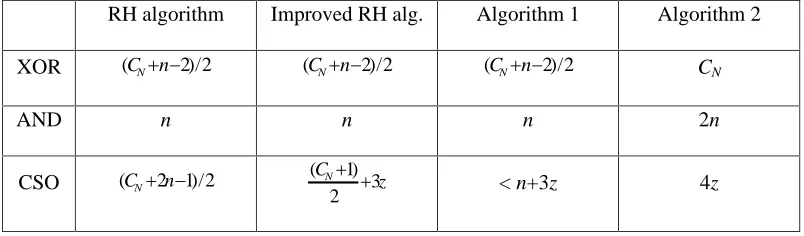
Table 1 compares the time complexity of these NB algorithms for nonoptimal normal bases in
GF(2
n
) where n is odd.
TABLE 1: Comparison of NB multiplication algorithms for nonoptimal normal bases.
RH algorithm
Improved RH alg.
Algorithm 1
Algorithm 2
XOR
(
C
Nn
2
)
/
2
(
C
Nn
2
)
/
2
(
C
Nn
2
)
/
2
C
N
AND
n
n
n
2n
CSO
(
C
N2
n
1
)
/
2
C
N3
z
2
)
1
(
< n+3z
4z
We assume that the general-purpose processor can perform 1 n-bit XOR or AND using 1 n-bit
operation. As defined in [3], we also assume that 1 CSO needs
n-bit operations. Our
experiments and [3] show that the value of
is typically 4 for the C programming language if
only simple logical instructions, such as AND, SHIFT and OR are used to emulated a k-fold cyclic
shift. When
=4 and z=32, we may deduce the following condition that Algorithm 1 is faster
than Algorithm 2: C
N
> 7n - 256. Thus for high complexity NBs, Algorithm 1 is theoretically the
fastest one among these NB algorithms. The experimental results listed in Table 4 confirm this
conclusion.
Now we compare Algorithm 2 to the NY algorithm for type-I ONBs.
A bit-level NB multiplication algorithm was presented in the IEEE standard P1363-2000 [4].
Ning and Yin proposed a generalized version of this algorithm in [5]. The NY algorithm is very
fast for ONBs, but it is slow for nonoptimal normal bases. The difference between Algorithm 2
and the NY algorithm is that a different multiplication matrix is used, i.e., Algorithm 2 uses the
matrix T0 defined in (15) and the NY algorithm uses the matrix M defined in Annex 6.3 of [4].
Hamming weight. The Hamming weight of A can be computed by a lookup table. For example, if
we create a table with 2
8
entries on a 32-bit computer, our experimental results show that the cost
to compute A's Hamming weight is no more than 4 times that of a field addition operation for
n=162, 418 and 562.
Since no description of the precomputation procedure was presented in [5] (part of the NY
algorithm was described in a patent application), we assume that the method introduced in Section
2 is used to perform this precomputation procedure. For the NY algorithm, DA
j
and DB
j
are
defined as z
n
z
-bit vector, thus the total number of CSO is about 2z. Based on this assumption, it
is easy to see that the fastest NY algorithm, Algorithm 4 of [5], requires about 2n bit XOR, n
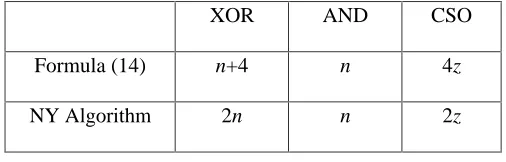
n-bit AND and 2z n-n-bit CSO. Thus the theoretical analysis shows that formula (14) is faster than the
NY algorithm for n>260 if we assume that
=4 and z=32. Our experiments confirm this
conclusion. Table 2 compares the time complexity of formula (14) and the fastest NY Algorithm
for type-I ONBs. Timings of some type-I ONBs are listed in Table 3.
TABLE 2: Comparison of Formula (14) and the fastest NY Algorithm for type-I ONBs.
XOR
AND
CSO
Formula (14)
n+4
n
4z
NY Algorithm
2n
n
2z
TABLE 3: Timing for some type-I ONBs (
s
)
GF(2
162
)
GF(2
226
)
GF(2
292
)
GF(2
418
)
GF(2
562
)
Formula (14)
31
49
67
122
195
NY Algorithm 4
31
49
69
136
216
We now compare these NB algorithms to the polynomial basis multiplication algorithm
presented in [6], i.e., the finite field analogue of the Montgomery multiplication for integers.
Since this method is significantly faster than the standard polynomial basis multiplication
implement the multiplication algorithm in GF(2
k
) instead of GF(2
n
), where
w n
w
k
. From [6]
we know that the case w=8 results in the fastest implementation on modern 32-bit computers. So
we also select w=8, and employ the table lookup approach, which is shown to be the best choice
to perform word-level multiplications [6].
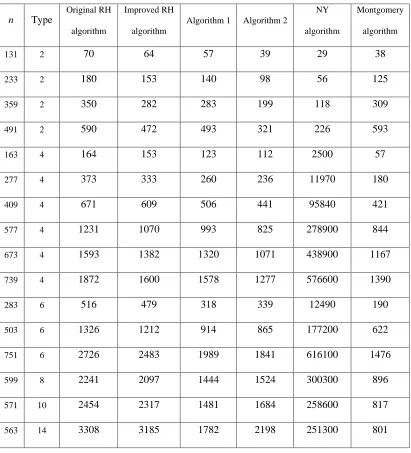
Experimental results are listed in Table 4. The 5 binary fields recommended by NIST for
ECDSA applications are GF(2
163
), GF(2
233
), GF(2
283
), GF(2
409
) and GF(2
571
).
TABLE 4: Timing for some GF(2
n
)s (
s
)
n
Type
Original RH
algorithm
Improved RH
algorithm
Algorithm 1
Algorithm 2
NY
algorithm
Montgomery
algorithm
131
2
70
64
57
39
29
38
233
2
180
153
140
98
56
125
359
2
350
282
283
199
118
309
491
2
590
472
493
321
226
593
163
4
164
153
123
112
2500
57
277
4
373
333
260
236
11970
180
409
4
671
609
506
441
95840
421
577
4
1231
1070
993
825
278900
844
673
4
1593
1382
1320
1071
438900
1167
739
4
1872
1600
1578
1277
576600
1390
283
6
516
479
318
339
12490
190
503
6
1326
1212
914
865
177200
622
751
6
2726
2483
1989
1841
616100
1476
599
8
2241
2097
1444
1524
300300
896
571
10
2454
2317
1481
1684
258600
817
563
14
3308
3185
1782
2198
251300
801
Table 4 shows that for some GF(2
n
)s where type 4 GNBs exist, Algorithm 2 is faster than the
algorithm. So for applications where many squaring operations are needed, e.g. exponentiation,
Algorithm 2 is a better choice.
6. Conclusions
We have presented two normal basis multiplication algorithms in GF(2
n
). Algorithm 1 is
suitable for high complexity NBs and Algorithm 2 is fast in GF(2
n
) where type-I ONBs or low
complexity NBs exist.
7. Acknowledgments
References
[1] Haining Fan, "Simple Multiplication Algorithm for a Class of GF(2
n
),"
Electronics Letters, vol. 32, No.7, pp.636-637, 1996.
[2] A. Reyhani-Masoleh and M.A. Hasan, "On Efficient Normal Basis Multiplication,"
In LNCS 1977 as Proceedings of Indocrypt 2000, pp.213-224, Calcutta, India, December 2000.
Springer Verlag.
[3] A. Reyhani-Masoleh and M.A. Hasan, "Fast Normal Basis Multiplication Using General
Purpose Processors," Technical Report CORR 2001-25, Dept. of C&O,
University of Waterloo, Canada, April 19, 2001.
[4] IEEE P1363-2000. "Standard Specifications for Public Key Cryptography," August 2000.
[5] P. Ning and Y.L. Yin, "Efficient Software Implementation for Finite Field Multiplication in
Normal Basis," In LNCS 2229 as Proceedings of 3rd International Conference on Information
and Communications Security (ICICS) 2001, pp.177-188, Xian, China, 2001. Springer Verlag.
[6] C. Koc and T. Acer, "Montgomery multiplication in GF(2
k
),"
Design,Codes and Cryptography, vol. 14, No.1, pp.57-69, Apr. 1998.
[7] R.C. Mullin, I.M. Onyszchuk, S.A. Vanstone, and R.M. Wilson, "Optimal normal bases in
GF(p
n
)," Discrete Applied Mathematics, vol. 22, pp.149-161, 1988/89.
[8] S. Gao and Jr. H.W. Lenstra, "Optimal Normal Bases,"
Design,Codes and Cryptography, 2:315-323, 1992.
[9] J. Lopez and R. Dahab. "High-Speed software multiplication in F(2
m
),"
Technical report, IC-00-09, May 2000. Available at
//Since the eprint accepts only .ps and .pdf, I put the ANSI C source program here: /*////////////////////////////////////////////////////////////////////////// //
// This file is used to test performance of multiplication algorithms. //
// Author: Haining Fan // Date: MAY 2003 //
// Usage: 1. Create a sample "Hello, world!" Win32 Console Application nb; // 2. Replace nb.cpp with this file;
// 3. Build nb.exe in Release mode.
// 4. You may change the definition of N and TEST_NUM_OF_MUL. // 5. Other changes should be made carefully.
//
// Source code for testing ONB1 algorithms is also included in this file. //
///////////////////////////////////////////////////////////////////////////*/ #include "stdafx.h"
#include <time.h> #include <sys/timeb.h> // You may change N
#define N 283 // N odd #if (N==131)
#define T 2
#define TAIL_MASK (0x7) // = (2**(N- (N/W)*W)) - 1 #endif
#if (N==233) #define T 2
#define TAIL_MASK (0x1ff) #endif
#if (N==359) #define T 2
#define TAIL_MASK (0x7f) #endif
#if (N==491) #define T 2
#define TAIL_MASK (0x7ff) #endif
#if (N==163) #define T 4
#define TAIL_MASK (0x7) #endif
#if (N==277) #define T 4
#define TAIL_MASK (0x1fffff) #endif
#if (N==409) #define T 4
#define TAIL_MASK (0x1ffffff) #endif
#if (N==577) #define T 4
#define TAIL_MASK (0x1) #endif
#if (N==673) #define T 4
#define TAIL_MASK (0x1) #endif
#if (N==739) #define T 4
#define TAIL_MASK (0x7) #endif
#if (N==283) #define T 6
#define TAIL_MASK (0x7ffffff) #endif
#if (N==503) #define T 6
#if (N==751) #define T 6
#define TAIL_MASK (0x7fff) #endif
#if (N==599) #define T 8
#define TAIL_MASK (0x7fffff) #endif
#if (N==571) #define T 10
#define TAIL_MASK (0x7ffffff) #endif
#if (N==563) #define T 14
#define TAIL_MASK (0x7ffff) #endif
#define ln_xor2(a, b) for (zqa=0; zqa<DWSZ; zqa++) a[zqa] ^= b[zqa];; #define ln_zero(a) for (zqa=0; zqa<DWSZ; zqa++) a[zqa]=0;;
#define ln_and(a, b, c) for (zqa=0; zqa<DWSZ; zqa++) a[zqa] = b[zqa] & c[zqa];; #define ln_copy(a, b) for (zqa=0; zqa<DWSZ; zqa++) a[zqa] = b[zqa];; #ifndef BYTE
typedef unsigned char BYTE; #endif
#ifndef WORD
typedef unsigned short WORD; #endif
#ifndef DWORD
typedef unsigned long DWORD; #endif
#define W 32
#define TAIL_SZ (N- (N/W)*W) #define P (T*N+1) #define V ((N- 1)/2) #define DWSZ ((N/W) + 1) // for Montgomery #define BLK_SZ 8 #if ((N % BLK_SZ) == 0) #define MBLK_NUM ((N/BLK_SZ)+1) #else
#define MBLK_NUM ((N/BLK_SZ)+2) #endif
// You may increase the value of TEST_NUM_OF_MUL if your computer is a faster one. #if (P>2000)
#define TEST_NUM_OF_MUL 1000 #else
#define TEST_NUM_OF_MUL 10000 #endif
void precomputation_of_Montgomery(); void precomputation_of_RH_and_me(); void precomputation_of_NY(); void ln_ror_once(DWORD *p); void ln_rol_once(DWORD *p); void ln_ror(DWORD *p, int count);
void ln_xor_ror(DWORD *r, DWORD *a, int count); // NB mul alg.
void original_RH_mul(DWORD * c, DWORD * a, DWORD * b); void improved_RH_mul(DWORD * c, DWORD * a, DWORD * b); void our_Alg_1(DWORD * c, DWORD * a, DWORD * b); void our_Alg_1_for_ONB2(DWORD * c, DWORD * a, DWORD * b); void our_Alg_1_without_DA_DB(DWORD * c, DWORD * a, DWORD * b); void our_Alg_2(DWORD * c, DWORD * a, DWORD * b);
// PB mul alg.
void Montgomery(BYTE * c, BYTE * a, BYTE * b); // tables used by the NY alg.
int tb_NY_t1[N], tb_NY_t2[N], tb_NY_M[N*N]; // tables used by the Montgomery alg.
BYTE TBL[65536], TBH[65536]; WORD TBN[MBLK_NUM];
// tables used by the RH and our alg.
int tb_RH_h[N], tb_RH_w_1D[T*N], tb_FD_e[N]; int tb_FD[T*N], tb_FD_i[N];
DWORD * tb_FD_pab[2*T*N+N];
DWORD * tb_FD_m_1D[T*N], tb_FD_r[V+2][DWSZ]; DWORD * tb_FD_m_1Dua[T*N];
DWORD * tb_FD_m_1Dub[T*N];
DWORD zua[32][2*DWSZ], zub[32][2*DWSZ]; int main(int argc, char* argv[]) {
DWORD bb[1+DWSZ], aa[1+DWSZ], vv[1+DWSZ], uu[1+DWSZ]; DWORD sss=0xabcdef21, seed=0x87654321;
int i, j, num=0;
int qq1=0, qq2=0, qq3=0, qq4=0; int qq5=0, qq6=0, qq7=0, qq8=0; struct timeb tt1, tt2;
precomputation_of_RH_and_me(); precomputation_of_Montgomery(); precomputation_of_NY();
printf("End of precomputation. N=%d T=%d", N, T); /*
// used to check correctness. for(;;)
{
ftime(&tt1); for(i=0; i<DWSZ; i++)
bb[i]=seed=tt1.millitm+tt1.time*sss + ((seed * (0xefabd67^seed) )>>3); for(i=0; i<DWSZ; i++)
vv[i]=seed=tt1.millitm+tt1.time*sss + ((seed * (0xefabd67^seed) )>>3); improved_RH_mul(aa, bb, vv);
our_Alg_2(uu, vv, bb); j=0;
for(i=0; i<=DWSZ- 2; i++) if (aa[i] != uu[i]) j++; if ( 0 != ((aa[DWSZ- 1]^uu[DWSZ- 1])<<(32- TAIL_SZ)) ) j++; if (j>0) printf("Error !!\ n");
} */ for(;;)
{ num++;
for(i=0; i<DWSZ; i++)
uu[i]^=seed=tt1.millitm+tt1.time*sss + ((seed * (0xefabd67^seed) )>>3); for(i=0; i<DWSZ; i++)
vv[i]=seed=tt1.millitm+tt1.time*sss + ((seed * (0xefabd67^seed) )>>3); printf("\ n\ nmultiplication performance (run %d times): \ n", TEST_NUM_OF_MUL); ftime(&tt1);
for(j=0; j<TEST_NUM_OF_MUL; j++)original_RH_mul(aa, uu, vv); ftime(&tt2);
if (tt2.millitm<tt1.millitm) {(unsigned short)tt2.millitm+=1000;(long)tt2.time--;} qq1 += 1000*(tt2.time- tt1.time) + tt2.millitm- tt1.millitm;
printf("original RH %d ms; ", qq1/num); ftime(&tt1);
for(j=0; j<TEST_NUM_OF_MUL; j++)improved_RH_mul(aa, uu, vv); ftime(&tt2);
if (tt2.millitm<tt1.millitm) {(unsigned short)tt2.millitm+=1000;(long)tt2.time--;} qq3 += 1000*(tt2.time- tt1.time) + tt2.millitm- tt1.millitm;
printf("improved RH %d ms; ", qq3/num); ftime(&tt1);
for(j=0; j<TEST_NUM_OF_MUL; j++)our_Alg_1_without_DA_DB(aa, uu, vv); ftime(&tt2);
if (T==2){// is ONB2 ftime(&tt1);
for(j=0; j<TEST_NUM_OF_MUL; j++)our_Alg_1_for_ONB2(aa, uu, vv); ftime(&tt2);
}else{ ftime(&tt1);
for(j=0; j<TEST_NUM_OF_MUL; j++)our_Alg_1(aa, uu, vv); ftime(&tt2);
}
if (tt2.millitm<tt1.millitm) {(unsigned short)tt2.millitm+=1000;(long)tt2.time--;} qq4 += 1000*(tt2.time- tt1.time) + tt2.millitm- tt1.millitm;
printf("\ nAlg.1 %d ms; ", qq4/num); ftime(&tt1);
for(j=0; j<TEST_NUM_OF_MUL; j++)our_Alg_2(aa, uu, vv); ftime(&tt2);
if (tt2.millitm<tt1.millitm) {(unsigned short)tt2.millitm+=1000;(long)tt2.time--;} qq6 += 1000*(tt2.time- tt1.time) + tt2.millitm- tt1.millitm;
printf("Alg.2 %d s; ", qq6/num); ftime(&tt1);
for(j=0; j<TEST_NUM_OF_MUL; j++) Montgomery((BYTE*)aa, (BYTE*)uu, (BYTE*)vv); ftime(&tt2);
if (tt2.millitm<tt1.millitm) {(unsigned short)tt2.millitm+=1000;(long)tt2.time--;} qq5 += 1000*(tt2.time- tt1.time) + tt2.millitm- tt1.millitm;
printf("Montgomery %d ms; ", qq5/num); if (T==2){// is ONB II
ftime(&tt1);
for(j=0; j<TEST_NUM_OF_MUL; j++)Alg3_of_NY_for_ONB2(aa, uu, vv); ftime(&tt2);
}else{
printf("\ nFor nonONB, the NY alg. is slow and we run it only %d times: ",\ TEST_NUM_OF_MUL/100);
ftime(&tt1);
for(j=0; j<TEST_NUM_OF_MUL/100; j++)Alg2_of_NY(aa, uu, vv); ftime(&tt2);
}
if (tt2.millitm<tt1.millitm) {(unsigned short)tt2.millitm+=1000;(long)tt2.time--;} qq7 += 1000*(tt2.time- tt1.time) + tt2.millitm- tt1.millitm;
printf("NY %d ms; ", qq7/num); // printf("\ n");
} return 0; }
int tb_tmp_w[V+2][N], tb_tmp_F[P], tb_tmp_m[N][N]; // these are local variables. void precomputation_of_RH_and_me()
{
int w, n, i, j, k, u, f; BYTE a[N], b[N], c[N]; // find a primitive mod P
u=1; next:
u++; j=1;
for(i=1; i <= P- 2; i++){ j = (j*u) % P; if (j==1) goto next; }
// here u is primitive mod P j=u;
for(i=1; i < N; i++) u = (u*j) % P; // now, u is an int of order T mod P, where P=TN+1; // get F(1..P)
w=1;
for (j=0; j<T; j++) { n=w;
for (i=0; i<N; i++) { tb_tmp_F[n] = i; n = (n<<1) % P; }
w = (u*w) % P; }
for (k=1; k<=V; k++){
for (j=0; j<N; j++) c[j]=a[j]=b[j]=0; w=0; u=k;
a[0]=b[k]=1; // A=Beta; B=Beta^(2^k) for (i=0; i<N; i++){
for (n=1; n<=P- 2; n++)
c[i] ^= (a[tb_tmp_F[n+1]]&b[tb_tmp_F[P- n]]); a[w]=b[u]=0;
if (--w < 0) w += N; if (--u < 0) u += N;
a[w]=b[u]=1; // A << 1; B << 1 }
tb_RH_h[k]=0; for (i=0; i<N; i++)
if (1 == c[i]) tb_tmp_w[k][++tb_RH_h[k]]=i;; }
u=0;
for (j=1; j<=V; j++)
for(i=1; i<=tb_RH_h[j]; i++)
tb_RH_w_1D[u++] = N - tb_tmp_w[j][i];; // tables for our algorithm 1
for (j=0; j<N; j++) tb_FD_e[j]=0; for (i=1; i<=V; i++)
for(j=1; j<=tb_RH_h[i]; j++)
tb_tmp_m[tb_tmp_w[i][j]][tb_FD_e[tb_tmp_w[i][j]]++]=i; u=0;
for(k=0; k<N; k++) if (tb_FD_e[k]>0) for (j=0; j<tb_FD_e[k]; j++) {
tb_FD_m_1Dua[u] = &zua[tb_tmp_m[k][j]&0x1f][tb_tmp_m[k][j]>>5] ;; tb_FD_m_1Dub[u] = &zub[tb_tmp_m[k][j]&0x1f][tb_tmp_m[k][j]>>5] ;; tb_FD_m_1D[u++] = (DWORD *) (& tb_FD_r[tb_tmp_m[k][j]][0]) ;; }
i=0; for(j=0; j<N; j++) {if (tb_FD_e[j]>0) i++;} printf("%d << (or >>) are needed in Alg.1.\ n", i); i=0; for(j=0; j<N; j++) {if (tb_FD_e[j]==0) i++;} i=0; for(j=0; j<N; j++) {if (tb_FD_e[j]==1) i++;} i=0; for(j=0; j<N; j++) {if (tb_FD_e[j]==2) i++;} // tables for our algorithm 2
for (i=0; i<N; i++) tb_FD_i[i]=0; u=n=0;
for (i=0; i<N; i++){ f=0;
for (j=1; j<=V; j++)
for (k=1; k<=tb_RH_h[j]; k++) if (i == tb_tmp_w[j][k]){
f=1; tb_FD_i[i]++;
w=(j- i>=0 ? (j- i):(N+(j- i)) ); tb_FD[u++]=w;
tb_FD_pab[n++] = (DWORD*)&zua[0x1f & w][0 + (w>>5)]; tb_FD_pab[n++] = (DWORD*)&zub[0x1f & w][0 + (w>>5)]; };;
if (f>0){
tb_FD_pab[n++] = (DWORD*)&zua[0x1f & (N- i)][0 + ((N- i)>>5)]; tb_FD_pab[n++] = (DWORD*)&zub[0x1f & (N- i)][0 + ((N- i)>>5)]; };
};
i=0; for(j=0; j<N; j++) {i+=tb_FD_i[j];} }
void original_RH_mul(DWORD * c, DWORD * a, DWORD * b) {
DWORD ub[DWSZ], ua[DWSZ], r[DWSZ]; int zqa, i, j, k, f=0;
ln_and(c, a, b); ln_rol_once(c);
for(j=0; j<DWSZ; j++) {ua[j]=a[j]; ub[j]=b[j];} for(i=1; i<=V; i++) {
ln_ror_once(ua); ln_ror_once(ub);
for(j=0; j<DWSZ; j++) r[j] = (a[j] & ub[j]) ^ (b[j] & ua[j]); for(k=1; k<=tb_RH_h[i]; k++) ln_xor_ror(c, r, tb_RH_w_1D[f++]); }
void our_Alg_1_without_DA_DB(DWORD * c, DWORD * a, DWORD * b) {
DWORD ub[DWSZ], ua[DWSZ], t[DWSZ], *pd; int zqa, i, j, k, f=0;
ln_and(c, a, b); ln_rol_once(c);
for(j=0; j<DWSZ; j++) {ua[j]=a[j]; ub[j]=b[j];} pd = (DWORD *) (& tb_FD_r[1][0]);
for (i=1; i<=V; i++) {
ln_ror_once(ua); ln_ror_once(ub);
for(j=0; j<DWSZ; j++) *(pd++) = (a[j] & ub[j]) ^ (b[j] & ua[j]); }
for (k=0; k<N; k++) if (tb_FD_e[k] > 0){ if (1==tb_FD_e[k]) {
ln_xor_ror(c, tb_FD_m_1D[f++], N- k); }else{
pd = tb_FD_m_1D[f++];
for(j=0; j<DWSZ; j++) t[j] = *(pd++); for(j=1; j<tb_FD_e[k]; j++) {
pd = tb_FD_m_1D[f++];
for(i=0; i<DWSZ; i++) t[i] ^= *(pd++); }
ln_xor_ror(c, t, N- k); }
} }
void improved_RH_mul(DWORD * c, DWORD * a, DWORD * b) {
int zqa, i, j, k, f=0; DWORD r[DWSZ];
DWORD ua[32][2*DWSZ], ub[32][2*DWSZ]; ln_and(c, a, b);
ln_rol_once(c);
for(j=0; j<DWSZ; j++) {ua[0][j]=a[j]; ub[0][j]=b[j];} // add v bits
ua[0][DWSZ- 1] &= TAIL_MASK; ub[0][DWSZ- 1] &= TAIL_MASK; ua[0][DWSZ- 1] ^= (ua[0][0] << TAIL_SZ); ub[0][DWSZ- 1] ^= (ub[0][0] << TAIL_SZ); j=DWSZ;
for(i=0; i<((V- (W- TAIL_SZ))/W) + 1; i++){
ua[0][j] = (ua[0][i]>>(W- TAIL_SZ)) ^ (ua[0][i+1]<<TAIL_SZ); ub[0][j++] = (ub[0][i]>>(W- TAIL_SZ)) ^ (ub[0][i+1]<<TAIL_SZ); }
for(i=0; i<W- 1; i++)
// ln_shr_once(ua[i+1], ua[i]); // ln_shr_once(ub[i+1], ub[i]); for(j=0; j<(N+V)/W+1; j++){
ua[i+1][j] = (ua[i][j]>>1) ^ (ua[i][j+1]<<(W- 1)); ub[i+1][j] = (ub[i][j]>>1) ^ (ub[i][j+1]<<(W- 1)); };
for(i=1; i<=V; i++) { for(j=0; j<DWSZ; j++)
r[j] = (a[j] & ub[i&0x1f][(i>>5)+j]) ^ (b[j] & ua[i&0x1f][(i>>5)+j]); for(k=1; k<=tb_RH_h[i]; k++) ln_xor_ror(c, r, tb_RH_w_1D[f++]);
} }
void our_Alg_1_for_ONB2(DWORD * c, DWORD * a, DWORD * b) {
DWORD t[DWSZ], *pd, *pua, *pub; int zqa, i, j, k, f=0;
ln_and(c, a, b); ln_rol_once(c);
for(j=0; j<DWSZ; j++) {zua[0][j]=a[j]; zub[0][j]=b[j];} // add v bits
zua[0][DWSZ- 1] &= TAIL_MASK; zub[0][DWSZ- 1] &= TAIL_MASK; zua[0][DWSZ- 1] ^= (zua[0][0] << TAIL_SZ); zub[0][DWSZ- 1] ^= (zub[0][0] << TAIL_SZ); j=DWSZ;
for(i=0; i<((V- (W- TAIL_SZ))/W) + 1; i++){
zua[0][j] = (zua[0][i]>>(W- TAIL_SZ)) ^ (zua[0][i+1]<<TAIL_SZ); zub[0][j++] = (zub[0][i]>>(W- TAIL_SZ)) ^ (zub[0][i+1]<<TAIL_SZ); }
for(i=0; i<W- 1; i++)
zub[i+1][j] = (zub[i][j]>>1) ^ (zub[i][j+1]<<(W- 1)); };
pd = (DWORD *) (& tb_FD_r[1][0]); for (i=1; i<=V; i++) {
pua = &zua[i&0x1f][i>>5]; pub = &zub[i&0x1f][i>>5];
for(j=0; j<DWSZ; j++) *(pd++) = (a[j] & pub[j]) ^ (b[j] & pua[j]); }
for (k=0; k<N; k++) if (tb_FD_e[k] > 0){ if (1==tb_FD_e[k]) {
ln_xor_ror(c, tb_FD_m_1D[f++], N- k); }else{// tb_FD_e[k]=2
pd = tb_FD_m_1D[f++]; pua = tb_FD_m_1D[f++];
for(j=0; j<DWSZ; j++) t[j] = (*(pd++)) ^ (*(pua++)); ln_xor_ror(c, t, N- k);
} } }
void our_Alg_1(DWORD * c, DWORD * a, DWORD * b) {
DWORD t[DWSZ], *pd, *pua, *pub; int zqa, i, j, k, f=0;
ln_and(c, a, b); ln_rol_once(c);
for(j=0; j<DWSZ; j++) {zua[0][j]=a[j]; zub[0][j]=b[j];} // add v bits
zua[0][DWSZ- 1] &= TAIL_MASK; zub[0][DWSZ- 1] &= TAIL_MASK; zua[0][DWSZ- 1] ^= (zua[0][0] << TAIL_SZ); zub[0][DWSZ- 1] ^= (zub[0][0] << TAIL_SZ); j=DWSZ;
for(i=0; i<((V- (W- TAIL_SZ))/W) + 1; i++){
zua[0][j] = (zua[0][i]>>(W- TAIL_SZ)) ^ (zua[0][i+1]<<TAIL_SZ); zub[0][j++] = (zub[0][i]>>(W- TAIL_SZ)) ^ (zub[0][i+1]<<TAIL_SZ); }
for(i=0; i<W- 1; i++)
for(j=0; j<(N+V)/W+1; j++){
zua[i+1][j] = (zua[i][j]>>1) ^ (zua[i][j+1]<<(W- 1)); zub[i+1][j] = (zub[i][j]>>1) ^ (zub[i][j+1]<<(W- 1)); };
pd = (DWORD *) (& tb_FD_r[1][0]); for (i=1; i<=V; i++) {
pua = &zua[i&0x1f][i>>5]; pub = &zub[i&0x1f][i>>5];
for(j=0; j<DWSZ; j++) *(pd++) = (a[j] & pub[j]) ^ (b[j] & pua[j]); }
for (k=0; k<N; k++) if (tb_FD_e[k] > 0){ if (1==tb_FD_e[k]) {
ln_xor_ror(c, tb_FD_m_1D[f++], N- k); }else{
pd = tb_FD_m_1D[f++];
for(j=0; j<DWSZ; j++) t[j] = *(pd++); for(j=1; j<tb_FD_e[k]; j++) {
pd = tb_FD_m_1D[f++];
for(i=0; i<DWSZ; i++) t[i] ^= *(pd++); }
ln_xor_ror(c, t, N- k); }
} }
void our_Alg_2(DWORD * c, DWORD * a, DWORD * b) {// alg. 2
int zqa, i, j, k, f, g;
DWORD ta[DWSZ], tb[DWSZ], *pai, *pbi, *paj, *pbj; ln_and(c, a, b);
ln_rol_once(c);
for(j=0; j<DWSZ; j++) {zua[0][j]=a[j]; zub[0][j]=b[j];} // add N bits
zua[0][DWSZ- 1] &= TAIL_MASK; zub[0][DWSZ- 1] &= TAIL_MASK; zua[0][DWSZ- 1] ^= (zua[0][0] << TAIL_SZ); zub[0][DWSZ- 1] ^= (zub[0][0] << TAIL_SZ); j=DWSZ;
for(i=0; i<((N- (W- TAIL_SZ))/W) + 1; i++){
for(i=0; i<W- 1; i++)
// ln_shr_once(zua[i+1], zua[i]); // ln_shr_once(zub[i+1], zub[i]); for(j=0; j<(N+N)/W+1; j++){
zua[i+1][j] = (zua[i][j]>>1) ^ (zua[i][j+1]<<(W- 1)); zub[i+1][j] = (zub[i][j]>>1) ^ (zub[i][j+1]<<(W- 1)); };;
f=g=0;
for (i=0; i<N; i++) if (tb_FD_i[i] > 0){ if (1==tb_FD_i[i]) {
paj=tb_FD_pab[g++];pbj=tb_FD_pab[g++]; pai=tb_FD_pab[g++];pbi=tb_FD_pab[g++]; for(j=0; j<DWSZ; j++)
c[j] ^= ( pai[j] & pbj[j]) ^ ( pbi[j] & paj[j]); ;f++;
}else{
paj=tb_FD_pab[g++];pbj=tb_FD_pab[g++]; ln_copy(ta, paj);ln_copy(tb, pbj); f++;
for(k=1; k<tb_FD_i[i]; k++) {
paj=tb_FD_pab[g++];pbj=tb_FD_pab[g++]; ln_xor2(ta, paj);ln_xor2(tb, pbj); f++;
}
pai=tb_FD_pab[g++];pbi=tb_FD_pab[g++]; for(j=0; j<DWSZ; j++)
c[j] ^= ( pai[j] & tb[j]) ^ ( pbi[j] & ta[j]); }// else
} }
void precomputation_of_Montgomery()
// The 3 tables are used to test performance ONLY. // They are NOT actual tables.
{int i;
for(i=0; i<65536; i++) TBL[i] = TBH[i] = i&0xff; for(i=0; i<MBLK_NUM; i++) TBN[i] = i; }
#define CONST_N0 0x11 // !!! For performance test ONLY . void Montgomery(BYTE * c, BYTE * a, BYTE * b)
{ int i, j; BYTE h, m, p, l; DWORD index, *pd;
// for(i=0; i <= MBLK_NUM; i++) c[i]=0; pd=(DWORD*)c;
for(i=0; i <= MBLK_NUM/4; i++) pd[i]=0; for(i=0; i <= MBLK_NUM- 1; i++){
for(j=0; j <= MBLK_NUM- 1; j++){ index = (a[j] << BLK_SZ) ^ b[i]; c[j] ^= TBL[index]; c[j+1] ^= TBH[index]; }
index = (c[0] << BLK_SZ) ^ CONST_N0; m = TBL[index]; h = TBH[index]; index = (m << BLK_SZ) ^ TBN[0];
l = TBL[index]; p = TBH[index]; for(j=1; j <= MBLK_NUM- 1; j++){
index = (m << BLK_SZ) ^ TBN[j];
l = TBL[index]; h = TBH[index]; c[j- 1] = c[j] ^ l ^ p;
p = h; }
c[MBLK_NUM- 1] = c[MBLK_NUM] ^ p ^ m; c[MBLK_NUM] = 0;
} }
void precomputation_of_NY() {int i, j;
// The 3 tables are used to test performance ONLY. // They are NOT actual tables.
for(j=0; j<T*N; j++)tb_NY_M[j]=1;;
// Table M has Cn (or approximately T*N) nonzero entries. }
void Alg2_of_NY(DWORD * c, DWORD * a, DWORD * b) {
DWORD temp, ub[DWSZ], ua[DWSZ], A[2*(N+1)], B[2*(N+1)], *pa, *pb; int zqa, i, j, k, f;
// precompute arrays A and B; ln_copy(ua, a); ln_copy(ub, b); for(i=0; i<W; i++){
ua[DWSZ- 1] &= TAIL_MASK; ub[DWSZ- 1] &= TAIL_MASK; ua[DWSZ- 1] ^= (ua[0] << TAIL_SZ); ub[DWSZ- 1] ^= (ub[0] << TAIL_SZ); pa=(DWORD*)ua; pb=(DWORD*)ub; for (j=0; j<(N/W)+1; j++)
{A[i+(j<<5)]=*(pa++); B[i+(j<<5)]=*(pb++);}; ln_ror_once(ua);
ln_ror_once(ub); }
for (j=0; j<N; j++){A[N+j]=A[j]; B[N+j]=B[j];} pa=A; pb=B;
for (k = 0; k < N/W+1; k++){ c[k] = f = 0; for (i=0; i<N; i++){
temp=0;
for (j=0; j<N; j++)
if (tb_NY_M[f++]==1) temp ^= pb[j];; c[k] ^= pa[i] & temp;
} pa += W; pb += W; }
}
void Alg3_of_NY_for_ONB2(DWORD * c, DWORD * a, DWORD * b) {
DWORD temp, ub[DWSZ], ua[DWSZ], A[2*(N+1)], B[2*(N+1)], *pa, *pb; int zqa, i, j, k;
// precompute arrays A and B; ln_copy(ua, a); ln_copy(ub, b); for(i=0; i<W; i++){
ua[DWSZ- 1] &= TAIL_MASK; ub[DWSZ- 1] &= TAIL_MASK; ua[DWSZ- 1] ^= (ua[0] << TAIL_SZ); ub[DWSZ- 1] ^= (ub[0] << TAIL_SZ); pa=(DWORD*)ua; pb=(DWORD*)ub; for (j=0; j<(N/W)+1; j++)
{A[i+(j<<5)]=*(pa++); B[i+(j<<5)]=*(pb++);}; ln_ror_once(ua);
ln_ror_once(ub); }
for (j=0; j<N; j++){A[N+j]=A[j]; B[N+j]=B[j];} pa=A; pb=B;
for (k = 0; k < N/W+1; k++) { temp = pa[0] & pb[tb_NY_t1[0]]; for (i = 1; i < N; i++)
temp ^= pa[i] & (pb[tb_NY_t1[i]] ^ pb[tb_NY_t2[i]]); c[k] = temp;
pa += W; pb += W; }
}
void ln_ror_once(DWORD *r) {
int i; DWORD t;
r[DWSZ- 1] &= TAIL_MASK; t=r[0];
for(i=0; i<=DWSZ- 2; i++) r[i] = (r[i]>>1)^(r[i+1]<<(32- 1)); r[DWSZ- 1] = (r[DWSZ- 1]>>1)^(t<<(TAIL_SZ- 1));
void ln_rol_once(DWORD *r) {
int i; DWORD t;
r[DWSZ- 1] &= TAIL_MASK; t=r[DWSZ- 1]; for(i=DWSZ- 1; i>0; i--)
r[i] = (r[i]<<1)^(r[i- 1]>>(32- 1));; r[0] = (r[0]<<1)^(t>>(TAIL_SZ- 1));; }
void ln_xor_ror(DWORD *r, DWORD *a, int count) {
// r = r ^ (a >> count) int wn, bn, bln, j, i;
a[DWSZ- 1] &= TAIL_MASK;
wn = count >> 5; bn = count & 0x1f; if (0==bn){
j=0;
for(i=wn; i<=DWSZ- 2; i++) r[j++] ^= a[i]; r[j++] ^= (a[DWSZ- 1] ^ (a[0]<<TAIL_SZ)); i=0;
while(j<DWSZ) {
r[j] ^= (a[i]>>(32- TAIL_SZ)); r[j++] ^= (a[++i]<<TAIL_SZ); }
return; } j=0;
for(i=wn; i<=DWSZ- 2; i++) r[j++] ^= ((a[i]>>bn)^(a[i+1]<<(32- bn))); if (TAIL_SZ==bn){
for(i=0; i<=wn; i++) r[j++] ^= a[i]; return;
}
if (TAIL_SZ<bn) {j--; bln = TAIL_SZ+32- bn;} else {r[j] ^= (a[DWSZ- 1]>>bn); bln=TAIL_SZ- bn;}; r[j++] ^= (a[0] << bln);
i=0; while(j<DWSZ) {
r[j] ^= (a[i]>>(32- bln)); r[j++] ^= (a[++i]<<bln); }
}
void ln_ror(DWORD *a, int count) {
int zqa, wn, bn, bln, j, i; DWORD r[DWSZ];
a[DWSZ- 1] &= TAIL_MASK;
wn = count >> 5; bn = count & 0x1f; if (0==bn){
j=0;
for(i=wn; i<=DWSZ- 2; i++) r[j++]=a[i]; r[j++] = a[DWSZ- 1] ^ (a[0]<<TAIL_SZ); i=0;
while(j<DWSZ) {
r[j] = a[i]>>(32- TAIL_SZ); r[j++] ^= a[++i]<<TAIL_SZ; }
ln_copy(a, r); return; } j=0;
for(i=wn; i<=DWSZ- 2; i++) r[j++] = (a[i]>>bn)^(a[i+1]<<(32- bn)); if (TAIL_SZ==bn){
for(i=0; i<=wn; i++) r[j++]=a[i]; ln_copy(a, r);
return; }
r[j++] ^= (a[0] << bln); i=0;
while(j<DWSZ) {
r[j] = a[i]>>(32- bln); r[j++] ^= a[++i]<<bln; }
ln_copy(a, r); }
/*
//////////////////////////////////////////////////////////////////////////// // Name: Test performance of type- I ONB algorithms
// Author: Haining Fan // Date: 2/5/2003 //
// Usage: 1. Create a sample "Hello, world!" Win32 Console Application onb1; // 2. Replace onb1.cpp with this file;
// 3. Build onb1.exe in Release mode.
// 4. You may change the definition of N and TEST_NUM_OF_MUL. // 5. Other changes should be made carefully.
//
///////////////////////////////////////////////////////////////////////////// #include "stdafx.h"
#include <time.h> #include <sys/timeb.h> #define N 562 #if (N==162) #define TAIL_MASK (0x3) #endif
#if (N==178)
#define TAIL_MASK (0x3ffff) #endif
#if (N==226) #define TAIL_MASK (0x3) #endif
#if (N==292) #define TAIL_MASK (0xf) #endif
#if (N==348)
#define TAIL_MASK (0xfffffff) #endif
#if (N==418) #define TAIL_MASK (0x3) #endif
#if (N==490)
#define TAIL_MASK (0x3ff) #endif
#if (N==562)
#define TAIL_MASK (0x3ffff) #endif
#define T 1 #define W 32 #define BLK_SZ 8