Copyright to IJIRCCE DOI: 10.15680/IJIRCCE.2015. 0310153 9844
Comparative Analysis and FPGA
Implementation of Vedic Multiplier for
various Bit Lengths using Different Adders
Parul Agrawal1, Rahul Sinha2
1M.E. Scholar, Dept. of Electronics & Telecommunication Engg., C.S.I.T Durg, Chhattisgarh ,India
2 Assistant Professor, Dept. of Electronics & Telecommunication Engg.,C.S.I.T Durg, Chhattisgarh ,India
ABSTRACT: This paper describes the design of Vedic Multiplier based on Urdhva Trigbhyam technique of multiplication. It is one of the ancient Vedic sutras for multiplication it means vertical & crosswise. The paper compares the design of Vedic Multiplier for different bit lengths based on Ripple Carry Adder & Kogge Stone Adder. For the highly efficient processor, multiplier plays an important role. It has been found that Kogge Stone Adder is fastest Parallel Prefix Adder, hence the delay in Vedic Multiplier based on Kogge Stone Adder is less as compared to that based on Ripple Carry Adder.The delay for 16bit Vedic Multiplier using Ripple Carry Adder has been found to be 29.051ns whereas using Kogge Stone Adder has been found as 27.499ns. The design has also been compared based on levels of logic, memory utilization. The proposed algorithm has been designed using Verilog HDL. Implementation has been done using Xilinx 14.4 with family Spartan6, device as xc6slx45, package csg324 with speed grade of -3.
KEYWORDS: KSA, RCA, Urdhva Trigbhyam, Vedic Multiplier
I. INTRODUCTION
Multiplication is an important function in many mathematical computations. It is nothing but a sequence of additions carried out on partial products as suggested by Jagadguru Swami [1]. The VLSI design is considered in terms of logic utilization, power, area, delay, levels of logic, total memory usage. A good multiplier is designed considering all these factors. Here the multiplier has been designed using URDHVA TRIGBHYAM sutra one of the 16 Vedic sutras based on ancient Vedic mathematics [2]. The adders used are Ripple Carry Adder in which the carryout of next stage depends on carryout of previous stage & Kogge Stone Adder which is the fastest parallel prefix adder.
II. URDHVA TRIGBHYAM
Fig. 1- 4 bit Vedic Multiplication
The method shown in fig. 1 is for 4 bit Vedic multiplication as the number of bits increases area and gate delay increases at a fader rate in Urdhva multiplication as compared to other techniques, therefore the techniques has been employed here for Vedic multiplication.
III. ADDERS
A. Ripple Carry Adder
It is a type of digital adder [5, 6] used in many logic circuits. In this adder the carry and sum bits are produced alongside. The carryout of the next stage depends on the carryout of previous stage. The carryout of one stage acts as carry in of the next stage. Fig. 2 shows the basic hierarchical block diagram of 4 bit adder using 1 bit adder.
Full_adder_1bit
c2 Full_adder_1bit Full_adder_1bit
c3
Full_adder_1bit
c1 a[0] a[2]
a[3] b[0]
]]]] cin
b[3] b[2] a[1] b[1]
cout sum[3] sum[2] sum[1] sum[0]
Fig. 2- 4 bit Ripple Carry Adder
B. Kogge Stone Adder
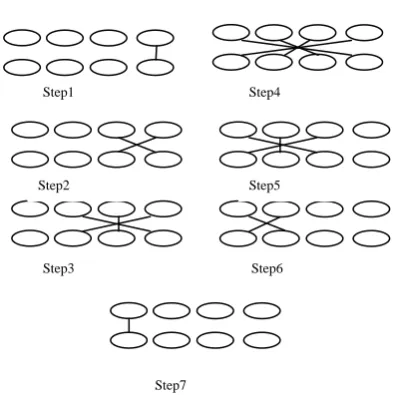
It is one of the fastest parallel prefix adder. It generates the carry signals in O(log n) time[ 7-8]. It uses group generate and propagate functions. It uses three stages
i) Pre-processing
ii) Carry look-ahead network iii) Post-processing
In Pre-processing stage, propagate (p) and generate (g) functions are calculated as p=a xor b;
g=a and b; Step1
Step2
Step3
Step4
Step5
Step6
Copyright to IJIRCCE DOI: 10.15680/IJIRCCE.2015. 0310153 9846
In Carry look-ahead network, group propagate and generate functions are calculated as:-
cp[i]=p[i] and p[i-1]
cg[i]=g[i] or (g[i-1] and p[i])
In Post-processing network, sum and cout is calculated
sum[i]=p[i] xor cg[i-1]
Fig. 3 - 16-bit Kogge Stone Adder network
IV. IMPLEMENTATION
A. 4 Bit Vedic Multiplier
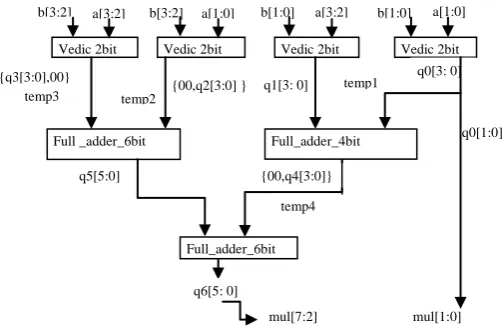
Firstly the 2 bit Vedic Multiplier has been designed using two half adders[9, 10] & four and gates. Next the four 2 bit Vedic Multipliers and three Ripple Carry Adders & also by Kogge Stone Adders each of 4 bit, 6 bit, 6 bit are needed for design of 4 bit Vedic Multiplier. The schematic could be as shown:-
Fig. 4(a) - Schematic for 4 bit Vedic Multiplier
B. 8 Bit Vedic Multiplier
The 8 bit Vedic Multiplier has been designed using four 4 bit Vedic Multipliers and three Ripple Carry Adders as well as Kogge Stone Adders each of 8 bit, 12 bit, 12 bit as shown:-
Vedic 2bit Vedic 2bit
Full _adder_6bit
Full_adder_6bit
Vedic 2bit Vedic 2bit
{q3[3:0],00} ,0000 0)000000000
temp3 temp2 {00,q2[3:0] } 0)0000
00000
q1[3: 0]
q0[3: 0]
q5[5:0]
q6[5: 0]
{00,q4[3:0]}
temp4
mul[1:0] q0[1:0]
mul[7:2] temp1 b[3:2]
b3 b2
b[3:2] b3 b2
b[1:0] b1 b0
a[1:0] b1 b0 a[3:2]
b3 b2
a[1:0] b3 b2
a[3:2] b1 b0
b[1:0] b1 b0
Copyright to IJIRCCE DOI: 10.15680/IJIRCCE.2015. 0310153 9847
Fig. 4(b) - Schematic for 8 bit Vedic Multiplier
C. 16 Bit Vedic Multiplier
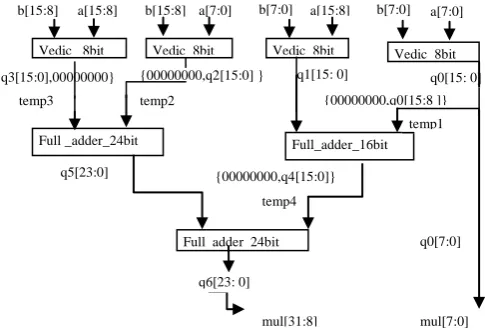
The 16 bit Vedic Multiplier has been designed using four 8 bit Vedic Multipliers and three Ripple Carry Adders as well as Kogge Stone Adders each of 16 bit, 24 bit, 24 bit. It is found that as the number of bits increases in the multiplier the performance of the system increases. Therefore the schematic for the 16 bit Vedic Multiplier could be as shown:-
Fig. 4(c) - Schematic for 16 bit Vedic Multiplier
V. SYNTHESIS & SIMULATION
The synthesis of Vedic Multiplier has been performed using Xilinx 14.4 ISE & simulation has been done using Isim simulation tool on Spartan6 FPGA. The family is spartan6, device xc6slx45, package csg324, speed -3.
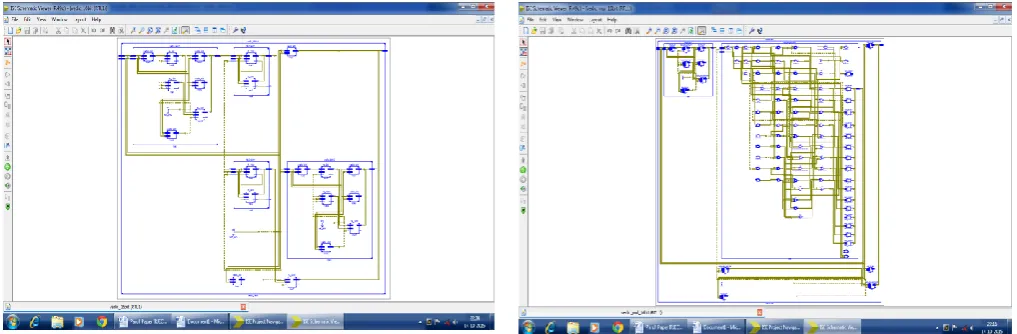
The technology Schematic of 8 bit Vedic Multiplier using RCA which requires more computational time compared to KSA has been shown in fig 5 (a) below:-
The technology Schematic of 8 bit Vedic Multiplier using which employs more complex hardware however speed grade is superior compared to RCA has been shown in fig 5(b) below:-
The simulation view of 8 bit Vedic Multiplier which displays the result of multiplying two 8 bit numbers has been shown in fig 5(c) below:-
q1[15: 0] Vedic_8bit
Vedic 8bit
Full _adder_24bit
Full_adder_24bit
Vedic_8bit Vedic_8bit
Full_adder_16bit {q3[15:0],00000000} temp3 00 0)00000 0000 temp2 0)00000 0000 q0[15: 0] q5[23:0] q6[23: 0] {00000000,q4[15:0]} temp4 mul[7:0] F i g 4 ( c ) -S c h e m a t i c f o r q0[7:0] mul[31:8] temp1 b[15:8] b[7:4] b[15:8] b3 b2 b[7:0] b1 b0 b[7:0] b1 b0 a[15:8] b[7:4] a[7:0] b3 b2 a[15:8] b1 b0 a[7:0] b1 b0 {00000000,q0[15:8 ]} {00000000,q2[15:0] } Vedic_4bit Vedic_ 4bit Full _adder_12bit Full_adder_12bit
Vedic_4bit Vedic_4bit
Copyright to IJIRCCE DOI: 10.15680/IJIRCCE.2015. 0310153 9848
Fig. 5(a) -Technology Schematic of 8 bit Vedic Multiplier Fig. 5(b) -Technology Schematic of 8 bit Vedic Multiplier
using RCA using KSA
Fig. 5(c) - Simulation result of 8 bit Vedic Multiplier
The technology Schematic of 16 bit Vedic Multiplier using RCA which has lower processing speed and therefore produces more delay in computation as compared to KSA has been shown in fig 5 (d) below:-
The technology Schematic of 16 bit Vedic Multiplier using KSA which is considered as one of the fastest parallel prefix has been shown in fig 5(e) below:-
The simulation view of 16 bit Vedic Multiplier which displays the result of multiplying two16 bit numbers has been shown in fig 5(f) below:-
Fig. 5(d) -Technology Schematic of 16 bit Vedic
Fig. 5(f) - Simulation result of 16 bit Vedic Multiplier
The obtained results i.e. Delay, Levels of Logic, No. Of LUTS, Memory for the Vedic Multiplier (4/8/16 bit) designed using RCA and KSA for the device Spartan 6 Xc6slx45~3csg324 has been shown in table 1 below. It has been found that value of delay is less in the design of Vedic Multiplier using KSA as compared to RCA however the memory requirement increases.
Table 1- Obtained Results
Device-Spartan6 Xc6slx45~3csg324
Using Ripple Carry Adder Using Kogge Stone Adder
Vedic Multiplier Delay (ns)
Levels of Logic
No. of slice LUTs
Memory (KB)
Delay (ns)
Levels of Logic
No. of
slice LUTs Memory (KB)
4 Bit 9.380 6 22 253328 9.813 7 22 253584
8 Bit 17.318 13 112 253200 15.713 13 130 254224
16 Bit 29.051 23 505 254800 27.499 22 647 256592
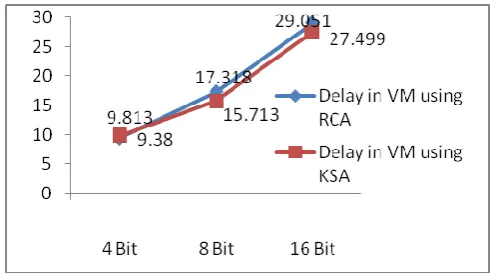
The delay comparison graph for the Vedic Multiplier (4/8/16 bit) designed using RCA and KSA for the device Spartan 6 Xc6slx45~3csg32 has been shown in fig 6 below. It has been found that the value of delay is less in KSA compared to RCA for the design of Vedic Multiplier(4/8/16 bit) as the number of bits of Vedic Multiplier increases the result becomes more accurate.
Fig. 6- Delay Comparison Graph for Vedic Multiplier (4/8/16 bit) using RCA & KSA
VI. CONCLUSION
Copyright to IJIRCCE DOI: 10.15680/IJIRCCE.2015. 0310153 9850
254800KB. Hence it can be concluded that the design using Kogge Stone Adder is more efficient in terms of speed as it produces less delay however more memory as compared to Ripple Carry Adder.
REFERENCES
[1] Jagadguru Swami Sri Bharti Krishna Tirthaji Maharaja “Vedic Mathematics or Sixteen Simple Mathematicle Formulae from the Veda,
Delhi(1965)”, Motilal Banarsidas Varanasi, India.
[2] Kumar G., “Design of High Speed Vedic Multiplier using Vedic Mathematics Techniques”, International Journal of Scientific and Research
Publications, Volume 2, Issue 3, March 2012, pp. 1-5.
[3] M. Poornima et. Al.“ Implementation of Multiplier using Vedic Algorithm IJITEE Volume-2, Issue-6, May 2013.
[4] Tiwari H.D, “Multiplier design based on ancient Indian Vedic Mathematics’’ SoC Design Conference, 2008 ISOCC'08.
International (Volume:02 ) Busan 24-25 Nov. 2008, pp II-65 - II-68.
[5] Anand N, et. Al. “Implementation of Adder Structure with Fast Carry Network for High Speed Processor” IEEE Transaction ICGCE
Vellore 2013.
[6] Ngai T.F., Irwin M.J., Rawat S., “Regular, area-time efficient carry-lookahead adders,” Journal of Parallel and Distributed Computing,
volume 3, no. 3, pp. 92–105, reprinted in E. E. Swartzlander, Computer Arithmetic, Vol. 2, IEEE, 1986.
[7] Kumar Sudheer, Naik Rajendra, “Design and Estimation of delay, power, area for Parallel Prefix Adders” RAECS Chandigarh 06-08 March
2014.
[8] Anjana et.al “Implementation of Vedic Multiplier using Kogge Stone Adder” IEEE Transaction ICES Coimbatore 2014
[9] Pohokar S.P, Sisal R.S “Design & Implementation of 16x16 multiplier using Vedic Mathematics” IEEE Transaction ICIC Pune May 2015
[10] M. C Sudeep, M Sharath Bimba, Vucha Mahendra, “Design and FPGA Implementation of High Speed Vedic Multiplier”, International Journal
of Computer Applications, Volume 90-No. 16, March 2014
BIOGRAPHY
Parul Agrawal, received the BE degree in Electronics & Telecommunication Engineering from the Chhattisgarh Swami Vivekanand Technical University, INDIA in 2014. Presently pursuing M.E. (Communication) from Chhatrapati Shivaji Institute of Technology, DURG (CG). Her research interest includes Adders & Multipliers.