A Survey on:
Improved Reliability Using
Secure Distributed Deduplication Systems
Kolekar Mayuri., Prof. Bere S. S.
P.G. Scholar, Dept. of Information Technology, DGOI, FOE, Bhigwan, Savitribai Phule University of Pune, Pune, India Professor, Dept. of Computer Engineering, DGOI, FOE, Bhigwan, Savitribai Phule University of Pune, Pune, India
ABSTRACT: For removing replication copies of data we use data deduplication process. As well as it is used in cloud storage to reduce memory space & upload bandwidth only one copy for each file stored in cloud that can be used by number of users. Deduplication process helps to improve storage reliability. One more challenge of privacy for sensitive data also arises when they are outsourced by users to cloud. The aim of this paper is to make the first attempt formalize the idea of distributed reliable deduplication system. In our proposed system we are going to develop new distributed deduplication systems which are highly reliable. In deduplication process data chunks are distributed across multiple cloud servers. The instead of using convergent encryption as in previous deduplication systems we use deterministic secret sharing scheme in distributed storage systems. So that we can achieve the required concepts for security that are data confidentiality and tag consistency. In the proposed security model, Security analysis demonstrates that our deduplication systems are secure.
KEYWORDS: Deduplication, reliability, distributed storage system, secret sharing, encryption
I.INTRODUCTION
Data deduplication is a technique for eliminating duplicate copies of data, and has been widely usedin cloud storage to reduce storage space and upload bandwidth. Promising as it is, an arising challenge is to perform secure deduplication in cloud storage. Although convergent encryption has been extensively adopted for secure deduplication, a critical issue of making convergent encryption practical is to efficiently and reliably manage a huge number of convergent keys. One critical challenge of today‟s cloud storage services is the management of the everincreasing volume of data. To make data management scalable deduplication we are use convergent Encryption for secure deduplication services.Businesses, especially startups, small and medium businesses (SMBs), are increasingly opting for outsourcing data and Computation to the Cloud. Today‟s commercial cloud storage services, such as Dropbox, Mozy, and Memopal, have been applying deduplication to user data to save maintenance cost . From a user‟s point of view, data outsourcing raises security and privacy concerns. We must trust thirdparty cloud providers to properly enforce confidentiality, integrity checking, and access control mecharisms against any insider and outsider attacks. However, deduplication, while improving storage and bandwidth efficiency, is compatible with Convergent key management. Specifically, traditional encryption requires different users to encrypt their data with their own keys. Many proposals have been made to secure remote data in the Cloud using encryption and standard access controls. It is fair to say all of the standard approaches have been demonstrated to fail from time to time for a variety of reasons, including insider Attacks, masconfigured services, faulty implementations, buggy code, and the creative construction of effective and Sophisticated attacks not envisioned by the implementers of security procedures. Building a trustworthy cloud computing environment is not enough, because accidents continue to happen, and when they do, and information gets lost, there is no way to get it back. One needs to prepare for such accidents.The basic idea is that we can limit the damage of stolen data if we decrease the value of that stolen information to the attacker. We can achieve this through a „preventive‟ disinformation attack. We posit that secure deduplication services can be implemented given two additional security features:
1.1 User Behavior Profiling: It is expect that access to a user‟s information in the Cloud will exhibit a normal means
user accesses their information in the Cloud. Such „normal user‟ behavior can be continuously checked to determine whether abnormal access to a user‟s information is occurring. This method of behavior base security is commonly used in fraud detection applications. Such pro files would naturally include volumetric information, how many documents are typically read and how often. These simple user specific features can serve to detect abnormal Cloud access based partially upon the scale and scope of data transfer.
1.2 Decoys: Decoy information, such as decoy documents, honey files, honeypots, and various other bogus information can be generated on demand and serve as a means of detecting unauthorized access to information and to „ poison‟ the thief‟s infiltrated information. Serving decoys will confound and confuse an attacker into believing they have bogus useful information, when they have not. Whenever abnormal access to a cloud service is notice, decoy information may be return by the Cloud and deliver in such a way as to appear completely legitimate and normal. The true user, who is the owner of the information, would readily identify when decoy information is being return by the Cloud, and hence could alter the Cloud‟s responses through a variety of means, such as challenge questions, to inform the Cloud security system that it has inaccurately detect an abnormal access. In the case where the access is correctly identified as an abnormal access, the Cloud security system would deliver unbounded amounts of bogus information to the adversary, thus securing the user‟s true data from unauthorized disclosure.
II.LITERATURE SURVEY
The Farsite distributed file system provides availability by replicating each file onto multiple desktop computers. Since this replication consumes significant storage space,[1] it is important to reclaim used space where possiblel. Measurement of over 500 desktop file systems shows that nearly half of all consumed space is occupied by duplicate files. We present a mechanism to reclaim space from this incidental duplication to make it available for controlled file replication. Our mechanism includes 1) convergent encryption, which enables duplicate files to coalesced into the space of a single file, even if the files are encrypted with different users' keys, and 2) SALAD, a SelfArranging, Lossy, Associative Database for aggregating file content and location information in a decentralized, scalable, fault-tolerant manner. Large-scale simulation experiments show that the duplicate-file coalescing system is scalable, highly effective, and fault-tolerant [4].
Cloud storage service providers such as Dropbox, Mozy, and others perform deduplication to save space by only storing one copy of each file uploaded [5]. Should clients conventionally encrypt their files, however, savings are lost. Message-locked encryption (the most prominent manifestation of which is convergent encryption) resolves this tension. However it is inherently subject to brute-force attacks that can recover files falling into a known set. We propose an architecture that provides secure deduplicated storage resisting brute-force attacks, and realize it in a system called DupLESS. In DupLESS, clients encrypt under message-based keys obtained from a key-server via an oblivious PRF protocol. It enables clients to store encrypted data with an existing service, have the service perform deduplication on their behalf, and yet achieves strong confidentiality guarantees. We show that encryption for deduplicated storage can achieve performance and space savings close to that of using the storage service with plaintext data [5].
An Information Dispersal Algorithm (IDA) is developed that breaks a file F of length L = ( F ( into n pieces F,, 1 5 i 5 n, each of length ( F, 1 = L/m, so that every m pieces suffice for reconstructing F[9]. Dispersal and reconstruction are computationally efficient. The sum of the lengths ( F, 1 is (n/m). L. Since n/m can be chosen to be close to I, the IDA is space eflicient. IDA has numerous applications to secure and reliable storage of information in computer networks and even on single disks, to fault-tolerant and efficient transmission of information in networks, and to communi-cations between processors in parallel computers. For the latter problem provably time-efftcient and highly fault-tolerant routing on the n-cube is achieved, using just constant size buffers. Categories and Subject Descriptors: E.4 [Coding and Information Theory]: nonsecret encoding schemes [9].
in cloud storage [11]. Although convergent encryption has been extensively adopted for secure deduplication, a critical issue of making convergent encryption practical is to efficiently and reliably manage a huge number of convergent keys. This paper makes the first attempt to formally address the problem of achieving efficient and reliable key management in secure deduplication. We first introduce a baseline approach in which each user holds an independent master key for encrypting the convergent keys and outsourcing them to the cloud. However, such a baseline key management scheme generates an enormous number of keys with the increasing number of users and requires users to dedicatedly protect the master keys. To this end, we propose Dekey , a new construction in which users do not need to manage any keys on their own but instead securely distribute the convergent key shares across multiple servers. Security analysis demonstrates that Dekey is secure in terms of the definitions specified in the proposed security model. As a proof of concept, we implement Dekey using the Ramp secret sharing scheme and demonstrate that Dekey incurs limited overhead in realistic environments [11].
Cloud storage systems are becoming increasingly popular. A promising technology that keeps their cost down is deduplication, which stores only a single copy of repeating data [12]. Client-side deduplication attempts to identify deduplication opportunities already at the client and save the bandwidth of uploading copies of existing files to the server. In this work we identify attacks that exploit client-side deduplication, allowing an attacker to gain access to arbitrary-size files of other users based on very small hash signatures of these files. More specifically, an attacker who knows the hash signature of a file can convince the storage service that it owns that file; hence the server lets the attacker download the entire file. (In parallel to our work, a subset of these attacks was recently introduced in the wild with respect to the Dropbox file synchronization service.) To overcome such attacks, we introduce the notion of proofs-ofownership (PoWs), which lets a client efficiently prove to a server that that the client holds a file, rather than just some short information about it. We formalize the concept of proof-of-ownership, under rigorous security definitions, and rigorous efficiency requirements of Petabyte scale storage systems. We then present solutions based on Merkle trees and specific encodings, and analyse their security. We implemented one variant of the scheme. Our performance measurements indicate that the scheme incurs only a small overhead compared to naive client-side deduplication [12].
III.EXISTING SYSTEM
A number of deduplication systems have been proposed based on various deduplication strategies such as client-side or server-side deduplications, file-level or block-level deduplications.Bellare et al. formalized this primitive as message-locked encryption, and explored its application in space efficient secure outsourced storage. There are also several implementations of convergent implementations of different convergent encryption variants for secure deduplication.Li addressed the key-management issue in block-level deduplication by distributing these keys across multiple servers after encrypting the files Bellare et al. showed how to protect data confidentiality by transforming the predictable message into a unpredictable message.[1]
Disadvantages of Existing System:
Data reliability is actually a very critical issue in a deduplication storage system because there is only one copy for each file stored in the server shared by all the owners.
Most of the previous deduplication systems have only been considered in a single-server setting.
The traditional deduplication methods cannot be directly extended and applied in distributed and multi-server systems.IV.PROPOSED ALGORITHM
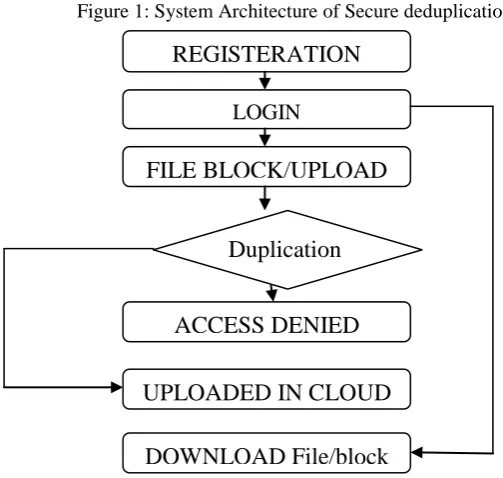
System Architecture:
to each storage server as the fingerprint of the fragment stored at each server. Only the data owner who first uploads the data is required to compute and distribute such secret shares, while all following users who own the same data copy do not need to compute and store these shares any more. To recover data copies, users must access a minimum number of storage servers through authentication and obtain the secret shares to reconstruct the data. In other words, the secret shares of data will only be accessible by the authorized users who own the corresponding data copy.Four new secure deduplication systems are proposed to provide efficient deduplication with high reliability for file-level and block-level deduplication, respectively. The secret splitting technique, instead of traditional encryption methods, is utilized to protect data confidentiality. Specifically, data are split into fragments by using secure secret sharing schemes and stored at different servers [1].
Figure 1: System Architecture of Secure deduplication
Figure 2: Data Flow Diagram of Secure deduplication
REGISTERATION
LOGIN
FILE BLOCK/UPLOAD
Duplication
ACCESS DENIED
UPLOADED IN CLOUD
Modules: System Model:
In this first module, we develop two entities: User and Secure-Cloud Service Provide. User: The user is an entity that wants to outsource data storage to the S-CSP and access the data later. In a storage system supporting deduplication, the user only uploads unique data but does not upload any duplicate data to save the upload bandwidth. Furthermore, the fault tolerance is required by users in the system to provide higher reliability.
S-CSP:
The S-CSP is an entity that provides the outsourcing data storage service for the users. In the deduplication system, when users own and store the same content, the S-CSP will only store a single copy of these files and retain only unique data. A deduplication technique, on the other hand, can reduce the storage cost at the server side and save the upload bandwidth at the user side. For fault tolerance and confidentiality of data storage, we consider a quorum of CSPs, each being an independent entity. The user data is distributed across multiple S-CSPs.
Data Deduplication:
Data Deduplication involves finding and removing of duplicate data‟s without considering its fidelity.Here the goal is to store more data‟s with less bandwidth.Files are uploaded to the CSP and only the Data owners can view and download it. The Security requirements are also achieved by Secret Sharing Scheme.Secret Sharing Scheme uses two algorithms, share and recover. Data‟s are uploaded both file and block level and the finding duplication is also in the same process. This is made possible by finding duplicate chunks and maintaining a single copy of chunks.
File Level Deduplication Systems:
To support efficient duplicate check, tags for each file will be computed and are sent to S-CSPs.To upload a file F , the user interacts with S-CSPs to perform the deduplication.More precisely, the user firstly computes and sends the file tag ϕF = TagGen(F) to S-CSPs for the file duplicate check.If a duplicate is found the user computes and sendsit to a server via a secure channel.Otherwise if no duplicate is found the process continues,i.e secret sharing scheme runs and the user will upload a file to CSP. To download a file the user will use the secret shares and download it from the SCSP‟s .This approach provides fault tolerance and allows the user to remain accessible even if any limited subsets of storage servers fail.
Block Level Deduplication Systems:
In this module we will show to achieve fine grained level distributeddeduplication systems.In a block-level deduplication system, the user also needs to firstly perform the file-block-level deduplication before uploading his file.If no duplicate is found, the user divides this file into blocks and performs block-level deduplication.The System setup is similar to the file level deduplication except the parameter changes. To download a block the user gets the secret shares and downloads the blocks from CSP.
Advantage:
1. Distinguishing feature of our proposal is that data integrity, including tag consistency, can be achieved. 2. To our knowledge, no existing work on secure deduplication can properly address the reliability and tag
consistency problem in distributed storage systems.
3. Our proposed constructions support both file-level and block-level deduplications.
5. We implement our deduplication systems using the Ramp secret sharing scheme that enables high reliability and confidentiality levels. Our evaluation results demonstrate that the new proposed constructions are efficient and the redundancies are optimized and comparable with the other storage system supporting the same level of reliability.
V.CONCLUSION AND FUTURE WORK
We implement the secure distributed deduplication systems to improve the reliability of data while achieving the secret of the clients outsourced data. Four constructions were proposed to support file-level and fine-grained block-level data deduplication. The security of tag consistency and integrity were achieved. We implemented our deduplication systems using the Ramp secret sharing scheme and demonstrated that it incurs small encoding/decoding overhead compared to the network transmission overhead in regular upload/download operations.
REFERENCES
[1] H. Shacham and B. Waters, “Compact proofs of retrievability,” in ASIACRYPT, 2008, pp. 90–107.
[2] J. Gantz and D. Reinsel, “The digital universe in 2020: Big data, bigger digital shadows, and biggest growth in the far east,” http://www.emc.com/collateral/analyst-reports/idcthe-digital-universe-in-2020.pdf, Dec 2012.
[3] M. O. Rabin, “Fingerprinting by random polynomials,” Center for Research in Computing Technology, Harvard University, Tech. Rep. Tech. Report TR-CSE-03-01, 1981.
[4] J. R. Douceur, A. Adya, W. J. Bolosky, D. Simon, and M. Theimer, “Reclaiming space from duplicate files in a serverless distributed file system.” in ICDCS, 2002, pp. 617–624.
[5] M. Bellare, S. Keelveedhi, and T. Ristenpart, “Dupless: Serveraided encryption for deduplicated storage,” in USENIX Security Symposium, 2013.
[6] “Message-locked encryption and secure deduplication,” in EUROCRYPT, 2013, pp. 296–312.
[7] G. R. Blakley and C. Meadows, “Security of ramp schemes,” in Advances in Cryptology: Proceedings of CRYPTO ‟84, ser. Lecture Notes in Computer Science, G. R. Blakley and D. Chaum, Eds. Springer-Verlag Berlin/Heidelberg, 1985, vol. 196, pp. 242–268.
[8] A. D. Santis and B. Masucci, “Multiple ramp schemes,” IEEE Transactions on Information Theory, vol. 45, no. 5, pp. 1720–1728, Jul. 1999. [9] M. O. Rabin, “Efficient dispersal of information for security, load balancing, and fault tolerance,” Journal of the ACM, vol. 36, no. 2, pp. 335– 348, Apr. 1989.
[10] A. Shamir, “How to share a secret,” Commun.ACM, vol. 22, no. 11, pp. 612–613, 1979.
[11] J. Li, X. Chen, M. Li, J. Li, P. Lee, and W. Lou, “Secure deduplication with efficient and reliable convergent key management,” in IEEE Transactions on Parallel and Distributed Systems, 2014, pp. vol. 25(6), pp. 1615–1625.
[12] S. Halevi, D. Harnik, B. Pinkas, and A. Shulman-Peleg, “Proofs of ownership in remote storage systems.” in ACM Conference on Computer and Communications Security, Y. Chen, G. Danezis, and V. Shmatikov, Eds. ACM, 2011, pp. 491–500.
[13] J. S. Plank, S. Simmerman, and C. D. Schuman, “Jerasure: A library in C/C++ facilitating erasure coding for storage applications - Version 1.2,” University of Tennessee, Tech. Rep. CS-08-627, August 2008.
[14] J. S. Plank and L. Xu, “Optimizing Cauchy Reed-solomon Codes for fault-tolerant network storage applications,” in NCA-06: 5th IEEE International Symposium on Network Computing Applications, Cambridge, MA, July 2006.
[15] C. Liu, Y. Gu, L. Sun, B. Yan, and D. Wang, “R-admad: High reliability provision for large-scale de-duplication archival storage systems,” in Proceedings of the 23rd international conference on Supercomputing, pp. 370–379.
[16] M. Li, C. Qin, P. P. C. Lee, and J. Li, “Convergent dispersal: Toward storage-efficient security in a cloud-of-clouds,” in The 6th USENIX Workshop on Hot Topics in Storage and File Systems, 2014.
[17] P. Anderson and L. Zhang, “Fast and secure laptop backups with encrypted de-duplication,” in Proc. of USENIX LISA, 2010. [18] Z. Wilcox-O‟Hearn and B. Warner, “Tahoe: the least-authority filesystem,” in Proc. of ACM StorageSS, 2008.
[19] A. Rahumed, H. C. H. Chen, Y. Tang, P. P. C. Lee, and J. C. S. Lui, “A secure cloud backup system with assured deletion and version control,” in 3rd International Workshop on Security in Cloud Computing, 2011.
[20] M. W. Storer, K. Greenan, D. D. E. Long, and E. L. Miller, “Secure data deduplication,” in Proc. of StorageSS, 2008.
[21] J. Stanek, A. Sorniotti, E. Androulaki, and L. Kencl, “A secure data deduplication scheme for cloud storage,” in Technical Report, 2013. [22] D. Harnik, B. Pinkas, and A. Shulman-Peleg, “Side channels in cloud services: Deduplication in cloud storage.” IEEE Security & Privacy, vol. 8, no. 6, pp. 40–47, 2010.
[23] R. D. Pietro and A. Sorniotti, “Boosting efficiency and security in proof of ownership for deduplication.” in ACM Symposium on Information, Computer and Communications Security, H. Y. Youm and Y. Won, Eds. ACM, 2012, pp. 81–82.
[24] J. Xu, E.-C.Chang, and J. Zhou, “Weak leakage-resilient client-side deduplication of encrypted data in cloud storage,” in ASIACCS, 2013, pp. 195–206.
[25] W. K. Ng, Y. Wen, and H. Zhu, “Private data deduplication protocols in cloud storage.” in Proceedings of the 27th Annual ACM Symposium on Applied Computing, S. Ossowski and P. Lecca, Eds. ACM, 2012, pp. 441–446.
[26] G. Ateniese, R. Burns, R. Curtmola, J. Herring, L. Kissner, Z. Peterson, and D. Song, “Provable data possession at untrusted stores,” in Proceedings of the 14th ACM conference on Computer and communications security, ser. CCS ‟07. New York, NY, USA: ACM, 2007, pp. 598–609. [Online].Available:http://doi.acm.org/10.1145/1315245.1315318