APE: Authenticated Permutation-Based
Encryption for Lightweight Cryptography
Elena Andreeva1,2, Beg¨ul Bilgin1,2,3, Andrey Bogdanov4, Atul Luykx1,2, Bart Mennink1,2, Nicky Mouha1,2, and Kan Yasuda1,5
1
Department of Electrical Engineering, ESAT/COSIC, KU Leuven, Belgium. [email protected]
2
iMinds, Belgium.
3
Faculty of EEMCS, DIES, UTwente, Netherlands.
4 Department of Mathematics, Technical University of Denmark, Denmark.
5 NTT Secure Platform Laboratories, Japan.
Abstract. The domain of lightweight cryptography focuses on crypto-graphic algorithms for extremely constrained devices. It is very costly to avoid nonce reuse in such environments, because this requires either a hardware source of randomness, or non-volatile memory to store a counter. At the same time, a lot of cryptographic schemes actually require the nonce assumption for their security. In this paper, we propose APE as the first permutation-based authenticated encryption scheme that is resistant against nonce misuse. We formally prove that APE is secure, based on the security of the underlying permutation. To decrypt, APE processes the ciphertext blocks in reverse order, and uses inverse permu-tation calls. APE therefore requires a permupermu-tation that is both efficient for forward and inverse calls. We instantiate APE with the permutations of three recent lightweight hash function designs:Quark,Photon, and
Spongent. For any of these permutations, an implementation that sup-ports both encryption and decryption requires less than 1.9 kGE and 2.8 kGE for 80-bit and 128-bit security levels, respectively.
Keywords.APE, Authenticated Encryption, Sponge Function, Online, Deterministic, Permutation-based, Misuse Resistant.
1
Introduction
In constrained environments, conventional solutions to cryptographic problems are prohibitively expensive to implement. Lightweight cryptography deals with cryptographic algorithms within the stringent requirements imposed by devices such as low-cost smart cards, sensor networks, and electronic body implants where energy, power, or hardware area consumption can be heavily restricted.
Lightweight permutation-based hash functions includeGluon[5],Photon[18],
Quark[1, 2], andSpongent[10].
Lightweight applications in practice require not only hash functions but also secret-key cryptographic functions, such as authenticated encryption (AE). AE is a cryptographic primitive that guarantees two security goals: privacy and integrity. The prevalent solutions in this direction are block cipher based [23, 27,30]. Permutation-based AE schemes were only recently proposed, such as the deterministic key-wrap scheme [20] of Khovratovich and SpongeWrap [6, 9] of theKeccakteam.
These two constructions unfortunately have their limitations. With the key-wrap scheme [20], the message length is restricted to one block by design. While sufficient for key wrapping [28], this construction cannot handle arbitrary-length data and is therefore not a full AE scheme. SpongeWrap [6, 9] can encrypt mes-sages of varying lengths but relies on the uniqueness of the nonce value: failure to ensure so makes it possible to reuse the keystream of the encryption. For example, if a pair of plaintexts share a common prefix, the XOR of the first pair of plaintext blocks after this common prefix is leaked.
In Rogaway’s security formalism of nonce-based encryption [25,26], the nonce is considered to be unique for every evaluation. While this approach has theo-retical merits, in practice it is challenging to ensure that a nonce is never reused. This is especially the case in lightweight cryptography, as a nonce is realized either by keeping a state (and correctly updating it) or by providing a hardware source of randomness. Indeed, nonce misuse is a security threat in plenty of prac-tical applications, not necessarily limited to the lightweight setting. Examples include flawed implementations of nonces [12, 14, 21, 22, 31], bad management of nonces by the user, and backup resets or virtual machine clones when the nonce is stored as a counter.
Noncemisuse resistancehas become an important criterion in the design of AE schemes. The CAESAR competition [13] considers misuse resistance in detail for their selection of a portfolio of AE algorithms. The problem of nonce misuse has also been addressed by the recent deterministic AE scheme SIV [28], by the online AE scheme McOE [17], and in part by the aforementioned deterministic key-wrap scheme [20]. However, there are currently no permutation-based AE schemes that are resistant to nonce misuse.
Our Contributions
show how APE can be generalized at almost no extra cost to handle fractional associated data and message blocks.
We prove that APE achieves privacy and integrity up to about 2c/2queries, wherecis the capacity parameter of APE. This result is proven in two different models: first, in Sect. 4, we prove security of APE in the ideal permutation model, where the underlying permutation is assumed to behave perfectly random. Next, in Sect. 5, we consider APEwith block ciphers, which is a generalization of APE where the permutation with surrounding key XORs is replaced with a block cipher call. We use the results from the ideal model to prove that APE with block ciphers is secure in the standard model up to roughly 2c/2queries as well. APE is designed to be well suited for lightweight applications. However, APE decrypts in inverse direction and requires an efficiently invertible permutation. In Sect. 7, we implement APE in less than 1.9 kGE and 2.8 kGE for 80-bit and 128-bit security respectively with the permutations of Quark, Photon, and
Spongent. The results indicate that including the inverses of these permuta-tions only leads to a marginal increase of the size of the implementation when compared to the cost of providing a hardware source of randomness to generate nonces.
2
Notation
SetR:={0,1}randC:={0,1}c. Given two stringsAandB, we useAkB and AB interchangeably, so for example AB =AkB ∈ R×C ∼= {0,1}r+c. Given X ∈ R×C, Xr denotes its projection onto R, also known as its rate part, and Xc denotes its projection onto C, or capacity part. We write 0 ∈R for a shorthand for 00· · ·0 ∈R and 1∈C for 00· · ·01∈C. The symbol ⊕denotes the bitwise XOR operation of two (or more) strings.
An element ofR is called a block. Let R∗ denote the set of strings whose length is a multiple ofr, with at most 2c/2blocks. This explicit bound of 2c/2is needed in order to define a random function as being sampled over a finite set of functions. Note that the bounds we prove become trivial for queries of length 2c/2blocks. Similarly, letR+denote the set of strings whose length is a positive multiple ofr, with at most 2c/2 blocks. GivenM ∈R+, we divide it into blocks and writeM[1]M[2]· · ·M[w]←M, where eachM[i] is a block andwthe block length of the stringM.
LetAbe some class of adversaries. For convenience, we use the notation
∆A[f, g] := sup
A∈A
Pr[Af = 1]−Pr[Ag= 1]
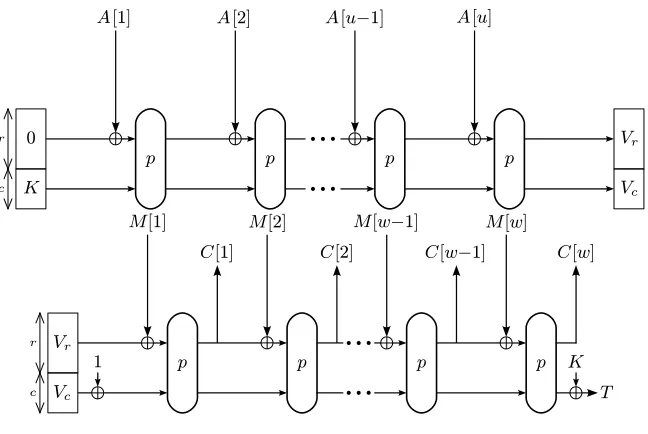
Fig. 1.The APE mode of operation (encryption). If there is no associated data (A= ∅), we haveVr:= 0 andVc:=K.
3
APE Authenticated Encryption Mode
We now define our APE mode for the case of plaintexts and associated data of length a multiple of the block size. We refer to Sect. 6 for the generalization of APE to fractional data blocks. APE iterates a fixed permutation p:R×C→
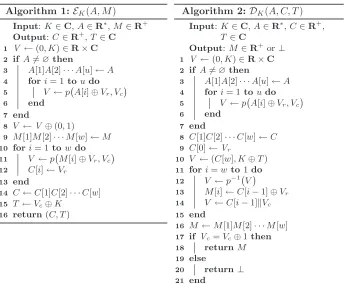
R×Cin a way similar to the sponge construction. The permutationpis the only underlying cryptographic primitive used by APE. A diagram of APE is given in Fig. 1 and an algorithmic description in Fig. 2.
The encryption algorithmE takes as input a keyK∈ K=C, associated data A∈R∗, and a messageM ∈R+, and returns a ciphertext C∈R+ and a tag T ∈C, as (C, T)← EK(A, M). On the other hand,Dtakes as input a keyK∈C, associated data A∈ R∗, a ciphertext C ∈R+, and a tagT ∈C, and returns either a messageM ∈R+or the reject symbol⊥, asM/⊥ ← D
K(A, C, T). The two functionalities are sound, in the sense that whenever we encrypt a message as (C, T)← EK(A, M), we always get the message back, not⊥, via the decryption processM ← DK(A, C, T).
Algorithm 1:EK(A, M)
Input:K∈C,A∈R∗,M ∈R+
Output:C∈R+, T ∈C
1 V ←(0, K)∈R×C
2 if A6=∅then
3 A[1]A[2]· · ·A[u]←A 4 for i= 1 toudo 5 V ←p`A[i]⊕Vr, Vc
´
6 end
7 end
8 V ←V ⊕(0,1)
9 M[1]M[2]· · ·M[w]←M 10 fori= 1to wdo 11 V ←p`M[i]⊕Vr, Vc
´
12 C[i]←Vr
13 end
14 C←C[1]C[2]· · ·C[w] 15 T←Vc⊕K
16 return(C, T)
Algorithm 2:DK(A, C, T)
Input:K∈C,A∈R∗,C∈R+
, T ∈C
Output:M ∈R+
or⊥
1 V ←(0, K)∈R×C
2 if A6=∅ then
3 A[1]A[2]· · ·A[u]←A 4 fori= 1toudo 5 V ←p`A[i]⊕Vr, Vc´
6 end
7 end
8 C[1]C[2]· · ·C[w]←C 9 C[0]←Vr
10 V ←(C[w], K⊕T) 11 fori=w to1do 12 V ←p−1`V´ 13 M[i]←C[i−1]⊕Vr
14 V ←C[i−1]kVc
15 end
16 M ←M[1]M[2]· · ·M[w] 17 if Vc=Vc⊕1then
18 returnM 19 else
20 return⊥
21 end
Fig. 2.The encryptionEK(A, M) and decryptionDK(A, C, T) algorithms of APE.
4
Privacy and Integrity of APE
We prove that APE satisfies privacy under chosen plaintext attacks (CPA) and integrity security up to aboutc/2 bits. Before doing so, in Sect. 4.1 we present the security model, where we formalize the notion of an ideal online function, and where we introduce the CPA and integrity security definitions. Then, privacy is proven in Sect. 4.2 and integrity in Sect. 4.3. The security results in this section assume that the underlying permutationpis ideal. Later, in Sect. 5, we consider the security of APE with block ciphers in the standard model.
4.1 Security Model
Let Perm(n) be the set of all permutations onnbits. By⊥, we denote a function that returns ⊥on every input. When writing x←$ X for some finite setX we mean thatxis sampled uniformly fromX. To avoid confusion, forX ∈R×C
Online functions were first introduced in [3]. We deviate slightly from their approach by explicitly defining our ideal online function in terms of random functions.
Definition 1 (Ideal Online Function). Let g:R∗×R∗→Randg′ :R∗× R∗ →C be random functions. Then, on input of (A, M) with w =|M|/r, we define $ :R∗×R+→R+×C as
$(A, M[1]kM[2]k · · · kM[w]) = (C[1]kC[2]k · · · kC[w], T),
where
C[j] =g(A, M[1]k · · · kM[j])for j= 1, . . . , w, T =g′(A, M).
Notice that the above function is actually online: prefixes of outputs remain the same if prefixes of the inputs remain constant. Furthermore, if the associated data in the ideal online function is unique for each invocation of the function, then we achieve full privacy. This is because the inputs tog andg′ will then be unique for each invocation, and sinceg andg′are random functions, we get out-puts that are independent and uniformly distributed. By comparing our scheme to the above ideal online function we will automatically achieve the notions of CPA security and integrity from Rogaway and Zhang [29] and Fleischmann et al. [17].
Definition 2. LetΠ = (K,E,D)denote an AE scheme. The CPA advantage of a distinguisher D is defined as
AdvcpaΠ (D) =
Prhp←$ Perm(r+c), K← K$ : DEK,⊥,p,p− 1
= 1i−
Prhp $
←Perm(r+c) : D$,⊥,p,p−1
= 1i .
ByAdvcpaΠ (q, m)we denote the supremum taken over all distinguishers making q queries of total lengthmblocks.
Definition 3. LetΠ= (K,E,D)denote an AE scheme. The integrity advantage of a distinguisher D is defined as
AdvintΠ(D) =
Prhp←$ Perm(r+c), K← K$ : DEK,DK,p,p− 1
= 1i−
Prhp←$ Perm(r+c), K← K$ : DEK,⊥,p,p− 1
= 1i .
4.2 Privacy
In this section, we present a privacy security proof for APE.
Theorem 1. Let Π= (K,E,D)be the APE construction. Then,
AdvcpaΠ (q, m)≤ m2 2r+c +
m(m+ 1) 2c .
Proof. We consider the strongest possible type of distinguishers: let D be any information-theoretic distinguisher which has unbounded computational power and whose complexity is measured solely by the number of queries it makes to its oracles. Without loss of generality, we restrict ourselves to distinguishers that do not ask “trivial” queries, queries to which it knows the answer in advance.
As a first step, we make a PRP-PRF switch [4]: we move from random per-mutation (p, p−1) to a primitive (f, f−1) defined as follows. This primitive main-tains an initially empty list of responses,F, and we denote its domain/range by
dom(F)/rng(F). Now, on a non-trivial forward query f(x), the response y is randomly drawn fromR×C. The primitive aborts ify happens to be inrng(F) already; otherwise, the fresh tuple (x, y) is added to F. Similarly for inverse queries to f−1. Clearly, (p, p−1) and (f, f−1) behave identically as long as the latter does not abort. Given that the distinguisher makes at most q queries of total lengthmblocks (each block corresponds to a new (f, f−1)-query), such an abort happens with probability at most m2
/2r+c ≤m2/2r+c+1. We apply this PRP-PRF switch to both the ideal and the real world, and hence we find
∆D(EK,⊥, p, p−1; $,⊥, p, p−1)≤ m 2
2r+c +∆D(EK,⊥, f, f
−1; $,⊥, f, f−1). (1)
In the remainder, we considerD to have oracle access to one of the two worlds: (F, f, f−1), where F∈ {E
K,$} (without loss of generality we can drop the⊥). Iff is called by D then we call this a directf-query, and similar for direct f−1-queries. A call off byE
K (as a result ofD callingEK) is called an indirect f-query. When we do not specify whether an f-query is indirect or direct, we mean that it could be either. Note that indirect queries do not occur in the random world ($, f, f−1). Every indirect f-query has a sequence of associated data blocks and message blocks leading up to it (from the EK-query calling it); we call this sequence the message chain associated to the indirectf-query.
Let Qi denote the set of all prefixes of all queries made by D to its F -oracle before the ith (f, f−1)-query, where a query (A, M) results in prefixes {A[1], A[1]kA[2], . . . , AkM}. Regarding all direct queries before the ith query, we denote byXdir
i the set of all capacity values input to f-queries or output of f−1-queries. For example, a direct forward query y ← f(x) adds [x]
c to Xidir and a direct inverse queryx←f−1(y) adds [x]
We define eventEi=Edir-Xi ∪Eind-Xi , where
Edir-Xi : direct queryy←f(x) orx←f−1(y) satisfies [x]c ∈Xiind∪Xiind⊕1,
Eind-Xi : indirect queryf(x) with message chain (A, M)∈ Q/ i satisfies [f(x)]c∈Xi∪Xi⊕1.
We furthermore define
ˆ
Ei:=Ei∩Tij=1−1Ej, andE:=Smi=1Eˆi, (2) whereEj is the complement of Ej.
Now, the remainder of the proof is divided as follows. In Lem. 1 we will prove that (EK, f, f−1) and ($, f, f−1) are indistinguishable as long as E does not occur. From (1) and the fundamental lemma of game playing [4] we find
AdvcpaΠ (q, m)≤ m 2
2r+c + Pr[D
EK,f,f−1
setsE].
Then, in Lem. 2, we will prove that Pr[DEK,f,f−1 setsE] ≤ m(m+ 1)
2c , which
completes the proof. ⊓⊔
Lemma 1. Given thatE does not occur,(EK, f, f−1)and($, f, f−1)are indis-tinguishable.
Proof. Note that in the ideal world, each directf-query is new, and is answered with a uniformly randomly drawn response. Now, consider a direct query f(x) in the real world. As the distinguisher does not make trivial queries, it does not coincide with any previous direct query. Additionally, if [x]c∈Xiind∪Xiind⊕1, where f(x) is the ith f-query, then this would trigger Edir-Xi , hence we can assume [x]c ∈/ Xiind∪Xiind⊕1. This means that the query f(x) is truly new, and its value is independently and uniformly distributed. The same reasoning applies to f−1-queries. Therefore, we only need to consider queries to the big oracle F ∈ {EK,$}. Let (A, M) be a query made by the distinguisher. Denote bywthe number of blocks ofM. Denote the corresponding ciphertext and tag by (C, T).
First consider the case (A, M[1]k · · · kM[j])∈ Qifor somej∈ {0, . . . , w}and assumej is maximal (we will come back to the case of (A,∗)6∈ Qi later in the proof). Let (A′, M′) be the corresponding earlier query, so M[1]k · · · kM[j] = M′[1]k · · · kM′[j], and denote its ciphertext and tag by (C′, T′) and block length byw′. Clearly, in the ideal world ($, f, f−1), we haveC[i] =C′[i] fori= 1, . . . , j, but C[i] for i = j+ 1, . . . , w and T are uniformly randomly drawn. We will consider how these values are distributed in the real world (EK, f, f−1). We first consider the general casej < w, the casej=wis discussed afterwards.
2. C[j+ 1]. We make a distinction betweenj >0 andj= 0, and start with the former case.
Write the indirect query corresponding to thejth round asf(x). The input of the (j+ 1)th query will bef(x)⊕(M[j+ 1],0). Note that (A, M′kM[j+ 1])6∈ Q, as this would contradict the fact that j is maximal. Now, assume this (j+ 1)th query has already been made before, i.e. [f(x)]c ∈Xdir∪Xind. This may be the case (it may even date from before the evaluation of (A, M′)), but at this particular time the capacity part [f(x)]c did not hit any element fromXdir∪Xind(otherwise it would have triggeredEind-X). After this query has been made, there has not been any newer indirect query or any newer direct query whose capacity part hit [f(x)]c(both cases would have triggered
Edir-X ∪Eind-X). Thus, the query corresponding to the (j + 1)th round is generated independently and uniformly at random.
Now, in the case j = 0, V denotes the state right after the hashing of A (V = (0, K) ifA=∅). The same story as before applies with the difference that now the input to the (j+ 1)th query isV ⊕(M[j+ 1],1). Here we use that by E, no other query hit Xind
j ⊕1 (for direct queries) orXj⊕1 (for indirect queries) in the meanwhile, and thatXind is initialized with{K}. 3. C[j+ 2], . . . , C[w]. By the above argument, the indirect query made in the
(j+ 1)th round of (A, M), sayf(x) for the sake of presentation, is responded with a uniformly random answer. This query would have triggeredEind-X
if [f(x)]c ∈ Xi. Therefore, we know that also the (j+ 2)th query is truly random and so isC[j+ 2]. The same reasoning applies up toC[w].
4. T. The same reasoning applies: the previous query is responded with a truly random answerf(x). ConsequentlyT = [f(x)]c⊕K is random too.
A special treatment is needed for j = w. In this case, C[1], . . . , C[w] equals C′[1], . . . , C′[w] by construction, but the query producingT is not new. Yet, the distinguisher never made that query itself by virtue ofEdir-X, so it never learnt T⊕K. Besides, due to the absence of indirect capacity collisions,Eind-X, every f-query will produce a tag at most once. This means thatT will look uniformly random to the distinguisher, as it would look if it were produced by $.
Finally, we consider the case (A,∗)6∈ Qi, hence this is the first time a query for this particular associated dataAis made. Then, the above reasoning carries over forj= 0 with the simplification that ifA6=∅, the valueVcright after the
hashing ofAcan be considered new. ⊓⊔
Lemma 2. Pr[DEK,f,f−1
sets E]≤ m(m+ 1) 2c .
Proof. Inspired by (2), we start bounding Pr[Ei∩Tij=1−1Ej] for i ∈ {1, . . . , m}. Clearly,
Pr[Ei∩Tij=1−1Ej]≤Pr[Ei|Tij=1−1Ej].
Therefore, we assumeTij=1−1Ejand consider the probability theith query triggers
If theith query is a direct (forward or inverse) query, it triggersEdir-Xi if the distinguisher guesses (in case of forward) or hits (in case of inverse) a capacity part in Xind
i ∪Xiind⊕1, which happens with probability at most 2|Xiind|/2c. On the other hand, if the ith query is a new indirect query (i.e. for which (A, M) ∈ Q/ i) it triggers Eind-Xi if [f(x)]c ∈ Xi ∪Xi ⊕1. This occurs with probability at most 2|Xi|/2c.
As the query is either direct or indirect, we could take the maximum of both values. Given that |Xind
i | ≤ |Xi| ≤i, we find: Pr[Ei|Tij=1−1Ej]≤ 2i
2c.
The result is now obtained by summing overi= 1, . . . , m(as in (2)). ⊓⊔
4.3 Integrity
In this section, we present an integrity security proof for APE.
Theorem 2. Let Π= (K,E,D)be the APE construction. Then,
AdvintΠ(q, m)≤ m2 2r+c +
2m(m+ 1) 2c .
Proof. The basic idea of the proof is the same as for Thm. 1. Again, let D be any information-theoretic distinguisher. By the PRP-PRF switch, we find
∆D(EK,DK, p, p−1;EK,⊥, p, p−1)≤ m2
2r+c +∆D(EK,DK, f, f
−1;E
K,⊥, f, f−1). (3)
We consider D to have oracle access to one of the two worlds: (EK, F, f, f−1), whereF ∈ {DK,⊥}.
We use the same notation as in Thm. 1, but slightly more involved definitions are required and we re-introduce them. If f is called by D then we call this a direct f-query, and similar for directf−1-queries. A call of f byE
K orDK (as a result ofDcalling them) is called an indirectf-query, and similar for indirect f−1-queries (viaD
K). Every indirectf-query has a sequence of associated data blocks and/or message blocks leading up to it (from theEK- orDK-query calling it); we call this sequence the message chain associated to the indirectf-query. Every indirectf−1-query has a tag and a sequence of ciphertext blocks leading up to it, and we call this sequence the associated ciphertext chain.
Let Qi denote the set of all prefixes of all queries made by D to its EK -oracle before theith (f, f−1)-query, where anE
byXdir
i the set of all capacity values input tof-queries or output off−1-queries, and byYdir
i the set of all capacity values input to f−1-queries or output off -queries. For example, a direct forward queryy←f(x) adds [x]ctoXidirand [y]c toYdir
i . The setsXiindandYiindare defined similarly. We writeXi=Xidir∪Xiind andYi=Yidir∪Yiind, and initializeX0ind=Y0ind={K}.
We define eventEi=Edir-Xi ∪Eind-Xi ∪Edir-Yi ∪Eind-Yi , whereEdir-Xi andEind-Xi are as in the proof of Thm. 1 with the renewed definitions of the sets, and where
Edir-Yi : direct queryy←f(x) or x←f−1(y) satisfies [y]
c∈Yiind∪Yiind⊕1,
Eind-Yi : indirect queryf−1(y) with ciphertext chain (C, T)∈ Q/ −i1 satisfies [f−1(y)]c∈Yi∪Yi⊕1 or [y]c ∈Yidir⊕K.
Definitions ˆEiandEare as before. The latter condition ofEind-Yi , [y]c∈Yidir⊕K, covers the case the distinguisher obtains the key by making a direct inverse query and a DK-query.
Now, the remainder of the proof is divided as follows. In Lem. 3 we will prove that (EK,DK, f, f−1) and (EK,⊥, f, f−1) are indistinguishable as long asEdoes not occur. From (3) and the fundamental lemma of game playing [4] we find
AdvcpaΠ (q, m)≤ m 2
2r+c + Pr[D
EK,DK,f,f−1
setsE].
Then, in Lem. 4, we will prove that Pr[DEK,DK,f,f−1 setsE]≤ 2m(m+ 1)
2c , which
completes the proof. ⊓⊔
Lemma 3. Given that E does not occur, (EK,DK, f, f−1) and (EK,⊥, f, f−1) are indistinguishable.
Proof. For direct (f, f−1)-queries, the analysis of Lem. 1 carries over with the difference that [y]c ∈Yiind∪Yiind⊕1 would trigger event Edir-Y. Also, queries made to EK in the real and ideal world are handled the same. Here, we use that in the real world, indirectf-queries coming fromDK (corresponding to the hashing ofA), do not ruin the distribution of the responses fromEK byEind-X, where we now deal with a larger setXind
i . Therefore, we only need to consider queries to the big oracleF ∈ {DK,⊥}. Let (A, C, T) be a query made by the distinguisher. Denote bywthe number of blocks ofM. Denote the state coming from the hashing of A by IV (IV = (0, K) if A= ∅), and the corresponding message and capacity value by (M, Vc). Here,Vc⊕1 equals the capacity part of the call to f−1corresponding to C[1].
Clearly, in the ideal world (EK,⊥, f, f−1), the query is responded with ⊥. Therefore, the distinguisher has no advantage in the real world unlessIVc=Vc. We distinguish two cases:
drawn. The only fundamental difference lies in the fact that we now use eventsEdir-Y and Eind-Y, and rely on the fact the first indirect query never matches a direct query ⊕K (by Eind-Yi ) or vice versa (by Edir-Yi ). We skip the details. Now,Dsucceeds if the capacity part of this value, say [f−1(y)]
c, equalsIVc⊕1, but then this indirect query would have triggeredE
ind-Y. We note that this valueIVc may be an older value, e.g., ifA∈ Qi, but this does not invalidate the analysis.
– (C, T)∈ Q−i1. The further reasoning depends on whether (A, M′)∈ Q
i for someM′.
• (A,∗) 6∈ Qi. If A = ∅, the distinguisher succeeding would mean that Vc=K⊕1. But this means that at some earlier point in time an indirect f−1-query has hit K⊕1 and thus invalidated Edir-Y ∪Eind-Y. Now, if A 6=∅, the analysis of Lem. 1 for the same case “(A,∗) 6∈ Qi” carries over: the valueIVc can be considered new and if it hitsVc⊕1, the query would triggerEind-X.
• (A, M′)∈ Q
i for some M′. By assumption, (A, M′) and (C, T) cannot correspond to one and the same query. Without loss of generality, (A, M′) corresponds to an earlier query than (C, T). Now, the distinguisher’s query is valid ifIVc=Vc⊕1. If this is the case, the (C, T) query must have triggeredEind-Y. Also, in caseA=⊥, this equation could not hold asVc=K⊕1 would have triggeredEind-Y.
This completes the proof of Lem. 3. ⊓⊔
Lemma 4. Pr[DEK,DK,f,f−1
sets E]≤2m(m+ 1) 2c .
Proof. The analysis is fairly similar to the proof of Lem. 2, with the difference that eventsEdir-Y andEind-Y have to be considered too.
If theith query is a direct (forward or inverse) query, it triggers Edir-Xi or
Edir-Yi with probability at most 4i
2c. If it is an indirect f-query, the analysis
of Lem. 2 carries over, which means that Eind-Xi is satisfied with probability at most 22ic. On the other hand, if it is an indirect f−1-query, it sets Eind-Yi
with probability at most 23ic (note thatE
ind-Y
i contains an additional condition, compared with Eind-Xi ). As the query is either direct or indirect, and either forward or inverse, we could take the maximum of the three values, and our bound is obtained by summing overi= 1, . . . , m. ⊓⊔
5
Standard Model Security of APE
EK :=KpK :=⊕0kK◦p◦ ⊕0kK. (One can view EK as the Even-Mansour [16] block cipher with partial key addition.) We remark that this is, indeed, an equivalent description of APE if the block cipher is replaced by KpK. In our notation we denote APE as described and based on some block cipher E by Π′= (K,EE,DE). We first give the privacy and integrity definitions in the stan-dard model and then show that our results of Thm. 1 and Thm. 2 easily translate to a standard model security ofΠ′.
Definition 4. Let Ebe a block cipher, and let Π′= (K,EE,DE)denote an AE scheme. The CPA advantage of a distinguisher D is defined as
AdvcpaΠ′ (D) = Pr
h
K← K$ : DEKE = 1
i
−PrhD$= 1i .
By AdvcpaΠ′(t, q, m) we denote the supremum taken over all distinguishers run-ning in time t and makingq queries of total length m blocks. Alternatively, we writeAdvcpaΠ′ (t, q, m) =∆
t
q,m(EKE; $)as in Def. 2 with the inclusion of t.
Definition 5. Let Ebe a block cipher, and let Π′= (K,EE,DE)denote an AE scheme. The integrity advantage of a distinguisher D is defined as
AdvintΠ′(D) = Pr
h
K← K$ : DEE K,D
E K= 1
i
−PrhK← K$ : DEE K,⊥= 1
i .
ByAdvintΠ′(t, q, m)we denote the supremum taken over all distinguishers running in time tand making qqueries of total length mblocks. Alternatively, we write
AdvintΠ′(t, q, m) =∆tq,m(EKE,DEK;EKE,⊥)as in Def. 3 with the inclusion of t. In both definitions we refer to the rate ofΠ′, the number of block cipher calls per message block, as ρ. Furthermore, we need the notion of strong pseudorandom permutation, or prp±1, security ofE.
Definition 6. Let E be a block cipher. Theprp±1 advantage of a distinguisher Dis defined as
AdvprpE ±1(D) =
PrhK← K$ : DEK,E− 1 K = 1
i −
Prhπ←$ Perm(r+c) : Dπ,π−1
= 1i .
ByAdvprpE ±1(t, q)we denote the maximum advantage taken over all distinguish-ers that run in time tand make qqueries.
We demonstrate that the standard model security of APE with block ciphers is implied by the results of Sect. 4. To this end we introduce two propositions, one with respect to the integrity and one with respect to the privacy ofΠ′.
Proposition 1. Let E be a block cipher.
AdvintΠ′(t, q, m)≤ m2 2r+c +
2m(m+ 1)
2c + 2Adv prp±1 E (t
Proof. Let K ← K. Let$ E be a publicly available block cipher and π, p ←$ Perm(r+c) be random permutations. We first switch fromE to randomπ:
∆q,mt (EKE,DKE;EKE,⊥)≤∆tq,m(EKE,DKE;EKπ,DKπ) +∆tq,m(EKπ,DπK;EKπ,⊥) + ∆tq,m(EKπ,⊥;EKE,⊥)
≤∆tq,m(EKπ,DπK;EKπ,⊥) + 2AdvprpE ±1(t
′, ρm),
where t′ ≈ t. As π is a random permutation, we could give the distinguisher unlimited time (effectively considering information-theoretic distinguishers), and the bound simplifies to:
∆t
q,m(EKE,DEK;EKE,⊥)≤∆q,m(EKπ,DπK;EKπ,⊥) + 2Adv prp±1
E (t′, ρm). For the remaining ∆-term:
∆q,m(EKπ,DKπ;EKπ,⊥)≤∆q,m(EKπ,DKπ;E KpK K ,D
KpK K ) + ∆q,m(EKKpK,D
KpK K ;E
KpK
K ,⊥) +∆q,m(EKKpK,⊥;EKπ,⊥) ≤0 +∆q,m(EKKpK,D
KpK K ;E
KpK
K ,⊥) + 0,
where we use that π and KpK are identically distributed asπ and p are ran-dom permutations and K is random and unknown. The middle term equals
AdvintΠ(q, m) with the difference that the distinguisher cannot access p. A dis-tinguisher would only benefit from such additional access, thus:
∆q,m(EKKpK,D KpK K ;E
KpK
K ,⊥)≤Adv int Π(q, m),
which is bounded in Thm. 2. This completes the proof. ⊓⊔
Proposition 2. Let E be a block cipher.
AdvcpaΠ′ (t, q, m)≤ m2 2r+c +
1m(m+ 1)
2c +Adv
prp±1
E (t′, ρm).
Proof. The proof is a straightforward simplification of the proof of Prop. 1, and
therefore omitted. ⊓⊔
6
APE for Fractional Data
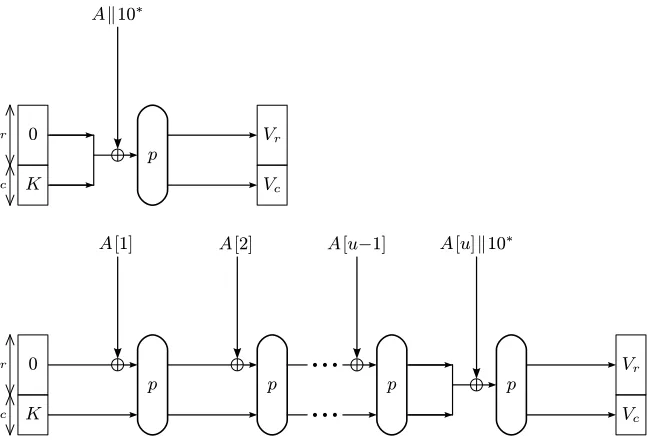
The APE description of Sect. 3 should only be used when the application can guarantee that the length of the plaintext and the associated data is always a multiple of the block size r. In this section, we explain how to adjust APE to handle fractional plaintext and associated data. This is done by applying ‘10*’-padding to all plaintext and associate data (fractional or not).
Fig. 3.A generalization of APE that can handle fractional associated data blocks.
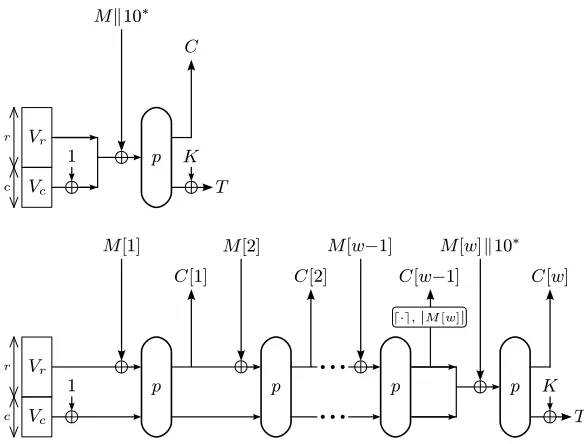
– |M[w]| ≤ r−1 and w = 1. The procedure can be seen in the top part of Fig. 4. Note that the corresponding ciphertext will berbits. This is required for decryption to be possible;
– |M[w]| ≤r−1 and w ≥ 2. The procedure is depicted in the bottom part of Fig. 4. Note that the ciphertextC[w−1] is of size equal to M[w]. The reason we opt for this design property is the following: despiteM[w] being smaller thanr bits, we require its corresponding ciphertext to ber bits for decryption to be possible. As a toll, the extended APE generates ciphertext C[w−1] to be of size equal toM[w];
– |M[w]|=r. In this special case whereM consists of integral message blocks, we nevertheless need a padding. However, instead of occupying an extra message block for this, the ‘10*’-padding spills over into the capacity. This can be seen as an XOR of 10· · ·00 into the capacity part of the state. We recall the reader of the fact that the⊕1 in the beginning of the function is a shorthand notation for⊕00· · ·01, and hence, these values do not cancel each other out.
The adjustments have no influence on the decryption algorithm D, except if |M| ≤ r for which a slightly more elaborate function is needed. Note that the spilling of the padding in case|M[w]|=rcauses security to degrade by half a bit: intuitively, APE is left with a capacity ofc′=c−1 bits. We have opted for this degrading over an efficiency loss due to an additional round.
For the purpose of the security analysis, we define the padding functions
Fig. 4.A generalization of APE that can handle fractional message blocks.
output blocks ofr′ =r+ 1 bits as suggested by Fig. 3 and Fig. 4, respectively. In more detail,padmessageis defined as follows: (i) if|M| ≤rthenpadmessage(M) = Mk10r−|M|, (ii) if|M|> r, we derive ther-bit message blocksM[1]· · ·M[w−1] and the|M|modr-bit message blockM[w], and setpadmessageto output thew message blocksM[1]k0, . . . , M[w−1]k0, andM[w]k10r−|M[w]|. The definition of paddata is analogous. Using these injective padding functions, the privacy and integrity proofs of Thm. 1 and Thm. 2 carry over with minor modifications, we only highlight the differences.
Theorem 3. Let Π = (K,E,D) be the APE construction for fractional data. Then,
AdvcpaΠ (q, m)≤ m2 2r+c +
m(m+ 1) 2c−1 .
Proof. Throughout this proof, for associated dataA and messageM, denote
pA=pA[1]kpA[2]k · · · kpA[u]←paddata(A), and
pM =pM[1]kpM[2]k · · · kpM[w]←padmessage(M).
except C[w−1] if w > 1 and |M[w]| 6= r. But in the current setting D has no access to the decryption oracle. Therefore, for simplicity we assume that all blocks C[j] are of length r bits. This does not invalidate the argument. This makes the case |M| ≤ r a special case of |M| > r, and the analysis of Lem. 1
carries over directly, usingpAandpM instead. ⊓⊔
Theorem 4. Let Π = (K,E,D) be the APE construction for fractional data. Then,
AdvintΠ(q, m)≤ m2 2r+c +
2m(m+ 1) 2c−1 .
Proof. DenotepA=pA[1]kpA[2]k · · · kpA[u] andpM =pM[1]kpM[2]k · · · kpM[w] as in Thm. 3. Note that these are blocks ofr′=r+ 1 bits, meaning that we have capacityc′=c−1. The proof of Thm. 2 now carries over using the new notation, with the difference that Lem. 3, bounding the distance between (EK,DK, f, f−1) and (EK,⊥, f, f−1) as long asEdoes not occur, needs closer attention as we need to consider different cases. As in Lem. 3, it suffices to consider queries to the big oracleF ∈ {DK,⊥}. Let (A, C, T) be a query made by the distinguisher.
First consider |C| > r. The ciphertext blocks are always c bits, except for block C[w−1] which may be shorter. For a ciphertext C denote pC = pC[1]kpC[2]k · · · kpC[w] ← padcipher(C), defined as follows: pC[j] = C[j] for j∈ {1, . . . , w−2, w}andpC[w−1] =C[w−1]k0r−|C[w−1]|. Using this notation, it is easy to see that the analysis of Lem. 3 carries over directly.
Next, assume|C|=r, hence the corresponding message blockM is of size at mostr bits. Clearly, in the ideal world (EK,⊥, f, f−1), the query is responded with ⊥. Therefore, the distinguisher has no advantage in the real world unless its query (A, C, T) is correct. Denote the state coming from the hashing ofAby IV. For a state valuex, denote its bottomc′ =c−1 bits by [x]
c′. The decryption query is successful if [IV]c′⊕1 = [f−1(C, T ⊕K)]c′. We distinguish two cases:
– (C, T)∈ Q/ −i1. Consider the indirectf−1-query. As (C, T)∈ Q/ −i1this means that it has never been made as an indirect query before. Also, it does not match an older direct query⊕K(byEind-Yi ). This implies the indirect query f−1(C, T⊕K) is fresh. If its bottomc′bits equal [IV]
c′⊕1, then this indirect query would have triggeredEind-Y.
– (C, T)∈ Q−i1. The analysis of Lem. 3 carries over.
This completes the proof. ⊓⊔
7
Hardware Implementation
We implement APE with the permutations of Photon [18], Quark [2], and
from random permutations. This assumption is necessary in order to achieve the claimed privacy (Thm. 1) and integrity (Thm. 2) security bounds. Since APE is designed for constrained devices, we focus on a security level of 80 and 128 bits, which correspond to a capacity of 160 or 256 bits, respectively. One exception is APE based onQuark: sinceQuark is not equipped with a version for 128 bits of security we resort to a permutation that offers 112 bits of security. The versions of Photon and Spongent with 80 bits of security are implemented with a 4-bit serialization, which means that we implement one 4-bit S-box. For the versions with higher security, we use an 8-bit serialization which requires two 4-bit S-boxes for Spongentand one 8-bit S-box forPhoton. UnlikePhoton
and Spongent, the round permutation of Quark is based on Feedback Shift Registers (FSRs). Hence it is possible to update one bit per clock cycle, and in our implementation we choose to do so for area efficiency.
As APE decrypts in reverse order and requires the inverse permutation, for each of the algorithms (Photon, Quark, and Spongent) we have provided both an encryption-only implementation and an implementation with encryption and decryption. In brief, we have implemented APE as follows. The initial state is XORed with the first data inserted nibble by nibble (or byte by byte, or bit by bit). After each permutation evaluation, the resulting ciphertext is output as the new data is inserted in the same clock cycle. At the end of the iteration, the entire state is output and the capacity part is XORed with the key to generate the tag. Similarly, for decryption, the first state corresponds to the ciphertext concatenated with an XOR of the key and the tag, and at the end authenticity is verified.
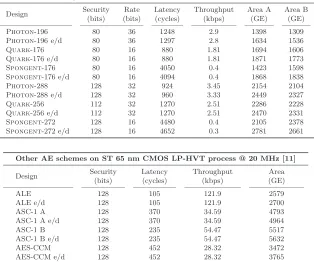
For the hardware implementation results in Table 1, we used ModelSim to verify the functionality of the designs and Synopsys Design Vision D-2010.03-SP4 for synthesis. We used Faraday Standard Cell Library based on UMC 0.18µm and open-cell 45nm NANGATE [24] library. As main observations, we see that APE with an encryption and decryption mode can be implemented with less than 1.9 kGE and 2.8 kGE for 80-bit and 128-bit security respectively.
When implemented with the same permutation, encryption-only implemen-tations of SpongeWrap and APE will have similar implementation figures. This is because in both constructions, the processing of every message block requires one XOR with the rate part and one permutation function call. We recall that the crucial difference between SpongeWrap and APE is that APE provides nonce misuse resistance. For the decryption operation, the cost of misuse resistance for APE is that the backwards permutation must be implemented as well.
As shown in Table 1, the overhead of implementing both p and p−1 is at most 283 GE on our 45 nm implementation. For devices without non-volatile memory, this overhead is very low compared to the cost of providing a hardware source of randomness to generate nonces.
Table 1.APE is implemented using the Photon,Quark, andSpongent permuta-tions. For each algorithm, we provide an encryption-only implementation, as well as one that does both encryption and decryption (denoted as “e/d”). The area figures depend on the library that we have used: Area A refers to UMC 180 nm, Area B refers to NANGATE 45 nm. Our overview also includes lightweight implementations of the authenticated encryption schemes ALE [11], ASC-1 [19], and AES-CCM [30]. We re-mark that the clock frequency of the APE implementations is 100 kHz, compared to 20 MHz for the other ciphers.
APE on CMOS process @ 100 kHz, A: UMC 180 nm, B: NANGATE 45 nm
Design Security Rate Latency Throughput Area A Area B (bits) (bits) (cycles) (kbps) (GE) (GE)
Photon-196 80 36 1248 2.9 1398 1309
Photon-196 e/d 80 36 1297 2.8 1634 1536
Quark-176 80 16 880 1.81 1694 1606
Quark-176 e/d 80 16 880 1.81 1871 1773
Spongent-176 80 16 4050 0.4 1423 1598
Spongent-176 e/d 80 16 4094 0.4 1868 1838
Photon-288 128 32 924 3.45 2154 2104
Photon-288 e/d 128 32 960 3.33 2449 2327
Quark-256 112 32 1270 2.51 2286 2228
Quark-256 e/d 112 32 1270 2.51 2470 2331
Spongent-272 128 16 4480 0.4 2105 2378
Spongent-272 e/d 128 16 4652 0.3 2781 2661
Other AE schemes on ST 65 nm CMOS LP-HVT process @ 20 MHz [11]
Design Security Latency Throughput Area (bits) (cycles) (kbps) (GE)
ALE 128 105 121.9 2579
ALE e/d 128 105 121.9 2700
ASC-1 A 128 370 34.59 4793
ASC-1 A e/d 128 370 34.59 4964
ASC-1 B 128 235 54.47 5517
ASC-1 B e/d 128 235 54.47 5632
AES-CCM 128 452 28.32 3472
differ, which lead to different throughput figures. However, it seems that APE and ALE have similar performance figures and APE is smaller than ASC-1 A, ASC-1 B and AES-CCM.
8
Conclusions
In this paper, we introduced APE, the first misuse resistant permutation-based AE scheme. We proved that APE provides security and integrity up to the birthday bound of the capacity, in the ideal permutation model. We show that the security of APE in the ideal permutation model implies the security of APE with block ciphers in the standard model. This not only ensures security of APE when its underlying primitive is considered an ideal permutation, but also allows to employ it with any secure block cipher of specific form. To achieve misuse resistance, the decryption of APE as a permutation-based construction uses the inverse permutation to decrypt in a backwards manner. The advantage of having backwards decryption is that if the tag or last ciphertext block is missing, then decryption is impossible. Our hardware implementations of APE show that it is well-suited for lightweight applications. In fact, using any of the permutations of Quark, Photon, and Spongent, less than 1.9 kGE (80-bit security) and less than 2.8 kGE (128-bit security) is required for an implementation of APE that supports both encryption and decryption. Due to its resistance against nonce reuse and its low area requirements in hardware, APE is suitable for environments where it is prohibitively expensive to require non-volatile memory or a hardware source of randomness.
Acknowledgments. We would like to thank the various anonymous review-ers for providing useful comments. Furthermore, we would like to thank Reza Reyhanitabar, Ivan Tjuawinata, Anthony Van Herrewege, Ingrid Verbauwhede, and Hongjun Wu for various suggestions to improve the quality of the text. This work was supported in part by the Research Council KU Leuven: GOA TENSE (GOA/11/007). In addition, this work was supported by the Research Fund KU Leuven, OT/13/071. Elena Andreeva and Nicky Mouha are supported by Post-doctoral Fellowships from the Flemish Research Foundation (FWO-Vlaanderen). Atul Luykx and Bart Mennink are supported by Ph.D. Fellowships from the Institute for the Promotion of Innovation through Science and Technology in Flanders (IWT-Vlaanderen). Beg¨ul Bilgin is partially supported by the FWO project G0B4213N.
References
1. Aumasson, J.P., Henzen, L., Meier, W., Naya-Plasencia, M.: Quark: A Lightweight Hash. In: Mangard, S., Standaert, F.X. (eds.) CHES. Lecture Notes in Computer Science, vol. 6225, pp. 1–15. Springer (2010)
3. Bellare, M., Boldyreva, A., Knudsen, L.R., Namprempre, C.: On-line Ciphers and the Hash-CBC Constructions. J. Cryptology 25(4), 640–679 (2012)
4. Bellare, M., Rogaway, P.: The security of triple encryption and a framework for code-based game-playing proofs. In: Vaudenay, S. (ed.) EUROCRYPT. Lecture Notes in Computer Science, vol. 4004, pp. 409–426. Springer (2006)
5. Berger, T.P., D’Hayer, J., Marquet, K., Minier, M., Thomas, G.: The GLUON Family: A Lightweight Hash Function Family Based on FCSRs. In: Mitrokotsa, A., Vaudenay, S. (eds.) AFRICACRYPT. Lecture Notes in Computer Science, vol. 7374, pp. 306–323. Springer (2012)
6. Bertoni, G., Daemen, J., Peeters, M., Van Assche, G.: Permutation-Based Encryp-tion, Authentication and Authenticated Encryption. Directions in Authenticated Ciphers (July 2012)
7. Bertoni, G., Daemen, J., Peeters, M., Van Assche, G.: Cryptographic Sponge Func-tions, available athttp://sponge.noekeon.org/CSF-0.1.pdf
8. Bertoni, G., Daemen, J., Peeters, M., Van Assche, G.: Sponge Functions. ECRYPT Hash Function Workshop (May 2007)
9. Bertoni, G., Daemen, J., Peeters, M., Van Assche, G.: Duplexing the Sponge: Single-Pass Authenticated Encryption and Other Applications. In: Miri, A., Vau-denay, S. (eds.) Selected Areas in Cryptography 2011. Lecture Notes in Computer Science, vol. 7118, pp. 320–337. Springer (2012)
10. Bogdanov, A., Knezevic, M., Leander, G., Toz, D., Varıcı, K., Verbauwhede, I.:
Spongent: A Lightweight Hash Function. In: Preneel, B., Takagi, T. (eds.) CHES. Lecture Notes in Computer Science, vol. 6917, pp. 312–325. Springer (2011) 11. Bogdanov, A., Mendel, F., Regazzoni, F., Rijmen, V., Tischhauser, E.: ALE:
AES-based lightweight authenticated encryption. In: Moriai, S. (ed.) FSE. Lecture Notes in Computer Science, Springer (2013)
12. Borisov, N., Goldberg, I., Wagner, D.: Intercepting mobile communications: the insecurity of 802.11. In: Rose, C. (ed.) MOBICOM. pp. 180–189. ACM (2001) 13. CAESAR: Competition for Authenticated Encryption: Security, Applicability, and
Robustness (April 2013)
14. Cantero, H.M., Peter, S., Bushing, Segher: Console Hacking 2010 – PS3 Epic Fail. 27th Chaos Communication Congress (December 2010)
15. Chang, D., Dworkin, M., Hong, S., Kelsey, J., Nandi, M.: A Keyed Sponge Con-struction with Pseudorandomness in the Standard Model. The Third SHA-3 Can-didate Conference (March 2012)
16. Even, S., Mansour, Y.: A Construction of a Cipher from a Single Pseudorandom Permutation. J. Cryptology 10(3), 151–162 (1997)
17. Fleischmann, E., Forler, C., Lucks, S.: McOE: A Family of Almost Foolproof On-Line Authenticated Encryption Schemes. In: Canteaut, A. (ed.) FSE. Lecture Notes in Computer Science, vol. 7549, pp. 196–215. Springer (2012)
18. Guo, J., Peyrin, T., Poschmann, A.: The PHOTON Family of Lightweight Hash Functions. In: Rogaway, P. (ed.) CRYPTO. Lecture Notes in Computer Science, vol. 6841, pp. 222–239. Springer (2011)
19. Jakimoski, G., Khajuria, S.: ASC-1: An Authenticated Encryption Stream Cipher. In: Miri, A., Vaudenay, S. (eds.) Selected Areas in Cryptography. Lecture Notes in Computer Science, vol. 7118, pp. 356–372. Springer (2011)
20. Khovratovich, D.: Key Wrapping with a Fixed Permutation. Cryptology ePrint Archive, Report 2013/145 (2013)
22. Lenstra, A.K., Hughes, J.P., Augier, M., Bos, J.W., Kleinjung, T., Wachter, C.: Public Keys. In: Safavi-Naini, R., Canetti, R. (eds.) CRYPTO. Lecture Notes in Computer Science, vol. 7417, pp. 626–642. Springer (2012)
23. McGrew, D.A., Viega, J.: The Security and Performance of the Galois/Counter Mode (GCM) of Operation. In: Canteaut, A., Viswanathan, K. (eds.) IN-DOCRYPT. Lecture Notes in Computer Science, vol. 3348, pp. 343–355. Springer (2004)
24. NANGATE: The NanGate 45nm Open Cell Library, available at http://www.nangate.com
25. Rogaway, P.: Authenticated-Encryption with Associated-Data. In: Atluri, V. (ed.) ACM Conference on Computer and Communications Security 2002. pp. 98–107. ACM (2002)
26. Rogaway, P.: Nonce-Based Symmetric Encryption. In: Roy, B.K., Meier, W. (eds.) FSE 2004. Lecture Notes in Computer Science, vol. 3017, pp. 348–359. Springer (2004)
27. Rogaway, P., Bellare, M., Black, J.: OCB: A Block-Cipher Mode of Operation for Efficient Authenticated Encryption. ACM Trans. Inf. Syst. Secur. 6(3), 365–403 (2003)
28. Rogaway, P., Shrimpton, T.: A Provable-Security Treatment of the Key-Wrap Problem. In: Vaudenay, S. (ed.) EUROCRYPT 2006. Lecture Notes in Computer Science, vol. 4004, pp. 373–390. Springer (2006)
29. Rogaway, P., Zhang, H.: Online Ciphers from Tweakable Blockciphers. In: Kiayias, A. (ed.) CT-RSA. Lecture Notes in Computer Science, vol. 6558, pp. 237–249. Springer (2011)
30. Whiting, D., Housley, R., Ferguson, N.: Counter with CBC-MAC (CCM). Request For Comments 3610 (2003)