Unbalanced Multiple-Description Video Coding
with Rate-Distortion Optimization
David Comas
Image Processing Group, Department of Signal Theory and Communications, Technical University of Catalonia (UPC), 08034 Barcelona, Spain
Email:[email protected]
Raghavendra Singh
IBM India Research Lab., Indian Institute of Technology (IIT) Delhi, New Delhi, India Email:[email protected]
Antonio Ortega
Signal and Image Processing Institute and Integrated Media Systems Center, Department of Electrical Engineering, University of Southern California, Los Angeles, CA 90089-2564, USA
Email:[email protected]
Ferran Marqu ´es
Image Processing Group, Department of Signal Theory and Communications, Technical University of Catalonia (UPC), 08034 Barcelona, Spain
Email:[email protected]
Received 7 May 2002 and in revised form 11 November 2002
We propose to use multiple-description coding (MDC) to protect video information against packet losses and delay, while also ensuring that it can be decoded using a standard decoder. Video data are encoded into a high-resolution stream using a standard compliant encoder. In addition, a low-resolution stream is generated by duplicating the relevant information (motion vectors, headers and some of the DCT coefficient) from the high-resolution stream while the remaining coefficients are set to zero. Both streams are independently decodable by a standard decoder. However, only in case of losses in the high resolution description, the corresponding information from the low resolution stream is decoded, else the received high resolution description is decoded. The main contribution of this paper is an optimization algorithm which, given the loss ratio, allocates bits to both descriptions and selects the right number of coefficients to duplicate in the low-resolution stream so as to minimize the expected distortion at the decoder end.
Keywords and phrases:multiple-description coding, robust video transmission, rate-distortion optimization, packet networks.
1. INTRODUCTION
In recent years, the volume of multimedia data transmitted overbest-effortnetworks such as the Internet has continued to increase while packet losses and delays, due to conges-tion, routing delay, and network heterogeneity, continue to be commonplace. In this paper, we address the issue of robust streaming of video data. Video data is usually encoded us-ing predictive encoders, for example, motion compensation in the standard H.263 [1] and MPEG [2] encoders. These encoders take advantage of the temporal redundancy in the data to achieve high compression performance. However, the main drawback of a predictive coding scheme is that even
a single packet loss (or erasure) in the transmitted stream causes decoding errors to propagate through all the samples following the erasure. This severely affects the video quality available at the receiver and motivates the need for robust transmission of video data.
Signal source
MDC encoder S1
S2
Channel 1
Channel 2
Side decoder 1
Central decoder
Side decoder 2
Side distortion DS1
Central distortion Dc
Side distortion DS2
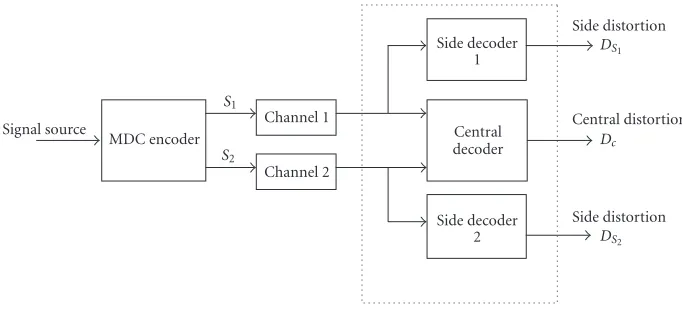
Figure1: Generic MDC system. The source is encoded in two descriptions:S1 andS2. They are transmitted through the network over different channels. At the decoder, if only one description is received, the signal can be reconstructed with acceptable side distortion whereas if both descriptions are received, the distortion obtained is less than or equal to the lowest side distortion.
the erased data; however, for streaming multimedia applica-tions, especially real-time applicaapplica-tions, there is a strict time constraint on the transmission of the data, which will limit the number of retransmissions that are possible and, conse-quently, the overall applicability of ARQ in certain scenarios. Further, in a broadcast network scenario that is often used for multimedia data transmission, ARQ can cause a nega-tive acknowledgement (NACK) implosion at the transmitter [3]. Thus, for streaming video applications, local recovery of erasures is often preferable to retransmission. Local recovery at the decoder could be provided with the use of forward-error-correction (FEC) techniques. In an FEC scheme, re-dundancy is added to the encoded data so that in case of era-sures, the redundancy can be used to reconstruct the lost data at the receiver. One drawback of FEC schemes is that they are not as bandwidth efficient as the ARQ schemes; in case of widely changing network conditions, FEC schemes are often designed for the worst case scenario, which usually leads to a waste of precious network resources. Moreover, the perfor-mance of popular FEC schemes like the FEC channel codes [4] suffers from the cliffeffect [5]: for an (n, k)-channel code, if the number of errors exceedn−k, then the channel code cannot recover from the channel errors. Hence, the perfor-mance is constant for up toe=n−kerasures but then drops very sharply when the actual number of erasures is greater thane.
An alternative approach for reliable transmission of mul-timedia data that provides graceful degradation of perfor-mance in presence of channel noise is multiple-description coding (MDC) [6,7]. In MDC, two or more independently decodable descriptions of the source are sent to the re-ceiver (Figure 1). If only descriptionS1 (orS2) is received,
the signal can be reconstructed with acceptable side distor-tion DS1 (orDS2). If both descriptions are received, the dis-tortion obtained at the central decoder DC is less than or
equal to the lowest side distortion; that is, ifDS1 is the low-est side distortion, then DC ≤ DS1. Thus, in an MDC sys-tem, there are three different decoders, each corresponding to
one of the possible loss scenarios. In an ideal MDC channel environment, the channels are independent and data on each channel is either completely lost or received intact. This en-vironment has been studied extensively both theoretically [6,7] and practically [8,9,10,11,12]. The paper by Goyal [5] provides a good overview of MDC systems.
In a packet network environment, these ideal conditions may not hold true; packet losses can be correlated and only partial data (of either description) may be received at the de-coder. Sufficient interleaving of packets of the two descrip-tions could provide a degree of independence between the packet losses of the descriptions. However, there still remains the issue of partially received data, which is especially im-portant for video streaming because of the associated er-ror propagation. There has been limited work on MD video coders for packet networks. Vaishampayan [8] used MDC scalar quantizers to develop robust image and video coders for packet loss environments. Recently, Reibman [13] has, independently, proposed an MD video coder for packet net-works based on a rate-allocation principle similar to the one that we propose. One of the novelties of this coder is that in minimizing the expected distortion for a given bitrate, it takes the error propagation into account.
In this paper, we propose an unbalanced MDC (UMDC) system for transmission of video data over best-effort packet networks. The system is unbalanced because the rate distri-bution among the various descriptions is not even; hence, one description has high rate (high resolution/quality) and the other low rate (low resolution); that is, ifS1is the
is particularly significant if the descriptions are to be coded in a standard syntax, would adversely affect the performance of balanced systems for low packet-loss rates. Moreover, though the UMDC encoder produces unbalanced descriptions, we use a smart packetization (similar to the one in [14]) to cre-ate packets that are equally important; thus, from the net-work viewpoint, all packets have equal priority.
In the proposed MDC system, the input video sequence is encoded into a high rate and quality video stream (HR de-scription) using an encoder that produces an H.263 compli-ant stream. Theimportant partsof this HR description are duplicated in a low rate and quality video stream (LR de-scription). The important information includes the headers, motion vectors, and a subset of the DCT coefficients in the HR video stream. The remaining DCT coefficients are set to zero in the LR video stream. At the receiver, if information from the HR description is lost, the corresponding informa-tion from the LR descripinforma-tion is decoded, else the HR descrip-tion decoded. The main advantages of our MD video coder are stated as follows:
(1) optimal descriptions that minimize the expected dis-tortion for a given probability of packet loss and rate budget are generated;
(2) the MD representation is constructed in such a way that both the descriptions are independently decod-able by a standard H.263 decoder, that is, the MD video coder maintains compatibility with the H.263 syntax [1].
The main disadvantage of our work is that, currently, we are not considering error propagation in our expected distor-tion formuladistor-tion. We propose this as part of future work.
The rest of the paper is organized as follows. InSection 2, we discuss other MDC-based video transmission systems. In
Section 3, we present our encoding algorithm. InSection 4, we compare our system with other MDC systems. We con-clude the paper with some thoughts for future work in
Section 5.
2. RELATED WORK
There has been substantial work in the area of MDC for video transmission over theidealMD channel environment, for ex-ample, [15,16,17,18]. A key challenge in designing MDC techniques that incorporate predictive coding is to avoid the
prediction loop mismatchproblem. When prediction is used, the decoder can only operate properly if it has received the data that the encoder used to generate the predictor, else there is a prediction loop mismatch that leads to poor per-formance. In an MDC system, if both descriptions were re-ceived at the decoder, the best predictor to be used by the central decoder would be the one formed from past infor-mation produced by the central decoder; that is, formed by combining information received in both descriptions. How-ever, if only a single-description was received, the best pre-dictor to use in encoding should be basedonlyon data pro-duced by the side decoder corresponding to the descrip-tion that has been received. Thus, ideally, for an MDC-based
prediction system, there should be three prediction loops, one for each decoder (Figure 1). Many MD video coders, for example, [16,17,18], are designed to send redundancy to avoid this mismatch problem.
Reibman et al. [15] proposed an MDC video coder that is similar in principle to our video coder. Descriptions are created by splitting the output of a standard codec; impor-tant information (DCT coefficients above a certain thresh-old, motion vectors, and headers) is duplicated in the de-scriptions while the remaining DCT coefficients are alter-nated between the descriptions, thus generating balanced de-scriptions. The threshold is found in a rate-distortion (R-D) optimal manner. At the decoder, if both descriptions are re-ceived, then the duplicate information is discarded, else the received description is decoded. This is in principle very sim-ilar to our MD video coder, with the main difference be-ing that we duplicate the first K coefficients of the block and we do not alternate coefficients. The numberK is also found in a rate-distortion optimal framework. The advan-tage of our method is that its coding efficiency is better than that of [15]. This is because in our system, in compliance with the standard syntax of H.263, an efficient end-of-block (EOB) symbol can be sent after theKth symbol. Moreover, in [15], inefficient runs of zeros are created by alternating DCT coefficients between the descriptions. The disadvantage of our system is that it is unbalanced in nature; hence, in case of losses in the HR description, there is a sharper drop in performance than in case of losses in either of the bal-anced descriptions of [15]. However, for low packet (<10%) loss scenarios, which are commonplace over the Internet, our system performs better than [13] (a version of [15] ex-tended to packet networks). This is shown inSection 4of this paper.
In [15], the prediction loop mismatch problem, that would arise if a description was lost, was not considered. In a later work, Reibman [13] extended this rate-distortion optimal-splitting method to design an MD video coder for a packet network. For a packet-loss environment, predic-tion loop mismatch could be due to loss of currentand/or
previous data. In [14], the Recursive Optimal per-Pixel Es-timate (ROPE) formulation was developed to calculate the overall distortion of the decoder reconstruction due to quan-tization, error propagation, and error concealment for a one-layer video coder subject to packet losses. Using this distor-tion, the best location for intrablocks was found using rate-distortion optimization. In [13], this optimal mode selection algorithm (i.e., coding a macroblock as inter/intra) was ex-tended to the MD framework to limit the error propagation due to the prediction mismatch. Thus, for each macroblock of a frame, given the bitrate and probability of packet loss, the optimal thresholdandmode was selected; that is, the redun-dancy bits were optimally distributed between information needed for local recovery and information needed to limit the error propagation.
HR side decoder, which implies that there is no prediction loop mismatch if there are no losses in the HR description. In case of a loss in the HR description, there is a predic-tion loop mismatch. This is because at the encoder, the in-formation in the HR description is used to predict the next frame, while at the decoder at the point of erasure, we will de-code the LR description. Thus, the prediction for the frame after the erasure will not be from the full HR information but only from the partial information that is available in the LR description. However, in this work, we have not con-sidered error propagation due to prediction loop mismatch. The formulation in ROPE, though exact, is computation-ally intensive and may not be suitable for real-time applica-tions. We are currently exploring alternative mode selection methods.
Both our MD video coder and Reibman’s [13,15] are syntax compatible with existing standard codecs. Preserving compatibility with existing standard decoders can affect the performance of an MDC system. For example, it will not be possible to use several techniques, such as MDC scalar quan-tization or MDC transform coding, while still preserving compatibility with the standard. However, preserving com-patibility may still be useful because these standard decoders are very commonly used. In particular, if syntax compatibil-ity with standard decoders is preserved, we can think of an MDC system as a wrapper that can use offthe shelf encoders and decoders to generate loss-robust transmitted data. Note that by standard compliance we imply that an H.263 compli-ant decoder can decode either of the descriptions. However, in our system, decoding the LR video stream by itself will not give very high quality, as the LR description has been de-signed only to add robustness to the HR stream. Hence, we need a parser, which in case of losses in the HR stream, can extract information from the LR stream and pass it to stan-dard decoder.
In this paper, we compare against the MD video coder, presented in [15], extended to the packet network envi-ronments. We also compare against the video redundancy coding (VRC) mode in H.263+ [19]. In VRC, the encoded frames are split into multiple-descriptions in a round-robin way and the prediction of a frame in one description is based on the past frames in the same description. In the case of two descriptions, an even frame is predicted from the nearest even frame and an odd frame from the nearest odd frame. Compared to a conventional single-description coder, there is a significantly lower prediction gain and hence higher re-dundancy to achieve the same distortion when both descrip-tions are received. A sync frame is also added periodically to prevent error propagation. The periodicity of the sync frame can be varied to increase robustness but at the ex-pense of additional redundancy. The advantage of VRC is that it is part of a standard and also that it avoids the pre-diction loop mismatch problem. However, in avoiding this problem, it adds implicit redundancy that adversely affects its performance.
Note that our UMDC system is not equivalent to the con-ventional scalable system. In a concon-ventional scalable scheme, for example, [20], the signal is coded into a low rate base
layer and a hierarchy of high rate enhancement layers. An enhancement layer is useful, that is, it decreases the distor-tion if and only if all the layers below it, in the hierarchy, have been decoded. Scalable coding schemes are rate distor-tion efficient; however, due to the dependency of layers, their performance decreases sharply in presence of packet losses. On the other hand, in the proposed UMDC scheme, the two descriptions are not complementary; the lowest distor-tion is achieved when the HR descripdistor-tion is received. Thus, UMDC as opposed to scalable coding has been designed to minimize the expected distortion at the receiver. Moreover, in the proposed UMDC system, the important layer is coded at HR description while the additional layer is coded at low rate.
3. PROPOSED MDC SYSTEM
The block diagram of the proposed system is shown in
Figure 2. Two descriptions are generated, an HR (quality and bitrate) description and an LR description. The HR descrip-tion is obtained by coding the input video sequence by a standard compliant H.263 encoder [21]. Theimportant parts
of the HR description are duplicated in the LR description. Since the motion vectors and the header information are im-portant, they are transmitted in both descriptions. More-over, for each frame of the video sequence, a select num-ber of high energy discrete cosine transform (DCT) coeffi -cients in an HR block, that is, a block of the frame in the HR description, are duplicated in the corresponding LR block. The remaining DCT coefficients in the LR block are set to zero.
For each frame of the video sequence, two packets are generated. Each packet contains the headers and the mo-tion vectors, in addimo-tion, one packet contains the odd group of blocks (GOB) of the HR frame (i.e., the frame in the HR description) and the even GOB of the LR frame. The other packet contains the even GOB of the HR frame and the odd GOB of the LR frame. Thus, contents of each packet are independently decodable by a standard H.263 decoder. If both packets are received, then HR GOBs are decoded and LR GOBs are discarded, else the received packet’s GOBs are decoded. These equal-importance pack-ets are transmitted over the packet network; virtual indepen-dent channels are created by sufficiently interleaving the two packets.
The main contribution of this work is that the descrip-tions are generated in a rate-distortion optimal framework; that is, given the probability of packet loss and the total avail-able rateRTOT, the MD video coder generates HR and LR
descriptions that minimize the expected distortion. This in-volves finding the rate allocation,RHR, for the HR
Figure2: Proposed UMD coder block diagram. The input video sequence is coded into two descriptions; one description has high quality and bitrate and is obtained by coding the video sequence by an H.263 compliant encoder. The second description has low quality and bitrate and is obtained by selecting the important information from the HR description. This information includes the headers, the motion vectors, and a select number of DCT coefficients. There is a feedback to optimally split the total rate into both descriptions according to the probability of packet loss. The descriptions are packetized, 2 packets per frame, such that each packet is of equal size and importance. Virtual independent channels are created over a packet network by sufficiently interleaving the two packets. If both packets are received, then the HR information is parsed from the packets and the LR information is discarded, else the contents of the received packets are decoded.
of ith frame of the HR and LR descriptions, respectively. LetErepresent the set of all macroblocks in the even GOBs of a frame and O the set of all macroblocks in the odd GOBs of a frame. Let ri
HR andrLRi represent theith frame
rate for the HR and LR descriptions, respectively. Given the packetization policy, the expected distortion can be written as
where piis the probability of packet loss for framei. In the
above formulation, we are ignoring the case when both pack-ets of a frame are lost. The objective is to minimize the above expected distortion under the constraint
RHR+RLR=RTOT, (2)
Solving this constrained optimization problem can be ex-tremely complex. Due to the predictive nature of the video coder,di, jHR,rHRj depend ondi
−1, j
HR ,rHRi−1(this is true also for LR
description). Further, in our MDC system,di, jLRis also
depen-dent onrHRi because the low-resolution description is
gener-ated from the high-resolution description.
We make the assumption that each frame is coded inde-pendently at a bitraterTOTi where
24
Probability of packet loss UMDC
MD-RDS SD
(a) Akiyo. 256 kbps. 30 fps.
20
Probability of packet loss UMDC
MD-RDS SD
(b) Akiyo. 384 kbps. 30 fps.
Figure3: UMDC versus MD-RDS and SD. Akiyo. 256 (a) and 384 (b) kbps.
J(D)=1−pi
With this formulation, allocation is done independently for each frame based on the budget obtained from TMN8 [23]. Therefore, in what follows we can ignore the frame index i when stating the objective function.
In the present work, we do not take error propagation into account; we are currently exploring ways of incorporat-ing the error propagation in this formulation while keepincorporat-ing the computational cost reasonably low for real-time appli-cations. Thus, the distortiondHRj of the jth macroblock in
the HR description is a function of the quantization param-eterQj, whiledj
LRis a function ofQjandkj, the number of
DCT coefficients duplicated, that is, not set to zero inall8×8 blocks in the macroblockj. We assume that all the blocks in a
macroblock employ the same value ofkj. This is reasonable
since most of the processes done in the encoder treat mac-roblocks as single entities (e.g., motion estimation, header generation, etc). The optimization can be then written as
min
where Q andk are the sets of quantization steps and the DCT coefficients duplicated in LR for each block j in the current frame, respectively. In our previous work, [24], we developed an algorithm for finding the optimalk, givenQ
and p. We assume that only the first kj DCT coefficients,
along the zig-zag scan, are duplicated. To reduce the search complexity, the admissible values ofkj are restricted to be
27
Probability of packet loss UMDC
MD-RDS
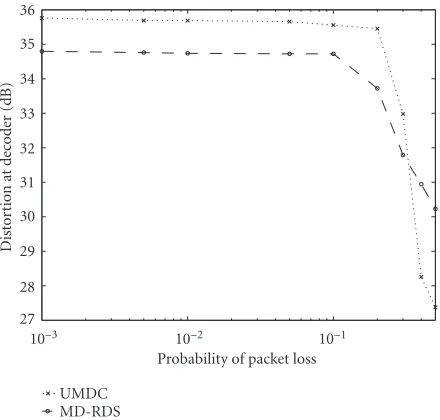
Figure4: UMDC versus MD-RDS. Akiyo. 800 kbps. 30 fps.
We use mean square error (MSE) as our distortion met-ric. Since DCT is an orthogonal transform, the distortion in a block of a frame can also be written as a function of the corre-sponding transform coefficients. Letldenote the index of the luminance block in the current macroblockj(l∈(1, . . . ,4)). Thus,Cnl, j is thenth coefficient in blocklfrom the current
macroblockj, and ˜Cn
l, j its quantized value, dependant on the
quantization step (Qj) used. We then can define the
distor-tion in the HR and LR macroblocks as follows:
dHRj
The rate and distortion of a macroblock for each possiblekj
is calculated directly in the H.263 codec. We ignore headers, motion vectors, and other side information since they will be present in both descriptions.
The proposed rate-distortion optimal algorithm for gen-erating the descriptions can be summarized into the follow-ing steps.
Using the TMN8 rate control algorithm find the required frame rate,rTOT, for each frame. Then, for each frame of the
input sequence,
(a) find all thedHR(Qj) anddLR(Qj, kj) for all possibleQ
andk;
(b) minimize the expected frame distortion (1) under the rate-budgetrTOTconstraint for the frame in
consider-ation (6);
(c) generate HR frame and LR frame according to the op-timalQandkfound.
4. SIMULATIONS AND RESULTS
The reported results are expressed in terms of the signal-to-noise ratio (SNR) of the luminance components of the first 100 frames of the two QCIF (176×144 pixels) test se-quences, namely, Akiyo and Coastguard. We compare the performance of our UMDC with the MD-RDS coder pro-posed by Reibman et al. [15]. The work in [15] has been extended to a packet network environment, similar to the work in [13] except that optimal mode selection is not con-sidered in the present work. Both systems are coded at the same total bitrate, RTOT, and each frame is packetized into
two packets. In the UMDC case, the packetization is as ex-plained in Section 3, whereas in the MD-RDS case, each packet contains a description. Thus, while our system cre-ates packets of equal size and importance by combining por-tions of the HR and LR descrippor-tions, in MD-RDS, each de-scription can be packetized separately due to the balanced nature of the descriptions. In both cases, if both descrip-tions are completely lost, we replace the lost information with the spatially corresponding information from the pre-vious frame. If this situation happens in the first frame, where no information is available, the lost macroblocks are set to their statistical mean value. We consider random losses with identical loss sequences being injected in both systems.
Figures3and4show the results for the sequence Akiyo coded at different bitrates. The frame rate is 30 fps and only the initial frame of the stream is intracoded. The results show that for lossy conditions, MD coding method easily outper-forms the single-description (with no redundancy) method SD. Among the MD methods, UMDC performs better than MD-RDS for low packet-loss conditions; this improvement in performance increases with increasing bitrate. This can be explained by the fact that because MD-RDS alternates coef-ficients in order to make the descriptions balanced its coding efficiency decreases. Alternate nonzero coefficients adversely affect the entropy coder of standards like H.263. This im-plicit redundancy increases with the increase in the number of nonzero coefficients.
Plots inFigure 5shows the results for the sequence Coast-guard.
Figure 6 shows the comparison of both systems when only the first frame is coded in intraframe mode (Figure 6a) and when an intraframe is transmitted every 10 frames (Figure 6b). In this last case, a larger number of DCT co-efficients are different from zero since intraframes contain a larger number of nonzero transform coefficients than in-terframes. Hence, the coding efficiency of the UMDC is much better than that of MD-RDS. The maximum gain over MD-RDS when an intraframe is inserted every 10 frames is around 1.3 dB, whereas in the case where only the first frame is coded without prediction, the gain is about 0.8 dB. The re-sults also show that MD methods perform better than sin-gle description. The test sequence used is Akiyo, coded at 512 kbps.
23 23.5 24 24.5 25 25.5 26 26.5 27 27.5
D
ist
or
ti
on
at
de
co
der
10−3 10−2 10−1
Probability of packet loss UMDC
MD-RDS
(a) Coastguard. 256 kbps. 30 fps.
23 23.5 24 24.5 25 25.5 26 26.5 27 27.5 28
D
ist
or
ti
on
at
de
co
der
10−3 10−2 10−1
Probability of packet loss UMDC
MD-RDS
(b) Coastguard. 384 kbps. 30 fps.
Figure5: UMDC versus MD-RDS. Coastguard. 256 (a) and 384 (b) kbps.
Table1: UMDC versus MD-RDS and versus VRC. Akiyo. 30 kbps. 10 fps.
Probability of packet loss 3% 5% 10%
UMDC 34.05 dB 34.01 dB 33.89 dB
MD-RDS 33.91 dB 33.87 dB 33.8 dB
VRC 33.7 dB 33.4 dB 32.5 dB
only the even GOBs and the other packet odd GOBs. Akiyo sequence is coded at 30 kbps with frame rate 10 fps. Again UMDC does very well for low packet-loss scenarios.
5. CONCLUSIONS AND FUTURE WORK
We have shown that the proposed UMDC system enhances the robustness of video coders to packet losses using a very small amount of extracomputational resources and being compliant with the existing video decoder standard syntax. The algorithm takes advantage of the processes done in the
encoder and then, by just pruning coefficients in a rate-distortion framework, generates a low-resolution stream to be used in case the main stream (HR) is lost.
One of the main emphases in our work was to design an MDC video system being compatible with existing codecs. As previously commented, better results could be obtained by removing this constraint.
Comparing our proposed system to MD-RDS, we have seen that the main benefits of UMDC are due to the un-balanced nature of the proposed scheme: by coding runs of zeroed DCT coefficients, the coding efficiency obtained is larger than the one obtained by alternating the transform coefficients. As part of our future work, we would like to keep on studying different options of UMDC schemes and com-pare them against balanced ones.
In future work, we would also like to take error propaga-tion into account as in [14], but since the generation of the low-resolution stream is done frame by frame, an appropri-ate model of the rappropri-ate distribution among frames prior to any encoding should be found.
15 20 25 30 35 40 45
D
ist
or
ti
on
at
de
co
der
(dB)
10−3 10−2 10−1
Probability of packet loss UMDC
MD-RDS SD
(a) Akiyo. 512 kbps. 1 Intra, 99 Inter.
20 22 24 26 28 30 32 34 36 38 40
D
ist
or
ti
on
at
de
co
der
(dB)
10−3 10−2 10−1
Probability of packet loss UMDC
MD-RDS SD
(b) Akiyo. 512 kbps. 1 Intra every 10 frames.
Figure6: UMDC versus MD-RDS and SD. Akiyo. 512 kbps. 30 fps.
ACKNOWLEDGMENTS
The authors would like to thank the reviewers for their help-ful suggestions. This work was done while the first and the second authors were affiliated with USC. The research has been funded in part by the Integrated Media Systems Center, a National Science Foundation Engineering Research Center, Cooperative Agreement no. EEC-9529152, by the National Science Foundation under grant MIP-9804959 and by the CICYT TIC2001-0996 project of the Spanish government.
REFERENCES
[1] ITU-T Recommendation H.263, “Video Coding for low bit rate communication,” International Telecommunications Union-Telecommunications, Geneva. 1, 1995; 2 (H.263+), 1998; 3 (H.263++), 2000.
[2] Motion Pictures Expert Group (ISO/IEC JTC 1/SC 2/WG 11), “Information Technology-Coding of Moving Pictures and Associated Audio for Digital Storage Media at up to About 1.5 Mbits/s - Part 2: Video,” Int. Std, 11172, November 1992. [3] R. Rejaie, M. Handley, and D. Estrin, “Quality adaptation for congestion controlled video playback over the internet,” in
Proc. ACM SIGCOMM ’99, pp. 189–200, Cambridge, Mass,
USA, September 1999.
[4] S. Lin and D. J. Costello, Error Control Coding: Fundamentals and Applications, Prentice-Hall, Englewood Cliffs, NJ, USA,
1983.
[5] V. K. Goyal, “Multiple description coding: Compression meets the network,”IEEE Signal Processing Magazine, vol. 18, no. 5, pp. 74–93, 2001.
[6] L. Ozarow, “On a source coding problem with two channels and three receivers,”Bell System Technical Journal, vol. 59, no. 10, pp. 1909–1921, 1980.
[7] A. A. El Gamal and T. M. Cover, “Achievable rates for multiple descriptions,” IEEE Transactions on Information Theory, vol. 28, no. 6, pp. 851–857, 1982.
[8] V. A. Vaishampayan, “Design of multiple description scalar quantizers,”IEEE Transactions on Information Theory, vol. 39, no. 3, pp. 821–834, 1993.
[9] V. K. Goyal, J. Kovacevic, R. Arean, and M. Vetterli, “Multiple description transform coding of images,” inProc. IEEE Inter-national Conference on Image Processing, vol. 1, pp. 674–678, Chicago, Ill, USA, October 1998.
[10] Y. Wang, M. T. Orchard, and A. R. Reibman, “Optimal pair-wise correlating transforms for multiple description coding,” inProc. IEEE International Conference on Image Processing, Chicago, Ill, USA, October 1998.
[12] W. Jiang and A. Ortega, “Multiple description coding via polyphase transform and selective quantization,” inProc. Vi-sual Communications and Image Processing, San Jose, Calif, USA, January 1999.
[13] A. R. Reibman, “Optimizing multiple description video coders in a packet loss environment,” inProc. Packet Video Workshop, Pittsburgh, Pa, USA, March 2002.
[14] R. Zhang, S. L. Regunathan, and K. Rose, “Video coding with optimal inter/intra mode switching for packet loss resilience,”
IEEE Journal on Selected Areas in Communications, vol. 18, no. 6, pp. 966–976, 2000.
[15] A. R. Reibman, H. Jafarkhani, Y. Wang, and M. T. Orchard, “Multiple description video using rate-distortion splitting,” in
Proc. IEEE International Conference on Image Processing, Tes-saloniki, Greece, October 2001.
[16] V. A. Vaishampayan and S. John, “Interframe balanced mul-tiple description video compression,” inProc. Packet Video Workshop, New York, NY, USA, April 1999.
[17] A. R. Reibman, H. Jafarkhani, Y. Wang, M. T. Orchard, and R. Puri, “Multiple description coding for video using motion compensated prediction,” inProc. IEEE International Confer-ence on Image Processing, Kobe, Japan, October 1999. [18] Y. Wang and S. Lin, “Error resilient video coding using
mul-tiple description motion compensation,” inProc. IEEE Mul-timedia Signal Processing Workshop, Cannes, France, October 2001.
[19] S. Wenger, “Video redundancy coding in H.263+,” inProc. Workshop on Audio-Visual Services for Packet Networks, Ab-erdeen, UK, 1997.
[20] M. van der Schaar and H. Radha, “A hybrid temporal-SNR fine-granular scalability for internet video,” IEEE Trans. Cir-cuits and Systems for Video Technology, vol. 11, no. 3, pp. 318– 331, 2001.
[21] M. Gallant, G. Cote, B. Erol, and F. Kossentini, “UBC’s H.263+ Public Domain Software, Version 3.2.0,” Official ITU-T Study Group 16 Video Experts Group Reference C Codec, July 1998.
[22] A. Ortega and K. Ramchandran, “Rate-distortion methods for image and video compression,” IEEE Signal Processing Magazine, vol. 15, no. 6, pp. 23–50, 1998.
[23] J. Ribas-Corbera and S. Lei, “Rate control in DCT video cod-ing for low-delay communications,” IEEE Trans. Circuits and Systems for Video Technology, vol. 9, no. 1, pp. 172–185, 1999. [24] D. Comas, R. Singh, and A. Ortega, “Rate-distortion op-timization in a robust video transmission based on unbal-anced multiple description coding,” inProc. IEEE Workshop
on Multimedia Signal Processing, Cannes, France, October
2001.
David Comas was born in Barcelona
(Spain) in 1976. In 2001, he received his M.S. degree in electrical engineering from the Technical University of Catalo-nia (UPC), Barcelona, Spain. From May 2000 to April 2001, he was with the Signal and Image Processing Institute (SIPI) at the University of Southern California (USC), Los Angeles, USA, doing his Master the-sis. In 2001, he joined the Image Processing
Group, in the Department of Signal Theory and Communications (TSC) and he is currently pursuing a Ph.D. degree in electrical engi-neering. His current research interests include multiple-description coding for video, image and sequence analysis, and image and se-quence coding.
Raghavendra Singhwas born in New Delhi, India, in 1971. He
received the B.E. in electrical and electronics from the Birla In-stitute of Technology and Science, Pilani, India in 1993 and the Ph.D. in electrical engineering from University of Southern Cali-fornia in 2001. His research interests are in the area of digital image and video processing, and reliable transmission of real-time multi-media data.
Antonio Ortegareceived the Telecommunications Engineering
de-gree from the Universidad Politecnica de Madrid (UPM), Madrid, Spain in 1989 and the Ph.D. in electrical engineering from Columbia University, New York, NY in 1994. At Columbia, he was supported by a Fulbright scholarship. In 1994, he joined the Elec-trical Engineering-System department at the University of South-ern California, where he is currently an Associate Professor. At USC, he is also a member of the Integrated Media Systems Center (IMSC) and the Signal and Image Processing Institute. He is a se-nior member of the IEEE, and a member of SPIE and ACM. He was a Technical Program Cochair of ICME 2002. He has been an Asso-ciate Editor for the IEEE Transactions on Image Processing and for the IEEE Signal Processing Letters. He has been a member of the Board of Governors of the IEEE SPS. He has received the NSF CA-REER Award, the 1997 IEEE Communications Society Leonard G. Abraham Prize Paper Award and the IEEE Signal Processing Soci-ety 1999 Magazine Award. His research interests are in the areas of multimedia compression and communications. They include top-ics such as rate control and video transmission over packet network and compression for recognition and classification applications.
Ferran Marqu´esreceived the M.S. degree
in electrical engineering from the Technical University of Catalonia (UPC), Barcelona, Spain, in 1988. From 1989 to June 1990, he worked in the Swiss Federal Institute of Technology in Lausanne (EPFL) and in June 1990, he joined the Department of Signal Theory and Communications of the Technical University of Catalonia (UPC). In 1991, he was with the Signal and Image