Study on Cross Layer protocols Used in
Hybrid Wireless Network for Efficient
Routing
Steven Raj N1, Dr. Dhananjay Maktedar 2 1
Research Scholar GNDEC, Bidar, Visvesvaraya Technological University Belagavi, Karnataka India, [email protected]
2 Professor GNDEC Bidar, Visvesvaraya Technological University, Belagavi,
Karnataka India,[email protected]
Abstract
Wireless Sensor Networks (WSNs) comprise of little hubs with sensing, calculation, and remote communications abilities. Multiple routing, controlling of power, data circulation protocols have explicitly intended for WSNs. Here energy recognition is a fundamental structure issue. There are different directing conventions used for productive course on system traffic premise of separation so on. They ought to be used for the help of the courses as sensor center points have obliged assets, for instance, transmission go, battery control, etc. Here, we discussed about, an overview of the WSNs nearby its course of action and besides have referenced the assessment between different directing conventions. We first diagram the structure difficulties for these protocols in WSNs pursued by a thorough study of various directing routing systems. In general, these protocols of WSN are ordered into four classifications dependent on the basic structure of network: Protocol operation, Next Hop Selection, Path Establishment and Network Structure. Here, we see few validation plans and multi-constrained optimal path selection dependent on specific criteria like QoS imperatives. We study the plan tradeoffs jitter speed, QoS, delay, bundle misfortune, packet loss and energy utilization in each routing protocol. The focus, still given to the routing protocols may differ upon the application and architecture of network. At last, we feature the preferences and performance issues of every routing system. Every routing protocol is depicted and discussed about covered the proper classification. The paper finishes up with conceivable future research zones.
Keywords: WSN, Quality of Service, Routing protocols.
1. Introduction
A wireless sensor network joins more or level incalculable sensor, hubs split over an enormous locale with at
any rate one Sub Stations (SSs) gathering information taken those sensor center points. For arrange and
exchanging the data, objective from source of hubs is managing parameter. The data were passed across center
points, along with gateway; the data is similar with mixed structures. This process wherein assertion is essential
problem in distant similarity data sending among nearest node centers. There are low power consumption in
each sensor center point besides have the most far off motivation behind observing data, information plan and
distant concurrence. The fate structure depends on centrality of node point and in this way with a particular
certifiable objective to store up the network duration; the imperativeness use is a primary concern in wireless
sensor network. There are little scale selector, outer memory, low control battery and in any occasion one
sensors are should having in every sensor hub. The control center gobbles up the best degree of intensity, there
are transmit and get also set out of rigging, final rest modes are handset framework.
Sensor structures have ascended as a propitious device for viewing (and conceivably affecting) the
substantial world, deploy self-overseeing frameworks of cell-filled remote node, this can recognize, process and
present. In sensor structure, criticalness is a basic resource, As such, there is both require and a chance to push
the framework working for the approach show a oblige resource used. Necessities and confinements of sensor
structures make their planning and show both testing and different from the prerequisites of standard Internet
designing. The sit out of rigging mode eats up a vague proportion of power from the get state. Thusly,
remembering the ultimate objective to save imperativeness it is perfect to mood killer the handset, although it is
either communicate or obtain negated to surrendering using sleep mode. The advances in remote exchanges,
Micro Electro Mechanical structures (MEMS) improvement, least-control hardware, Wireless Sensor Network
(WSNs) are climbing excessively known and head methodology for giving certain figuring conditions to
different applications in light of traits, for instance, low-control, unimportant size, multi limits and unessential
effort Two or three methodologies have been familiar with regulate WSN limitations. One of the methodologies
maybe possible essentialness use dynamic directing for example grouping based estimation. In bundling the
center points in a structure are consolidated to shape insignificant disjoint get-togethers, each pack has a pioneer
in like way spoke to as bunch head additionally, substitute h center points in a social event are called as part
hub. The sensor center point perceives the information removed the universe and send it to single get-together
points. The bundle points accordingly accumulate the data in to node center points; it pass through substation
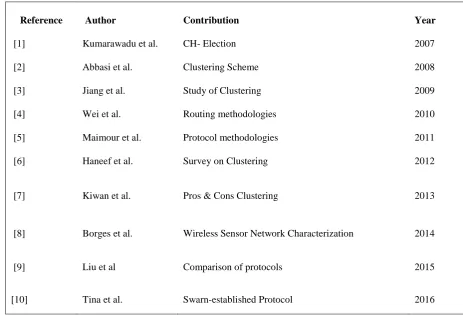
following for evaluation. In Table1 we demonstrated the liberal arts review of wireless sensor network.
Table 1: Review on WSNs
Reference Author Contribution Year
[1] Kumarawadu et al. CH- Election 2007
[2] Abbasi et al. Clustering Scheme 2008
[3] Jiang et al. Study of Clustering 2009
[4] Wei et al. Routing methodologies 2010
[5] Maimour et al. Protocol methodologies 2011
[6] Haneef et al. Survey on Clustering 2012
[7] Kiwan et al. Pros & Cons Clustering 2013
[8] Borges et al. Wireless Sensor Network Characterization 2014
[9] Liu et al Comparison of protocols 2015
[10] Tina et al. Swarn-established Protocol 2016
This manuscript is well ordered as follows. Importance of Literature review is presented under section 2. For
optimal path selection, we have survey various routing protocols under section 3. Based on above sections, we
described problem statement and Suggestion in section 4and 5.In the end, we complete in section 6.
2. Importance of Literature Survey
In this area, we clarify quickly the key standard of most particular routing protocol approaches in the review; At
that point we characterize them into different classifications. There are various route arranging algorithms
applied for optimal path selection. The primary methodologies presented in the literature are quickly depicted
under section 3 and 4. By utilizing different protocol like: Proactive, On-request and clustering routing protocol
to assessing delay, jitter, packet loss, energy utilization and QoS. the present paper, we primarily focused on
searching best algorithm for optimal trust node path selection for ideal trust hub path choice for moving data
from sender to receiver and boost the network lifetime. It's hard to discover the trust hub for secure transmission
from various algorithms. Compelling energy the executives is utilized for picking the correct group head
adequately. Here, algorithms are utilized for expanding jitter and QoS performance, packet loss minimize delay.
The total procedure comes in systems which are clarified briefly in upcoming sections.
3. Survey on Routing Protocol Classification in WSN
This portion explains groupings of various routing protocols in WSNs.Coordinating are a victor among the most
inconvenient assignments in WSN. Getting sorted out is done to find the most ideal path among the source to
target center point [11]. For routing purposes, an equipment which is known as switch is used. From particular
certified objective to pass a packet or text from transmitter center to target center, a planning design is created to
find the better sensible process. The text or packet is passed through that technique. Controlling unit of sensor
network, characterize the initiator with light of concurrence, orchestrate formation, show activity, way
establishment, next hop assurance. Distinctive leveled, organizing and region based planning. The quantity
steering was did in small scale assign, when all node hubs recreate out near undertakings and recognizing tasks
when it change co-coordinately, a structure is distributed levels, the center points in high-ranking stage were
used with an authoritative objective of statistics party and statistics taking consideration with at any rate the
center points in least stage were used for perceiving responsibility [12] [13]. The complete course of wireless
sensor network routing protocols is according to the Fig.1
Wireless Sensor Network Routing Protocols
Protocol Operation
Multi Path Based
QoS Based
Next Hop Selection
Broadcast Based
Content Based
Path Establishment
Proactive
Hybrid
Structure of networks
Flat Depended
Fig.1
Fig.1: Ordering of routing protocols in wireless sensor network
3.1 Routing Protocol Operation
In this area, we characterized various routing protocol activity like multipath, QoS, Negotiation, coherent and
non-sound and Query based. It must be seen that a segment of these protocols may fall underneath in any event
above routing categories.
3.1.1 Multipath routing protocols
In this section, we take a directing at the coordinating demonstrates that utilization different ways as opposed to
a solitary way. So as to upgrade the system execution. The acclimation to non-key disappointment (quality) of a
show is assessed by the possible of another route can exists among the source and objective ,while the huge
process produces short. It maybe associated by maintaining various kinds among the source and the target to the
shortcoming of a generally all encompassing importance use and traffic age. These replacement processes are
kept active by transmitting erratic text along these lines, engineer enduring condition may be associated with the
obstruction of broadened elevated of hold tight a substitute process [14].
The process is changed at whatever point an unrivaled way is found. The fundamental way will be used
until its essentialness falls underneath the imperativeness of the fortification route at which the support way is
used. Using this approach, the centers in the basic way won't deplete their imperativeness resources through
tireless usage of a comparable course, on above lines achieving longer life. In any case, the way trading cost was
not assessed in the criteria [15].
The utilization of a multiple hazardous ways every so often to gather the vitality of the frame work.
These ways are picked by methods for a probability which relies on how low the imperativeness use of every
way. The path with the best remaining criticalness when used to course data in a framework, may be centrality
exorbitant also. In this way, the tradeoff between obliging the firm power drained and centrality of the structure.
The creator in [16] implemented an estimation where holding up importance of course is slackened up a piece
to pick a more greater essentialness beneficial way.
Multi path and Multi SPEED.
Sensor Protocols for Information via Negotiation.
Directed Diffusion.
3.1.2 QoS Based
This quality of service related routing protocols, have the network required to modify among energy usage and
data condition. Definitely, a network required to satisfy, particular QoS metrics, e.g., delay factor, bandwidth
factor, energy factor and so on. While conveying information to the BS [3]. We talk about an model of these
protocols in this section. Despite restricting essentialness usage, it is comparably essential to consider nature of
organization necessities to the degree deferral, unflinching quality, and change in accordance with noncritical
frustration in controlling in WSNs. Although the fact that Qos metrics, for example, delay and bandwidth
capacity are significant, additionally control utilization is significant and urgent [17]
Sequential assignment routing.
SPEED
3.1.3
Query based routing
In this sort of controlling, the objective centers spread a request for data (perceiving task) from a center point
through system also a middle having this information sends the information which matches the request return to
center point, which starts the request. The maximum, focuses have tables containing the perceiving assignments
tends to that they get and send information which matches these undertakings when they get it. In created
scattering, the BS focus direct passes on intrigue messages toward sensors. As the intrigue is duplicated all
through the sensor sort out, the inclinations from source back into BS is created. Precisely a input information of
the intrigue, the input data passes information along with interests point way. To cut down vitality use,
information full scale (e.g., copy covering) is performed enroot. A middle point won't convey a request except
for if it learns a course to required occasion. In the criteria, there is no course open, the inside transmit a request
in a flighty heading. By at that point, focus point keeps a tight grasp on know whether the request achieved the
target for particular extent of time, after which the middle floods the structure if no reaction is heard from the
goal [18] [19].
Sensor Protocols for Information via Negotiation.
Directed Diffusion.
Rumor Routing protocol
3.1.4
Routing Protocols based Negotiation
These shows utilize unusual state information descriptors in order to dispose of abundance information
transmissions through course of action. Correspondence choices are additionally taken dependent on the focal
points that are available to them. The SPIN family shows dissected already and the shows in are events of
exchange based coordinating shows. The reason is usage submerge to spread information it will make collapse
and spread between the transmitted information, in this manner centers will get copies of basically comparable
data. This development debilitates more prominent centrality and more preparing by sending relative
information by various sensors and The SPIN shows are intended to spread the information of single sensor to
each other sensor expecting these sensors obtain potential base-stations. so these lines, the standard reasoning
of plan related to organizing with sensor network is cover information were copied and shield repetitive data
sent to going with sensor or the fundamental station by driving a development of exchange information before
veritable information transmission starts [20].
SPIN
Directed Diffusion (DD).
Sequential Assignment Routing (SAR).
3.1.5 Coherent and Non coherent
Sensor centers take parts combine with process using various information browsing the framework. Information
handling is the common noteworthy problem of capacity in WSNs and this process can do by two different
models [21]. Comprehensible directing, here least preparing method process is used on information likewise
after that passed to accumulation. Another system is non-reasonable, here the center point may itself action the
assembled data ahead passing it.
Multiple winner
Single winner
3.2 Path Establishment
3.2.1 Proactive Routing Protocol
In proactive protocols, single hub keeps up individual coordinating table containing steering information for all
hub in the framework. Each hub maintain steady and current remarkable coordinating sending control of
messages of each data systematically among the hubs,this is update on directing tables.The proactive
coordinating shows use associate state directing counts which as frequently as conceivable flood the connection
information about its neighbour's. The drawback of proactive guiding show is that all hubs in the framework
reliably hold on revived table. A portion of current proactive controlling shows are DSDV, WRP and OLSR
[22].
Destination Sequenced Distance Vector Routing (DSDV): It is a counter-operate estimation
dependent on customary algorithm of bellman ford direct framework. In this coordinating show,
doled out by the objective hub. The arrangement numbers engage the flexible centers to perceive
stale courses from new ones, so those lines avoiding the advancement of steering circles. Steering
tables are refreshed every so often hold on table current. To decrease the possibly enormous
proportion of framework over-load that such updates can make, course updates can use two potential
sorts of groups. The first is known as a full dump. This kind of package passes on all open
controlling information [23].
During times of Occasional improvement, these packets are conducted once in a while and
second are smaller enduring groups are utilized to hand-off only that information which has been
changed as final full dump. New course imparts contain the area of the objective, the load of
bounces to accomplish the objective, the progression number of data got along with objective,
similarly as another gathering number exceptional to the convey [24].
Wireless Routing Protocol (WRP): The WRP underpins circle opportunity [25]. It requires every
hub to keep up four steering tables which causes a huge overhead at every hub as the capacity of
framework builds directing table, remove table, interface cost table and message re-transmission
rundown table. Every passage of the message re-transmission rundown contains the succession
number of the update message, a re-transmission counter, an affirmation required banner vector with
one section for each neighbor, and a rundown of updates pass in update message. The message
re-transmission rundown records which updates in an update message shall be retransmitted, which
neighbors should recognize re-transmission. Moreover, WRP guarantees its network by utilizing of
hi messages. These messages are traded at whatever point here no ongoing parcel transmission. This
procedure expends a best deal of data transfer capacity just as power since every hub is required to
remain dynamic consistently [26] [27].
Optimized Link state Routing Protocol (OLSR): It’s a dynamic directing convention and paths
are in every case, soon approachable when it need. This technique were considered as advance
method in routing protocol. The property changes cause the flooding of the topological data to every
single accessible host in the system. To lessen the conceivable overhead in the system, convention
utilizes Multipoint Relays (MPR) [28] [29]. The possibility of MPR is to lessen flooding of
communicates by diminishing a similar communicate in certain districts in the system. Another
utilization of MPR is to give the most brief way. The lessening the time interim for the control
messages transmission can carry greater reactivity to the topological changes. OLSR utilizes two
sorts of the control messages: Hello and Topology Control (TC). Hi messages are utilized for finding
the data about the connection status and the host's neighbors. With the Hello message the Multipoint
Relay (MPR) Selector set is developed which depicts which neighbors has picked this host to go
about as MPR and from this data the host can figure its own arrangement of the MPRs. The Hello
messages are sent just one bounce away however the TC messages are communicated all through the
whole system. TC messages are utilized for broadcasting data about possess publicized neighbors
which incorporates in any event the MPR Selector list. The TC messages are communicated
occasionally and just the MPR hosts can advance the TC messages OLSR utilizes two sorts of the
control messages: Hello and Topology Control (TC). Hi messages are utilized for finding the data
about the connection status and the host's neighbors. With the Hello message the Multipoint Relay
(MPR) Selector set is developed which depicts which neighbors has picked this host to go about as
MPR and from this data the host can ascertain its very own arrangement of the MPRs. The Hello
messages are sent just one jump away yet the TC messages are communicated all through the whole
system. TC messages are utilized for broadcasting data about claim [30].
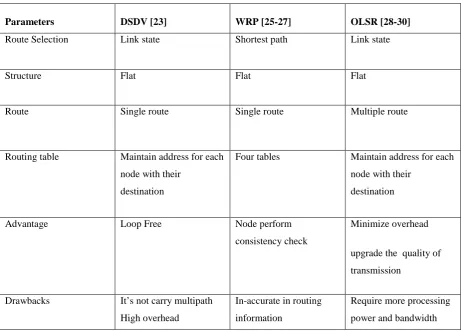
Table 2: Comparison of AODV, WRP and OLSR protocol
Parameters DSDV [23] WRP [25-27] OLSR [28-30]
Route Selection Link state Shortest path Link state
Structure Flat Flat Flat
Route Single route Single route Multiple route
Routing table Maintain address for each
node with their
destination
Four tables Maintain address for each
node with their
destination
Advantage Loop Free Node perform
consistency check
Minimize overhead
upgrade the quality of
transmission
Drawbacks It’s not carry multipath
High overhead
In-accurate in routing
information
Require more processing
power and bandwidth
3.2.2 On Demand Routing Protocol (ODRP)
In on interest routing protocols, when a source needs to send information to a collector, it summons the route
disclosure parts to find the course to the recipient hub. The route remains authentic till the objective is reachable
or until the route is never again required. As opposed to table driven shows, all hubs need not keep-up upto-date
steering information [31].
Ad Hoc On-Demand Distance Vector Routing (AODV): AODV is an adhoc on interest
remove vector,that is a kind of receptive convention. AODV is a Source drive type steering
convention [31]. In AODV the correspondence happens just when attractive. In AODV a
bounce to-jump technique happens. AODV is a combination of separation vector and on
interest.On-request implies the correspondence happens just when required and separation
vector implies a connection state convention. In AODV a RREQ (Route Request) is pass to
every single hub in system. At the point when every halfway hub have a substantial and
proper course to the goal then the RREP (Route Reply) parcels are sending to the source by
the hubs or by the goal itself. On the off chance that no substantial course is finding by the
hubs, at that point the RERR (Route Error) is send to the source hub.
Dynamic Source Routing (DSR): DSR describes a kind of responsive convention and
dynamic source routing. DSR is an on interest convention which is intended for use in
multihop remote system [32]. DSR enables the frame work to be completly self-sorting out
and self arranging, without the requirement for every current system foundation or
organization. The two noteworthy periods of convention is course disclosure and course
support. In DSR all hubs progressively find a course from source to the goal. A course
solicitation is send to all the multihop organize hubs. Directed bundles contain the location of
considerable number of gadgets which navigate in course disclosure [33].
Temporally Ordered Routing Algorithm (TORA): Which is versatile and adaptable
steering calculation dependent on the idea of connection inversion. It finds different courses
from source to goal in an exceptionally unique versatile systems administration condition. A
significant plan idea of TORA is that control messages are limited to a little arrangement of
hubs close-by a topological change. Hubs keep up directing data about their quick one-bounce
neighbors. The convention has three essential capacities: course creation, course support, and
course deletion. Nodes utilize a "height" metric to build up a directed cyclic graph (DAG)
established at the goal during the course creation and course upkeep stages. The connection
can be either an upstream or downstream dependent on the relative stature metric of the
neighboring hubs [34] [35]. TORA's measurement contains five components: the one of a kind
hub ID, coherent time of a connection disappointment, the extraordinary ID of a hub that
characterized the new reference level, a reflection pointer bit, and a spread requesting
parameter. Foundation of DAG looks like the question/answer procedure talked about in
Lightweight Mobile Routing (LMR). Course upkeep is fundamental when any of the
connections in DAG is broken. This pursuit component for the most part requires a solitary go
of the conveyed calculation since the directing tables are altered all the while during the
outward period of the hunt instrument. Other directing calculations, for example, LMR utilize
two-pass though both DSR and AODV utilize three pass technique.
Associatively Based Routing (ABR): The ABR protocol uses a request answer methodology
to select the routes to recipient [36]. Regardless, in ABR course assurance is fundamentally
established on quality. To choose constant parts every inside tip keeps up an amiably strong
with its neighbors and the association with prohibitive pleasingly strong are picked in affinity
to the ones with lower charmingly tick. The square of ABR doesn't take up with different
terms or a course hold so the help approaches won't be immediately open. Regardless, ABR is
repaid this drawback somewhat by starting a constrained course divulgence structure [37].
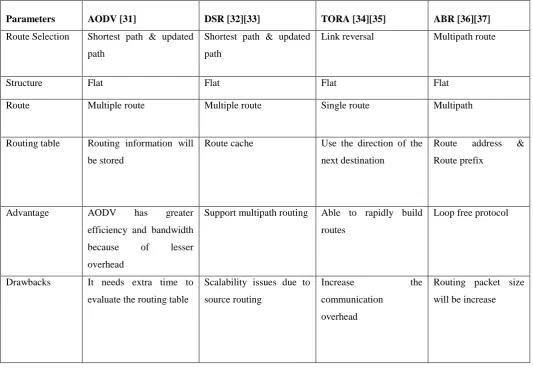
Table 3: On Demand routing protocol comparison
3.2.3 Hybrid routing protocol
This protocol utilizes the couple of proactive and reactive routing protocols. It is most appropriate for zone
routing protocol in which zone neighbors are dictated by dynamic routing convention and reactive routing
protocols are controlling the hubs among routes [38] [39].
Parameters AODV [31] DSR [32][33] TORA [34][35] ABR [36][37]
Route Selection Shortest path & updated
path
Shortest path & updated
path
Link reversal Multipath route
Structure Flat Flat Flat Flat
Route Multiple route Multiple route Single route Multipath
Routing table Routing information will
be stored
Route cache Use the direction of the
next destination
Route address &
Route prefix
Advantage AODV has greater
efficiency and bandwidth
because of lesser
overhead
Support multipath routing Able to rapidly build
routes
Loop free protocol
Drawbacks It needs extra time to
evaluate the routing table
Scalability issues due to
source routing
Increase the
communication
overhead
Routing packet size
will be increase
Zone Routing Protocol(ZRP)
In a portable specially appointed system, it very well may be expected that the greater part of the
correspondence happens between hubs near one another. ZRP characterizes a zone around every hub
comprising of its k-neighborhood. That is, in ZRP, all hubs inside k-jump good ways from hub have a
place with the directing zone of hub. There are two sub-conventions available in ZRP,one is utilized for
receptive zones and steering zones, which is Intra-zone Routing Protocol (IARP) also it is directing
proactive protocol. Among the direct zones the Inter-zone Routing Protocol (IERP) can be utilized
separately. A course to a goal inside the neighborhood zone able to set up taken the proactively stored
directing table of source by IARP. In this manner, if the source and goal is in a similar zone, the parcel
can be conveyed right away. For IARP with ZRP,there is current proactive steeting calculations
maximum part utilized.For courses past the neighborhood zone course disclosure happens responsively.
The Zone Routing Protocol (ZRP) portrayed in exploits this reality and partitions the whole arrange into
covering zones of variable size [40][41]
Order One Network Protocol (OORP)
The Order One MANET Routing Protocol (OORP) is a calculation for PC imparting by computerized
radio in a work system to locate one another, and send messages to one another along a sensibly
proficient way [42]. It was intended for, and advanced as working with remote work systems. OORP can
deal with many hubs, where most different conventions handle not exactly a hundred. OORP utilizes
various leveled calculations to limit the aggregate sum of transmissions required for steering. Directing
overhead is just about 1% to 5% of hub to hub transmission capacity in any system and does not develop
as the system size develops. The fundamental thought is that a system arranges itself into a tree. Hubs
meet at the base of the tree to build up an underlying course. The course at that point moves from the
root by compromising, as subterranean insect trails do. At the point when there are no more corners to
cut, an about ideal course exists [43].
3.3 Next Hop Selection
3.3.1 Broadcast Based
The standard strategy of award in WSN is submerged, this may undeniable and clear process. Correctly a
nearest node. Each center point were got the bundle curiously will re-grant the social affair to its nearest node,
which trigger to the help amazing number of center points in passing on the gathering [44].
3.3.2 Location Based
This technique used for enormity sufficiency in sensor network called GPSRS. It relies on greedy perimeter
stateless routing in wireless networks, which is a legend among the unmistakable no doubt locale based
arranging shows up for remote amazingly assigned frameworks. We update the vitality sufficiency by
considering focus purposes of GPSR, criticalness level and region information. Moreover, we change the
territory operate area of considering long side data handle [45].
3.3.3 Content Based
A substance based framework recognizes messages for movement, and is connectionless and best-effort in
nature. In a substance based framework, centers are not doled out stand-out framework addresses, nor are
messages directed to a specific center. Or maybe, every center point advances a predicate that portrays messages
of excitement for that center and, therefore, the messages that the center way to get. The substance based
organization involves passing on a message to all the client centers that plugged predicates planning the
message.
3.3.4 Probabilistic
Probabilistic, is a refreshed form of perimeter algorithm, which is used to assess the extreme upheld
recognizable proof likelihood for an objective territory. This algorithm can be used to assess the viable inclusion
which able to given to the application to abusing the sensor hubs [48].
3.4 Network Formation
Steering conventions can be arranged into 3 one of kind conventions as demonstrated by the framework
structure: various leveled, level, and territory based [49].
3.4.1 Flat routing
From this routing protocol node center points inside a system do process expect an indistinct activity. These
lines, in this methodology, the information is go through by substation of center point. Here, the segment can get
the information from node center point then the midway node center points plays out some scattering on the sent
data which is begun by each other center point show up in framework in conclusion, the all things considered
spread information and pass to same source [50] [51] . Design of flat routing convention were displayed in
Fig.2.
Flat Based
Routing Rumor
Routing
Directed
Diffusion Flooding
Fig.2: Classification of Flat Routing
Few flat routing schemes:
• Directed Diffusion
• Active Query forwarding In sensor network
• Sequential Assignment Routing
• Minimum Cost Forwarding Algorithm
• Constrained Anisotropic Diffusion Routing
• Energy Aware Routing
• Gradient based Routing
• Sensor Protocol for Information via Negotiation
3.4.2 Hierarchical Based
Different stages in hierarchical convention techniques are stunning essentialness and flexibility adequacy [54].
Incorporate under this solicitation from time to time assigned centrality capacity planning figuring's. These
structures are equivalently called assembling philosophies since focus focuses inside a WSN are bound into
different packs. Center point focuses with wealth significance are used to process and move data while focuses
with least centrality are used to see and gather data. Get-together progress, Cluster head attestation and turn are
enormous activities of this methodology realizes fortifying of framework future. Multi-bounce correspondence
is likewise used by this method to save imperativeness use. Get-together of Hierarchical Based Routing is
appeared in Fig.3.
HEED
PEGASIS
Fig.3: Hierarchical routing protocol classification
Some hierarchical routing:
• Self-Organizing Protocol
• Minimum energy communication network
• Low energy adaptive clustering hierarchy
•Threshold Sensitive Energy Efficient Protocols
• Power efficient gathering in sensor information systems
3.4.3 Location Based Routing
Region demonstrates a bit of duration in like way represented Geographic shows. In view of this structure center
points acts perceived their district. Especially perceived locale show up in the system subsistence utilized to pick
the proportion of imperativeness subsistence needed to convey information. Center points existing in that whole
structure are furnished over recipient of minimum control GPS gadgets. There two types of systems available in
this types, single way or multipath. [55]. Request from routing is dependent on area, showed up in Fig.4.
Location GAF
GEAR
MECN
Fig.4: Classification of location based routing protocol
Some algorithm of location based routing
• Greedy Perimeter Stateless Routing
• Sequential assignment routing
• Geographic adaptive fidelity
• Graph Embedding for Routing
• Ad-hoc positioning system
• Geographic distance routing
• Location Aided Routing
• Geographic and energy aware routing
Table: 4 Comparison of proactive, reactive and on demand classification
Protocols Routing
structure
Control Overhead
Periodic updates
Bandwidth requirement
Route acquisition
delay
Power requirement
Proactive Both Flat &
hierarchical
structures
High Yes, some
may use
conditional
High Low High
On Demand
routing
protocol
Mostly flat,
Except CBRP
Low Some nodes
may require
Periodic
beacons.
Low High Low
Hybrid Flat Medium Yes Medium Lower for
Intra-zone;
Higher for
Inter-zone
Medium
3.5 Routing Protocols Outline Distribution
From the beginning sensor network was essentially persuaded by military approach. Slow on the standard local
approach space of remote node systems were observed, for example, organic and pattern watching, creation and
helpful organizations, fast home, and so on. This sensor network may include assorted and versatile node points;
the system topology might be as principal as a star topology; the scale and thickness of a structure change
dependent on the application. To meet this general model towards enlarging, the going with tremendous
structure issues of sensor system must be considered [56] [57].
3.5.1 Fault Tolerance
Some sensor focuses focuses may crash and burn or stopped because of not appear of power, have physical
fiendishness or characteristic impedance. The mistake of sensor focus focuses ought not affect the general
assignment of sensor sort out. This is the faithfulness or change in accordance with inside frustration issue.
[58]Adjustment to inside disappointment is the capacity to enable sensor to engineer functionalities with no
impediment because of sensor focus point dissatisfactions
.
3.5.2 Expansible
That gathering on sensor focuses passed on in perceiving district might be sales for near hundreds, managing
plans or thousands should be flexible enough to employed occasions.
3.5.3 Operating Territory
We able to set sensor sort out within huge hardware, during base of a sea, in an ordinarily and falsely spoiled
area, in the adversary lines of region in a home or monstrous structure, with a huge flow center, related with
creatures, joined to fast transferring vehicles, in timberland area for viewing of living spaces, and etc.
3.5.4 Energy Utilization
Considering the remote radio transmission force is in regard into segment quadrate or astonishingly greater sales
inside observing snags, multi-hop guiding may deplete less centrality than direct correspondence. Regardless,
multi-hop controlling presents goliath expenses as long as topology the medium access control with board.
Immediate controlling will carry out OK whether the majority of middle focuses have been unfathomably close
to sink. Node focuses are provided over obliged power source (<0.5 Ah 1.2V).Sensor deadline is clearly subject
to own battery deadline.
3.5.5 Creation Costs
Since the sensor structures incorporate incalculable sensor focuses, expenditure of lone focus point is
fundamental to legitimatize the common expenditure of the systems and from this time forward the expense of
every sensor focus point must be kept low.
3.5.6 Information Amassment
Since sensor focus focuses may make fundamental excess information, for all intents and purposes
indistinguishable bundles from different focuses can be totaled with the target is the proportion of transfers will
be diminished. Data accumulating is blend of data from various origins by using limits, example, cover (doing
without transcripts), min, max and run of the mill. As estimation would be less criticalness eating up than
correspondence, liberal essentialness spare resources can be crossed information gathering. This methodology
were used to achieve essentialness ability also traffic redesign within different directing shows.
3.5.7 Data Conveyance Prototype
Data improvement models pick when the data amassed by the inside point must be passed on. Subordinate upon
the utilization of sensor sort out, that data advancement sink the model able to be constant, mixed, Query and
Event driven. Within decided of vehicle, every nodes passing data
now and again. Within event driven
models,
the communication of information is requested while an employing of event. Being implied drivenmodels, the transmission of data is founded when requesting is passed on by the sink. A couple of frameworks
implement a crossbreed model using a mixing of unending, event employs and sales driven data improvement.
3.5.8 Node Deployment
.
Center point course of action is application ward and effects the introduction of the coordinating show. The
passing is likewise self-managing and deterministic. Within deterministic conditions, those sensors are
physically set and data is composed over pre-picked ways. At any rate within own managing structures, the
sensor focus focuses are dissipated discretionarily made a Ad-hoc foundation way. From this structure, a
circumstance of a substation or cluster head is moreover dire to the extent essentialness capability and
execution. Exactly when the movement of centers isn't uniform, perfect arranging of bundle head transforms
into an issue that is asking to be routed to enable essentialness capable framework action.
3.5.9 Information Overhead and Latency
These are considered as the tremendous portions that impact coordinating show setup structure. Data gathering
and multi-hop moves cause information dormancy. In like way, some controlling shows make ridiculous
overheads to finish their counts, which are not legitimate for affirmed essentialness compelled structures.
3.5.10 Quality Of Service
The QoS infers the quality association required near the application, it can be length of life time, the data based,
significance capacity, also region care, organize arranged managing. These portions will affect the choice of
controlling shows for a particular application. In explicit uses (for example few military purposes) the data must
be moved inside a specific timeframe into minute it is recognized [59].
4. Problem Statement
From the above review, we quickly talked about different algorithm and protocols for checking execution of
delay, jitter, packet loss and quality of service. Improving QoS and jitter is a difficult issue from those protocols.
Its elusive the ideal way from hubs. By utilizing proactive and on-request directing convention, we misfortune
more bundles from sender to recipient hub; Then organize information transmitting pace were diminished;
When parcel transmitting rate limited, delay were happen; Finally, nature of administration is limited. For
energy utilization and postponement limiting, we utilized to think about different directing conventions in above
segment. Arrangement of protocols depends upon throwing approaches which is completely founded on the
cardinality of goal set, notwithstanding directing conventions unpredictability correlation is additionally
performed. This paper spreads overview of steering convention and prior proposed procedures. The main goal of
this study paper is looking through best course from source to goal hub. Tássio Carvalho (65) have took a little
steering convention affirmation by improving nature of administration and jitter. At the point when contrast with
these conventions and calculations, QRCL is better for QoS and jitter.
5. Suggestion
From this survey, I suggested a QRCL method; it might give better results compare with other routing protocols.
Thus in present article survey, different sorts of existing routing protocols in WSN is finished. The advantages
and downsides of the overviewed protocols are portrayed. We have likewise talked about some probability
procedure here. When we use QoS productive and asset mindful VoIP/SIP cross-layer (QRCL) conspire, the the
delay, jitter, packet loss may lessen and PSNR, SSIM may increment.
6. Conclusion
In this study paper, we learned about various routing protocols utilized for delay performance and QoS
measurements. This survey dissected various issues from cross breed system were regarding to discussed. In the
section 3 and 4 the point by point investigation of proactive directing protocols orders and on-request routing
protocols arrangement and its presentation are clarified. A cross layer convention utilized in the remote system
is portrayed and there correlation is performed. The new cross-layer directing convention QRCL can execution
better for a half and half remote system. The performance metrics like delay, jitter, and packet loss misfortune
are taken for the examination reason. Utilizing the QRCL the QoS measurements like PSNR, SSIM are
additionally assessed. Thusly by utilizing QRCL it is conceivable to accomplish high PSNR and SSIM.
Simultaneously different performances parameters like delay, jitter, and packet loss assume a significant job in
the half and half organize. In this way by utilizing QRCL it is conceivable to diminish the negative execution
parameters like delay, jitter, and packet loss.
Acknowledgement
This Research was supported by Visvesvaraya Technological University, Jnana Sangama, Belagavi -590018 for Grant of financial assistance.
References
[1] A. A. Abbasi and M. Younis, “A survey on clustering algorithms for wireless sensor networks,” Comput. Commun., vol. 30, nos. 14–15, Oct. 2007 pp. 2826–2841.
[2] P. Kumarawadu, D. J. Dechene, M. Luccini, and A. Sauer, “Algorithms for node clustering in wireless sensor networks: A survey,” in Proc. 4th Int. Conf. Inf. Autom. Sustainability, Colombo, Sri Lanka, Dec. 2008, pp. 295–300. [3] C. Jiang, D. Yuan, and Y. Zhao, “Towards clustering algorithms in wireless sensor networks—A survey,” in Proc. IEEE Wireless Commun. Netw. Conf., Budapest, Hungary, Apr. 2009, pp. 1–6.
[4] M. Maimour, H. Zeghilet, and F. Lepage. Cluster-Based Routing Protocols for Energy-Efficiency in Wireless Sensor Networks. [Online]. Available: http://cdn.intechweb.org/pdfs/12423.pdf, accessed Dec. 14, 2010.
[5] C. Wei, J. Yang,. Y. Gao,Z Zhang., ”Cluster-Based Routing Protocols in Wireless Sensor Networks: A Survey” In Proceedings of 2011 International Conference on Computer Science and Network Technology, Harbin, China, 24–26 December 2011; pp. 1659–1663.
[6] M. Haneef and Z. Deng, “Design challenges and comparative analysis of cluster based routing protocols used in wireless sensor networks for improving network life time,” Adv. Inf. Sci. Service Sci., vol. 4, no. 1, 2012, pp. 450–459. [7] H. Kiwan, Y. L. Morgan, “Hierarchical Networks: Routing And Clustering (A Concise Survey),” In Proceedings of IEEE CCECE/CCGEI, Ottawa, ON, Canada, 2013.
[8] Luís M. Borges, Fernando J. Velez and António S. Lebres, “Survey on the Characterization and Classification of Wireless Sensor Network Applications,” IEEE Communication Surveys & Tutorials, vol. 4, 2014, pp. 1860-1890. [9] Xuxun Liu, “ Atypical Hierarchical Routing Protocols for Wireless Sensor Networks: A Review,” IEEE Sensors Journal, vol. 15, no. 10, 2015, pp. 5372-5383.
[10] Tina Gui, C. Ma, F. Wang and D. E. Wilkins, "Survey on Swarm Intelligence based Routing Protocols for Wireless Sensor Networks," IEEE Journal, 2016, pp. 1944-1949.
[11] Pantazis, N.A., Nikolidakis, S.A. and Vergados, D.D., 2012. Energy-efficient routing protocols in wireless sensor networks: A survey. IEEE Communications surveys & tutorials, 15(2), pp.551-591.
[12] Liu, X., 2017. Routing protocols based on ant colony optimization in wireless sensor networks: a survey. IEEE Access, 5, pp.26303-26317.
[13] Liu, X., 2015. Atypical hierarchical routing protocols for wireless sensor networks: A review. IEEE Sensors Journal, 15(10), pp.5372-5383.
[14] Lan, L., Li, L. and Jianya, C., 2012, October. A multipath routing algorithm based on OSPF routing protocol. In 2012 Eighth International Conference on Semantics, Knowledge and Grids (pp. 269-272). IEEE.
[15] Raval, C. and Hegde, S., 2011, April. Ant-CAMP: ant based congestion adaptive multipath routing protocol for wireless networks. In 2011 International Conference on Emerging Trends in Networks and Computer Communications (ETNCC) (pp. 463-468). IEEE.
[16] Ding, S. and Liu, L., 2010, August. A node-disjoint multipath routing protocol based on AODV. In 2010 Ninth International Symposium on Distributed Computing and Applications to Business, Engineering and Science (pp. 312-316). IEEE.
[17] Sihai, Z., Layuan, L. and Lin, G., 2012, August. QoS-Based multicast routing protocol in MANET. In 2012 International Conference on Industrial Control and Electronics Engineering (pp. 262-265). IEEE.
[18] Pearlman, M.R. and Haas, Z.J., 1999, September. Improving the performance of query-based routing protocols through" diversity injection". In WCNC. 1999 IEEE Wireless Communications and Networking Conference (Cat. No. 99TH8466) (Vol. 3, pp. 1548-1552). IEEE.
[19] Zhang, Z., Yu, F., Chen, L. and Zhang, B., 2009, June. Dynamic routing layer for data query in wireless sensor networks. In 2009 11th IEEE International Conference on High Performance Computing and Communications (pp. 251-257). IEEE.
[20] Pan, J. and Li, J., 2009, September. ESS_SKN: An Effective, Strong Anonymous and Secure Shared Key Negotiation Protocol in MANETs. In 2009 International Conference on Management and Service Science (pp. 1-4). IEEE.
[21] Gnanambigai, J., Rengarajan, N. and Anbukkarasi, K., 2013, January. Q-Leach: An energy efficient cluster based routing protocol for Wireless Sensor Networks. In 2013 7th International Conference on Intelligent Systems and Control (ISCO) (pp. 359-362). IEEE.
[22] Dargahi, T., Rahmani, A.M. and Khademzadeh, A., 2008, December. SP-AODV: A Semi-Proactive AODV routing protocol for wireless networks. In 2008 International Conference on Advanced Computer Theory and Engineering (pp. 613-617). IEEE.
[23] Nithya, S., Kumar, G.A. and Adhavan, P., 2012, December. Destination-sequenced distance vector routing (DSDV) using clustering approach in mobile adhoc network. In 2012 International Conference on Radar, Communication and Computing (ICRCC) (pp. 319-323). IEEE.
[24] Khan, K.U.R., Zaman, R.U., Reddy, A.V., Reddy, K.A. and Harsha, T.S., 2008, August. An efficient destination sequenced distance vector routing protocol for mobile ad hoc networks. In 2008 International Conference on Computer Science and Information Technology (pp. 467-471). IEEE.
[25] He, L., Huang, J. and Yang, F., 2010, August. A noval hybrid wireless routing protocol for WMNs. In 2010 International Conference on Electronics and Information Engineering (Vol. 1, pp. V1-281). IEEE.
[26] Srivastava, D., Sharma, V. and Soni, D., 2019, April. Optimization of CSMA (Carrier Sense Multiple Access) over AODV, DSR & WRP Routing Protocol. In 2019 4th International Conference on Internet of Things: Smart Innovation and Usages (IoT-SIU) (pp. 1-4). IEEE.
[27] Imran, M. and Qadeer, M.A., 2016, September. Evaluation study of performance comparison of topology based routing protocol, AODV and DSDV in MANET. In 2016 International Conference on Micro-Electronics and Telecommunication Engineering (ICMETE) (pp. 207-211). IEEE.
[28] Gadekar, S. and Kadam, S., 2017, September. Secure optimized link state routing (OLSR) protocol against node isolation attack. In 2017 IEEE International Conference on Power, Control, Signals and Instrumentation Engineering (ICPCSI) (pp. 684-687). IEEE.
[29] Dhurandher, S.K., Obaidat, M.S. and Gupta, M., 2010, December. A reactive optimized link state routing protocol for mobile ad hoc networks. In 2010 17th IEEE International Conference on Electronics, Circuits and Systems (pp. 367-370). IEEE.
[30] Wang, J.C.P., Abolhasan, M., Franklin, D.R. and Safaei, F., 2009, October. OLSR-R 3: Optimised link state routing with reactive route recovery. In 2009 15th Asia-Pacific Conference on Communications (pp. 359-362). IEEE.
[31] Poongkuzhali, T., Bharathi, V. and Vijayakumar, P., 2011, June. An optimized power reactive routing based on AODV protocol for Mobile Ad-hoc network. In 2011 International conference on recent trends in information technology (ICRTIT) (pp. 194-199). IEEE.
[32] Cao, Z. and Lu, G., 2010, April. S-AODV: Sink routing table over AODV routing protocol for 6LoWPAN. In 2010 Second International Conference on Networks Security, Wireless Communications and Trusted Computing (Vol. 2, pp. 340-343). IEEE.
[33] Khelifa, S. and Maaza, Z.M., 2010, October. An energy multi-path AODV routing protocol in ad hoc mobile networks. In 2010 5th International Symposium On I/V Communications and Mobile Network (pp. 1-4). IEEE.
[34] Park, V.D., Macker, J.P. and Corson, M.S., 1998, October. Applicability of the temporally-ordered routing algorithm for use in mobile tactical networks. In IEEE Military Communications Conference. Proceedings. MILCOM 98 (Cat. No. 98CH36201) (Vol. 2, pp. 426-430). IEEE.
[35] Weiss, E., Hiertz, G.R. and Xu, B., 2005, May. Performance analysis of temporally ordered routing algorithm based on IEEE 802.11 a. In 2005 IEEE 61st Vehicular Technology Conference (Vol. 4, pp. 2565-2569). IEEE.
[36] Heo, G. and Song, W.C., 2009, January. Associativity-based dynamic source routing in MANETs. In 2009 International Conference on Information Networking (pp. 1-3). IEEE.
[37] Kummakasikit, M., Thipchaksurat, S. and Varakulsiripunth, R., 2005, December. Performance Improvement of Associativity-Based Routing Protocol for Mobile Ad Hoc Networks. In 2005 5th International Conference on Information Communications & Signal Processing (pp. 16-20). IEEE.
[38] Gnanambigai, J., Rengarajan, N. and Navaladi, N., 2014, March. A clustering based hybrid routing protocol for enhancing network lifetime of Wireless Sensor Network. In 2014 2nd International Conference on Devices, Circuits and Systems (ICDCS) (pp. 1-4). IEEE.
[39] Khatkar, A. and Singh, Y., 2012, January. Performance evaluation of hybrid routing protocols in mobile ad hoc networks. In 2012 Second International Conference on Advanced Computing & Communication Technologies (pp. 542-545). IEEE.
[40] Jaiswal, A.K. and Singh, P., 2010, September. Optimizing velocity based adaptive zone routing protocol. In 2010 International Conference on Computer and Communication Technology (ICCCT) (pp. 149-152). IEEE.
[41] Minh, T.P.T., Nguyen, T.T. and Kim, D.S., 2015, September. Location aided zone routing protocol in mobile Ad Hoc Networks. In 2015 IEEE 20th Conference on Emerging Technologies & Factory Automation (ETFA) (pp. 1-4). IEEE.
[42] Jang, H.C. and Yang, C.K., 2012, June. A hybrid architecture of routing protocols for vanet with cross-layer design. In 2012 International Symposium on Computer, Consumer and Control (pp. 68-71). IEEE.
[43] Yi, Z., Xiaofei, W., Xiumei, Z. and Li, F., 2009, January. HRPMA: A Hybrid Routing Protocol Based on Mobile Agent for Wireless Ad Hoc Networks. In 2009 WRI International Conference on Communications and Mobile Computing (Vol. 2, pp. 137-141). IEEE.
[44] Mousset, J., Zhou, H.Y. and Hou, K.M., 2011, October. One-hop broadcast routing protocol for wireless sensor. In 2011 First International Conference on Instrumentation, Measurement, Computer, Communication and Control (pp. 804-807). IEEE.
[45] Kumari, U., 2015, October. Few location based routing protocols in Wireless Sensor Network. In 2015 International Conference on Green Computing and Internet of Things (ICGCIoT) (pp. 749-752). IEEE.
[46] Xue, T. and Zhou, R., 2010, August. A content-based publish-subscribe routing protocol in mobile ad hoc network. In 2010 International Conference on Internet Technology and Applications (pp. 1-4). IEEE.
[47] Ansari, J., Zhang, X., Cugola, C., Migliavacca, M., Bennebroek, M. and Mähönen, P., 2010. Poster Abstract: Wirelessly Accessible Sensor Populations (WASP) Cross-layer Design of Low Power Medium Access and Content based Routing. In Proc. of SECON.
[48] Li, S., Lou, L. and Hong, L., 2013, August. An improved probabilistic protocol for Mobile Ad Hoc Networks. In 2013 IEEE International Conference on Signal Processing, Communication and Computing (ICSPCC 2013) (pp. 1-4). IEEE.
[49] Panda, M. and Sethy, P.K., 2014, August. Network structure based protocols for Wireless Sensor Networks. In 2014 International Conference on Advances in Engineering & Technology Research (ICAETR-2014) (pp. 1-10). IEEE. [50] Galatchi, D.N. and Zoican, R.A., 2011, October. Flat routing protocols for ad hoc mobile wireless networks. In 2011 10th International Conference on Telecommunication in Modern Satellite Cable and Broadcasting Services (TELSIKS) (Vol. 2, pp. 669-672). IEEE.
[51] Raj, D.A.A. and Sumathi, P., 2016, January. Analysis and comparison of EEEMR protocol with the Flat Routing Protocols of Wireless Sensor Networks. In 2016 International Conference on Computer Communication and Informatics (ICCCI) (pp. 1-5). IEEE.
[52] Deepa, C. and Latha, B., 2014, February. HHCS: Hybrid hierarchical cluster based secure routing protocol for wireless sensor networks. In International conference on information communication and embedded systems (ICICES2014) (pp. 1-6). IEEE.
[53] Kwon, H., Kim, J.H. and Kwak, H.Y., 2008, September. A Hierarchical Routing Protocol for Sensor Network Reconfiguration. In 2008 Fourth International Conference on Networked Computing and Advanced Information Management (Vol. 1, pp. 30-35). IEEE.
[54] Kumari, U., 2015, October. Few location based routing protocols in Wireless Sensor Network. In 2015 International Conference on Green Computing and Internet of Things (ICGCIoT) (pp. 749-752). IEEE.
[55] Deng, G., Zhang, X., Zhang, J. and Liu, F., 2006, June. TLRP: Tree-shape location-based routing protocol in mobile ad hoc network. In 2006 6th International Conference on ITS Telecommunications (pp. 646-649). IEEE.
[56] Xianyang, F., 2013, June. Design and implementation of QoS routing protocol for wireless sensor network. In 2013 Fourth International Conference on Digital Manufacturing & Automation (pp. 428-431). IEEE.
[57] Thorat, S.A. and Kulkarni, P.J., 2014, July. Design issues in trust based routing for MANET. In Fifth International Conference on Computing, Communications and Networking Technologies (ICCCNT) (pp. 1-7). IEEE.
[58] Chandra, M.R. and Reddy, P.C.S., 2016, February. Fault tolerance QoS routing protocol for MANETs. In 2016 IEEE 6th International Conference on Advanced Computing (IACC) (pp. 623-628). IEEE.
[59] Rao, M. and Singh, N., 2014, February. Quality of service enhancement in MANETs with an efficient routing algorithm. In 2014 IEEE international advance computing conference (IACC) (pp. 381-384). IEEE.
[60] Hsiao, C.C., Tsai, Y.J. and Zheng, W.D., 2013, April. Node deployment strategy for WSN-based node-sequence localization considering specific paths. In 2013 IEEE eighth international conference on intelligent sensors, sensor networks and information processing (pp. 201-206). IEEE.
Steven Raj N received B.E Degree in CSE from REC Bhalki Karnataka. and M.Tech from Poojya Dodappa Appa College of Engineering, Gulbarga Karnataka. Pursuing Ph.D from VTU Belagavi. Presently working as Assistant Professor CSE Department GNDEC Bidar Karnataka.
Dr. Dhananjay Maktedar received B.E. from REC Bhalki Karnataka , M.Tech from Sri Jaya Cham Rajendra College of Engineering
Mysore Karnataka and completed Ph.D from JNTU Hyderabad in the year 2015,Presently working as a Professor and Head of Computer
Science and Engineering Guru Nanak Dev Engineering College, Bidar Karnataka, 22 years of academic Experience and supervising Ph.D
Students under VTU University Belagavi, Interested in Research on Image Processing, Pattern Reorganization and WSN. Published papers in various Journals.