Cryptanalytic Time-Memory-Data Tradeoffs for
FX-Constructions with Applications to PRINCE
and PRIDE
Itai Dinur
D´epartement d’Informatique, ´Ecole Normale Sup´erieure, Paris, France
Abstract. The FX-construction was proposed in 1996 by Kilian and Rogaway as a generalization of the DESX scheme. The construction in-creases the security of ann-bit core block cipher with aκ-bit key by using two additionaln-bit masking keys. Recently, several concrete instances of the FX-construction were proposed, including PRINCE (proposed at Asiacrypt 2012) and PRIDE (proposed at CRYPTO 2014). These ci-phers haven=κ= 64, and are proven to guarantee about 127−dbits of security, assuming that their core ciphers are ideal, and the adversary can obtain at most 2ddata.
In this paper, we devise new cryptanalytic time-memory-data tradeoff attacks on FX-constructions. While our attacks do not contradict the security proof of PRINCE and PRIDE, nor pose an immediate threat to their users, some specific choices of tradeoff parameters demonstrate that the security margin of the ciphers against practical attacks is smaller than expected. Our techniques combine a special form of time-memory-data tradeoffs, typically applied to stream ciphers, with recent analysis of FX-constructions by Fouque, Joux and Mavromati.
Keywords: Cryptanalysis, block cipher, time-memory-data tradeoff, FX-construction, DESX, PRINCE, PRIDE.
1
Introduction
n-bit whitening keysK1, K2, and defined asF XK,K1,K2(P) =K2⊕FK(K1⊕P).
Kilian and Rogaway proved that the cipher guaranteesκ+n−d−1 bits of se-curity,1 assuming thatF is a perfect block cipher and the adversary can obtain
D = 2d plaintext-ciphertext pairs. Furthermore, Kilian and Rogaway showed that the bound is tight by extending the attack of Daemen [11] (on the related Even-Mansour construction) to a simple attack on the FX-construction with complexity of about 2κ+n−d−1.
The analysis of Kilian and Rogaway implies that the security of the FX-construction depends on how much data the attacker can obtain, and thus the security is not completely determined by the computational power of the at-tacker. This is a unique situation, as for (almost) all block ciphers used in prac-tice today that have no known weaknesses, obtaining additional data does not seem to give any significant advantage in key recovery attacks. Thus, the security level of κ+n−d−1 does not allow to directly compare FX-constructions to classical ciphers, and does not give a clear indication on the effort required in order to break such a construction.
Until recently, the security guaranteed by FX-constructions was perhaps not very relevant, as such constructions were not proposed for practical use (apart from DESX). This situation changed in 2012, when the FX-construction PRINCE was presented at Asiacrypt [7], and more recently, at CRYPTO 2014, a similar FX-construction (named PRIDE [1]) was proposed.2Both of these
con-structions haven=κ= 64, and thus they offer security of about 127−d bits, assuming that their core ciphers are ideal.3
In order to encourage its adoption by the industry, the designers of PRINCE launched a competition (named the PRINCE Challenge [23]), calling for crypt-analysis of the cipher which would lead to better understanding of its secu-rity. The competition focuses on practical attacks on round-reduced variants of PRINCE, where a practical attack is defined to have data complexity of (up to) 230 known plaintexts (or 220chosen plaintexts), time complexity of 264 and
memory complexity of 245 bytes.
Motivated by the PRINCE Challenge, in this paper, we investigate the se-curity margin guaranteed by FX-constructions against practical attacks, with a focus on PRINCE and PRIDE (i.e., FX-constructions withn=κ= 64). We first analyze well-known generic attacks on FX-constructions [5, 12, 18], and conclude that these attacks do to threaten the security of PRINCE and PRIDE. Then, we devise new attacks with lower memory complexity, and claim that the security margin of FX-constructions with n=κ= 64 against these attacks is somewhat reduced (although the attacks remain impractical).
1 A cipher guaranteesbbits of security if the complexity of the most efficient attack
on it is at least 2b.
2 PRINCE and PRIDE are FX-constructions of a particular type, whereK
2 linearly
depends onK1. However, it is shown in [7] that the smaller key size does not reduce
the security of the schemes against generic attacks.
3
Despite the new attacks described above, our most interesting attacks are carried out in Hellman’s time-memory tradeoff model [16]. In this model, the adversary spends a lot of resources on a one-time preprocessing phase that ana-lyzes the scheme, and whose output is stored in (relatively small) memory. After this one-time preprocessing phase is completed, the scheme can be attacked much more efficiently, and this makes Hellman’s model attractive in many cases.
The starting point of our attacks is a recent analysis of the FX-construction and related designs by Fouque et al. [14]. One of the attacks of [14] on PRINCE has data complexity of 232 and a very efficient time complexity of 232. The
main shortcomings of this attack are its huge memory complexity of about 267
bytes, and its impractical preprocessing phase, which has time complexity of 296. The techniques we develop trade off these high memory and preprocessing
complexities with time and data complexities, and allow to obtain more balanced and practical tradeoffs.
Some concrete parameters of our attacks on PRICE and PRIDE in Hellman’s model are summarized in Table 1. Consider the online phase of Attack 1, which requires about 232 data, takes 264 time and requires 251 bytes of memory. The
parameters of this attack are thus not far from the parameters considered in the PRINCE challenge [23] as practical, and they are valid regardless of the cipher’s internal number of rounds. Furthermore, we show in this paper that Attack 1 (as well as our other online attacks in Table 1) rarely accesses the memory (which can be stored on a hard disk), and can be efficiently realized using dedicated hardware with a budget of a medium-size enterprize. Therefore, we consider this attack to be semi-practical.
Attack 1 has two main shortcomings: it requires the 232 data in the form
of adaptively chosen plaintexts, and more significantly, it requires a long and impractical one-time precomputation phase of4 complexity 296.
In order to reduce the preprocessing complexity, we consider Attack 2 which exploits a larger number of 240 adaptively chosen plaintexts. This data can be
collected (for example) if the attacker can obtain black-box access to the en-cryption device for a few hours, and can thus be considered practical in some (restricted) scenarios. The online attack runs in time 256, requires 251 bytes of
storage, and is therefore even more efficient than the online phase of Attack 1. More significantly, it requires a shorter precomputation phase of time complexity 288, which is still impractical, but only marginally.5
An interesting observation is that when we execute a 0< p≤1 fraction of the preprocessing phase of Attack 2, then the key recovery attack succeeds with probability p. If we considerp= 2−8, the attack succeeds with a non-negligible
4
Note that according to the bound of [18], any generic attack on FX-constructions withn=κ= 64 using 232data, must have time complexity of at least 264+64−32−1=
295.
5 We assume that some adversaries can spend a huge amount of resources on
prepro-cessing (in contrast to online attacks). Therefore, we consider preproprepro-cessing time complexity of 280 to be (marginally) practical, as demonstrated by the capacity of
probability of p ≈ 1/256, requires only 251−8 = 243 bytes of disk space (or
8 terabytes), and can be implemented today with a small academical budget (similar tasks have been implemented with such a budget [15]). Moreover, the preprocessing time complexity of the attack above becomes 288−8= 280(which
is more practical than 288). This shows that it may be beneficial to start the
preprocessing phase today, instead of waiting for the technology that would make it fully realizable in the future. We further note that the complexity parameters of Attack 2 forp= 2−8andn=κ= 64 are, in fact, equivalent to those forp
≈1 and n= 64, κ = 56. Since DES has a 56-bit key, the full attack against DESX could potentially be carried out today by a resourceful adversary.
Table 1.Attacks on PRINCE and PRIDE
Attack Reference Data Preprocessing Online Memory Online Attack ID (ACP)† Time Time (Bytes) Cost Estimate††
(US Dollars) – [14] 232 296 232 267 >10,000,000,000 1 This paper 232 296 264 251 <1,000,000
2 This paper 240 288 256 251 <1,000,000 3 This paper 240 288 264 247 <1,000,000 4 This paper 248 280 264 251 <1,000,000
†
Adaptively chosen plaintexts ††
As estimated at the end of Section 3
Although the FX-construction is a block cipher, our techniques are borrowed from cryptanalysis of stateful ciphers (i.e., stream ciphers). We first notice that the FX-construction can be viewed as a (standard) core block cipher with an additional secret state (namely, the input or output to the core block cipher), which is hidden by the masking keys using simple XOR operations. Our main methodological contribution it to use Hellman’s time-memory tradeoff to in-vert a set of special states, similarly to the techniques that Biryukov, Shamir and Wagner applied to stream ciphers which have low sampling resistance [3, 4]. However, unlike the case of stream ciphers, in some cases we analyze (in partic-ular ford > n/2), we have to request the data and optimize our algorithms in a non-trivial way in order to obtain efficient tradeoffs.
A unique feature of our time-memory-data tradeoff curve for 2d ≤2n/2, is
that the effective hidden state (key) size of the FX-construction is reduced by a factor of 21.5d in the online phase of the attack. On the other hand, for stream ciphers, the effective hidden state size is only reduced by a factor of 2d. The reason for this is that in most stream ciphers, the hidden state is permuted and its entropy is maintained when producing keystream. On the other hand, we exploit the basic technique of Fouque et al., which applies a non-bijective function to the hidden state of the FX-construction, reducing its entropy. In particular, for κ=n= 64 and 2d= 232, the effective key size is reduced to 64+64
bits, whereas one could have expected it to be 64 + 64−32 = 96 bits. Exploiting memory to further reduce the effective key size, leads to online key recovery attacks on PRINCE and PRIDE with semi-practical complexities.
In Appendix C, we show that PRINCE and PRIDE can be easily tweaked to provide improved security against generic attacks by incorporating the masking keys into the key schedules of the core ciphers. This questions the use of the FX-construction in new designs.
The paper is organized as follows. We begin by introducing our notation in Section 2, while Section 3 provides an overview of our attacks. Section 4 gives some necessary background, and our simple attacks (that do not use a preprocessing phase) are described in Section 5, while our advanced attacks are described in Section 6. Finally, we conclude the paper in Section 7.
2
Notations and Conventions
The FX-construction [18] is built using an (arbitrary) n-bit block cipher FK with aκ-bit keyKand 2 additionaln-bit whitening keysK1, K2, and defined as
F XK,K1,K2(P) =K2⊕FK(K1⊕P). We denote the plaintext byP, its ciphertext
F XK,K1,K2(P) = K2⊕FK(K1⊕P) by C, and the inner values K1⊕P and
FK(K1⊕P) byX andY, respectively (see Figure 1).
P
⊕
K1
X F
K Y
⊕
K2
C
Fig. 1.The FX-Construction
In this paper, we are also interested in more specific instances of the FX-construction. In particular, this construction also inspired the design of the Even-Mansour scheme [13], in which the core cipher is, in fact, an unkeyed public permutation F (for which κ = 0). Furthermore, a major focus of this paper is placed on the recently proposed concrete FX-constructions PRINCE [7] and PRIDE [1]. These constructions use only n bits of whitening key materialK1,
where K2 is defined by A(K1), for an invertible affine function A. We refer to
this simplified scheme as anSFX-construction.
As we deal with various tradeoffs between complexity parameters of attacks, we define some notation that is used in order to quantify these parameters. For ann-bit block cipher, we denoteN = 2n. When considering an attack, we denote by T its total online time complexity, where a unit of time corresponds to an encryption of a single plaintext. We denote byM = 2mthe memory complexity of the attack in terms of n-bit words, and by D = 2d its data complexity in
terms of plaintext-ciphertext pairs. Finally, we denote by ˆT the preprocessing time complexity of the attack (if the attack does not require preprocessing, then
ˆ T = 0).
The online and preprocessing time complexities of our attacks throughout this paper are formulated in terms of the parameters n, κ, d, m defined above. For the sake of convenience, we assume in several parts of this paper that κ= n, which is the case for PRINCE and PRIDE. We note that if κ > n, the attacks we describe have a small penalty of aboutdκ/nein the time and memory complexities.6
Since we estimate the practicality of some of our attacks, it is insufficient to merely compute their time, data, and memory complexities. Indeed, the prac-ticality of an attack is largely influenced by more subtle properties such as the number of memory lookups during its execution (which determines whether the memory has to be stored in RAM, or can be stored on a cheaper hard disk), and whether the workload of the attack can be easily parallelized (i.e., divided across different CPUs). Another crucial element is the size of the implementation circuit, which determines whether the attack can be efficiently realized on cheap dedicated hardware.
3
Overview of Previous and New Attacks on
FX-Constructions
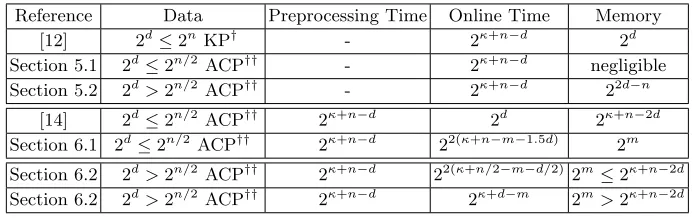
The new and previously published tradeoffs for FX-constructions are summa-rized in Table 2. We now compare these attacks at a high level, and then em-phasize their practicality for n=κ= 64, focusing on the concrete parameters for the attacks given in Table 1 that use preprocessing.7
Attacks without Preprocessing We first examine attacks with no prepro-cessing, for which an initial chosen plaintext attack was described in [18]. Then, a known plaintext attack with the same complexity was published in [5] for D = 2n/2, and later generalized in [12] to work with any number of known
plaintexts. All of these attacks require M = D memory and seem impractical for n = κ= 64, as they either require impractical data and memory (e.g. for D =M = 264), or impractical time (e.g., forD =M = 232 thenT = 296).
In-termediate values such asD=M = 248andT = 280may seems more practical,
but we note that the large memory of 248 has to be accessed a huge number of
280 times (essentially, for each cipher evaluation). While this can be somewhat
optimized by grouping together the memory lookups, these parameters still seem completely impractical.
6
The ratio between the key size and block size is typically small in modern block ciphers.
7
The new attacks we describe in Section 5 show that in the adaptively chosen plaintext model, we can mount attacks with the same data and time complexi-ties, and a reduced memory complexity. In particular, forD = 2n/2, our attack
requires negligible memory, while the attacks of [5, 12, 18] require 2n/2memory.
Forn=κ= 64 and D= 248, our attack requires only 22·d−n = 22·48−64= 232
words of memory, which is significantly better than the attack of [12]. In this case, the time complexity is 280, which can be considered as marginally
practi-cal, but is still a huge effort put into recovering a single key. Furthermore, as the data collection cannot be parallelized, obtaining 248 data is generally not
considered practical. Nevertheless, we still believe that the attack for D = 248
serves as an initial indication that the security margin of PRINCE and PRIDE is smaller than expected.
Attacks with Preprocessing We examine the attacks that require prepro-cessing assuming 2d
≤2n/2, for which the previously published attack was given
in [14]. This attack has a very efficient online time complexity of 2d, but re-quires 2κ+n−2d
≥2κwords of memory. Our attack trades-off this memory at the expense of increasing the time complexity, and obtainsT = 22(κ+n−m−1.5d).
For d > n/2, assuming 2m ≤ 2κ+n−2d, we can further reduce the pre-processing complexity and obtain a more efficient online time complexity of 22(κ+n/2−m−d/2). Concrete parameter sets for ciphers withn=κ= 64 are given
in Table 1.
The Practicality of Our Attacks As we show in sections 6.1 and 6.2, the online attacks summarized in Table 1 rarely access the memory, which can be stored on a hard disk. Moreover, the attacks can be easy parallelized, and al-though they are conceptually non-trivial, their circuit sizes are almost as small as the circuits of the attacked FX-constructions. Therefore, the attacks can be efficiently implemented on dedicated hardware.
As a consequence of the above, we estimate that the online phase of the attacks in Table 1 (which require at most 264 cipher evaluations and 251 bytes
of storage) can be realized today by a medium-size enterprize with a budget of several hundred thousand dollars. This rough estimation is based on the fact that up to about 264cipher evaluations can be performed in a few weeks on dedicated
hardware with such a budget [10]. Considering storage, a standard 1-terabyte hard disk costs about 100 US dollars (as of 2015). Therefore, 251bytes of storage
(or about 2,000 terabytes) cost roughly 200,000 dollars. Of course, fully realizing an attack requires additional expenses, but we do not expect them to increase the overall cost by a significant factor. On the other hand, using the same metric, we estimate the cost of 267 bytes of storage to be more than 10,000,000,000 US
Table 2.Time-Memory-Data Tradeoffs for FX-Constructions
Reference Data Preprocessing Time Online Time Memory [12] 2d≤2n KP† - 2κ+n−d 2d Section 5.1 2d≤2n/2 ACP††
- 2κ+n−d negligible Section 5.2 2d>2n/2 ACP††
- 2κ+n−d 22d−n
[14] 2d≤2n/2 ACP††
2κ+n−d 2d 2κ+n−2d Section 6.1 2d≤2n/2 ACP†† 2κ+n−d 22(κ+n−m−1.5d) 2m
Section 6.2 2d>2n/2 ACP††
2κ+n−d 22(κ+n/2−m−d/2) 2m≤2κ+n−2d Section 6.2 2d>2n/2 ACP†† 2κ+n−d 2κ+d−m 2m>2κ+n−2d
†
Known plaintexts ††
Adaptively chosen plaintexts
4
Background
The new attacks described in this paper combine several previously published techniques, which are described in this section.
4.1 Hellman’s Time-Memory Tradeoff [16] (with Preprocessing)
We summarize Hellman’s classical time-memory tradeoff attack [16] on ann-bit block cipher EK, assuming that κ = n. In the preprocessing phase, we fix a plaintext P, and define the function h({0,1}n)
→ {0,1}n as h(K) = EK(P). The goal in this phase is to cover most (more than half) of the key space with chains defined by iterating the functionh. For parametersM0andT0, we choose
M0 arbitrary starting points for the chains, where each chain is of length T0.
We store in a table only the (startpoint, endpoint) pair8of each chain and sort
the table according to the endpoint value. Such a table requires M0 words of
memory, and is referred to as aHellman table.
After evaluatingM0chains, and reaching the birthday bound (stopping rule)
ofT0·M0T0 =N, adding additional chains to the table is wasteful. Thus, we can
cover M0T0 =N/T0 points withM0 words of memory. In order to cover most
of the key space, we use flavors of h, where flavor i is defined (for example) as h[i](K) =h(K)+i. Thus, we useT0flavors ofh, and compute a Hellman table for
each flavor, covering a total of aboutN/T0·T0 =N= 2κkeys as required. The T0tables are the output of the preprocessing phase, and they requireM =M0T0 words of memory, and a total of ˆT =N computation time.
During the online phase, we request the encryption ofP under the unknown key K, EK(P). In order to recover K, we try to invert it using each of the Hellman tables by iteratively calculating h[i] starting form EK(P), and
search-ing if the current value is an endpoint in the table. Once we reach an end-point, we obtain its startend-point, and continue the evaluation, hoping to reach
8 We note that we can save a large fraction of the memory required for startpoint
(h[i])−1(Ek(P)+i) and to recoverK. This process has a time complexity of about
T0for each Hellman table. Thus, the total online time complexity isT =T02, and
asM =M0T0andM0T02=N, we obtain a time-memory tradeoff ofT M2=N2,
orT = 22(κ−m).
Reducing memory lookups using distinguished points. A simple variant of Hell-man’s algorithm (attributed to Ron Rivest, and later analyzed in [8, 22]), stops each chain once it reaches a set ofdistinguished points, which are defined accord-ing to an easily verifiable condition onh[i](K). For example, in case we require
chains of length T0, we define the set of distinguished points to contain the
points whose log(T0) LSBs are zero. With this variant, the length of the chains
is variable and is only defined on average, but this does not result in a significant penalty on the theoretical time complexity of the attack. On the other hand, the distinguished points method has a big advantage in practice, as we only need to access a large Hellman table once for (about) everyT0 evaluations of h[i] in
the online phase of the attack. The small number of memory lookups allows the attacker to store the memory on hard disk, which is much cheaper than RAM.
Parallelization. Since each of the T0 Hellman tables can be searched
indepen-dently, the computation can be divided across (at most)T0CPUs, each requiring
access to a Hellman table of sizeM0. Furthermore, each CPU is expected to
ac-cess the memory only once during the computation ofT0 time (in order to find a
startpoint that corresponds to an endpoint). Consequently, time-memory trade-off algorithms can be implemented relatively cheaply on dedicated hardware [19, 22].
For example, in case where κ = 64 and we haveM = 248 available words
of memory, then the online algorithm requires T = 22(64−48) = 232 time. This
computation can be divided acrossT0 =N/M = 216processors, each performing
216operations, and requiring (a single) access toM0=M/T0= 232memory (i.e.,
32 gigabytes).
4.2 Parallel Collision Search [24]
The parallel collision search algorithm was published by van Oorschot and Wiener [24], reducing the memory required for finding collisions in ann-bit functionF (com-pared to trivial algorithms). Given M = 2m words of memory, the algorithm builds a chain structure which is similar to a Hellman table. The chain structure contains 2m chains, where each chain starts at an arbitrary point and is termi-nated at a distinguished point (stored in memory) such that its average length isT0 = 2(n−m)/2(i.e., the distinguished point set is of sizeN/T0). As in the case of a Hellman table, since T0
·T0M =N, then every chain is expected to collide
with about one other chain in the structure. Thus, the structure contains about M0 collisions which can be recovered efficiently as shown in [24]. However, as our
4.3 Basic Time-Memory-Data Tradeoff Attacks on the FX-Construction [18] (without Preprocessing)
We describe the basic and well-known chosen plaintext attack of the FX-construction [18], which is based on the attack of Daemen on the Even-Manour scheme [11]. We
also mention the known plaintext attack with the same complexity on the scheme (see [12]), but we do not describe it here, as it is less relevant for this paper. On the other hand, the ideas and notation introduced in this simple attack will be repeatedly used throughout the rest of this paper.
The attack on the FX-construction is based on encrypting plaintexts Pi, and independently evaluating the core function FK with values of K and Xj, while looking for an (i, j) pair such thatPi⊕K1=Xj. In order to detect such a
collision efficiently, we cancel the effect of the masking keys by defining functions φ1(Pi) andφ2(K, Xj) such thatPi⊕K1=Xj implies thatφ1(Pi) =φ2(K, Xj).
These functions enable us to efficiently filter the (i, j) candidates.
For a general FX-construction, we pre-fix an arbitrary value ∆ 6= 0, set P0
i ,Pi⊕∆andXj0 ,Xj⊕∆, and define:
φF X1 (Pi),Ci⊕Ci0=F XK,K1,K2(Pi)⊕F XK,K1,K2(Pi⊕∆)
φF X2 (K, Xj),Yj⊕Yj0=FK(Xj)⊕FK(Xj⊕∆).
Thus,Pi⊕K1=Xj implies thatφF X1 (Pi) =F XK,K1,K2(Pi)⊕F XK,K1,K2(Pi⊕ ∆) =K2⊕FK(K1⊕Pi)⊕K2⊕FK(K1⊕Pi⊕∆) =FK(Xj)⊕FK(Xj⊕∆) = φF X
2 (K, Xj) as required. Note that each collision gives candidates for the full key (K, K1 = Pi⊕Xj, K2 = Ci⊕Yj), which can be easily tested using trial encryptions.
For an SFX-construction in which K2 = A(K1) (such as PRINCE and
PRIDE), the functions φ1(Pi) and φ2(K, Xj) can be simplified to use single pairs of (Pi, Ci) and (Xj, Yj), respectively. Formally, we define:
φSF X1 (Pi),A(Pi)⊕Ci=A(Pi)⊕F XK,K1,K2(Pi) φSF X2 (K, Xj),A(Xj)⊕Yj=A(Xj)⊕FK(Xj).
Thus, Pi ⊕K1 = Xj implies that φSF X1 (Pi) = A(Pi) ⊕F XK,K1,K2(Pi) = A(Pi)⊕K2⊕FK(K1⊕Pi) =A(Pi⊕K1)⊕FK(K1⊕Pi) =A(Xj)⊕FK(Xj) = φSF X
2 (K, Xj) as required.
The details of the attack are given in Appendix A. It has a memory com-plexity of D and an expected time complexity of max(2D,2κ+n−d+1) on
FX-constructions. For SFX-constructions, the data and time complexities of the attack are reduced by a factor of 2.
4.4 Time-Memory-Data Tradeoff attacks on Even-Mansour [14] (with Preprocessing)
the attack is to request plaintexts Pi, and evaluate the permutation F with valuesXj such that a collisionPi⊕K1=Xjcan be efficiently detected. In order to do so, we request the data Pi and evaluate values Xj in the form of chains, as in the parallel collision search algorithm [24].
Although we cannot immediately detect thatPi⊕K1=Xj, the main obser-vation of Fouque et al. is that we can independently add toPi andXj the same value φ1(Pi) = φ2(Xj) (for the functions φ1, φ2 defined above for the FX and
SFX constructions, where the key of the core cipher K is simply be ignored), which guarantees that in casePi⊕K1 =Xj, thenPi+1⊕K1=Xj+1.9 Hence,
the functions we iterate are defined as
Pi+1,Φ1(Pi),Pi⊕φ1(Pi)
Xj+1,Φ2(Xj),Xj⊕φ2(−, Xj).
Note thatΦ1 andΦ2 are generally non-bijective mappings (rather than
permu-tations), and their behaviour (and in particular, the analysis of their collision probability) can be modeled using random functions, assuming that the under-lying cipher does not behave unexpectedly.10
The downside of the approach of iterating the defined functions is that the attack becomes an adaptively-chosen plaintext attack, as Pi+1 = Pi⊕φ1(Pi)
depends on Ci and cannot be computed in advance (both for general FX-constructions and SFX-FX-constructions).
The attack works by evaluating chains during the preprocessing phase, where each chain is iterated usingΦ2 and terminated at a distinguished point that is
stored in memory. During the online phase, we evaluate a chain iterated using Φ1 and terminated at a distinguished point. The online distinguished point is
matched with the ones stored in memory, where a match allows to recover the key.
The full details of the attack are described in Appendix B. The time and data complexities of the online phase of the attack are both aboutT =D = 2d for SFX-constructions and 2d+1 for FX-constructions. Its memory
complex-ity is M = 2n−2d, and it requires preprocessing time of ˆT = 2n−d for SFX-constructions and 2N/D= 2n−d+1 for FX-constructions.
4.5 Time-Memory-Data Tradeoff attacks on the FX-Construction [14] (with Preprocessing)
As described in [14], we can easily generalize the previous attack on Even-Mansour to FX-constructions in which the internal permutation is keyed. We
9
The paper of [14] refers to this situation as the chains becoming parallel.
10An exception is the specific case of SFX-constructions where the masking keys are
equal (the affine mappingAis the identity), and henceΦ1andΦ2defined with the
correspondingφSF X
1 andφSF X2 are permutations. Thus, in this particular case, we
useΦ1andΦ2 defined with the more generalφF X1 andφF X2 , resulting in slightly less
simply iterate over the 2κ keys of the internal permutation, and preprocess each one separately by computing and storing its distinguished points. In to-tal, we have M = 2κ
·2n−2d = 2κ+n−2d, while the preprocessing time is about ˆ
T = 2κ+n−d for SFX-constructions and ˆT = 2κ+n−d+1 for FX-constructions.
The online phase of the attack is essentially the same as in the previous attack, i.e.,T =D= 2d for SFX-constructions and 2d+1 for FX-constructions.
5
New Time-Memory-Data Tradeoff Attacks on the
FX-Construction without Preprocessing
In this section, we describe our new time-memory-data tradeoff attacks on the FX-construction, without using a preprocessing phase. The attacks are described in the most general form, i.e., they are applicable to general FX-constructions (exploiting the general definitions of φ1, φ2, given in Section 4.3). However, as
this paper focuses on the concrete SFX-constructions PRINCE and PRIDE, we directly analyze only the variants of the attacks which are optimized for SFX-constructions (i.e., assuming φ1 = φSF X1 , φ2 = φSF X2 ). In order to calculate
the complexity parameters for general FX-constructions, we simply multiply the data and time complexities of the attack by a factor of 2, as in the attacks of sections 4.3, 4.4 and 4.5.
5.1 The Case of D≤ 2n/2
The attack for the case of D ≤ 2n/2 can be considered as a straightforward
extension of the attack of [14] on the FX-construction (described in Section 4.5). However, [14] focused on attacks with preprocessing on the FX-Construction, and attacks without preprocessing were not described.
We extend the iteration functionΦ2(defined in the Even-Mansour attack of
the FX-construction in Section 4.4) by adding the key of the core cipher as a parameter. The iteration functions are now defined11 as
Pi+1,Φ1(Pi),Pi⊕φ1(Pi)
Xj+1,Φ2(K, Xj),Xj⊕φ2(K, Xj).
The attack is described below:
1. Build a chain of plaintexts, starting from an arbitrary plaintext, ex-tended using the iteration functionPi+1=Φ1(Pi), and terminated at a
distinguished point ˆP for which the log(D) LSBs ofφ1( ˆP) are 0 (as in
the attack of Appendix B). Store the endpoint ˆP, and its valueφ1( ˆP).
2. For each possible value ofK:
11
(a) For N/D2 different starting pointsX 0:
i. Build a chain starting from X0, defined according to Xj+1 =
Φ2(K, Xj), and terminated at a distinguished point ˆX for which
the log(D) LSBs ofφ2(K,Xˆ) are 0. Ifφ2(K,Xˆ) =φ1( ˆP), test the
full keyK, K1, K2derived from ˆPand ˆXusing a trial encryption.
For the correct value ofKin Step 2, we expect a collision between a node in the online chain (of average lengthD) and the (expected number of)N/Dnodes evaluated offline. As this collision causes the corresponding chains to merge, it will be detected at the next distinguished point, allowing to recover the key.
The expected data complexity of the attack isD= 2d, while its memory com-plexity is negligible. The total number of distinguished points that we compute in Step 2 is about 2κ+n−2d, requiring about 2κ+n−2d+d= 2κ+n−d computation time. For each such distinguished point, we do not perform more than one trial encryption, and therefore the expected total time complexity of the attack is 2κ+n−d.
Consequently, we obtain about the same data and time complexities as the attack described in Section 4.3, but (almost) completely nullify the memory complexity in the adaptively chosen plaintext model.
5.2 The Case of D >2n/2
The attack for D ≤ 2n/2 has to be adapted for the case of D >2n/2, as the
online chain (built in Step 1 of the previous attack) is expected to cycle (i.e., collide with itself) after about 2n/2evaluations, and thus cannot cover more than
2n/2 nodes. Therefore, we build the structure of chains online, while evaluating
offline only one chain per key.
We note that while this attack can also be viewed as an extension of the attacks of [14], it is less straightforward, as all the attacks of [14] useD≤2n/2.
The reason is that the attacks of [14] are based on the basic Even-Mansour attack (described in Section 4.4), for which κ= 0 and there is no gain in using D > 2n/2 (as this increases the total time complexity of the attack). On the
other hand, we observe that for FX-constructions, we can indeed benefit from D >2n/2.
1. ForD2/N different starting pointsP 0:
(a) Build a chain of plaintexts, starting from P0, extended using the
formula Pi+1 =Φ1(Pi), and terminated at a distinguished point ˆP
for which the log(N/D) LSBs ofφ1( ˆP) are 0. Store the endpoint ˆP
in a listL, sorted according toφ1( ˆP).
2. For each possible value ofK:
(a) Build a chain starting from an arbitrary valueX0, defined according
which the log(N/D) LSBs of φ2(K,Xˆ) are 0. Search for φ2(K,Xˆ)
in the listLand for each match with someφ1( ˆP), recover ˆP, obtain
a suggestion for the full key K, K1, K2 and test it using a trial
encryption.
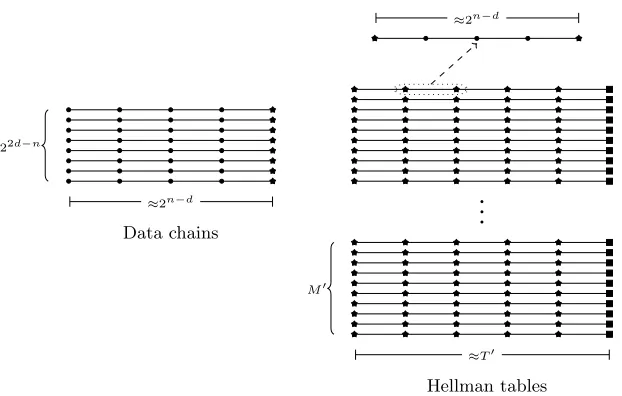
The chain structure of plaintexts coversD2/N
·N/D=Dnodes on average, and it is expected to collide with the chain of values (of expected lengthN/D) for the correct K, allowing to recover it. The data complexity of the attack is D= 2d, while its memory complexity isM =D2/N= 22d−n.
Computing the distinguished points online and offline requiresmax(2d,2κ+n−d) = 2κ+n−d time (assumingκ≥n). Two arbitrary distinguished points match with probability 2(n−d)−n = 2−d (as the n−d LSBs of distinguished points always match). We store a total of 22d−ndistinguished points inL, and evaluate a total of 2κ distinguished points in Step 2. Thus, the expected number of matches (re-sulting in trial encryptions) is 2(κ+2d−n)−d= 2κ−n+d
≤2κ+n−d (asd
≤n), and the expected total time complexity is 2κ+n−d, dominated by the computation of the distinguished points in Step 2.
Consequently, we obtain (about) the same time complexity as the basic attack of Section 4.3, but gain a factor of 2d/(22d−n) = 2n−din memory.
6
New Time-Memory-Data Tradeoff Attacks on the
FX-Construction with Preprocessing
In this section, we describe our new time-memory-data tradeoff attacks on the FX-construction, taking advantage of a preprocessing phase. As in Section 5, we directly analyze only the attack variants which are optimized for SFX-constructions (although the attacks are described in the most general form). For general FX-constructions, we simply multiply the data and time complexities of the attacks by a factor of 2.
6.1 The Case of D≤ 2n/2
It is possible to apply standard time-memory-data tradeoffs for stream ciphers [3, 4] to the FX-construction in the chosen plaintext model (and to some extent, also in the known plaintext model). However, the most interesting tradeoffs are obtained in the adaptively chosen plaintext model, in which we combine the attacks of the previous section with techniques borrowed from stream cipher cryptanalysis.
The idea of using Hellman’s time-memory tradeoff algorithm to cover special points was first published in cryptanalysis of a certain type of stream ciphers,12
and we now show how to adapt it to the FX-construction. In order to cover the pairs of (K,distinguished point), we define a mapping between the 2κ+n−2d pairs, denoted byh2(K,Xˆ). One problem that we need to overcome is that ˆX is
ann-bit word, and does not contain the sufficientκ+n−2d≥nbits13 in order
to define this mapping. Furthermore, the mapping cannot directly depend onK, as in the online phase we search the Hellman tables without knowledge of the online key. Thus, in order to collect more data, we simply continue evaluating the chain by applyingΦ2 to (K,Xˆ) sufficiently many times, until we collect the
κ+n−2d bits required in order to define the Hellman value of (K,Xˆ). This value will be used in order to determine the next (K,distinguished point) pair, i.e., the output of h2(K,Xˆ). The algorithm of the Hellman mapping h2(K,Xˆ)
is given below, assuming that κ=nfor the sake of simplicity. We note that in cases whereκ > n, we simply applyΦ2more times in order to collect more data
(the case ofκ < n can be handled by truncation).
1. Compute the 2n-bit Hellman value of (K,Xˆ) by first computing the next 2 points in the chain X0 = Φ
2(K,Xˆ) and X00 =Φ2(K, X0). The
Hellman value of (K,Xˆ) is defined as (φ2(K, X0), φ2(K, X00)).
2. Interpret the Hellman value as (Z, Knext) = (φ
2(K, X0), φ2(K, X00))
(note that bothZandKnextaren-bit words). Compute a chain of (aver-age) lengthD= 2d, using the iteration functionΦ
2(Knext, X), starting
from X = Z, and terminating at a distinguished point (Knext,Zˆnext) (i.e., the log(D) LSBs ofφ2(Knext,Zˆnext) are zero). Outputh2(K,Xˆ) =
(Knext,Zˆnext).
Once the mappingh2(K,Xˆ) is well-defined, we can use Hellman’s
preprocess-ing algorithm to cover a space of 2κ+n−2dpoints (pairs) (K,Xˆ). As the average time complexity of one application of h2(K,Xˆ) isD, the total time complexity
of the preprocessing phase is ˆT =D·2κ+n/D2= 2κ+n−d. Sinceh2is defined on
(at most) 2nbits, we can storeM/2 chains withM words of memory. However, in case D≈2n/2 andκ
≤n, we essentially need to cover a space of at most 2n (we cover one distinguished point per key on average), and thus we can store a larger number ofM chains withM words of memory.
We now point out a few technical issues about the preprocessing algorithm: since we are using Hellman’s algorithm to cover 2κ+n−2d points, the (average) length of the Hellman chains is 2κ+n−2d−m (determined according to the avail-able memoryM = 2m). In order to terminate a Hellman chain (computed using h2 on the space of κ+n−2d bits), we need to define a subset of “Hellman 12
Refer to tradeoffs for stream ciphers with low sampling resistance [3, 4].
13
distinguished points”, containing pairs of (K,Xˆ). Such a subset (which deter-mines when to terminate an iteration chain ofh2) can be defined (for example)
according to the LSBs of the Hellman value (φ2(K, X0), φ2(K, X00)), computed
in Step 1 of the algorithm above. The “Hellman distinguished points” should be contrasted with the distinguished points defined for the iteration on the n-bit space with a fixed key using Φ2 (such distinguished points are defined
accord-ing to the LSBs of φ2(K,Xˆ)). In order to avoid confusion, we refer to chains
and distinguished points computed using h2 as Hellman chains and Hellman
distinguished points, whereas the ones computed using Φ1 and Φ2 are simply
referred to as (standard) chains and distinguished points.14An additional
tech-nical issue is that in order to cover the full space of 2κ+n−2d points, we need to define flavors ofh2(namely,h[2i]), and this can be done (for example) by defining
h[2i] =h2(K,Xˆ) + (i, i).
The online algorithm is given below.
1. Compute a chain of (approximately)Dpoints using the iteration func-tionφ1, starting from an arbitrary plaintext, and terminating at a
dis-tinguished point ˆP, where the log(D) LSBs ofφ1( ˆP) are 0.
2. Given ˆP, compute the corresponding Hellman value (φ1(P0), φ1(P00))
similarly to the preprocessing phase, by computing the next 2 points in the chainP0 =Φ
1( ˆP) andP00=Φ1(P0).
3. Invert (K0, X0) = (φ
1(P0), φ1(P00)) using the Hellman tables, obtain a
suggestion for the full key (K, K1, K2) and test it.
The data complexity of the attack is D, and according to Hellman’s time-memory tradeoff curve, its average time complexity is T0 = (N0/M0)2
evalua-tions of h2, where N0 = 2κ+n−2d is the size of the covered space and M0 =
M/2 = 2m−1 is the number of Hellman chains stored in memory. Thus T0 =
(2κ+n−2d/2m−1)2 = 22(κ+n−m−2d+1), and since each evaluation of h2 requires
D = 2d time, thenT = 22(κ+n−m−1.5d+1). When D
≈2n/2 and κ
≤n, we can use theM memory words more efficiently and obtain a (slightly) improved time complexity ofT = 22(κ+n−m−1.5d).
The Difference Between Tradeoffs for FX-Constructions and Stream Ciphers As can be seen from the tradeoff above for FX-constructions, the effective key size is reduced by a factor of 21.5d when obtaining 2d data. On the other hand, for stream ciphers, the effective hidden state size is only reduced by a factor of 2d. The reason for this is that in the case of stream ciphers,
14
the state update function is typically a permutation.15 On the other hand, the
corresponding function in the case of FX-constructions is Φ1, which is a
non-bijective function rather than a permutation. Iterating Φ1 a large number of
times results in entropy loss due to collisions in its functional graph. This reduces the number of points that we need to search in the Hellman tables to recover the key, and improves the complexity of the online attack compared to the case of stream ciphers.
Implementation for n=κ = 64 In the case of PRINCE and PRIDE, then n=κ= 64. We assume that we have 2m= 248words of memory (251bytes) and
we can obtain 2d = 232 adaptively chosen plaintexts. In total, the online time
complexity of the algorithm is 22(64+64−48−48) = 264, corresponding to Attack
1 in Table 1. Similarly to the example given at the end of Section 4.1, as the Hellman chains cover a space of size 2κ = 264 points, the 264 computation can
be divided across 216 CPUs, each requiring (a single) access to a memory of 232
words (and it can thus be stored on a hard disk). Each CPU invokesh2about 216
times, where each invocation requires 232 cipher evaluations. Thus, each CPU
performs about 248cipher evaluations in total.
6.2 The Case of D >2n/2
As in the case considered in Section 5.2, we need to adapt the previous attack to efficiently exploitD >2n/2data. Similarly to the case ofD
≤2n/2, the
tech-niques we use forD >2n/2are related to those of [3, 4]. However, as we describe
next, the method in which we request the data and optimize the parameters in this setting are different from the stream cipher setting (where the method in which the keystream is obtained does not seem to influence the complexity of the attack).
We consider two different adaptation methods to the previous attack ofD≤ 2n/2. In the first method, we obtain the data using chains of (maximal) length
2n/2. In order to ensure that these chains do not merge, we define flavors of
Φ1 and Φ2 (which should be contrasted with the Hellman flavors of h2). Thus,
we define 2d−n/2 flavors, and build Hellman tables for each one. During the
online phase, we obtain one distinguished point per flavor and search it in the corresponding Hellman tables. One can observe that in terms of the time-memory tradeoff, the flavors ofΦ1 and Φ2 play a similar role to the flavors of h2 in the
attack with d=n/2. Consequently, we obtain the same time-memory tradeoff as for d=n/2, i.e., T = 22(κ+n/4−m).16 On the other hand, the preprocessing
complexity is reduced to ˆT = 2κ+n−d.
An Improved Tradeoff The attack above is a direct extension of the tradeoff obtained forD = 2n/2, which covered offline, 2κ distinguished points usingh
2. 15For example, many stream ciphers are built using feedback shift registers, and it is
possible to run them backwards in a deterministic way.
16
We now show how to obtain an improved attack, using a simple and yet subtle and non-trivial observation. We notice that for D >2n/2, we can use chains of
lengthN/D <2n/2. These chains are shorter than the ones used for D = 2n/2
data, and are of the same length as in the attack with only 2d0
= 2n−ddata. At first, it may not be clear why using shorter chains results in a better attack. As we show next, the reason for this is that we can use the memory more efficiently than in the case of longer chains.
We first compare our case of 2d > 2n/2 data and the case of 2d0
= 2n−d data, which use the same chain length. The difference is that in the case of 2d0
= 2n−d data, we obtained only one distinguished point online, whereas now we have 2d−(n−d)= 22d−n such distinguished points, and we need to cover only one of them offline in order to succeed. Thus, in the attack with 2d0 = 2n−d data, we had to cover offline, the large space of 2κ+n−2d0 distinguished points using Hellman tables, whereas now we need to cover only 2κ+n−2d0−(2d−n) =
2κ+n−2(n−d)−(2d−n)= 2κ distinguished points. Namely, we need to cover about one distinguished point for every keyKof the core cipher, as in the attack above. However, the crucial observation is that the space of distinguished points is of the same size as in the attack with 2d0
= 2n−d data. This space is larger than the space for D = 2n/2, implying that we can build larger Hellman tables and
use the memory more efficiently compared to the (non optimal) attack above (which is a direct extension of the case ofD= 2n/2).
A simple way to compute the improved tradeoff is to start with the formula T = 22(κ+n0−m−1.5d0)
, calculated for the attack withd0
≤n/2. Then, we plug in d0 =n
−d andn0 =n
−(2d−n), as the space size that we cover by Hellman tables is reduced by a factor of 22d−n(which is the number of distinguished points obtained online). In other words, the tradeoff T = 2κ+n−(2d−n)−m−1.5(n−d) =
22(κ+n/2−m−d/2) is obtained by reducing the number of Hellman tables (by a
factor of 22d−n) compared to the attack that used d0 = n−d. However, the
attack cannot use less than 1 Hellman table, and it is therefore necessary to derive an expression for this variable, which restricts the tradeoff. Interestingly, the simplest method that we found to compute the number of Hellman tables is to redo the low-level computation, which also gives a better understanding of the full attack.
For parametersT0 andM0, we build a Hellman table of distinguished points
(using the functionh2) with the stopping rule of
T0·T0M0= 2κ+n−2d0 = 2κ−n+2d (1) (after which the Hellman chains start colliding extensively).17We need to cover
about 2κ distinguished points withH Hellman tables, namely
HT0M0 = 2κ. (2)
Since each evaluation ofh2requires 2n−dtime, the preprocessing time
complex-ity is ˆT = 2κ+n−d (as in the non-optimized attack above). The total memory
17
Data chains ≈2n−d 22d−n
≈2n−d
≈T0 M0
Hellman tables
Fig. 2.Time-Memory-Data Tradeoff with Preprocessing forD >2n/2
complexity of the attack is
M =HM0 (3)
and the total online time complexity is calculated as follows: searching a single Hellman table requiresT0 evaluations of h
2, i.e., a total ofT0·2n−d time. For
each of the 22d−n distinguished points, we need to search theH Hellman tables, and thus the total online time complexity is
T=T0·2n−d·H·22d−n =T0H·2d. (4) We calculate the tradeoff according to (3) and (4) by evaluatingT ·M2 =
T0H·2d·(HM0)2= 2d·H3·T0·(M0)2. From (2), we getT·M2= 2κ+d·H2·M0.
Furthermore, from (1) and (2), we obtain
H2·M0= 22κ−(κ−n+2d)= 2κ+n−2d. (5) Thus,T·M2= 2κ+d+κ+n−2d = 22κ+n−d, i.e., we obtain the tradeoff
T = 22(κ+n/2−m−d/2)
(which was obtained above in a different way). This tradeoff efficiently exploits more than 2n/2 data, unlike the previous tradeoffT = 22(κ+n/4−m).
As noted above, a condition that we have to impose on this tradeoff is that the number of Hellman tables is at least 1, i.e.,H ≥1. In order to calculateH, we use (3) and (5), obtaining H= 2κ+n−2d−m. SinceH
≥1, the tradeoff above is valid only form≤κ+n−2d.
When we want to utilize 2mmemory form > κ+n
the stopping rule (T0)2
·M0<2κ−n+2d(1). Namely, we haveM0 =M = 2mand T0M0 = 2κ, implying that T0 = 2κ−m, and using (4), T = T0
·2d = 2κ+d−m. Note that (T0)2
·M0 = 22(κ−m)
·2m = 22κ−m < 22κ−(κ+n−2d) = 2κ−n+2d, so indeed we do not violate the stopping rule (1).
Finally, we observe that a similar restriction onmalso applies to the previous tradeoffT = 22(κ+n/4−m)ford > n/2, and it is possible to show that the tradeoff
obtained here is always at least as efficient as the previous one.
Implementation for n = κ= 64 We assume that we have 2m= 248 words
of memory and we can obtain 2d = 240 adaptively chosen plaintexts. In
to-tal, the online time complexity of the algorithm is T = 22(κ+n/2−m−d/2) =
22(64+32−48−20)= 256, corresponding to Attack 2 in Table 1. In this case H =
2κ+n−2d−m= 1, i.e., we have a single Hellman table. As we search the table with 22d−n = 216 distinguished points, the 256 computations can be divided across
(up to) 216 CPUs, each performing 256−16 = 240 computations, and accessing
the memory only once (and it can therefore be stored on a hard disk).
7
Conclusions
In this paper, we proposed new generic time-memory-data tradeoffs for FX-constructions, and optimized them for the recent proposals PRINCE and PRIDE. Some of our attacks are surprisingly efficient, and despite their limitations, we believe that they demonstrate the small security margin of PRINCE and PRIDE against practical attacks. In Appendix C, we show that PRINCE and PRIDE could counter these generic attacks with little overhead by incorporating the masking keys into the key schedule of the core ciphers. This suggests that the DESX solution proposed by Ron Rivest in 1984 (in order to provide better se-curity for the widely-deployed DES) may be less suitable for new ciphers.
Acknowledgements:The author would like to thank Orr Dunkelman and Adi Shamir for helpful discussions on this work.
References
1. Martin R. Albrecht, Benedikt Driessen, Elif Bilge Kavun, Gregor Leander, Christof Paar, and Tolga Yal¸cin. Block Ciphers - Focus on the Linear Layer (feat. PRIDE). In Juan A. Garay and Rosario Gennaro, editors, Advances in Cryp-tology - CRYPTO 2014 - 34th Annual CrypCryp-tology Conference, Santa Barbara, CA, USA, August 17-21, 2014, Proceedings, Part I, volume 8616 ofLecture Notes in Computer Science, pages 57–76. Springer, 2014.
2. Elad Barkan, Eli Biham, and Adi Shamir. Rigorous Bounds on Cryptanalytic Time/Memory Tradeoffs. In Cynthia Dwork, editor, CRYPTO, volume 4117 of
Lecture Notes in Computer Science, pages 1–21. Springer, 2006.
4. Alex Biryukov, Adi Shamir, and David Wagner. Real Time Cryptanalysis of A5/1 on a PC. In Bruce Schneier, editor,FSE, volume 1978 ofLecture Notes in Computer Science, pages 1–18. Springer, 2000.
5. Alex Biryukov and David Wagner. Advanced Slide Attacks. In Bart Preneel, editor,EUROCRYPT, volume 1807 ofLecture Notes in Computer Science, pages 589–606. Springer, 2000.
6. Bitcoin network graphs. http://bitcoin.sipa.be/.
7. Julia Borghoff, Anne Canteaut, Tim G¨uneysu, Elif Bilge Kavun, Miroslav Kneze-vic, Lars R. Knudsen, Gregor Leander, Ventzislav Nikov, Christof Paar, Christian Rechberger, Peter Rombouts, Søren S. Thomsen, and Tolga Yal¸cin. PRINCE -A Low-Latency Block Cipher for Pervasive Computing -Applications - Extended Abstract. In Xiaoyun Wang and Kazue Sako, editors,ASIACRYPT, volume 7658 ofLecture Notes in Computer Science, pages 208–225. Springer, 2012.
8. Johan Borst, Bart Preneel, and Joos Vandewalle. On the Time-Memory Tradeoff Between Exhaustive Key Search and Table Precomputation. InProceedings of 19th Symposium in Information Theory in the Benelux, WIC, pages 111–118, 1998. 9. Anne Canteaut, Thomas Fuhr, Henri Gilbert, Mar´ıa Naya-Plasencia, and
Jean-Ren´e Reinhard. Multiple Differential Cryptanalysis of Round-Reduced PRINCE (Full version). IACR Cryptology ePrint Archive, 2014:89, 2014. Presented at 2014. To appear in Lecture Notes in Computer Science.
10. COPACOBANA faqs. http://www.copacobana.org/faq.html.
11. Joan Daemen. Limitations of the Even-Mansour Construction. In Imai et al. [17], pages 495–498.
12. Orr Dunkelman, Nathan Keller, and Adi Shamir. Minimalism in Cryptography: The Even-Mansour Scheme Revisited. In David Pointcheval and Thomas Johans-son, editors,EUROCRYPT, volume 7237 ofLecture Notes in Computer Science, pages 336–354. Springer, 2012.
13. Shimon Even and Yishay Mansour. A Construction of a Cioher From a Single Pseudorandom Permutation. In Imai et al. [17], pages 210–224.
14. Pierre-Alain Fouque, Antoine Joux, and Chrysanthi Mavromati. Multi-user Colli-sions: Applications to Discrete Logarithm, Even-Mansour and PRINCE. In Palash Sarkar and Tetsu Iwata, editors, Advances in Cryptology ASIACRYPT 2014 -20th International Conference on the Theory and Application of Cryptology and Information Security, Kaoshiung, Taiwan, R.O.C., December 7-11, 2014. Proceed-ings, Part I, volume 8873 ofLecture Notes in Computer Science, pages 420–438. Springer, 2014.
15. Tim G¨uneysu, Timo Kasper, Martin Novotn´y, Christof Paar, and Andy Rupp. Cryptanalysis with COPACOBANA. IEEE Trans. Computers, 57(11):1498–1513, 2008.
16. Martin E. Hellman. A cryptanalytic time-memory trade-off. IEEE Transactions on Information Theory, 26(4):401–406, 1980.
17. Hideki Imai, Ronald L. Rivest, and Tsutomu Matsumoto, editors. Advances in Cryptology - ASIACRYPT ’91, International Conference on the Theory and Ap-plications of Cryptology, Fujiyoshida, Japan, November 11-14, 1991, Proceedings, volume 739 ofLecture Notes in Computer Science. Springer, 1993.
18. Joe Kilian and Phillip Rogaway. How to Protect DES Against Exhaustive Key Search. In Neal Koblitz, editor,CRYPTO, volume 1109 ofLecture Notes in Com-puter Science, pages 252–267. Springer, 1996.
Jo˜ao M. P. Cardoso, and Stamatis Vassiliadis, editors,ARC, volume 3985 ofLecture Notes in Computer Science, pages 323–334. Springer, 2006.
20. National Institute of Standards and Technology. Recommendation for Key Man-agement – Part 1: General (revision 3). NIST Special Publication 800–57, 2012. 21. Ronald L. Rivest. DESX, 1984. Never Published.
22. Fran¸cois-Xavier Standaert, Ga¨el Rouvroy, Jacques Quisquater, and Jean-Didier Legat. A Time-Memory Tradeoff Using Distinguished Points: New Analysis & FPGA Results. In Burton S. Kaliski Jr., C¸ etin Kaya Ko¸c, and Christof Paar, editors,CHES, volume 2523 ofLecture Notes in Computer Science, pages 593–609. Springer, 2002.
23. The PRINCE Team. The PRINCE Challenge, 2014.https://www.emsec.rub.de/ research/research_startseite/prince-challenge/.
24. Paul C. van Oorschot and Michael J. Wiener. Parallel Collision Search with Crypt-analytic Applications. J. Cryptology, 12(1):1–28, 1999.
25. Jingyuan Zhao, Xiaoyun Wang, Meiqin Wang, and Xiaoyang Dong. Differential Analysis on Block Cipher PRIDE. Cryptology ePrint Archive, Report 2014/525, 2014. http://eprint.iacr.org/.
A
Details of the Basic Time-Memory-Data Tradeoff
Attack on the FX-Construction [18] (without
Preprocessing)
We give the details of the basic attack using the general functions φ1(Pi) and
φ2(K, Xj), defined in Section 4.3.
1. Obtain the encryptions ofDarbitrary valuesPi, denoted byCi. For gen-eral FX-constructions, also obtain theDadditional encryptions required to calculateφF X
1 (Pi), by asking for the encryptions ofPi0 =Pi⊕∆. Store (Pi, Ci) in a listL, sorted according toφ1(Pi).
2. For each possible value ofK: (a) For N/Ddifferent values ofXj:
i. Computeφ2(K, Xj) by computingYj =FK(Xj) (for a general FX-construction, also compute FK(Xj⊕∆)).
ii. Searchφ2(K, Xj) inL. For each match, retrieve (Pi, Ci), and test each of the key candidate triplet (K, K1=Pi⊕Xj, K2=Ci⊕Yj) using trial encryptions. If a trial encryption succeeds, return the corresponding full key (otherwise return to Step 2.(a)).
According the the birthday paradox, for the correct value ofKin Step 2, we expect a pair (i, j) such that Pi⊕K1 =Xj. Therefore, we expect to obtain a match inLin Step 2.(a).ii betweenφ1(Pi) andφ2(K, Xj) and recover the correct
K, K1, K2.
order to store L. In order to compute the time complexity, we note that for an arbitrary value of the nbits of φ2(K, Xj), we expect at most one match in
L (which contains at most 2n elements). Thus, the expected time complexity of Step 2.(a) is about 2, implying that the expected time complexity of the full attack is max(2D,2κ+n−d+1) (i.e., we can efficiently exploit D
≤2(κ+n)/2
data). For SFX-constructions, the data and time complexities of the attack are reduced by a factor of 2 (note that in this case, the attack requires only known plaintexts).
B
Details of the Time-Memory-Data Tradeoff Attack on
Even-Mansour [14] (with Preprocessing)
We assume that we can obtain the encryptions of about D ≤2n/2
adaptively-chosen plaintexts during the online phase. During the preprocessing phase, we use the preprocessing iteration functionΦ2(X) (defined in Section 4.4) in order
to build a structure containing N/D2 chains. Each chain is evaluated from an
arbitrary starting point, and terminated at a distinguished point ˆX for which the log(D) LSBs of φ2( ˆX) are zero. Thus, the average chain length is D,
im-plying that the time complexity of preprocessing is ˆT = N/D = 2n−d for SFX-constructions and 2N/D = 2n−d+1 for FX-constructions. For each chain
in the structure, we store in memory only the endpoint18 Xˆ, and sort the chains according to their values φ2( ˆX). Thus, the memory complexity is about
M =N/D2= 2n−2d.
During the online phase, we evaluate a single chain of (expected) lengthD, starting for an arbitrary plaintext. The chain is defined according to the online iteration functionΦ1(P), and is terminated at a distinguished point ˆP for which
the log(D) LSBs of φ1( ˆP) are zero. Once a distinguished point is reached, we
search for it in the structure, and for each match, we obtain and test the key suggestions forK1, K2. Note that unlike Hellman’s original attack, we directly
recover the key from the distinguished points stored in the structure, without the need to further traverse the chains (and thus we do not need to store any information about their startpoints).
As the offline structure covers about 2n−d values ofX
j and the online chain contains 2d values of Pi, we expect a collision P
i ⊕K1 = Xj. The collision
implies that φ1(Pi) = φ2(Xj), which causes the two corresponding chains to
merge and reach distinguished points with the same value. This distinguished point is recovered in the online phase and allows to recover the keyK1, K2. Thus,
the time and data complexities of the online phase of the attack are both about T =D= 2d for SFX-constructions and 2d+1 for FX-constructions.
18
C
Tweaking PRINCE and PRIDE
In this section, we tweak the SFX-constructions PRINCE [7] and PRIDE [1], such that they resist the attacks described in this paper. As our attacks are generic, we need to make sure that the tweaked block ciphers are no longer FX-constructions. Hence, we modify the key schedule of the core ciphers, such that they depend of the masking key K1. Additionally, we need to make sure
that the tweaked ciphers maintain their original design goals. In particular, our tweak should be sufficiently simple and not result in a (significant) performance penalty.
We stress that we do not claim that the tweaked ciphers have ideal security of (about) 128 bits. If fact, recent cryptanalytic results on round-reduced variants of these ciphers [9, 25] suggest that this may not be the case. However, we still believe that our tweaks ensure a larger security margin against practical attacks at a minimal cost and may be considered as alternatives after further analysis.
PRIDE The design goals of the software-optimized cipher PRIDE do not place any specific restriction on its internal key schedule (except for efficiency in soft-ware). The key schedule of PRIDE XORs to the state 20 round-keys K[i] (for
i ∈ {0,1, . . . ,19}) such that K[i] = L[i](K) and the L[i] functions are simple
linear mappings. There are several ways to incorporate K1 into the key
sched-ule such that efficiency is maintained. Here, we propose a key schedsched-ule which alternatesKandK1, i.e., we setK[2i+1]=L[2i+1](K) andK[2i]=L[2i](K1), for
i∈ {0,1, . . . ,9}.
PRINCE Apart from standard efficiency considerations, a central design goal of the hardware-optimized cipher PRINCE was to realize decryption on top of encryption with a negligible cost. This goal was implemented by ensuring that PRINCE has a specific symmetric property around its middle round, calledα -reflection.19
Theα-reflection property places several constraints on the internal compo-nents of the core cipher. However, since we are only interested in tweaking the key schedule of PRINCE, we are only concerned with the restriction on the round keys. This restriction simply forces the round keys to be symmetric around the middle rounds. More specifically, the core of PRINCE XORs 12 round keysK[i]
(for i ∈ {0,1, . . . ,11}) to the state, and they are restricted by the equalities K[i]=K[11−i]. In the specification of PRINCE, the 128-bit master key (k
0kk1)
is extended to a 192-bit key (k0kk00kk1) by a linear mapping, wherek0 andk00
are used as masking keys andk1is used as the master key of core PRINCE. The
design preserves symmetry and ensures an efficient implementation by using a very simple key schedule for the core cipher that sets all round keys to be equal to thek1 (i.e.,K[i]=k1).
19If we denote by F
There are several ways to incorporate k0 into the key schedule such that
symmetry is preserved and efficiency is maintained. Here, similarly to the case of PRIDE, we propose a key schedule which alternates k1 and k0, i.e., we set
K[0]=K[2]=K[4]=k
1and K[1]=K[3]=K[5]=k0, and fori∈ {6,7, . . . ,11}
we simply set K[i] = K[11−i] as required. We note that the modification only
applies to core PRINCE, and the masking keys k0, k00 are used as in original