Acoustic Model Optimization for Multilingual Speech Recognition 365
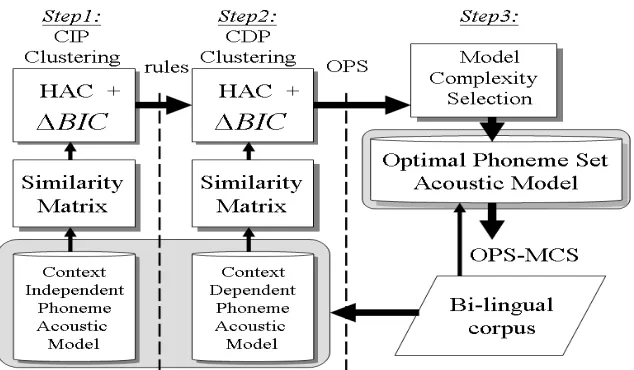
to well-trained acoustic models. Then, we apply a 2-step clustering using the hierarchical agglomerative clustering (HAC) [Fowlkes et al. 1983] with delta Bayesian information criteria (△BIC) [Tristschler et al. 1999] to automatically select the optimal context dependent phoneme (CDP) set. The first clustering step is to generate context-independent phoneme (CIP) clustering rules. In the second clustering step, we use the rules as phonetic knowledge to constrain the CDP clustering. After the clustering procedures, we generate the new phoneme set where the sounds with the same label will share the training data. Finally, to optimize the acoustic model of the new phoneme set, we use a model complexity selection (MCS) [Anguera et al. 2007] to adjust the number of Gaussian components in the Gaussian mixture to balance between the new phoneme set and the unbalanced training data.
This paper is organized as follows. In Section 2, we introduce the three main languages in Taiwan -- Mandarin, Taiwanese, and Hakka -- and also discuss their linguistic and phonetic characteristics. In Section 3, we use a knowledge-based approach to build two baseline systems, a language-dependent and a language-independent recognizer, on an unbalanced speech corpus. In Section 4, we describe our proposed approach to automatically optimize a multilingual acoustic model, including three components: CIP clustering, CDP clustering, and MCS. Then, several experiments are conducted for comparison with the baseline system and the decision tree based approach. Finally, we summarize our key contributions of this paper.
2.
Linguistic and Phonetic Properties of Mandarin, Taiwanese and Hakka
The goal of this paper is to use a majority language, like Mandarin, to assist minor languages, such as Taiwanese and Hakka, to train a unified acoustic model for a trilingual ASR system. In order to efficiently combine the acoustic units among the languages, some basic knowledge, such as the phonetics, phonology, and other linguistic aspects, is essential. In this section, we will introduce the linguistic and phonetic characteristics of the three languages.
2.1 Linguistic Properties
366 Dau-Cheng Lyu et al.
mutually unintelligible. Due to their mutual unintelligibility, we prefer to call Mandarin, Taiwanese, and Hakka three languages.
2.2 Phonetic Properties
To express the three languages in phonetic properties, we applied a heuristic mapping approach based on the Formosa Phonetic Alphabet (ForPA), an easy-to-use transcribing system for the trilingual speech data of these three languages [Lyu et al. 2004]. Basically, the Mandarin Phonetic Alphabet (MPA, also called zhu-in-fu-hao) and Pinyin (han-yu-pin-yin) are the most widely known phonetic symbol sets to transcribe Mandarin Chinese, but both of these systems are designed for Mandarin. ForPA is designed for transcribing Mandarin, Taiwanese, and Hakka for linguistic computing. Generally speaking, ForPA might be considered as a subset of IPA [Mathews et al. 1975], but it is more suitable for applications to the languages used in Taiwan.
These three languages are monosyllabic languages; therefore, a syllable, the smallest meaningful unit, is the basic pronunciation unit of the Chinese languages. Although the three languages have similar CV (C: Consonant, V: Vowel) structure at a syllabic level, Taiwanese and Hakka have much more abundant variation in allowing syllable-final consonants, including -p, -t, -k, -h. Totally, there are 408 base syllables in Mandarin, 709 base syllables in Taiwanese, and 777 base syllables in Hakka. The total number of the union set of syllables among the languages is 1333, and only 141 syllables are in common.
In the phonemic level, there are 21 consonants and 9 vowels in Mandarin, while there are 18 consonants and 16 vowels in Taiwanese. In Hakka, there are 20 consonants and 25 vowels. Therefore, the total number of phonemes is 30, 34, and 45 for Mandarin, Taiwanese, and Hakka, respectively. Additionally, some of the phonemes in the three languages are labeled with the same symbols by phoneticians, meaning that they are phonetically very close. In our observation, only 26 phonemes are truly in common. The common phonemes can share acoustic data among the languages. We list the statistical information of several different phonetic units in these three languages in Table 1.
Table 1. The statistic information of all Mandarin (M) Taiwanese (T) and Hakka (H) linguistic units in two levels: the numbers of phoneme (Np), the numbers of syllables (NS), where ∩and
∪
represent intersection and union of sets, respectively.M T H
M
∪
T
∪
H
M
∩
T
∩
H
Np 30 34 45 73 26
NS 408 709 777 1333 141
Acoustic Model Optimization for Multilingual Speech Recognition 367
3.
Language-Dependent and Language-Independent System
In this section, we describe two ASR systems A) language-dependent ASR and B) language-independent ASR. The first one is solely trained on a single language for each language, and we combine each recognizer into one recognizer as the language-dependent ASR system. The second one uses a universal phoneme inventory to map phonemes among the languages and build the common recognizer in one level. In the following, we first introduce the speech corpora for training the acoustic models, and then we report the performance of the two systems. Of course, some discussions are also included at the end of this section.
3.1 Trilingual Speech Corpus
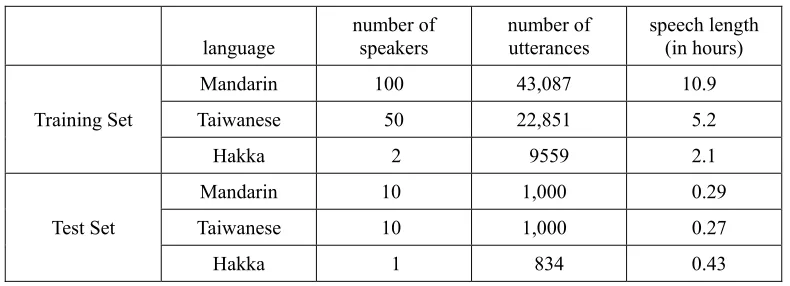
In order to simulate the available speech data in Taiwan, we use an unbalanced trilingual speech corpus for all of the experiments of this paper. The details of the corpus are listed in Table 2. Three languages are included -- Mandarin Taiwanese, and Hakka -- which are recorded with a 16 kHz, 16-bit, microphone channel. There are 100 speakers, 50 speakers each for Mandarin and Taiwanese, for the training set. Each of the speakers recorded two sets of phonetically balanced utterances, and each of the utterances contained one to four syllables. In the Hakka training set, there were only two speakers; one speaker recorded two monosyllabic sets, and the other speaker recorded 4320 phonetically balanced utterances. In the two monosyllabic sets, we included the two main Hakka accents, Miaoli and Hsinzu, of Taiwan. The former contains 2269 tonal syllables, and the latter contains 2970 tonal syllables. As we mentioned before, the training sets of the corpus are unbalanced, where the total number of hours for Taiwanese is about half of that of Mandarin, and the amount of the speech data in Mandarin is five times as large as that of Hakka. For the test set, another 21 speakers recorded the test speech, with a total length of almost 1 hour.
Table 2. Statistics of training and testing the trilingual speech corpus.
language number of speakers number of utterances speech length (in hours)
Training Set
Mandarin 100 43,087 10.9
Taiwanese 50 22,851 5.2
Hakka 2 9559 2.1
Test Set
Mandarin 10 1,000 0.29
Taiwanese 10 1,000 0.27
Hakka 1 834 0.43
368 Dau-Cheng Lyu et al.
3.2 Language-Dependent System
For the language-dependent recognizer for the trilingual speech, we trained a monolingual acoustic model for each of the languages using individual language training speech data. After that, we combined the monolingual acoustic model of all languages into a single one. Based on the units of each monolingual acoustic model having their language tags, they do not share the training data. For example, unit /a/ for Mandarin is labeled as /a_M/, /a_T/, and /a_H/ for Taiwanese and Hakka as well. The same ForPA symbols among the languages cannot share parameters in the acoustic model. Therefore, the size of the parameters will increase proportional to the number of languages. The number of tri-phone context-dependent acoustic phone models for the language-dependent system is 2579.
The experimental setups are described as follows. For the feature extraction, each frame of short-time speech waveform is represented by a feature vector consisting of 12 mel-frequency cepstral coefficients (MFCCs), energy, their first order derivatives (delta coefficients), and second order derivatives (delta-delta coefficients). Each of the frames is 20 milliseconds in length with 10 milliseconds shifting, which means that the adjacent frames have a 10 milliseconds overlap. For the acoustic modeling, we used the Hidden Markov Model (HMM) for constructing a context-dependent acoustic phone model, and each of the HMMs has three states. For the language modeling of each language, a uniform distribution is used, which implies that the perplexities of the language model of Mandarin, Taiwanese, and Hakka are 408, 709, and 777, respectively. The acoustic model and the Viterbi decoding used to generate the recognized syllable sequences are implemented with HTK [Young et al. 2002].
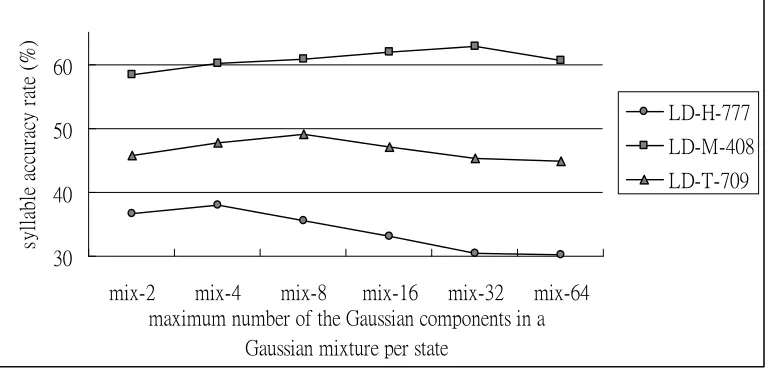
The language-dependent systems are trained and evaluated only on language specific data, and the results are shown in Figure 1. Basically, the syllable error rate is positively correlated to the perplexities of the language model. For example, the highest perplexity among the three languages is Hakka, 777; therefore, the average syllable accuracy rate of Hakka is 33.9%. In contrast, the smallest perplexity is Mandarin, and the average syllable accuracy rate of Mandarin is 60.8%. We believe both the perplexity of language modeling and the amount of training data influence the results. Due to the lack of training data, the highest performance of Hakka is achieved when the number of Gaussian components in the Gaussian mixture is only 4. When we increased the number of Gaussian components in the Gaussian mixture, the performance dropped. On the other hand, Mandarin achieved the highest performance when the number of Gaussian components in the Gaussian mixture was 32, and the performance steadily increased when we increased the number components in the Gaussian mixture.
Acoustic Model Optimization for Multilingual Speech Recognition 371
Obviously, due to the sharing of training data, we obtained better performance from the language-independent acoustic model with the language-specific language model than from the language-dependent system. The average of the syllable accuracy rates for Mandarin, Taiwanese, and Hakka are 63.9%, 52.3%, and 40.1%, respectively. On the other hand, the performance dropped reasonably when we used the language-independent language model, where the language perplexity is 1333, compared with that of the language-specific case. The best performance for Hakka with the language-independent recognition system used 8 Gaussian components in a Gaussian mixture per state, but that of the language-dependent recognition system used only 4 Gaussian components in a Gaussian mixture per state. This means that the training data sharing from Mandarin helps Hakka, because some of the sounds of Hakka can get training data from the sounds of Mandarin if they share the same ForPA labels.
Based on this experiment, we had the following two conclusions: first, the number of Gaussian components in a Gaussian mixture for such a small amount of Hakka training data in the acoustic model was too large, thereby causing the poor performance. Therefore, when we used too many parameters in the number of Gaussian components in a Gaussian mixture per state, it made their estimations become unreliable because the available training data was insufficient to accurately estimate the parameters. According to this fact, second, we have to find a way to decrease the parameters in the acoustic model and give the retrenched parameters “more” training data to estimate.
3.4 Discussion
According to the performance of the baseline results of language-dependent and language-independent systems, we have found that the accuracy rate is positively correlated to the amount of training speech. This means that if we have more available training data, we may obtain higher performance. This assumption is reasonable, because, if the parameters in the acoustic model have more data for estimation, the parameters will be more reliable. However, it is time consuming and expensive to collect more training data for a new language, especially a minor one. On other words, it is not always feasible for all of the languages to get as large training data as possible. As a result, the performance of the minor language, Hakka, is not comparable with that of the majority language, Mandarin. Since the problem of training data shortage will encumber the overall performance of multilingual speech recognition, we should find a way to use the available majority language corpus to help the ASR system in the minor language to balance the total parameters in the acoustic model between the available training data.
372 Dau-Cheng Lyu et al.
language. In our previous bilingual speech recognition experiments [Lyu et al. 2008], we clustered similar phonemes so the total numbers of the phoneme set in the acoustic model reduced and required fewer parameters to get sufficient training data for estimation. As sufficient data becomes available, parameter estimating will be more robust. Furthermore, the number of mixtures in the acoustic models is also a critical factor influencing the recognition performance when using an HMM-based recognizer. According to our Hakka experiments, when we increased the number of Gaussian components in a Gaussian mixture in the minor language, the accuracy rate dropped. Contrary to the result of the minor language, the accuracy rate of the majority language increased as the number of Gaussian components in a Gaussian mixture increased. Based on the above analysis, we identify the following two issues in order to improve the final performance using the unbalanced trilingual corpus.
zHow to efficiently cluster similar phonemes in these three languages then automatically decide the final number of phonemes in the acoustic model of the trilingual recognizer. In other words, we need to redefine the acoustic unit and make the parameters in the acoustic model have sufficient training data to evaluate and then get better performance in the unbalanced speech corpus.
zThe number of Gaussian components in a Gaussian mixture within a state should depend on the amount of the available training data. We should not increase the mixtures blindly.
In order to cluster the phonemes, we should first analyze the shortage condition of the training data of all the languages. To get such the knowledge, the training data should be totally “observed”. After observation, we recognize all the conditions of the training data of each language then generate the clustering rules to refine the phoneme set based on the observed data. In fact, this kind of method is a data-driven approach. According to the rules, we generate a new phoneme set which is given a consideration to balance the available training data and the training parameters. Therefore, the parameters of such a new phoneme set will have sufficient training data in an unbalanced corpus. In the next section, we propose an approach which not only automatically optimizes the number of parameters in the acoustic model but also increases the number of mixtures per state depending on model complexity selection.
4.
Acoustic Model Optimization
4.1 System Overview
376 Dau-Cheng Lyu et al.
Figure 5. The consonant example of using HAC and CIP for Mandarin, Taiwanese, and Hakka, where the height is the value of the Euclidean distance
among the phoneme models.
Acoustic Model Optimization for Multilingual Speech Recognition 377
4.3 CDP Clustering
Based on the rules derived from CIP clustering, we constrained the CDP clustering. The procedure was the same with CIP clustering, but we used context-dependent phonemes to replace context-independent phonemes. We generated 12 consonant and 20 vowel CDP clusters, and took the merging process for the phonemes /c_T+*_T/ and /c_M+*_M/ as an example, which were shown in Figure 7. First, we generated a hierarchical tree whose bottom nodes are context-dependent phonemes containing /c_T/ and /c_M/ in their phonemic transcription using the HAC algorithm based on the similarity matrix. Then, we created a new context-dependent phoneme set using △BIC. If the value of △BIC between two context-dependent phonemes or sets is bigger than zero, then the two context-dependent phonemes or the two sets are merged. The merged context-dependent phonemes or the sets are used as the new context-dependent phonemes, and the new context-dependent phonemes in the same group use common training data to train new acoustic models. On the other hand, if the value of △BIC is negative, the merging process stops.
Figure 7. The merging result of LD-CDP, where the center of consonant is /c_M/ and /c_T/.
378 Dau-Cheng Lyu et al.
and /g_K/, of the context-dependent phoneme, such as /b_K+*/, /d_K+*/ and /g_K+*/ in a clustering pool. Based on this rule, we used CDP clustering to generate new acoustic units. Essentially, as shown in Figure 8, there are 41 context-dependent phonemes in this clustering pool based on CDP clustering. Then, using HAC and △BIC, the final 31 new acoustic units are generated. For example, some of the sub-phone such as the first two in Figure 8, /g_K+ok_K/ and /g_K+ok_K/, are merged. It is noticed that, although the context-independent phonemes of Hakka, /b_K/, /d_K/ and /g_K/, became a confusion set, the final CDP clustering made the set of context-dependent phonemes separable. In Figure 8, we can see, basically, the sub-phones of /g_K+*/, /d_K+*/ and /b_K+*/ are not inter-merged, they are intra-merged. This means that the context-dependent phonemes merge together only when the have the same context-independent phonemes.
Figure 8. The merging result of LD-CDP, where the center of vowel is /ok_K/ and /op_T/.
4.4 Model Complexity Selection
380 Dau-Cheng Lyu et al.
For the OPS part, we built an OPS recognizer from the LI-CDP acoustic model based on the three procedures described in Section 4. First, we generated a set of 32 CIP clustering rules from CIP clustering; then, we generated 169 CDP rules to merge the tri-phone model in accordance with these rules. Finally, we obtained 1314 HMMs from LI-CDP’s 2579 sub-phones. For each state of the HMMs, we increased the number of the Gaussian components in a Gaussian mixture by MCS approach.
We also compare the performance of a decision tree (DT) approach with our OPS recognition system. The leaf nodes in a DT ASR system are sub-phones, and each node of the tree was associated with a binary question which had been selected from a set derived by linguistic experts. The best question was assigned to a node if it results in a binary splitting with minimal loss of likelihood [Liang et al. 1998]. For the other parameter configuration in the experiments, we used the same setting described in Section 3.2, and we showed the results of the decision tree system and OPS in Figure 11 and Figure 12.
5.1 MCS Results
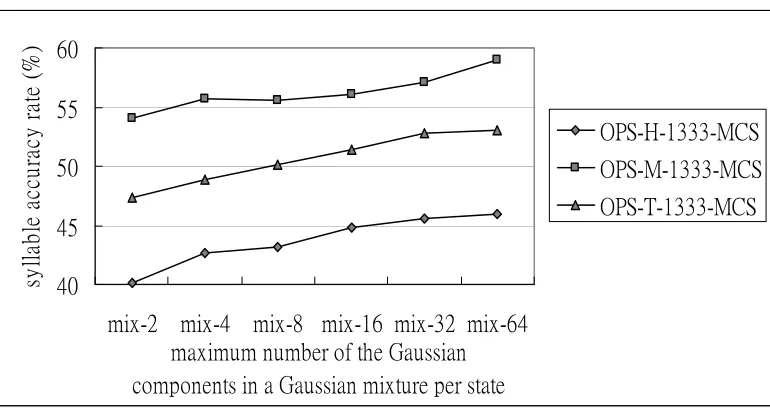
First, all of the performances of all the languages using MCS (Figure 9) are better than those without using MCS (Figure 3). The average improvements for Hakka, Mandarin, and Taiwanese are 4.5%, 2.5%, and 2.5%, respectively. The best results for LI-system for each of the languages are 42.01%, 58.45%, and 48.79% when the maximum number of Gaussian components in a Gaussian mixture per state is 32, 64, and 32 for Hakka, Mandarin, and Taiwanese, respectively. Second, unlike the results shown in Figure 3, the results in Figure 9 show that increasing of the number of Gaussian components in a Gaussian mixture caused the performance to drop in the Hakka case. This is because of increasing the number of Gaussian components in a Gaussian mixture per state based on the occurrence training data using MCS. The accuracy rate increases when the number of the Gaussian components in a Gaussian mixture is also increased.
To analyze the total number of Gaussian components in a Gaussian mixture in the acoustic model between the system with using MCS and without using MCS, we illustrated the differences in Figure 10. We can see that the average number of the Gaussian components in a Gaussian mixture in LI system without using MCS is almost the same as the maximum number of Gaussian components in a Gaussian mixture. However, for the MCS case, the average number of Gaussian components in a Gaussian mixture of mix-2, mix-4, mix-8, mix-16, mix-32, and mix-64 are 2, 3.1, 6.6, 11.3, 18.1, and 24.5, respectively. Therefore, the total numbers of Gaussian components in a Gaussian mixture using MCS are much fewer than those without using MCS system.
384 Dau-Cheng Lyu et al.
6.
Conclusion
In this paper, we have demonstrated a clustering approach with CIP, CDP clustering, and MCS steps with HAC and △BIC algorithm to generate the OPS of HMM-based acoustic model in an unbalanced trilingual corpus. It has been shown that the rules generated form the CIP provide sufficient information from the unbalanced conditions of the training corpus. When a trilingual corpus is unbalanced, we should put more emphasis on the characteristics of the corpus. We have shown that the rules derived from the data can reflect the properties of the corpus better and those rules are as good as the phonetic knowledge to smooth the unbalanced condition of the data. Besides, the MCS also plays an important role in balancing the OPS and the available training data. The experimental results are very encouraging in that the proposed approach reduces relative syllable error rate by 4.5% over the best result of the decision tree based approach and 13.5% over the best result of the knowledge-based approach.
Reference
Anguera, X., T. Shinozaki, C. Wooters, and J. Hernando, "Model Complexity Selection and Cross-Validation EM Training for Robust Speaker Diarization," In Proceedings of IEEE International Conference on Acoustics, Speech and Signal Processing, 2007, Honolulu, USA.
Fowlkes, E. B., and C. L. Mallows, "A Method for Comparing Two Hierarchical Clusterings," Journal of the American Statistical Association, 78(383), 1983, pp. 553-584.
Kohler, J., "Multi-lingual Phone Model for Vocabulary-Independent Speech Recognition Task," International Journal of Speech Communication, (35), 2001, pp. 21-30.
Kumar, C. S., V. P. Mohandas, and H. Z. Li, "Multi-lingual Speech Recognition - A Unified Approach," In Proceedings of Interspeech, 2005, Lisbon, Portugal.
Liang, P. Y., J. L. Shen, and L. S. Lee, "Decision Tree Clustering for Acoustic Modeling in Speaker-Independent Mandarin Telephone Speech Recognition," In Proceedings of the International Symposium on Chinese Spoken Language Processing, 1998, Singapore, pp. 207-211.
Liu, Y., and P. Fung, "Automatic Phone Set Extension with Confidence Measure for Spontaneous Speech," In Proceedings of Interspeech, 2005, Lisbon, Portugal.
Lyu, D. C., B. H. Yang, M. S. Liang, R. Y. Lyu, and C.N. Hsu, "Speaker Independent Acoustic Modeling for Large Vocabulary Bi-lingual Taiwanese/Mandarin Continuous Speech Recognition," In Proceedings of SST, 2002, Melbourne, Australia.
Acoustic Model Optimization for Multilingual Speech Recognition 385
Lyu, R. Y., M. S. Liang, and Y. C. Chiang, "Toward Constructing A Multi-lingual Speech Corpus for Taiwanese (Minnan), Hakka, and Mandarin," International Journal of Computational Linguistics & Chinese Language Processing, 9(2), 2004, pp. 1-12. Mak, B., and E. Barnard, "Phone Clustering Using the Bhattacharyya Distance," In
Proceedings of International Conference on Spoken Language Processing, 1996, Philadelphia, PA, USA, pp. 2005-2008.
Marthi, B., J. Morgan, N. Peterek, J. Picone, and W. Wang, "Towards Language Independent Acoustic Modeling," In Proceedings of ASRU, 1999, Keystone, USA.
Mathews, R. H., Chinese-English Dictionary, Caves, 13th printing, 1975.
Schultz, T., and K. Kirchhoff, Multi-lingual Speech Processing, Elsevier, Academic Press, 2006.
Schwarz, G., "Estimating The Dimension of A Model," The annals of statistics, 6(2), 1978, pp. 461-464.
Tritschler, A., and R. Gopinath, "Improved Speaker Segmentation And Segments Clustering Using The Bayesian Information Criterion," In Proceedings of Interspeech, 1999, pp. 679-682.
Uebler, U., "Multi-lingual Speech Recognition in Seven Languages," International Journal of Speech Communication, (35), 2001, pp. 53-69.
Wu, C. H., Y. H. Chiu, C. J. Shia, and C. Y. Lin, "Phone Set Generation Based On Acoustic and Contextual," In Proceedings of International Conference on Acoustics, Speech, and Signal Processing, 2006, Toulouse, France.
Young, S. J., J. J. Odell, and P. C. Woodland, "Tree-based State Tying for High Accuracy Acoustic Modelling," In Proceedings of the ARPA Workshop on Human Language Technology, 1994, Berlin, German.
Young, S. P., G. Evermann, T. Hain, D. Kershaw, G. Moore, J. Odell, D. Ollason, D. Povey, V. Valtchev, and P. Woodland, The HTK Book, Version 3.2, Cambridge, 2002.