497
Discourse-Aware Hierarchical Attention Network for
Extractive Single-Document Summarization
Tatsuya Ishigaki? Hidetaka Kamigaito? Hiroya Takamura? Manabu Okumura?
?Tokyo Institute of Technology
National Institute of Advanced Industrial Science and Technology
{ishigaki, kamigaito}@lr.pi.titech.ac.jp, {takamura, oku}@pi.titech.ac.jp
Abstract
Discourse relations between sentences are often represented as a tree, and the tree structure provides important information for summarizers to create a short and co-herent summary. However, current neu-ral network-based summarizers treat the source document as just a sequence of sentences and ignore the tree-like dis-course structure inherent in the docu-ment. To incorporate the information of a discourse tree structure into the neural network-based summarizers, we propose a discourse-aware neural extractive summa-rizer which can explicitly take into account the discourse dependency tree structure of the source document. Our discourse-aware summarizer can jointly learn the discourse structure and the salience score of a sentence by using novel hierarchical attention modules, which can be trained on automatically parsed discourse depen-dency trees. Experimental results showed that our model achieved competitive or better performances against state-of-the-art models in terms of ROUGE scores on the DailyMail dataset. We further con-ducted manual evaluations. The results showed that our approach also gained the coherence of the output summaries.
1 Introduction
Document summarization is the task of automati-cally shortening a source document while retain-ing its salient information. In this paper, we present a recurrent neural network (RNN)-based extractive summarizer taking into account the dis-course structure inherent in the source document.
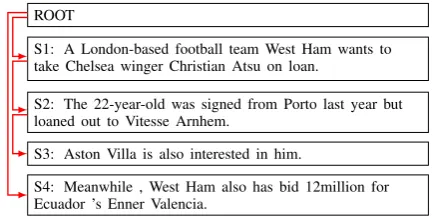
S1: A London-based football team West Ham wants to take Chelsea winger Christian Atsu on loan.
S2: The 22-year-old was signed from Porto last year but loaned out to Vitesse Arnhem.
S3: Aston Villa is also interested in him.
S4: Meanwhile , West Ham also has bid 12million for Ecuador ’s Enner Valencia.
ROOT
Figure 1: Example of discourse dependency struc-ture.
The discourse structure consists of discourse re-lations between units in the input, and discourse information has been shown useful for summa-rization tasks. An example of a Rhetorical Struc-ture Theory (RST) (Mann and Thompson,1988 )-based discourse structure, expressed as a depen-dency tree, is illustrated in Figure1. In the figure, each node corresponds to a sentence. Regarding the relations between the sentences, sentenceS2
elaborates the fact mentioned in sentenceS1. In addition,S2is further elaborated by S3. S4is a contrast to the mentionS1. Such relations are es-sential cues for generating a concise and coherent summary. For example, elaborated sentences tend to be more important than elaborating sentences, and the elaborated sentences should be included in the summary while the elaborating sentences are not.
RNN-based approaches have achieved the state-of-the-art performance in document summariza-tion (Cheng and Lapata, 2016; Nallapati et al.,
2017). However, RNN-based summarizers treat the source document just as a sequence of sen-tences, and ignore the discourse tree structure in-herent in the document. The lack of such infor-mation limits the ability to correctly compute rel-ative importance between sentences and reduces the coherence of output summaries. Cohan et al. (2018) might be the only exception to the above, showing that the effectiveness of incorporating discourse information into an RNN-based summa-rizer for scientific papers by treating the source document as a sequence of sections such as “In-troduction” or “Conclusion”. However, they were not able to show how the tree-like discourse struc-ture is effective in RNN-based approaches for ex-tractive single-document summarization.
To effectively avoid the influence of parse er-rors and take advantage of the recent advances in neural network-based approaches, we propose a model that jointly learns the discourse tree struc-ture of the source document and a scoring func-tion for sentence extracfunc-tion. Our model represents the discourse tree structure as an attention distri-bution and the probability of including a sentence in a summary as the softmax layer. In addition, recursive attention modules in our model can con-sider multi-hop dependencies between sentences. Therefore, our model can capture the relationships between sentences effectively and create a sum-mary without losing the coherence between sen-tences.
We used an existing RST parser (Hernault et al.,
2010) to add discourse dependency structure an-notations to the DailyMail dataset (Hermann et al.,
2015) and thereby obtained a large-scale annotated dataset to train the model. One of the advantages of our model is that we do not need the RST an-notations in the inference phase because the model automatically infers the latent discourse tree struc-ture of the source document and outputs the prob-ability for each sentence as a salience score.
We empirically compared our model with other models. The results showed that discourse infor-mation improves the performance, and also that our models perform competitively with or better than state-of-the-art neural network-based extrac-tive summarizers.
2 Related Work
There have long been many attempts at tackling extractive single-document summarization (Luhn,
1958), but there is still room for improvements in terms of ROUGE scores (Hirao et al.,2017). The recent focus has been on RNN-based approaches (Cheng and Lapata, 2016; Nallapati et al., 2017;
Narayan et al.,2018). We further extend the atten-tion mechanism used in RNN-based summarizers to capture a discourse structure.
RNN-based approaches were introduced to nat-ural language processing tasks by the pioneering work byBahdanau et al.(2015) andLuong et al.
(2015), originally for machine translation. Rush et al. (2015) applied the approach to a sentence compression task.Nallapati et al.(2016) extended the model to abstractive document summarization. The DailyMail dataset (Hermann et al.,2015) has been commonly used for training abstractive sum-marizers. Cheng and Lapata(2016) andNallapati et al. (2017) later proposed the methods to auto-matically annotate the binary labels, enabling us to train extractive models. Cohan et al. (2018) demonstrated the usefulness of incorporating dis-course information into RNN-based summarizers. Unlike their model, our attention module explic-itly captures the hierarchical tree structure inher-ent in the documinher-ent.
Nallapati et al. (2016) and Yang et al. (2016) also used a hierarchical attention that consists of two simple attention modules; one is for words and the other is for sentences. Our attention mechanism differs from them in that ours cap-tures discourse tree struccap-tures by new hierarchi-cal attention networks, inspired by the models for capturing sentence-level dependency structures, e.g. machine translation (Hashimoto and Tsu-ruoka, 2017), dependency parsing (Zhang et al.,
2017), constituency parsing (Kamigaito et al.,
2017) and sentence compression (Kamigaito et al.,
2018). Note that these models were designed for sentence-level tasks while we focus on the document-level summarization task.
Sentence selection modules that consider dis-course structures of documents have been shown to be useful in ILP-based summarizers.Hirao et al.
an ILP summarizer. Unlike the researches above, our focus is on incorporating discourse informa-tion into RNN-based summarizers.
Penn Discourse TreeBank (PDTB) (Prasad et al., 2008) and RST are the most commonly used framework to represent a discourse structure. PDTB focuses on the relation between two sen-tences, and the annotated structure for a docu-ment is not necessarily a tree. In contrast, RST is forced to represent a document as a tree. Dis-course parsers for both schema are available ( Her-nault et al., 2010; Feng and Hirst, 2014; Wang and Lan, 2015). There are at least two methods to convert an RST-based tree structure to a depen-dency structure (Hirao et al.,2002;Li et al.,2014).
Hayashi et al.(2016) compared these methods and mentioned that DEP-DT byHirao et al.(2002) has an advantage for applying to summarization tasks. We use DEP-DT for this research since we focus on integrating the tree structure into a summarizer. We found only one model that jointly learns RST parsing and document summarization (Goyal and Eisenstein,2016). They used the SampleRank algorithm (Wick et al., 2011), a stochastic struc-ture prediction model, while our main focus is to take into account discourse structures in RNN-based summarizers.
3 Problem Formulation
We formulate extractive document summarization as a sentence tagging problem. We first briefly ex-plain the notation in the paper and describe the de-tails of the model in the following sections.
The source document x is represented as a sequence of sentences x1, ..., xN. Each sen-tence xi is composed of a sequence of words
wi,j(1≤j≤Mi), where Mi is the number of words inxi. We also considerx0as a dummy root node. The summarizer outputs a sequence of bi-nary decisions y = y1, ..., yN, whereyi = 1for thei-th sentencexito be included in the summary and yi = 0 for the sentence not to be included. The binary decisionsy are made by using a neu-ral network-based probability distribution function
p(yi|x, θ), where θis the set of learned parame-ters. The model finds the best decisions y by a simple greedy search to maximize the sum of the probabilities within the length constraint.
Thus, our goal is to construct a better function
p(yi|x, θ)given training dataD. Each instance in
Dis a triple(x,E,y), whereEis a matrix to
rep-resent the discourse dependency tree ofx. Specif-ically, elementEk,lequals 1 if the edge fromxkto
xlexists in the discourse tree; otherwiseEk,l = 0. Note that we use the discourse structure matri-cesE only in the training phase. The model does not require the RST annotations of the source doc-ument when calculating the probability distribu-tionp(yi|x, θ).
4 RNN-Based Extractive Summarizer
In this section, we first explain the base model and give the details of our proposed attention mod-ule in the following section. The base model is composed of two main components: a neural network-based hierarchical document encoder and a decoder-based sentence scorer. The document encoder is further split into two components; a sentence reader and a document reader. The hi-erarchical architecture is commonly used in recent neural network-based models (Cheng and Lapata,
2016;Nallapati et al.,2017;Cohan et al.,2018).
4.1 Word Reader
The goal of the Word reader is to convert sen-tence xi to a sentence embedding hi. For each word wi,j in a sentence xi, the word reader first convert every word embeddingemb(wi,j)to hid-den states −→ei,j = LST M(−→ei,j−1, emb(wi,j)) and←−ei,j =LST M(←−ei,j+1, emb(wi,j))by using bi-directional Long short-term memory (LSTM) (Hochreiter and Schmidhuber,1997). Then, ←−ei,j and −→ei,j are concatenated into a hidden state
hi,j = [−→ei,j;←−ei,j], where[ ]represents a concate-nation operation of a vector. After that, allhi,j in the sentencexi are averaged and represented as a sentence embeddinghi.
4.2 Sentence Reader
Once we obtain sentence embeddingshi for each sentence xi, the Sentence reader then reads sen-tence embeddings hi by another bi-directional LSTM and generates context-aware sentence rep-resentationHi for eachxi. Specifically, two
vec-tors generated by the forward recurrent neural net-work−→Hi =LST M(
− →
Hi−1, hi)and the backward
←−
Hi = LST M(
←−
Hi+1, hi) are concatenated into sentence representationHiforxi:
Hi= [
−→
Hi;
←−
Hi]. (1)
4.3 Decoder-Based Sentence Scorer
This module outputs the probability of including
xi in the summary, p(yi = 1|x, θ), by using an LSTM-based decoder. At each time step t(1 ≤ t ≤ N), the previous state of the decoder st−1 and the sentence representationhtare fed into the LSTM, and the LSTM outputs a new state; st =
LST M(st−1, ht). The initial states0is initialized by the last states of the backward LSTM in the document reader←H−0.
Extractive document summarization often adopts a “hard attention”, which focuses only on the encoder hidden stateHtin the decoding time step t (Cheng and Lapata, 2016). In addition, document representation K is also important to decode summaries (Nallapati et al., 2017). Based on them, the output layer calculates the probability distribution ofxtbeing included in the summary as:
p(yt|x, θ) =sof tmax(Wotanh(Wc[Ht;st;K])). (2)
5 Discourse-Aware Hierarchical
Attention Network
We assume that taking into account the discourse dependency structure is also useful in determining whether the summary includes a target sentence or not. Here, we make the model capable of account-ing for the information of the parent sentences on the discourse dependency structure by incorporat-ing our proposed hierarchical attention mechanism into the RNN-based extractive summarizer.
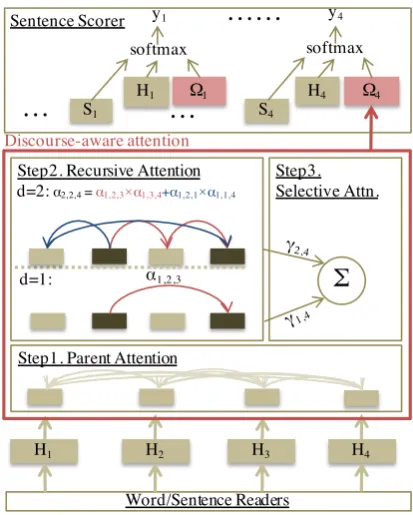
As shown in Figure2, the goal of our attention mechanism is to generate an attention vector Ωi containing the information from the parent sen-tences ofxithrough the three-step attention mod-ules. Below, we first give an overview of each step in the procedure and then formulate the com-ponents after that.
Step1: Parent Attention Module This module calculates the probability ofxkbeing the parent of
xifor all combinations ofkandiwherek6=i. We denote this probability asp(k|i,H). In the figure, the starting point of an edge is the parent, and the end point is the child. The probability p(k|i,H)
is used as the weight for the edge fromHktoHi. The edge weights are passed to the Recursive At-tention Module.
Step2: Recursive Attention ModuleThis mod-ule outputs the weighted sum vectorsγd,ioverH,
Word/Sentence Readers
H1 H2 H3 H4
Step1. Parent Attention Step2. Recursive Attention d=2:α2,2,4=α1,2,3 α1,3,4+α1,2,1 α1,1,4
Step3. Selective Attn.
Σ
d=1: α1,2,3
γ2,4
γ1,4
S1
…
S4softmax
Ω4 H4
…
y4
softmax
……
Ω1 H1
y1 Sentence Scorer
Discourse-aware attention
Figure 2: Overview of hierarchical attention mechanism for generating attention vectorΩ4. Parent Attention
first calculates how likely the sentencexiis the parent ofxj
for all combinations. Recursive Attentionthen gen-erates weighted sum vectorsγd,4over encoder hidden states
Hi considering how likely the sentencexi is the d-th order
parent ofx4. Selective Attentionfinally generates
another weighted sum vectorΩ4overγd,4.
taking into account thed-th-order parents ofxi1. The module starts the calculation with the set-ting d = 1. Correspondingly, the module only considers the 1st-order parents ofxi. The Parent Attention Module has already calculated the prob-ability of xk being the parents of xi. Thus, the Recursive Attention Module simply uses the prob-abilities as the weightsα1,k,ifor everyHkand out-puts the weighted sum vectorγ1,i.
When d = 2, the weightsα2,k,i for every Hk are calculated on the basis of how likely xk be-comes the2nd-order parent ofxi. Here,d-th-order refers to the distance betweenxk andxi. For ex-ample, suppose there are two different paths con-necting two nodes, and that their distances are both 2, illustrated by the path colored blue and red in Figure 2. The module multiplies the weights of the edges on each path, α1,2,3 × α1,3,4 for the red path and α1,2,1 × α1,1,4 for the blue path, and then the module sums the multiplied values;
1We use the plural form “parents” here because how likely
a sentence becomes the parent ofxiis represented as a
con-the preprocessed DailyMail dataset4 provided by
Cheng and Lapata (2016) and commonly used
for summarization tasks was not suitable for our use. The dataset is anonymized; all named enti-ties were replaced by the special token@entity, and paragraph boundaries were deleted. There-fore, we used the non-anonymized version of the dataset provided by Hermann et al. (2015). We obtained 196,557 training documents, 12,147 vali-dation documents and 10,396 test documents from the DailyMail dataset.
The DUC2002 test set consists of 116 pairs of source documents and their extractive summaries, and 567 pairs of source documents and their ab-stractive summaries. We used the dataset for eval-uation on out-of-domain data.
Compared Models: We compared our models with various baseline models. DIS w/ PAR is our model with the model parameterλ >0. With this setting, all the parameters are tuned to repro-duce the correct labels and the edges given by the RST parser. DIS fixed is the discourse-aware model with the attention vectorΩt=Ht−1. Thus, this model always treats the preceding sentence as the parent. DIS w/o PAR is the model with the model parameterλ = 0. Note that the objective function in this model does not take into account the RST annotations given by the RST parser. Thus, all the discourse structures are learned to reproduce the correct sentence labels without the information from the parser.
We compared the above models with the model without any discourse-aware attention mecha-nisms (no-attn) to verify the effectiveness of our attention mechanisms. Lead-3 is a com-mon baseline to select the first three sentences.
SummaRuNNer is a well-known RNN-based summarizer byNallapati et al.(2017). This model uses some types of information that we do not use, such as the similarity between the source doc-ument and the target sentence, and the novelty score of the target sentence, while our approach incorporates the information on the parent sen-tence of the target sensen-tence. NeuralSum is also a neural network-based summarizer which uses convolutional neural networks in the encoder.
Refreshis a state-of-the-art method using rein-forcement learning (Narayan et al.,2018)5.
In addition to the above methods, we compared
4
http://homepages.inf.ed.ac.uk/mlap/ index.php?page=resources
5We used the implementation provided by the authors.
our models with previously reported performances on the DUC2002 test set. LREGis a feature-rich logistic regression based approach used as a base-line inCheng and Lapata(2016).ILPis a phrase-based extraction system proposed by Woodsend and Lapata (2010). The approach extracts the phrases and recombines them subject to the con-straints in the ILP such as length, coverage or grammaticality. Both TGRAPH (Parveen et al.,
2015) and URANK (Wan, 2010) are graph-based sentence extraction approaches, that perform well on the DUC2002 corpus.
Evaluation Metrics: We conducted both auto-matic evaluation and human evaluation. In au-tomatic evaluation, we adopted ROUGE scores (Lin,2004). We specifically calculated ROUGE-1, ROUGE-2 and ROUGE-L by using the Pyrouge library6. The highlights in the Dailymail dataset were treated as reference summaries when we cal-culated the scores. We used three length con-straints; 75 bytes, 275 bytes (Nallapati et al.,2017;
Cheng and Lapata, 2016) and the bytes of ref-erence summaries. We truncated generated sum-maries in the middle to conform to the length con-straints. We adopted the last constraint to evalu-ate whether a model can include sufficient infor-mation within the ideal summary length. For the evaluation on out-of-domain data, we report the ROUGE scores on the DUC2002 abstractive and extractive test sets. Our models are trained on the DailyMail dataset and tested on DUC2002.
We additionally carried out human evaluation because ROUGE scores cannot capture the co-herence, though our attention modules are de-signed to improve the coherence of summaries. We used Amazon Mechanical Turk to conduct hu-man evaluation. Specifically, randomly selected 100 documents and their four summaries gener-ated byDIS w/ PAR,Lead-3,no-attn, and
SummaRuNNer were shown to the workers. Five workers were asked to rate each summary on a 1-5 scale in terms of coherence and informativeness. The instruction shown to the workers follows the DUC quality question7.
Training Details: We used Adam (Kingma and Ba, 2015) for the optimizer, where the learning rate was set to 0.001. In accordance with the model parameters used in Nallapati et al. (2017),
6The options for the Rouge script were “-a -c 95 -m -n 2
-b 75” and “-a -c 95 -m -n 2 -b 275”.
7https://duc.nist.gov/duc2007/
we limited the vocabulary size of the input to 150,000 and replaced the out-of-vocabulary words with the token UNK. The size of the mini-batch was set to 8. We used the size of 100 for hid-den layers in the LSTMs and 300 for word em-beddings, which were initialized with pre-trained embeddings, word2vec-slim. Note that the previ-ous researches (Nallapati et al., 2017;Cheng and Lapata,2016) also used pre-trained embeddings. We filtered the training instances consisting of 50 or more sentences in the source document, follow-ing Nallapati et al. (2017). The parameter λof all the discourse-aware models was tuned on the validation set. We tried the following values forλ: 0.01, 0.1, 1.0, 2.0, 5.0 and 10.0.
7 Results and Discussion
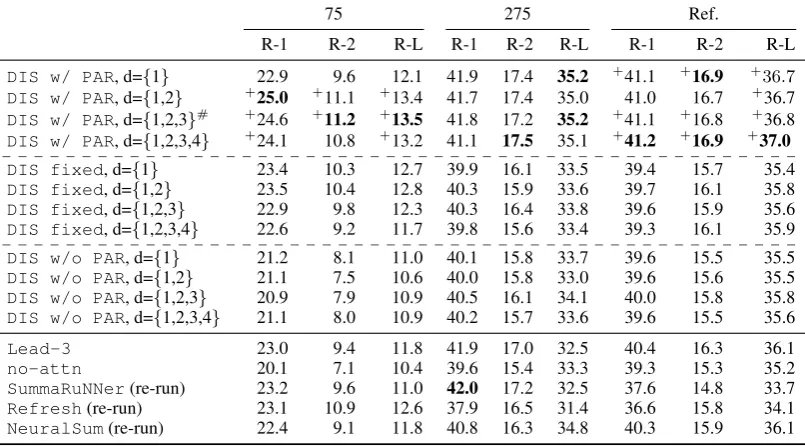
ROUGE scores on DailyMail dataset: Table1
shows the ROUGE scores evaluated on the Dai-lyMail test set. For fair comparison, we also re-trained the baseline models by using our non-anonymized dataset.
DIS w/o PAR achieved better ROUGE
scores than no-attn in all variations of length constraint except for ROUGE-L score on the set-ting with d = {1,2}. Furthermore, we obtained better scores for DIS fixed than DIS w/o PAR. Incorporating the simple discourse informa-tion which treats the preceding sentence as the parent in the objective function improved the per-formance. Exploiting the discourse information given by the RST parser (DIS w/ PAR) further improved the scores in most settings. These obser-vations suggest that discourse information is use-ful in RNN-based summarizers.
In the setting with the length constraint of 75 bytes, we observed a statistically significant difference between DIS w/ PAR and other neural network-based models (SummaRuNNer ,
Refresh andNeuralSum) on the settings with
d = {1,2} and d = {1,2,3}. We also ob-served the similar tendency in the setting with the length constraint of reference summaries. Fur-thermore, we did not observe a statistically sig-nificant difference between DIS w/ PAR and
SummaRuNNer in the setting with the length constraint of 275 bytes. Those facts would sug-gest that our models achieve a performance simi-lar to the other baseline models in the setting with longer length constraints, and can perform better with shorter length constraints.
ROUGE scores on DUC2002 dataset: The re-sults are shown in Table2. Neural network-based approaches achieved similar scores on the abstrac-tive test set because the length constraint is long; specifically it was set to 100-words. However, graph-based approaches (TGRAPH and URANK) performed better than the neural network-based approaches. As reported inNallapati et al.(2017), neural network-based approaches suffer the diffi-culties in achieving high performance on out-of-domain data due to its high capability to fit in-domain data. Another possible reason might be the method for creating the binary labels for the training dataset. The binary decisions on the train-ing dataset were made to maximize the ROUGE-F scores. Thus, the labels are strongly affected by the length of reference summaries in the Dai-lyMail dataset. Since the average length of the reference summaries in the DUC test set is longer than the average length in the DailyMail dataset, the models trained on the DailyMail dataset might face difficulties. Our proposed models achieved the significantly better performances among the neural network-based approaches on the extractive test sets, which are for the settings with shorter length constraints (50 and 100 words) .
Human Evaluation: Table 3 shows the re-sults. DIS w/ PAR were evaluated better than
no-attn and SummaRuNNer in terms of co-herence in the settings with all the different length constraints. These differences are statistically sig-nificant with the sign test (p <0.05). Thus, human evaluation also supports the effectiveness of incor-porating discourse information. Lead-3 is in-herently strong in terms of coherence because this model is constrained to extract consecutive sen-tences while other models possibly extract non-consecutive ones. It was evaluated better in the setting with 75 bytes length constraint.
Analysis:Table4shows an example of the source document and outputs of two models; the sen-tences selected by our model are colored red and those selected bySummaRuNNer are blue, and those selected by both are purple. In this example,
S7 elaborates S6. Our summarizer successfully extractedS6, that made the output summary more similar to the gold summary.
8 Conclusion
75 275 Ref.
R-1 R-2 R-L R-1 R-2 R-L R-1 R-2 R-L
DIS w/ PAR, d={1} 22.9 9.6 12.1 41.9 17.4 35.2 +41.1 +16.9 +36.7
DIS w/ PAR, d={1,2} +25.0 +11.1 +13.4 41.7 17.4 35.0 41.0 16.7 +36.7
DIS w/ PAR, d={1,2,3}# +
24.6 +11.2 +13.5 41.8 17.2 35.2 +41.1 +16.8 +36.8
DIS w/ PAR, d={1,2,3,4} +
24.1 10.8 +13.2 41.1 17.5 35.1 +41.2 +16.9 +37.0
DIS fixed, d={1} 23.4 10.3 12.7 39.9 16.1 33.5 39.4 15.7 35.4
DIS fixed, d={1,2} 23.5 10.4 12.8 40.3 15.9 33.6 39.7 16.1 35.8
DIS fixed, d={1,2,3} 22.9 9.8 12.3 40.3 16.4 33.8 39.6 15.9 35.6
DIS fixed, d={1,2,3,4} 22.6 9.2 11.7 39.8 15.6 33.4 39.3 16.1 35.9
DIS w/o PAR, d={1} 21.2 8.1 11.0 40.1 15.8 33.7 39.6 15.5 35.5
DIS w/o PAR, d={1,2} 21.1 7.5 10.6 40.0 15.8 33.0 39.6 15.6 35.5
DIS w/o PAR, d={1,2,3} 20.9 7.9 10.9 40.5 16.1 34.1 40.0 15.8 35.8
DIS w/o PAR, d={1,2,3,4} 21.1 8.0 10.9 40.2 15.7 33.6 39.6 15.5 35.6
Lead-3 23.0 9.4 11.8 41.9 17.0 32.5 40.4 16.3 36.1
no-attn 20.1 7.1 10.4 39.6 15.4 33.3 39.3 15.3 35.2
SummaRuNNer(re-run) 23.2 9.6 11.0 42.0 17.2 32.5 37.6 14.8 33.7
Refresh(re-run) 23.1 10.9 12.6 37.9 16.5 31.4 36.6 15.8 34.1
NeuralSum(re-run) 22.4 9.1 11.8 40.8 16.3 34.8 40.3 15.9 36.1
Table 1:ROUGE Scores on DailyMail dataset. The models aretrained and tested on DailyMail dataset. The length constraints are set to 75 bytes, 275 bytes and the reference length. The best scores among the models in bold. The symbol + indicates statistical significance using 95% confidence interval with respect to the nearest baseline, estimated by the ROUGE script. # indicates the model that achieved the best score in ROUGE-2 among the same methods with differentdin the development dataset.
Abstracts Extracts (50 words) Extracts (10 words) R-1 R-2 R-L R-1 R-2 R-L R-1 R-2 R-L
DIS w/ PAR 44.7 21.8 38.2 43.7 14.2 38.6 21.4 8.2 19.5
DIS w/o PAR 46.1 23.3 43.6 42.1 13.5 36.8 19.0 7.5 17.3
no-attn 43.3 20.9 41.0 42.5 13.3 37.3 19.1 7.1 17.3
SummaRuNNer 46.6 23.1 43.0 42.1 13.4 36.7 20.9 7.8 19.0
Refresh - - -
-NeuralSum - - -
-LEAD-3 43.6 21.0 40.2 43.4 14.1 38.4 21.3 8.1 19.4
LREG 43.8 20.7 40.3 - - -
-ILP 45.4 21.3 42.8 - - -
-TGRAPH 48.1 24.3 - - -
-URANK 48.5 21.5 - - -
-Table 2: ROUGE scores on DUC2002 dataset. All neural network-based models are trained on DailyMail dataset and tested on DUC2002 test set.
75 275 Ref
C I C I C I
DIS w/ PAR ∗3.86 3.57 ∗4.11 ∗3.97 ∗3.98 3.78
SummaRuNNer 3.61 3.57 2.98 3.77 2.81 3.16
no-attn 3.73 3.52 3.92 3.86 3.80 3.70
LEAD-3 3.98 3.69 4.06 3.97 3.94 3.80
Table 3: Human evaluation on randomly selected 100 doc-uments from DailyMail dataset. C and I stand for coher-ence and informativeness respectively. The mark∗indicates thatDIS w/ PAR achieved statistically significant differ-ence, calculated by the sign test (p < 0.05), from both
SummaRuNNer andno-attn.
source document. The experiments showed that incorporating discourse information into RNN-based extractive summarizers improves coherence and informativeness evaluated by human judges in addition to ROUGE scores. Our models out-performed or achieved competitive performances against the state-of-the-art methods. Improving the performance on out-of-domain data will be one
Document:
S1: Bayern Munich is interested in Chelsea defender Branislav Ivanovic but are unlikely to make a move until Jan.
S2: The Serbia captain has yet to open talks over a new contract at Chelsea and his current deal runs out in 2016.
S3: Chelsea defender Branislav Ivanovic could be targeted by Bayern Munich in the January transfer window. S4: Bayern like Ivanovic but don’t expect Chelsea to sell yet they know he will be free to talk to foreign clubs from Jan.
S5: Paris Saint-germain will make a 7million offer for Chelsea goalkeeper Petr Cech this summer.
S6:The 32-year-old is poised to leave Stamford Bridge and wants to play for a champions league.
S7: Contender PSG are set to make a 7million bid for Ivanovic’s Chelse a team-mate Petr Cech in the summer.
Gold Summary:
Branislav Ivanovic’s contract at Chelsea expires at the end of next season.The 31-year-old has yet to open
talks over a new deal at Stanford bridge. Petrcech is poised to leave Chelsea at the end of the season
Table 4: Example of the extracted sentences. The sen-tences in bold are included in our summary. The sen-tences colored red were selected by our model, blue were by
SummaRuNNer and purple were by both models.
of our future directions.
Acknowledgements
References
Dzmitry Bahdanau, Kyunghyun Cho, and Yoshua Ben-gio. 2015. Neural machine translation by jointly learning to align and translate. In Proceedings of ICLR2015.
Jianpeng Cheng and Mirella Lapata. 2016. Neural summarization by extracting sentences and words. InProceedings of ACL2016, pages 484–494, Berlin, Germany.
Arman Cohan, Franck Dernoncourt, Doo Soon Kim, Trung Bui, Seokhwan Kim, Walter Chang, and Nazli Goharian. 2018. A discourse-aware attention model for abstractive summarization of long documents. In Proceedings of NAACL2018, pages 615–621.
Vanessa Wei Feng and Graeme Hirst. 2014. A linear-time bottom-up discourse parser with constraints and post-editing. InProceedings of ACL2014, pages 511–521.
Naman Goyal and Jacob Eisenstein. 2016. A joint model of rhetorical discourse structure and summa-rization. InProceedings of the Workshop on Struc-tured Prediction for NLP, pages 25–34.
Kazuma Hashimoto and Yoshimasa Tsuruoka. 2017. Neural machine translation with source-side latent graph parsing. In Proceedings of EMNLP2017, pages 125–135.
Katsuhiko Hayashi, Tsutomu Hirao, and Masaaki Na-gata. 2016. Empirical comparison of dependency conversions for rst discourse trees. InProceedings of SIGDIAL2016, pages 128–136.
Karl Moritz Hermann, Tomas Kocisky, Edward
Grefenstette, Lasse Espeholt, Will Kay, Mustafa Su-leyman, and Phil Blunsom. 2015. Teaching ma-chines to read and comprehend. InProceedings of NIPS2015, pages 1693–1701.
Hugo Hernault, Helmut Prendinger, Mitsuru Ishizuka, et al. 2010. Hilda: A discourse parser using sup-port vector machine classification. Dialogue & Dis-course, 1(3).
Tsutomu Hirao, Hideki Isozaki, Eisaku Maeda, and Yuji Matsumoto. 2002. Extracting important sen-tences with support vector machines. In Proceed-ings of COLING2002, pages 1–7.
Tsutomu Hirao, Masaaki Nishino, and Masaaki Na-gata. 2017. Oracle summaries of compressive sum-marization. InProceedings of ACL2017, pages 275– 280.
Tsutomu Hirao, Yasuhisa Yoshida, Masaaki Nishino, Norihito Yasuda, and Masaaki Nagata. 2013. Single-document summarization as a tree knapsack problem. In Proceedings of EMNLP2013, pages 1515–1520.
Sepp Hochreiter and Jurgen Schmidhuber. 1997. Long short-term memory. Neural Computation, 9(8):1735–1780.
Hidetaka Kamigaito, Katsuhiko Hayashi, Tsutomu Hi-rao, and Masaaki Nagata. 2018. Higher-order syn-tactic attention network for longer sentence com-pression. In Proceedings of NAACL2018, pages 1716–1726.
Hidetaka Kamigaito, Katsuhiko Hayashi, Tsutomu Hirao, Hiroya Takamura, Manabu Okumura, and Masaaki Nagata. 2017. Supervised attention for sequence-to-sequence constituency parsing. In Pro-ceedings of IJCNLP2018 (Volume 2), pages 7–12.
Yuta Kikuchi, Tsutomu Hirao, Hiroya Takamura, Man-abu Okumura, and Masaaki Nagata. 2014. Single document summarization based on nested tree struc-ture. InProceedings of ACL2014, pages 315–320.
Diederik P Kingma and Jimmy Ba. 2015. Adam: A method for stochastic optimization. InProceedings of ICLR2015.
Sujian Li, Liang Wang, Ziqiang Cao, and Wenjie Li. 2014. Text-level discourse dependency parsing. In Proceedings of ACL2014, pages 25–35.
Chin-Yew Lin. 2004. Rouge: A package for auto-matic evaluation of summaries. InProceedings of ACL2004 Workshop, pages 74–81.
H. P. Luhn. 1958. The automatic creation of literature abstracts. IBM J. Res. Dev., (2):159–165.
Minh-Thang Luong, Hieu Pham, and Christopher D. Manning. 2015. Effective approaches to attention-based neural machine translation. InProceedings of EMNLP2015, pages 1412–1421.
William C Mann and Sandra A Thompson. 1988. Rhetorical structure theory: Toward a functional the-ory of text organization. Text-Interdisciplinary Jour-nal for the Study of Discourse, 8(3):243–281.
Ramesh Nallapati, Feifei Zhai, and Bowen Zhou. 2017. Summarunner: A recurrent neural network based se-quence model for extractive summarization of doc-uments. InProceedings of AAAI2017, pages 3075– 3081.
Ramesh Nallapati, Bowen Zhou, Cicero dos Santos, C¸ a glar Gulc¸ehre, and Bing Xiang. 2016. Abstrac-tive text summarization using sequence-to-sequence rnns and beyond. In Proceedings of CoNLL2016, pages 280–290.
Shashi Narayan, Shay B Cohen, and Mirella Lapata. 2018. Ranking sentences for extractive summariza-tion with reinforcement learning. InProceedings of NAACL2018, pages 1747–1759.
Rashmi Prasad, Nikhil Dinesh, Alan Lee, Eleni Milt-sakaki, Livio Robaldo, Aravind K Joshi, and Bon-nie L Webber. 2008. The penn discourse treebank 2.0. InProceedings of LREC2008.
Alexander M. Rush, Sumit Chopra, and Jason Weston. 2015. A neural attention model for sentence sum-marization. InProceedings of EMNLP2015, pages 379–389.
Xiaojun Wan. 2010. Towards a unified approach to simultaneous single-document and multi-document summarizations. In Proceedings of COLING2010, pages 1137–1145.
Jianxiang Wang and Man Lan. 2015. A refined end-to-end discourse parser. InProceedings of the Nine-teenth Conference on Computational Natural Lan-guage Learning-Shared Task, pages 17–24.
Michael L Wick, Khashayar Rohanimanesh, Kedar Bellare, Aron Culotta, and Andrew McCallum. 2011. Samplerank: Training factor graphs with atomic gradients. In Proceedings of ICML2011, pages 777–784.
Kristian Woodsend and Mirella Lapata. 2010. Auto-matic generation of story highlights. InProceedings of ACL2010, pages 565–574.
Zichao Yang, Diyi Yang, Chris Dyer, Xiaodong He, Alex Smola, and Eduard Hovy. 2016. Hierarchical attention networks for document classification. In Proceedings of NAACL2016, pages 1480–1489.