Proceedings of the 2nd Workshop on Multilingual Surface Realisation (MSR 2019), pages 41–49 Hong Kong, China, November 3rd, 2019. c2019 Association for Computational Linguistics
41
Realizing
Universal Dependencies
Structures using a symbolic
approach
Guy Lapalme
RALI-DIRO, Universit´e de Montr´eal [email protected]
Abstract
We first describe a surface realizer for
Uni-versal Dependencies(UD) structures. The system uses a symbolic approach to transform the dependency tree into a tree of constituents that is transformed into an English sentence by an existing realizer. This approach was then adapted for the two shared tasks of SR’19. The system is quite fast and showed compet-itive results for English sentences using auto-matic and manual evaluation measures.
1 Introduction
This paper describe the system that we submit-ted to the Surface Realization Shared Task 2019
(SR’19)1 in conjunction with Second Workshop
on Multilingual Surface Realization (Mille et al.,
2019). The data used by this shared task was
cre-ated by modifying originalUniversal
Dependen-ciesstructures (Nivre et al.,2016) (UD) to create
two tracks:
Shallow Track(T1) in which word order is per-muted and tokens have been lemmatized and some information about linear order about the governor has been added. The task con-sists in determining the word order and in-flecting the words.
Deep Track(T2) in which functional and surface-oriented morphological information
has been removed from the T1 structures.
The goal is to reintroduce the missing func-tional words and morphological features.
The creation of the data set is described in (Mille
et al.,2018). The output of the systems have been evaluated using automated metrics and a subset of those, evaluated manually.
1http://taln.upf.edu/pages/msr2019-ws/
SRST.html
The organizers of SR’19 have taken for granted that this task would be solved using statistical and machine learning approaches, which seems to be anobviousway of going given the recent trends in
NLP. They provide a list of authorized resources
such as language models and distributed represen-tations of words.
We decided to try an alternative approach by
first building UD-SURFR (Universal Dependency
Surface Realizer), a symbolic system for the
orig-inalUDstructures and then adapting it for the two
tasks of SR’19. We thought it would be
interest-ing to see how thisclassical approach compares
with machine learning systems.
Written in Prolog, UD-SURFR parses the
orig-inal UD structure and builds the corresponding
dependency tree which is then converted to a
tree of constituents realized using JSREALB,2 a
web-based English and French realizer written in JavaScript; only the English realizer is used here because we worked only on the English corpora
ofUD. TheUDstructures are provided in tab
sep-arated files in a well-defined format (see row 1 of
Table1for a small example). Given the fact that
the input and output representations are trees, Pro-log seemed a natural symbolic of choice for a tree to tree transformation engine.
We are aware thatwe are not following the rules
of SR’19 as we use JSREALB, a system that is
not authorized by the competition, but we think this experiment is still interesting. It does not re-quire any specialized hardware and huge amount of memory as is often the case by modern ma-chine learning approaches. It has been developed using only a few hand selected examples. These results could be used as a baseline on which sta-tistical systems could build. We have deliberately shirked from adding any statistical techniques on
2http://rali.iro.umontreal.ca/rali/?q=
the output of UD-SURFR just to determine how far a symbolic approach can go. In a production setting, it would surely be better to combine statis-tical and symbolic systems.
We did not find any text realizer that takesUD
annotations as input except for Ranta and
Ko-lachina(2017) who present an algorithm to
trans-form many UDs into Grammatical Framework
structures from with English sentences can be gen-erated.
A UD realizer might seem pointless, because
UD annotations are created from realized
sen-tences. As UDs contains all the tokens in their
original form (except for elision in some cases), the realization can be obtained trivially by listing
theFORMin the second column of each line.
What we propose in this paper is afullrealizer
that uses only the lemmas and the syntactic
infor-mation contained in theUDto create the final
sen-tence from scratch which can be compared to the original. The linear ordering of the tokens is
ex-tracted from the tree structure given by theHEAD
links (column 7) of theUD. We can imagine two
interesting uses for such a realizer:
• Should aWhat to saymodule of an NLG
sys-tem produceUDstructures, then UD-SURFR
could be used as theHow to saymodule.
• Providing help to annotators to check if the information they entered is correct by regen-erating the sentence from the dependencies. This enables to catch more types of errors in the annotation; this is not foolproof, but it is
easier to detect astrangesentence than a bad
link buried in lines of dependencies. During our development, we encountered a concrete example where the automatic realization re-vealed an error in the original annotation; the error was later confirmed by the maintainer of the corpus.
The next section shows the tree representations used by our system using a simple example from
the training test. Section3describes the
develop-ment of UD-SURFR for the originalUDstructures
and how it was adapted for SR’19. AsT1
struc-tures are a permutation of the lines of the original structure, but we conjectured that, once the tree structure would be retrieved, the differences would
be minor aftersorting the leaves at each level of
the tree. For T2, we took the realizer for T1
andabstracted the name of the dependencies by
reversingthe transformations described in (Mille et al.,2018). Section4gives the results of the eval-uation obtained using the evaleval-uation scripts pro-vided with the task. We also compare our results with the automatic and manual scores obtained by other systems that participated in the task. We conclude with some lessons learned from this de-velopment.
2 Representations
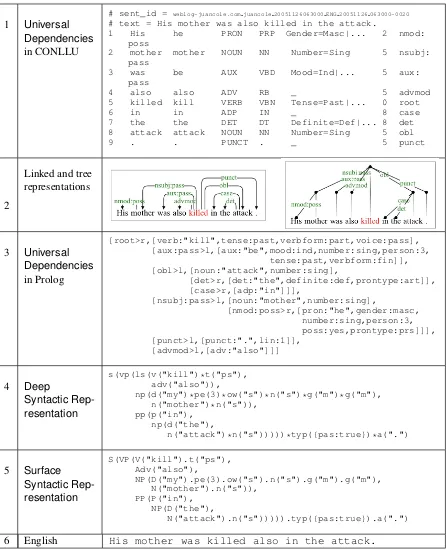
Table 1 illustrates the transformation steps
be-tween an input UD (row 1) and an English
sen-tence using a short example from the train set
(en_ewt-ud-train.conllu). Row 1 shows
the CONLLU format,3 a series of tab separated
lines into fields giving information for each token of the sentence. Row 2 shows the dependencies either as a set of links between words (on the left part) or as a tree (on the right) Row 3 shows the Prolog structure corresponding to the tree which
is transformed into the Deep Syntactic
Repre-sentationshown in Row 4. Row 5 shows the Sur-face Syntactic Representationwhich is used by
JSREALB to realize the sentence shown in Row 6.
2.1 UDin Prolog
The first step is to parse a group of lines in
CON-LLU format corresponding toUDstructure and to
build the corresponding tree. The root is easily
identified: itsHEAD(field 7) is 0. Its children are
found by looking for lines that have the root as
HEAD. Each child is then taken as the root of the
subtree and recursively parsed and transformed in the following format, using the official CONLLU field names:
[DEPREL>LR, [UPOS:LEMMA | FEATS]
| children]
LRis eitherlorrdepending on whether the
re-lation is to the left or the right of theHEAD. In
Pro-log, “|” separates the start of a list within brackets
from the rest of the list which can be empty. This representation keeps intact the parent-child relations and the relative ordering between the children, it also keeps track of the fact that some children occur to the left or to the right of the
par-ent. This is easily inferred from the ID of each
token compared with the value of itsHEAD. This
3https://universaldependencies.org/
1 Universal Dependencies
in CONLLU
# sent_id = weblog-juancole.com juancole 20051126063000 ENG 20051126 063000-0020
# text = His mother was also killed in the attack.
1 His he PRON PRP Gender=Masc|... 2 nmod: poss
2 mother mother NOUN NN Number=Sing 5 nsubj: pass
3 was be AUX VBD Mood=Ind|... 5 aux: pass
4 also also ADV RB _ 5 advmod
5 killed kill VERB VBN Tense=Past|... 0 root
6 in in ADP IN _ 8 case
7 the the DET DT Definite=Def|... 8 det 8 attack attack NOUN NN Number=Sing 5 obl
9 . . PUNCT . _ 5 punct
2
Linked and tree representations
3 Universal Dependencies
in Prolog
[root>r,[verb:"kill",tense:past,verbform:part,voice:pass], [aux:pass>l,[aux:"be",mood:ind,number:sing,person:3,
tense:past,verbform:fin]], [obl>l,[noun:"attack",number:sing],
[det>r,[det:"the",definite:def,prontype:art]], [case>r,[adp:"in"]]],
[nsubj:pass>l,[noun:"mother",number:sing],
[nmod:poss>r,[pron:"he",gender:masc, number:sing,person:3, poss:yes,prontype:prs]]], [punct>l,[punct:".",lin:1]],
[advmod>l,[adv:"also"]]]
4 Deep
Syntactic Rep-resentation
s(vp(ls(v("kill")*t("ps"), adv("also")),
np(d("my")*pe(3)*ow("s")*n("s")*g("m")*g("m"), n("mother")*n("s")),
pp(p("in"), np(d("the"),
n("attack")*n("s")))))*typ({pas:true})*a(".")
5 Surface Syntactic Rep-resentation
S(VP(V("kill").t("ps"), Adv("also"),
NP(D("my").pe(3).ow("s").n("s").g("m").g("m"), N("mother").n("s")),
PP(P("in"), NP(D("the"),
N("attack").n("s"))))).typ({pas:true}).a(".")
[image:3.595.74.520.59.609.2]6 English His mother was killed also in the attack.
Table 1: Representations used in the transformation of theUniversal Dependenciesin CONLLU format in row 1
to the sentence shown in row 6.
is useful in some cases for putting compounds and complements before or after the head. But for the
T1andT2, this information is not reliable because
the nodes have been permuted and it is the job of the realizer to get the compound and complements in the right order.
2.2 Deep Syntactic Representation(DSR)
TheDSRis an intermediary Prolog structure that
corresponds to the constituency tree of the real-ized sentence. A Definite Clause Grammar (DCG)
transforms this structure into theSurface
pos-sible to create theSSRdirectly, but, for technical reasons, it proved more convenient to use this in-termediary step.
The creation of theDSRfrom theUDin Prolog,
which is the core part of the system, is described
in Section3.
2.3 Surface Syntactic Representation
(SSR)
The SSRis the input form for JSREALB(Molins
and Lapalme, 2015), a surface realizer
writ-ten in JavaScript similar in principle to
SIMPLENLG (Gatt and Reiter, 2009) in which programming language instructions create data structures corresponding to the constituents of the sentence to be produced. Once the data structure (a tree) is built in memory, it is traversed to produce the list of tokens of the sentence.
This data structure is built by function calls whose names are the same as the symbols usually
used for classical syntax trees: for example, Nto
create anoun structure, NPfor anoun phrase, V
for a verb, D for a determiner, S for a sentence
and so on. Options added to the structures using the dot notation can modify the values according to what is intended.
The JSREALB syntactic representation is
pat-terned after classical constituent grammar nota-tions. For example:
S(NP(D("a"),N("woman")).n("p"), VP(V("eat"),
NP(D("the"), A("red"),
N("apple"))).t("ps"))
is the JSREALB specification for Women ate
the red apple. Plural is indicated with the
optionn("p")wherenindicates the number and
"p"plural; this explains why the determiner"a"
does not appear in the output. The verb is
conju-gated to past tense indicated by the option tenset
with value"ps". Agreement within the NPand
betweenNPandVPis performed automatically.
JSREALB is aimed at web developers that want
to produce web pages from data.4 It takes care
of morphology, declension and conjugation to cre-ate well-formed texts. Some options allow adding HTML tags to the realized text.
An interesting feature of JSREALB, inspired
by a similar mechanism in SIMPLENLG, is
4Tutorial and demos are available at http:
//rali.iro.umontreal.ca/JSrealB/current/ documentation/in_action/README.html
the fact that once the sentence structure has been built, many variations can be obtained by adding a set of options to the sentences, to get
negative, progressive, passive, modality and
some type of questions. For example, adding
.typ({neg:true,pas:true,mod:"poss"}) to
the previous JSREALB structure will be realized
as The red apple cannot be eaten by women., a negative passive sentence with a modal verb for possibility.
Row 5 of Table1is theJSREALB structure that
is realized as the bottom part of the table. The structure of constituents written as an active sen-tence has been realized as a passive one, the orig-inal complement becoming the subject. The verb was also conjugated to the past tense. This was
made possible by the options given toJSREALB.
3 Deep Syntactic Representation
We now describe how a UD in Prolog is
trans-formed into aDSR. The main idea is to reverse
engineer the universal dependencies annotation
guidelines5.
3.1 Morphology
Word forms in UDare lists without children that
are mapped to terminal symbols inJSREALB. So
we transform theUDnotation to theDSRone by
mapping lemma and feature names, see Table2.
As shown in the last example, we had to
nor-malizepronouns to whatJSREALB considers as its
base form. In the morphology principles ofUD6,
it is specified that
treebanks have considerable leeway in interpreting what “canonical or base form” means
In the English UD corpora, it seems that the
LEMMAof pronoun is always the same as itsFORM.
We decided tolemmatize furtherinstead of merely
copying the lemma as a string input toJSREALB
so that verb agreement can be performed.
What should be a LEMMA is a hotly discussed
subject on theUDGitHub, but there are still too
many debatable lemmas such as an, n’t, plural
nouns etc. In one corpus, lowercasing has been ap-plied to some proper nouns, but not all. We think
5
https://universaldependencies.org/ guidelines.html
6https://universaldependencies.org/u/
UD J SRE A LB
[noun:"mother",number:sing] n("mother")*n("s") [verb:"be",mood:ind,number:sing,person:3, v("be")*t("p")*pe(3)
tense:pres,verbform:fin]
[image:5.595.66.510.61.125.2][pron:"we",case:nom,number:plur,person:1, pro("I")*n("p")*pe(1) prontype:prs]
Table 2: Some examples of mapping betweenUDfeatures andJSREALB options
it would be preferable to do a moreaggressive
lemmatization to lower the number of base forms in order to help further NLP processing that is of-ten dependent on the number of different types.
3.2 UDtoDeep Syntactic Representation
The essential idea is to transform recursively each
child to produce a list of DSRs labeled with the
name of the relation. The head of the relation is used as the constituent to which are added the de-pendents.
According to the annotation guidelines, there are two main types of dependents: nominals and
clauses7 which themselves can be simple or
com-plex.
Nominals are triggered when the head is ei-ther a noun, an adjective, a proper noun, a pro-noun or a number. When it is a pro-noun, most often
a NP is created using information gathered from
the dependents depending on their part of speech
tags such as det, nummod, amod, compound
or nmod:poss. Special cases are needed for
proper nouns, possessives with’s, prepositional
phrases and appositions. Nouns and adjectives can be transformed to a sentence when its dependent is ansubjwith a possiblecop; if the copula is not
given, thenbeis used.
Clauses (both simple and complex) are trig-gered when a verb is encountered as the head. In
this case, aSis created taking as subject aexpl
or nsubj; the Vof the VP is the lemma of the head and the complements are all other dependen-cies in order of appearance which corresponds to the order of the original sentence.
Prepositional phrases are dealt specially by re-moving the preposition and dealing with the other
dependents like an ordinary clause that is then
nested into the prepositional phrase. Proper nouns
withflatdependents are built beforehand.
This mechanism (25 rules in 100 lines of com-mented and indented Prolog) was first developed by reading the annotation guidelines and then
re-fined by experience on theUDcorpus.
7not to be confused with the Prolog clauses...
This exercise in transforming UDstructures to
JSREALB revealed an important difference in their
level of representation. By designUDstays at the
level of the form in the sentence, whileJSREALB
works at the constituent level. For example, in
UD, negation is indicated by annotatingnot and
the auxiliary elsewhere in the sentence, while in
JSREALB the negation is given as anoptionfor the
whole sentence. So before starting the transforma-tion previously described, the structure is checked
for the occurrence ofpart:"not" and an
aux-iliary to generate the.typ({neg:true})
op-tion for JSREALB; these dependents are then
removed for the rest of the processing.
Simi-lar checks must also be performed for passive constructs, modal verbs, progressive, perfect and
even future tense in order to abstract the UD
annotations into the corresponding structure for
JSREALB.
3.3 T1toDeep Syntactic Representation
The algorithm given in the previous section cannot
be used directly on the input of theShallow Track
because the word order has been permuted while keeping the intact the relations between the words.
Proper lemmatization is performed by
JSREALB. Unfortunately, lemmatization for
T1is not always systematic, there are a few cases
such as grounds or rights where the plural was
left in the lemma; no pronoun is lemmatized,
so we find he, them, she, it while a canonical
pronoun should be used, JSREALB uses I. Not
having to find the appropriate pronoun simplifies realization because this is one of the difficulties of English generation whose morphology is otherwise relatively simple at least compared to other languages.
# sent_id = weblog-juancole.com_juancole_20051126063000_ENG_20051126_063000-0020 # text = His mother was also killed in the attack.
1 kill _ VERB _ Tense=Past|id2=1|id1=9|original_id=5|... 0 ROOT 2 mother _ NOUN _ Number=Sing|id1=3|original_id=2 ... 1 A2 3 also _ ADV _ id1=7|original_id=4 ... 1 A1INV 4 attack _ NOUN _ Number=Sing|id2=5|id1=2|id3=8|origina... 1 AM 5 he _ PRON _ Number=Sing|id1=4|Poss=Yes|original_i... 2 AM
['ROOT'>r,[verb:"kill",tense:past,clausetype:dec], ['A2'>r,[noun:"mother",number:sing],
['AM'>r,[pron:"he",number:sing,poss:yes,person:3,prontype:prs]]], ['A1INV'>r,[adv:"also"]],
['AM'>r,[noun:"attack",number:sing,definite:def]]]
s(vp(v("kill")*t("ps"), adv("also"),
np(d("my")*pe(3)*ow("s")*n("s")*g("m"), n("mother")*n("s")),
pp(p("in"), np(d("the"),
n("attack"))*n("s"))))*typ({pas:true})
[image:6.595.69.523.55.307.2]His mother was killed also in the attack.
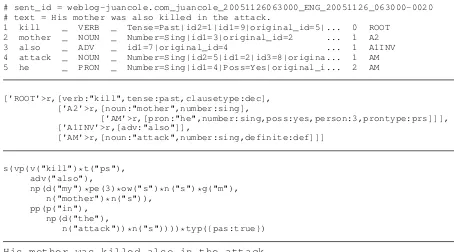
Table 3: TheT2dependency given at the top is parsed into the nested list structure shown in the second line; theid
andoriginal idfeatures are ignored as they are given for easing the training of learning algorithms. It is then
transformed into aDeep Syntactic Representationshown in the third line and then into aSurface Syntactic
Representation(not shown here) which is given toJSREALB to realize the sentence shown at the bottom which
is the same as the original sentence given at the top of Table1.
order of relation name is chosen so that a subject appears before the verb or its complements, a de-terminer will be placed before an adjective and a noun, etc.
Once theT1structure has been sorted, it is
pro-cessed like aUDstructure using the algorithm
de-scribed above. In this case, the algorithm does not use the fact the left or right position of the chil-dren in relation to the head; this relation being lost
by the permutation applied in creatingT1. For the
two previous examples, the sorting process
recre-ates almost exactly the structure of the originalUD
and the output sentence is the same. This hap-pens because small differences in the placement
ofaux,markorprepdo not change the
realiza-tion.
3.4 T2toDeep Syntactic Representation
The SR’19 documentation dataset8 provides a
mapping between the universal dependencies and
the ones used forT2. So we adapted the algorithm
given for theUDby changing the names of the
re-lations.
The tree is built by reading the T2
dependen-cies and the dependents are sorted at each level
8http://taln.upf.edu/pages/msr2019-ws/
srst_dataset_doc.txt
according to the relation names. Then theNAME
dependents are processed using the linear order in-formation.
Using a similar process as described forUD, we
deal with nominals and clauses. For nominals, all
A1andAMdependents are used for building aNP.
A sentence is built when a verb is encountered as
a head, the subject being the value of theA1
rela-tion, the verb phrase comprises the head verb and all other dependents. Some care has to be given to
theAiINV relations that are used as relative
sen-tences for verbs and noun complements. Given the fact that important information has been removed
in theT2structures, the resultsleave much room
for improvement. It would surely be interesting to improve this output using a statistical spell or style checker.
Table 3 shows the T2 structure for the
exam-ple shown in Table 1. That this sentence should
be written in passive mode is not specified in the input, but the transformation rules indicate that a
passive subject is indicated by aA2relation
with-out any A1. Prepositions being absent from T2
structures, we computed the most frequent prepo-sition used with each word as head in the
pro-cess used in our system, but there should be more. This preposition is added for all dependents
hav-ing relationAMandAi(i>= 3). For the verbkill,
the most frequent preposition beingin, it is added
(correctly in this case) beforethe attack. The
orig-inal sentence was thus reproducedverbatimbut, of
course, this is not always the case...
4 Results and Evaluation
We ran the program on all training (≈20 000
sen-tences) and development (≈4 000sentences) sets
provided by the organizers of SR’19 for English. We also ran them on the test sets of the 2018 and 2019 competitions. Using SWI-Prolog V8.1, the whole set is processed in about 5 minutes of real time (half of which is CPU) on a 2.2 GHz Mac-Book Pro, including the production of evaluation
files, a good example ofGreen AI(Schwartz et al.,
2019).
4.1 Automatic Evaluation
4.1.1 Training and development sets
Table4shows the BLEU, NIST and DIST scores
on the 2019 training and development sets for the
four English corpora. The scores forT1andUD
are quite similar and their value are within the scores obtained by systems on a similar task in
2018. Comparing the automatic results on the
train and development sets, we see that the results
forT1are only slightly worse than the ones forUD
(especially for BLEU), so we consider that this ap-proach is valuable for this special task.
It seems to us that the permutation of the lines in the dependency file does not change the input so much to warrant a special task. In fact, from an
NLG point of view,T1seems artificial, as we
can-not imagine a generation system that determines all the tokens but in a random order.
4.1.2 Test sets
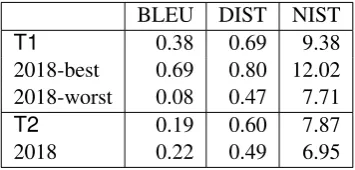
Table5 gives these scores for the test set used in
the 2018 competition. These scores are
compet-itive for T1 and only slightly less in BLEU than
the unique participant for this task in 2018. A
cur-sory manual evaluation of the output forT2shows
the need for improvement for long sentences even though the automatic scores are quite similar ex-cept for BLEU. This can be explained by the fact that a lot of information is not given in the output, but is expected to be inferred by the NLG system.
For the moment, the onlyrealinformation added
by the system is the most frequent preposition en-countered in the test and development set for com-plements of nouns or of verbs.
The 2019 test set was much more comprehen-sive with more languages and different types of corpora. Evaluation was done on both tokenized anddetokenizedinput. In the case of UD-SURFR,
as JSREALB was already realizing adetokenized
output, we had to write a tokenizer to separate the tokens in order to make the output comparable with the one of other systems working at the to-ken level and then applying some postprocessing to produce a more readable output with proper cas-ing and appropriate spaccas-ing around punctuation.
In terms of automatic scores, UD-SURFR is
com-petitive: it is more or less the average between the best and worst scores obtained by other systems. And this seems consistent across all types of
cor-pora. Figure1shows a graph of the BLEU scores
for the tokenized sentences which seem to be typi-cal of the comparison across the scores for all
par-ticipants to the tasks. ForT1(left part of the
fig-ure), the score for UD-SURFR (the black stripped
bar on the left) is approximately in the middle of
the score of other systems. ForT2, except for the
very best system, UD-SURFR does surprisingly
well compared with other participants.
4.2 Manual Evaluation
The SR’19 organizers evaluated the output of 16 systems on two aspects:
• The text adequately expresses the meaning of the sentence for which our T1 system
ob-tained 73% (ranked 11th) and T2 obtained
68% (ranked 14th) after scoring about 700 sentences; in fact these scores are not statisti-cally different from each other.
• the text reads well and is free from grammat-ical errors and awkward constructions for
with ourT1system obtained 58% which
cor-responds to the second group of system over 4. Note that the human reference only ob-tained 71% on this evaluation. These scores were based on about 550 sentences. We were
quite surprised to see that theT2system
man-aged to get 50% even though no effort was put in adding any language model.
ewt gum lines partut BLEU DIST NIST BLEU DIST NIST BLEU DIST NIST BLEU DIST NIST
train 12 543 sent. 2 914 sent. 2 738 sent. 1 781 sent.
UD 0.49 0.64 12.26 0.48 0.58 10.93 0.46 0.56 10.53 0.44 0.48 10.37
T1 0.38 0.62 10.88 0.40 0.55 10.17 0.36 0.53 9.42 0.38 0.48 9.73
T2 0.25 0.56 9.24 0.26 0.47 8.63 0.24 0.49 8.11 0.24 0.42 8.03
dev 2002 sent. 707 sent. 912 sent 156 sent.
UD 0.48 0.69 10.39 0.49 0.60 9.87 0.48 0.60 9.96 0.39 0.61 7.76
T1 0.37 0.66 9.33 0.41 0.57 9.23 0.38 0.56 9.00 0.33 0.60 7.31
[image:8.595.72.481.60.167.2]T2 0.25 0.64 8.21 0.25 0.49 7.83 0.24 0.54 7.66 0.23 0.54 6.46
Table 4: Automatic evaluation scores produced by the evaluation scripts of the SR’19 organizers on the train and
dev sets. ForUDandT1, the scores seem competitive with the ones obtained by the participants at the 2018
competition shown in Table5.
BLEU DIST NIST
T1 0.38 0.69 9.38
2018-best 0.69 0.80 12.02
2018-worst 0.08 0.47 7.71
T2 0.19 0.60 7.87
[image:8.595.210.388.222.307.2]2018 0.22 0.49 6.95
Table 5: Automatic evaluation on the 2061 sentences of the 2018 test set compared with the scores obtained by
systems participating in the 2018 shared task. Only one system provided output for theT2task.
0 10 20 30 40 50 60 70 80 90 100
en_ewt-ud-test en_gum-ud-test en_lines-ud-test en_partut-ud-test en_pud-ud-test en_ewt-Pred-HIT-edit en_pud-Pred-LATTICE Task 1 - BLEU - Tokenized
Team 2 Team 1 Team 3 Team 4 Team 6 Team 7 Team 8 Team 9 Team 11 Team 12 Team 13
0 10 20 30 40 50 60
en_ewt-ud-test en_gum-ud-test en_lines-ud-test en_partut-ud-test en_pud-ud-test en_ewt-Pred-HIT-edit en_pud-Pred-LATTICE Task 2 - BLEU-Tokenized
Team 2 Team 5 Team 9 Team 10 Team 13
Figure 1: Comparison for BLEU scores for T1 (left) andT2 (right) on tokenized sentences from the English
corpora for UD-SURFR (Team 2) shown as the first black stripped bar to the left compared with the scores obtained
by other participants.
5 Conclusion
We have described a symbolic approach for
tack-ling the tasksT1andT2 of SR’19. We first
de-scribed the development of UD-SURFR, a text
realizer for standard UD input that can be used
for checking the annotation. We then described
UD-SURFR was modified to take into account the
specificities of the shared task. The system has processed the training, development and test sets of the competition and obtained average results compared to other machine learning approaches. This is quite surprising given the fact, that the
symbolic system only used a very small part of the training and development corpora. But more important, the experiment has revealed that task
T1 (for English at least) is perhaps too easy and
does not really correspond to a realistic input for a
text realizer. T2proved more challenging but the
[image:8.595.79.522.356.519.2]References
Albert Gatt and Ehud Reiter. 2009. SimpleNLG: A
re-alisation engine for practical applications. In Pro-ceedings of the 12th European Workshop on Natural Language Generation (ENLG 2009), pages 90–93, Athens, Greece. Association for Computational Lin-guistics.
Simon Mille, Anja Belz, Bernd Bohnet, Yvette
Gra-ham, and Leo Wanner. 2019. The Second
Mul-tilingual Surface Realisation Shared Task (SR’19):
Overview and Evaluation Results. InProceedings of
the 2nd Workshop on Multilingual Surface Realisa-tion (MSR), 2019 Conference on Empirical Methods in Natural Language Processing (EMNLP), Hong Kong, China.
Simon Mille, Anja Belz, Bernd Bohnet, and Leo
Wan-ner. 2018. Underspecified universal dependency
structures as inputs for multilingual surface reali-sation. In Proceedings of the 11th International Conference on Natural Language Generation, pages 199–209, Tilburg University, The Netherlands. As-sociation for Computational Linguistics.
Paul Molins and Guy Lapalme. 2015.JSrealB: A
bilin-gual text realizer for web programming. In Pro-ceedings of the 15th European Workshop on Natu-ral Language Generation (ENLG), pages 109–111, Brighton, UK. Association for Computational Lin-guistics.
Joakim Nivre, Marie-Catherine de Marneffe, Filip Gin-ter, Yoav Goldberg, Jan Hajiˇc, Christopher D. Man-ning, Ryan McDonald, Slav Petrov, Sampo Pyysalo, Natalia Silveira, Reut Tsarfaty, and Daniel Zeman.
2016. Universal dependencies v1: A multilingual
treebank collection. InProceedings of the Tenth In-ternational Conference on Language Resources and Evaluation (LREC 2016), pages 1659–1666, Por-toroˇz, Slovenia. European Language Resources As-sociation (ELRA).
Aarne Ranta and Prasanth Kolachina. 2017. From
universal dependencies to abstract syntax. In Pro-ceedings of the NoDaLiDa 2017 Workshop on Uni-versal Dependencies (UDW 2017), pages 107–116, Gothenburg, Sweden. Association for Computa-tional Linguistics.
Roy Schwartz, Jesse Dodge, Noah A. Smith, and Oren