Eye Tracking as a Tool for Machine Translation Error Analysis
Sara Stymne, Henrik Danielsson, Sofia Bremin, Hongzhan Hu, Johanna Karlsson,
Anna Prytz Lillkull, Martin Wester
Link¨oping University, Sweden
Corresponding authors:{sara.stymne,henrik.danielsson}@liu.se
Abstract
We present a preliminary study where we use eye tracking as a complement to machine translation (MT) error analysis, the task of identifying and classifying MT errors. We performed a user study where subjects read short texts translated by three MT systems and one human translation, while we gathered eye tracking data. The subjects were also asked comprehension questions about the text, and were asked to estimate the text quality. We found that there are a longer gaze time and a higher number of fixations on MT errors, than on correct parts. There are also differences in the gaze time of different error types, with word order errors having the longest gaze time. We also found correlations between eye tracking data and human estimates of text quality. Overall our study shows that eye tracking can give complementary information to error analysis, such as aiding in ranking error types for seriousness.
Keywords:Machine translation evaluation, eye tracking, error analysis
1.
Introduction
Evaluation of machine translation is a difficult task, both for humans and using automatic metrics. MT systems are often evaluated using automatic metrics, such as Bleu (Papineni et al., 2002), which commonly rely on comparing a trans-lation to only a single human reference transtrans-lation. Such a quantitative evaluation does not give any indications of the particular problems with a system. In addition, they need a large test set and the correlation with human judgments has been debated (Callison-Burch et al., 2006; Chiang et al., 2008). The most common type of human evaluation is estimations of adequacy and fluency, which can be useful, but is expensive and gives little information about particu-lar strengths and weaknesses of the system. An alternative evaluation method is human error analysis, where errors in the MT output are identified and classified into different categories.
We have performed a preliminary study where we inves-tigated the possibility of using eye tracking as a comple-ment to other types of MT error analysis, by recording the eye movements of people reading machine translated texts. Our hypotheses were that bad MT output is harder to read than good MT output and that certain types of errors will take longer time for a reader to process.
2.
Related Work
A very common way to evaluate MT systems is by using automatic metrics. The vast majority of automatic metrics, such as Bleu (Papineni et al., 2002) or Meteor (Denkowski and Lavie, 2010), are based on some way of calculating the closeness to one or more human reference translation, mostly giving a single system score for a collection of sen-tences. Using automatic metrics is fast and cheap, and can be useful, especially for comparing incremental versions of the same system, or for systems with a similar architecture. Metrics, however, usually only give a single quantitative score, and do not give much information about particular strengths and weaknesses of the system, even though dif-ferent metrics focus on difdif-ferent aspects of the translation. Comparing scores from different metrics can give a very
rough indication of major differences, especially in combi-nation with a part-of-speech analysis (Popovi´c et al., 2006). Another evaluation possibility is human evaluation, which is often performed in order to compare several MT systems. It can be in the form of estimates of values such as adequacy and fluency, or by ranking sentences from differ-ent systems (e.g. Callison-Burch et al. (2007)). A combi-nation of human and automatic metrics is human-targeted metrics such as HTER, where a human post-edits the output of a system to the closest correct translation, on which stan-dard metrics such as TER is then computed (Snover et al., 2006). While both these types of evaluation are certainly useful, they are expensive and time-consuming, and still give only a quantitative score for each system, not telling us much about the particular errors of a system. These types of human evaluation work best with bilingual evaluators, who can compare the system output with the source sentence. It is also possible to present monolingual evaluators with one or several human reference translations as a source of com-parison (Callison-Burch et al., 2007); this might, however, result in biased scores depending on certain choices made by the translator of the reference sentences.
dif-the odif-ther error types, and since dif-the errors made on dif-these categories were quite similar for all systems. The error analysis was performed by two of the authors, both native Swedish speakers. On a sample analysis the two annota-tors had an error classification agreement of 87.8% (Kappa: 0.63).
3.2. MT Systems
We included three different English–Swedish MT systems in the study. All were standard phrase-based statistical machine translation systems, built using the Moses toolkit (Koehn et al., 2007) and trained on the Europarl corpus (Koehn, 2005). Two systems differ in the amount of train-ing data:Smallwas trained on 100,000 sentences andLarge on 701,157 sentences. The third system,Compis trained with the same number of sentences as Large, but with the addition of a compound processing module (Stymne and Holmqvist, 2008). While the compounding module focused on processing compounds, this change also had other effects, since it affected the whole translation process, for instance by affecting the overall word alignment. We also compare the three MT systems to the human reference translation in Europarl,Human.
3.3. Procedure
Each subject read four different texts, one from each MT system and one human translation. The order and combi-nations of the texts and systems were balanced between the subjects. Each of the four texts was shown on the screen and the eye movements were recorded. The subjects were asked to read for comprehension and told that they would answer comprehension questions after they finished read-ing. There was no limit on the reading time; the subjects decided themselves when they had finished reading a text. After reading each text, the subjects were given a question-naire with reading comprehension questions and estima-tion quesestima-tions. There were three multiple-choice quesestima-tions about the text content, and subjects were also asked to give confidence ratings of their answers on these questions. We also had three estimation questions, where subjects were asked to judge the fluency of the text, their experienced comprehension of the text, and the perceived amount of er-rors in the text on an 8-point scale.2
4.
Results
In this section we first present the results on the contrastive evaluations: automatic metrics and error analysis. We then go on to discuss the results of the user study and the cor-relations between the different evaluation types. To calcu-late significance we used a repeated measures analysis of variance (ANOVA), except on the automatic metrics, where we used approximate randomization (Riezler and Maxwell, 2005).
4.1. Contrastive Evaluations
We evaluated the three SMT systems on two test sets, both the short texts used in the experiments, aggregated, with a
2The common featureadequacycould not be estimated, since the subjects did not see the source text.
Short texts Large test set Bleu Meteor Bleu Meteor
Comp 17.48 58.02 22.12 58.43
Large 16.96 58.58 21.63 57.86 Small 14.33 55.67 20.79 56.82
Table 1: Metric scores
Figure 1: Frequencies of errors
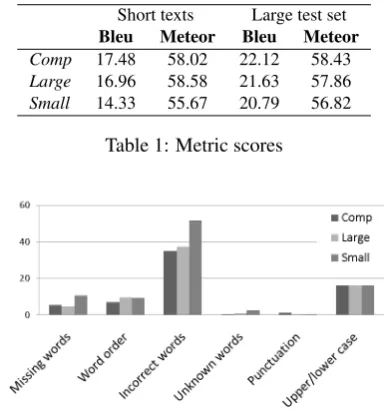
total of 80 sentences and on a standard 2000 sentence Eu-roparl test set. Table 1 shows Bleu (Papineni et al., 2002) and Meteor (Lavie and Agarwal, 2007) scores, on the two test sets, calculated based on one human reference. On both test sets,Smallis significantly worse, on the 5%-level, than the other systems on both metrics. Compis significantly better thanLargeon both metrics on the large test set, but on the short texts, there are no significant differences be-tween these two systems, but the trend of which system is better is opposite on the two metrics. This contrast illus-trates the challenge of evaluating systems with small qual-ity differences on short texts.
Figure 1 shows the results of the error analysis, for the three MT systems. A repeated measures analysis of vari-ance (ANOVA) showed significant differences between the three systems (F(2,6) = 13.39, p < .05), between the six error types (F(5,15) = 41.84, p < .05), and for the interaction between system and error type (F(10,30) = 8.59, p < .05).3 The Smallsystem has the highest num-ber of errors, especially for incorrect and missing words, which is not surprising considering that it is trained on less data than the other systems, Comphas fewer errors than Largeand incorrect words is by far the most common error in all systems.
4.2. User Study
For the full texts, there was no significant differences be-tween all the translations either for overall gaze time or for fixation count. Errors had both a significantly higher num-ber of fixations, 3.3 compared to 2.5 (F(1,21) = 0.58, p < .05) and a significantly higher average gaze time, 1418 ms compared to 998 ms (F(1,21) = 8.55, p < .05) than the control markers, also shown in Figure 2.
3
Standard notation for ANOVA results are used. In the formula
F(n, m) = x, p < .05,F means that the F-test is used,n is the degrees of freedom for the between groups variance,mis the degrees of freedom for the error variance,xis the F-value and
Figure 2: Average fixation count (left) and gaze time (right) for error and control boxes. Error bars show the 95% con-fidence interval.
Figure 3: Average gaze time in the error boxes for the MT systems
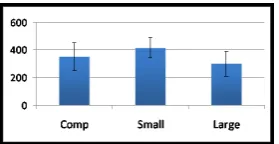
There was also a significant difference between the av-erage gaze time of errors in the three different systems (F(1,21) = 3.98, p < .05), as shown in Figure 3. The Smallsystem had longer average gaze time per error (415 ms) thanComp(350 ms) andLarge(298 ms). This is differ-ent from the number of errors, which were fewest inComp and is an indication that the errors that occur inSmalland to some extent inComp, might be more serious than the errors inLarge, since they take longer time for readers to process. The different types of errors have significantly different average gaze time (F(3,63) = 8.55, p < .05), as shown in Figure 4. Word order errors have the longest average gaze time, followed by incorrect and missing words, with unknown words having the shortest time. All subjects had a good command of English; the fixations on the unknown English words would probably be more and longer with a source language that the subjects do not know.
The results on the reading comprehension and quality estimations are shown in Table 2. The differences be-tween the four translations are not significant, but there are some overall trends. The number of correct answers on the reading comprehension questions is actually higher for the Largesystem than for the human reference, but the confi-dence of the correct answers is lower. On the estimation questions, the human translation is markedly better than all machine translated options. On both the estimation ques-tions and reading comprehension,Largeis best andSmall is worse, withCompin the middle.
We also investigated Pearson correlations between the eye tracking results and human estimates per system. For Compthere were significant correlations between total fix-ation count and estimated fluency,r=−.39and estimated comprehension, r = −.45 and between total gaze time and estimated errors, r = .37 and estimated comprehen-sion, r = −.37. For Largethere were significant corre-lations between total fixation count and estimated fluency,
Figure 4: Average gaze time (ms) for different types of er-rors
r=−.61and estimated errors,r=.40and between total gaze time and estimated fluency,r = −.38and estimated errors,r =.37. This shows that there are some moderate correlations between eye tracking measurements and hu-man estimates, but they are not consistent for all systems.
5.
Conclusion
We presented a preliminary study that showed that eye tracking can give information that complements other types of error analyses. Using Bleu or human estimates, it was hard to find differences between the systems, especially be-tween the two best systems,CompandLarge. Using either error analysis or eye tracking, however, we were able to identify some differences between the systems.
We also showed that MT errors have both longer gaze times and more fixations than correct passages. Most im-portantly, we showed that the average gaze time is depen-dent on error types. This could be an indication that some error types are more disturbing for readers than others.
This study is small and preliminary, and there is plenty of room for more and larger studies on this theme. We would especially like to extend this study by using a more fine-grained error typology, since there likely are differences between the errors within each of our rather large error cat-egories. It would also be interesting to test the methods on a post-editing scenario, on other language pairs, and on other translation systems. We also want to perform a qualitative investigation of parts in the texts that have long and many fixations. In our study we did not normalize for the size of the error boxes. While we strived to keep them of similar size by mainly marking one or two words, it would have been better to normalize the results based on box size.
Matthew Snover, Bonnie Dorr, Richard Schwartz, Linnea Micciulla, and John Makhoul. 2006. A study of transla-tion edit rate with targeted human notatransla-tion. In Proceed-ings of the 7th Conference of the Association for Machine Translation in the Americas, pages 223–231, Cambridge, Massachusetts, USA.
Sara Stymne and Maria Holmqvist. 2008. Processing of Swedish compounds for phrase-based statistical machine translation. InProceedings of the 12th Annual Confer-ence of the European Association for Machine Transla-tion, pages 180–189, Hamburg, Germany.