.
RESEARCH PAPER.
Quantum key-recovery attack on Feistel structures
Xiaoyang DONG
1& Xiaoyun WANG
1,2 *1Institute for Advanced Study, Tsinghua University, P. R. China;
2Key Laboratory of Cryptologic Technology and Information Security, Ministry of Education,
Shandong University, P. R. China
{xiaoyangdong,xiaoyunwang}@tsinghua.edu.cn
Received ; accepted
Abstract Post-quantum cryptography has drawn considerable attention from cryptologists on a global scale. At Asiacrypt 2017, Leander and May combined Grover’s and Simon’s quantum algorithms to break the FX-based block ciphers, which were introduced by Kilian and Rogaway to strengthen DES. In this study, we investigate the Feistel constructions using Grover’s and Simon’s algorithms to generate new quantum key-recovery attacks on different rounds of Feistel constructions. Our attacks require 2nr/4−3n/4 quantum queries to break an r-round Feistel construction. The time complexity of our attacks is less than that observed for quantum brute-force search by a factor of 20.75n. When compared with the best classical attacks, i.e., Dinuret al.’s attacks at
CRYPTO 2015, the time complexity is reduced by a factor of 20.5nwithout incurring any memory cost.
Keywords Quantum cryptanalysis, Quantum key-recovery, Feistel structure, Simon, Grover
Citation Dong X Y, Wang X Y. Quantum key-recovery attack on Feistel structures. Sci China Inf Sci, 2016, (): xxxxxx, doi: xxxxxxxxxxxxxx
1
Introduction
Due to the rapid development of quantum computers, the security of classical cryptographic schemes is heavily debated. The most severe and notable threat is the Shor’s algorithm [1] which breaks the most currently used public-key systems (such as the RSA [2] and elliptic-curve cryptosystems). Re-cently, researchers have observed that quantum computing not only impacts public key cryptography, but also breaks several secret key schemes in polynomial time, such as Even-Mansour block cipher-s [3, 4] and cipher-some widely ucipher-sed modecipher-s of operation for authentication and authenticated encryption (e.g.
CBC-MACs, PMAC, GMAC, etc.) [5]. Investigation of the security of several classical and relevant cryptographic schemes against quantum attacks is urgently required. At Asiacrypt 2017, Moody [6] on behalf of National Institute of Standards and Technology (NIST) reported the ongoing competition for post-quantum cryptographic algorithms, including signatures, encryptions, and key-establishments. The ship for post-quantum crypto has sailed, cryptographic communities should become ready to welcome the post-quantum age.
In case of a quantum computer, the adversaries were able to generate quantum queries on some super-position quantum states of the relevant cryptosystem, which is the so-called quantum chosen-plaintext
i
F
i
k
x
Ri1i L
x
i R
x
1
i L
x
Figure 1 Theith round of the Feistel structure
attacks (qCPA) [7]. It is known that using the Grover’s algorithm [8] could accelerate the brute force search. Given an m-bit key, the Grover’s algorithm allows for the recovery of the key using O(2m/2) quantum steps. It is observed that doubling the key length of one block cipher could achieve a similar amount of security against quantum attackers. However, Kuwakado and Morii [4] identified a new family of quantum attacks that target certain generic constructions of secret key schemes. They exhibited that the Even-Mansour ciphers could be broken in polynomial time using Simon’s algorithm [9], which could estimate the period of a periodic function in polynomial time in case of a quantum computer. Kaplan
et al.[5] revealed that several widely used modes of operation for authentication and authenticated en-cryption, such as CBC-MAC, PMAC, GMAC and some CAESAR candidates, could also be broken by Simon’s algorithm.
Feistel block ciphers [10] are observed to be important and constitute one of the extensively researched cryptographic schemes. Several block cipher standards, such as DES, Triple-DES, MISTY1, Camellia, and CAST-128 [11], are based on the Feistel design. In a seminal work, Luby and Rackoff [12] proved that a three-round Feistel scheme can securely perform pseudo-random permutation. However, Kuwakado and Morii [13] introduced a quantum distinguisher attack on 3-round Feistel ciphers, that could distinguish between the cipher and a random permutation in polynomial time. In a classical setting, Dinuret al.[14] generated a series of key-recovery attacks on 5- to 32-round Feistel ciphers. However, there are no key-recovery attacks that are observed on Feistel ciphers in the qCPA setting.
In this study, we consider the quantum key-recovery attack on Feistel schemes for the very first time. As depicted in Figure 1, in theith round of the Feistel structure, then-bit blocks were divided into two equal parts, (xLi−1, xRi−1), whereas then/2-bit subkeyskiwere wrapped into the round function,Fi. The output is (xLi, xRi). Similar to the attacks of Dinuret al.[14], our attacks also constitute generic attacks that assume that the round functions in each round of the Feistel cipher are not necessarily identical and that the round keys, ki, are independent of each other. Hence, using Grover’s algorithm to perform a brute-force search on all the subkeys,ki, of an r-round Feistel cipher will require 2nr/4quantum queries.
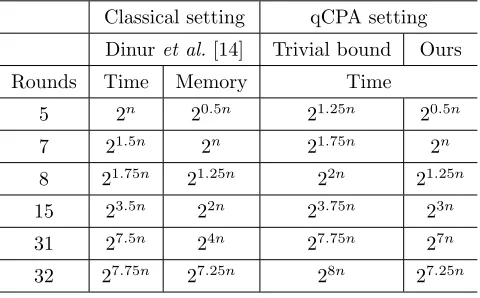
We combine Grover’s and Simon’s algorithms to generate a series of quantum key-recovery attacks on different rounds of Feistel structures. Our attacks require 2nr/4−3n/4quantum queries, which reduces the time complexity by a factor of 20.75nas compared with that observed in the quantum brute-force search. When compared with the best classical attacks, i.e., those observed by Dinur et al. [14], our results reduce the time complexity by a factor of 20.5n without incurring any memory cost. All the results are summarized in Table 1.
2
Related Works
Our quantum attacks are based on two of the most popular quantum algorithms, namely Simon’s algo-rithm [9] and Grover’s algoalgo-rithm [8].
Table 1 Summary of the key-recovery attacks on Feistel schemes in classical and qCPA settings
Classical setting qCPA setting
Dinuret al. [14] Trivial bound Ours
Rounds Time Memory Time
5 2n 20.5n 21.25n 20.5n
7 21.5n 2n 21.75n 2n
8 21.75n 21.25n 22n 21.25n
15 23.5n 22n 23.75n 23n
31 27.5n 24n 27.75n 27n
32 27.75n 27.25n 28n 27.25n
The optimal time to solve the problem isO(2n/2). However, Simon [9] presents a quantum algorithm
that provides exponential speedup and requires only O(n) quantum queries to find a. The algorithm includes five quantum steps that are as follows:
I. Initialization of twon-bit quantum registers to state|0i⊗n|0i⊗n. Then apply the Hadamard trans-form to the first register to attain an equal superposition in the following manner:
H⊗n|0i|0i= √1
2n X
x∈{0,1}n
|xi|0i. (1)
II. A quantum query to the functionf maps this to
1 √
2n X
x∈{0,1}n
|xi|f(x)i.
III. While measuring the second register, the first register is observed to collapse to the following state:
1 √
2(|zi+|z⊕ai).
IV. Applying the Hadamard transform to the first register, we obtain:
1 √ 2
1 √
2n X
y∈{0,1}n
(−1)y·z(1 + (−1)y·a)|yi.
V. The vectors,y, are selected such that y·a= 1 depict an amplitude of zero. Hence, measuring the state yields a value,y, which depicts thaty·a= 0.
RepeatO(n) times, we can obtainaby solving a system of linear equations.
Kuwakado and Morii [4] used Simon’s algorithm to break the Even-Mansour (EM) cipher [3]. For a given permutationP, the EM cipher isEnc(x) =P(x⊕k1)⊕k2. Classically, an EM cipher is secure for
up to 2n/2queries, wherenis the input size ofP. However, using Simon’s algorithm [9], Kuwakado and Morii [4] presented a quantum key-recovery attack on EM ciphers with a time complexity ofO(n). They define f(x) =Enc(x)⊕P(x) =P(x⊕k1)⊕P(x)⊕k2. Clearly, it is a periodic function that satisfies
f(x⊕k1) =f(x).
0
k
E
1k
k
2x
Enc x
( )
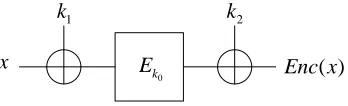
Figure 2 FX constructions
I. Initialization of an-bit register|0i⊗n. Apply the Hadamard transform to the first register to attain an equal superposition that can be given as follows:
H⊗n|0i= √1
2n X
x∈{0,1}n
|xi=|ϕi. (2)
II. Construct an oracle O: |xi −O→ (−1)f(x)|xi, where f(x) = 1 if x is the correct state; otherwise,
f(x) = 0.
III. Apply Grover’s iterationR≈π
4
√
2n times that can be given as follows:
[(2|ϕihϕ| −I)O]R|ϕi ≈ |x0i.
IV. returnx0.
Further, Brassardet al.[15] generalized the Grover search as an amplitude amplification method.
Theorem 1. (Brassard, Hoyer, Mosca and Tapp [15]). LetA be any quantum algorithm onq qubits that performs no measurement. LetB:Fq2→ {0,1} be a function that classifies the outcomes of
Aas either good or bad state. Letp >0 be the initial success probability that the measurement ofA|0i is good. Setk =dπ
4θe, where θ is defined usingsin
2(θ) =p. Furthermore, define the unitary operator
Q=−AS0A−1SB, where the operator SB changes the sign of the good state,
|xi 7→ (
−|xiifB(x) = 1,
|xiifB(x) = 0.
Further,S0 changes the sign of the amplitude only in case of the zero state|0i. Finally, after performing
the computation ofQkA|0i, the measurement yields a good state with probability a least max{1-p,p}.
Assume that|ϕi=A|0iis the initial vector, whose projections on the good and the bad subspace are denoted by|ϕ1iand |ϕ0i, respectively. The state|ϕi=A|0iexhibits an θ with a bad subspace, where
sin2(θ) =p. EachQiteration increases the angle to 2θ. Hence, afterk≈ π
4θ, the angle is observed to be approximately equal toπ/2. Therefore, the state afterk iterations is almost orthogonal to that of the bad subspace. After measurement, it produces a good vector with high probability.
At Asiacrypt 2017, Leander and May [16] presented a quantum key-recovery attack on FX-construction, which were introduced by Kilian and Rogaway to strengthen DES [17], as shown in Figure 2: Enc(x) = Ek0(x⊕k1)⊕k2. They introduce the functionf(k, x) =Enc(x)⊕Ek(x) =Ek0(x⊕k1)⊕k2⊕Ek(x). For
the correct guess of the keyk=k0, we havef(k, x) =f(k, x⊕k1) for allx. However, fork6=k0,f(k,·)
is not periodic. They combined Simon’s and Grover’s algorithms to attack several FX-based ciphers (PRINCE [18], PRIDE [19], DESX [17]) in the qCPA setting with a complexity of approximately 232.
3
Quantum Key-recovery Attacks on 5-Round Feistel Structures
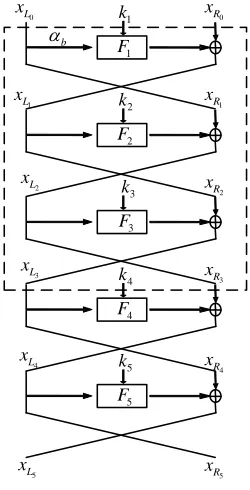
1 F 1 k 2 F 2 k 3 F 3 k 4 F 4 k 5 F 5 k 0 L
x xR0
1 L
x xR1
2 L x 2 R x 3 L x 3 R x 4 L x 4 R x 5 L
x xR5
b
Figure 3 Quantum key-recovery attack on 5-round Feistel structures
n/2. Dinur et al.[14] recovers the complete key (k1, k2, k3, k4, k5) of the 5-round Feistel cipher with 2n
classical queries on the cipher. In a quantum computer, we can use Grover’s search algorithm to observe all the round keys with 21.25n quantum queries. Therefore, we have to construct a quantum algorithm that exhibits less time complexity than both 2n and 21.25n. Inspired by Leander and May’s study [16], we combine Grover’s and Simon’s algorithms to observe the round keys.
Kuwakado and Morii [13] introduced a quantum distinguish attack on 3-round Feistel schemes by using Simon’s algorithm. As depicted in Figure 3, we place the 3-round distinguisher part in the dashed box.
The following functions are defined:
f(b, xR0) =F2(k2, xR0⊕F1(k1, αb)) =αb⊕xR3 =αb⊕F4(k4, F5(k5, xR5)⊕xL5)⊕xR5 (3)
whereb ∈F2,αb ∈Fn/2 2 is an arbitrary constant andα06=α1, (xL5kxR5) =Enc(αbkxR0). It is easy to
verify thatf(b, xR0) =f(b⊕1, xR0⊕F1(k1, α0)⊕F1(k1, α1)). Therefore, using the accurate guess of the key
(k4, k5),f(b, xR0) =αb⊕F4(k4, F5(k5, xR5)⊕xL5) has a nontrivial period s= 1kF1(k1, α0)⊕F1(k1, α1).
However, if the guessed (k4, k5) is wrong, f(b, xR0) will be a random function that is not periodic with
high probability.
Theorem 2. Letg: Fn/2 2×F
n/2 2 ×F
n/2+1 2 7→F
n/2 2 with
(k4, k5, y)7→f(y) =f(b, xR0) =αb⊕F4(k4, F5(k5, xR5)⊕xL5)⊕xR5,
where y =bkxR0, α0, α1 are two arbitrary constants, and (xL5kxR5) =Enc(αbkxR0). Given quantum
oracles of gand Enc, (k4, k5) andF1(k1, α0)⊕F1(k1, α1) could be computed usingn+ (n+ 1)(n+ 2 +
2pn/2 + 1) qubits and approximately 2n/2quantum queries.
Under the accurate guess of the keyk4, k5,g(k4, k5, y) =g(k4, k5, y⊕s), leth: Fn2×F (n/2+1)l
2 7→F
(n/2)l 2
with
(k4, k5, y1, ..., yl)7→g(k4, k5, y1)k...kg(k4, k5, yl). (4)
LetUh be a quantum oracle that maps
|k4, k5, y1, ..., yl,0, ...,0i 7→ |k4, k5, y1, ..., yl, h(k4, k5, y1, ..., yl)i. (5)
1. Preparing the initial (n+ (n/2 + 1)l+nl/2)-qubit state|0i.
2. Apply Hadamard H⊗n+(n/2+1)l on the firstn+ (n/2 + 1)lqubits resulting in
X
k4,k5∈Fn/2 2,y1,...,yl∈Fn/2 2+1
|k4, k5i|y1i...|yli|0i, (6)
where we omit the amplitudes 2−(n+(n/2+1)l)/2.
3. ApplyingUh to the above state, we get:
X
k4,k5∈Fn/2 2,y1,...,yl∈Fn/2 2+1
|k4, k5i|y1i...|yli|h(k4, k5, y1, ..., yl)i. (7)
4. Apply Hadamard to the qubits|y1i...|yliin the above state, we get:
|ϕi= X
k4,k5∈Fn/2 2,u1,...,ul,y1,...,yl∈Fn/2 2+1
|k4, k5i(−1)hu1,y1i|u1i...(−1)hul,yli|uli|h(k4, k5, y1, ..., yl)i. (8)
If the guessedk4, k5is right, the periodsis observed to be orthogonal to all theu1, ..., ulafter measuring
|ϕi. According to Lemma 4 of [16], choosingl= 2(n/2 + 1 +pn/2 + 1) is enough to compute a unique
s.
Without measuring and considering the superposition |ϕi, we assume that we had a classifier B :
Fn2+(n/2+1)l 7→ {0,1}, that partitioned |ϕi into a good subspace and a bad subspace as follows: |ϕi =
|ϕ1i+|ϕ0i, where |ϕ1i and |ϕ0i denotes the projection onto the good subspace and bad subspace,
respectively. In case of the good subspace|xi, we haveB(x) = 1.
Therefore, we define |ϕ1i as the sum of those basis states while accurately guessing the key k4, k5.
However, the accuracy of k4, k5 could not be directly verified. The classifier, B, could compute the
period,s, ofg(k4, k5,·) byk4, k5, u1, ..., ul and verify whetherg(k4, k5, y) =g(k4, k5, y⊕s) for a giveny. Classifier B. DefineB:Fn2+(n/2+1)l7→ {0,1} that maps (k4, k5, u1, ..., ul)7→ {0,1}.
1. LetU =hu1, ..., ulibe the linear span of allui. Ifdim(U)6=n/2, the output will be 0. Otherwise,
use Lemma 4 of [16] to compute the unique periods.
2. Checkg(k4, k5, y) =g(k4, k5, y⊕s) for a randomly providedy. If the identity holds, output will be
equal to one. Else output will be zero.
We classify a state |k4, k5i|u1i...|uli to be good if and only ifB(k4, k5, u1, ..., ul) = 1. If we measure
|ϕi, it produces a good state with probabilityp.
p= Pr[|k4, k5i|u1i...|uliis good]
= Pr|(k4, k5) is right]·Pr[B(k4, k5, u1, ..., ul) = 1|(k4, k5) is right]≈2−n.
(9)
Our classifierBdefines a unitary operatorSBthat conditionally changes the sign of the quantum states
that can be given as follows:
|k4, k5i|u1i...|uli 7→ (
−|k4, k5i|u1i...|uliifB(k4, k5, u1, ..., ul) = 1,
|k4, k5i|u1i...|uliifB(k4, k5, u1, ..., ul) = 0.
(10)
The complete amplification process can be realized by repeatedly applying the unitary operator, Q = −AS0A−1SB, ttimes to the state|ϕi=A|0i, namelyQtA|0i.
Initially, the angle between |ϕi=A|0iand the bad subspace |ϕ0iisθ, wheresin2(θ) =p=hϕ1|ϕ1i.
Whenpis small enough, θ ≈arcsin(√p)≈2−n2. According to Theorem 1, after k =dπ 4θe=d
π
4×2−n2e
approximately π/2. The probability Pgood that is used by the measurement to yield a good state is approximatelysin2(π/2) = 1.
The whole attack requires (n+(n/2+1)l+nl/2) =n+(n+1)(n+2+2pn/2 + 1) qubits. Approximately
k =d π
4×2−n2e= 2
n/2 quantum queries are required. Similarly, we can recover k
1, k2 by placing the
3-round quantum distinguisher in the last three 3-rounds, which indicates that a decryption quantum oracle of the 5-round Feistel structure is required.
The quantum key-recovery attacks on 7-/8-/15-/31-/32-round Feistel structures depict a similar mech-anism to that of the 5-round attack. The results are summarized in Table 1.
4
Conclusion
In this study, we considered the first quantum key-recovery attack against Feistel structures. Inspired by Leander and May’s works, we combined Grover’s and Simon’s algorithms to construct the attack. Our attacks required 2nr/4−3n/4 quantum queries. When compared with the quantum brute-force search, the
time complexity is reduced by a factor of 20.75n. When compared with the best classical attacks, the time complexity is reduced by a factor of 20.5n without incurring any memory cost.
Acknowledgement
This work is supported by the National Key Research and Development Program of China (No. 2017Y-FA0303903), the National Natural Science Foundation of China (No. 61672019), the Fundamental Re-search Funds of Shandong University (No. 2016JC029), National Cryptography Development Fund (No. MMJJ20170121), Zhejiang Province Key R&D Project (No. 2017C01062), Project funded by China Postdoctoral Science Foundation (No. 2017M620807).
Conflict of interest The authors declare that they have no conflict of interest.
References
1 Shor P W. Polynomial-time algorithms for prime factorization and discrete logarithms on a quantum computer. SIAM Journal on Computing, 1997, 26(5): 1484–1509.
2 Rivest R L, Shamir A, Adleman L. A Method for obtaining digital signatures and public-key cryptosystems. Commun. ACM, 1978, 21(2): 120–126.
3 Even S, Mansour Y. A construction of a cipher from a single pseudorandom permutation. Journal of Cryptology, 1997, 10(2): 151–161.
4 Kuwakado H, Morii M. Security on the quantum-type even-mansour cipher. In: International symposium on informa-tion theory and its applicainforma-tions, ISITA 2012. IEEE, 2012. 312–316.
5 Kaplan M, Leurent G, Leverrier A, et al. Breaking symmetric cryptosystems using quantum period finding. In: Robshaw M, Katz J, eds. Advances in Cryptology - CRYPTO 2016. Lecture Notes in Computer Science, Vol 9815. Berlin: Springer-Verlag, 2016. 207–237.
6 Takagi T, Peyrin T. Advances in Cryptology - ASIACRYPT 2017, Part I. Lecture Notes in Computer Science, Vol 10624. Berlin: Springer-Verlag, 2017. 1-813.
7 Boneh D, Zhandry M. Secure signatures and chosen ciphertext security in a quantum computing world. In: Canetti R, Garay J A, eds. Advances in Cryptology - CRYPTO 2013. Lecture Notes in Computer Science, Vol 8043. Berlin: Springer-Verlag, 2013. 361–379.
8 Grover L K. A fast quantum mechanical algorithm for database search. In: Miller G L, eds. Proceedings of STOC 1996. ACM, 1996. 212–219.
9 Simon D R. On the power of quantum computation. SIAM Journal on Computing, 1997, 26(5):1474–1483.
10 Feistel H, Notz W A, Smith J L. Some cryptographic techniques for machine-to-machine data communications. In: Proceedings of the IEEE, 1975, 63(11): 1545–1554.
11 International Organization for Standardization(ISO). International Standard- ISO/IEC 18033-3, Information technology-Security techniques-Encryption algorithms -Part 3: Block ciphers. 2010.
12 Luby M G, Rackoff C. How to construct pseudorandom permutations from pseudorandom functions. SIAM Journal on Computing, 1988, 17(2):373–386.
14 Dinur I, Dunkelman O, Keller N, et al. New attacks on Feistel structures with improved memory complexities. In: Gennaro R, Robshaw M, eds. Advances in Cryptology - CRYPTO 2015, Part I. Lecture Notes in Computer Science, Vol 9215. Berlin: Springer-Verlag, 2015. 433–454.
15 Brassard G, Hoyer P, Mosca M, et al. Quantum amplitude amplification and estimation. arXiv: Quantum Physics, 2000.
16 Leander G, May A. Grover meets simon - quantumly attacking the FX-construction. In: Takagi T, Peyrin T, eds. Advances in Cryptology - ASIACRYPT 2017, Part II. Lecture Notes in Computer Science, Vol 10625. Cham: Springer, 2017. 161–178.
17 Kilian J, Rogaway P. How to Protect DES Against Exhaustive Key Search. In: Koblitz N, eds. Advances in Cryptology - CRYPTO 1996. Lecture Notes in Computer Science, Vol 1109. Berlin: Springer-Verlag, 1996. 252–267.
18 Julia Borghoff, Canteaut A, G¨uneysu T, et al. PRINCE - A Low-Latency Block Cipher for Pervasive Computing Applications - Extended Abstract. In: Wang X Y, Sako K, eds. Advances in Cryptology - ASIACRYPT 2012. Lecture Notes in Computer Science, Vol 7658. Berlin: Springer-Verlag, 2012. 208–225.